Acute Limb Ischemia
    N Engl J Med 2012;366:2198-206
Key Clinical Points
 Acute limb ischemia is a sudden decrease in limb
 perfusion that threatens limb viability and requires
 urgent evaluationand management.
 Causes of acute limb ischemia include acute
 thrombosis of a limb artery or bypass graft,
 embolism from the heart or a diseased artery,
 dissection, and trauma.
 Assessment of limb appearance, temperature,
 pulses (including by Doppler), sensation, and
 strength is used to determine whether the limb is
 viable, threatened, or irreversibly damaged.
Key Clinical Points
 Prompt diagnosis and revascularization by means of
 catheter-based thrombolysis or thrombectomy or by
 surgical reconstruction reduce the risk of limb loss.
 Catheter-directed thrombolysis is the preferred
 treatment for a viable or marginally threatened limb,
 recent occlusion, thrombosis of synthetic grafts, and
 occluded stents. Surgical revascularization is
 generally preferred for an immediately threatened
 limb or occlusion of more than 2 weeks’ duration.
 Amputation is performed in patients with irreversible
 damage.
In contrast to chronic limb ischemia, in
  which collateral blood vessels may
  circumvent an occluded artery, acute
  ischemia threatens limb viability
  because there is insufficient time for
  new blood-vessel growth to
  compensate for loss of perfusion.
Despite urgent revascularization with
  thrombolytic agents or surgery, amputation
  occurs in 10 to 15% of patients during
  hospitalization.
A majority of amputations are above the knee.
Approximately 15 to 20% of patients die within
  1 year after presentation, often from
  coexisting conditions that predisposed them
  to acute limb ischemia.
6 Ps
 Paresthesia     Poikilothermia
 Pain            impaired regulation of
 Pallor          body temperature, with
 Pulselessness   the temperature of the
                 limb usually cool,
                 reflecting the ambient
                 temperature
                 Paralysis
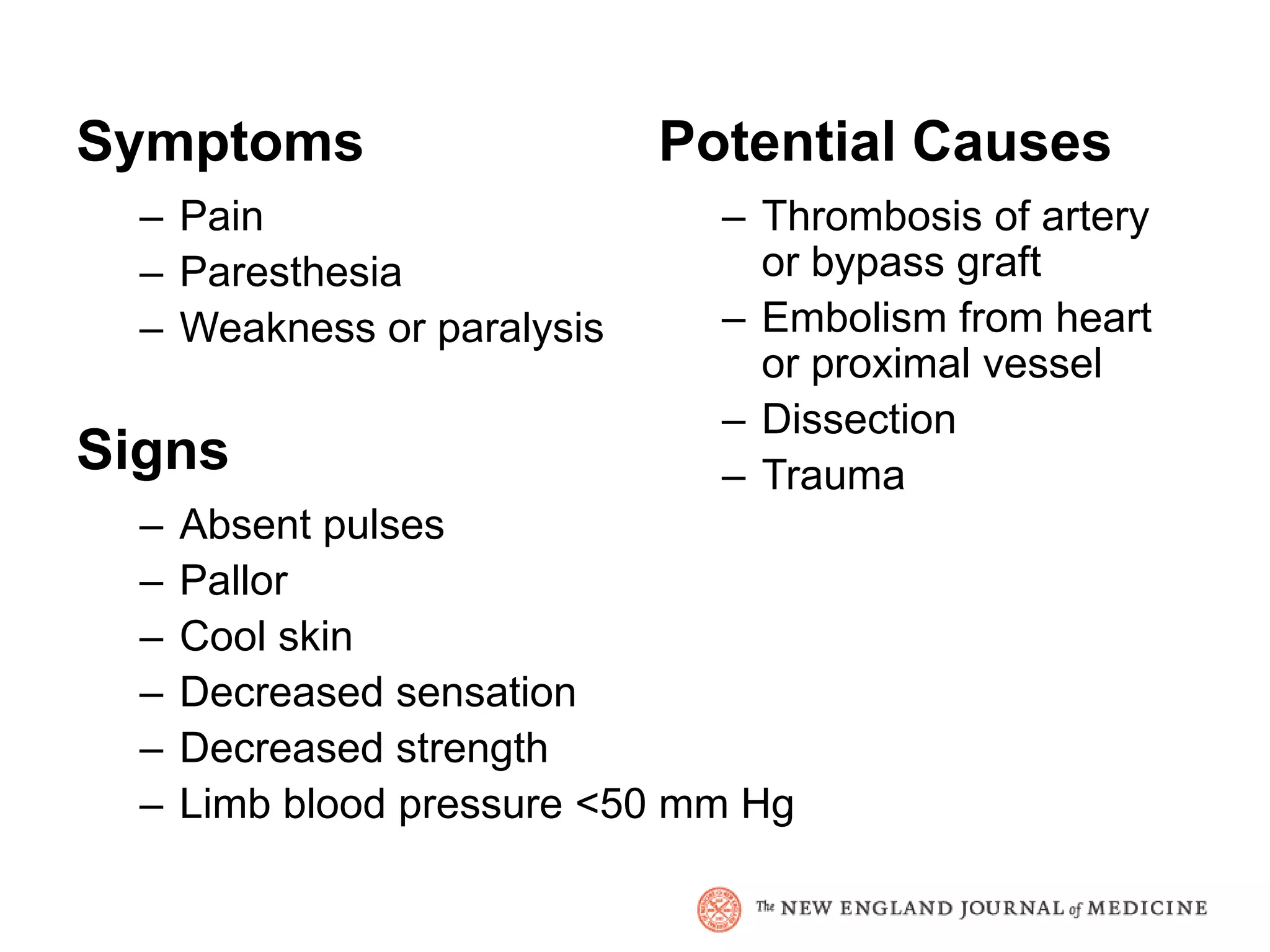
Symptoms                    Potential Causes
  – Pain                       – Thrombosis of artery
  – Paresthesia                  or bypass graft
  – Weakness or paralysis      – Embolism from heart
                                 or proximal vessel
                               – Dissection
Signs                          – Trauma
  –   Absent pulses
  –   Pallor
  –   Cool skin
  –   Decreased sensation
  –   Decreased strength
  –   Limb blood pressure <50 mm Hg
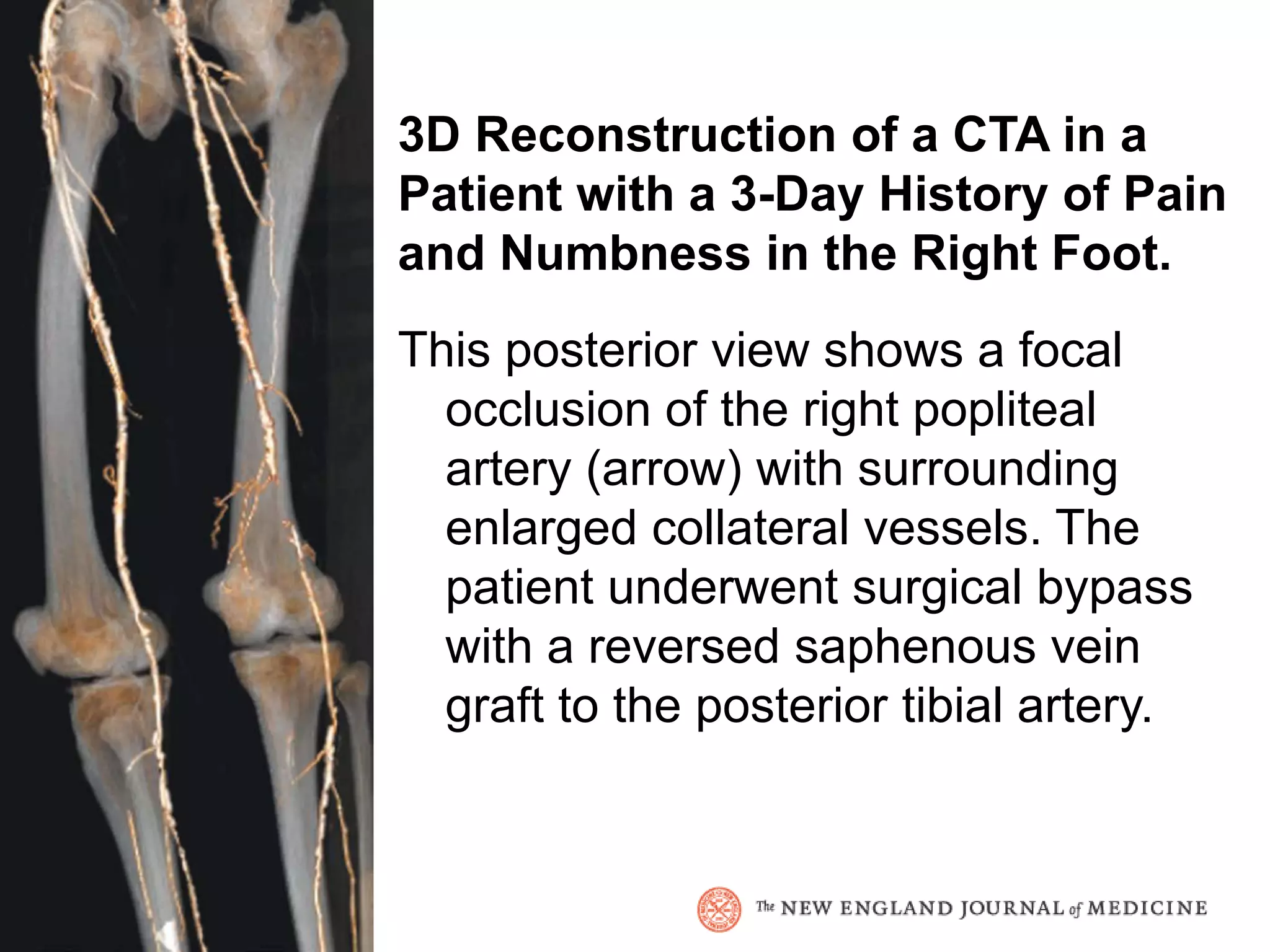
3D Reconstruction of a CTA in a
Patient with a 3-Day History of Pain
and Numbness in the Right Foot.
This posterior view shows a focal
  occlusion of the right popliteal
  artery (arrow) with surrounding
  enlarged collateral vessels. The
  patient underwent surgical bypass
  with a reversed saphenous vein
  graft to the posterior tibial artery.
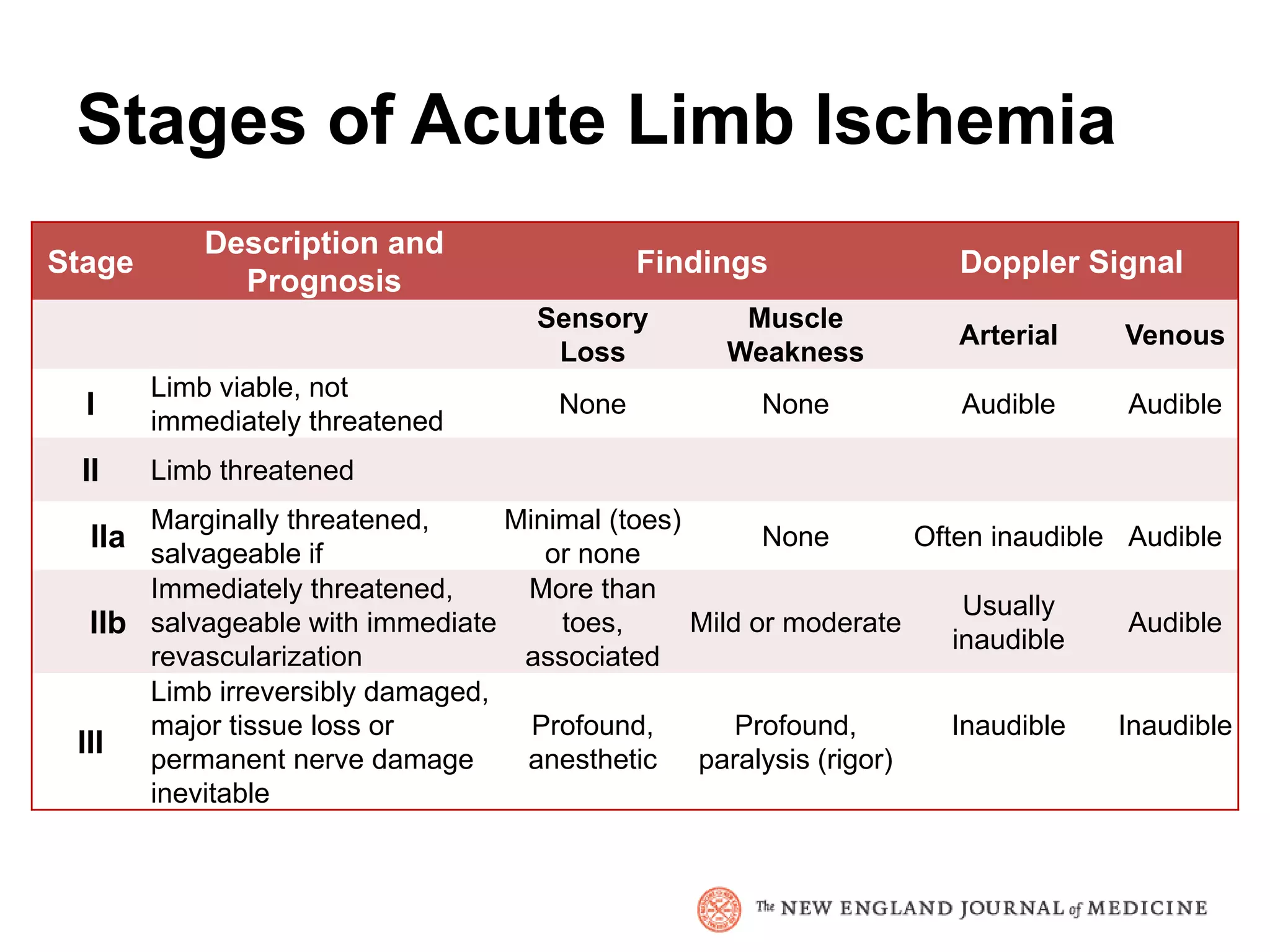
Stages of Acute Limb Ischemia
            Description and
Stage                                        Findings               Doppler Signal
              Prognosis
                                    Sensory         Muscle
                                                                    Arterial     Venous
                                     Loss          Weakness
        Limb viable, not
  I     immediately threatened
                                      None           None            Audible     Audible

 II     Limb threatened
        Marginally threatened,   Minimal (toes)
  IIa salvageable if                or none
                                                      None       Often inaudible Audible
      Immediately threatened,     More than
                                                                     Usually
  IIb salvageable with immediate     toes,      Mild or moderate
                                                                    inaudible
                                                                                  Audible
      revascularization           associated
      Limb irreversibly damaged,
      major tissue loss or         Profound,        Profound,       Inaudible    Inaudible
 III permanent nerve damage       anesthetic paralysis (rigor)
      inevitable
Treatment
 Endovascular Revascularization
 Surgical Revascularization
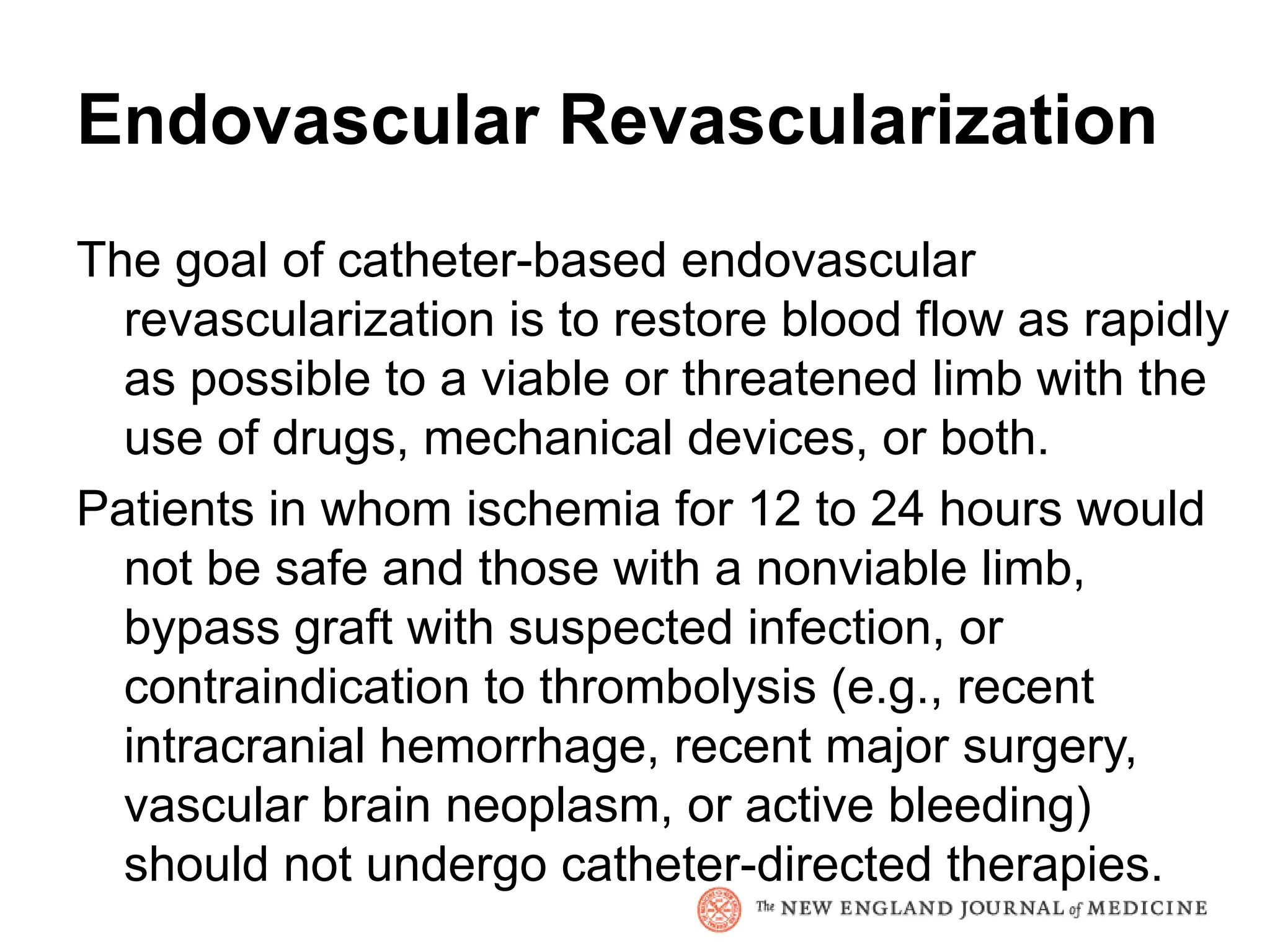
Endovascular Revascularization
The goal of catheter-based endovascular
  revascularization is to restore blood flow as rapidly
  as possible to a viable or threatened limb with the
  use of drugs, mechanical devices, or both.
Patients in whom ischemia for 12 to 24 hours would
  not be safe and those with a nonviable limb,
  bypass graft with suspected infection, or
  contraindication to thrombolysis (e.g., recent
  intracranial hemorrhage, recent major surgery,
  vascular brain neoplasm, or active bleeding)
  should not undergo catheter-directed therapies.
Thrombolytic Agents
 Alteplase   (Genentech)
 Reteplase (EKR Therapeutics)
 Tenecteplase(Genentech)
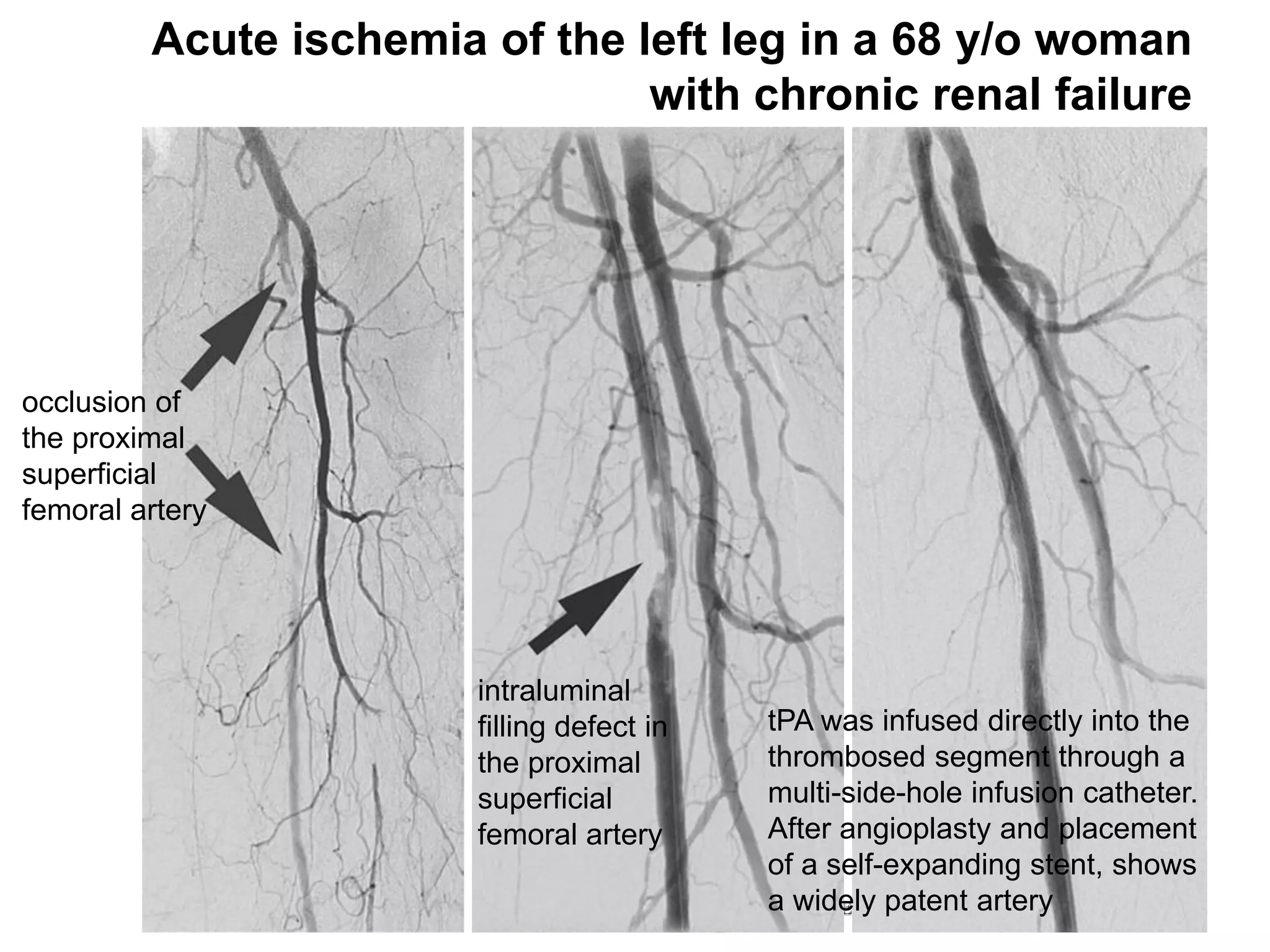
Acute ischemia of the left leg in a 68 y/o woman
                                with chronic renal failure


occlusion of
the proximal
superficial
femoral artery


                        intraluminal
                        filling defect in   tPA was infused directly into the
                        the proximal        thrombosed segment through a
                        superficial         multi-side-hole infusion catheter.
                        femoral artery      After angioplasty and placement
                                            of a self-expanding stent, shows
                                            a widely patent artery
Surgical Revascularization
Surgical approaches to the treatment of
 acute limb ischemia include
 thromboembolectomy with a balloon
 catheter, bypass surgery, and adjuncts
 such as endarterectomy, patch angioplasty,
 and intraoperative thrombolysis.
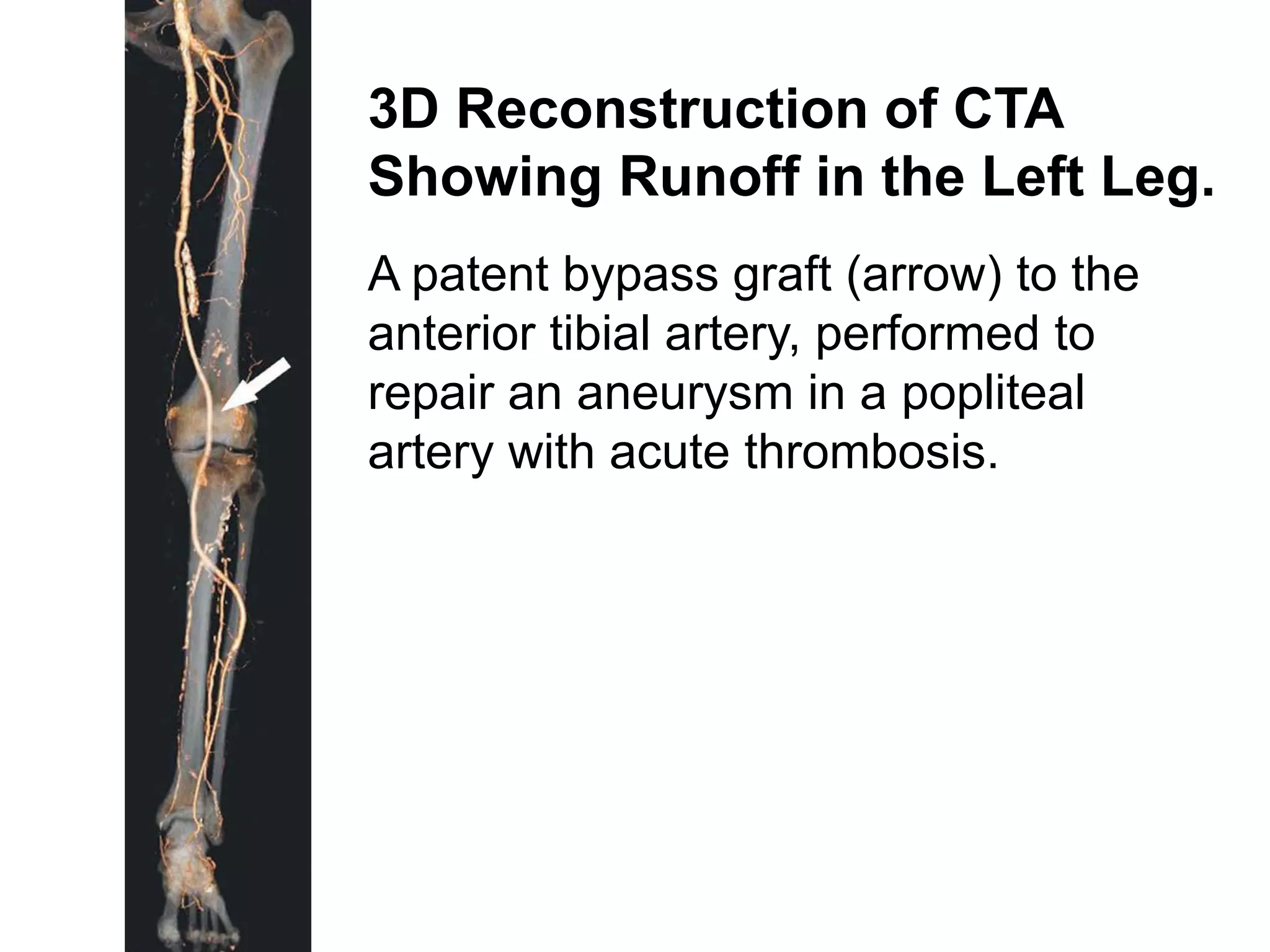
3D Reconstruction of CTA
Showing Runoff in the Left Leg.
A patent bypass graft (arrow) to the
anterior tibial artery, performed to
repair an aneurysm in a popliteal
artery with acute thrombosis.
Endovascular versus Surgical
Revascularization
The Surgery versus Thrombolysis for Ischemia of the
   Lower Extremity (STILE) trial was halted early
   because of higher rates of ischemia, amputation,
   and complications among patients undergoing
   thrombolysis than among those undergoing
   surgery.
In the Thrombolysis or Peripheral Arterial Surgery
   (TOPAS) trial, the rates of limb salvage and
   survival did not differ significantly between the
   thrombolysis and surgery groups, but complication
   rates were higher in the thrombolysis group.
Endovascular versus Surgical
Revascularization
Catheter-directed thrombolysis has the best
 results in patients with a viable or marginally
 threatened limb, recent occlusion (no more
 than 2 weeks’ duration), thrombosis of a
 synthetic graft or an occluded stent, and at
 least one identifiable distal runoff vessel.
Surgical revascularization is generally preferred
 for patients with an immediately threatened
 limb or with symptoms of occlusion for more
 than 2 weeks.
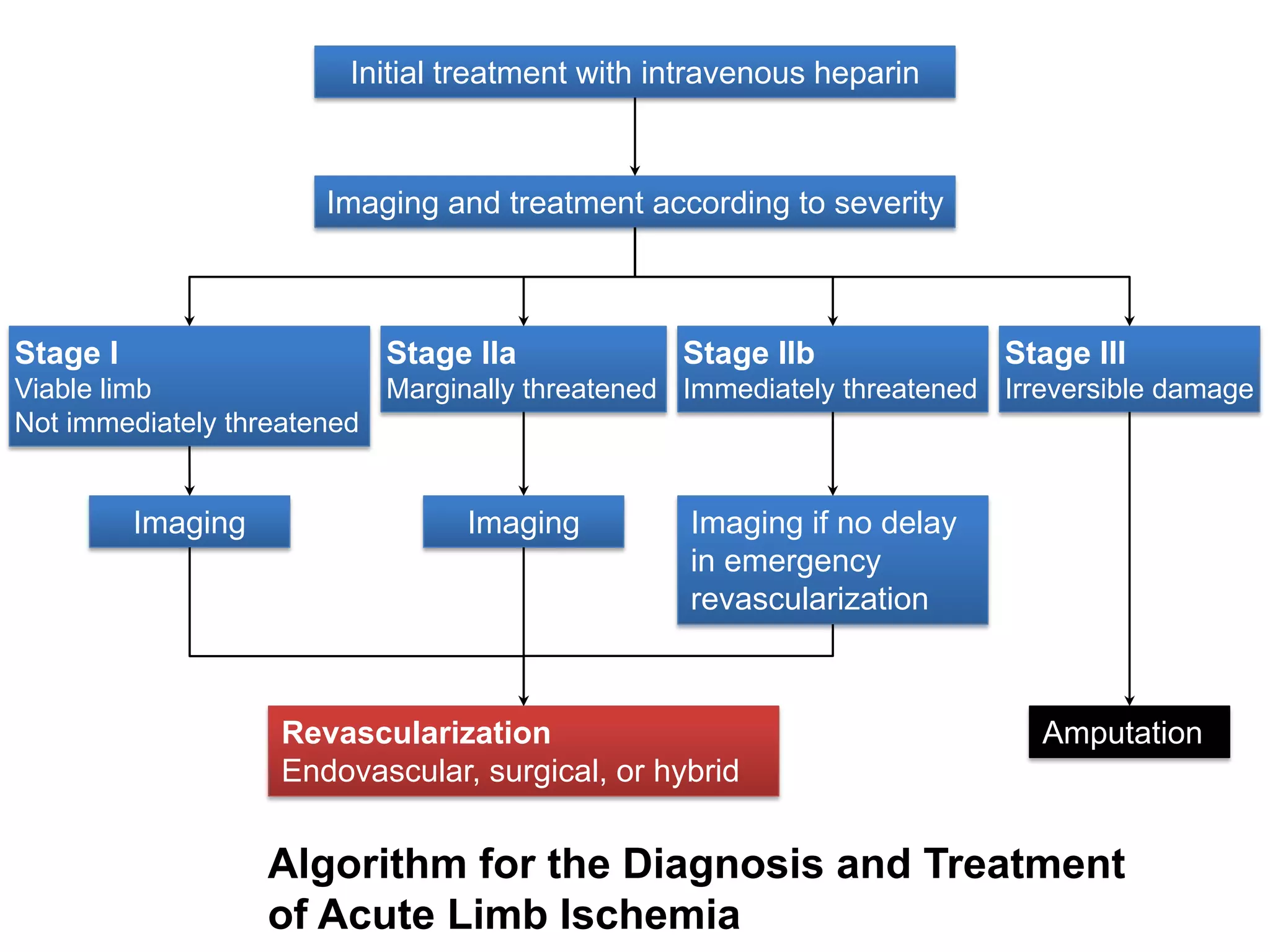
Initial treatment with intravenous heparin


                       Imaging and treatment according to severity


Stage I                    Stage IIa             Stage IIb              Stage III
Viable limb                Marginally threatened Immediately threatened Irreversible damage
Not immediately threatened


          Imaging                Imaging         Imaging if no delay
                                                 in emergency
                                                 revascularization


                    Revascularization                                      Amputation
                    Endovascular, surgical, or hybrid


                    Algorithm for the Diagnosis and Treatment
                    of Acute Limb Ischemia
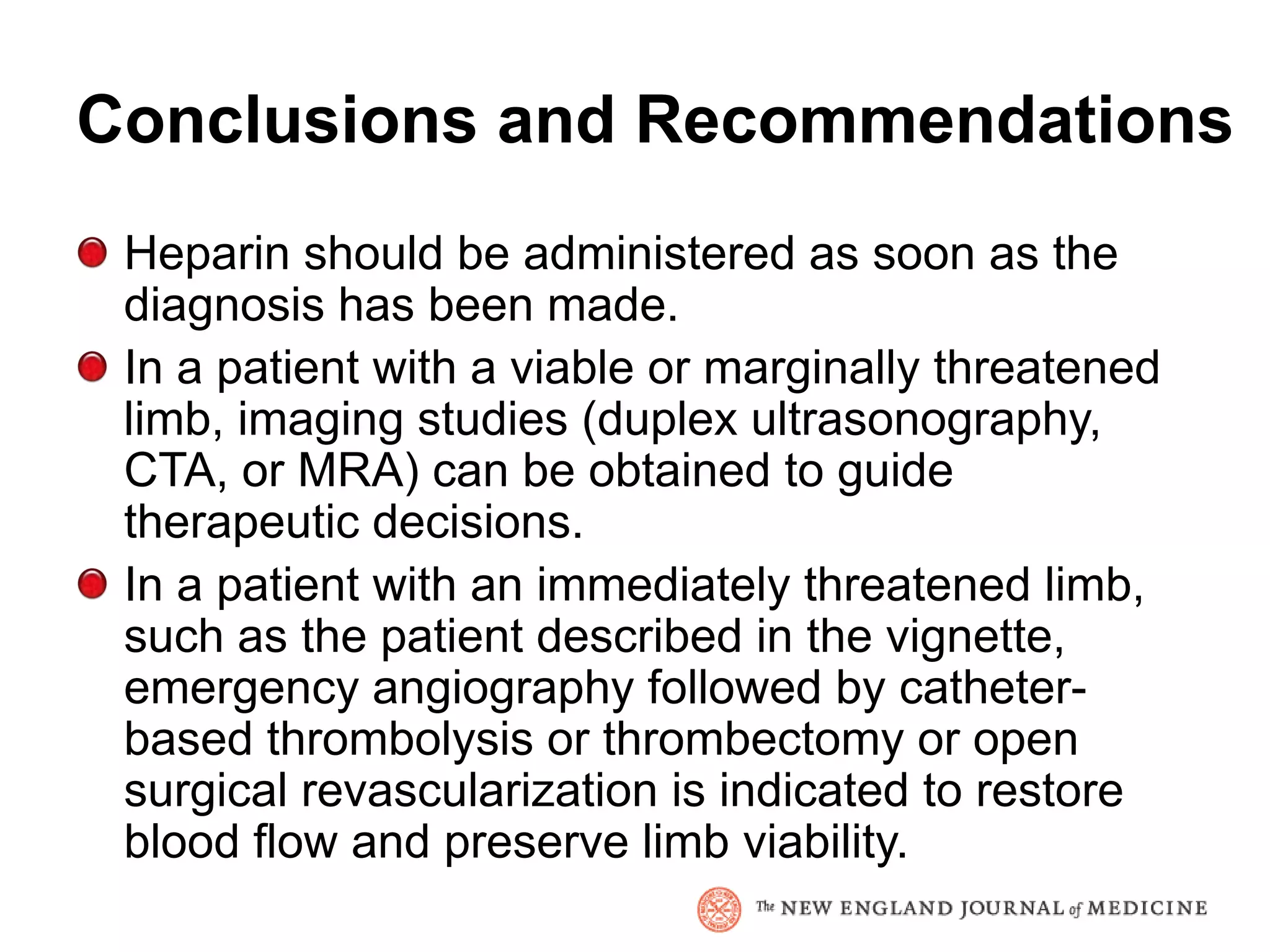
Conclusions and Recommendations
 Heparin should be administered as soon as the
 diagnosis has been made.
 In a patient with a viable or marginally threatened
 limb, imaging studies (duplex ultrasonography,
 CTA, or MRA) can be obtained to guide
 therapeutic decisions.
 In a patient with an immediately threatened limb,
 such as the patient described in the vignette,
 emergency angiography followed by catheter-
 based thrombolysis or thrombectomy or open
 surgical revascularization is indicated to restore
 blood flow and preserve limb viability.
Acute Limb Ischemia

Acute Limb Ischemia

  • 1.
    Acute Limb Ischemia N Engl J Med 2012;366:2198-206
  • 2.
    Key Clinical Points Acute limb ischemia is a sudden decrease in limb perfusion that threatens limb viability and requires urgent evaluationand management. Causes of acute limb ischemia include acute thrombosis of a limb artery or bypass graft, embolism from the heart or a diseased artery, dissection, and trauma. Assessment of limb appearance, temperature, pulses (including by Doppler), sensation, and strength is used to determine whether the limb is viable, threatened, or irreversibly damaged.
  • 3.
    Key Clinical Points Prompt diagnosis and revascularization by means of catheter-based thrombolysis or thrombectomy or by surgical reconstruction reduce the risk of limb loss. Catheter-directed thrombolysis is the preferred treatment for a viable or marginally threatened limb, recent occlusion, thrombosis of synthetic grafts, and occluded stents. Surgical revascularization is generally preferred for an immediately threatened limb or occlusion of more than 2 weeks’ duration. Amputation is performed in patients with irreversible damage.
  • 4.
    In contrast tochronic limb ischemia, in which collateral blood vessels may circumvent an occluded artery, acute ischemia threatens limb viability because there is insufficient time for new blood-vessel growth to compensate for loss of perfusion.
  • 5.
    Despite urgent revascularizationwith thrombolytic agents or surgery, amputation occurs in 10 to 15% of patients during hospitalization. A majority of amputations are above the knee. Approximately 15 to 20% of patients die within 1 year after presentation, often from coexisting conditions that predisposed them to acute limb ischemia.
  • 6.
    6 Ps Paresthesia Poikilothermia Pain impaired regulation of Pallor body temperature, with Pulselessness the temperature of the limb usually cool, reflecting the ambient temperature Paralysis
  • 7.
    Symptoms Potential Causes – Pain – Thrombosis of artery – Paresthesia or bypass graft – Weakness or paralysis – Embolism from heart or proximal vessel – Dissection Signs – Trauma – Absent pulses – Pallor – Cool skin – Decreased sensation – Decreased strength – Limb blood pressure <50 mm Hg
  • 8.
    3D Reconstruction ofa CTA in a Patient with a 3-Day History of Pain and Numbness in the Right Foot. This posterior view shows a focal occlusion of the right popliteal artery (arrow) with surrounding enlarged collateral vessels. The patient underwent surgical bypass with a reversed saphenous vein graft to the posterior tibial artery.
  • 9.
    Stages of AcuteLimb Ischemia Description and Stage Findings Doppler Signal Prognosis Sensory Muscle Arterial Venous Loss Weakness Limb viable, not I immediately threatened None None Audible Audible II Limb threatened Marginally threatened, Minimal (toes) IIa salvageable if or none None Often inaudible Audible Immediately threatened, More than Usually IIb salvageable with immediate toes, Mild or moderate inaudible Audible revascularization associated Limb irreversibly damaged, major tissue loss or Profound, Profound, Inaudible Inaudible III permanent nerve damage anesthetic paralysis (rigor) inevitable
  • 10.
  • 11.
    Endovascular Revascularization The goalof catheter-based endovascular revascularization is to restore blood flow as rapidly as possible to a viable or threatened limb with the use of drugs, mechanical devices, or both. Patients in whom ischemia for 12 to 24 hours would not be safe and those with a nonviable limb, bypass graft with suspected infection, or contraindication to thrombolysis (e.g., recent intracranial hemorrhage, recent major surgery, vascular brain neoplasm, or active bleeding) should not undergo catheter-directed therapies.
  • 12.
    Thrombolytic Agents Alteplase (Genentech) Reteplase (EKR Therapeutics) Tenecteplase(Genentech)
  • 13.
    Acute ischemia ofthe left leg in a 68 y/o woman with chronic renal failure occlusion of the proximal superficial femoral artery intraluminal filling defect in tPA was infused directly into the the proximal thrombosed segment through a superficial multi-side-hole infusion catheter. femoral artery After angioplasty and placement of a self-expanding stent, shows a widely patent artery
  • 14.
    Surgical Revascularization Surgical approachesto the treatment of acute limb ischemia include thromboembolectomy with a balloon catheter, bypass surgery, and adjuncts such as endarterectomy, patch angioplasty, and intraoperative thrombolysis.
  • 15.
    3D Reconstruction ofCTA Showing Runoff in the Left Leg. A patent bypass graft (arrow) to the anterior tibial artery, performed to repair an aneurysm in a popliteal artery with acute thrombosis.
  • 16.
    Endovascular versus Surgical Revascularization TheSurgery versus Thrombolysis for Ischemia of the Lower Extremity (STILE) trial was halted early because of higher rates of ischemia, amputation, and complications among patients undergoing thrombolysis than among those undergoing surgery. In the Thrombolysis or Peripheral Arterial Surgery (TOPAS) trial, the rates of limb salvage and survival did not differ significantly between the thrombolysis and surgery groups, but complication rates were higher in the thrombolysis group.
  • 17.
    Endovascular versus Surgical Revascularization Catheter-directedthrombolysis has the best results in patients with a viable or marginally threatened limb, recent occlusion (no more than 2 weeks’ duration), thrombosis of a synthetic graft or an occluded stent, and at least one identifiable distal runoff vessel. Surgical revascularization is generally preferred for patients with an immediately threatened limb or with symptoms of occlusion for more than 2 weeks.
  • 18.
    Initial treatment withintravenous heparin Imaging and treatment according to severity Stage I Stage IIa Stage IIb Stage III Viable limb Marginally threatened Immediately threatened Irreversible damage Not immediately threatened Imaging Imaging Imaging if no delay in emergency revascularization Revascularization Amputation Endovascular, surgical, or hybrid Algorithm for the Diagnosis and Treatment of Acute Limb Ischemia
  • 19.
    Conclusions and Recommendations Heparin should be administered as soon as the diagnosis has been made. In a patient with a viable or marginally threatened limb, imaging studies (duplex ultrasonography, CTA, or MRA) can be obtained to guide therapeutic decisions. In a patient with an immediately threatened limb, such as the patient described in the vignette, emergency angiography followed by catheter- based thrombolysis or thrombectomy or open surgical revascularization is indicated to restore blood flow and preserve limb viability.