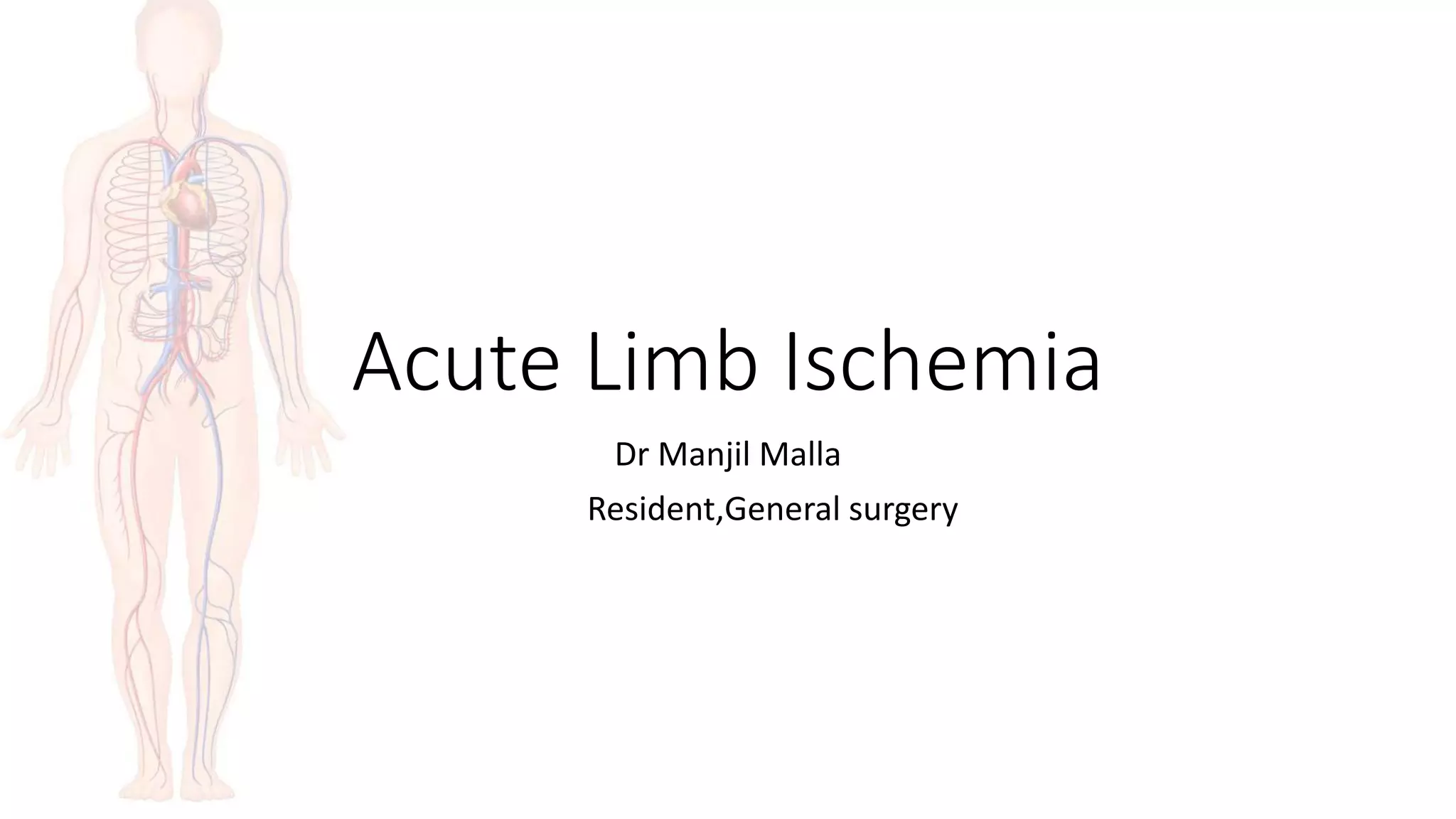
Acute Limb Ischemia
Dr Manjil Malla
Resident,General surgery
• Acute limb Ischemia
 sudden decrease in limb perfusion that threatens limb viability
and requires urgent evaluation and management
 Incidence approximately 1.5 cases per 10,000 persons per year
Etiology
1.Arterial embolism
• Cardiac source
Atrial fibrillation
Myocardial infarction
Endocarditis
Valvular disease
Atrial myxoma
Prosthetic valves
• Arterial source
 Aneurysm
Atherosclerotic plaque
• Paradoxical embolus
venous thrombus that traverses a cardiac defect to access the
arterial circulation
2. Native arterial thrombosis
• Atherosclerotic plaque
• Aneurysm thrombosis
• Arterial dissection
• Arterial entrapment/compression
Popliteal entrapment
Thoracic outlet syndrome
• Thrombophilia
• Low flow state
3.Arterial thrombosis following intervention
• Vein bypass graft
• Prosthetic bypass graft
• Angioplasty site
• Stent/stent-graft site
4.Arterial Injury
• Iatrogenic
Thromboembolism
Closure devices
Device embolization
• Traumatic
Diagnosis
• History
Leg symptoms in ALI relate to pain or function.
Duration and intensity of the pain and
presence of motor or sensory changes.
 Previous Hx of claudication, heart disease or aneurysm, and
atherosclerotic risk factor
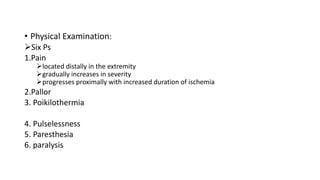
• Physical Examination:
Six Ps
1.Pain
located distally in the extremity
gradually increases in severity
progresses proximally with increased duration of ischemia
2.Pallor
3. Poikilothermia
4. Pulselessness
5. Paresthesia
6. paralysis
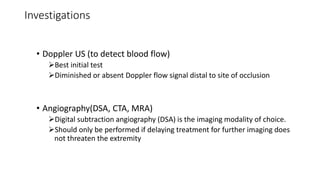
Investigations
• Doppler US (to detect blood flow)
Best initial test
Diminished or absent Doppler flow signal distal to site of occlusion
• Angiography(DSA, CTA, MRA)
Digital subtraction angiography (DSA) is the imaging modality of choice.
Should only be performed if delaying treatment for further imaging does
not threaten the extremity
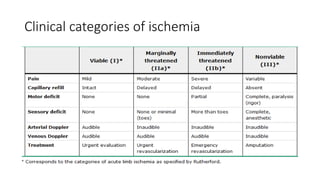
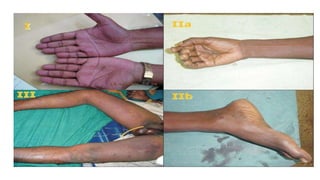
Clinical categories of ischemia
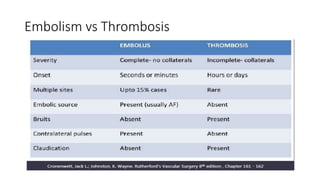
Embolism vs Thrombosis
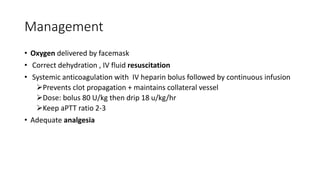
Management
• Oxygen delivered by facemask
• Correct dehydration , IV fluid resuscitation
• Systemic anticoagulation with IV heparin bolus followed by continuous infusion
Prevents clot propagation + maintains collateral vessel
Dose: bolus 80 U/kg then drip 18 u/kg/hr
Keep aPTT ratio 2-3
• Adequate analgesia
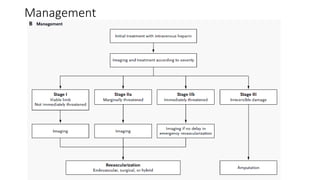
Management
• Nonviable limb :
 Condition of extremity (or portion of extremity) in which loss of
motor function, neurological function, and tissue integrity cannot
be restored with treatment.
• Salvageable limb :
Condition of extremity with potential to secure viability and
preserve motor function to the weight-bearing portion of the foot
if treated
2016 AHA/ACC Lower Extremity PAD Guideline
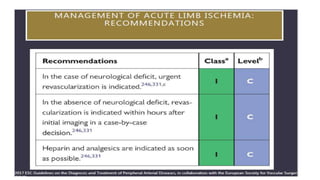
REVASCULARIZATION FOR ALI(Recommendations)
• For viable,non threatened Limb
Urgent Angiography to localize site of occulusion
Revascularization Procedure(open or catheter-directed thrombectomy or
thrombolysis
within 6 to 24 hours
• For marginally or immediately threatened limbs(Category IIa and IIb ALI)
 Emergency Revascularization within 6 hrs
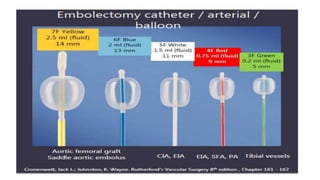
First-line: catheter-directed thrombolysis and/or percutaneous mechanical
thromboembolectomy (e.g., balloon catheter embolectomy)
Second-line: open thromboembolectomy
2016 AHA/ACC Lower Extremity PAD Guideline
Revascularization Procedure
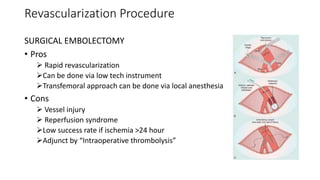
SURGICAL EMBOLECTOMY
• Pros
 Rapid revascularization
Can be done via low tech instrument
Transfemoral approach can be done via local anesthesia
• Cons
 Vessel injury
 Reperfusion syndrome
Low success rate if ischemia >24 hour
Adjunct by “Intraoperative thrombolysis”
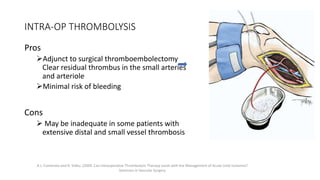
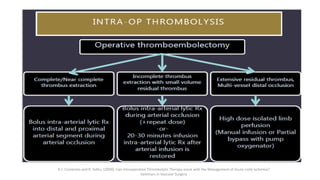
INTRA-OP THROMBOLYSIS
Pros
Adjunct to surgical thromboembolectomy
Clear residual thrombus in the small arteries
and arteriole
Minimal risk of bleeding
Cons
 May be inadequate in some patients with
extensive distal and small vessel thrombosis
A.J. Comerota and R. Sidhu. (2009. Can Intraoperative Thrombolytic Therapy assist with the Management of Acute Limb Ischemia?
Seminars in Vascular Surgery
A.J. Comerota and R. Sidhu. (2009). Can Intraoperative Thrombolytic Therapy assist with the Management of Acute Limb Ischemia?
Seminars in Vascular Surgery
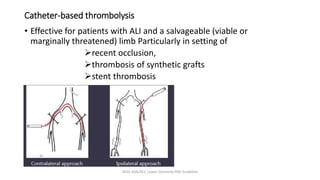
Catheter-based thrombolysis
• Effective for patients with ALI and a salvageable (viable or
marginally threatened) limb Particularly in setting of
recent occlusion,
thrombosis of synthetic grafts
stent thrombosis
2016 AHA/ACC Lower Extremity PAD Guideline
Contraindication of Thrombolysis
• Absolute contraindications
Prior intracranial hemorrhage
Known structural cerebral vascular lesion
Known malignant intracranial neoplasm
Ischemic stroke within three months (excluding stroke within
three hours)
Suspected aortic dissection
Active bleeding or bleeding diathesis (excluding menses)
Significant closed-head trauma or facial trauma within three
months
• Relative contraindications
History of chronic, severe, poorly controlled hypertension
Severe uncontrolled hypertension on presentation (SBP >180 mmHg or DBP
>110 mmHg)
History of ischemic stroke more than three months prior
Traumatic or prolonged (>10 minute) CPR or major surgery less than three
weeks
Recent (within two to four weeks) internal bleeding
Noncompressible vascular punctures
Recent invasive procedure
Pregnancy
Active peptic ulcer
Pericarditis
Current use of anticoagulant (eg, warfarin sodium) that has produced an
elevated international normalized ratio (INR) >1.7 or prothrombin time (PT)
>15 seconds
Age >75 years
MECHANICAL THROMBECTOMY
Percutaneous mechanical thrombectomy (PMT)
as adjunctive therapy to thrombolysis
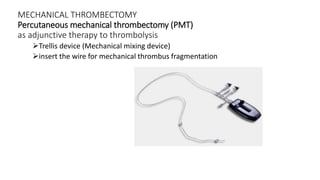
Trellis device (Mechanical mixing device)
insert the wire for mechanical thrombus fragmentation
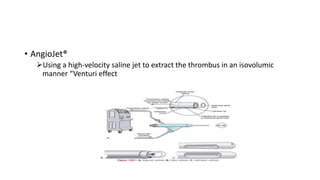
• AngioJet®
Using a high-velocity saline jet to extract the thrombus in an isovolumic
manner “Venturi effect
• Pros
Disrupts the thrombus Allows better penetration of the clot by a
thrombolytic agent
 ↓ Thrombolytic dosing
 ↓ Therapy time Increasingly being used in “class IIb”
Done via percutaneous approach with local anesthesia
Less vessel injury
• Cons
 Can be used only large vessel
 Expensive device
Cronenwett, Jack L.; Johnston, K. Wayne. Rutherford's Vascular
Surgery 8th edition , Chapter 161 - 162
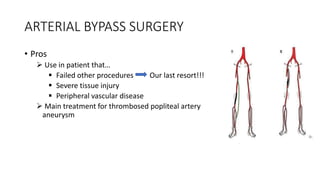
ARTERIAL BYPASS SURGERY
• Pros
 Use in patient that…
 Failed other procedures Our last resort!!!
 Severe tissue injury
 Peripheral vascular disease
 Main treatment for thrombosed popliteal artery
aneurysm
• Amputation* :
 Performed as the first(index) procedure in
 Nonsalvageable (class III) limb
 Low potential of limb salvage
 Risk of reperfusion syndrome
• Monitored and treated (e.g., fasciotomy) for compartment syndrome
after revascularization (due to reperfusion causing edema)
• Indications
 Raised intra compartment pressure (> 30 mmHg)
Clinical: increased pain, tense muscle, or nerve injury
 Category IIb ischemia for whom time to revascularization is > 4
hours
2016 AHA/ACC Lower Extremity PAD Guideline
Complication of Acute Limb Ischemia
1. Limb Loss
2. Death
3. Compartment Syndrome
4. Reperfusion Effects
5. Volkmann Ischemic Contracture
Reperfusion Effects
• Local
 Reperfusion injury – paradoxical death of already dying muscles after
reperfusion
• Systemic
 Reperfusion syndrome
 Hypotension
 ARDS
 Lactic acidosis
 Hyperkalemia
 Renal failure
Thank You

Acute limb ischemia

  • 1.
    Acute Limb Ischemia DrManjil Malla Resident,General surgery
  • 2.
    • Acute limbIschemia  sudden decrease in limb perfusion that threatens limb viability and requires urgent evaluation and management  Incidence approximately 1.5 cases per 10,000 persons per year
  • 3.
    Etiology 1.Arterial embolism • Cardiacsource Atrial fibrillation Myocardial infarction Endocarditis Valvular disease Atrial myxoma Prosthetic valves
  • 4.
    • Arterial source Aneurysm Atherosclerotic plaque • Paradoxical embolus venous thrombus that traverses a cardiac defect to access the arterial circulation
  • 5.
    2. Native arterialthrombosis • Atherosclerotic plaque • Aneurysm thrombosis • Arterial dissection • Arterial entrapment/compression Popliteal entrapment Thoracic outlet syndrome • Thrombophilia • Low flow state
  • 6.
    3.Arterial thrombosis followingintervention • Vein bypass graft • Prosthetic bypass graft • Angioplasty site • Stent/stent-graft site
  • 7.
    4.Arterial Injury • Iatrogenic Thromboembolism Closuredevices Device embolization • Traumatic
  • 8.
    Diagnosis • History Leg symptomsin ALI relate to pain or function. Duration and intensity of the pain and presence of motor or sensory changes.  Previous Hx of claudication, heart disease or aneurysm, and atherosclerotic risk factor
  • 9.
    • Physical Examination: SixPs 1.Pain located distally in the extremity gradually increases in severity progresses proximally with increased duration of ischemia 2.Pallor 3. Poikilothermia 4. Pulselessness 5. Paresthesia 6. paralysis
  • 10.
    Investigations • Doppler US(to detect blood flow) Best initial test Diminished or absent Doppler flow signal distal to site of occlusion • Angiography(DSA, CTA, MRA) Digital subtraction angiography (DSA) is the imaging modality of choice. Should only be performed if delaying treatment for further imaging does not threaten the extremity
  • 11.
  • 13.
  • 15.
    Management • Oxygen deliveredby facemask • Correct dehydration , IV fluid resuscitation • Systemic anticoagulation with IV heparin bolus followed by continuous infusion Prevents clot propagation + maintains collateral vessel Dose: bolus 80 U/kg then drip 18 u/kg/hr Keep aPTT ratio 2-3 • Adequate analgesia
  • 16.
  • 17.
    • Nonviable limb:  Condition of extremity (or portion of extremity) in which loss of motor function, neurological function, and tissue integrity cannot be restored with treatment. • Salvageable limb : Condition of extremity with potential to secure viability and preserve motor function to the weight-bearing portion of the foot if treated 2016 AHA/ACC Lower Extremity PAD Guideline
  • 18.
    REVASCULARIZATION FOR ALI(Recommendations) •For viable,non threatened Limb Urgent Angiography to localize site of occulusion Revascularization Procedure(open or catheter-directed thrombectomy or thrombolysis within 6 to 24 hours • For marginally or immediately threatened limbs(Category IIa and IIb ALI)  Emergency Revascularization within 6 hrs First-line: catheter-directed thrombolysis and/or percutaneous mechanical thromboembolectomy (e.g., balloon catheter embolectomy) Second-line: open thromboembolectomy 2016 AHA/ACC Lower Extremity PAD Guideline
  • 19.
    Revascularization Procedure SURGICAL EMBOLECTOMY •Pros  Rapid revascularization Can be done via low tech instrument Transfemoral approach can be done via local anesthesia • Cons  Vessel injury  Reperfusion syndrome Low success rate if ischemia >24 hour Adjunct by “Intraoperative thrombolysis”
  • 21.
    INTRA-OP THROMBOLYSIS Pros Adjunct tosurgical thromboembolectomy Clear residual thrombus in the small arteries and arteriole Minimal risk of bleeding Cons  May be inadequate in some patients with extensive distal and small vessel thrombosis A.J. Comerota and R. Sidhu. (2009. Can Intraoperative Thrombolytic Therapy assist with the Management of Acute Limb Ischemia? Seminars in Vascular Surgery
  • 22.
    A.J. Comerota andR. Sidhu. (2009). Can Intraoperative Thrombolytic Therapy assist with the Management of Acute Limb Ischemia? Seminars in Vascular Surgery
  • 23.
    Catheter-based thrombolysis • Effectivefor patients with ALI and a salvageable (viable or marginally threatened) limb Particularly in setting of recent occlusion, thrombosis of synthetic grafts stent thrombosis 2016 AHA/ACC Lower Extremity PAD Guideline
  • 24.
    Contraindication of Thrombolysis •Absolute contraindications Prior intracranial hemorrhage Known structural cerebral vascular lesion Known malignant intracranial neoplasm Ischemic stroke within three months (excluding stroke within three hours) Suspected aortic dissection Active bleeding or bleeding diathesis (excluding menses) Significant closed-head trauma or facial trauma within three months
  • 25.
    • Relative contraindications Historyof chronic, severe, poorly controlled hypertension Severe uncontrolled hypertension on presentation (SBP >180 mmHg or DBP >110 mmHg) History of ischemic stroke more than three months prior Traumatic or prolonged (>10 minute) CPR or major surgery less than three weeks Recent (within two to four weeks) internal bleeding Noncompressible vascular punctures Recent invasive procedure Pregnancy Active peptic ulcer Pericarditis Current use of anticoagulant (eg, warfarin sodium) that has produced an elevated international normalized ratio (INR) >1.7 or prothrombin time (PT) >15 seconds Age >75 years
  • 26.
    MECHANICAL THROMBECTOMY Percutaneous mechanicalthrombectomy (PMT) as adjunctive therapy to thrombolysis Trellis device (Mechanical mixing device) insert the wire for mechanical thrombus fragmentation
  • 27.
    • AngioJet® Using ahigh-velocity saline jet to extract the thrombus in an isovolumic manner “Venturi effect
  • 28.
    • Pros Disrupts thethrombus Allows better penetration of the clot by a thrombolytic agent  ↓ Thrombolytic dosing  ↓ Therapy time Increasingly being used in “class IIb” Done via percutaneous approach with local anesthesia Less vessel injury • Cons  Can be used only large vessel  Expensive device Cronenwett, Jack L.; Johnston, K. Wayne. Rutherford's Vascular Surgery 8th edition , Chapter 161 - 162
  • 29.
    ARTERIAL BYPASS SURGERY •Pros  Use in patient that…  Failed other procedures Our last resort!!!  Severe tissue injury  Peripheral vascular disease  Main treatment for thrombosed popliteal artery aneurysm
  • 30.
    • Amputation* : Performed as the first(index) procedure in  Nonsalvageable (class III) limb  Low potential of limb salvage  Risk of reperfusion syndrome
  • 31.
    • Monitored andtreated (e.g., fasciotomy) for compartment syndrome after revascularization (due to reperfusion causing edema) • Indications  Raised intra compartment pressure (> 30 mmHg) Clinical: increased pain, tense muscle, or nerve injury  Category IIb ischemia for whom time to revascularization is > 4 hours 2016 AHA/ACC Lower Extremity PAD Guideline
  • 32.
    Complication of AcuteLimb Ischemia 1. Limb Loss 2. Death 3. Compartment Syndrome 4. Reperfusion Effects 5. Volkmann Ischemic Contracture
  • 33.
    Reperfusion Effects • Local Reperfusion injury – paradoxical death of already dying muscles after reperfusion • Systemic  Reperfusion syndrome  Hypotension  ARDS  Lactic acidosis  Hyperkalemia  Renal failure
  • 34.