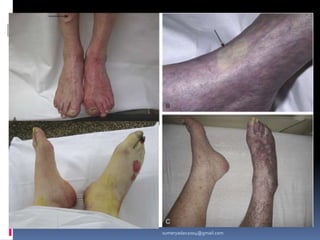
ACUTE LIMB ISCHAEMIA
Dr Sumer Yadav
MCh --PlasticAnd Reconstructive Surgeon
sumeryadav2004@gmail.com
Acute limb Ischaemia
 Sudden interruption of blood supply to
limb resulting in threat to the limb
viability.
sumeryadav2004@gmail.com
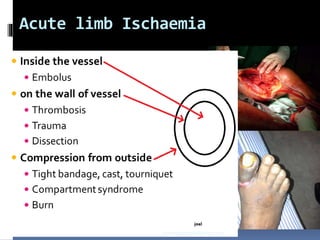
Acute limb Ischaemia
sumeryadav2004@gmail.com
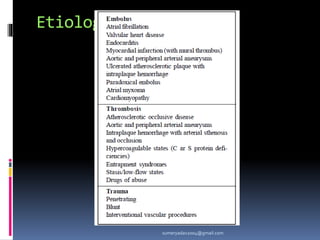
Etiology
sumeryadav2004@gmail.com
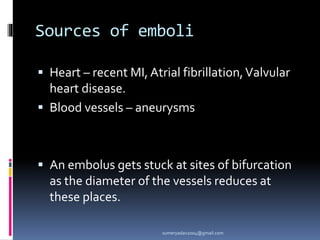
Sources of emboli
 Heart – recent MI, Atrial fibrillation,Valvular
heart disease.
 Blood vessels – aneurysms
 An embolus gets stuck at sites of bifurcation
as the diameter of the vessels reduces at
these places.
sumeryadav2004@gmail.com
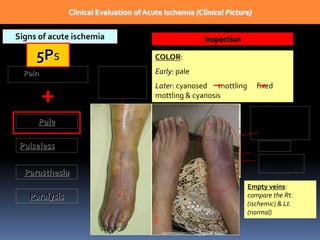
Clinical Evaluation of Acute Ischemia (Clinical Picture)
Signs of acute ischemia
5Ps
Pain: symptom
+
Pulseless
Pale
Parasthesia
Paralysis
Inspection
COLOR:
Early: pale
Later: cyanosed mottling fixed
mottling & cyanosis
Pallor
Reversible
mottling
An area of fixed
cyanosis
surrounded by
reversible mottling
Empty veins:
compare the Rt.
(ischemic) & Lt.
(normal)
Fixed
mottling &
cyanosis
sumeryadav2004@gmail.com
Clinical Evaluation of Acute Ischemia (Clinical Picture)
Signs of acute ischemia
5Ps
Pain: symptom
+
Pulseless
Pale
Parasthesia
Paralysis
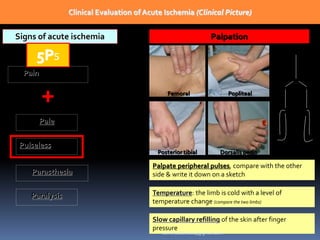
Palpation
Femoral Popliteal
Posterior tibial Dorsalis pedis
Palpate peripheral pulses, compare with the other
side & write it down on a sketch
Temperature: the limb is cold with a level of
temperature change (compare the two limbs)
Slow capillary refilling of the skin after finger
pressure
sumeryadav2004@gmail.com
Clinical Evaluation of Acute Ischemia (Clinical Picture)
Signs of acute ischemia
5Ps
Pain: symptom
+
Pulseless
Pale
Parasthesia
Paralysis
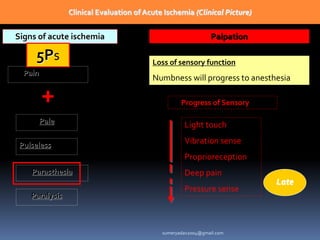
Palpation
Loss of sensory function
Numbness will progress to anesthesia
Progress of Sensory loss
Light touch
Vibration sense
Proprioreception
Deep pain
Pressure sense
Late
sumeryadav2004@gmail.com
Clinical Evaluation of Acute Ischemia (Clinical Picture)
Signs of acute ischemia
5Ps
Pain: symptom
+
Pulseless
Pale
Parasthesia
Paralysis
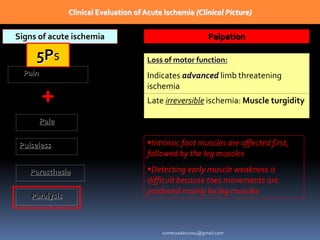
Palpation
Loss of motor function:
Indicates advanced limb threatening
ischemia
Late irreversible ischemia: Muscle turgidity
Intrinsic foot muscles are affected first,
followed by the leg muscles
Detecting early muscle weakness is
difficult because toes movements are
produced mainly by leg muscles
sumeryadav2004@gmail.com
INVESTIGATIONS
The severity and duration of ischemia at the time of presentation
provides a narrow margin of time for investigations
sumeryadav2004@gmail.com
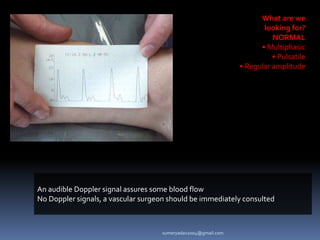
What are we
looking for?
NORMAL
• Multiphasic
• Pulsatile
• Regular amplitude
An audible Doppler signal assures some blood flow
No Doppler signals, a vascular surgeon should be immediately consulted
sumeryadav2004@gmail.com
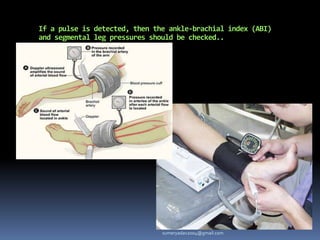
If a pulse is detected, then the ankle-brachial index (ABI)
and segmental leg pressures should be checked..
sumeryadav2004@gmail.com
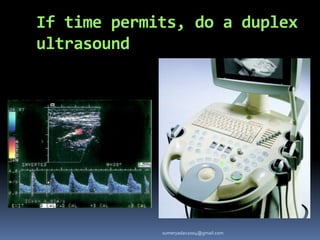
If time permits, do a duplex
ultrasound
sumeryadav2004@gmail.com
Arteriography
 If the differentiation between embolic & thrombotic
ischemia is not clear clinically, and if the limb condition
permits,
 DO ANGIOGRAPHY
sumeryadav2004@gmail.com
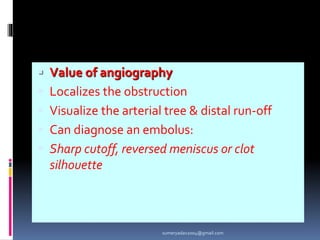
 Value of angiography
 Localizes the obstruction
 Visualize the arterial tree & distal run-off
 Can diagnose an embolus:
 Sharp cutoff, reversed meniscus or clot
silhouette
sumeryadav2004@gmail.com
WWW.SMSO.NET
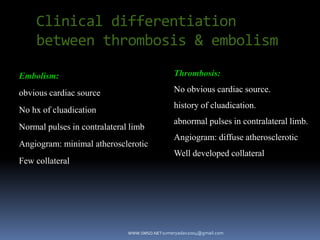
Embolism:
obvious cardiac source
No hx of cluadication
Normal pulses in contralateral limb
Angiogram: minimal atherosclerotic
Few collateral
Clinical differentiation
between thrombosis & embolism
Thrombosis:
No obvious cardiac source.
history of cluadication.
abnormal pulses in contralateral limb.
Angiogram: diffuse atherosclerotic
Well developed collateral
sumeryadav2004@gmail.com
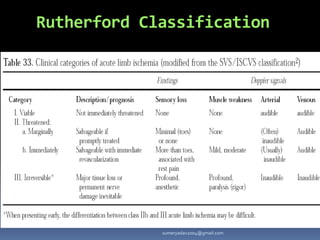
Rutherford Classification
Category Description Cap. refill Paralysis Sensory
loss
A V
I Viable Not immediately
threatened
Intact - - Aud Aud
IIa Threatened Salvagable if
treated
Intact/slow - Partial _ Aud
IIb Threatened Salvagable if
treated
emergently
Slow/absent Partial Partial _ Aud
III Irreversible Primary
amputation req.
Absent Complete Complete _ _
Doppler
sumeryadav2004@gmail.com
Management
sumeryadav2004@gmail.com
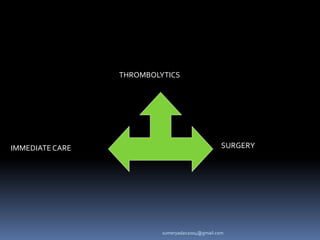
IMMEDIATECARE
THROMBOLYTICS
SURGERY
sumeryadav2004@gmail.com
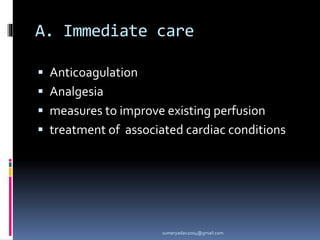
A. Immediate care
 Anticoagulation
 Analgesia
 measures to improve existing perfusion
 treatment of associated cardiac conditions
sumeryadav2004@gmail.com
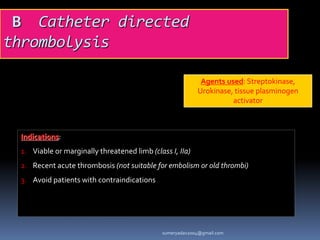
B Catheter directed
thrombolysis
Agents used: Streptokinase,
Urokinase, tissue plasminogen
activator
Indications:
1. Viable or marginally threatened limb (class I, IIa)
2. Recent acute thrombosis (not suitable for embolism or old thrombi)
3. Avoid patients with contraindications
sumeryadav2004@gmail.com
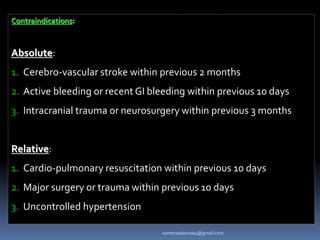
Contraindications:
Absolute:
1. Cerebro-vascular stroke within previous 2 months
2. Active bleeding or recent GI bleeding within previous 10 days
3. Intracranial trauma or neurosurgery within previous 3 months
Relative:
1. Cardio-pulmonary resuscitation within previous 10 days
2. Major surgery or trauma within previous 10 days
3. Uncontrolled hypertension
sumeryadav2004@gmail.com
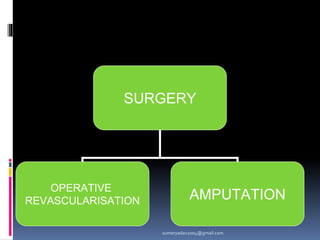
SURGERY
OPERATIVE
REVASCULARISATION AMPUTATION
sumeryadav2004@gmail.com
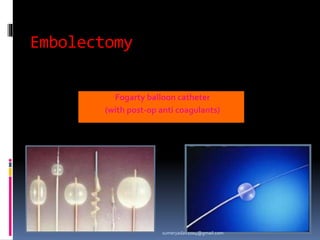
Embolectomy
Fogarty balloon catheter
(with post-op anti coagulants)
sumeryadav2004@gmail.com
Embolectomy
SurgicalTherapy
• Iliac and femoral embolectomy
– Common femoral approach
–Transverse arteriotomy proximal profunda origin
– Collateral circulation may increase backbleeding
– Examine thrombus
sumeryadav2004@gmail.com
Embolectomy
• Popliteal embolectomy
– 49% success rate from femoral approach
– Blind passage selects peroneal 90%
– may expose tibialperoneal trunk & guide catheter
– Idrectly cannulate distal vessels
• Distal embolectomy
– Retrograde/antegrade via ankle incisions
– Frequent Rethrombosis
–ThrombolyticTx viable alternative
sumeryadav2004@gmail.com
Embolectomy
• Completion angiography
– 35% incdence of retained thrombus
• Failure requires
–Thrombolytic thearpy
– revascularization
sumeryadav2004@gmail.com
Thrombolytic Therapy
 Advantages
• Opens collaterals & microcirculation
• Avoids sudden reperfusion
• Reveals underlying stenosis
• Prevent endothelial damage from balloons
Risks
• Hemmorhage • Stroke • Renal failure • Distal emboli
transiently worsen ischemia
sumeryadav2004@gmail.com
Indications for Thrombolysis
 Category 1-2a limbs should be considered
– Class 2b :Two schools of thought
1)“Delay in definitiveTx”
2)“Thrombolytics extend window of opportunity”
• Clots <14days most responsive
– But even chronic thrombus can be lysed
• Large clot burden
– Requires longer duration of thrombolytics
sumeryadav2004@gmail.com
Technique of Thrombolysis
• Catheter directed delivery
1) Lace clot via catheter with side holes
2) Pulse-Spray technique (mechanical component)
• Urokinase andTPA equally effective
• 4 hr treatment followed by angiogram – 4000IU/min x4hr,
2000Iu/M=min x 48h – r-UK (TOPASTrial) – no
improvement after 4hr >> surgery
– Continue Heparin tt
– Fibrinogen levels
sumeryadav2004@gmail.com
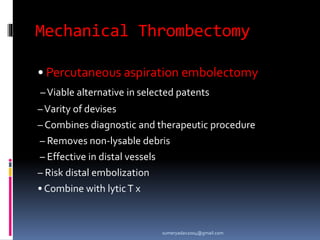
Mechanical Thrombectomy
• Percutaneous aspiration embolectomy
–Viable alternative in selected patents
–Varity of devises
– Combines diagnostic and therapeutic procedure
– Removes non-lysable debris
– Effective in distal vessels
– Risk distal embolization
• Combine with lyticT x
sumeryadav2004@gmail.com
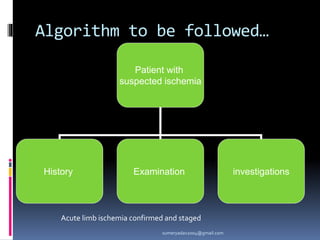
Algorithm to be followed…
Patient with
suspected ischemia
History Examination investigations
Acute limb ischemia confirmed and staged
sumeryadav2004@gmail.com
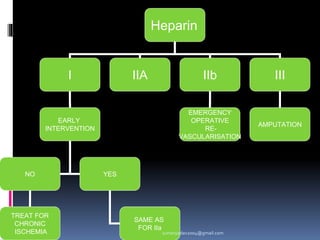
Heparin
I IIA IIb III
AMPUTATION
EMERGENCY
OPERATIVE
RE-
VASCULARISATION
EARLY
INTERVENTION
NO YES
TREAT FOR
CHRONIC
ISCHEMIA
SAME AS
FOR IIa
sumeryadav2004@gmail.com
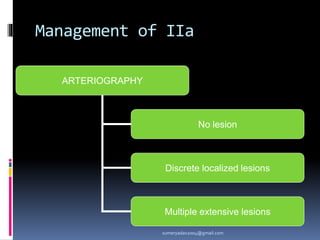
Management of IIa
ARTERIOGRAPHY
No lesion
Discrete localized lesions
Multiple extensive lesions
sumeryadav2004@gmail.com
Post operative management
 Monitor distal pulse
 Keep foot elevated
 Monitor movements and sensation
 Continue Heparin – 18U/kg per hour infusion
 Start warfarin when surgical bleeding is not a
concern
 Monitor for reperfusion effects
sumeryadav2004@gmail.com
Clinical outcomes /
complications
• Mortality -15–20%.
• Major morbidities include:
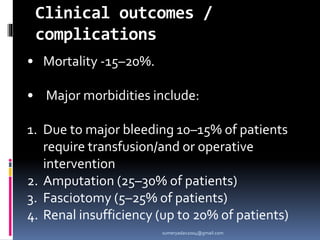
1. Due to major bleeding 10–15% of patients
require transfusion/and or operative
intervention
2. Amputation (25–30% of patients)
3. Fasciotomy (5–25% of patients)
4. Renal insufficiency (up to 20% of patients)
sumeryadav2004@gmail.com
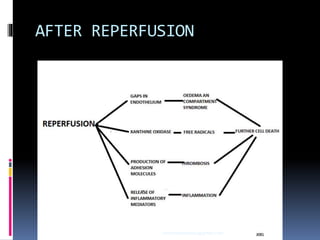
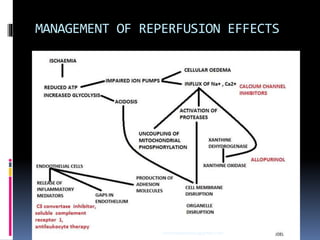
Reperfusion effects
 Local
 Reperfusion injury – paradoxical death of already
dying muscles after reperfusion
 Systemic
 Reperfusion syndrome
 Hypotension
 ARDS
 Lactic acidosis
 Hyperkalemia
 Renal failure
sumeryadav2004@gmail.com
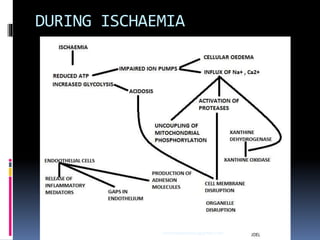
DURING ISCHAEMIA
sumeryadav2004@gmail.com
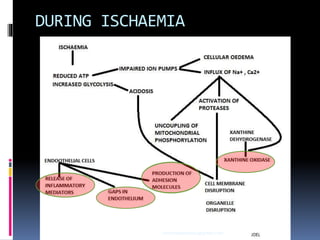
DURING ISCHAEMIA
sumeryadav2004@gmail.com
AFTER REPERFUSION
sumeryadav2004@gmail.com
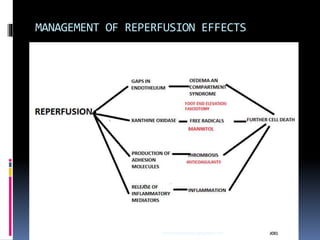
MANAGEMENT OF REPERFUSION EFFECTS
sumeryadav2004@gmail.com
MANAGEMENT OF REPERFUSION EFFECTS
sumeryadav2004@gmail.com
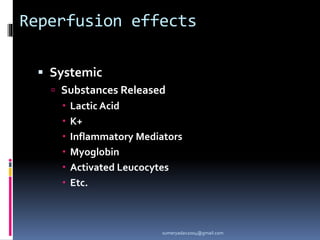
Reperfusion effects
 Systemic
 Substances Released
 Lactic Acid
 K+
 Inflammatory Mediators
 Myoglobin
 Activated Leucocytes
 Etc.
sumeryadav2004@gmail.com
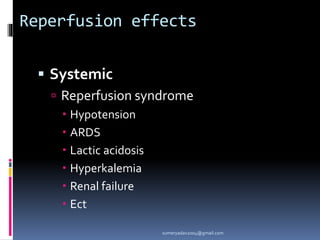
Reperfusion effects
 Systemic
 Reperfusion syndrome
 Hypotension
 ARDS
 Lactic acidosis
 Hyperkalemia
 Renal failure
 Ect
sumeryadav2004@gmail.com
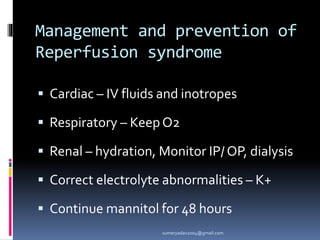
Management and prevention of
Reperfusion syndrome
 Cardiac – IV fluids and inotropes
 Respiratory – KeepO2
 Renal – hydration, Monitor IP/ OP, dialysis
 Correct electrolyte abnormalities – K+
 Continue mannitol for 48 hours
sumeryadav2004@gmail.com
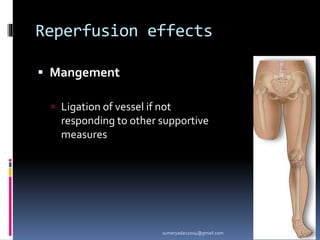
Reperfusion effects
 Mangement
 Ligation of vessel if not
responding to other supportive
measures
sumeryadav2004@gmail.com
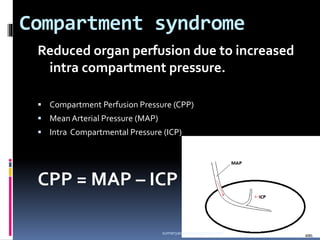
Compartment syndrome
Reduced organ perfusion due to increased
intra compartment pressure.
 Compartment Perfusion Pressure (CPP)
 MeanArterial Pressure (MAP)
 Intra Compartmental Pressure (ICP)
CPP = MAP – ICP
sumeryadav2004@gmail.com
Compartment syndrome
Causes
 Trauma (muscle contusion)
 Haematoma
 Reperfusion
 Intracompartmental extravasation of fluids
 Tight bandage, cast
sumeryadav2004@gmail.com
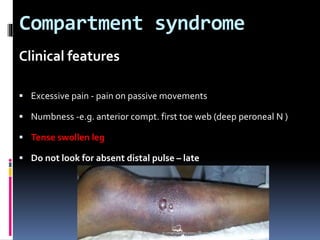
Compartment syndrome
Clinical features
 Excessive pain - pain on passive movements
 Numbness -e.g. anterior compt. first toe web (deep peroneal N )
 Tense swollen leg
 Do not look for absent distal pulse – late
sumeryadav2004@gmail.com
Compartment syndrome
Treatment
 Recognize
 Reduce intracomparmental pressure
 Remove bandages and cast
 Keep limb elevated
Fasciotomy
sumeryadav2004@gmail.com
Compartment syndrome
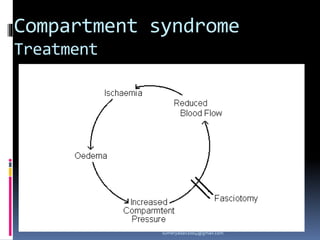
Treatment
sumeryadav2004@gmail.com
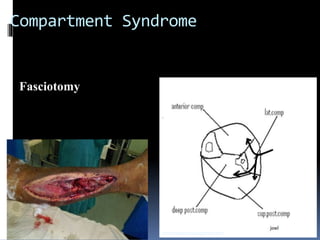
Compartment Syndrome
Fasciotomy
sumeryadav2004@gmail.com
Thank You
sumeryadav2004@gmail.com

Acute limb ischaemia

  • 1.
    ACUTE LIMB ISCHAEMIA DrSumer Yadav MCh --PlasticAnd Reconstructive Surgeon sumeryadav2004@gmail.com
  • 2.
    Acute limb Ischaemia Sudden interruption of blood supply to limb resulting in threat to the limb viability. sumeryadav2004@gmail.com
  • 3.
  • 4.
  • 5.
    Sources of emboli Heart – recent MI, Atrial fibrillation,Valvular heart disease.  Blood vessels – aneurysms  An embolus gets stuck at sites of bifurcation as the diameter of the vessels reduces at these places. sumeryadav2004@gmail.com
  • 6.
  • 7.
    Clinical Evaluation ofAcute Ischemia (Clinical Picture) Signs of acute ischemia 5Ps Pain: symptom + Pulseless Pale Parasthesia Paralysis Inspection COLOR: Early: pale Later: cyanosed mottling fixed mottling & cyanosis Pallor Reversible mottling An area of fixed cyanosis surrounded by reversible mottling Empty veins: compare the Rt. (ischemic) & Lt. (normal) Fixed mottling & cyanosis sumeryadav2004@gmail.com
  • 8.
    Clinical Evaluation ofAcute Ischemia (Clinical Picture) Signs of acute ischemia 5Ps Pain: symptom + Pulseless Pale Parasthesia Paralysis Palpation Femoral Popliteal Posterior tibial Dorsalis pedis Palpate peripheral pulses, compare with the other side & write it down on a sketch Temperature: the limb is cold with a level of temperature change (compare the two limbs) Slow capillary refilling of the skin after finger pressure sumeryadav2004@gmail.com
  • 9.
    Clinical Evaluation ofAcute Ischemia (Clinical Picture) Signs of acute ischemia 5Ps Pain: symptom + Pulseless Pale Parasthesia Paralysis Palpation Loss of sensory function Numbness will progress to anesthesia Progress of Sensory loss Light touch Vibration sense Proprioreception Deep pain Pressure sense Late sumeryadav2004@gmail.com
  • 10.
    Clinical Evaluation ofAcute Ischemia (Clinical Picture) Signs of acute ischemia 5Ps Pain: symptom + Pulseless Pale Parasthesia Paralysis Palpation Loss of motor function: Indicates advanced limb threatening ischemia Late irreversible ischemia: Muscle turgidity Intrinsic foot muscles are affected first, followed by the leg muscles Detecting early muscle weakness is difficult because toes movements are produced mainly by leg muscles sumeryadav2004@gmail.com
  • 11.
    INVESTIGATIONS The severity andduration of ischemia at the time of presentation provides a narrow margin of time for investigations sumeryadav2004@gmail.com
  • 12.
    What are we lookingfor? NORMAL • Multiphasic • Pulsatile • Regular amplitude An audible Doppler signal assures some blood flow No Doppler signals, a vascular surgeon should be immediately consulted sumeryadav2004@gmail.com
  • 13.
    If a pulseis detected, then the ankle-brachial index (ABI) and segmental leg pressures should be checked.. sumeryadav2004@gmail.com
  • 14.
    If time permits,do a duplex ultrasound sumeryadav2004@gmail.com
  • 15.
    Arteriography  If thedifferentiation between embolic & thrombotic ischemia is not clear clinically, and if the limb condition permits,  DO ANGIOGRAPHY sumeryadav2004@gmail.com
  • 16.
     Value ofangiography  Localizes the obstruction  Visualize the arterial tree & distal run-off  Can diagnose an embolus:  Sharp cutoff, reversed meniscus or clot silhouette sumeryadav2004@gmail.com
  • 17.
    WWW.SMSO.NET Embolism: obvious cardiac source Nohx of cluadication Normal pulses in contralateral limb Angiogram: minimal atherosclerotic Few collateral Clinical differentiation between thrombosis & embolism Thrombosis: No obvious cardiac source. history of cluadication. abnormal pulses in contralateral limb. Angiogram: diffuse atherosclerotic Well developed collateral sumeryadav2004@gmail.com
  • 18.
    Rutherford Classification Category DescriptionCap. refill Paralysis Sensory loss A V I Viable Not immediately threatened Intact - - Aud Aud IIa Threatened Salvagable if treated Intact/slow - Partial _ Aud IIb Threatened Salvagable if treated emergently Slow/absent Partial Partial _ Aud III Irreversible Primary amputation req. Absent Complete Complete _ _ Doppler sumeryadav2004@gmail.com
  • 19.
  • 20.
  • 21.
    A. Immediate care Anticoagulation  Analgesia  measures to improve existing perfusion  treatment of associated cardiac conditions sumeryadav2004@gmail.com
  • 22.
    B Catheter directed thrombolysis Agentsused: Streptokinase, Urokinase, tissue plasminogen activator Indications: 1. Viable or marginally threatened limb (class I, IIa) 2. Recent acute thrombosis (not suitable for embolism or old thrombi) 3. Avoid patients with contraindications sumeryadav2004@gmail.com
  • 23.
    Contraindications: Absolute: 1. Cerebro-vascular strokewithin previous 2 months 2. Active bleeding or recent GI bleeding within previous 10 days 3. Intracranial trauma or neurosurgery within previous 3 months Relative: 1. Cardio-pulmonary resuscitation within previous 10 days 2. Major surgery or trauma within previous 10 days 3. Uncontrolled hypertension sumeryadav2004@gmail.com
  • 24.
  • 25.
    Embolectomy Fogarty balloon catheter (withpost-op anti coagulants) sumeryadav2004@gmail.com
  • 26.
    Embolectomy SurgicalTherapy • Iliac andfemoral embolectomy – Common femoral approach –Transverse arteriotomy proximal profunda origin – Collateral circulation may increase backbleeding – Examine thrombus sumeryadav2004@gmail.com
  • 27.
    Embolectomy • Popliteal embolectomy –49% success rate from femoral approach – Blind passage selects peroneal 90% – may expose tibialperoneal trunk & guide catheter – Idrectly cannulate distal vessels • Distal embolectomy – Retrograde/antegrade via ankle incisions – Frequent Rethrombosis –ThrombolyticTx viable alternative sumeryadav2004@gmail.com
  • 28.
    Embolectomy • Completion angiography –35% incdence of retained thrombus • Failure requires –Thrombolytic thearpy – revascularization sumeryadav2004@gmail.com
  • 29.
    Thrombolytic Therapy  Advantages •Opens collaterals & microcirculation • Avoids sudden reperfusion • Reveals underlying stenosis • Prevent endothelial damage from balloons Risks • Hemmorhage • Stroke • Renal failure • Distal emboli transiently worsen ischemia sumeryadav2004@gmail.com
  • 30.
    Indications for Thrombolysis Category 1-2a limbs should be considered – Class 2b :Two schools of thought 1)“Delay in definitiveTx” 2)“Thrombolytics extend window of opportunity” • Clots <14days most responsive – But even chronic thrombus can be lysed • Large clot burden – Requires longer duration of thrombolytics sumeryadav2004@gmail.com
  • 31.
    Technique of Thrombolysis •Catheter directed delivery 1) Lace clot via catheter with side holes 2) Pulse-Spray technique (mechanical component) • Urokinase andTPA equally effective • 4 hr treatment followed by angiogram – 4000IU/min x4hr, 2000Iu/M=min x 48h – r-UK (TOPASTrial) – no improvement after 4hr >> surgery – Continue Heparin tt – Fibrinogen levels sumeryadav2004@gmail.com
  • 32.
    Mechanical Thrombectomy • Percutaneousaspiration embolectomy –Viable alternative in selected patents –Varity of devises – Combines diagnostic and therapeutic procedure – Removes non-lysable debris – Effective in distal vessels – Risk distal embolization • Combine with lyticT x sumeryadav2004@gmail.com
  • 33.
    Algorithm to befollowed… Patient with suspected ischemia History Examination investigations Acute limb ischemia confirmed and staged sumeryadav2004@gmail.com
  • 34.
    Heparin I IIA IIbIII AMPUTATION EMERGENCY OPERATIVE RE- VASCULARISATION EARLY INTERVENTION NO YES TREAT FOR CHRONIC ISCHEMIA SAME AS FOR IIa sumeryadav2004@gmail.com
  • 35.
    Management of IIa ARTERIOGRAPHY Nolesion Discrete localized lesions Multiple extensive lesions sumeryadav2004@gmail.com
  • 36.
    Post operative management Monitor distal pulse  Keep foot elevated  Monitor movements and sensation  Continue Heparin – 18U/kg per hour infusion  Start warfarin when surgical bleeding is not a concern  Monitor for reperfusion effects sumeryadav2004@gmail.com
  • 37.
    Clinical outcomes / complications •Mortality -15–20%. • Major morbidities include: 1. Due to major bleeding 10–15% of patients require transfusion/and or operative intervention 2. Amputation (25–30% of patients) 3. Fasciotomy (5–25% of patients) 4. Renal insufficiency (up to 20% of patients) sumeryadav2004@gmail.com
  • 38.
    Reperfusion effects  Local Reperfusion injury – paradoxical death of already dying muscles after reperfusion  Systemic  Reperfusion syndrome  Hypotension  ARDS  Lactic acidosis  Hyperkalemia  Renal failure sumeryadav2004@gmail.com
  • 39.
  • 40.
  • 41.
  • 42.
    MANAGEMENT OF REPERFUSIONEFFECTS sumeryadav2004@gmail.com
  • 43.
    MANAGEMENT OF REPERFUSIONEFFECTS sumeryadav2004@gmail.com
  • 44.
    Reperfusion effects  Systemic Substances Released  Lactic Acid  K+  Inflammatory Mediators  Myoglobin  Activated Leucocytes  Etc. sumeryadav2004@gmail.com
  • 45.
    Reperfusion effects  Systemic Reperfusion syndrome  Hypotension  ARDS  Lactic acidosis  Hyperkalemia  Renal failure  Ect sumeryadav2004@gmail.com
  • 46.
    Management and preventionof Reperfusion syndrome  Cardiac – IV fluids and inotropes  Respiratory – KeepO2  Renal – hydration, Monitor IP/ OP, dialysis  Correct electrolyte abnormalities – K+  Continue mannitol for 48 hours sumeryadav2004@gmail.com
  • 47.
    Reperfusion effects  Mangement Ligation of vessel if not responding to other supportive measures sumeryadav2004@gmail.com
  • 48.
    Compartment syndrome Reduced organperfusion due to increased intra compartment pressure.  Compartment Perfusion Pressure (CPP)  MeanArterial Pressure (MAP)  Intra Compartmental Pressure (ICP) CPP = MAP – ICP sumeryadav2004@gmail.com
  • 49.
    Compartment syndrome Causes  Trauma(muscle contusion)  Haematoma  Reperfusion  Intracompartmental extravasation of fluids  Tight bandage, cast sumeryadav2004@gmail.com
  • 50.
    Compartment syndrome Clinical features Excessive pain - pain on passive movements  Numbness -e.g. anterior compt. first toe web (deep peroneal N )  Tense swollen leg  Do not look for absent distal pulse – late sumeryadav2004@gmail.com
  • 51.
    Compartment syndrome Treatment  Recognize Reduce intracomparmental pressure  Remove bandages and cast  Keep limb elevated Fasciotomy sumeryadav2004@gmail.com
  • 52.
  • 53.
  • 54.