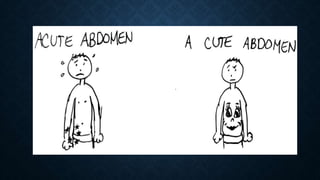
UNDERSTANDING
ACUTE ABDOMEN
Dr.Md. Majedul Islam
MBBS, FCPS(Surgery)
Specialist, Department of General Surgery
Square Hospital Ltd
ACUTE ABDOMEN
The acute abdomen characterised by the any sudden,
spontaneous, nontraumatic, severe abdominal pain of less
than 24 hours duration.
The acute abdomen requires rapid and specific diagnosis as several etiologies
demand urgent operative intervention. Because undue delay in diagnosis and
treatment may adversely affect outcome.
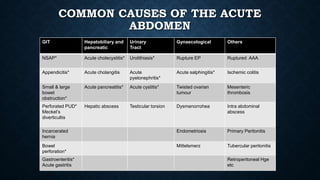
COMMON CAUSES OF THE ACUTE
ABDOMEN
GIT Hepatobiliary and
pancreatic
Urinary
Tract
Gynaecological Others
NSAP* Acute cholecystitis* Urolithiasis* Rupture EP Ruptured AAA
Appendicitis* Acute cholangitis Acute
pyelonephritis*
Acute salphingitis* Ischemic colitis
Small & large
bowel
obstruction*
Acute pancreatitis* Acute cystitis* Twisted ovarian
tumour
Mesenteric
thrombosis
Perforated PUD*
Meckel’s
diverticultis
Hepatic abscess Testicular torsion Dysmenorrohea Intra abdominal
abscess
Incarcerated
hernia
Endometriosis Primary Peritonitis
Bowel
perforation*
Mittelsmerz Tubercular peritonitis
Gastroenteritis*
Acute gastritis
Retroperitoneal Hge
etc
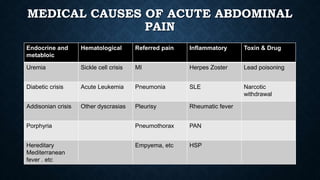
MEDICAL CAUSES OF ACUTE ABDOMINAL
PAIN
Endocrine and
metabloic
Hematological Referred pain Inflammatory Toxin & Drug
Uremia Sickle cell crisis MI Herpes Zoster Lead poisoning
Diabetic crisis Acute Leukemia Pneumonia SLE Narcotic
withdrawal
Addisonian crisis Other dyscrasias Pleurisy Rheumatic fever
Porphyria Pneumothorax PAN
Hereditary
Mediterranean
fever . etc
Empyema, etc HSP
DIAGNOSIS OF ACUTE ABDOMEN
A. History
• Abdominal pain & Other Symptoms Associated with Abdominal Pain
• Past medical history / Past Surgical history
• Gynaecological history
• Medication history
• Family History
• Travel history
B. Physical Examination
C. Laboratory Investigation
D.Imaging studies
E. Diagnostic Laparoscopy.
ABDOMINAL PAIN IN ACUTE ABDOMEN
Pain is the most common and predominant presenting feature of an
acute abdomen. Careful consideration of the
• Location,
• severity,
• mode of onset and progression,
• the character of the pain will suggest a preliminary list of diagnoses.
Abdominal pain may be :
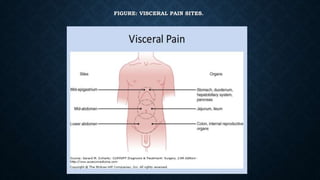
1. Visceral pain
2. Parietal Pain
3. Referred pain and shifting pain
ABDOMINAL PAIN CONTD.
Visceral Pain:
* Distention, inflammation, ischemia or malignant infiltration of
sensory nerves.
* Slow in onset, dull, poorly localized.
* Most often felt in the midline because of the bilateral sensory
supply to the spinal cord.
FIGURE: VISCERAL PAIN SITES.
ABDOMINAL PAIN CONTD.
Parietal Pain:
• Direct irritation parietal peritoneum by pus, bile, urine, or GI
secretions.
• More acute, sharper, better localized pain.
• The cutaneous distribution of parietal pain corresponds to the T6-
L1 areas.
ABDOMINAL PAIN CONTD.
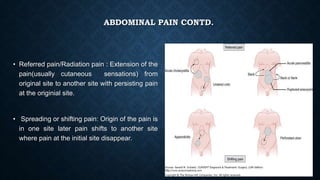
• Referred pain/Radiation pain : Extension of the
pain(usually cutaneous sensations) from
original site to another site with persisting pain
at the originial site.
• Spreading or shifting pain: Origin of the pain is
in one site later pain shifts to another site
where pain at the initial site disappear.
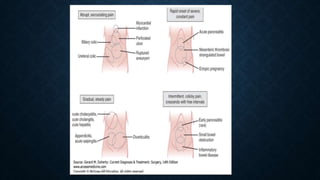
• The mode of onset of pain:
1. explosive (within seconds),
2. rapidly progressive (within 1-2 hours), or
3. gradual (over several hours).
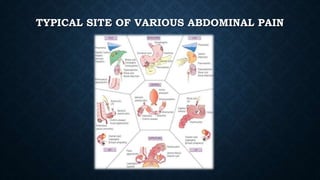
TYPICAL SITE OF VARIOUS ABDOMINAL PAIN
CHARACTER OF PAIN
1. Colicky pain – Sharp intermitten gripping pain i.e – obsturction to a
hollow organ.
2. Constant burning pain – feature of peritonitis
3. Severe Agonising pain – Characterstics of acute pancreatitis.
4. Throbbing pain – suggestive of inflammation i.e – Cholecystitis
Change in character of pain i.e – colicky pain sometime change into
constant pain indicate strangulation.
VOMITING (OTHER ASSOCIATED SYMPTOMS)
Differential diagnosis of characterstics of vomit with abdominal pain
1. Billous(green) : Intestinal obstruction, Malrotation or sepsis
2. Coffee ground : Gastritis, gastric ulcer, esophagitis.
3. Fresh blood : Esophagitis, gastritis, Gastric/duodenal ulcer, Mallory-
Weiss tear
4. Food/Stomach content: Gastroenteritis, Early small intestinal
obstruction.
5. Feculent: Late intestinal content.
OTHER SYMPTOMS ASSOCIATED WITH ABDOMINAL PAIN
1. Constipation : Suggest mechanical bowel obstruction.
2. Diarrhea: Suggests Pelvic abscess, blood stained suggests ischemic
colitis, IBD etc
3. Fever: marker of inflammation
4. Other symptom:
• Hematemesis
• Hematochezia or melena a lower GI bleed or colonic ischemia and
• Hematuria, ureteral colic, or cystitis.
PAST MEDICAL & SURGICAL HISTORY
Past Medical History:
1. Pulmonary TB
2. Cardiac Disease: AF
3. PUD
4. Biliary colic & Pancreatitis
5. IBD
6. Abdominal trauma i.e Delayed splenic
bledding. etc
Past Surgical History:
1. Previous abdominal surgery.
2. Mode of operation (laparoscopic, open,
endovascular)
3. Operative notes and pathology reports
should be obtained and reviewed.
OTHER RELEVANT ASPECTS OF THE HISTORY
Gynaecological History:
• 1. The menstrual history is is crucial to the diagnosis of
ectopic pregnancy, mittelschmerz (due to a ruptured
ovarian follicle) and endometriosis.
• 2. A history of vaginal discharge or dysmenorrhea may
denote pelvic inflammatory disease.
1. Medication History: NSAIDS or aspirin,
Anticoagulants or antiplatelet drug. OCP,
Corticosteroid or chemotherapeutic or
immunosuppressive drugs.
2. Family history: Hereditary pancreatits
3. Travel History : amebic liver abscess
or hydatid cyst, malarial spleen, tuberculosis,
Salmonella typhi infection of the ileocecal area, or
dysentery.
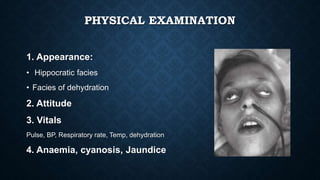
PHYSICAL EXAMINATION
1. Appearance:
• Hippocratic facies
• Facies of dehydration
2. Attitude
3. Vitals
Pulse, BP, Respiratory rate, Temp, dehydration
4. Anaemia, cyanosis, Jaundice
ABDOMINAL EXAMINATION
1. Inspection:
• Hernial Orifices
• Abdominal contour
• Respiratory Movement
• Peristaltic movement
• Visible swelling
• Skin condition
2. Palpation:
• Hyperasthesia
• Tenderness
• Distension
• Lump
• Hernial Site
ABDOMINAL FINDINGS IN DIFFERENT CONDITION
Perforated Viscus/Peritonitis :
• Tenderness ± guarding/rigidity/rebound of
abdominal wall
• Pain/tenderness on rectal/vaginal
examination (pelvic peritonitis)
• Absent or reduced bowel sounds
Intestinal Obstruction:
• Diffuse pain without rebound tenderness
• Abdominal distension(late)
• Hyperperistalsis(Early)
• Quiet Abdomen(late)
• No localized tenderness(Paralytic ileus)
• Tenderness, rigidity & P/R bleeding(Strangulation)
SPECIAL SIGN
Four sign that may prove helpful in deciding the momentous question
“Is this an acute abdomen”
1. The pointing test /pointing sign
2. The cough test/Dunphy’s sign
3. Rebound tenderness/release sign/Blumberg ‘s sign
4. The Bed-Shaking Test/Bapat’s sign.
Other’s
* Alder’s Sign : Shifting tenderness helpful to differentiate between appendicitis
with uterine origin tenderness.
IMPORTANT SIGN IN PT WITH ABDOMINAL
PAIN
1. Murphy’s sign – Acute cholecystitis
2. Kehr’s sign – Splenic ruptute, Ectopic pregnancy rupture.
3. McBurney’s sign – Appendicitis
4. Iliopsoas sign _ Appendicitis
5. Rovsin sign- Appendicitis.
6. K sign – Appendicitis
7. Grey Turners sign – Hemoperitoneum.
8. Chandelier sign – PID .
9. Dance sign – Intussusception. etc
OTHER EXAMINATION
1. Percussion:
• Shifting dullness – presence of free fluid
• Obliteration of liver dullness – pneumoperitoneum
2. Auscultaion :
• Silent – peritonitis
• Increase peristaaltic sound in intestinal obstruction
3. Rectal examination
4. Vaginal examination
LABORATORY INVESTIGATION
A. Blood Studies:
• Neutrophilic leucocytosis
• CRP
• Electrolyte, Creatinine & BUN
• ABG
• Serum Lactate(Raised in ischemic bowel)
• Lipase
• Liver function tests if suspect hepato-biliary disease
• Beta HCG (women of childbearing age.)
B. Urine Tests:
RE & ME to see hematuria, pyuria
Dipstick Test - (for albumin, bilirubin, glucose and ketones), Pregnancy test.
IMAGING STUDIES
A. Plain Chest X-Ray Studies:
• lower lobe pneumonia or ruptured esophagus
• An elevated hemidiaphragm or pleural effusion
• In CXR Subdiaphragmatic air(Pneumoperitoneum) more sensitive
than abdominal plain films for free intraperitoneal air.
B. Abdominal X Ray Studies:
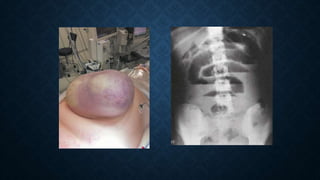
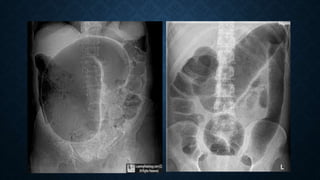
• Multiple air fluid level or 3 , 6 , 9 rules or string of Pearl sign to
identify intestinal obstruction.
• Pneumoperitoneum
• Calculous, Calcification, intraperitoneal and retroperitoneal collections
etc.
X RAY CONTD.
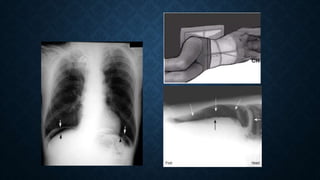
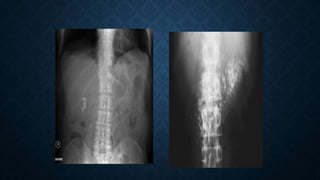
Pneumoperitoneum: usually by suggests a perforated viscous
1 ml air in peritoneum produce pneumoperitoneum in upright CXR
5-10 ml air in peritoneum produce pneumoperitoneum in lateral decubitus position
(after 10 minutes)
Pneumoperitoneum is usually not found in Burst appendix.
90% renal stone
10 % gall stone
5% appendicolith
Also pancreatic calcification, AAA calcification are seen.
Radio – Opaque
ULTRASONOGRAPHY
• Identify inflammatory conditions, stone disease, free fluid collection.
• Most useful in pregnant patients
• Gynecologic causes of abdominal pain.
• Color Doppler distinguish from inflammatory and infectious processes
& evaluating for flow through the mesenteric vessels.
Pitfall :
• obesity;
• following previous surgery;
• ascites;
• gaseous distension of upper abdominal viscera
CT SCAN
Provides excellent diagnostic accuracy whom do not already have
clear indications for laparotomy or laparoscopy.
• Mis- or delayed diagnosed?
• Unknown diagnosis?
• Young female patient, GI or GYN problem?
• Intractable abdominal pain (infarction or vascular lesion?)
• High risk patient (sometimes…VIP)
• With or without contrast medium?
CT ANGIOGRAPHY (CTA),OR MAGNETIC
RESONANCE ANGIOGRAPHY (MRA)
• Intestinal ischemia or ongoing hemorrhage.
• May identify the bleeding site in Pt with massive lower GI bleeding,
• Additionally it can be therapeutic for coiling or embolizing of bleeding vessel's
ROLE OF ENDOSCOPY IN ACUTE ABDOMEN
• Urgent ERCP may be indicated in cases of suspected cholangitis.
• Sigmoidoscopy to reducing a sigmoid volvulus
• colonoscopy to locate the source of bleeding in cases of lower GI
hemorrhage
ROLE OF LAPAROSCOPY IN ACUTE
ABDOMEN
• Laparoscopy is a therapeutic as well as diagnostic modality
• In cases of unclear diagnosis, it guide surgical planning and avoid
unneeded laparotomies.
• In young women, it may distinguish a nonsurgical problem (ruptured
graafian follicle, pelvic inflammatory disease, tubo-ovarian disease) from
appendicitis
CAREFUL ABOUT SPECIAL POPULATION
1. Extremes of age (Children & Elderly)
2. Obese
3. Pregnant
4. Critically ill patient
5. Immunocompromised Pt
PATIENTS WITH ACUTE ABDOMEN ATTENDING
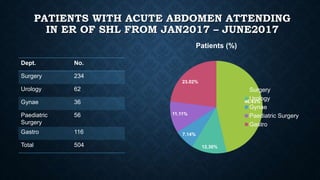
IN ER OF SHL FROM JAN2017 – JUNE2017
Dept. No.
Surgery 234
Urology 62
Gynae 36
Paediatric
Surgery
56
Gastro 116
Total 504
46.43%
12.30%
7.14%
11.11%
23.02%
Patients (%)
Surgery
Urology
Gynae
Paediatric Surgery
Gastro
GENERAL SURGERY
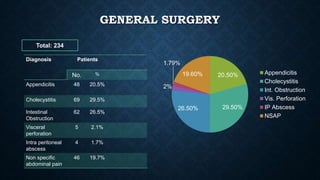
Diagnosis Patients
No. %
Appendicitis 48 20.5%
Cholecystitis 69 29.5%
Intestinal
Obstruction
62 26.5%
Visceral
perforation
5 2.1%
Intra peritoneal
abscess
4 1.7%
Non specific
abdominal pain
46 19.7%
20.50%
29.50%26.50%
2%
1.79%
19.60% Appendicitis
Cholecystitis
Int. Obstruction
Vis. Perforation
IP Abscess
NSAP
Total: 234
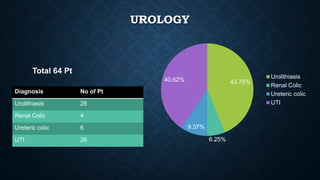
UROLOGY
Total 64 Pt
Diagnosis No of Pt
Urolithiasis 28
Renal Colic 4
Ureteric colic 6
UTI 26
43.75%
6.25%
9.37%
40.62% Urolithiasis
Renal Colic
Ureteric colic
UTI
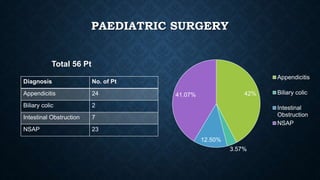
PAEDIATRIC SURGERY
Total 56 Pt
Diagnosis No. of Pt
Appendicitis 24
Biliary colic 2
Intestinal Obstruction 7
NSAP 23
42%
3.57%
12.50%
41.07%
Appendicitis
Biliary colic
Intestinal
Obstruction
NSAP
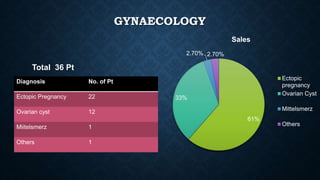
GYNAECOLOGY
Total 36 Pt
Diagnosis No. of Pt
Ectopic Pregnancy 22
Ovarian cyst 12
Miitelsmerz 1
Others 1
61%
33%
2.70% 2.70%
Sales
Ectopic
pregnancy
Ovarian Cyst
Mittelsmerz
Others
TAKE HOME MESSAGE
Acute abdominal pain remains a challenging part of surgeons life.
So appropriate focus to approach such ways and to set the plan of action whether the
patient will need to:
• go directly to the operating room,
• be admitted for surgical observation and expected operative intervention,
• be admitted for surgical observation or further diagnostics, or
• be admitted to medical service for nonoperative abdominal pain.
Understanding acute abdomen

Understanding acute abdomen

  • 1.
    UNDERSTANDING ACUTE ABDOMEN Dr.Md. MajedulIslam MBBS, FCPS(Surgery) Specialist, Department of General Surgery Square Hospital Ltd
  • 2.
    ACUTE ABDOMEN The acuteabdomen characterised by the any sudden, spontaneous, nontraumatic, severe abdominal pain of less than 24 hours duration. The acute abdomen requires rapid and specific diagnosis as several etiologies demand urgent operative intervention. Because undue delay in diagnosis and treatment may adversely affect outcome.
  • 3.
    COMMON CAUSES OFTHE ACUTE ABDOMEN GIT Hepatobiliary and pancreatic Urinary Tract Gynaecological Others NSAP* Acute cholecystitis* Urolithiasis* Rupture EP Ruptured AAA Appendicitis* Acute cholangitis Acute pyelonephritis* Acute salphingitis* Ischemic colitis Small & large bowel obstruction* Acute pancreatitis* Acute cystitis* Twisted ovarian tumour Mesenteric thrombosis Perforated PUD* Meckel’s diverticultis Hepatic abscess Testicular torsion Dysmenorrohea Intra abdominal abscess Incarcerated hernia Endometriosis Primary Peritonitis Bowel perforation* Mittelsmerz Tubercular peritonitis Gastroenteritis* Acute gastritis Retroperitoneal Hge etc
  • 4.
    MEDICAL CAUSES OFACUTE ABDOMINAL PAIN Endocrine and metabloic Hematological Referred pain Inflammatory Toxin & Drug Uremia Sickle cell crisis MI Herpes Zoster Lead poisoning Diabetic crisis Acute Leukemia Pneumonia SLE Narcotic withdrawal Addisonian crisis Other dyscrasias Pleurisy Rheumatic fever Porphyria Pneumothorax PAN Hereditary Mediterranean fever . etc Empyema, etc HSP
  • 5.
    DIAGNOSIS OF ACUTEABDOMEN A. History • Abdominal pain & Other Symptoms Associated with Abdominal Pain • Past medical history / Past Surgical history • Gynaecological history • Medication history • Family History • Travel history B. Physical Examination C. Laboratory Investigation D.Imaging studies E. Diagnostic Laparoscopy.
  • 6.
    ABDOMINAL PAIN INACUTE ABDOMEN Pain is the most common and predominant presenting feature of an acute abdomen. Careful consideration of the • Location, • severity, • mode of onset and progression, • the character of the pain will suggest a preliminary list of diagnoses.
  • 7.
    Abdominal pain maybe : 1. Visceral pain 2. Parietal Pain 3. Referred pain and shifting pain
  • 8.
    ABDOMINAL PAIN CONTD. VisceralPain: * Distention, inflammation, ischemia or malignant infiltration of sensory nerves. * Slow in onset, dull, poorly localized. * Most often felt in the midline because of the bilateral sensory supply to the spinal cord.
  • 9.
  • 10.
    ABDOMINAL PAIN CONTD. ParietalPain: • Direct irritation parietal peritoneum by pus, bile, urine, or GI secretions. • More acute, sharper, better localized pain. • The cutaneous distribution of parietal pain corresponds to the T6- L1 areas.
  • 11.
    ABDOMINAL PAIN CONTD. •Referred pain/Radiation pain : Extension of the pain(usually cutaneous sensations) from original site to another site with persisting pain at the originial site. • Spreading or shifting pain: Origin of the pain is in one site later pain shifts to another site where pain at the initial site disappear.
  • 12.
    • The modeof onset of pain: 1. explosive (within seconds), 2. rapidly progressive (within 1-2 hours), or 3. gradual (over several hours).
  • 13.
    TYPICAL SITE OFVARIOUS ABDOMINAL PAIN
  • 14.
    CHARACTER OF PAIN 1.Colicky pain – Sharp intermitten gripping pain i.e – obsturction to a hollow organ. 2. Constant burning pain – feature of peritonitis 3. Severe Agonising pain – Characterstics of acute pancreatitis. 4. Throbbing pain – suggestive of inflammation i.e – Cholecystitis Change in character of pain i.e – colicky pain sometime change into constant pain indicate strangulation.
  • 16.
    VOMITING (OTHER ASSOCIATEDSYMPTOMS) Differential diagnosis of characterstics of vomit with abdominal pain 1. Billous(green) : Intestinal obstruction, Malrotation or sepsis 2. Coffee ground : Gastritis, gastric ulcer, esophagitis. 3. Fresh blood : Esophagitis, gastritis, Gastric/duodenal ulcer, Mallory- Weiss tear 4. Food/Stomach content: Gastroenteritis, Early small intestinal obstruction. 5. Feculent: Late intestinal content.
  • 17.
    OTHER SYMPTOMS ASSOCIATEDWITH ABDOMINAL PAIN 1. Constipation : Suggest mechanical bowel obstruction. 2. Diarrhea: Suggests Pelvic abscess, blood stained suggests ischemic colitis, IBD etc 3. Fever: marker of inflammation 4. Other symptom: • Hematemesis • Hematochezia or melena a lower GI bleed or colonic ischemia and • Hematuria, ureteral colic, or cystitis.
  • 18.
    PAST MEDICAL &SURGICAL HISTORY Past Medical History: 1. Pulmonary TB 2. Cardiac Disease: AF 3. PUD 4. Biliary colic & Pancreatitis 5. IBD 6. Abdominal trauma i.e Delayed splenic bledding. etc Past Surgical History: 1. Previous abdominal surgery. 2. Mode of operation (laparoscopic, open, endovascular) 3. Operative notes and pathology reports should be obtained and reviewed.
  • 19.
    OTHER RELEVANT ASPECTSOF THE HISTORY Gynaecological History: • 1. The menstrual history is is crucial to the diagnosis of ectopic pregnancy, mittelschmerz (due to a ruptured ovarian follicle) and endometriosis. • 2. A history of vaginal discharge or dysmenorrhea may denote pelvic inflammatory disease. 1. Medication History: NSAIDS or aspirin, Anticoagulants or antiplatelet drug. OCP, Corticosteroid or chemotherapeutic or immunosuppressive drugs. 2. Family history: Hereditary pancreatits 3. Travel History : amebic liver abscess or hydatid cyst, malarial spleen, tuberculosis, Salmonella typhi infection of the ileocecal area, or dysentery.
  • 20.
    PHYSICAL EXAMINATION 1. Appearance: •Hippocratic facies • Facies of dehydration 2. Attitude 3. Vitals Pulse, BP, Respiratory rate, Temp, dehydration 4. Anaemia, cyanosis, Jaundice
  • 21.
    ABDOMINAL EXAMINATION 1. Inspection: •Hernial Orifices • Abdominal contour • Respiratory Movement • Peristaltic movement • Visible swelling • Skin condition 2. Palpation: • Hyperasthesia • Tenderness • Distension • Lump • Hernial Site
  • 22.
    ABDOMINAL FINDINGS INDIFFERENT CONDITION Perforated Viscus/Peritonitis : • Tenderness ± guarding/rigidity/rebound of abdominal wall • Pain/tenderness on rectal/vaginal examination (pelvic peritonitis) • Absent or reduced bowel sounds Intestinal Obstruction: • Diffuse pain without rebound tenderness • Abdominal distension(late) • Hyperperistalsis(Early) • Quiet Abdomen(late) • No localized tenderness(Paralytic ileus) • Tenderness, rigidity & P/R bleeding(Strangulation)
  • 23.
    SPECIAL SIGN Four signthat may prove helpful in deciding the momentous question “Is this an acute abdomen” 1. The pointing test /pointing sign 2. The cough test/Dunphy’s sign 3. Rebound tenderness/release sign/Blumberg ‘s sign 4. The Bed-Shaking Test/Bapat’s sign. Other’s * Alder’s Sign : Shifting tenderness helpful to differentiate between appendicitis with uterine origin tenderness.
  • 24.
    IMPORTANT SIGN INPT WITH ABDOMINAL PAIN 1. Murphy’s sign – Acute cholecystitis 2. Kehr’s sign – Splenic ruptute, Ectopic pregnancy rupture. 3. McBurney’s sign – Appendicitis 4. Iliopsoas sign _ Appendicitis 5. Rovsin sign- Appendicitis. 6. K sign – Appendicitis 7. Grey Turners sign – Hemoperitoneum. 8. Chandelier sign – PID . 9. Dance sign – Intussusception. etc
  • 25.
    OTHER EXAMINATION 1. Percussion: •Shifting dullness – presence of free fluid • Obliteration of liver dullness – pneumoperitoneum 2. Auscultaion : • Silent – peritonitis • Increase peristaaltic sound in intestinal obstruction 3. Rectal examination 4. Vaginal examination
  • 26.
    LABORATORY INVESTIGATION A. BloodStudies: • Neutrophilic leucocytosis • CRP • Electrolyte, Creatinine & BUN • ABG • Serum Lactate(Raised in ischemic bowel) • Lipase • Liver function tests if suspect hepato-biliary disease • Beta HCG (women of childbearing age.) B. Urine Tests: RE & ME to see hematuria, pyuria Dipstick Test - (for albumin, bilirubin, glucose and ketones), Pregnancy test.
  • 27.
    IMAGING STUDIES A. PlainChest X-Ray Studies: • lower lobe pneumonia or ruptured esophagus • An elevated hemidiaphragm or pleural effusion • In CXR Subdiaphragmatic air(Pneumoperitoneum) more sensitive than abdominal plain films for free intraperitoneal air.
  • 28.
    B. Abdominal XRay Studies: • Multiple air fluid level or 3 , 6 , 9 rules or string of Pearl sign to identify intestinal obstruction. • Pneumoperitoneum • Calculous, Calcification, intraperitoneal and retroperitoneal collections etc.
  • 29.
    X RAY CONTD. Pneumoperitoneum:usually by suggests a perforated viscous 1 ml air in peritoneum produce pneumoperitoneum in upright CXR 5-10 ml air in peritoneum produce pneumoperitoneum in lateral decubitus position (after 10 minutes) Pneumoperitoneum is usually not found in Burst appendix. 90% renal stone 10 % gall stone 5% appendicolith Also pancreatic calcification, AAA calcification are seen. Radio – Opaque
  • 34.
    ULTRASONOGRAPHY • Identify inflammatoryconditions, stone disease, free fluid collection. • Most useful in pregnant patients • Gynecologic causes of abdominal pain. • Color Doppler distinguish from inflammatory and infectious processes & evaluating for flow through the mesenteric vessels. Pitfall : • obesity; • following previous surgery; • ascites; • gaseous distension of upper abdominal viscera
  • 35.
    CT SCAN Provides excellentdiagnostic accuracy whom do not already have clear indications for laparotomy or laparoscopy. • Mis- or delayed diagnosed? • Unknown diagnosis? • Young female patient, GI or GYN problem? • Intractable abdominal pain (infarction or vascular lesion?) • High risk patient (sometimes…VIP) • With or without contrast medium?
  • 36.
    CT ANGIOGRAPHY (CTA),ORMAGNETIC RESONANCE ANGIOGRAPHY (MRA) • Intestinal ischemia or ongoing hemorrhage. • May identify the bleeding site in Pt with massive lower GI bleeding, • Additionally it can be therapeutic for coiling or embolizing of bleeding vessel's
  • 37.
    ROLE OF ENDOSCOPYIN ACUTE ABDOMEN • Urgent ERCP may be indicated in cases of suspected cholangitis. • Sigmoidoscopy to reducing a sigmoid volvulus • colonoscopy to locate the source of bleeding in cases of lower GI hemorrhage
  • 38.
    ROLE OF LAPAROSCOPYIN ACUTE ABDOMEN • Laparoscopy is a therapeutic as well as diagnostic modality • In cases of unclear diagnosis, it guide surgical planning and avoid unneeded laparotomies. • In young women, it may distinguish a nonsurgical problem (ruptured graafian follicle, pelvic inflammatory disease, tubo-ovarian disease) from appendicitis
  • 39.
    CAREFUL ABOUT SPECIALPOPULATION 1. Extremes of age (Children & Elderly) 2. Obese 3. Pregnant 4. Critically ill patient 5. Immunocompromised Pt
  • 40.
    PATIENTS WITH ACUTEABDOMEN ATTENDING IN ER OF SHL FROM JAN2017 – JUNE2017 Dept. No. Surgery 234 Urology 62 Gynae 36 Paediatric Surgery 56 Gastro 116 Total 504 46.43% 12.30% 7.14% 11.11% 23.02% Patients (%) Surgery Urology Gynae Paediatric Surgery Gastro
  • 41.
    GENERAL SURGERY Diagnosis Patients No.% Appendicitis 48 20.5% Cholecystitis 69 29.5% Intestinal Obstruction 62 26.5% Visceral perforation 5 2.1% Intra peritoneal abscess 4 1.7% Non specific abdominal pain 46 19.7% 20.50% 29.50%26.50% 2% 1.79% 19.60% Appendicitis Cholecystitis Int. Obstruction Vis. Perforation IP Abscess NSAP Total: 234
  • 42.
    UROLOGY Total 64 Pt DiagnosisNo of Pt Urolithiasis 28 Renal Colic 4 Ureteric colic 6 UTI 26 43.75% 6.25% 9.37% 40.62% Urolithiasis Renal Colic Ureteric colic UTI
  • 43.
    PAEDIATRIC SURGERY Total 56Pt Diagnosis No. of Pt Appendicitis 24 Biliary colic 2 Intestinal Obstruction 7 NSAP 23 42% 3.57% 12.50% 41.07% Appendicitis Biliary colic Intestinal Obstruction NSAP
  • 44.
    GYNAECOLOGY Total 36 Pt DiagnosisNo. of Pt Ectopic Pregnancy 22 Ovarian cyst 12 Miitelsmerz 1 Others 1 61% 33% 2.70% 2.70% Sales Ectopic pregnancy Ovarian Cyst Mittelsmerz Others
  • 45.
    TAKE HOME MESSAGE Acuteabdominal pain remains a challenging part of surgeons life. So appropriate focus to approach such ways and to set the plan of action whether the patient will need to: • go directly to the operating room, • be admitted for surgical observation and expected operative intervention, • be admitted for surgical observation or further diagnostics, or • be admitted to medical service for nonoperative abdominal pain.