ACUTE APPENDICITIS
Dr. P.Sandeep
APPENDIX






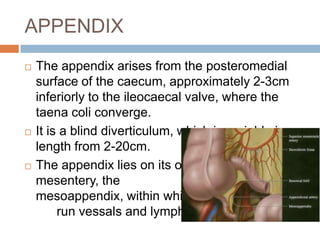
The appendix arises from the posteromedial
surface of the caecum, approximately 2-3cm
inferiorly to the ileocaecal valve, where the
taena coli converge.
It is a blind diverticulum, which is variable in
length from 2-20cm.
The appendix lies on its own
mesentery, the
mesoappendix, within which
run vessals and lymphatics.


Location of the base of the appendix is relatively
constant, located roughly between the iliocecal
valve and the apex of the caecum. But the tip of
the appendix can have a variable position within
the abdominal cavity:
a.
b.
c.

d.

e.

behind the caecum (ascending retrocaecal) : 65%
inferior to the caecum (subcaecal) : 31%
behind the caecum (transverse retrocaecal) : 2%
anterior to the ileum (ascending paracaecal preileal)
: 1%
posteior to the ileum (ascending paracaecal
Blood supply
 Arterial - Appendicular artery, a branch of the
Ileocolic artery (a derivative of the superior
mesenteric artery)
 Venous - similarly named veins draining to the
portal venous system
Plain film
 An appendicolith is seen in 10% of
patients, with 90% going on to develop
appendicitis some time in the future.
 The appendix can fill with contrast during a
barium enema study
Ultrasound
 Normal appendix is visible in 60% of children
and thin adults.
CT:






The maximal normal appendiceal diameter is
quite variable; although it usually is 7mm or less.
The lumen of the normal appendix may fill with
contrast material, or it may contain intraluminal air
or fluid.
In children who often have much less
intraperitoneal and retroperitoneal fat to delineate
the cecum and appendix compared with adults, it
is difficult to differentiate the normal appendix from
adjacent unopacified bowel loops.
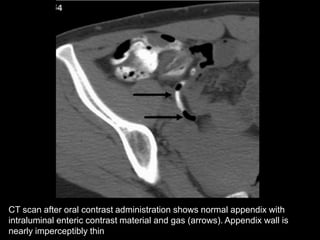
CT scan after oral contrast administration shows normal appendix with
intraluminal enteric contrast material and gas (arrows). Appendix wall is
nearly imperceptibly thin
Appendicitis





Inflammation of the appendix.
Acute appendicitis occurs when the appendiceal
lumen is obstructed, leading to fluid accumulation,
luminal distention, inflammation, and, finally,
perforation.
Obstruction may be caused by :
a.
b.
c.

d.
e.

lymphoid hyperplasia (60%)
appendicolith
foreign bodies
Crohn's disease
other rare causes, e.g. stricture, tumor, parasite


Tip of appendix is often first site of
inflammation and appendiceal perforation.




Appendicitis traditionally has been a clinical
diagnosis, many patients are found to have
normal appendixes at surgery.
However, negative laparotomy can be avoided
in many patients if modern diagnostic methods
are used to confirm or exclude acute
appendicitis.
IMAGING
Radiography:
Non specific
 Appendicolith in 5-10% of patients
 Sentinel loop: dilated atonic ileum containing air-fluid levels.
 Dilated caecum
 Widening and blurring of properitoneal fat lin
 Scoliosis with concavity to right
 Right lower quadrant mass indenting on caecum
 Loss of right psoas margin
 Free peritoneal air very uncommon
 With perforation




Small bowel obstruction
RLQ extraluminal gas
Displacement of bowel loops from RLQ
Fluoroscopy:


Barium Enema
 Non-filling

of appendix (normal in 1/3 of patients)
 Focal mural thickening of medial wall of cecum
("arrowhead deformity")
Ultrasound:
sensitivity of 85% and specificity of 92%
The graded-compression technique of US is performed
with a high resolution, linear array transducer
 Non-compressible, blind-ending tubular structure.
 The maximal appendiceal diameter, from outside wall to
outside wall, is greater than 7 mm
 Sonographic "McBurney sign" with focal pain over
appendix
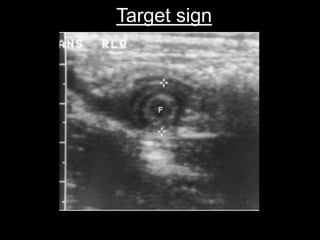
 Target appearance : If fluid is present in the lumen, a
fluid-filled center and surrounded by a echogenic
mucosa and submucosa and hypoechoic muscularis,
may be seen when imaging in the axial plane
 Shadowing, echogenic appendicolith.
 Increased periappendiceal echogenicity representing fat
infiltration and enlarged mesenteric lymph nodes
Target sign
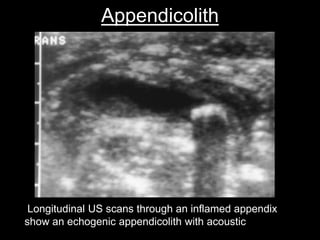
Appendicolith

Longitudinal US scans through an inflamed appendix
show an echogenic appendicolith with acoustic shadowing


Perforation
•
•

•

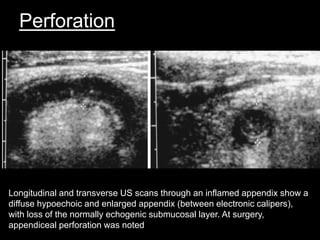
Loss of the echogenic submucosal layer
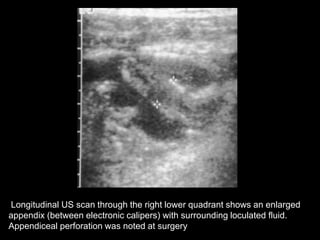
Presence of a loculated periappendiceal or pelvic
fluid collection or abscess
The appendix itself is visible in only 40%–60% of
patients with appendiceal perforation.
Perforation

Longitudinal and transverse US scans through an inflamed appendix show a
diffuse hypoechoic and enlarged appendix (between electronic calipers),
with loss of the normally echogenic submucosal layer. At surgery,
appendiceal perforation was noted
Longitudinal US scan through the right lower quadrant shows an enlarged
appendix (between electronic calipers) with surrounding loculated fluid.
Appendiceal perforation was noted at surgery
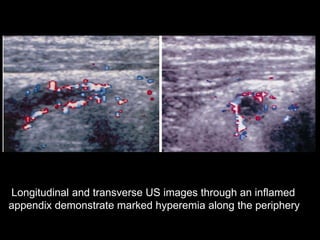
Color Doppler:


Peripheral wall hyperemia, reflecting
inflammatory hyperperfusion.






In early inflammation, color flow may be absent or
limited to the appendiceal tip.
Color flow may also be absent in gangrenous
appendicitis.

In appendiceal perforation


hyperemia in the periappendiceal soft tissues or
within a well-defined abscess
Longitudinal and transverse US images through an inflamed
appendix demonstrate marked hyperemia along the periphery
False-negative diagnosis:
1.

Early inflammation is limited to the appendiceal tip,
which can be missed if only the proximal appendix is
Imaged.
 visualize the entire length of the appendix.
2. Failure to visualize the appendix
 Inability to compress the right lower quadrant adequately
 Aberrant location of the appendix, such as retrocecal
position.


can be minimized by having the patient identify the site of
maximal tenderness and by scanning in a coronal plane with the
transducer parallel to the iliac wing. If the psoas muscle is
visualized, a retrocecal appendix should be seen

 Appendiceal


perforation.

Identification of secondary findings can help to suggest the
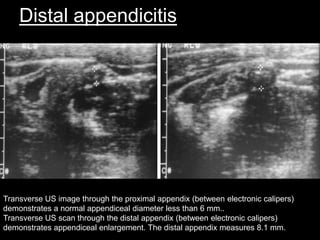
Distal appendicitis

Transverse US image through the proximal appendix (between electronic calipers)
demonstrates a normal appendiceal diameter less than 6 mm..
Transverse US scan through the distal appendix (between electronic calipers)
demonstrates appendiceal enlargement. The distal appendix measures 8.1 mm.
False-positive diagnosis:
1. Normal appendix may be visible with gradedcompression


Measures 6 mm or less in maximal outer diameter, is
compressible, and lacks adjacent inflammatory
changes

2. Periappendiceal inflammation due to Crohn
disease
or pelvic inflammatory disease
3. Inflamed Meckel diverticulum
4. Spontaneous resolution of acute appendicitis
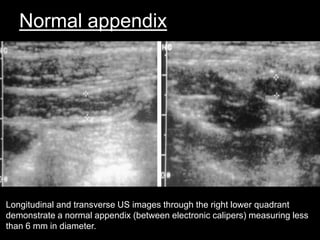
Normal appendix

Longitudinal and transverse US images through the right lower quadrant
demonstrate a normal appendix (between electronic calipers) measuring less
than 6 mm in diameter.
CT Findings
Sensitivity and specificity approaches 100%
The highest diagnostic efficacy at CT has been obtained with the use
of rectal contrast material and thin collimation through the lower
abdomen and pelvis





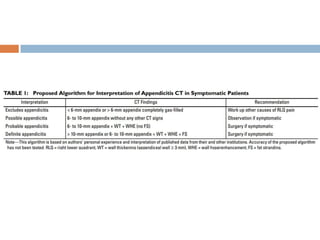
Dilated appendix >7 mm
Appendiceal wall thickening (≥3mm) and enhancement.
Mural stratification of the appendiceal wall
Circumferential or focal apical cecal thickening






useful in allowing diagnosis of acute appendicitis if there is difficulty in
identifying an enlarged appendix

Arrowhead sign: focal cecal wall thickening centered on the
appendiceal orifice: enteric contrast material in the cecal lumen
points to the abnormal appendix and assumes a triangular
configuration
The cecal bar sign: Inflammatory soft tissue at the base of the
appendix that separates the appendix from the contrast-filled
cecum.


Appendicolith
May be incidental finding
 Retained barium can be differentiated from an
appendicolith by viewing the digital scout radiograph,
as retained barium will have a higher attenuation
 may have prognostic importance : increases the
likelihood of appendiceal perforation





Periappendiceal fat stranding
Adjacent bowel wall thickening, free peritoneal
fluid, mesenteric lymphadenopathy,
intraperitoneal phlegmon, or abscess
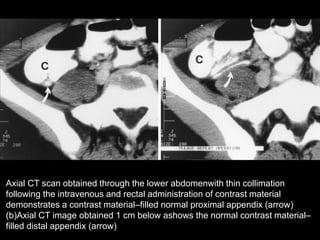
Axial CT scan obtained through the lower abdomenwith thin collimation
following the intravenous and rectal administration of contrast material
demonstrates a contrast material–filled normal proximal appendix (arrow)
(b)Axial CT image obtained 1 cm below ashows the normal contrast material–
filled distal appendix (arrow)
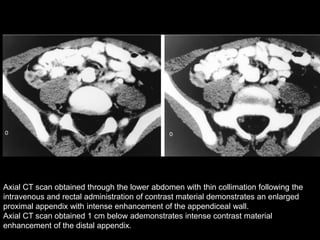
Axial CT scan obtained through the lower abdomen with thin collimation following the
intravenous and rectal administration of contrast material demonstrates an enlarged
proximal appendix with intense enhancement of the appendiceal wall.
Axial CT scan obtained 1 cm below ademonstrates intense contrast material
enhancement of the distal appendix.
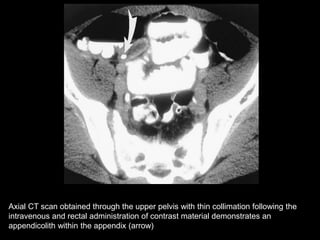
Axial CT scan obtained through the upper pelvis with thin collimation following the
intravenous and rectal administration of contrast material demonstrates an
appendicolith within the appendix (arrow)
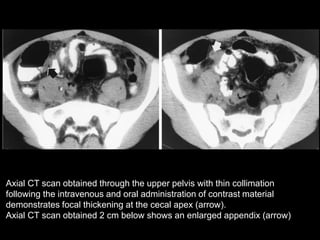
Axial CT scan obtained through the upper pelvis with thin collimation
following the intravenous and oral administration of contrast material
demonstrates focal thickening at the cecal apex (arrow).
Axial CT scan obtained 2 cm below shows an enlarged appendix (arrow)
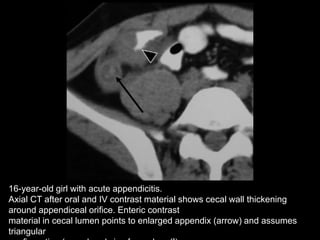
16-year-old girl with acute appendicitis.
Axial CT after oral and IV contrast material shows cecal wall thickening
around appendiceal orifice. Enteric contrast
material in cecal lumen points to enlarged appendix (arrow) and assumes
triangular
Complications


Perforation






Periappendiceal Abscess




defect in the enhancing appendiceal walL
presence of localized periappendiceal inflammation
presence of one or more appendicoliths in association with
periappendiceal inflammation is virtually diagnostic of perforation

loculated, rim-enhancing fluid collection that may have mass effect on
adjacent bowel loops

Peritonitis



interloop fluid and free-fluid tracking along the peritoneal reflections
CE CT helps differentiate bacterial peritonitis from ascites by showing
enhancement and thickening of peritoneal reflections, inflammatory
changes in the mesentery and omentum, engorgement of regional
mesenteric vessels, and hyperemic changes in contiguous bowel
segments.
Pitfalls in the CT diagnosis of
acute appendicitis
1.

Overlapping range in maximal appendiceal
diameter between inflamed and uninflamed
appendices.


2.

Inflamed appendix may be mistaken for
unopacified bowel loops.


3.

assess for associated secondary changes, including
cecal apical thickening and infiltration of
periappendiceal fat

optimize cecal and colonic opacification

Early appendiceal inflammation may be limited to
the appendiceal tip.


identify the entire appendix at CT


Bowel Obstruction




mechanical obstruction, likely secondary to
entrapment of the distal ileum in a periappendiceal
inflammatory mass

Gangrenous Appendicitis
Gangrenous appendicitis is the result of intramural
and arterial thromboses.
 pneumatosis,
 shaggy appendiceal wall,
 patchy areas of mural nonperfusion.

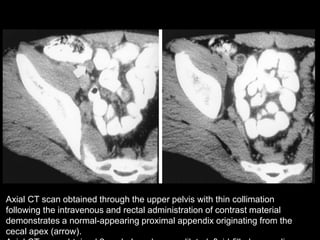
Axial CT scan obtained through the upper pelvis with thin collimation
following the intravenous and rectal administration of contrast material
demonstrates a normal-appearing proximal appendix originating from the
cecal apex (arrow).
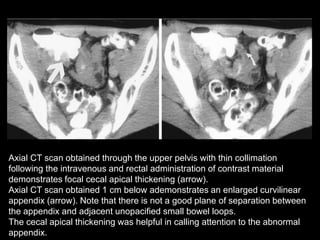
Axial CT scan obtained through the upper pelvis with thin collimation
following the intravenous and rectal administration of contrast material
demonstrates focal cecal apical thickening (arrow).
Axial CT scan obtained 1 cm below ademonstrates an enlarged curvilinear
appendix (arrow). Note that there is not a good plane of separation between
the appendix and adjacent unopacified small bowel loops.
The cecal apical thickening was helpful in calling attention to the abnormal
appendix.
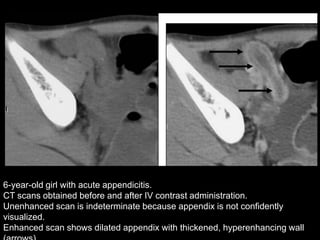
6-year-old girl with acute appendicitis.
CT scans obtained before and after IV contrast administration.
Unenhanced scan is indeterminate because appendix is not confidently
visualized.
Enhanced scan shows dilated appendix with thickened, hyperenhancing wall
Advantages of US:
 Lower cost
 Lack of ionizing radiation
 Ability to assess vascularity through color Doppleranalysis
 Provide dynamic information through graded-compression
 Delineate gynecologic disease which is a common mimic of
acute appendicitis.
Advantages of CT:
 Less operator dependency than US.
 Higher diagnostic accuracy.
 Enhanced delineation of disease extent in perforated
appendicitis.
 Valuable in obese patients, since they are typically difficult to
evaluate with US.
Differential Diagnosis
1.
2.
3.
4.

5.
6.

Mesenteric Adenitis
Cecal Diverticulitis
Epiploic Appendagitis
Crohn’s Disease
Infectious Terminal Ileitis
Appendiceal Mucocele
REFERNCES




Carlos J. Sivit, MD, Marilyn J.
Siegel, MD, Kimberly E. Applegate, MD Kurt
D. Newman, MD : When Appendicitis Is
Suspected in Children.
Pinto Leite et al : CT Evaluation of Appendicitis
and Its Complications: Imaging Techniques
and Key Diagnostic Findings

Imaging in Appendicitis

  • 1.
  • 2.
    APPENDIX    The appendix arisesfrom the posteromedial surface of the caecum, approximately 2-3cm inferiorly to the ileocaecal valve, where the taena coli converge. It is a blind diverticulum, which is variable in length from 2-20cm. The appendix lies on its own mesentery, the mesoappendix, within which run vessals and lymphatics.
  • 3.
     Location of thebase of the appendix is relatively constant, located roughly between the iliocecal valve and the apex of the caecum. But the tip of the appendix can have a variable position within the abdominal cavity: a. b. c. d. e. behind the caecum (ascending retrocaecal) : 65% inferior to the caecum (subcaecal) : 31% behind the caecum (transverse retrocaecal) : 2% anterior to the ileum (ascending paracaecal preileal) : 1% posteior to the ileum (ascending paracaecal
  • 4.
    Blood supply  Arterial- Appendicular artery, a branch of the Ileocolic artery (a derivative of the superior mesenteric artery)  Venous - similarly named veins draining to the portal venous system
  • 5.
    Plain film  Anappendicolith is seen in 10% of patients, with 90% going on to develop appendicitis some time in the future.  The appendix can fill with contrast during a barium enema study Ultrasound  Normal appendix is visible in 60% of children and thin adults.
  • 6.
    CT:    The maximal normalappendiceal diameter is quite variable; although it usually is 7mm or less. The lumen of the normal appendix may fill with contrast material, or it may contain intraluminal air or fluid. In children who often have much less intraperitoneal and retroperitoneal fat to delineate the cecum and appendix compared with adults, it is difficult to differentiate the normal appendix from adjacent unopacified bowel loops.
  • 7.
    CT scan afteroral contrast administration shows normal appendix with intraluminal enteric contrast material and gas (arrows). Appendix wall is nearly imperceptibly thin
  • 8.
    Appendicitis    Inflammation of theappendix. Acute appendicitis occurs when the appendiceal lumen is obstructed, leading to fluid accumulation, luminal distention, inflammation, and, finally, perforation. Obstruction may be caused by : a. b. c. d. e. lymphoid hyperplasia (60%) appendicolith foreign bodies Crohn's disease other rare causes, e.g. stricture, tumor, parasite
  • 9.
     Tip of appendixis often first site of inflammation and appendiceal perforation.
  • 10.
      Appendicitis traditionally hasbeen a clinical diagnosis, many patients are found to have normal appendixes at surgery. However, negative laparotomy can be avoided in many patients if modern diagnostic methods are used to confirm or exclude acute appendicitis.
  • 11.
    IMAGING Radiography: Non specific  Appendicolithin 5-10% of patients  Sentinel loop: dilated atonic ileum containing air-fluid levels.  Dilated caecum  Widening and blurring of properitoneal fat lin  Scoliosis with concavity to right  Right lower quadrant mass indenting on caecum  Loss of right psoas margin  Free peritoneal air very uncommon  With perforation    Small bowel obstruction RLQ extraluminal gas Displacement of bowel loops from RLQ
  • 12.
    Fluoroscopy:  Barium Enema  Non-filling ofappendix (normal in 1/3 of patients)  Focal mural thickening of medial wall of cecum ("arrowhead deformity")
  • 13.
    Ultrasound: sensitivity of 85%and specificity of 92% The graded-compression technique of US is performed with a high resolution, linear array transducer  Non-compressible, blind-ending tubular structure.  The maximal appendiceal diameter, from outside wall to outside wall, is greater than 7 mm  Sonographic "McBurney sign" with focal pain over appendix  Target appearance : If fluid is present in the lumen, a fluid-filled center and surrounded by a echogenic mucosa and submucosa and hypoechoic muscularis, may be seen when imaging in the axial plane  Shadowing, echogenic appendicolith.  Increased periappendiceal echogenicity representing fat infiltration and enlarged mesenteric lymph nodes
  • 14.
  • 15.
    Appendicolith Longitudinal US scansthrough an inflamed appendix show an echogenic appendicolith with acoustic shadowing
  • 16.
     Perforation • • • Loss of theechogenic submucosal layer Presence of a loculated periappendiceal or pelvic fluid collection or abscess The appendix itself is visible in only 40%–60% of patients with appendiceal perforation.
  • 17.
    Perforation Longitudinal and transverseUS scans through an inflamed appendix show a diffuse hypoechoic and enlarged appendix (between electronic calipers), with loss of the normally echogenic submucosal layer. At surgery, appendiceal perforation was noted
  • 18.
    Longitudinal US scanthrough the right lower quadrant shows an enlarged appendix (between electronic calipers) with surrounding loculated fluid. Appendiceal perforation was noted at surgery
  • 19.
    Color Doppler:  Peripheral wallhyperemia, reflecting inflammatory hyperperfusion.    In early inflammation, color flow may be absent or limited to the appendiceal tip. Color flow may also be absent in gangrenous appendicitis. In appendiceal perforation  hyperemia in the periappendiceal soft tissues or within a well-defined abscess
  • 20.
    Longitudinal and transverseUS images through an inflamed appendix demonstrate marked hyperemia along the periphery
  • 21.
    False-negative diagnosis: 1. Early inflammationis limited to the appendiceal tip, which can be missed if only the proximal appendix is Imaged.  visualize the entire length of the appendix. 2. Failure to visualize the appendix  Inability to compress the right lower quadrant adequately  Aberrant location of the appendix, such as retrocecal position.  can be minimized by having the patient identify the site of maximal tenderness and by scanning in a coronal plane with the transducer parallel to the iliac wing. If the psoas muscle is visualized, a retrocecal appendix should be seen  Appendiceal  perforation. Identification of secondary findings can help to suggest the
  • 22.
    Distal appendicitis Transverse USimage through the proximal appendix (between electronic calipers) demonstrates a normal appendiceal diameter less than 6 mm.. Transverse US scan through the distal appendix (between electronic calipers) demonstrates appendiceal enlargement. The distal appendix measures 8.1 mm.
  • 23.
    False-positive diagnosis: 1. Normalappendix may be visible with gradedcompression  Measures 6 mm or less in maximal outer diameter, is compressible, and lacks adjacent inflammatory changes 2. Periappendiceal inflammation due to Crohn disease or pelvic inflammatory disease 3. Inflamed Meckel diverticulum 4. Spontaneous resolution of acute appendicitis
  • 24.
    Normal appendix Longitudinal andtransverse US images through the right lower quadrant demonstrate a normal appendix (between electronic calipers) measuring less than 6 mm in diameter.
  • 25.
    CT Findings Sensitivity andspecificity approaches 100% The highest diagnostic efficacy at CT has been obtained with the use of rectal contrast material and thin collimation through the lower abdomen and pelvis     Dilated appendix >7 mm Appendiceal wall thickening (≥3mm) and enhancement. Mural stratification of the appendiceal wall Circumferential or focal apical cecal thickening    useful in allowing diagnosis of acute appendicitis if there is difficulty in identifying an enlarged appendix Arrowhead sign: focal cecal wall thickening centered on the appendiceal orifice: enteric contrast material in the cecal lumen points to the abnormal appendix and assumes a triangular configuration The cecal bar sign: Inflammatory soft tissue at the base of the appendix that separates the appendix from the contrast-filled cecum.
  • 26.
     Appendicolith May be incidentalfinding  Retained barium can be differentiated from an appendicolith by viewing the digital scout radiograph, as retained barium will have a higher attenuation  may have prognostic importance : increases the likelihood of appendiceal perforation    Periappendiceal fat stranding Adjacent bowel wall thickening, free peritoneal fluid, mesenteric lymphadenopathy, intraperitoneal phlegmon, or abscess
  • 27.
    Axial CT scanobtained through the lower abdomenwith thin collimation following the intravenous and rectal administration of contrast material demonstrates a contrast material–filled normal proximal appendix (arrow) (b)Axial CT image obtained 1 cm below ashows the normal contrast material– filled distal appendix (arrow)
  • 28.
    Axial CT scanobtained through the lower abdomen with thin collimation following the intravenous and rectal administration of contrast material demonstrates an enlarged proximal appendix with intense enhancement of the appendiceal wall. Axial CT scan obtained 1 cm below ademonstrates intense contrast material enhancement of the distal appendix.
  • 29.
    Axial CT scanobtained through the upper pelvis with thin collimation following the intravenous and rectal administration of contrast material demonstrates an appendicolith within the appendix (arrow)
  • 30.
    Axial CT scanobtained through the upper pelvis with thin collimation following the intravenous and oral administration of contrast material demonstrates focal thickening at the cecal apex (arrow). Axial CT scan obtained 2 cm below shows an enlarged appendix (arrow)
  • 31.
    16-year-old girl withacute appendicitis. Axial CT after oral and IV contrast material shows cecal wall thickening around appendiceal orifice. Enteric contrast material in cecal lumen points to enlarged appendix (arrow) and assumes triangular
  • 32.
    Complications  Perforation     Periappendiceal Abscess   defect inthe enhancing appendiceal walL presence of localized periappendiceal inflammation presence of one or more appendicoliths in association with periappendiceal inflammation is virtually diagnostic of perforation loculated, rim-enhancing fluid collection that may have mass effect on adjacent bowel loops Peritonitis   interloop fluid and free-fluid tracking along the peritoneal reflections CE CT helps differentiate bacterial peritonitis from ascites by showing enhancement and thickening of peritoneal reflections, inflammatory changes in the mesentery and omentum, engorgement of regional mesenteric vessels, and hyperemic changes in contiguous bowel segments.
  • 33.
    Pitfalls in theCT diagnosis of acute appendicitis 1. Overlapping range in maximal appendiceal diameter between inflamed and uninflamed appendices.  2. Inflamed appendix may be mistaken for unopacified bowel loops.  3. assess for associated secondary changes, including cecal apical thickening and infiltration of periappendiceal fat optimize cecal and colonic opacification Early appendiceal inflammation may be limited to the appendiceal tip.  identify the entire appendix at CT
  • 34.
     Bowel Obstruction   mechanical obstruction,likely secondary to entrapment of the distal ileum in a periappendiceal inflammatory mass Gangrenous Appendicitis Gangrenous appendicitis is the result of intramural and arterial thromboses.  pneumatosis,  shaggy appendiceal wall,  patchy areas of mural nonperfusion. 
  • 35.
    Axial CT scanobtained through the upper pelvis with thin collimation following the intravenous and rectal administration of contrast material demonstrates a normal-appearing proximal appendix originating from the cecal apex (arrow).
  • 36.
    Axial CT scanobtained through the upper pelvis with thin collimation following the intravenous and rectal administration of contrast material demonstrates focal cecal apical thickening (arrow). Axial CT scan obtained 1 cm below ademonstrates an enlarged curvilinear appendix (arrow). Note that there is not a good plane of separation between the appendix and adjacent unopacified small bowel loops. The cecal apical thickening was helpful in calling attention to the abnormal appendix.
  • 37.
    6-year-old girl withacute appendicitis. CT scans obtained before and after IV contrast administration. Unenhanced scan is indeterminate because appendix is not confidently visualized. Enhanced scan shows dilated appendix with thickened, hyperenhancing wall
  • 38.
    Advantages of US: Lower cost  Lack of ionizing radiation  Ability to assess vascularity through color Doppleranalysis  Provide dynamic information through graded-compression  Delineate gynecologic disease which is a common mimic of acute appendicitis. Advantages of CT:  Less operator dependency than US.  Higher diagnostic accuracy.  Enhanced delineation of disease extent in perforated appendicitis.  Valuable in obese patients, since they are typically difficult to evaluate with US.
  • 39.
    Differential Diagnosis 1. 2. 3. 4. 5. 6. Mesenteric Adenitis CecalDiverticulitis Epiploic Appendagitis Crohn’s Disease Infectious Terminal Ileitis Appendiceal Mucocele
  • 41.
    REFERNCES   Carlos J. Sivit,MD, Marilyn J. Siegel, MD, Kimberly E. Applegate, MD Kurt D. Newman, MD : When Appendicitis Is Suspected in Children. Pinto Leite et al : CT Evaluation of Appendicitis and Its Complications: Imaging Techniques and Key Diagnostic Findings