1
APPENDICITIS
Presented by :JISHA JAMES
2
What is appendicitis?
Appendicitis is inflammation of the appendix.
Appendicitis is the leading cause of emergency
abdominal operations.
3
What is appendix?
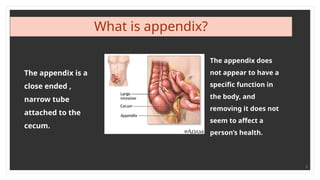
The appendix is a
close ended ,
narrow tube
attached to the
cecum.
The appendix does
not appear to have a
specific function in
the body, and
removing it does not
seem to affect a
person’s health.
4
Anatomy & physiology
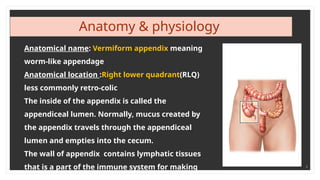
Anatomical name: Vermiform appendix meaning
worm-like appendage
Anatomical location :Right lower quadrant(RLQ)
less commonly retro-colic
The inside of the appendix is called the
appendiceal lumen. Normally, mucus created by
the appendix travels through the appendiceal
lumen and empties into the cecum.
The wall of appendix contains lymphatic tissues
that is a part of the immune system for making
5
Pathogenesis
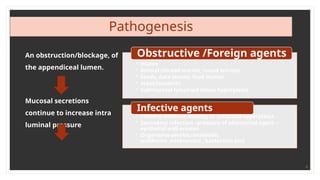
• mucus
• Animal (thread worms, round worms)
• Seeds, date stones, food matter
• Stool(faecalith)
• Submucosal lymphoid tissue hyperplasia
Obstructive /Foreign agents
• Primary infection leading to lymphoid hyperplasia
• Secondary infection –pressure of obstructed agent –
epithelial wall erosion
• Organisms-aerobic/anaerobic
(coliforms ,enterococci , bacteroids etc)
Infective agents
An obstruction/blockage, of
the appendiceal lumen.
Mucosal secretions
continue to increase intra
luminal pressure
6
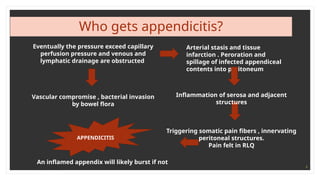
Who gets appendicitis?
APPENDICITIS
An inflamed appendix will likely burst if not
removed.
Eventually the pressure exceed capillary
perfusion pressure and venous and
lymphatic drainage are obstructed
Vascular compromise , bacterial invasion
by bowel flora
Arterial stasis and tissue
infarction . Peroration and
spillage of infected appendiceal
contents into peritoneum
Inflammation of serosa and adjacent
structures
Triggering somatic pain fibers , innervating
peritoneal structures.
Pain felt in RLQ
7
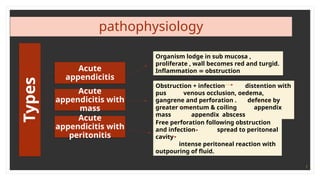
pathophysiology
Types
Acute
appendicitis
Acute
appendicitis with
mass
Acute
appendicitis with
peritonitis
Organism lodge in sub mucosa ,
proliferate , wall becomes red and turgid.
Inflammation obstruction
∞
Obstruction + infection distention with
pus venous occlusion, oedema,
gangrene and perforation . defence by
greater omentum & coiling appendix
mass appendix abscess
Free perforation following obstruction
and infection spread to peritoneal
cavity
intense peritoneal reaction with
outpouring of fluid.
8
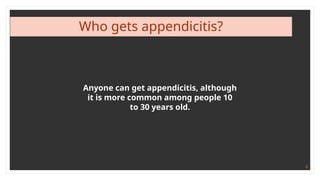
Who gets appendicitis?
Anyone can get appendicitis, although
it is more common among people 10
to 30 years old.
9
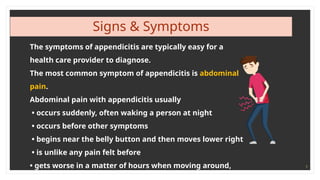
Signs & Symptoms
The symptoms of appendicitis are typically easy for a
health care provider to diagnose.
The most common symptom of appendicitis is abdominal
pain.
Abdominal pain with appendicitis usually
• occurs suddenly, often waking a person at night
• occurs before other symptoms
• begins near the belly button and then moves lower right
• is unlike any pain felt before
• gets worse in a matter of hours when moving around,
10
Signs & Symptoms
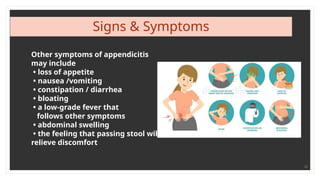
Other symptoms of appendicitis
may include
• loss of appetite
• nausea /vomiting
• constipation / diarrhea
• bloating
• a low-grade fever that
follows other symptoms
• abdominal swelling
• the feeling that passing stool will
relieve discomfort
11
Signs & Symptoms
Symptoms vary and can mimic the following conditions that cause
abdominal pain:
‡ Intestinal obstruction
‡ IBD
‡ Pelvic inflammatory disease
‡ Abdominal adhesions
‡ mesentric adenitis
‡ Urolithiasis
‡ Constipation
12
DIAGNOSIS
‡ A health care provider can diagnose most cases of
appendicitis by taking a person’s medical history and
performing a physical exam.
Physical exam:
Details about the person’s abdominal pain are key to
diagnosing appendicitis. The health care provider will assess the
pain by touching or applying pressure to specific areas of the
abdomen. Responses that may indicate appendicitis include:
13
DIAGNOSIS
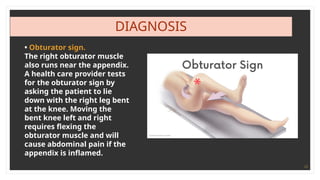
• Obturator sign.
The right obturator muscle
also runs near the appendix.
A health care provider tests
for the obturator sign by
asking the patient to lie
down with the right leg bent
at the knee. Moving the
bent knee left and right
requires flexing the
obturator muscle and will
cause abdominal pain if the
appendix is inflamed.
14
DIAGNOSIS
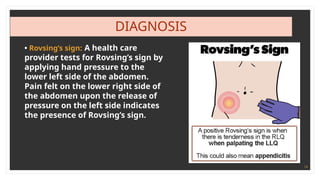
• Rovsing’s sign: A health care
provider tests for Rovsing’s sign by
applying hand pressure to the
lower left side of the abdomen.
Pain felt on the lower right side of
the abdomen upon the release of
pressure on the left side indicates
the presence of Rovsing’s sign.
15
DIAGNOSIS
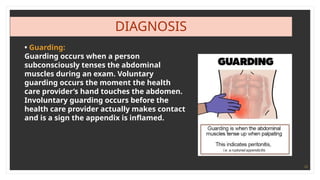
• Guarding:
Guarding occurs when a person
subconsciously tenses the abdominal
muscles during an exam. Voluntary
guarding occurs the moment the health
care provider’s hand touches the abdomen.
Involuntary guarding occurs before the
health care provider actually makes contact
and is a sign the appendix is inflamed.
16
DIAGNOSIS
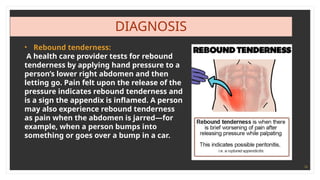
• Rebound tenderness:
A health care provider tests for rebound
tenderness by applying hand pressure to a
person’s lower right abdomen and then
letting go. Pain felt upon the release of the
pressure indicates rebound tenderness and
is a sign the appendix is inflamed. A person
may also experience rebound tenderness
as pain when the abdomen is jarred—for
example, when a person bumps into
something or goes over a bump in a car.
17
Diagnosis
3.Laboratory Tests
Laboratory tests can help confirm the diagnosis of appendicitis
or find other causes of abdominal pain.
• Blood tests. show signs of infection, dehydration or fluid and
electrolyte imbalances.
• Urinalysis. used to rule out a urinary tract infection or a
kidney stone.
4.Imaging Tests
Imaging tests can confirm the diagnosis of appendicitis or find other
causes of abdominal pain.
• Abdominal ultrasound can show signs of inflammation, a burst
appendix, a blockage in the appendiceal lumen, and other sources of
abdominal pain.
• MRI/CT scan
18
BURST APPENDIX
A burst appendix spreads infection throughout the abdomen—a
potentially dangerous condition called peritonitis. A person with
peritonitis may be extremely ill and have nausea, vomiting, fever,
and severe abdominal tenderness. This condition requires
immediate surgery through laparotomy to clean the abdominal
cavity and remove the appendix. Without prompt treatment,
peritonitis can cause death. Sometimes an abscess forms around a
burst appendix—called an appendiceal abscess. A surgeon may
drain the pus from the abscess during surgery or, more commonly,
before surgery. To drain an abscess, a tube is placed in the abscess
through the abdominal wall. The drainage tube is left in place for
about 2 weeks while antibiotics are given to treat infection. Six to 8
weeks later, when infection and inflammation are under control,
surgeons operate to remove what remains of the burst appendix.
19
MANAGEMENT
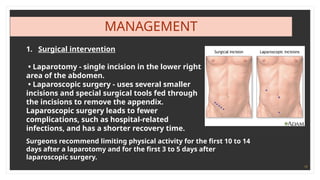
1. Surgical intervention
• Laparotomy - single incision in the lower right
area of the abdomen.
• Laparoscopic surgery - uses several smaller
incisions and special surgical tools fed through
the incisions to remove the appendix.
Laparoscopic surgery leads to fewer
complications, such as hospital-related
infections, and has a shorter recovery time.
Surgeons recommend limiting physical activity for the first 10 to 14
days after a laparotomy and for the first 3 to 5 days after
laparoscopic surgery.
20
MANAGEMENT
2.Nonsurgical treatment may be used if surgery is not available, a
person is not well enough to undergo surgery, or the diagnosis is
unclear.
Nonsurgical treatment includes antibiotics to treat infection.
However once appendicitis is diagnosed, antibiotics should be
started and surgery should be consulted emergently.
Antibiotics for acute appendicitis include:
 Piperacillin +tazobactam
 Metronidazole/tinidazole+ cephalosporins
 Ertapenem
21
MANAGEMENT
Eating, Diet, and Nutrition Researchers have not found that
eating, diet, and nutrition play a role in causing or preventing
appendicitis.

If a health care provider prescribes nonsurgical treatment for a
person with appendicitis, the person will be asked to follow a
liquid or soft diet until the infection subsides. A soft diet is low
in fiber and is easily digested in the GI tract. A soft diet
includes foods such as milk, fruit juices, eggs, puddings,
strained soups, rice, fish, and mashed, boiled, or baked
potatoes.
22
KEYNOTE
Appendicitis is a medical emergency that requires
immediate care. People who think they have
appendicitis should see a health care provider or
go to the emergency room right away. Swift
diagnosis and treatment can reduce the chances
the appendix will burst and improve recovery
time.
23
CASE PRESENATATION
24
SUBJECTIVE
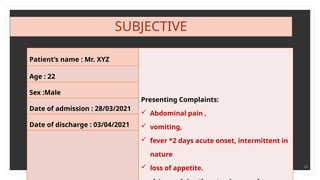
Patient’s name : Mr. XYZ
Presenting Complaints:
 Abdominal pain ,
 vomiting,
 fever *2 days acute onset, intermittent in
nature
 loss of appetite.
Age : 22
Sex :Male
Date of admission : 28/03/2021
Date of discharge : 03/04/2021
25
OBJECTIVE
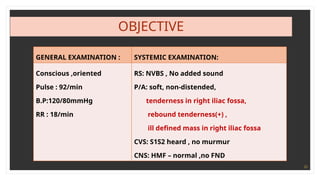
GENERAL EXAMINATION : SYSTEMIC EXAMINATION:
Conscious ,oriented
Pulse : 92/min
B.P:120/80mmHg
RR : 18/min
RS: NVBS , No added sound
P/A: soft, non-distended,
tenderness in right iliac fossa,
rebound tenderness(+) ,
ill defined mass in right iliac fossa
CVS: S1S2 heard , no murmur
CNS: HMF – normal ,no FND
26
LABORATORY DATA
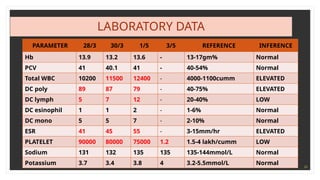
PARAMETER 28/3 30/3 1/5 3/5 REFERENCE INFERENCE
Hb 13.9 13.2 13.6 - 13-17gm% Normal
PCV 41 40.1 41 - 40-54% Normal
Total WBC 10200 11500 12400 - 4000-1100cumm ELEVATED
DC poly 89 87 79 - 40-75% ELEVATED
DC lymph 5 7 12 - 20-40% LOW
DC esinophil 1 1 2 - 1-6% Normal
DC mono 5 5 7 - 2-10% Normal
ESR 41 45 55 - 3-15mm/hr ELEVATED
PLATELET 90000 80000 75000 1.2 1.5-4 lakh/cumm LOW
Sodium 131 132 135 135 135-144mmol/L Normal
Potassium 3.7 3.4 3.8 4 3.2-5.5mmol/L Normal
27
LABORATORY DATA
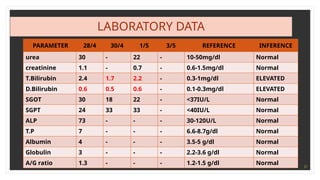
PARAMETER 28/4 30/4 1/5 3/5 REFERENCE INFERENCE
urea 30 - 22 - 10-50mg/dl Normal
creatinine 1.1 - 0.7 - 0.6-1.5mg/dl Normal
T.Bilirubin 2.4 1.7 2.2 - 0.3-1mg/dl ELEVATED
D.Bilirubin 0.6 0.5 0.6 - 0.1-0.3mg/dl ELEVATED
SGOT 30 18 22 - <37IU/L Normal
SGPT 24 33 33 - <40IU/L Normal
ALP 73 - - - 30-120U/L Normal
T.P 7 - - - 6.6-8.7g/dl Normal
Albumin 4 - - - 3.5-5 g/dl Normal
Globulin 3 - - - 2.2-3.6 g/dl Normal
A/G ratio 1.3 - - - 1.2-1.5 g/dl Normal
28
OBJECTIVE
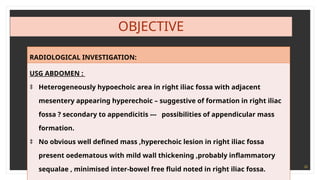
RADIOLOGICAL INVESTIGATION:
USG ABDOMEN :
‡ Heterogeneously hypoechoic area in right iliac fossa with adjacent
mesentery appearing hyperechoic – suggestive of formation in right iliac
fossa ? secondary to appendicitis --- possibilities of appendicular mass
formation.
‡ No obvious well defined mass ,hyperechoic lesion in right iliac fossa
present oedematous with mild wall thickening ,probably inflammatory
sequalae , minimised inter-bowel free fluid noted in right iliac fossa.
29
ASSESSMENT
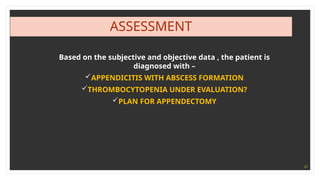
Based on the subjective and objective data , the patient is
diagnosed with –
APPENDICITIS WITH ABSCESS FORMATION
THROMBOCYTOPENIA UNDER EVALUATION?
PLAN FOR APPENDECTOMY
30
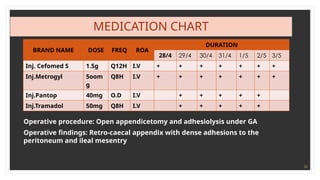
MEDICATION CHART
BRAND NAME DOSE FREQ ROA
DURATION
28/4 29/4 30/4 31/4 1/5 2/5 3/5
Inj. Cefomed S 1.5g Q12H I.V + + + + + + +
Inj.Metrogyl 5oom
g
Q8H I.V + + + + + + +
Inj.Pantop 40mg O.D I.V + + + + +
Inj.Tramadol 50mg Q8H I.V + + + + +
Operative procedure: Open appendicetomy and adhesiolysis under GA
Operative findings: Retro-caecal appendix with dense adhesions to the
peritoneum and ileal mesentry
31
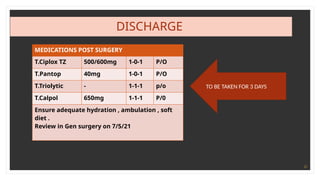
DISCHARGE
TO BE TAKEN FOR 3 DAYS
MEDICATIONS POST SURGERY
T.Ciplox TZ 500/600mg 1-0-1 P/O
T.Pantop 40mg 1-0-1 P/O
T.Triolytic - 1-1-1 p/o
T.Calpol 650mg 1-1-1 P/0
Ensure adequate hydration , ambulation , soft
diet .
Review in Gen surgery on 7/5/21
32
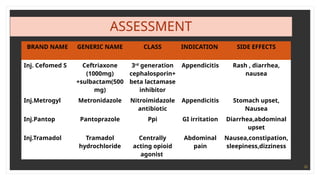
ASSESSMENT
BRAND NAME GENERIC NAME CLASS INDICATION SIDE EFFECTS
Inj. Cefomed S Ceftriaxone
(1000mg)
+sulbactam(500
mg)
3rd
generation
cephalosporin+
beta lactamase
inhibitor
Appendicitis Rash , diarrhea,
nausea
Inj.Metrogyl Metronidazole Nitroimidazole
antibiotic
Appendicitis Stomach upset,
Nausea
Inj.Pantop Pantoprazole Ppi GI irritation Diarrhea,abdominal
upset
Inj.Tramadol Tramadol
hydrochloride
Centrally
acting opioid
agonist
Abdominal
pain
Nausea,constipation,
sleepiness,dizziness
33
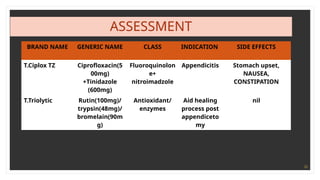
ASSESSMENT
BRAND NAME GENERIC NAME CLASS INDICATION SIDE EFFECTS
T.Ciplox TZ Ciprofloxacin(5
00mg)
+Tinidazole
(600mg)
Fluoroquinolon
e+
nitroimadzole
Appendicitis Stomach upset,
NAUSEA,
CONSTIPATION
T.Triolytic Rutin(100mg)/
trypsin(48mg)/
bromelain(90m
g)
Antioxidant/
enzymes
Aid healing
process post
appendiceto
my
nil
34
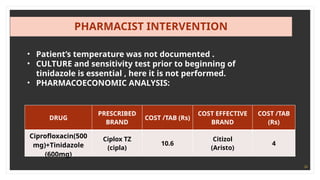
PHARMACIST INTERVENTION
• Patient’s temperature was not documented .
• CULTURE and sensitivity test prior to beginning of
tinidazole is essential , here it is not performed.
• PHARMACOECONOMIC ANALYSIS:
DRUG
PRESCRIBED
BRAND
COST /TAB (Rs)
COST EFFECTIVE
BRAND
COST /TAB
(Rs)
Ciprofloxacin(500
mg)+Tinidazole
(600mg)
Ciplox TZ
(cipla)
10.6
Citizol
(Aristo)
4
35
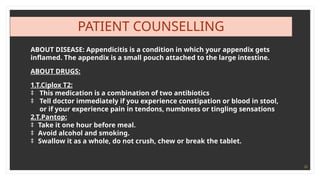
PATIENT COUNSELLING
ABOUT DISEASE: Appendicitis is a condition in which your appendix gets
inflamed. The appendix is a small pouch attached to the large intestine.
ABOUT DRUGS:
1.T.Ciplox T2:
‡ This medication is a combination of two antibiotics
‡ Tell doctor immediately if you experience constipation or blood in stool,
or if your experience pain in tendons, numbness or tingling sensations
2.T.Pantop:
‡ Take it one hour before meal.
‡ Avoid alcohol and smoking.
‡ Swallow it as a whole, do not crush, chew or break the tablet.
36
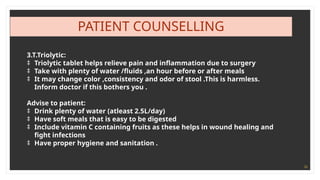
PATIENT COUNSELLING
3.T.Triolytic:
‡ Triolytic tablet helps relieve pain and inflammation due to surgery
‡ Take with plenty of water /fluids ,an hour before or after meals
‡ It may change color ,consistency and odor of stool .This is harmless.
Inform doctor if this bothers you .
Advise to patient:
‡ Drink plenty of water (atleast 2.5L/day)
‡ Have soft meals that is easy to be digested
‡ Include vitamin C containing fruits as these helps in wound healing and
fight infections
‡ Have proper hygiene and sanitation .
37
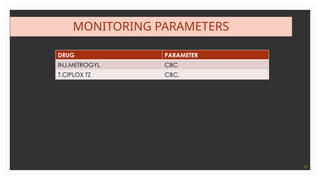
MONITORING PARAMETERS
DRUG PARAMETER
INJ.METROGYL CBC
T.CIPLOX TZ CBC,
38
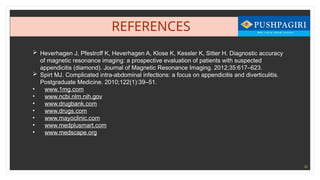
REFERENCES
 Heverhagen J, Pfestroff K, Heverhagen A, Klose K, Kessler K, Sitter H. Diagnostic accuracy
of magnetic resonance imaging: a prospective evaluation of patients with suspected
appendicitis (diamond). Journal of Magnetic Resonance Imaging. 2012;35:617–623.
 Spirt MJ. Complicated intra-abdominal infections: a focus on appendicitis and diverticulitis.
Postgraduate Medicine. 2010;122(1):39–51.
• www.1mg.com
• www.ncbi.nlm.nih.gov
• www.drugbank.com
• www.drugs.com
• www.mayoclinic.com
• www.medplusmart.com
• www.medscape.org
39
THANKYOU

medical case presentation on APPENDICITIS.pptx

  • 1.
  • 2.
    2 What is appendicitis? Appendicitisis inflammation of the appendix. Appendicitis is the leading cause of emergency abdominal operations.
  • 3.
    3 What is appendix? Theappendix is a close ended , narrow tube attached to the cecum. The appendix does not appear to have a specific function in the body, and removing it does not seem to affect a person’s health.
  • 4.
    4 Anatomy & physiology Anatomicalname: Vermiform appendix meaning worm-like appendage Anatomical location :Right lower quadrant(RLQ) less commonly retro-colic The inside of the appendix is called the appendiceal lumen. Normally, mucus created by the appendix travels through the appendiceal lumen and empties into the cecum. The wall of appendix contains lymphatic tissues that is a part of the immune system for making
  • 5.
    5 Pathogenesis • mucus • Animal(thread worms, round worms) • Seeds, date stones, food matter • Stool(faecalith) • Submucosal lymphoid tissue hyperplasia Obstructive /Foreign agents • Primary infection leading to lymphoid hyperplasia • Secondary infection –pressure of obstructed agent – epithelial wall erosion • Organisms-aerobic/anaerobic (coliforms ,enterococci , bacteroids etc) Infective agents An obstruction/blockage, of the appendiceal lumen. Mucosal secretions continue to increase intra luminal pressure
  • 6.
    6 Who gets appendicitis? APPENDICITIS Aninflamed appendix will likely burst if not removed. Eventually the pressure exceed capillary perfusion pressure and venous and lymphatic drainage are obstructed Vascular compromise , bacterial invasion by bowel flora Arterial stasis and tissue infarction . Peroration and spillage of infected appendiceal contents into peritoneum Inflammation of serosa and adjacent structures Triggering somatic pain fibers , innervating peritoneal structures. Pain felt in RLQ
  • 7.
    7 pathophysiology Types Acute appendicitis Acute appendicitis with mass Acute appendicitis with peritonitis Organismlodge in sub mucosa , proliferate , wall becomes red and turgid. Inflammation obstruction ∞ Obstruction + infection distention with pus venous occlusion, oedema, gangrene and perforation . defence by greater omentum & coiling appendix mass appendix abscess Free perforation following obstruction and infection spread to peritoneal cavity intense peritoneal reaction with outpouring of fluid.
  • 8.
    8 Who gets appendicitis? Anyonecan get appendicitis, although it is more common among people 10 to 30 years old.
  • 9.
    9 Signs & Symptoms Thesymptoms of appendicitis are typically easy for a health care provider to diagnose. The most common symptom of appendicitis is abdominal pain. Abdominal pain with appendicitis usually • occurs suddenly, often waking a person at night • occurs before other symptoms • begins near the belly button and then moves lower right • is unlike any pain felt before • gets worse in a matter of hours when moving around,
  • 10.
    10 Signs & Symptoms Othersymptoms of appendicitis may include • loss of appetite • nausea /vomiting • constipation / diarrhea • bloating • a low-grade fever that follows other symptoms • abdominal swelling • the feeling that passing stool will relieve discomfort
  • 11.
    11 Signs & Symptoms Symptomsvary and can mimic the following conditions that cause abdominal pain: ‡ Intestinal obstruction ‡ IBD ‡ Pelvic inflammatory disease ‡ Abdominal adhesions ‡ mesentric adenitis ‡ Urolithiasis ‡ Constipation
  • 12.
    12 DIAGNOSIS ‡ A healthcare provider can diagnose most cases of appendicitis by taking a person’s medical history and performing a physical exam. Physical exam: Details about the person’s abdominal pain are key to diagnosing appendicitis. The health care provider will assess the pain by touching or applying pressure to specific areas of the abdomen. Responses that may indicate appendicitis include:
  • 13.
    13 DIAGNOSIS • Obturator sign. Theright obturator muscle also runs near the appendix. A health care provider tests for the obturator sign by asking the patient to lie down with the right leg bent at the knee. Moving the bent knee left and right requires flexing the obturator muscle and will cause abdominal pain if the appendix is inflamed.
  • 14.
    14 DIAGNOSIS • Rovsing’s sign:A health care provider tests for Rovsing’s sign by applying hand pressure to the lower left side of the abdomen. Pain felt on the lower right side of the abdomen upon the release of pressure on the left side indicates the presence of Rovsing’s sign.
  • 15.
    15 DIAGNOSIS • Guarding: Guarding occurswhen a person subconsciously tenses the abdominal muscles during an exam. Voluntary guarding occurs the moment the health care provider’s hand touches the abdomen. Involuntary guarding occurs before the health care provider actually makes contact and is a sign the appendix is inflamed.
  • 16.
    16 DIAGNOSIS • Rebound tenderness: Ahealth care provider tests for rebound tenderness by applying hand pressure to a person’s lower right abdomen and then letting go. Pain felt upon the release of the pressure indicates rebound tenderness and is a sign the appendix is inflamed. A person may also experience rebound tenderness as pain when the abdomen is jarred—for example, when a person bumps into something or goes over a bump in a car.
  • 17.
    17 Diagnosis 3.Laboratory Tests Laboratory testscan help confirm the diagnosis of appendicitis or find other causes of abdominal pain. • Blood tests. show signs of infection, dehydration or fluid and electrolyte imbalances. • Urinalysis. used to rule out a urinary tract infection or a kidney stone. 4.Imaging Tests Imaging tests can confirm the diagnosis of appendicitis or find other causes of abdominal pain. • Abdominal ultrasound can show signs of inflammation, a burst appendix, a blockage in the appendiceal lumen, and other sources of abdominal pain. • MRI/CT scan
  • 18.
    18 BURST APPENDIX A burstappendix spreads infection throughout the abdomen—a potentially dangerous condition called peritonitis. A person with peritonitis may be extremely ill and have nausea, vomiting, fever, and severe abdominal tenderness. This condition requires immediate surgery through laparotomy to clean the abdominal cavity and remove the appendix. Without prompt treatment, peritonitis can cause death. Sometimes an abscess forms around a burst appendix—called an appendiceal abscess. A surgeon may drain the pus from the abscess during surgery or, more commonly, before surgery. To drain an abscess, a tube is placed in the abscess through the abdominal wall. The drainage tube is left in place for about 2 weeks while antibiotics are given to treat infection. Six to 8 weeks later, when infection and inflammation are under control, surgeons operate to remove what remains of the burst appendix.
  • 19.
    19 MANAGEMENT 1. Surgical intervention •Laparotomy - single incision in the lower right area of the abdomen. • Laparoscopic surgery - uses several smaller incisions and special surgical tools fed through the incisions to remove the appendix. Laparoscopic surgery leads to fewer complications, such as hospital-related infections, and has a shorter recovery time. Surgeons recommend limiting physical activity for the first 10 to 14 days after a laparotomy and for the first 3 to 5 days after laparoscopic surgery.
  • 20.
    20 MANAGEMENT 2.Nonsurgical treatment maybe used if surgery is not available, a person is not well enough to undergo surgery, or the diagnosis is unclear. Nonsurgical treatment includes antibiotics to treat infection. However once appendicitis is diagnosed, antibiotics should be started and surgery should be consulted emergently. Antibiotics for acute appendicitis include:  Piperacillin +tazobactam  Metronidazole/tinidazole+ cephalosporins  Ertapenem
  • 21.
    21 MANAGEMENT Eating, Diet, andNutrition Researchers have not found that eating, diet, and nutrition play a role in causing or preventing appendicitis. If a health care provider prescribes nonsurgical treatment for a person with appendicitis, the person will be asked to follow a liquid or soft diet until the infection subsides. A soft diet is low in fiber and is easily digested in the GI tract. A soft diet includes foods such as milk, fruit juices, eggs, puddings, strained soups, rice, fish, and mashed, boiled, or baked potatoes.
  • 22.
    22 KEYNOTE Appendicitis is amedical emergency that requires immediate care. People who think they have appendicitis should see a health care provider or go to the emergency room right away. Swift diagnosis and treatment can reduce the chances the appendix will burst and improve recovery time.
  • 23.
  • 24.
    24 SUBJECTIVE Patient’s name :Mr. XYZ Presenting Complaints:  Abdominal pain ,  vomiting,  fever *2 days acute onset, intermittent in nature  loss of appetite. Age : 22 Sex :Male Date of admission : 28/03/2021 Date of discharge : 03/04/2021
  • 25.
    25 OBJECTIVE GENERAL EXAMINATION :SYSTEMIC EXAMINATION: Conscious ,oriented Pulse : 92/min B.P:120/80mmHg RR : 18/min RS: NVBS , No added sound P/A: soft, non-distended, tenderness in right iliac fossa, rebound tenderness(+) , ill defined mass in right iliac fossa CVS: S1S2 heard , no murmur CNS: HMF – normal ,no FND
  • 26.
    26 LABORATORY DATA PARAMETER 28/330/3 1/5 3/5 REFERENCE INFERENCE Hb 13.9 13.2 13.6 - 13-17gm% Normal PCV 41 40.1 41 - 40-54% Normal Total WBC 10200 11500 12400 - 4000-1100cumm ELEVATED DC poly 89 87 79 - 40-75% ELEVATED DC lymph 5 7 12 - 20-40% LOW DC esinophil 1 1 2 - 1-6% Normal DC mono 5 5 7 - 2-10% Normal ESR 41 45 55 - 3-15mm/hr ELEVATED PLATELET 90000 80000 75000 1.2 1.5-4 lakh/cumm LOW Sodium 131 132 135 135 135-144mmol/L Normal Potassium 3.7 3.4 3.8 4 3.2-5.5mmol/L Normal
  • 27.
    27 LABORATORY DATA PARAMETER 28/430/4 1/5 3/5 REFERENCE INFERENCE urea 30 - 22 - 10-50mg/dl Normal creatinine 1.1 - 0.7 - 0.6-1.5mg/dl Normal T.Bilirubin 2.4 1.7 2.2 - 0.3-1mg/dl ELEVATED D.Bilirubin 0.6 0.5 0.6 - 0.1-0.3mg/dl ELEVATED SGOT 30 18 22 - <37IU/L Normal SGPT 24 33 33 - <40IU/L Normal ALP 73 - - - 30-120U/L Normal T.P 7 - - - 6.6-8.7g/dl Normal Albumin 4 - - - 3.5-5 g/dl Normal Globulin 3 - - - 2.2-3.6 g/dl Normal A/G ratio 1.3 - - - 1.2-1.5 g/dl Normal
  • 28.
    28 OBJECTIVE RADIOLOGICAL INVESTIGATION: USG ABDOMEN: ‡ Heterogeneously hypoechoic area in right iliac fossa with adjacent mesentery appearing hyperechoic – suggestive of formation in right iliac fossa ? secondary to appendicitis --- possibilities of appendicular mass formation. ‡ No obvious well defined mass ,hyperechoic lesion in right iliac fossa present oedematous with mild wall thickening ,probably inflammatory sequalae , minimised inter-bowel free fluid noted in right iliac fossa.
  • 29.
    29 ASSESSMENT Based on thesubjective and objective data , the patient is diagnosed with – APPENDICITIS WITH ABSCESS FORMATION THROMBOCYTOPENIA UNDER EVALUATION? PLAN FOR APPENDECTOMY
  • 30.
    30 MEDICATION CHART BRAND NAMEDOSE FREQ ROA DURATION 28/4 29/4 30/4 31/4 1/5 2/5 3/5 Inj. Cefomed S 1.5g Q12H I.V + + + + + + + Inj.Metrogyl 5oom g Q8H I.V + + + + + + + Inj.Pantop 40mg O.D I.V + + + + + Inj.Tramadol 50mg Q8H I.V + + + + + Operative procedure: Open appendicetomy and adhesiolysis under GA Operative findings: Retro-caecal appendix with dense adhesions to the peritoneum and ileal mesentry
  • 31.
    31 DISCHARGE TO BE TAKENFOR 3 DAYS MEDICATIONS POST SURGERY T.Ciplox TZ 500/600mg 1-0-1 P/O T.Pantop 40mg 1-0-1 P/O T.Triolytic - 1-1-1 p/o T.Calpol 650mg 1-1-1 P/0 Ensure adequate hydration , ambulation , soft diet . Review in Gen surgery on 7/5/21
  • 32.
    32 ASSESSMENT BRAND NAME GENERICNAME CLASS INDICATION SIDE EFFECTS Inj. Cefomed S Ceftriaxone (1000mg) +sulbactam(500 mg) 3rd generation cephalosporin+ beta lactamase inhibitor Appendicitis Rash , diarrhea, nausea Inj.Metrogyl Metronidazole Nitroimidazole antibiotic Appendicitis Stomach upset, Nausea Inj.Pantop Pantoprazole Ppi GI irritation Diarrhea,abdominal upset Inj.Tramadol Tramadol hydrochloride Centrally acting opioid agonist Abdominal pain Nausea,constipation, sleepiness,dizziness
  • 33.
    33 ASSESSMENT BRAND NAME GENERICNAME CLASS INDICATION SIDE EFFECTS T.Ciplox TZ Ciprofloxacin(5 00mg) +Tinidazole (600mg) Fluoroquinolon e+ nitroimadzole Appendicitis Stomach upset, NAUSEA, CONSTIPATION T.Triolytic Rutin(100mg)/ trypsin(48mg)/ bromelain(90m g) Antioxidant/ enzymes Aid healing process post appendiceto my nil
  • 34.
    34 PHARMACIST INTERVENTION • Patient’stemperature was not documented . • CULTURE and sensitivity test prior to beginning of tinidazole is essential , here it is not performed. • PHARMACOECONOMIC ANALYSIS: DRUG PRESCRIBED BRAND COST /TAB (Rs) COST EFFECTIVE BRAND COST /TAB (Rs) Ciprofloxacin(500 mg)+Tinidazole (600mg) Ciplox TZ (cipla) 10.6 Citizol (Aristo) 4
  • 35.
    35 PATIENT COUNSELLING ABOUT DISEASE:Appendicitis is a condition in which your appendix gets inflamed. The appendix is a small pouch attached to the large intestine. ABOUT DRUGS: 1.T.Ciplox T2: ‡ This medication is a combination of two antibiotics ‡ Tell doctor immediately if you experience constipation or blood in stool, or if your experience pain in tendons, numbness or tingling sensations 2.T.Pantop: ‡ Take it one hour before meal. ‡ Avoid alcohol and smoking. ‡ Swallow it as a whole, do not crush, chew or break the tablet.
  • 36.
    36 PATIENT COUNSELLING 3.T.Triolytic: ‡ Triolytictablet helps relieve pain and inflammation due to surgery ‡ Take with plenty of water /fluids ,an hour before or after meals ‡ It may change color ,consistency and odor of stool .This is harmless. Inform doctor if this bothers you . Advise to patient: ‡ Drink plenty of water (atleast 2.5L/day) ‡ Have soft meals that is easy to be digested ‡ Include vitamin C containing fruits as these helps in wound healing and fight infections ‡ Have proper hygiene and sanitation .
  • 37.
  • 38.
    38 REFERENCES  Heverhagen J,Pfestroff K, Heverhagen A, Klose K, Kessler K, Sitter H. Diagnostic accuracy of magnetic resonance imaging: a prospective evaluation of patients with suspected appendicitis (diamond). Journal of Magnetic Resonance Imaging. 2012;35:617–623.  Spirt MJ. Complicated intra-abdominal infections: a focus on appendicitis and diverticulitis. Postgraduate Medicine. 2010;122(1):39–51. • www.1mg.com • www.ncbi.nlm.nih.gov • www.drugbank.com • www.drugs.com • www.mayoclinic.com • www.medplusmart.com • www.medscape.org
  • 39.