Revealing the True Cost of
Products and Services
Activity-Based
Costing System
Jan 11, 2026
Ahmad Tariq Bhatti, FCMA, CGMA
5 When overhead represents substantial product costs, multiple cost
drivers provide superior allocation accuracy
Multiple Drivers
4 Cost-benefit analysis is essential as ABC system implementation
requires higher investments in time and analytical resources
Implementation Consideration
3 ABC system accumulates overhead costs by organizational activities,
then assigns them to specific cost objects
ABC Advantage
2 Traditional absorption costing may not adequately address overhead
allocation complexities for multiple products and services
Traditional Limitations
1 Accurately determining manufacturing costs is vital for effective
decision-making and competitive positioning in the market
Strategic Imperative
Introduction to Activity-Based Costing
1
ABC model became integral to management
accounting curricula and organizational cost
allocation methods worldwide.
Global Adoption
David Cooper and Robert Kaplan developed ABC concept,
publishing foundational articles in 1990 and 1992.
Pioneering Research
Traditional systems worked when companies
operated limited product ranges with
relatively low overhead costs.
Market Evolution
The 1980s marked critical period when absorption
costing limitations became increasingly apparent to
organizations.
Historical Context
Origin and Development of ABC
Any factor or activity directly influencing
resource consumption patterns and associated
cost allocation requirements.
Cost Driver
Total overhead costs allocated to specific activity
types or related operational activity groupings.
Activity Cost Pool
Any product, service, process, or project
requiring separate cost measurement for
strategic decision-making purposes.
Cost Object
Any event that incurs costs within the
organizational operational framework and
resource consumption patterns.
Activity Definition
Cost attribution to cost units based on benefits
received from indirect activities per CIMA
terminology.
Activity-Based Costing
Key Definitions and Terminology
5
Traditional systems are cost-driven
while ABC systems maintain
process-driven strategic operational
focus
Strategic Orientation
4
Traditional systems are effective when
direct labor constitutes a significant
portion; the ABC system is used when
technology dominates costs
Optimal Usage
3
ABC employs multiple cost drivers
versus traditional systems relying on
single cost driver allocation
Key Differentiator
2
Accounts for total product costs
using a single overhead rate based
on production characteristics and
volume
Absorption Costing
1
Assigns only variable costs to
products, emphasizing contribution
to cover indirect operational
expenses
Direct Costing
Overview of the Related Costing Systems
When is ABC System Worth Using?
N.B.: Not using the ABC system in such
environments is far more expensive than
implementing it. So, better implement it
rather than facing consequences in the form
of incorrect product or service or customer
costs leading to incorrect price settings.
Incorrect pricing is the major reason behind
product failure in the market.
A
B
C
D
E
Overheads are high in amount
Products or customers are diverse
Business processes are complex
Pricing pressure and competition are intense
Product or service profitability is unclear
5 Underpins critical business decisions including pricing strategies, inventory
valuation, and overhead allocation optimization.
Decision Support
4 Establishes a clear relationship between overhead costs and production
activities through relevant activity levels.
Accuracy Enhancement
3 Serves as both a planning tool and management control mechanism
for pricing and profitability analysis.
Strategic Application
2 Identify necessary activities, assign overhead costs, determine cost drivers, calculate
predetermined rates, allocate costs.
Implementation Steps
1 ABC distributes overhead costs across multiple activity cost pools,
then assigns them using specific cost drivers.
Core Process
The Framework of ABC System
5
Transaction drivers count
occurrences; duration drivers
measure time; intensity
drivers weight resource
consumption.
Driver Categories
4
Administrative costs include
depreciation, taxes, security,
insurance, accounting, and
management salaries.
Facility Support
3
Costs specific to product
lines include engineering
changes, design
modifications, and
warehousing requirements.
Product-Line Activities
2
Costs incurred per batch
production include purchase
orders, machine setups, and
comprehensive quality
testing.
Batch-Level Activities
1
Costs directly related to
individual units include
direct materials, labor, and
machine maintenance
operations.
Unit-Level Activities
Cost Drivers and Activity Levels
6
5
4
3
2
1
Facilitates benchmarking against other products and enables
comprehensive performance comparisons across business units.
Strategic Benchmarking
Supports comprehensive performance management frameworks
and balanced scorecard development for strategic alignment.
Performance Management
In-depth overhead analysis highlights non-value-added activities,
enabling better production waste control measures.
Waste Identification
Aligns effectively with Six Sigma and continuous improvement
initiatives, facilitating enhanced operational efficiency.
Process Integration
Management gains clearer visibility into overhead cost drivers and
their operational impact on profitability.
Overhead Understanding
Provides precise product and service costing through direct
activity linkage, improving financial decision-making.
Cost Accuracy
Advantages of ABC System
More time-consuming to implement and
operate, therefore, necessitating objective
collection of cost driver information
Time Investment
Demands cross-functional team design,
consultant engagement, and specialized
software selection with expert guidance
Resource Requirements
Requires convincing employees of ABC
benefits and securing strong top
management support throughout
implementation
Employee Buy-in
Reports don't adhere to IFRSs /IASs
under ABC, requiring dual cost systems
for internal and external reporting
IFRS Compliance
Often gives different product margins
than traditional systems, potentially
creating management confusion
Profit Reporting
Requires a larger initial budget compared
to traditional costing methods with
ongoing maintenance expenses
Implementation Costs
Drawbacks and Implementation Challenges
1
2
3
6
5
4
Understands research, development, and
production costs, facilitating superior
budgeting and pricing for the strategic
initiatives
Pharmaceuticals
Enables accurate cost assignment to
different service lines, improving
profitability analysis and strategic
decision-making
Telecommunications
Manages intricate costs in high regulatory
environments with sophisticated production
and project management requirements
Aerospace Defense
Consulting and IT services benefit through
improved insights into service delivery costs
and pricing strategies
Service Industries
Helps understand patient care costs,
enabling informed financial decisions
and strategic resource allocation
optimization
Healthcare Organizations
Effective in complex production
environments where overhead costs vary
significantly between different product lines
Manufacturing Sector
Industries Using ABC Successfully
6
5
4
3
2
1
Tableau integrates with ABC data, providing insightful analytics
and comprehensive reporting for strategic decision-making
Visualization Integration
Prophix and Workday Adaptive Planning support ABC
methodologies within broader financial planning frameworks
Performance Management
CostPerform focuses exclusively on ABC with extensive cost
analysis functionality for comprehensive management insights
Dedicated Solutions
Infor CloudSuite provides industry-specific solutions with
extensive ABC capabilities for detailed cost tracking
Industry-Specific Tools
Sage Intacct and IBM Cognos Analytics offer dedicated cost
management and business intelligence capabilities
Specialized Platforms
Oracle NetSuite, SAP Business By Design, and Microsoft
Dynamics 365 provide comprehensive ABC functionality
Enterprise Solutions
Software Solutions for ABC System
Traditional system overstated Product
A costs while understating Product B,
requiring ABC implementation for
accuracy.
Strategic Impact
ABC results: Product A: USD. 255.60
(3.55% lower), Product B: USD. 396.50
(31.07% higher) than traditional
costing.
Cost Comparison
Multiple cost drivers including
machine hours, purchase orders, and
setups provided more accurate cost
allocation.
ABC Implementation
Single overhead rate of USD. 4 per
labor hour resulted in Product A: USD.
265, Product B: USD. 302.50 per unit.
Traditional Costing
Manufacturing Products A and B with
identical processes but different
overhead allocation requirements and
cost structures.
Alpha Ltd
Manufacturing Company Example
5
Provides insights for strategic resource
allocation and operational efficiency
improvements across service delivery
activities
Resource Allocation
4
ABC enables consulting firms to
understand activity-specific costs and
make informed pricing decisions
Strategic Value
3
5 meetings, 20 research hours, and 3
reports resulted in a total service cost of
USD. 6,000 per client
Client D Analysis
2 Client meetings: USD. 200 per meeting,
Research: USD. 100 per hour, Report
preparation: USD. 1,000 per report
Activity Rates
1
Management consulting firm with USD.
100,000 overhead allocated across
client meetings, research, and report
preparation
XYZ Consulting
Service Company Example
5
Helps trading companies optimize
cost structures and make strategic
operational decisions based on
activity analysis
Operational Insights
4
ABC implementation enables
understanding of actual trading
activity costs and informed pricing
decision-making processes
Cost Structure
3
Total budgeted operational costs of
USD. 30,000 with cost per unit of USD.
6 for electronic trading operations
Total Cost
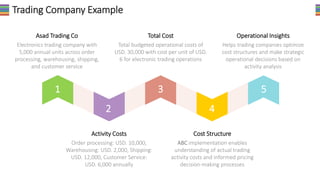
2
Order processing: USD. 10,000,
Warehousing: USD. 2,000, Shipping:
USD. 12,000, Customer Service:
USD. 6,000 annually
Activity Costs
1
Electronics trading company with
5,000 annual units across order
processing, warehousing, shipping,
and customer service
Asad Trading Co
Trading Company Example
Important Question
When the ABC system is embedded in most of the ERPs, what is the purpose of all the
above discussions? The ERP vendor does all the job as a part of the implementation
exercise.
Even though ABC is embedded in most modern ERP systems, the discussion of ABC remains essential because an ERP only runs a costing
model. It does not design it, challenge it, or think for management. Software can allocate costs once activities, cost pools, and drivers are
defined, but it cannot understand how the business truly works. Only management can decide which activities really consume resources,
which ones add value, and which ones exist only because of poor processes or weak controls.
Vendors and consultants can technically configure ABC inside an ERP, but they cannot judge whether a customer order, a machine setup,
a design change, or a sales visit is the real driver of cost in your business. They also cannot decide how costs should be interpreted for
pricing, product mix, outsourcing, customer profitability, or market strategy. These are economic and managerial judgments, not IT
decisions.
If management does not understand ABC, the ERP will simply automate bad assumptions. Wrong cost drivers, poorly defined activities, or
incomplete cost pools will still produce neat-looking reports, but the numbers will be misleading. This creates a dangerous situation
where managers trust the system while being guided by distorted cost information, leading to wrong pricing, loss-making customers
being subsidized, and profitable products being dropped.
ABC is therefore not a software feature. It is a way of thinking about how resources are consumed by activities and how those activities
serve products, services, and customers. The ERP only provides speed, scale, and data handling. The real value of ABC comes from
management using that information to challenge processes, remove waste, redesign workflows, and make better strategic choices.
In short, ABC must be understood and actively used by management. Without that understanding, an ERP will only make a poor costing
model run faster, not make it correct.
Utilizing ABC System in the Strategic Decision-Making Process
ABC system supports some of the most important business decisions, such as:
 Product Pricing Decisions
ABC shows the true cost of serving each product and customer. This costing method prevents underpricing
or overpricing of products or services.
 Making Customer Profitability Analysis
Some customers order small quantities, demand fast delivery, require many changes, and call support often.
ABC reveals whether they are worth keeping.
 Product Design Finalization
ABC highlights which design (features) drives cost more or less, thus allowing engineers to design products
for higher profitability.
 Outsourcing Expensive Activities
ABC shows which activities are more expensive internally and may be cheaper outside, thus allowing
outsourcing of such activities.
 Production Capacity Management
ABC separates unused capacity from used capacity, thus making inefficiencies visible to management.
6 Focuses on strategic management and
process improvement rather than reactive
budgeting and basic cost control
Proactive Management
5 Relies on comprehensive data analysis to
guide management decisions, making it
more strategic than traditional approaches
Data-Driven Decisions
4 Encourages alignment of activities with
strategic objectives, ensuring effective
resource allocation and operational focus
Strategic Alignment
3 Understanding activity-specific costs
enables informed decisions to minimize
waste and optimize resource utilization
Cost Control
2 Emphasizes continuous improvement by
identifying inefficiencies in processes and
operational activities systematically
Performance Improvement
1 ABM uses ABC insights to optimize
processes, reduce costs, and enhance
overall organizational effectiveness
Strategic Framework
Activity-Based Management Approach
5
Builds upon ABC cost information to estimate
future activity costs and create
comprehensive organizational budgets.
ABC Integration
4 Results in well-structured budgets aligning
spending with strategic priorities and ensuring
efficient resource allocation.
Resource Alignment
3
Define objectives, identify required activities,
estimate costs using ABC data, and compile
comprehensive strategic budgets.
Implementation Process
2 Uses ABC insights to create budgets reflecting
resources needed for performing planned
strategic activities.
Planning Focus
1
ABB plans future expenses by setting budgets
based on activities required to achieve
organizational goals.
Strategic Purpose
Activity-Based Budgeting Framework
Beyond Costing, Toward Better Management
The ABC system delivers accurate product and service costs by
allocating overheads based on the activities that actually consume
resources, rather than spreading them uniformly across all outputs.
It, therefore, goes beyond costing and becomes a way of
understanding how the business truly operates through its cost
drivers and activities.
This visibility allows management to see where money is spent,
why it is spent, and how processes, products, and customers can
be managed more efficiently and effectively.
For feedback & queries
on the presentation, please
contact us via the following email:
at.bhatty@gmail.com
A presentation by
Ahmad Tariq Bhatti, FCMA, CGMA
Dubai

Activity-Based Costing System (A Comprehensive Study)

  • 1.
    Revealing the TrueCost of Products and Services Activity-Based Costing System Jan 11, 2026 Ahmad Tariq Bhatti, FCMA, CGMA
  • 2.
    5 When overheadrepresents substantial product costs, multiple cost drivers provide superior allocation accuracy Multiple Drivers 4 Cost-benefit analysis is essential as ABC system implementation requires higher investments in time and analytical resources Implementation Consideration 3 ABC system accumulates overhead costs by organizational activities, then assigns them to specific cost objects ABC Advantage 2 Traditional absorption costing may not adequately address overhead allocation complexities for multiple products and services Traditional Limitations 1 Accurately determining manufacturing costs is vital for effective decision-making and competitive positioning in the market Strategic Imperative Introduction to Activity-Based Costing
  • 3.
    1 ABC model becameintegral to management accounting curricula and organizational cost allocation methods worldwide. Global Adoption David Cooper and Robert Kaplan developed ABC concept, publishing foundational articles in 1990 and 1992. Pioneering Research Traditional systems worked when companies operated limited product ranges with relatively low overhead costs. Market Evolution The 1980s marked critical period when absorption costing limitations became increasingly apparent to organizations. Historical Context Origin and Development of ABC
  • 4.
    Any factor oractivity directly influencing resource consumption patterns and associated cost allocation requirements. Cost Driver Total overhead costs allocated to specific activity types or related operational activity groupings. Activity Cost Pool Any product, service, process, or project requiring separate cost measurement for strategic decision-making purposes. Cost Object Any event that incurs costs within the organizational operational framework and resource consumption patterns. Activity Definition Cost attribution to cost units based on benefits received from indirect activities per CIMA terminology. Activity-Based Costing Key Definitions and Terminology
  • 5.
    5 Traditional systems arecost-driven while ABC systems maintain process-driven strategic operational focus Strategic Orientation 4 Traditional systems are effective when direct labor constitutes a significant portion; the ABC system is used when technology dominates costs Optimal Usage 3 ABC employs multiple cost drivers versus traditional systems relying on single cost driver allocation Key Differentiator 2 Accounts for total product costs using a single overhead rate based on production characteristics and volume Absorption Costing 1 Assigns only variable costs to products, emphasizing contribution to cover indirect operational expenses Direct Costing Overview of the Related Costing Systems
  • 6.
    When is ABCSystem Worth Using? N.B.: Not using the ABC system in such environments is far more expensive than implementing it. So, better implement it rather than facing consequences in the form of incorrect product or service or customer costs leading to incorrect price settings. Incorrect pricing is the major reason behind product failure in the market. A B C D E Overheads are high in amount Products or customers are diverse Business processes are complex Pricing pressure and competition are intense Product or service profitability is unclear
  • 7.
    5 Underpins criticalbusiness decisions including pricing strategies, inventory valuation, and overhead allocation optimization. Decision Support 4 Establishes a clear relationship between overhead costs and production activities through relevant activity levels. Accuracy Enhancement 3 Serves as both a planning tool and management control mechanism for pricing and profitability analysis. Strategic Application 2 Identify necessary activities, assign overhead costs, determine cost drivers, calculate predetermined rates, allocate costs. Implementation Steps 1 ABC distributes overhead costs across multiple activity cost pools, then assigns them using specific cost drivers. Core Process The Framework of ABC System
  • 8.
    5 Transaction drivers count occurrences;duration drivers measure time; intensity drivers weight resource consumption. Driver Categories 4 Administrative costs include depreciation, taxes, security, insurance, accounting, and management salaries. Facility Support 3 Costs specific to product lines include engineering changes, design modifications, and warehousing requirements. Product-Line Activities 2 Costs incurred per batch production include purchase orders, machine setups, and comprehensive quality testing. Batch-Level Activities 1 Costs directly related to individual units include direct materials, labor, and machine maintenance operations. Unit-Level Activities Cost Drivers and Activity Levels
  • 9.
    6 5 4 3 2 1 Facilitates benchmarking againstother products and enables comprehensive performance comparisons across business units. Strategic Benchmarking Supports comprehensive performance management frameworks and balanced scorecard development for strategic alignment. Performance Management In-depth overhead analysis highlights non-value-added activities, enabling better production waste control measures. Waste Identification Aligns effectively with Six Sigma and continuous improvement initiatives, facilitating enhanced operational efficiency. Process Integration Management gains clearer visibility into overhead cost drivers and their operational impact on profitability. Overhead Understanding Provides precise product and service costing through direct activity linkage, improving financial decision-making. Cost Accuracy Advantages of ABC System
  • 10.
    More time-consuming toimplement and operate, therefore, necessitating objective collection of cost driver information Time Investment Demands cross-functional team design, consultant engagement, and specialized software selection with expert guidance Resource Requirements Requires convincing employees of ABC benefits and securing strong top management support throughout implementation Employee Buy-in Reports don't adhere to IFRSs /IASs under ABC, requiring dual cost systems for internal and external reporting IFRS Compliance Often gives different product margins than traditional systems, potentially creating management confusion Profit Reporting Requires a larger initial budget compared to traditional costing methods with ongoing maintenance expenses Implementation Costs Drawbacks and Implementation Challenges
  • 11.
    1 2 3 6 5 4 Understands research, development,and production costs, facilitating superior budgeting and pricing for the strategic initiatives Pharmaceuticals Enables accurate cost assignment to different service lines, improving profitability analysis and strategic decision-making Telecommunications Manages intricate costs in high regulatory environments with sophisticated production and project management requirements Aerospace Defense Consulting and IT services benefit through improved insights into service delivery costs and pricing strategies Service Industries Helps understand patient care costs, enabling informed financial decisions and strategic resource allocation optimization Healthcare Organizations Effective in complex production environments where overhead costs vary significantly between different product lines Manufacturing Sector Industries Using ABC Successfully
  • 12.
    6 5 4 3 2 1 Tableau integrates withABC data, providing insightful analytics and comprehensive reporting for strategic decision-making Visualization Integration Prophix and Workday Adaptive Planning support ABC methodologies within broader financial planning frameworks Performance Management CostPerform focuses exclusively on ABC with extensive cost analysis functionality for comprehensive management insights Dedicated Solutions Infor CloudSuite provides industry-specific solutions with extensive ABC capabilities for detailed cost tracking Industry-Specific Tools Sage Intacct and IBM Cognos Analytics offer dedicated cost management and business intelligence capabilities Specialized Platforms Oracle NetSuite, SAP Business By Design, and Microsoft Dynamics 365 provide comprehensive ABC functionality Enterprise Solutions Software Solutions for ABC System
  • 13.
    Traditional system overstatedProduct A costs while understating Product B, requiring ABC implementation for accuracy. Strategic Impact ABC results: Product A: USD. 255.60 (3.55% lower), Product B: USD. 396.50 (31.07% higher) than traditional costing. Cost Comparison Multiple cost drivers including machine hours, purchase orders, and setups provided more accurate cost allocation. ABC Implementation Single overhead rate of USD. 4 per labor hour resulted in Product A: USD. 265, Product B: USD. 302.50 per unit. Traditional Costing Manufacturing Products A and B with identical processes but different overhead allocation requirements and cost structures. Alpha Ltd Manufacturing Company Example
  • 14.
    5 Provides insights forstrategic resource allocation and operational efficiency improvements across service delivery activities Resource Allocation 4 ABC enables consulting firms to understand activity-specific costs and make informed pricing decisions Strategic Value 3 5 meetings, 20 research hours, and 3 reports resulted in a total service cost of USD. 6,000 per client Client D Analysis 2 Client meetings: USD. 200 per meeting, Research: USD. 100 per hour, Report preparation: USD. 1,000 per report Activity Rates 1 Management consulting firm with USD. 100,000 overhead allocated across client meetings, research, and report preparation XYZ Consulting Service Company Example
  • 15.
    5 Helps trading companiesoptimize cost structures and make strategic operational decisions based on activity analysis Operational Insights 4 ABC implementation enables understanding of actual trading activity costs and informed pricing decision-making processes Cost Structure 3 Total budgeted operational costs of USD. 30,000 with cost per unit of USD. 6 for electronic trading operations Total Cost 2 Order processing: USD. 10,000, Warehousing: USD. 2,000, Shipping: USD. 12,000, Customer Service: USD. 6,000 annually Activity Costs 1 Electronics trading company with 5,000 annual units across order processing, warehousing, shipping, and customer service Asad Trading Co Trading Company Example
  • 16.
    Important Question When theABC system is embedded in most of the ERPs, what is the purpose of all the above discussions? The ERP vendor does all the job as a part of the implementation exercise. Even though ABC is embedded in most modern ERP systems, the discussion of ABC remains essential because an ERP only runs a costing model. It does not design it, challenge it, or think for management. Software can allocate costs once activities, cost pools, and drivers are defined, but it cannot understand how the business truly works. Only management can decide which activities really consume resources, which ones add value, and which ones exist only because of poor processes or weak controls. Vendors and consultants can technically configure ABC inside an ERP, but they cannot judge whether a customer order, a machine setup, a design change, or a sales visit is the real driver of cost in your business. They also cannot decide how costs should be interpreted for pricing, product mix, outsourcing, customer profitability, or market strategy. These are economic and managerial judgments, not IT decisions. If management does not understand ABC, the ERP will simply automate bad assumptions. Wrong cost drivers, poorly defined activities, or incomplete cost pools will still produce neat-looking reports, but the numbers will be misleading. This creates a dangerous situation where managers trust the system while being guided by distorted cost information, leading to wrong pricing, loss-making customers being subsidized, and profitable products being dropped. ABC is therefore not a software feature. It is a way of thinking about how resources are consumed by activities and how those activities serve products, services, and customers. The ERP only provides speed, scale, and data handling. The real value of ABC comes from management using that information to challenge processes, remove waste, redesign workflows, and make better strategic choices. In short, ABC must be understood and actively used by management. Without that understanding, an ERP will only make a poor costing model run faster, not make it correct.
  • 17.
    Utilizing ABC Systemin the Strategic Decision-Making Process ABC system supports some of the most important business decisions, such as:  Product Pricing Decisions ABC shows the true cost of serving each product and customer. This costing method prevents underpricing or overpricing of products or services.  Making Customer Profitability Analysis Some customers order small quantities, demand fast delivery, require many changes, and call support often. ABC reveals whether they are worth keeping.  Product Design Finalization ABC highlights which design (features) drives cost more or less, thus allowing engineers to design products for higher profitability.  Outsourcing Expensive Activities ABC shows which activities are more expensive internally and may be cheaper outside, thus allowing outsourcing of such activities.  Production Capacity Management ABC separates unused capacity from used capacity, thus making inefficiencies visible to management.
  • 18.
    6 Focuses onstrategic management and process improvement rather than reactive budgeting and basic cost control Proactive Management 5 Relies on comprehensive data analysis to guide management decisions, making it more strategic than traditional approaches Data-Driven Decisions 4 Encourages alignment of activities with strategic objectives, ensuring effective resource allocation and operational focus Strategic Alignment 3 Understanding activity-specific costs enables informed decisions to minimize waste and optimize resource utilization Cost Control 2 Emphasizes continuous improvement by identifying inefficiencies in processes and operational activities systematically Performance Improvement 1 ABM uses ABC insights to optimize processes, reduce costs, and enhance overall organizational effectiveness Strategic Framework Activity-Based Management Approach
  • 19.
    5 Builds upon ABCcost information to estimate future activity costs and create comprehensive organizational budgets. ABC Integration 4 Results in well-structured budgets aligning spending with strategic priorities and ensuring efficient resource allocation. Resource Alignment 3 Define objectives, identify required activities, estimate costs using ABC data, and compile comprehensive strategic budgets. Implementation Process 2 Uses ABC insights to create budgets reflecting resources needed for performing planned strategic activities. Planning Focus 1 ABB plans future expenses by setting budgets based on activities required to achieve organizational goals. Strategic Purpose Activity-Based Budgeting Framework
  • 20.
    Beyond Costing, TowardBetter Management The ABC system delivers accurate product and service costs by allocating overheads based on the activities that actually consume resources, rather than spreading them uniformly across all outputs. It, therefore, goes beyond costing and becomes a way of understanding how the business truly operates through its cost drivers and activities. This visibility allows management to see where money is spent, why it is spent, and how processes, products, and customers can be managed more efficiently and effectively.
  • 21.
    For feedback &queries on the presentation, please contact us via the following email: at.bhatty@gmail.com
  • 23.
    A presentation by AhmadTariq Bhatti, FCMA, CGMA Dubai