CHAPTER-FIVE
COST
ALLOCATION
COST AND MANAGEMENT
ACCOUNTING I
Sunday, January 8, 2023 Cost & Management Accounting - I Instructor: Kassaye Tuji
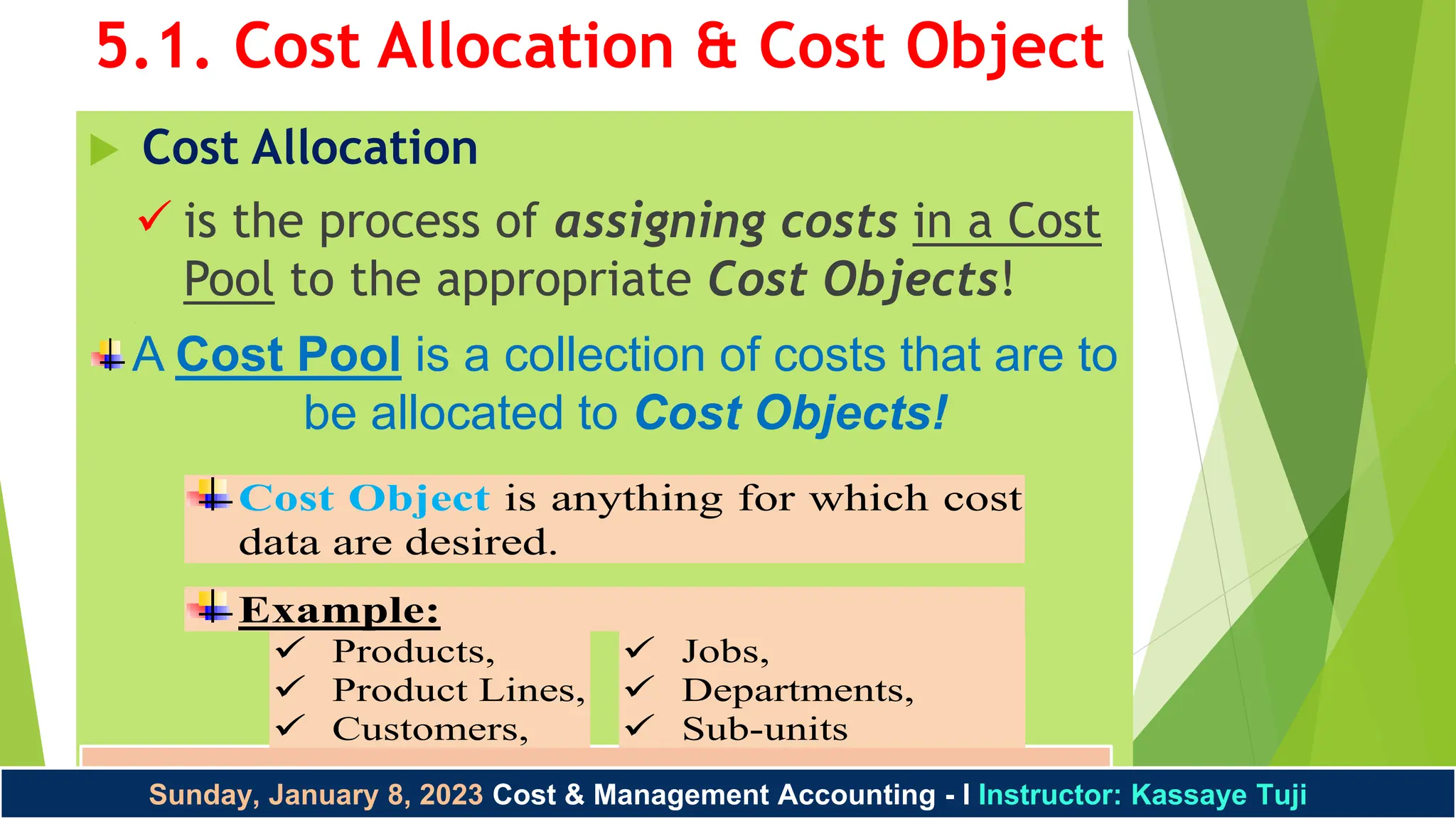
 Cost Allocation
 is the process of assigning costs in a Cost
Pool to the appropriate Cost Objects!

A Cost Pool is a collection of costs that are to
be allocated to Cost Objects!
Instructor: Kassaye Tuji 1/8/2023
Sunday, January 8, 2023 Cost & Management Accounting - I Instructor: Kassaye Tuji
5.1. Cost Allocation & Cost Object
Lincoln University, California-USA; Western University College; Extension Ethiopia
Cost Object is anything for which cost
data are desired.
Example:
 Products,
 Product Lines,
 Customers,
 Jobs,
 Departments,
 Sub-units
Instructor: Kassaye Tuji 1/8/2023
Sunday, January 8, 2023 Cost & Management Accounting - I Instructor: Kassaye Tuji
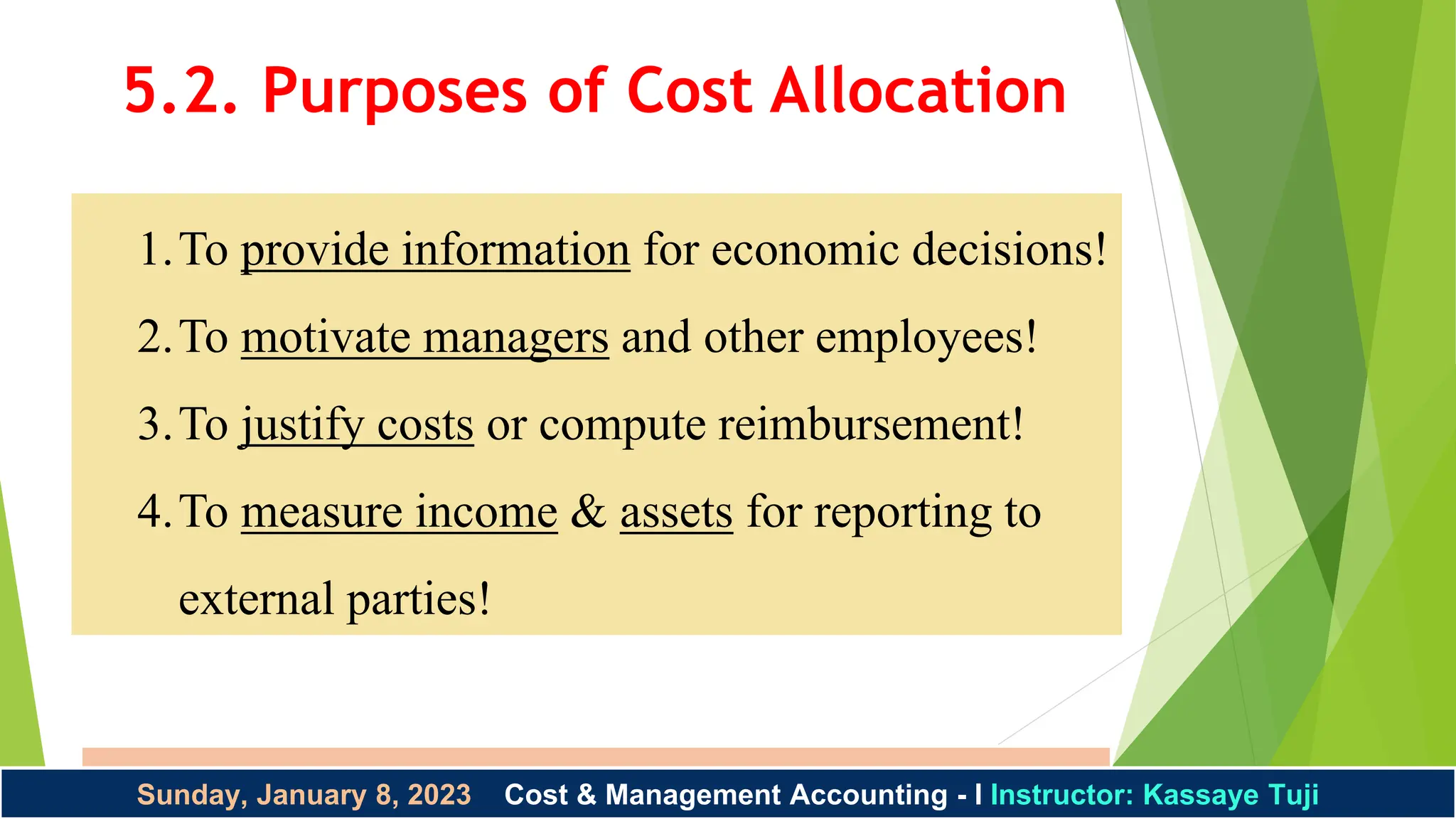
1.To provide information for economic decisions!
2.To motivate managers and other employees!
3.To justify costs or compute reimbursement!
4.To measure income & assets for reporting to
external parties!
5.2. Purposes of Cost Allocation
Sunday, January 8, 2023 Cost & Management Accounting - I Instructor: Kassaye Tuji
5.3 Cost Allocation Methods
Instructor: Kassaye Tuji 1/8/2023
Sunday, January 8, 2023 Cost & Management Accounting - I Instructor: Kassaye Tuji
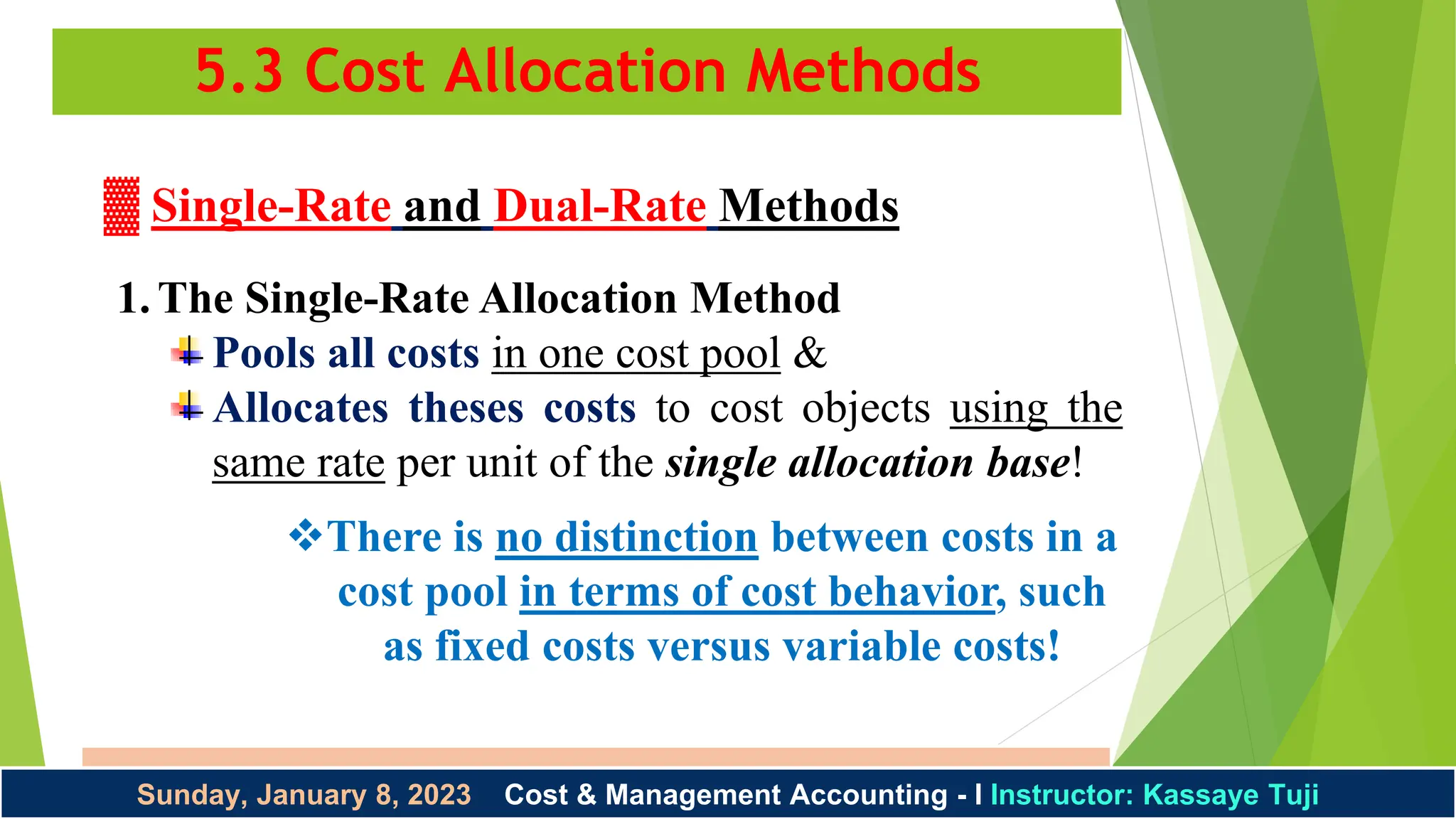
▓ Single-Rate and Dual-Rate Methods
1.The Single-Rate Allocation Method
Pools all costs in one cost pool &
Allocates theses costs to cost objects using the
same rate per unit of the single allocation base!
There is no distinction between costs in a
cost pool in terms of cost behavior, such
as fixed costs versus variable costs!
Cost Allocation Methods…
Instructor: Kassaye Tuji 1/8/2023
Sunday, January 8, 2023 Cost & Management Accounting - I Instructor: Kassaye Tuji
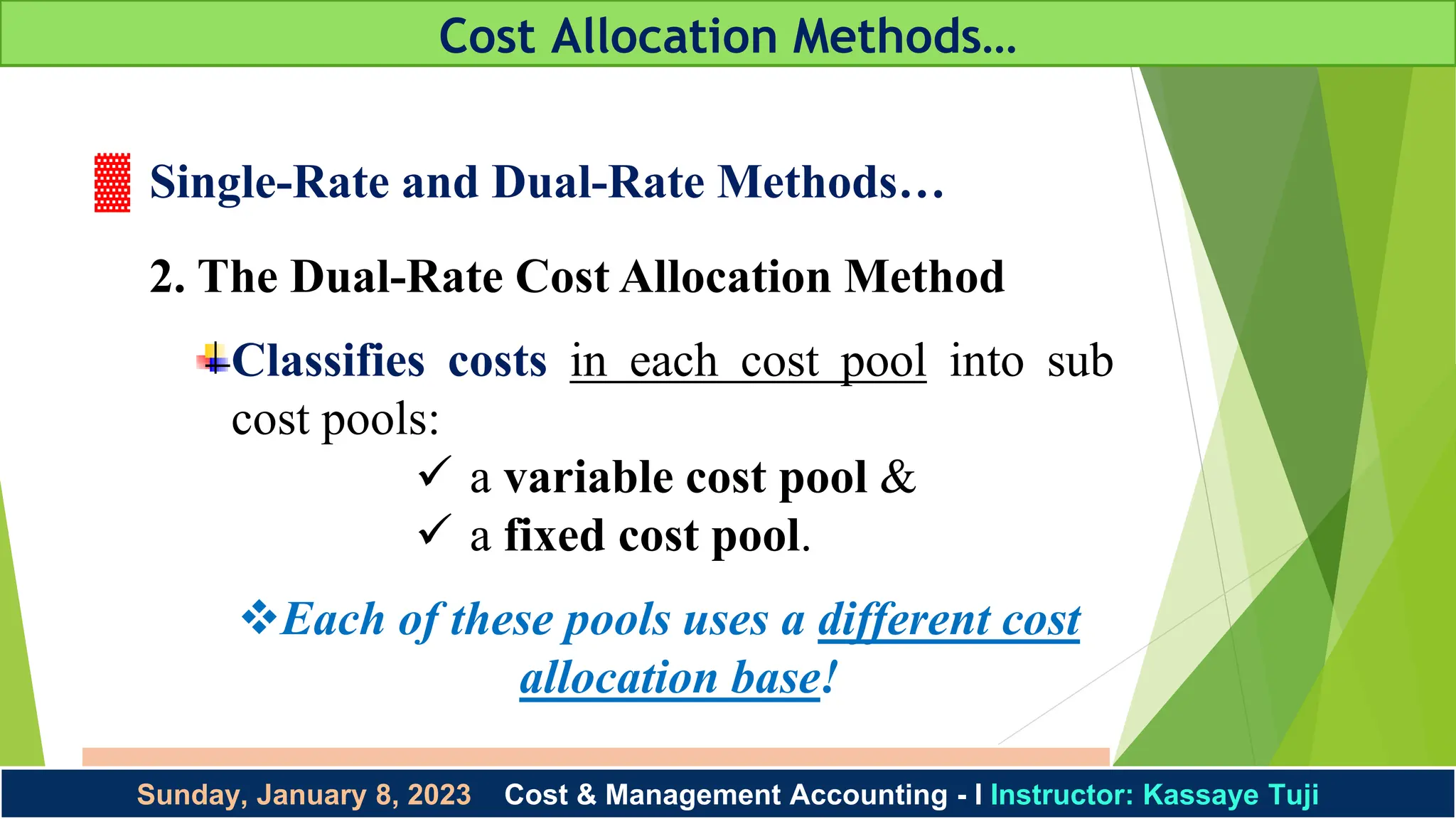
▓ Single-Rate and Dual-Rate Methods…
2. The Dual-Rate Cost Allocation Method
Classifies costs in each cost pool into sub
cost pools:
 a variable cost pool &
 a fixed cost pool.
Each of these pools uses a different cost
allocation base!
Single-Rate and Dual-Rate Methods…
Instructor: Kassaye Tuji 1/8/2023
Sunday, January 8, 2023 Cost & Management Accounting - I Instructor: Kassaye Tuji
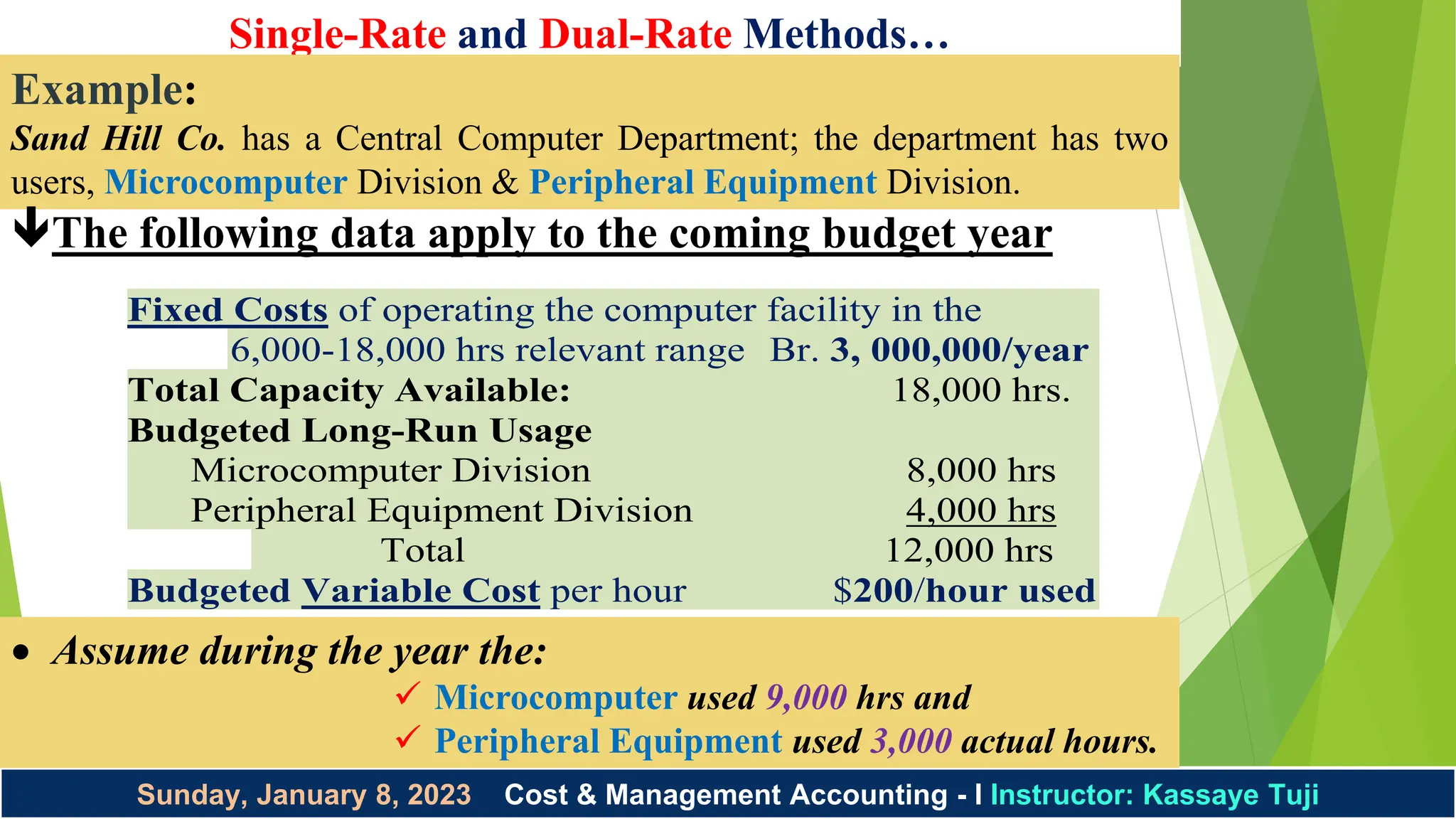
Example:
Sand Hill Co. has a Central Computer Department; the department has two
users, Microcomputer Division & Peripheral Equipment Division.
The following data apply to the coming budget year
Fixed Costs of operating the computer facility in the
6,000-18,000 hrs relevant range Br. 3, 000,000/year
Total Capacity Available: 18,000 hrs.
Budgeted Long-Run Usage
Microcomputer Division 8,000 hrs
Peripheral Equipment Division 4,000 hrs
Total 12,000 hrs
Budgeted Variable Cost per hour $200/hour used
 Assume during the year the:
 Microcomputer used 9,000 hrs and
 Peripheral Equipment used 3,000 actual hours.
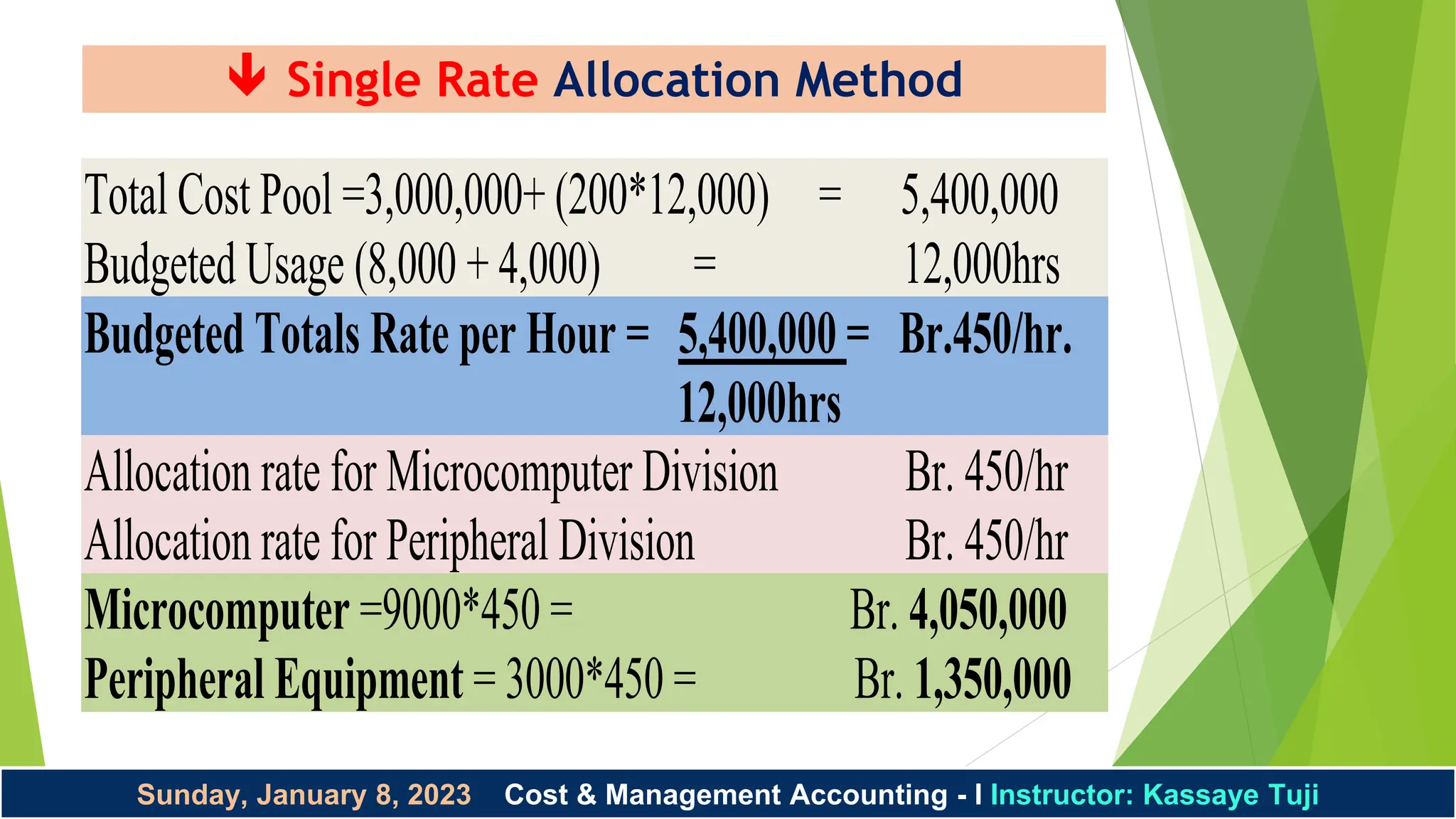
 Single Rate Allocation Method
Sunday, January 8, 2023 Cost & Management Accounting - I Instructor: Kassaye Tuji
Total Cost Pool =3,000,000+ (200*12,000) = 5,400,000
Budgeted Usage (8,000 + 4,000) = 12,000hrs
Budgeted Totals Rate per Hour = 5,400,000 = Br.450/hr.
12,000hrs
Allocation rate for Microcomputer Division Br. 450/hr
Allocation rate for Peripheral Division Br. 450/hr
Microcomputer =9000*450 = Br. 4,050,000
Peripheral Equipment = 3000*450 = Br. 1,350,000
 Dual-Rate Allocation Method
Sunday, January 8, 2023 Cost & Management Accounting - I Instructor: Kassaye Tuji
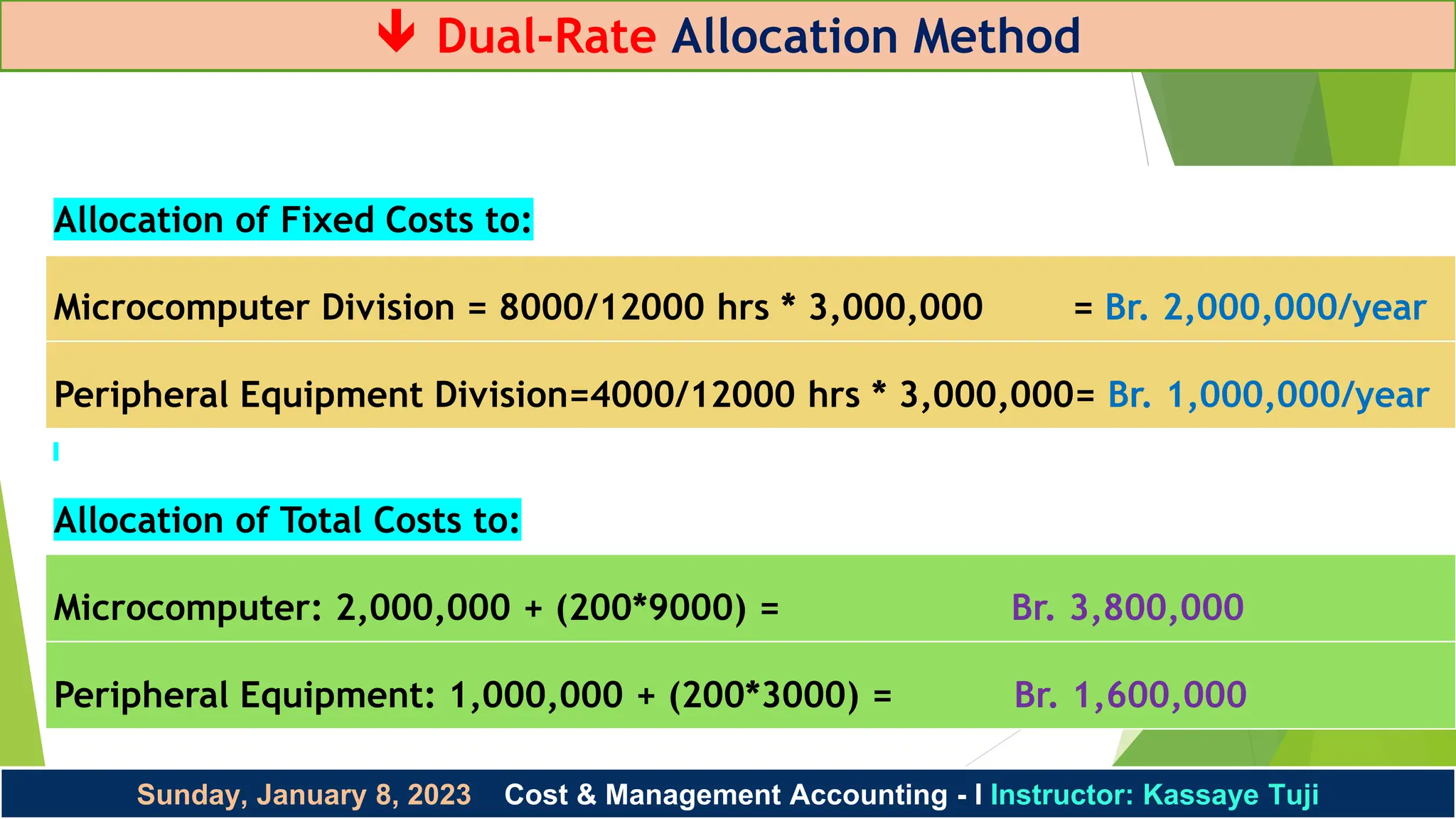
Allocation of Fixed Costs to:
Microcomputer Division = 8000/12000 hrs * 3,000,000 = Br. 2,000,000/year
Peripheral Equipment Division=4000/12000 hrs * 3,000,000= Br. 1,000,000/year
Allocation of Total Costs to:
Microcomputer: 2,000,000 + (200*9000) = Br. 3,800,000
Peripheral Equipment: 1,000,000 + (200*3000) = Br. 1,600,000
Sunday, January 8, 2023 Cost & Management Accounting - I Instructor: Kassaye Tuji
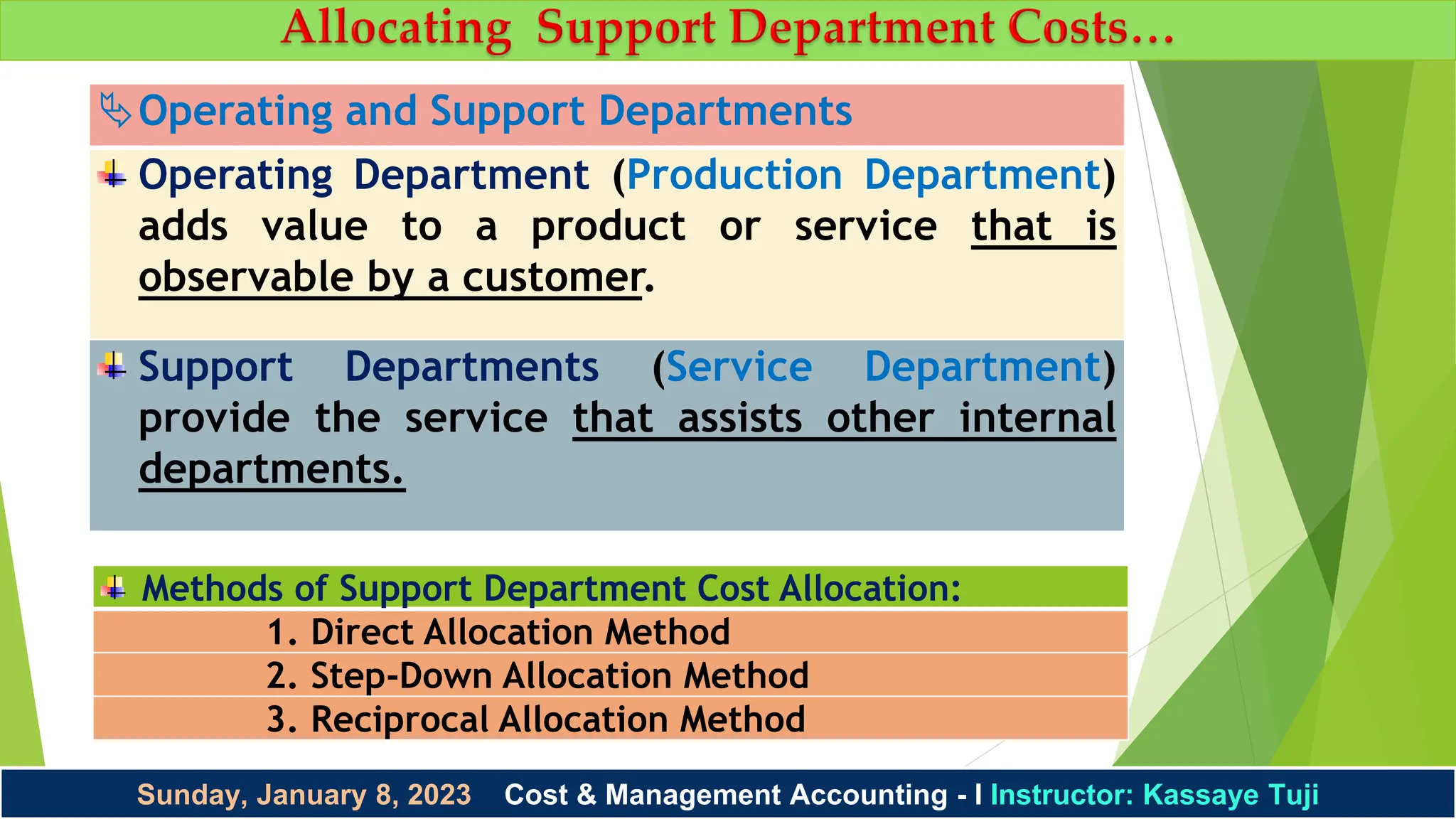
Operating and Support Departments
Operating Department (Production Department)
adds value to a product or service that is
observable by a customer.
Support Departments (Service Department)
provide the service that assists other internal
departments.
Methods of Support Department Cost Allocation:
1. Direct Allocation Method
2. Step-Down Allocation Method
3. Reciprocal Allocation Method
Sunday, January 8, 2023 Cost & Management Accounting - I Instructor: Kassaye Tuji
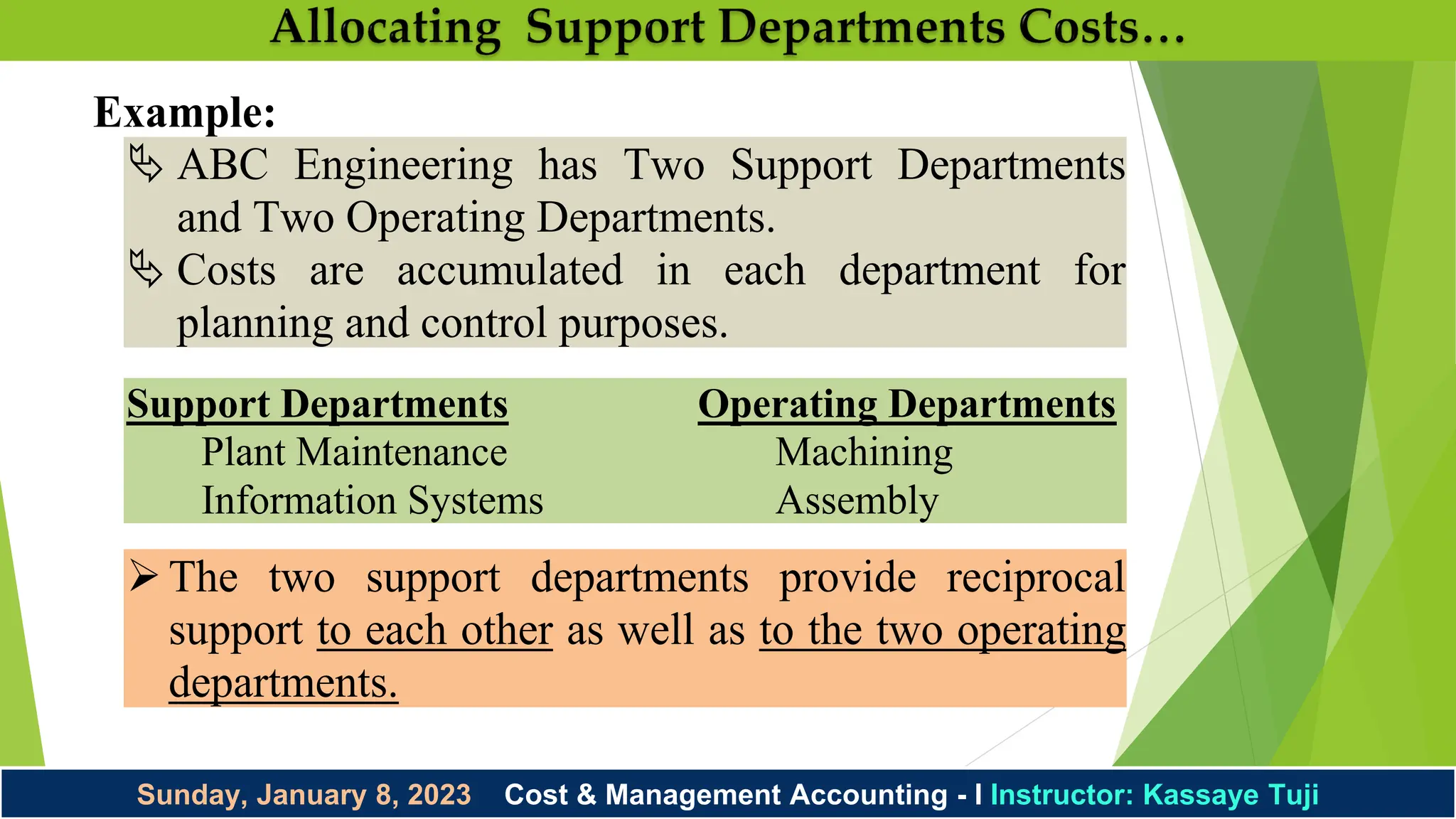
Example:
 ABC Engineering has Two Support Departments
and Two Operating Departments.
 Costs are accumulated in each department for
planning and control purposes.
Support Departments Operating Departments
Plant Maintenance Machining
Information Systems Assembly
The two support departments provide reciprocal
support to each other as well as to the two operating
departments.
Sunday, January 8, 2023 Cost & Management Accounting - I Instructor: Kassaye Tuji
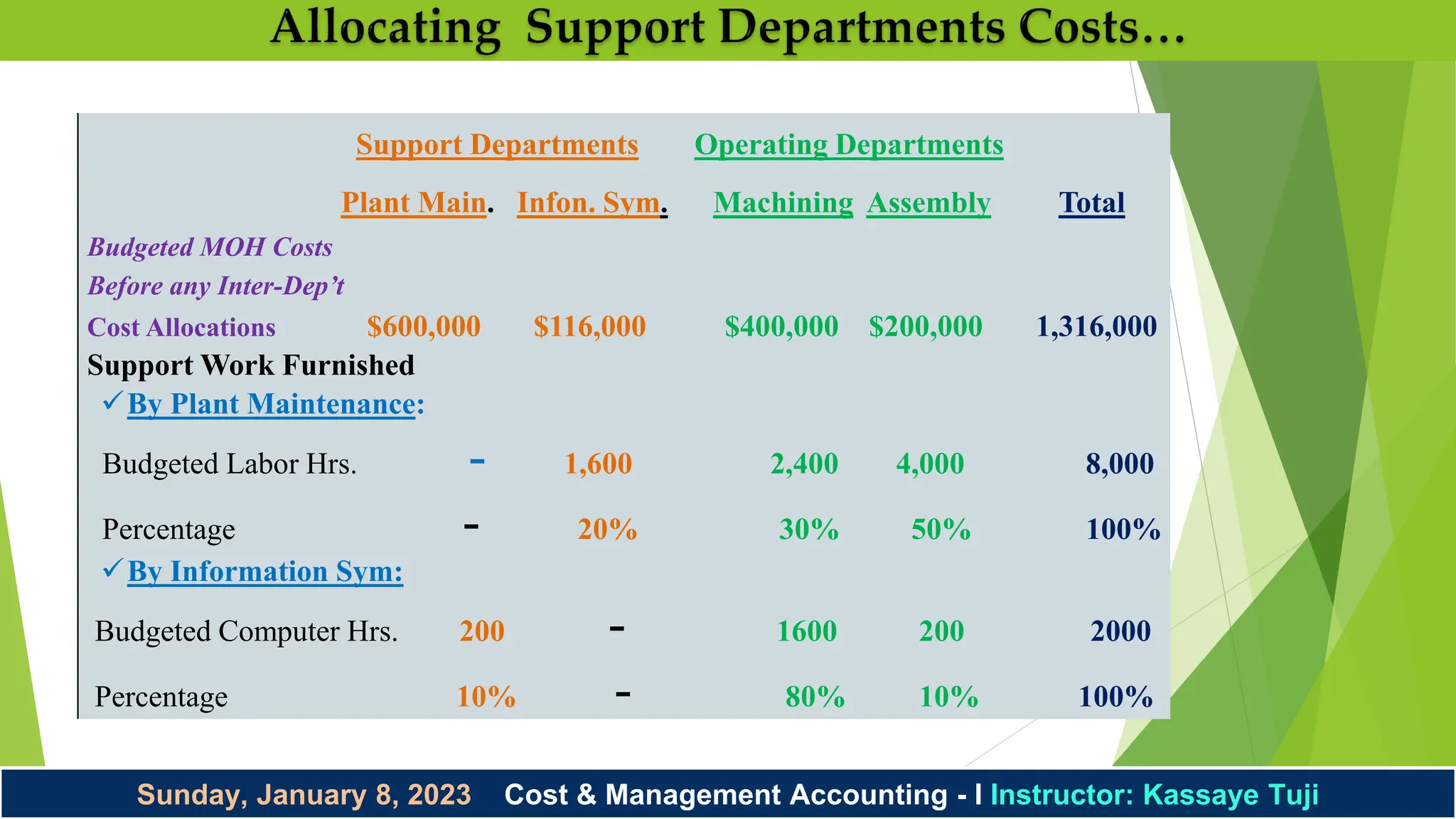
Support Departments Operating Departments
Plant Main. Infon. Sym. Machining Assembly Total
Budgeted MOH Costs
Before any Inter-Dep’t
Cost Allocations $600,000 $116,000 $400,000 $200,000 1,316,000
Support Work Furnished
By Plant Maintenance:
Budgeted Labor Hrs. - 1,600 2,400 4,000 8,000
Percentage - 20% 30% 50% 100%
By Information Sym:
Budgeted Computer Hrs. 200 - 1600 200 2000
Percentage 10% - 80% 10% 100%
Sunday, January 8, 2023 Cost & Management Accounting - I Instructor: Kassaye Tuji
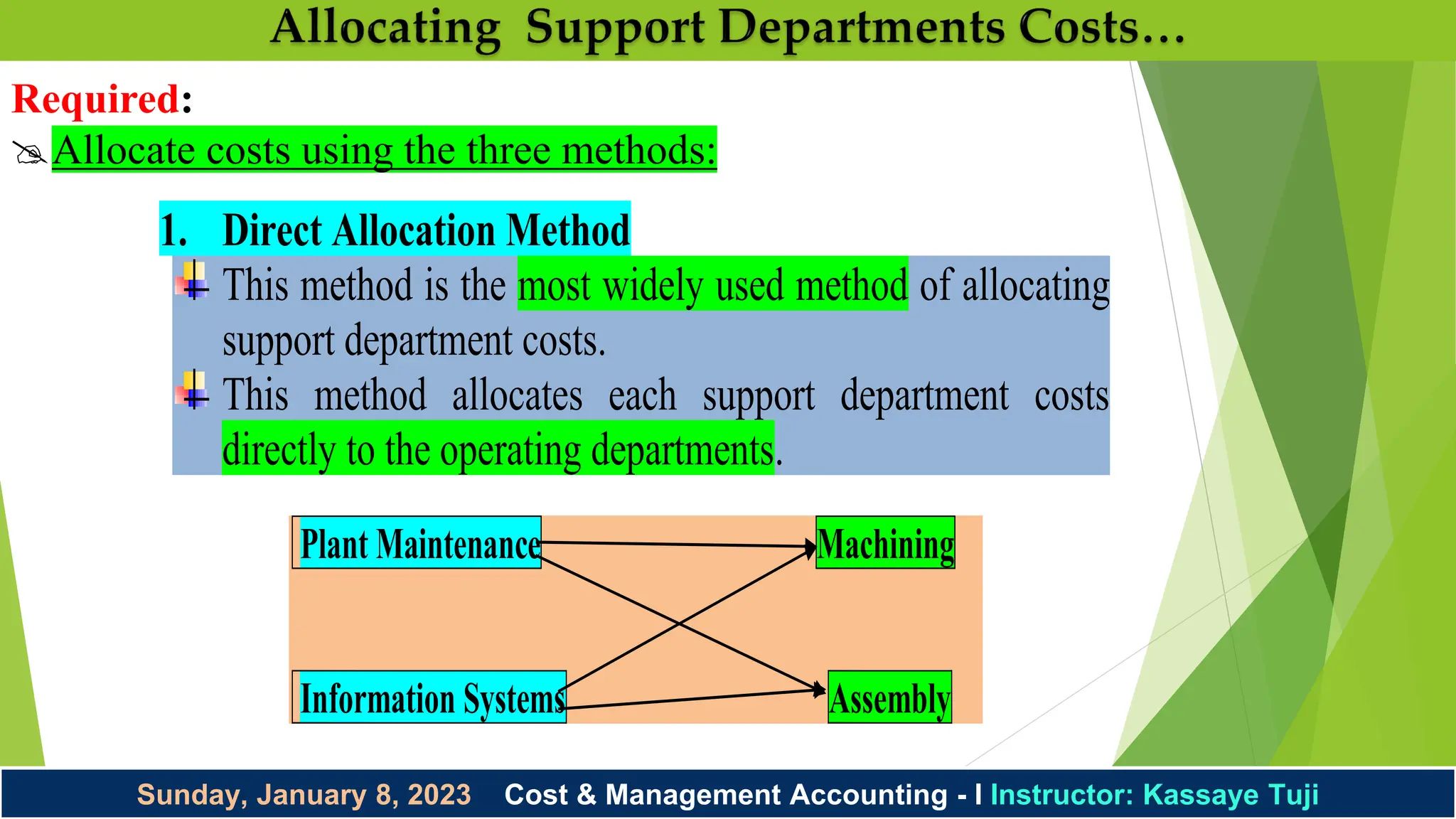
Required:
Allocate costs using the three methods:
Plant Maintenance Machining
Information Systems Assembly
1. Direct Allocation Method
This method is the most widely used method of allocating
support department costs.
This method allocates each support department costs
directly to the operating departments.
Sunday, January 8, 2023 Cost & Management Accounting - I Instructor: Kassaye Tuji
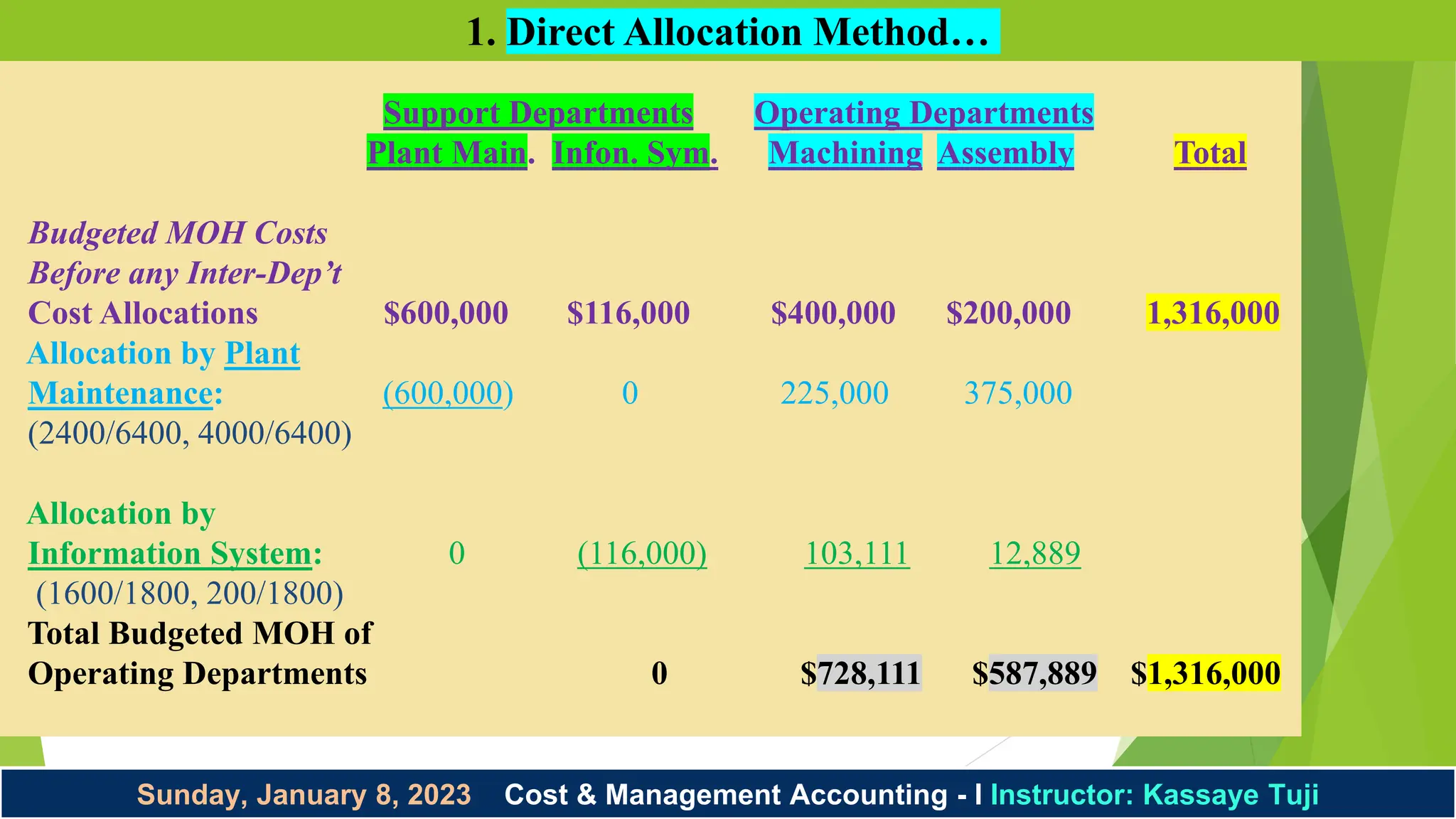
Support Departments Operating Departments
Plant Main. Infon. Sym. Machining Assembly Total
Budgeted MOH Costs
Before any Inter-Dep’t
Cost Allocations $600,000 $116,000 $400,000 $200,000 1,316,000
Allocation by Plant
Maintenance: (600,000) 0 225,000 375,000
(2400/6400, 4000/6400)
Allocation by
Information System: 0 (116,000) 103,111 12,889
(1600/1800, 200/1800)
Total Budgeted MOH of
Operating Departments 0 $728,111 $587,889 $1,316,000
1. Direct Allocation Method…
Sunday, January 8, 2023 Cost & Management Accounting - I Instructor: Kassaye Tuji
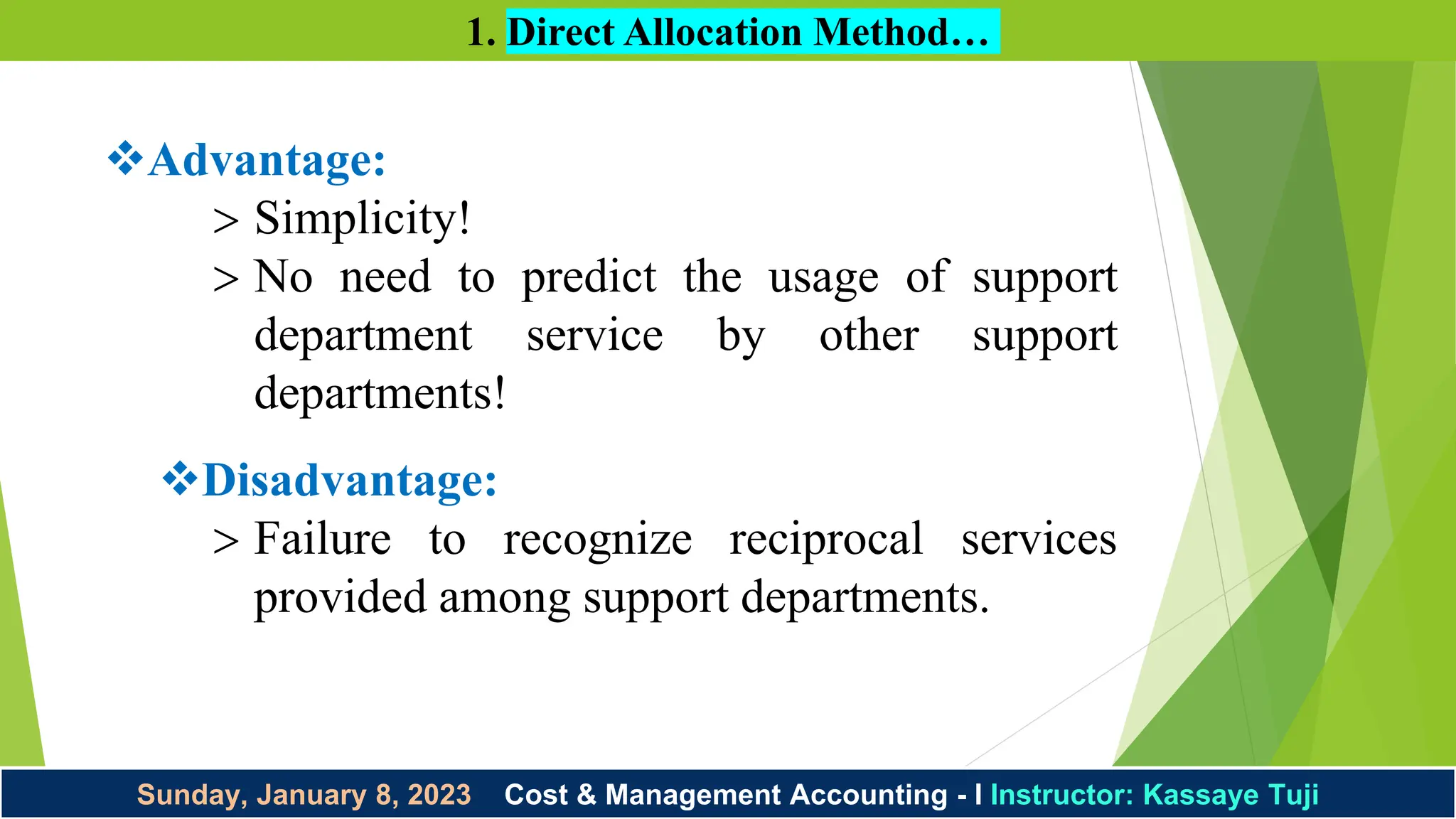
Advantage:
 Simplicity!
 No need to predict the usage of support
department service by other support
departments!
Disadvantage:
 Failure to recognize reciprocal services
provided among support departments.
1. Direct Allocation Method…
Sunday, January 8, 2023 Cost & Management Accounting - I Instructor: Kassaye Tuji
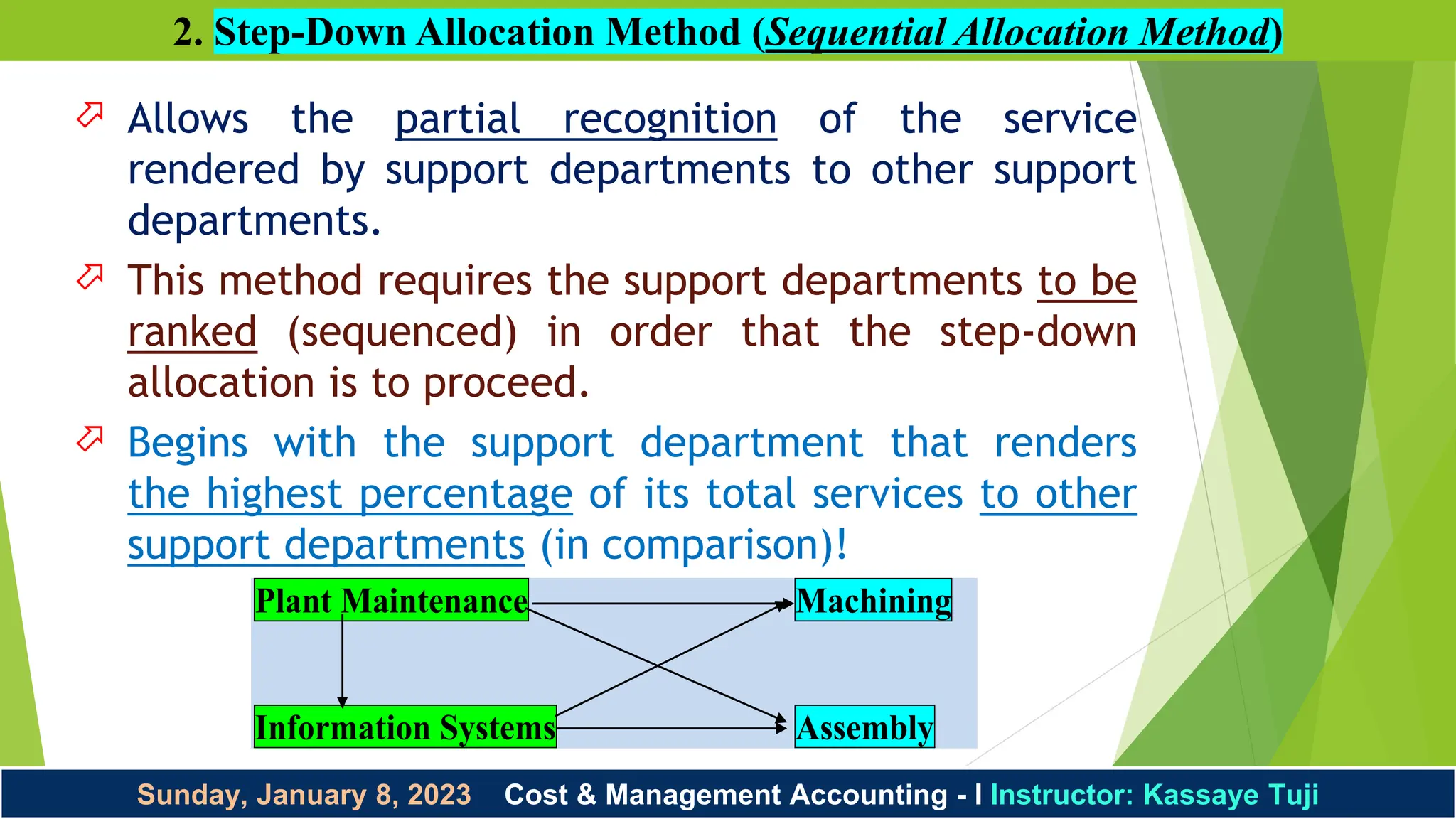
2. Step-Down Allocation Method (Sequential Allocation Method)
 Allows the partial recognition of the service
rendered by support departments to other support
departments.
 This method requires the support departments to be
ranked (sequenced) in order that the step-down
allocation is to proceed.
 Begins with the support department that renders
the highest percentage of its total services to other
support departments (in comparison)!
Plant Maintenance Machining
Information Systems Assembly
Sunday, January 8, 2023 Cost & Management Accounting - I Instructor: Kassaye Tuji
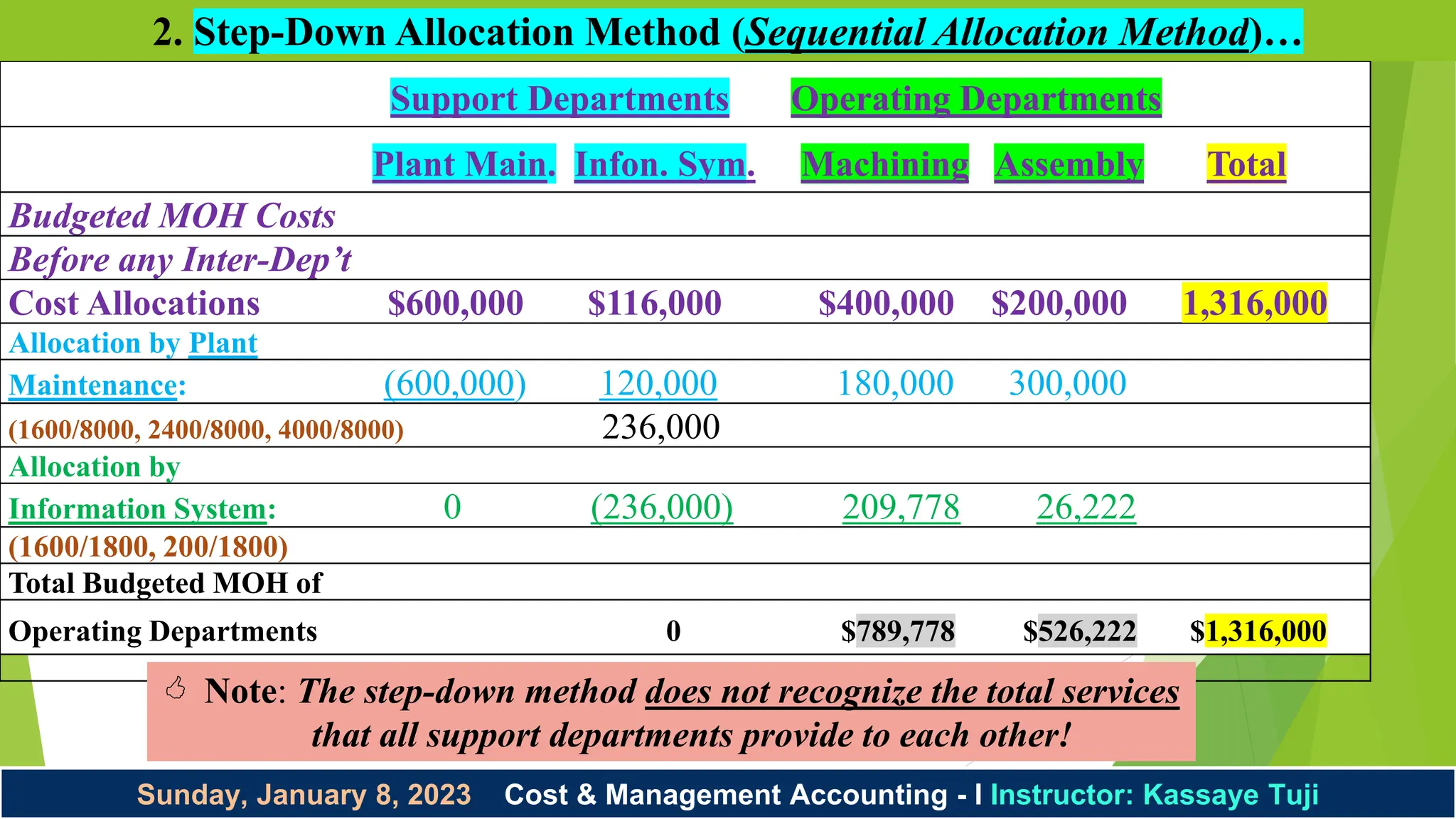
Support Departments Operating Departments
Plant Main. Infon. Sym. Machining Assembly Total
Budgeted MOH Costs
Before any Inter-Dep’t
Cost Allocations $600,000 $116,000 $400,000 $200,000 1,316,000
Allocation by Plant
Maintenance: (600,000) 120,000 180,000 300,000
(1600/8000, 2400/8000, 4000/8000) 236,000
Allocation by
Information System: 0 (236,000) 209,778 26,222
(1600/1800, 200/1800)
Total Budgeted MOH of
Operating Departments 0 $789,778 $526,222 $1,316,000
 Note: The step-down method does not recognize the total services
that all support departments provide to each other!
2. Step-Down Allocation Method (Sequential Allocation Method)…
Sunday, January 8, 2023 Cost & Management Accounting - I Instructor: Kassaye Tuji
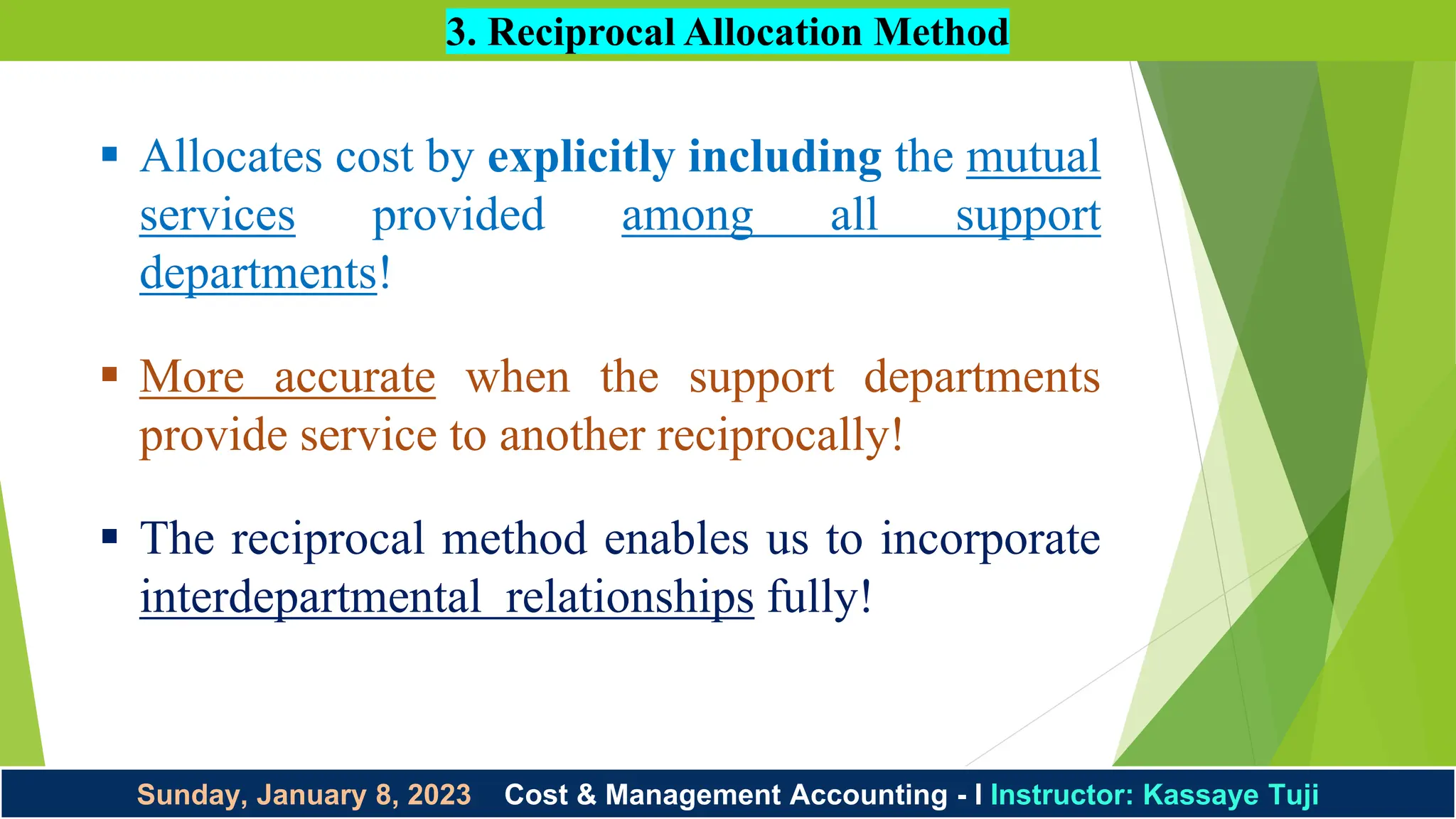
3. Reciprocal Allocation Method
 Allocates cost by explicitly including the mutual
services provided among all support
departments!
 More accurate when the support departments
provide service to another reciprocally!
 The reciprocal method enables us to incorporate
interdepartmental relationships fully!
Sunday, January 8, 2023 Cost & Management Accounting - I Instructor: Kassaye Tuji
3. Reciprocal Allocation Method…
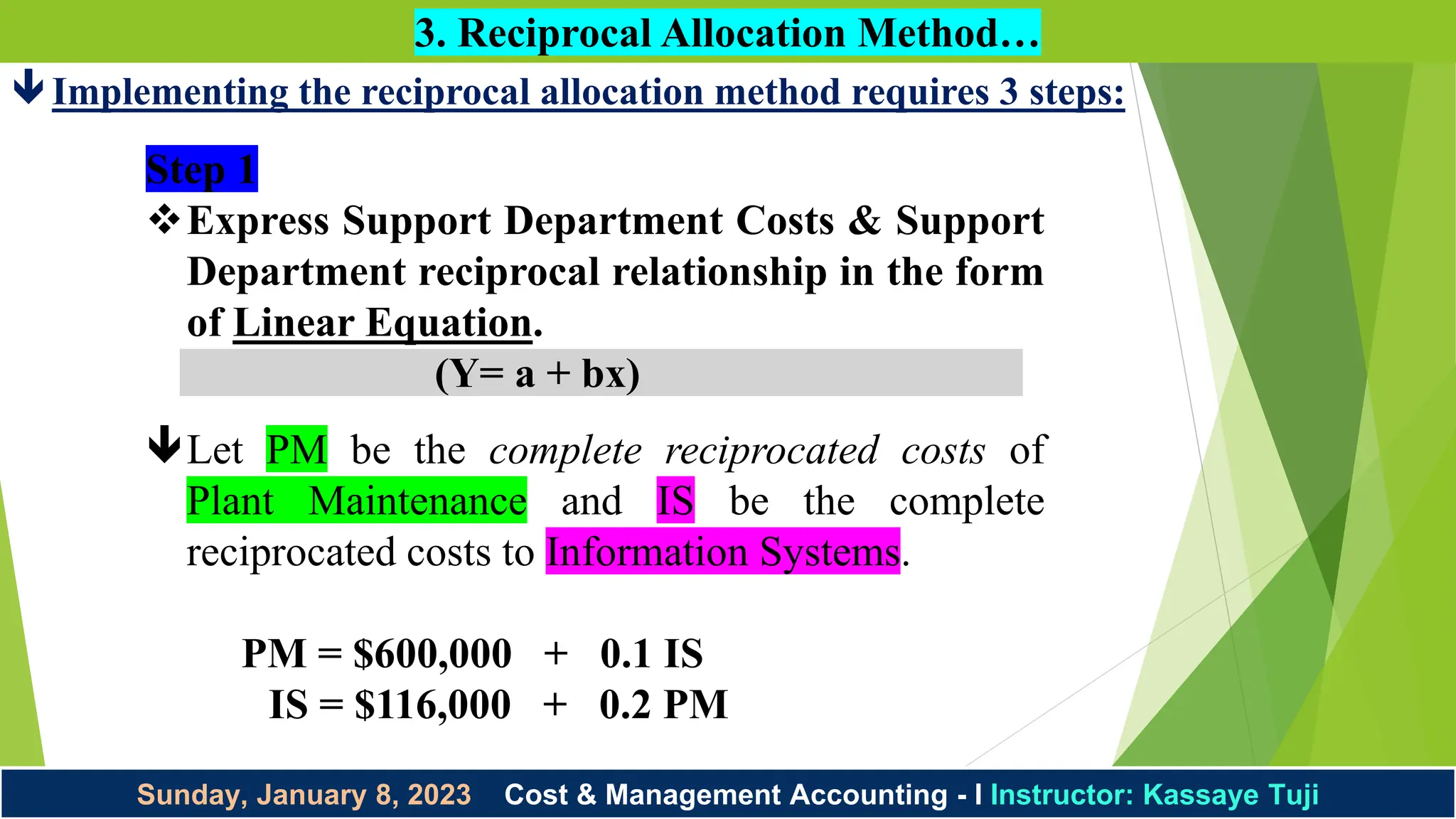
Implementing the reciprocal allocation method requires 3 steps:
Step 1
Express Support Department Costs & Support
Department reciprocal relationship in the form
of Linear Equation.
(Y= a + bx)
Let PM be the complete reciprocated costs of
Plant Maintenance and IS be the complete
reciprocated costs to Information Systems.
PM = $600,000 + 0.1 IS
IS = $116,000 + 0.2 PM
Sunday, January 8, 2023 Cost & Management Accounting - I Instructor: Kassaye Tuji
3. Reciprocal Allocation Method…
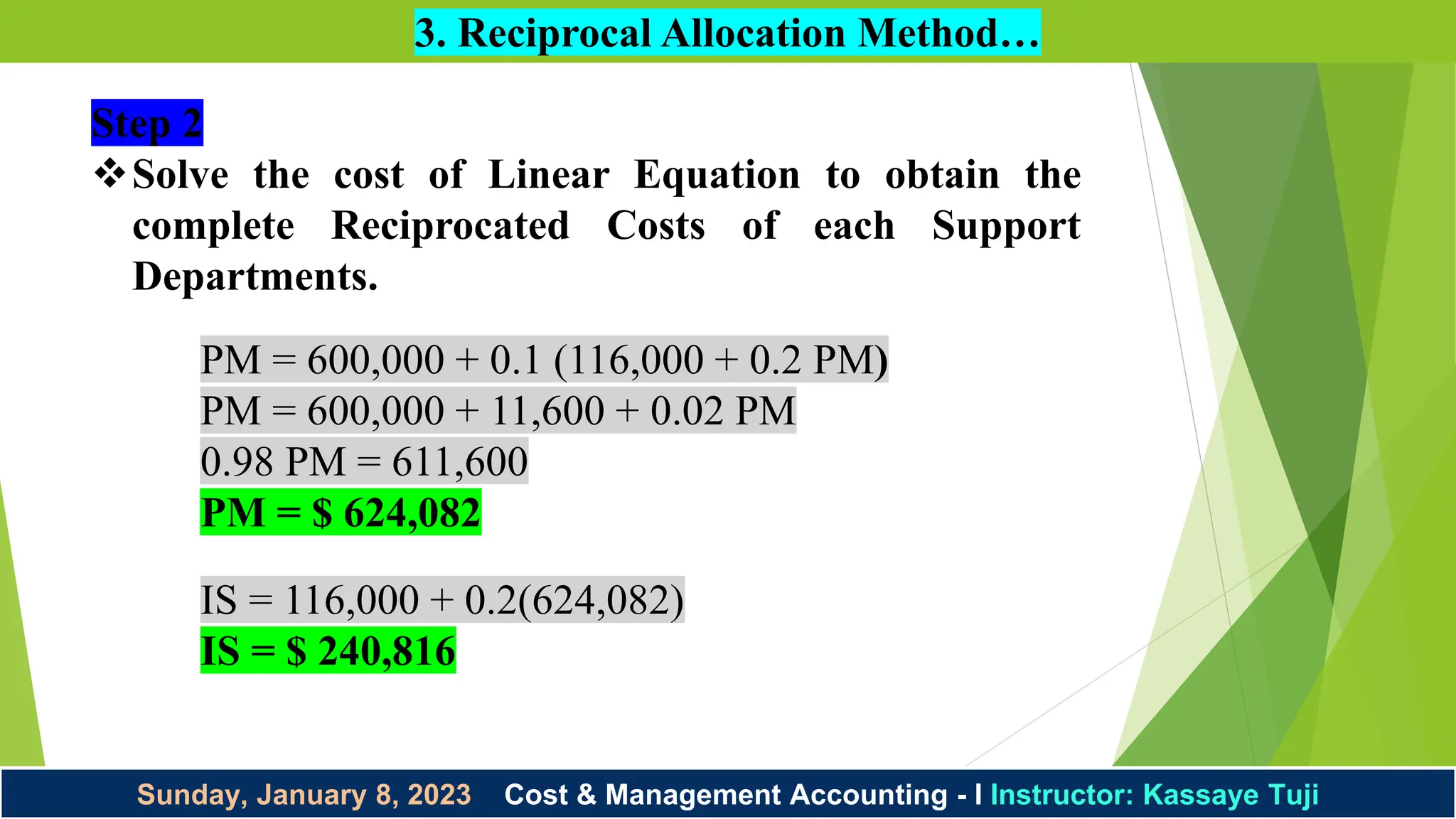
Step 2
Solve the cost of Linear Equation to obtain the
complete Reciprocated Costs of each Support
Departments.
PM = 600,000 + 0.1 (116,000 + 0.2 PM)
PM = 600,000 + 11,600 + 0.02 PM
0.98 PM = 611,600
PM = $ 624,082
IS = 116,000 + 0.2(624,082)
IS = $ 240,816
Sunday, January 8, 2023 Cost & Management Accounting - I Instructor: Kassaye Tuji
3. Reciprocal Allocation Method…
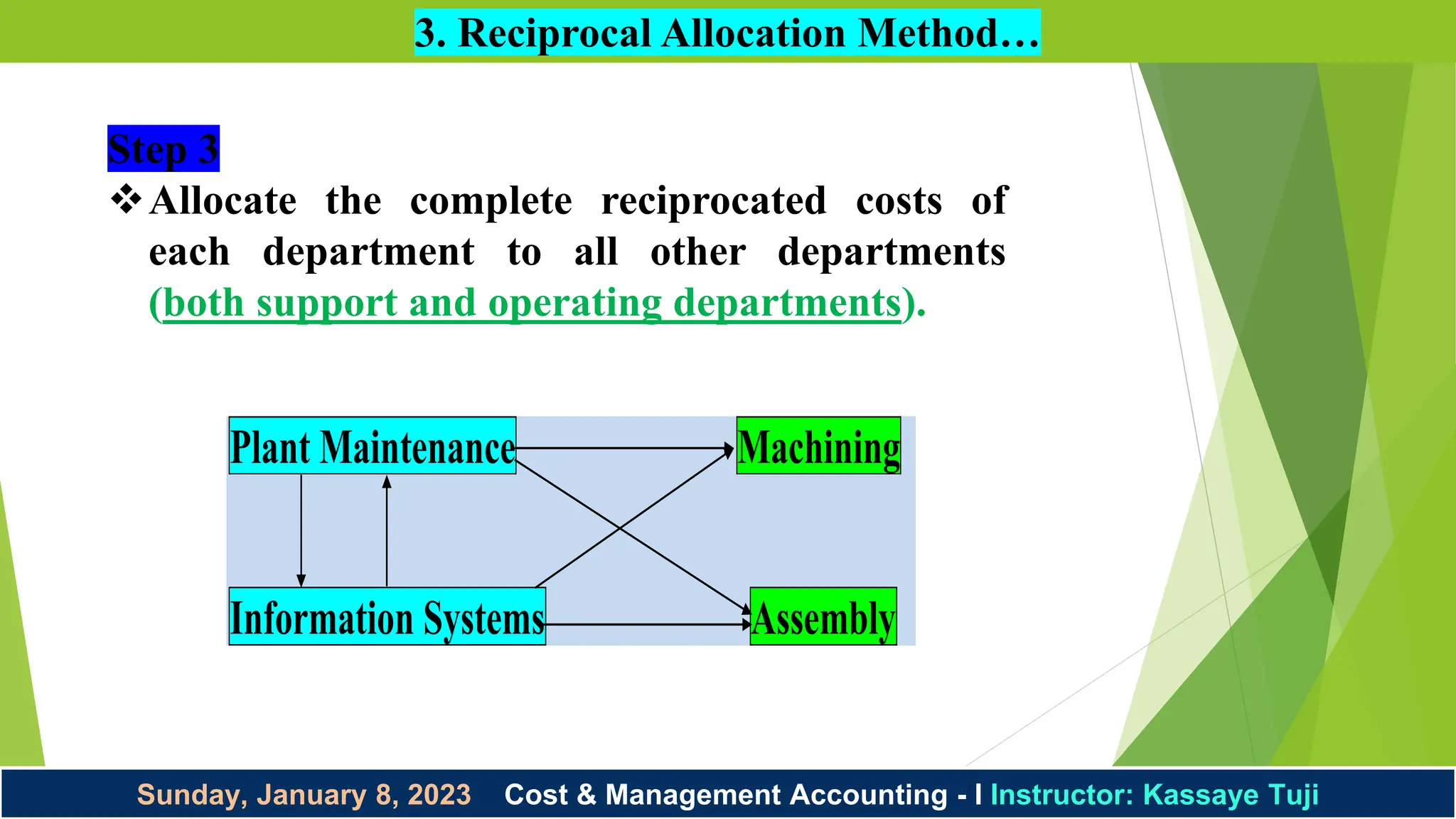
Step 3
Allocate the complete reciprocated costs of
each department to all other departments
(both support and operating departments).
Plant Maintenance Machining
Information Systems Assembly
Sunday, January 8, 2023 Cost & Management Accounting - I Instructor: Kassaye Tuji
3. Reciprocal Allocation Method…
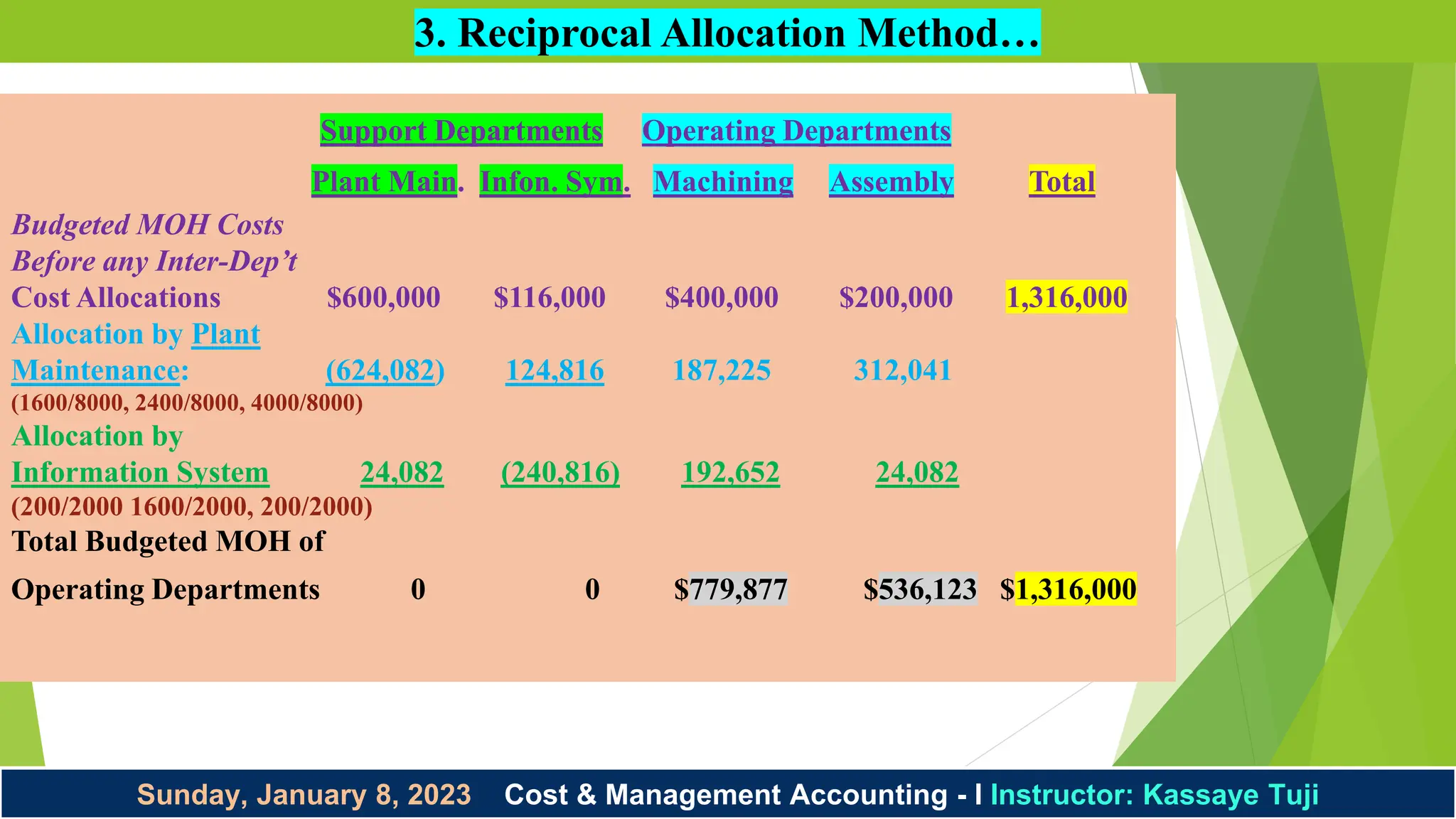
Support Departments Operating Departments
Plant Main. Infon. Sym. Machining Assembly Total
Budgeted MOH Costs
Before any Inter-Dep’t
Cost Allocations $600,000 $116,000 $400,000 $200,000 1,316,000
Allocation by Plant
Maintenance: (624,082) 124,816 187,225 312,041
(1600/8000, 2400/8000, 4000/8000)
Allocation by
Information System 24,082 (240,816) 192,652 24,082
(200/2000 1600/2000, 200/2000)
Total Budgeted MOH of
Operating Departments 0 0 $779,877 $536,123 $1,316,000
Sunday, January 8, 2023 Cost & Management Accounting - I Instructor: Kassaye Tuji
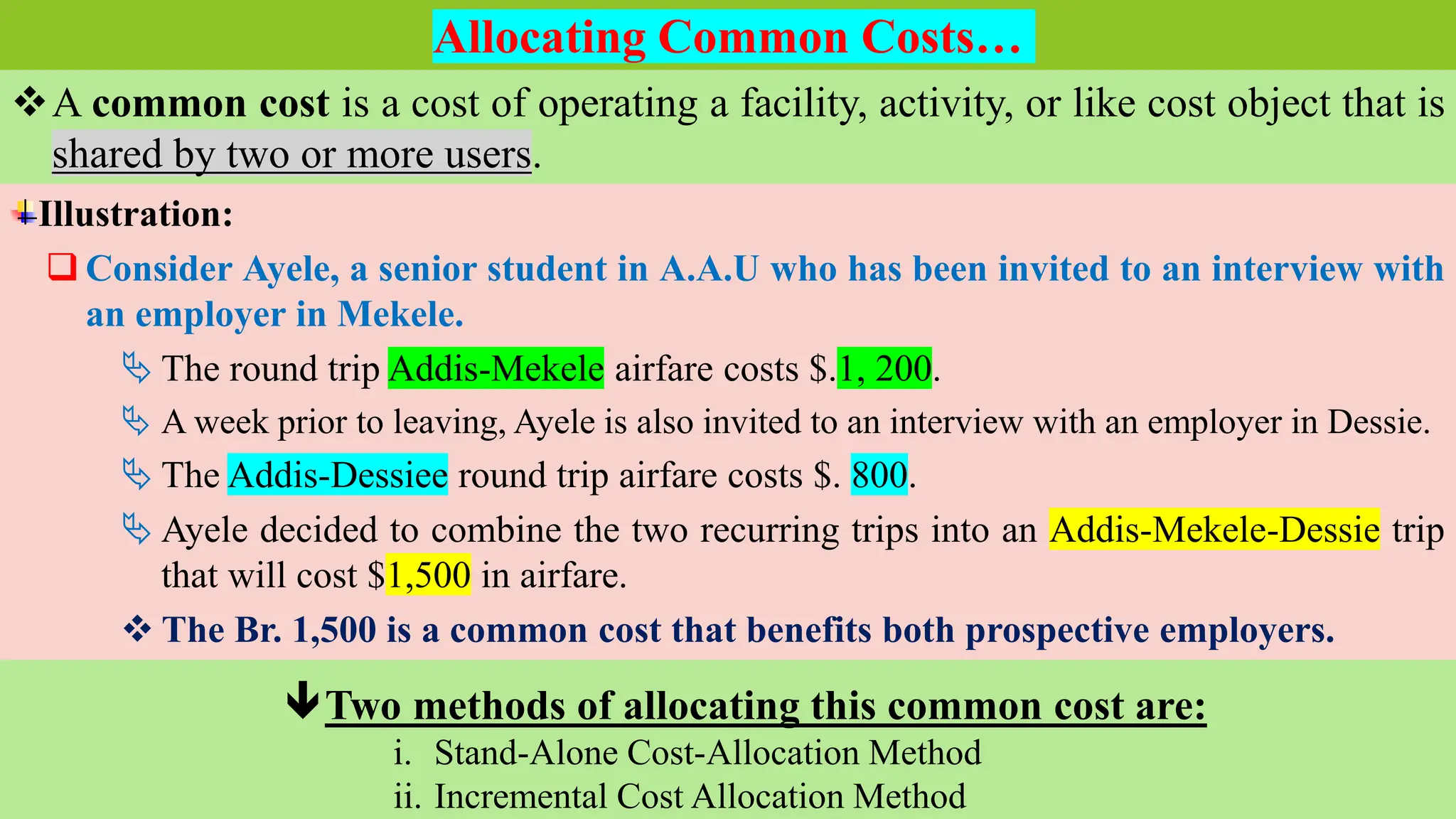
A common cost is a cost of operating a facility, activity, or like cost object that is
shared by two or more users.
Allocating Common Costs…
Illustration:
 Consider Ayele, a senior student in A.A.U who has been invited to an interview with
an employer in Mekele.
 The round trip Addis-Mekele airfare costs $.1, 200.
 A week prior to leaving, Ayele is also invited to an interview with an employer in Dessie.
 The Addis-Dessiee round trip airfare costs $. 800.
 Ayele decided to combine the two recurring trips into an Addis-Mekele-Dessie trip
that will cost $1,500 in airfare.
 The Br. 1,500 is a common cost that benefits both prospective employers.
Two methods of allocating this common cost are:
i. Stand-Alone Cost-Allocation Method
ii. Incremental Cost Allocation Method
Sunday, January 8, 2023 Cost & Management Accounting - I Instructor: Kassaye Tuji
Allocating Common Costs…
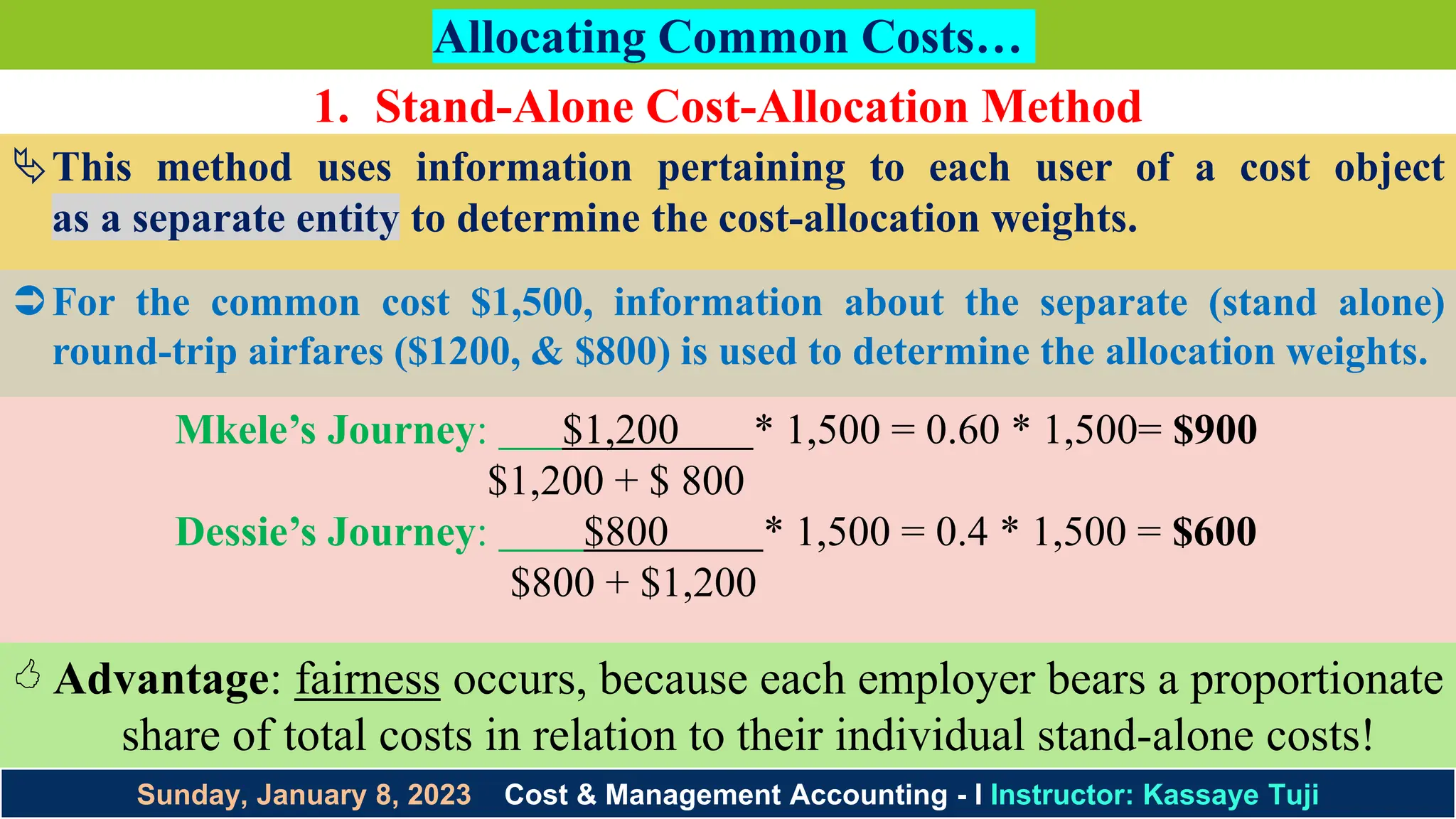
1. Stand-Alone Cost-Allocation Method
This method uses information pertaining to each user of a cost object
as a separate entity to determine the cost-allocation weights.
For the common cost $1,500, information about the separate (stand alone)
round-trip airfares ($1200, & $800) is used to determine the allocation weights.
Mkele’s Journey: $1,200 * 1,500 = 0.60 * 1,500= $900
$1,200 + $ 800
Dessie’s Journey: $800 * 1,500 = 0.4 * 1,500 = $600
$800 + $1,200
 Advantage: fairness occurs, because each employer bears a proportionate
share of total costs in relation to their individual stand-alone costs!
Sunday, January 8, 2023 Cost & Management Accounting - I Instructor: Kassaye Tuji
Allocating Common Costs…
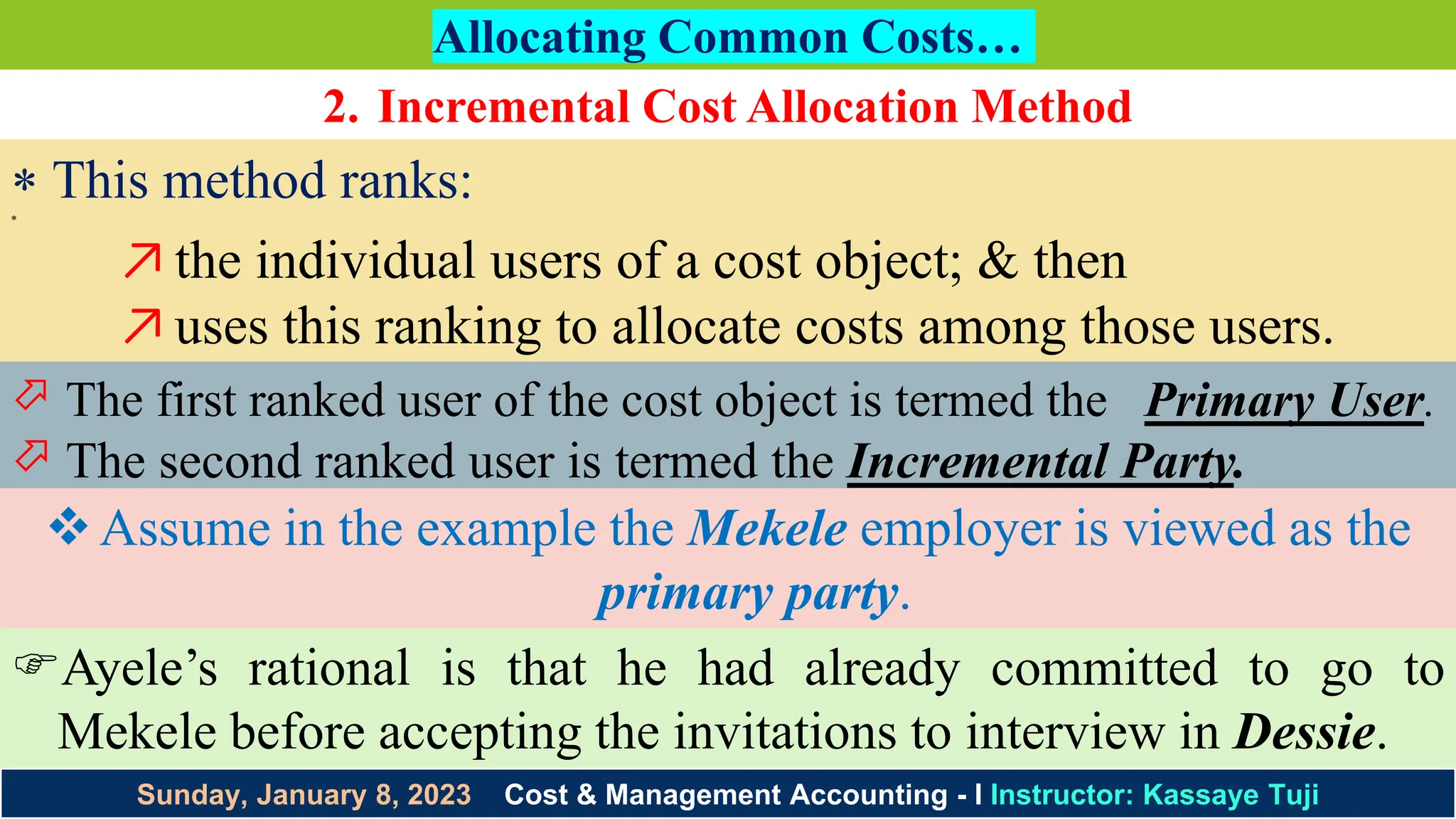
2. Incremental Cost Allocation Method
 This method ranks:

↗the individual users of a cost object; & then
↗uses this ranking to allocate costs among those users.
 The first ranked user of the cost object is termed the Primary User.
 The second ranked user is termed the Incremental Party.
Assume in the example the Mekele employer is viewed as the
primary party.
Ayele’s rational is that he had already committed to go to
Mekele before accepting the invitations to interview in Dessie.
Sunday, January 8, 2023 Cost & Management Accounting - I Instructor: Kassaye Tuji
Allocating Common Costs…
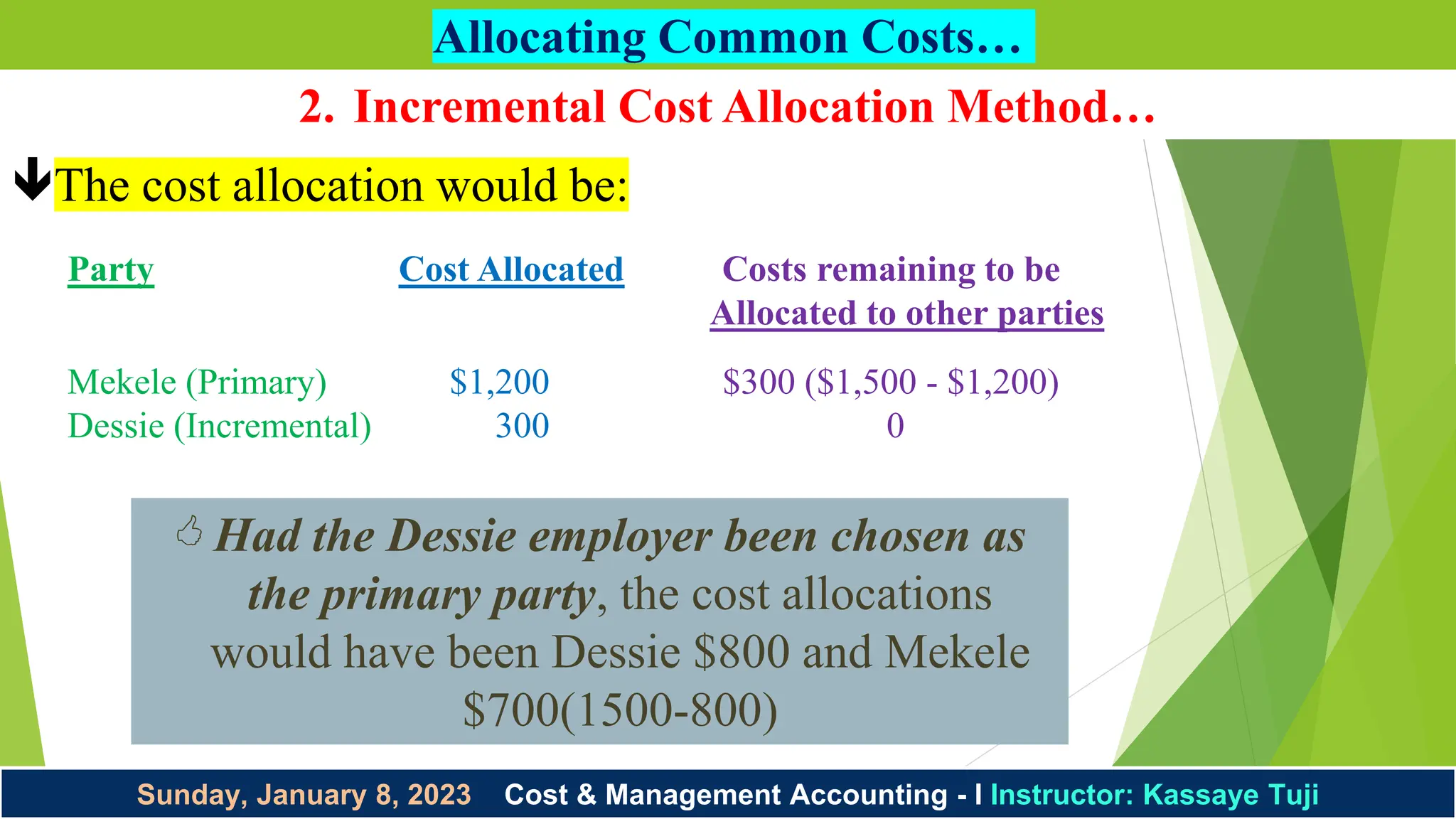
The cost allocation would be:
Party Cost Allocated Costs remaining to be
Allocated to other parties
Mekele (Primary) $1,200 $300 ($1,500 - $1,200)
Dessie (Incremental) 300 0
 Had the Dessie employer been chosen as
the primary party, the cost allocations
would have been Dessie $800 and Mekele
$700(1500-800)
2. Incremental Cost Allocation Method…
©2003 Prentice Hall Business Publishing, Cost Accounting 11/e, Horngren/Datar/Foster
End of Chapter 5
1 - 29
Sunday, January 8, 2023 Cost & Mgt. Acct- I Instructor: Kassaye Tuji

PPT- Chapter 5- Cost Allocation presentation pdf

  • 1.
    CHAPTER-FIVE COST ALLOCATION COST AND MANAGEMENT ACCOUNTINGI Sunday, January 8, 2023 Cost & Management Accounting - I Instructor: Kassaye Tuji
  • 2.
     Cost Allocation is the process of assigning costs in a Cost Pool to the appropriate Cost Objects!  A Cost Pool is a collection of costs that are to be allocated to Cost Objects! Instructor: Kassaye Tuji 1/8/2023 Sunday, January 8, 2023 Cost & Management Accounting - I Instructor: Kassaye Tuji 5.1. Cost Allocation & Cost Object Lincoln University, California-USA; Western University College; Extension Ethiopia Cost Object is anything for which cost data are desired. Example:  Products,  Product Lines,  Customers,  Jobs,  Departments,  Sub-units
  • 3.
    Instructor: Kassaye Tuji1/8/2023 Sunday, January 8, 2023 Cost & Management Accounting - I Instructor: Kassaye Tuji 1.To provide information for economic decisions! 2.To motivate managers and other employees! 3.To justify costs or compute reimbursement! 4.To measure income & assets for reporting to external parties! 5.2. Purposes of Cost Allocation
  • 4.
    Sunday, January 8,2023 Cost & Management Accounting - I Instructor: Kassaye Tuji
  • 5.
    5.3 Cost AllocationMethods Instructor: Kassaye Tuji 1/8/2023 Sunday, January 8, 2023 Cost & Management Accounting - I Instructor: Kassaye Tuji ▓ Single-Rate and Dual-Rate Methods 1.The Single-Rate Allocation Method Pools all costs in one cost pool & Allocates theses costs to cost objects using the same rate per unit of the single allocation base! There is no distinction between costs in a cost pool in terms of cost behavior, such as fixed costs versus variable costs!
  • 6.
    Cost Allocation Methods… Instructor:Kassaye Tuji 1/8/2023 Sunday, January 8, 2023 Cost & Management Accounting - I Instructor: Kassaye Tuji ▓ Single-Rate and Dual-Rate Methods… 2. The Dual-Rate Cost Allocation Method Classifies costs in each cost pool into sub cost pools:  a variable cost pool &  a fixed cost pool. Each of these pools uses a different cost allocation base!
  • 7.
    Single-Rate and Dual-RateMethods… Instructor: Kassaye Tuji 1/8/2023 Sunday, January 8, 2023 Cost & Management Accounting - I Instructor: Kassaye Tuji Example: Sand Hill Co. has a Central Computer Department; the department has two users, Microcomputer Division & Peripheral Equipment Division. The following data apply to the coming budget year Fixed Costs of operating the computer facility in the 6,000-18,000 hrs relevant range Br. 3, 000,000/year Total Capacity Available: 18,000 hrs. Budgeted Long-Run Usage Microcomputer Division 8,000 hrs Peripheral Equipment Division 4,000 hrs Total 12,000 hrs Budgeted Variable Cost per hour $200/hour used  Assume during the year the:  Microcomputer used 9,000 hrs and  Peripheral Equipment used 3,000 actual hours.
  • 8.
     Single RateAllocation Method Sunday, January 8, 2023 Cost & Management Accounting - I Instructor: Kassaye Tuji Total Cost Pool =3,000,000+ (200*12,000) = 5,400,000 Budgeted Usage (8,000 + 4,000) = 12,000hrs Budgeted Totals Rate per Hour = 5,400,000 = Br.450/hr. 12,000hrs Allocation rate for Microcomputer Division Br. 450/hr Allocation rate for Peripheral Division Br. 450/hr Microcomputer =9000*450 = Br. 4,050,000 Peripheral Equipment = 3000*450 = Br. 1,350,000
  • 9.
     Dual-Rate AllocationMethod Sunday, January 8, 2023 Cost & Management Accounting - I Instructor: Kassaye Tuji Allocation of Fixed Costs to: Microcomputer Division = 8000/12000 hrs * 3,000,000 = Br. 2,000,000/year Peripheral Equipment Division=4000/12000 hrs * 3,000,000= Br. 1,000,000/year Allocation of Total Costs to: Microcomputer: 2,000,000 + (200*9000) = Br. 3,800,000 Peripheral Equipment: 1,000,000 + (200*3000) = Br. 1,600,000
  • 10.
    Sunday, January 8,2023 Cost & Management Accounting - I Instructor: Kassaye Tuji
  • 11.
    Sunday, January 8,2023 Cost & Management Accounting - I Instructor: Kassaye Tuji Operating and Support Departments Operating Department (Production Department) adds value to a product or service that is observable by a customer. Support Departments (Service Department) provide the service that assists other internal departments. Methods of Support Department Cost Allocation: 1. Direct Allocation Method 2. Step-Down Allocation Method 3. Reciprocal Allocation Method
  • 12.
    Sunday, January 8,2023 Cost & Management Accounting - I Instructor: Kassaye Tuji Example:  ABC Engineering has Two Support Departments and Two Operating Departments.  Costs are accumulated in each department for planning and control purposes. Support Departments Operating Departments Plant Maintenance Machining Information Systems Assembly The two support departments provide reciprocal support to each other as well as to the two operating departments.
  • 13.
    Sunday, January 8,2023 Cost & Management Accounting - I Instructor: Kassaye Tuji Support Departments Operating Departments Plant Main. Infon. Sym. Machining Assembly Total Budgeted MOH Costs Before any Inter-Dep’t Cost Allocations $600,000 $116,000 $400,000 $200,000 1,316,000 Support Work Furnished By Plant Maintenance: Budgeted Labor Hrs. - 1,600 2,400 4,000 8,000 Percentage - 20% 30% 50% 100% By Information Sym: Budgeted Computer Hrs. 200 - 1600 200 2000 Percentage 10% - 80% 10% 100%
  • 14.
    Sunday, January 8,2023 Cost & Management Accounting - I Instructor: Kassaye Tuji Required: Allocate costs using the three methods: Plant Maintenance Machining Information Systems Assembly 1. Direct Allocation Method This method is the most widely used method of allocating support department costs. This method allocates each support department costs directly to the operating departments.
  • 15.
    Sunday, January 8,2023 Cost & Management Accounting - I Instructor: Kassaye Tuji Support Departments Operating Departments Plant Main. Infon. Sym. Machining Assembly Total Budgeted MOH Costs Before any Inter-Dep’t Cost Allocations $600,000 $116,000 $400,000 $200,000 1,316,000 Allocation by Plant Maintenance: (600,000) 0 225,000 375,000 (2400/6400, 4000/6400) Allocation by Information System: 0 (116,000) 103,111 12,889 (1600/1800, 200/1800) Total Budgeted MOH of Operating Departments 0 $728,111 $587,889 $1,316,000 1. Direct Allocation Method…
  • 16.
    Sunday, January 8,2023 Cost & Management Accounting - I Instructor: Kassaye Tuji Advantage:  Simplicity!  No need to predict the usage of support department service by other support departments! Disadvantage:  Failure to recognize reciprocal services provided among support departments. 1. Direct Allocation Method…
  • 17.
    Sunday, January 8,2023 Cost & Management Accounting - I Instructor: Kassaye Tuji 2. Step-Down Allocation Method (Sequential Allocation Method)  Allows the partial recognition of the service rendered by support departments to other support departments.  This method requires the support departments to be ranked (sequenced) in order that the step-down allocation is to proceed.  Begins with the support department that renders the highest percentage of its total services to other support departments (in comparison)! Plant Maintenance Machining Information Systems Assembly
  • 18.
    Sunday, January 8,2023 Cost & Management Accounting - I Instructor: Kassaye Tuji Support Departments Operating Departments Plant Main. Infon. Sym. Machining Assembly Total Budgeted MOH Costs Before any Inter-Dep’t Cost Allocations $600,000 $116,000 $400,000 $200,000 1,316,000 Allocation by Plant Maintenance: (600,000) 120,000 180,000 300,000 (1600/8000, 2400/8000, 4000/8000) 236,000 Allocation by Information System: 0 (236,000) 209,778 26,222 (1600/1800, 200/1800) Total Budgeted MOH of Operating Departments 0 $789,778 $526,222 $1,316,000  Note: The step-down method does not recognize the total services that all support departments provide to each other! 2. Step-Down Allocation Method (Sequential Allocation Method)…
  • 19.
    Sunday, January 8,2023 Cost & Management Accounting - I Instructor: Kassaye Tuji 3. Reciprocal Allocation Method  Allocates cost by explicitly including the mutual services provided among all support departments!  More accurate when the support departments provide service to another reciprocally!  The reciprocal method enables us to incorporate interdepartmental relationships fully!
  • 20.
    Sunday, January 8,2023 Cost & Management Accounting - I Instructor: Kassaye Tuji 3. Reciprocal Allocation Method… Implementing the reciprocal allocation method requires 3 steps: Step 1 Express Support Department Costs & Support Department reciprocal relationship in the form of Linear Equation. (Y= a + bx) Let PM be the complete reciprocated costs of Plant Maintenance and IS be the complete reciprocated costs to Information Systems. PM = $600,000 + 0.1 IS IS = $116,000 + 0.2 PM
  • 21.
    Sunday, January 8,2023 Cost & Management Accounting - I Instructor: Kassaye Tuji 3. Reciprocal Allocation Method… Step 2 Solve the cost of Linear Equation to obtain the complete Reciprocated Costs of each Support Departments. PM = 600,000 + 0.1 (116,000 + 0.2 PM) PM = 600,000 + 11,600 + 0.02 PM 0.98 PM = 611,600 PM = $ 624,082 IS = 116,000 + 0.2(624,082) IS = $ 240,816
  • 22.
    Sunday, January 8,2023 Cost & Management Accounting - I Instructor: Kassaye Tuji 3. Reciprocal Allocation Method… Step 3 Allocate the complete reciprocated costs of each department to all other departments (both support and operating departments). Plant Maintenance Machining Information Systems Assembly
  • 23.
    Sunday, January 8,2023 Cost & Management Accounting - I Instructor: Kassaye Tuji 3. Reciprocal Allocation Method… Support Departments Operating Departments Plant Main. Infon. Sym. Machining Assembly Total Budgeted MOH Costs Before any Inter-Dep’t Cost Allocations $600,000 $116,000 $400,000 $200,000 1,316,000 Allocation by Plant Maintenance: (624,082) 124,816 187,225 312,041 (1600/8000, 2400/8000, 4000/8000) Allocation by Information System 24,082 (240,816) 192,652 24,082 (200/2000 1600/2000, 200/2000) Total Budgeted MOH of Operating Departments 0 0 $779,877 $536,123 $1,316,000
  • 24.
    Sunday, January 8,2023 Cost & Management Accounting - I Instructor: Kassaye Tuji
  • 25.
    Sunday, January 8,2023 Cost & Management Accounting - I Instructor: Kassaye Tuji A common cost is a cost of operating a facility, activity, or like cost object that is shared by two or more users. Allocating Common Costs… Illustration:  Consider Ayele, a senior student in A.A.U who has been invited to an interview with an employer in Mekele.  The round trip Addis-Mekele airfare costs $.1, 200.  A week prior to leaving, Ayele is also invited to an interview with an employer in Dessie.  The Addis-Dessiee round trip airfare costs $. 800.  Ayele decided to combine the two recurring trips into an Addis-Mekele-Dessie trip that will cost $1,500 in airfare.  The Br. 1,500 is a common cost that benefits both prospective employers. Two methods of allocating this common cost are: i. Stand-Alone Cost-Allocation Method ii. Incremental Cost Allocation Method
  • 26.
    Sunday, January 8,2023 Cost & Management Accounting - I Instructor: Kassaye Tuji Allocating Common Costs… 1. Stand-Alone Cost-Allocation Method This method uses information pertaining to each user of a cost object as a separate entity to determine the cost-allocation weights. For the common cost $1,500, information about the separate (stand alone) round-trip airfares ($1200, & $800) is used to determine the allocation weights. Mkele’s Journey: $1,200 * 1,500 = 0.60 * 1,500= $900 $1,200 + $ 800 Dessie’s Journey: $800 * 1,500 = 0.4 * 1,500 = $600 $800 + $1,200  Advantage: fairness occurs, because each employer bears a proportionate share of total costs in relation to their individual stand-alone costs!
  • 27.
    Sunday, January 8,2023 Cost & Management Accounting - I Instructor: Kassaye Tuji Allocating Common Costs… 2. Incremental Cost Allocation Method  This method ranks:  ↗the individual users of a cost object; & then ↗uses this ranking to allocate costs among those users.  The first ranked user of the cost object is termed the Primary User.  The second ranked user is termed the Incremental Party. Assume in the example the Mekele employer is viewed as the primary party. Ayele’s rational is that he had already committed to go to Mekele before accepting the invitations to interview in Dessie.
  • 28.
    Sunday, January 8,2023 Cost & Management Accounting - I Instructor: Kassaye Tuji Allocating Common Costs… The cost allocation would be: Party Cost Allocated Costs remaining to be Allocated to other parties Mekele (Primary) $1,200 $300 ($1,500 - $1,200) Dessie (Incremental) 300 0  Had the Dessie employer been chosen as the primary party, the cost allocations would have been Dessie $800 and Mekele $700(1500-800) 2. Incremental Cost Allocation Method…
  • 29.
    ©2003 Prentice HallBusiness Publishing, Cost Accounting 11/e, Horngren/Datar/Foster ©2003 Prentice Hall Business Publishing, Cost Accounting 11/e, Horngren/Datar/Foster End of Chapter 5 1 - 29 Sunday, January 8, 2023 Cost & Mgt. Acct- I Instructor: Kassaye Tuji