Activity Based Costing
Structure
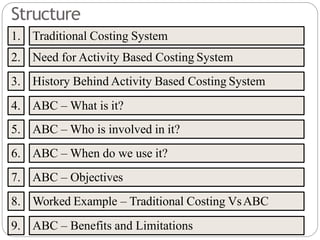
Traditional Costing System
1.
Need for Activity Based Costing System
2.
History Behind Activity Based Costing System
3.
ABC – What is it?
4.
ABC – Who is involved in it?
5.
ABC – When do we use it?
6.
ABC – Objectives
7.
Worked Example – Traditional Costing VsABC
8.
ABC – Benefits and Limitations
9.
Traditional Costing Systems
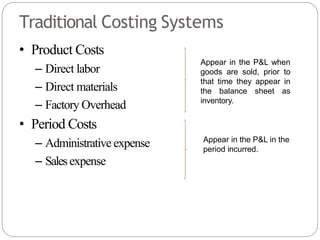
• Product Costs
– Direct labor
– Direct materials
– Factory Overhead
• Period Costs
– Administrative expense
– Salesexpense
Appear in the P&L when
goods are sold, prior to
that time they appear in
the balance sheet as
inventory.
Appear in the P&L in the
period incurred.
Traditional Costing Systems
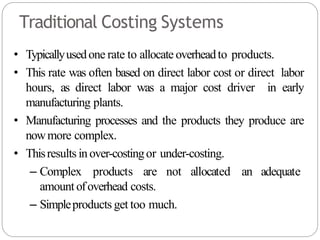
• Typicallyusedone rate to allocate overheadto products.
• This rate was often based on direct labor cost or direct labor
hours, as direct labor was a major cost driver in early
manufacturing plants.
• Manufacturing processes and the products they produce are
nowmore complex.
• Thisresults inover-costingor under-costing.
– Complex products are not allocated an adequate
amount ofoverhead costs.
– Simpleproducts get too much.
Need forABC
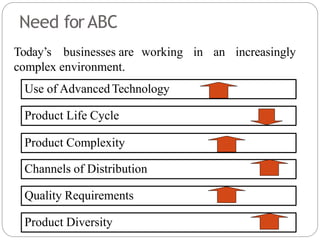
Today’s businesses are working in an increasingly
complex environment.
Use of Advanced Technology
Product Life Cycle
Product Complexity
Channels of Distribution
Quality Requirements
Product Diversity
Need forABC
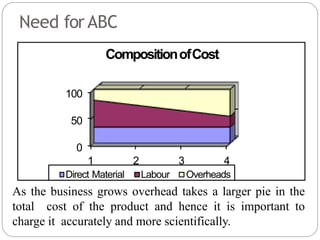
As the business grows overhead takes a larger pie in the
total cost of the product and hence it is important to
charge it accurately and more scientifically.
CompositionofCost
100
50
0
1 2 3 4
Direct Material Labour Overheads
History behind ABC
ABC became practiced in the early 1980’s but it has
really become a force in industry in the mid to late
1990’s.
Most current approaches to ABC are based on
concepts developed by the Computer Aided
Manufacturing-International (CAM-I) Project.
Since then ABC plans have been further developed
and diversified down to mid and small size companies.
ABC – What is it?
ABC is the Activity Based Cost accounting method.
ABC focuses on identifying all activities associated
with making a product or doing a process.
ABC – What is it?
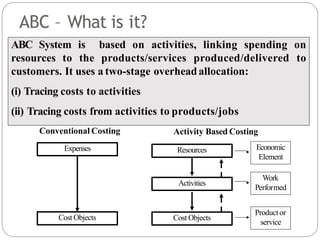
Conventional Costing
Expenses
Cost Objects
Resources
Activities
Cost Objects
Productor
service
Work
Performed
Economic
Element
Activity Based Costing
ABC System is based on activities, linking spending on
resources to the products/services produced/delivered to
customers. It uses a two-stage overheadallocation:
(i) Tracing costs to activities
(ii) Tracing costs from activities to products/jobs
Tracing Cost toActivities
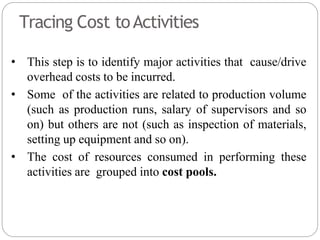
• This step is to identify major activities that cause/drive
overhead costs to be incurred.
• Some of the activities are related to production volume
(such as production runs, salary of supervisors and so
on) but others are not (such as inspection of materials,
setting up equipment and so on).
• The cost of resources consumed in performing these
activities are grouped into cost pools.
Tracing Cost toActivities
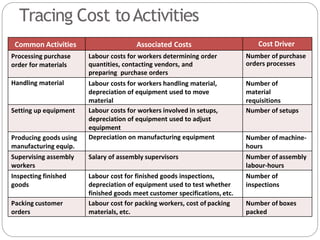
Common Activities Associated Costs Cost Driver
Processing purchase
order for materials
Labour costs for workers determining order
quantities, contacting vendors, and
preparing purchase orders
Number of purchase
orders processes
Handling material Labour costs for workers handling material,
depreciation of equipment used to move
material
Number of
material
requisitions
Setting up equipment Labour costs for workers involved in setups,
depreciation of equipment used to adjust
equipment
Number of setups
Producing goods using
manufacturing equip.
Depreciation on manufacturing equipment Number of machine-
hours
Supervising assembly
workers
Salary of assembly supervisors Number of assembly
labour-hours
Inspecting finished
goods
Labour cost for finished goods inspections,
depreciation of equipment used to test whether
finished goods meet customer specifications, etc.
Number of
inspections
Packing customer
orders
Labour cost for packing workers, cost of packing
materials, etc.
Number of boxes
packed
Tracing Costs from Activities toProducts
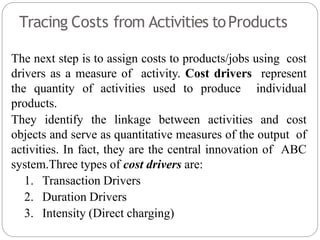
The next step is to assign costs to products/jobs using cost
drivers as a measure of activity. Cost drivers represent
the quantity of activities used to produce individual
products.
They identify the linkage between activities and cost
objects and serve as quantitative measures of the output of
activities. In fact, they are the central innovation of ABC
system.Three types of cost drivers are:
1. Transaction Drivers
2. Duration Drivers
3. Intensity (Direct charging)
Tracing Costs from Activities toProducts
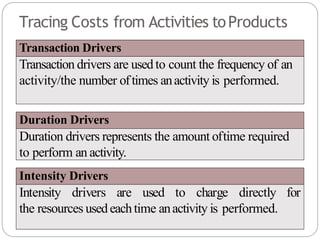
Transaction drivers are usedto count the frequency of an
activity/the number oftimes anactivity is performed.
Duration drivers represents the amount oftime required
to perform an activity.
Intensity drivers are used to charge directly for
the resources usedeachtime anactivity is performed.
Transaction Drivers
Duration Drivers
Intensity Drivers
Who is involved init?
Engineers
Accountants
Management
Factory workers
Supply Chain Management personnel
Sales
……………….EVERYONE!
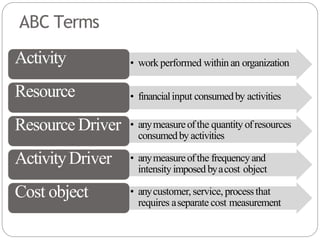
ABC Terms
• work performed within an organization
• financialinput consumedby activities
• anymeasureofthe quantity ofresources
consumedby activities
• anymeasureofthe frequencyand
intensity imposedbyacost object
• anycustomer, service, processthat
requires aseparate cost measurement
Activity
Resource
Resource Driver
ActivityDriver
Cost object
ABC – When do we use it?
• Product lines differ in volume and manufacturing
complexity.
• Product lines are numerous and diverse, and they
require different degrees of support services.
• Overhead costs constitute a significant portion of total
costs.
• The manufacturing process or number of products
for example, has changed significantly - from labor
intensive to capital intensive automation.
ABC – Objectives
1. To rectify the inaccurate cost information.
2. To allocate the overhead on activity basis.
3. To help the management in taking quality and timely
decisions.
ABC – Objectives
• The primary objective of ABC is to assign costs that
reflect / mirror the physical dynamics of the business.
• Provides ways of assigning the costs of indirect support
resources to activities, business processes, customers,
products.
• It recognises that many organisational resources are
required not for physical production of units of product
but to provide a broad array of support activities.
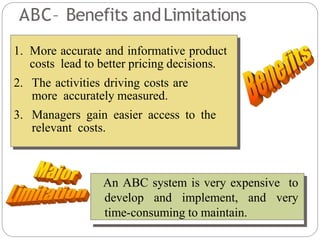
ABC– Benefits andLimitations
1. More accurate and informative product
costs lead to better pricing decisions.
2. The activities driving costs are
more accurately measured.
3. Managers gain easier access to the
relevant costs.
An ABC system is very expensive to
develop and implement, and very
time-consuming to maintain.
Illustration – Traditional Costing System
Montex PenTotal and Product Profitability (Amt. in Rs.)
Particulars
Blue
Pens
Black
Pens
Red
Pens
Purple
Pens
Total
(1) (2) (3) (4) (5)
Production/Sales volume 25,000 20,000 4,500 500 50,000
Unit sale price 45 45 46.5 49.5
Sales (a) 11,25,000 9,00,000 2,09,250 24,750 22,59,000
Material costs 3,75,000 3,00,000 70,200 8,250 7,53,450
Direct labour costs 1,50,000 1,20,000 27,000 3,000 3,00,000
Overheads (300% of Direct
Labour)
4,50,000 3,60,000 81,000 9,000 9,00,000
Total costs (b) 9,75,000 7,80,000 1,78,200 20,250 19,53,450
Total operating income
[(a) – (b)]
1,50,000 1,20,000 31,050 4,500 3,05,550
Return on sales (%) 13.3 13.3 14.8 18.2 13.5
Illustration – Activity Based Costing
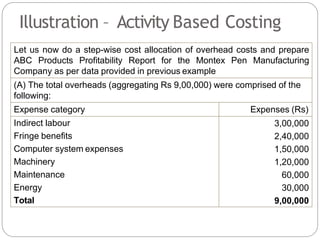
Let us now do a step-wise cost allocation of overhead costs and prepare
ABC Products Profitability Report for the Montex Pen Manufacturing
Company as per data provided in previous example
(A) The total overheads (aggregating Rs 9,00,000) were comprised of the
following:
Expense category Expenses (Rs)
Indirect labour
Fringe benefits
Computer system expenses
Machinery
Maintenance
Energy
Total
3,00,000
2,40,000
1,50,000
1,20,000
60,000
30,000
9,00,000
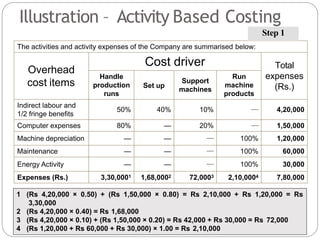
Illustration – Activity Based Costing
The activities and activity expenses of the Company are summarised below:
Overhead
cost items
Cost driver Total
expenses
(Rs.)
Handle
production
runs
Set up
Support
machines
Run
machine
products
Indirect labour and
1/2 fringe benefits
50% 40% 10% — 4,20,000
Computer expenses 80% — 20% — 1,50,000
Machine depreciation — — — 100% 1,20,000
Maintenance — — — 100% 60,000
Energy Activity — — — 100% 30,000
Expenses (Rs.) 3,30,0001 1,68,0002 72,0003 2,10,0004 7,80,000
1 (Rs 4,20,000 × 0.50) + (Rs 1,50,000 × 0.80) = Rs 2,10,000 + Rs 1,20,000 = Rs
3,30,000
2 (Rs 4,20,000 × 0.40) = Rs 1,68,000
3 (Rs 4,20,000 × 0.10) + (Rs 1,50,000 × 0.20) = Rs 42,000 + Rs 30,000 = Rs 72,000
4 (Rs 1,20,000 + Rs 60,000 + Rs 30,000) × 1.00 = Rs 2,10,000
Step 1
Illustration – Activity Based Costing
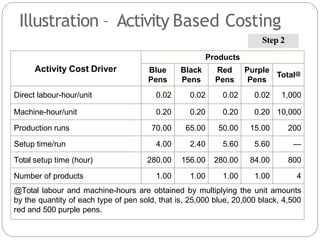
Activity Cost Driver
Products
Blue
Pens
Black
Pens
Red
Pens
Purple
Pens
Total@
Direct labour-hour/unit 0.02 0.02 0.02 0.02 1,000
Machine-hour/unit 0.20 0.20 0.20 0.20 10,000
Production runs 70.00 65.00 50.00 15.00 200
Setup time/run 4.00 2.40 5.60 5.60 —
Total setup time (hour) 280.00 156.00 280.00 84.00 800
Number of products 1.00 1.00 1.00 1.00 4
@Total labour and machine-hours are obtained by multiplying the unit amounts
by the quantity of each type of pen sold, that is, 25,000 blue, 20,000 black, 4,500
red and 500 purple pens.
Step 2
Illustration – Activity Based Costing
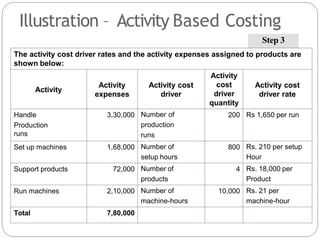
Step 3
The activity cost driver rates and the activity expenses assigned to products are
shown below:
Activity
Activity
expenses
Activity cost
driver
Activity
cost
driver
quantity
Activity cost
driver rate
Handle
Production
runs
3,30,000 Number of
production
runs
200 Rs 1,650 per run
Set up machines 1,68,000 Number of
setup hours
800 Rs. 210 per setup
Hour
Support products 72,000 Number of
products
4 Rs. 18,000 per
Product
Run machines 2,10,000 Number of
machine-hours
10,000 Rs. 21 per
machine-hour
Total 7,80,000
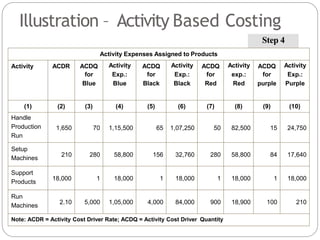
Illustration – Activity Based Costing
Step 4
Activity Expenses Assigned to Products
Activity ACDR ACDQ
for
Blue
Activity
Exp.:
Blue
ACDQ
for
Black
Activity
Exp.:
Black
ACDQ
for
Red
Activity
exp.:
Red
ACDQ
for
purple
Activity
Exp.:
Purple
(1) (2) (3) (4) (5) (6) (7) (8) (9) (10)
Handle
Production
Run
1,650 70 1,15,500 65 1,07,250 50 82,500 15 24,750
Setup
Machines
210 280 58,800 156 32,760 280 58,800 84 17,640
Support
Products
18,000 1 18,000 1 18,000 1 18,000 1 18,000
Run
Machines
2.10 5,000 1,05,000 4,000 84,000 900 18,900 100 210
Note: ACDR = Activity Cost Driver Rate; ACDQ = Activity Cost Driver Quantity
Illustration – Activity Based Costing
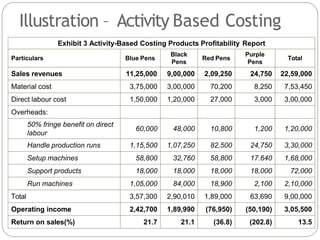
Exhibit 3 Activity-Based Costing Products Profitability Report
Particulars Blue Pens
Black
Pens
Red Pens
Purple
Pens
Total
Sales revenues 11,25,000 9,00,000 2,09,250 24,750 22,59,000
Material cost 3,75,000 3,00,000 70,200 8,250 7,53,450
Direct labour cost 1,50,000 1,20,000 27,000 3,000 3,00,000
Overheads:
50% fringe benefit on direct
labour
60,000 48,000 10,800 1,200 1,20,000
Handle production runs 1,15,500 1,07,250 82,500 24,750 3,30,000
Setup machines 58,800 32,760 58,800 17.640 1,68,000
Support products 18,000 18,000 18,000 18,000 72,000
Run machines 1,05,000 84,000 18,900 2,100 2,10,000
Total 3,57,300 2,90,010 1,89,000 63,690 9,00,000
Operating income 2,42,700 1,89,990 (76,950) (50,190) 3,05,500
Return on sales(%) 21.7 21.1 (36.8) (202.8) 13.5
Thank you

Activity Based Costing.pptx

  • 1.
  • 2.
    Structure Traditional Costing System 1. Needfor Activity Based Costing System 2. History Behind Activity Based Costing System 3. ABC – What is it? 4. ABC – Who is involved in it? 5. ABC – When do we use it? 6. ABC – Objectives 7. Worked Example – Traditional Costing VsABC 8. ABC – Benefits and Limitations 9.
  • 3.
    Traditional Costing Systems •Product Costs – Direct labor – Direct materials – Factory Overhead • Period Costs – Administrative expense – Salesexpense Appear in the P&L when goods are sold, prior to that time they appear in the balance sheet as inventory. Appear in the P&L in the period incurred.
  • 4.
    Traditional Costing Systems •Typicallyusedone rate to allocate overheadto products. • This rate was often based on direct labor cost or direct labor hours, as direct labor was a major cost driver in early manufacturing plants. • Manufacturing processes and the products they produce are nowmore complex. • Thisresults inover-costingor under-costing. – Complex products are not allocated an adequate amount ofoverhead costs. – Simpleproducts get too much.
  • 5.
    Need forABC Today’s businessesare working in an increasingly complex environment. Use of Advanced Technology Product Life Cycle Product Complexity Channels of Distribution Quality Requirements Product Diversity
  • 6.
    Need forABC As thebusiness grows overhead takes a larger pie in the total cost of the product and hence it is important to charge it accurately and more scientifically. CompositionofCost 100 50 0 1 2 3 4 Direct Material Labour Overheads
  • 7.
    History behind ABC ABCbecame practiced in the early 1980’s but it has really become a force in industry in the mid to late 1990’s. Most current approaches to ABC are based on concepts developed by the Computer Aided Manufacturing-International (CAM-I) Project. Since then ABC plans have been further developed and diversified down to mid and small size companies.
  • 8.
    ABC – Whatis it? ABC is the Activity Based Cost accounting method. ABC focuses on identifying all activities associated with making a product or doing a process.
  • 9.
    ABC – Whatis it? Conventional Costing Expenses Cost Objects Resources Activities Cost Objects Productor service Work Performed Economic Element Activity Based Costing ABC System is based on activities, linking spending on resources to the products/services produced/delivered to customers. It uses a two-stage overheadallocation: (i) Tracing costs to activities (ii) Tracing costs from activities to products/jobs
  • 10.
    Tracing Cost toActivities •This step is to identify major activities that cause/drive overhead costs to be incurred. • Some of the activities are related to production volume (such as production runs, salary of supervisors and so on) but others are not (such as inspection of materials, setting up equipment and so on). • The cost of resources consumed in performing these activities are grouped into cost pools.
  • 11.
    Tracing Cost toActivities CommonActivities Associated Costs Cost Driver Processing purchase order for materials Labour costs for workers determining order quantities, contacting vendors, and preparing purchase orders Number of purchase orders processes Handling material Labour costs for workers handling material, depreciation of equipment used to move material Number of material requisitions Setting up equipment Labour costs for workers involved in setups, depreciation of equipment used to adjust equipment Number of setups Producing goods using manufacturing equip. Depreciation on manufacturing equipment Number of machine- hours Supervising assembly workers Salary of assembly supervisors Number of assembly labour-hours Inspecting finished goods Labour cost for finished goods inspections, depreciation of equipment used to test whether finished goods meet customer specifications, etc. Number of inspections Packing customer orders Labour cost for packing workers, cost of packing materials, etc. Number of boxes packed
  • 12.
    Tracing Costs fromActivities toProducts The next step is to assign costs to products/jobs using cost drivers as a measure of activity. Cost drivers represent the quantity of activities used to produce individual products. They identify the linkage between activities and cost objects and serve as quantitative measures of the output of activities. In fact, they are the central innovation of ABC system.Three types of cost drivers are: 1. Transaction Drivers 2. Duration Drivers 3. Intensity (Direct charging)
  • 13.
    Tracing Costs fromActivities toProducts Transaction drivers are usedto count the frequency of an activity/the number oftimes anactivity is performed. Duration drivers represents the amount oftime required to perform an activity. Intensity drivers are used to charge directly for the resources usedeachtime anactivity is performed. Transaction Drivers Duration Drivers Intensity Drivers
  • 14.
    Who is involvedinit? Engineers Accountants Management Factory workers Supply Chain Management personnel Sales ……………….EVERYONE!
  • 15.
    ABC Terms • workperformed within an organization • financialinput consumedby activities • anymeasureofthe quantity ofresources consumedby activities • anymeasureofthe frequencyand intensity imposedbyacost object • anycustomer, service, processthat requires aseparate cost measurement Activity Resource Resource Driver ActivityDriver Cost object
  • 16.
    ABC – Whendo we use it? • Product lines differ in volume and manufacturing complexity. • Product lines are numerous and diverse, and they require different degrees of support services. • Overhead costs constitute a significant portion of total costs. • The manufacturing process or number of products for example, has changed significantly - from labor intensive to capital intensive automation.
  • 17.
    ABC – Objectives 1.To rectify the inaccurate cost information. 2. To allocate the overhead on activity basis. 3. To help the management in taking quality and timely decisions.
  • 18.
    ABC – Objectives •The primary objective of ABC is to assign costs that reflect / mirror the physical dynamics of the business. • Provides ways of assigning the costs of indirect support resources to activities, business processes, customers, products. • It recognises that many organisational resources are required not for physical production of units of product but to provide a broad array of support activities.
  • 19.
    ABC– Benefits andLimitations 1.More accurate and informative product costs lead to better pricing decisions. 2. The activities driving costs are more accurately measured. 3. Managers gain easier access to the relevant costs. An ABC system is very expensive to develop and implement, and very time-consuming to maintain.
  • 20.
    Illustration – TraditionalCosting System Montex PenTotal and Product Profitability (Amt. in Rs.) Particulars Blue Pens Black Pens Red Pens Purple Pens Total (1) (2) (3) (4) (5) Production/Sales volume 25,000 20,000 4,500 500 50,000 Unit sale price 45 45 46.5 49.5 Sales (a) 11,25,000 9,00,000 2,09,250 24,750 22,59,000 Material costs 3,75,000 3,00,000 70,200 8,250 7,53,450 Direct labour costs 1,50,000 1,20,000 27,000 3,000 3,00,000 Overheads (300% of Direct Labour) 4,50,000 3,60,000 81,000 9,000 9,00,000 Total costs (b) 9,75,000 7,80,000 1,78,200 20,250 19,53,450 Total operating income [(a) – (b)] 1,50,000 1,20,000 31,050 4,500 3,05,550 Return on sales (%) 13.3 13.3 14.8 18.2 13.5
  • 21.
    Illustration – ActivityBased Costing Let us now do a step-wise cost allocation of overhead costs and prepare ABC Products Profitability Report for the Montex Pen Manufacturing Company as per data provided in previous example (A) The total overheads (aggregating Rs 9,00,000) were comprised of the following: Expense category Expenses (Rs) Indirect labour Fringe benefits Computer system expenses Machinery Maintenance Energy Total 3,00,000 2,40,000 1,50,000 1,20,000 60,000 30,000 9,00,000
  • 22.
    Illustration – ActivityBased Costing The activities and activity expenses of the Company are summarised below: Overhead cost items Cost driver Total expenses (Rs.) Handle production runs Set up Support machines Run machine products Indirect labour and 1/2 fringe benefits 50% 40% 10% — 4,20,000 Computer expenses 80% — 20% — 1,50,000 Machine depreciation — — — 100% 1,20,000 Maintenance — — — 100% 60,000 Energy Activity — — — 100% 30,000 Expenses (Rs.) 3,30,0001 1,68,0002 72,0003 2,10,0004 7,80,000 1 (Rs 4,20,000 × 0.50) + (Rs 1,50,000 × 0.80) = Rs 2,10,000 + Rs 1,20,000 = Rs 3,30,000 2 (Rs 4,20,000 × 0.40) = Rs 1,68,000 3 (Rs 4,20,000 × 0.10) + (Rs 1,50,000 × 0.20) = Rs 42,000 + Rs 30,000 = Rs 72,000 4 (Rs 1,20,000 + Rs 60,000 + Rs 30,000) × 1.00 = Rs 2,10,000 Step 1
  • 23.
    Illustration – ActivityBased Costing Activity Cost Driver Products Blue Pens Black Pens Red Pens Purple Pens Total@ Direct labour-hour/unit 0.02 0.02 0.02 0.02 1,000 Machine-hour/unit 0.20 0.20 0.20 0.20 10,000 Production runs 70.00 65.00 50.00 15.00 200 Setup time/run 4.00 2.40 5.60 5.60 — Total setup time (hour) 280.00 156.00 280.00 84.00 800 Number of products 1.00 1.00 1.00 1.00 4 @Total labour and machine-hours are obtained by multiplying the unit amounts by the quantity of each type of pen sold, that is, 25,000 blue, 20,000 black, 4,500 red and 500 purple pens. Step 2
  • 24.
    Illustration – ActivityBased Costing Step 3 The activity cost driver rates and the activity expenses assigned to products are shown below: Activity Activity expenses Activity cost driver Activity cost driver quantity Activity cost driver rate Handle Production runs 3,30,000 Number of production runs 200 Rs 1,650 per run Set up machines 1,68,000 Number of setup hours 800 Rs. 210 per setup Hour Support products 72,000 Number of products 4 Rs. 18,000 per Product Run machines 2,10,000 Number of machine-hours 10,000 Rs. 21 per machine-hour Total 7,80,000
  • 25.
    Illustration – ActivityBased Costing Step 4 Activity Expenses Assigned to Products Activity ACDR ACDQ for Blue Activity Exp.: Blue ACDQ for Black Activity Exp.: Black ACDQ for Red Activity exp.: Red ACDQ for purple Activity Exp.: Purple (1) (2) (3) (4) (5) (6) (7) (8) (9) (10) Handle Production Run 1,650 70 1,15,500 65 1,07,250 50 82,500 15 24,750 Setup Machines 210 280 58,800 156 32,760 280 58,800 84 17,640 Support Products 18,000 1 18,000 1 18,000 1 18,000 1 18,000 Run Machines 2.10 5,000 1,05,000 4,000 84,000 900 18,900 100 210 Note: ACDR = Activity Cost Driver Rate; ACDQ = Activity Cost Driver Quantity
  • 26.
    Illustration – ActivityBased Costing Exhibit 3 Activity-Based Costing Products Profitability Report Particulars Blue Pens Black Pens Red Pens Purple Pens Total Sales revenues 11,25,000 9,00,000 2,09,250 24,750 22,59,000 Material cost 3,75,000 3,00,000 70,200 8,250 7,53,450 Direct labour cost 1,50,000 1,20,000 27,000 3,000 3,00,000 Overheads: 50% fringe benefit on direct labour 60,000 48,000 10,800 1,200 1,20,000 Handle production runs 1,15,500 1,07,250 82,500 24,750 3,30,000 Setup machines 58,800 32,760 58,800 17.640 1,68,000 Support products 18,000 18,000 18,000 18,000 72,000 Run machines 1,05,000 84,000 18,900 2,100 2,10,000 Total 3,57,300 2,90,010 1,89,000 63,690 9,00,000 Operating income 2,42,700 1,89,990 (76,950) (50,190) 3,05,500 Return on sales(%) 21.7 21.1 (36.8) (202.8) 13.5
  • 27.