An acid (from the Latin acidus/acēre meaning sour) is a substance
which reacts with a base. Commonly, acids can be identified as tasting
sour, reacting with metals such as calcium, and bases like sodium
carbonate. Aqueous acids have a pH of less than 7, where an acid of lower
pH is typically stronger. Chemicals or substances having the property of an
acid are said to be acidic.
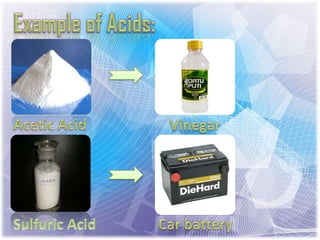
Common examples of acids include
acetic acid (in vinegar), sulfuric acid (used in car
batteries), and tartaric acid (used in baking). As
these three examples show, acids can be
solutions, liquids or solids. Gases such as hydrogen
chloride can be acids as well. Strong acids and
some concentrated weak acids are corrosive, but
there are exceptions such as carboranes and
boric acid.
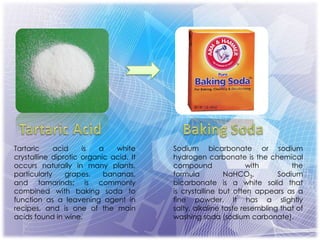
Tartaric acid is a white
crystalline diprotic organic acid. It
occurs naturally in many plants,
particularly grapes, bananas,
and tamarinds; is commonly
combined with baking soda to
function as a leavening agent in
recipes, and is one of the main
acids found in wine.
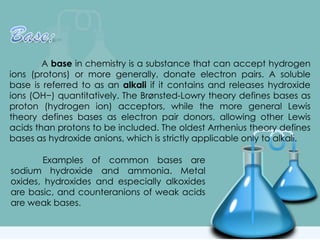
Sodium bicarbonate or sodium
hydrogen carbonate is the chemical
compound with the
formula NaHCO3. Sodium
bicarbonate is a white solid that
is crystalline but often appears as a
fine powder. It has a slightly
salty, alkaline taste resembling that of
washing soda (sodium carbonate).
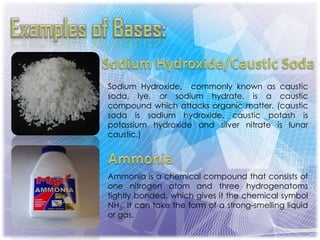
A base in chemistry is a substance that can accept hydrogen
ions (protons) or more generally, donate electron pairs. A soluble
base is referred to as an alkali if it contains and releases hydroxide
ions (OH−) quantitatively. The Brønsted-Lowry theory defines bases as
proton (hydrogen ion) acceptors, while the more general Lewis
theory defines bases as electron pair donors, allowing other Lewis
acids than protons to be included. The oldest Arrhenius theory defines
bases as hydroxide anions, which is strictly applicable only to alkali.
Examples of common bases are
sodium hydroxide and ammonia. Metal
oxides, hydroxides and especially alkoxides
are basic, and counteranions of weak acids
are weak bases.
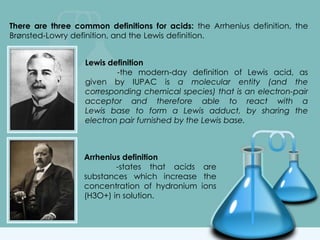
Sodium Hydroxide, commonly known as caustic
soda, lye, or sodium hydrate, is a caustic
compound which attacks organic matter. (caustic
soda is sodium hydroxide, caustic potash is
potassium hydroxide and silver nitrate is lunar
caustic.)
Ammonia is a chemical compound that consists of
one nitrogen atom and three hydrogenatoms
tightly bonded, which gives it the chemical symbol
NH3. It can take the form of a strong-smelling liquid
or gas.
There are three common definitions for acids: the Arrhenius definition, the
Brønsted-Lowry definition, and the Lewis definition.
Arrhenius definition
-states that acids are
substances which increase the
concentration of hydronium ions
(H3O+) in solution.
Lewis definition
-the modern-day definition of Lewis acid, as
given by IUPAC is a molecular entity (and the
corresponding chemical species) that is an electron-pair
acceptor and therefore able to react with a
Lewis base to form a Lewis adduct, by sharing the
electron pair furnished by the Lewis base.
Brønsted-Lowry definition
-it is an expansion: an acid is a substance
which can act as a proton donor. Most acids
encountered in everyday life are aqueous solutions,
or can be dissolved in water, and these two
definitions are most relevant. The reason why pHs of
acids are less than 7 is that the concentration of
hydronium ions is greater than 10−7 moles per liter.
Since pH is defined as the negative logarithm of
the concentration of hydronium ions, acids thus
have pHs of less than 7. By the Brønsted-Lowry
definition, any compound which can easily be
deprotonated can be considered an acid.
Examples include alcohols and amines which
contain O-H or N-H fragments.
An acid–base reaction is a
chemical reaction that occurs between
an acid and a base. Several concepts
that provide alternative definitions for the
reaction mechanisms involved and their
application in solving related problems
exist. Despite several differences in
definitions, their importance becomes
apparent as different methods of analysis
when applied to acid–base reactions for
gaseous or liquid species, or when acid or
base character may be somewhat less
apparent. The first of these scientific
concepts of acids and bases was
provided by the French chemist Antoine
Lavoisier, circa 1776.
Antoine-Laurent de Lavoisier (also Antoine
Lavoisier after the French Revolution; 26 August
1743 – 8 May 1794; French
pronunciation: [ twan lɔʁɑ də lavwazje]), the
"father of modern chemistry",[1] was a French
nobleman prominent in the histories of
chemistry and biology. He named both oxygen
(1778) and hydrogen (1783) and helped
construct the metric system, put together the
first extensive list of elements, and helped to
reform chemical nomenclature.
He was also the first to establish that
sulfur was an element (1777) rather than a
compound. He discovered that, although
matter may change its form or shape, its mass
always remains the same.
What You Need:
Baking Soda, Paper, Water, Light Bulb (heat
source), Paintbrush or Swab, Measuring Cup,
Purple Grape Juice (optional)
Sodium bicarbonate or sodium hydrogen carbonate is the chemical
compound with the formula NaHCO3. Sodium bicarbonate is a white solid
that is crystalline but often appears as a fine powder. It has a slightly salty,
alkaline taste resembling that of washing soda (sodium carbonate). The
natural mineral form is nahcolite. It is a component of the mineral natron and
is found dissolved in many mineral springs.
Since it has long been known and is widely used,
the salt has many related names such as baking soda,
bread soda, cooking soda, and bicarbonate of soda. In
colloquial usage, its name is shortened to sodium bicarb,
bicarb soda, or simply bicarb.
Grape juice is obtained from crushing and
blending grapes into a liquid. The juice is often
sold in stores or fermented and made into wine,
brandy, or vinegar.
The incandescent light bulb, incandescent lamp or incandescent
light globe produces light by heating a filament wire to a high temperature
until it glows. The hot filament is protected from oxidation in the air with a
glass enclosure that is filled with inert gas or evacuated. In a halogen lamp,
filament evaporation is prevented by a chemical process that redeposits
metal vapor onto the filament, extending its life. The light bulb is supplied
with electrical current by feed-through terminals or wires embedded in the
glass. Most bulbs are used in a socket which provides mechanical support
and electrical connections.
Water is a chemical substance with the
chemical formula H2O. A water molecule
contains one oxygen and two hydrogen atoms
connected by covalent bonds. Water is a liquid
at ambient conditions, but it often co-exists on
Earth with its solid state, ice, and gaseous state
(water vapor or steam). Water also exists in a
liquid crystal state near hydrophilic surfaces.
Under nomenclature used to name chemical
compounds, Dihydrogen monoxide is the
scientific name for water, though it is almost
never used.
1. There are at least two methods to use baking soda as an invisible ink. Mix
equal parts water and baking soda.
2. Use a cotton swab, toothpick, or paintbrush to write a message onto white
paper, using the baking soda solution as 'ink'.
3. Allow the ink to dry.
4. One way to read the message is to hold the
paper up to a heat source, such as a light bulb.
The baking soda will cause the writing in the
paper to turn brown.
5. A second method to read the message is to
paint over the paper with purple grape juice. The
message will appear in a different color.
If you are using the heating method,
avoid igniting the paper - don't use a
halogen bulb.
Baking soda and grape juice react
with each other in an acid-base reaction,
producing a color change in the paper.
The baking soda mixture can also be
used more diluted, with one part baking
soda to two parts water.
Grape juice concentrate results in a
more visible color change than regular
grape juice.
Acid- base Reaction

Acid- base Reaction

  • 3.
    An acid (fromthe Latin acidus/acēre meaning sour) is a substance which reacts with a base. Commonly, acids can be identified as tasting sour, reacting with metals such as calcium, and bases like sodium carbonate. Aqueous acids have a pH of less than 7, where an acid of lower pH is typically stronger. Chemicals or substances having the property of an acid are said to be acidic. Common examples of acids include acetic acid (in vinegar), sulfuric acid (used in car batteries), and tartaric acid (used in baking). As these three examples show, acids can be solutions, liquids or solids. Gases such as hydrogen chloride can be acids as well. Strong acids and some concentrated weak acids are corrosive, but there are exceptions such as carboranes and boric acid.
  • 5.
    Tartaric acid isa white crystalline diprotic organic acid. It occurs naturally in many plants, particularly grapes, bananas, and tamarinds; is commonly combined with baking soda to function as a leavening agent in recipes, and is one of the main acids found in wine. Sodium bicarbonate or sodium hydrogen carbonate is the chemical compound with the formula NaHCO3. Sodium bicarbonate is a white solid that is crystalline but often appears as a fine powder. It has a slightly salty, alkaline taste resembling that of washing soda (sodium carbonate).
  • 6.
    A base inchemistry is a substance that can accept hydrogen ions (protons) or more generally, donate electron pairs. A soluble base is referred to as an alkali if it contains and releases hydroxide ions (OH−) quantitatively. The Brønsted-Lowry theory defines bases as proton (hydrogen ion) acceptors, while the more general Lewis theory defines bases as electron pair donors, allowing other Lewis acids than protons to be included. The oldest Arrhenius theory defines bases as hydroxide anions, which is strictly applicable only to alkali. Examples of common bases are sodium hydroxide and ammonia. Metal oxides, hydroxides and especially alkoxides are basic, and counteranions of weak acids are weak bases.
  • 7.
    Sodium Hydroxide, commonlyknown as caustic soda, lye, or sodium hydrate, is a caustic compound which attacks organic matter. (caustic soda is sodium hydroxide, caustic potash is potassium hydroxide and silver nitrate is lunar caustic.) Ammonia is a chemical compound that consists of one nitrogen atom and three hydrogenatoms tightly bonded, which gives it the chemical symbol NH3. It can take the form of a strong-smelling liquid or gas.
  • 8.
    There are threecommon definitions for acids: the Arrhenius definition, the Brønsted-Lowry definition, and the Lewis definition. Arrhenius definition -states that acids are substances which increase the concentration of hydronium ions (H3O+) in solution. Lewis definition -the modern-day definition of Lewis acid, as given by IUPAC is a molecular entity (and the corresponding chemical species) that is an electron-pair acceptor and therefore able to react with a Lewis base to form a Lewis adduct, by sharing the electron pair furnished by the Lewis base.
  • 9.
    Brønsted-Lowry definition -it isan expansion: an acid is a substance which can act as a proton donor. Most acids encountered in everyday life are aqueous solutions, or can be dissolved in water, and these two definitions are most relevant. The reason why pHs of acids are less than 7 is that the concentration of hydronium ions is greater than 10−7 moles per liter. Since pH is defined as the negative logarithm of the concentration of hydronium ions, acids thus have pHs of less than 7. By the Brønsted-Lowry definition, any compound which can easily be deprotonated can be considered an acid. Examples include alcohols and amines which contain O-H or N-H fragments.
  • 10.
    An acid–base reactionis a chemical reaction that occurs between an acid and a base. Several concepts that provide alternative definitions for the reaction mechanisms involved and their application in solving related problems exist. Despite several differences in definitions, their importance becomes apparent as different methods of analysis when applied to acid–base reactions for gaseous or liquid species, or when acid or base character may be somewhat less apparent. The first of these scientific concepts of acids and bases was provided by the French chemist Antoine Lavoisier, circa 1776.
  • 11.
    Antoine-Laurent de Lavoisier(also Antoine Lavoisier after the French Revolution; 26 August 1743 – 8 May 1794; French pronunciation: [ twan lɔʁɑ də lavwazje]), the "father of modern chemistry",[1] was a French nobleman prominent in the histories of chemistry and biology. He named both oxygen (1778) and hydrogen (1783) and helped construct the metric system, put together the first extensive list of elements, and helped to reform chemical nomenclature. He was also the first to establish that sulfur was an element (1777) rather than a compound. He discovered that, although matter may change its form or shape, its mass always remains the same.
  • 12.
    What You Need: BakingSoda, Paper, Water, Light Bulb (heat source), Paintbrush or Swab, Measuring Cup, Purple Grape Juice (optional)
  • 13.
    Sodium bicarbonate orsodium hydrogen carbonate is the chemical compound with the formula NaHCO3. Sodium bicarbonate is a white solid that is crystalline but often appears as a fine powder. It has a slightly salty, alkaline taste resembling that of washing soda (sodium carbonate). The natural mineral form is nahcolite. It is a component of the mineral natron and is found dissolved in many mineral springs. Since it has long been known and is widely used, the salt has many related names such as baking soda, bread soda, cooking soda, and bicarbonate of soda. In colloquial usage, its name is shortened to sodium bicarb, bicarb soda, or simply bicarb. Grape juice is obtained from crushing and blending grapes into a liquid. The juice is often sold in stores or fermented and made into wine, brandy, or vinegar.
  • 14.
    The incandescent lightbulb, incandescent lamp or incandescent light globe produces light by heating a filament wire to a high temperature until it glows. The hot filament is protected from oxidation in the air with a glass enclosure that is filled with inert gas or evacuated. In a halogen lamp, filament evaporation is prevented by a chemical process that redeposits metal vapor onto the filament, extending its life. The light bulb is supplied with electrical current by feed-through terminals or wires embedded in the glass. Most bulbs are used in a socket which provides mechanical support and electrical connections. Water is a chemical substance with the chemical formula H2O. A water molecule contains one oxygen and two hydrogen atoms connected by covalent bonds. Water is a liquid at ambient conditions, but it often co-exists on Earth with its solid state, ice, and gaseous state (water vapor or steam). Water also exists in a liquid crystal state near hydrophilic surfaces. Under nomenclature used to name chemical compounds, Dihydrogen monoxide is the scientific name for water, though it is almost never used.
  • 15.
    1. There areat least two methods to use baking soda as an invisible ink. Mix equal parts water and baking soda. 2. Use a cotton swab, toothpick, or paintbrush to write a message onto white paper, using the baking soda solution as 'ink'. 3. Allow the ink to dry. 4. One way to read the message is to hold the paper up to a heat source, such as a light bulb. The baking soda will cause the writing in the paper to turn brown. 5. A second method to read the message is to paint over the paper with purple grape juice. The message will appear in a different color.
  • 17.
    If you areusing the heating method, avoid igniting the paper - don't use a halogen bulb. Baking soda and grape juice react with each other in an acid-base reaction, producing a color change in the paper. The baking soda mixture can also be used more diluted, with one part baking soda to two parts water. Grape juice concentrate results in a more visible color change than regular grape juice.