FATTY ALCOHOLS
Prepared by:
Nurul Afifah Binti Mohd Yusoff
2013275464
EH110 4B
Faculty of Chemical Engineering
Lecturer’s name : Miss NorKamruzita Saadon
 Define fatty alcohols
 Describe the production processes of fatty
alcohols and its derivatives
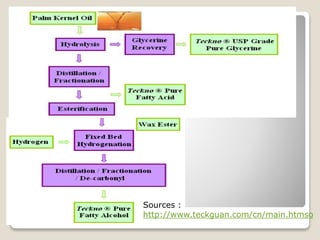
 Draw the flow chart of fatty alcohol
production
 Explain the uses and application of fatty
alcohols.
Definitionof Fatty Alcohols
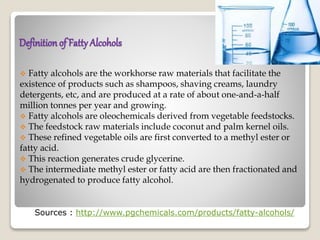
 Fatty alcohols are the workhorse raw materials that facilitate the
existence of products such as shampoos, shaving creams, laundry
detergents, etc, and are produced at a rate of about one-and-a-half
million tonnes per year and growing.
 Fatty alcohols are oleochemicals derived from vegetable feedstocks.
 The feedstock raw materials include coconut and palm kernel oils.
 These refined vegetable oils are first converted to a methyl ester or
fatty acid.
 This reaction generates crude glycerine.
 The intermediate methyl ester or fatty acid are then fractionated and
hydrogenated to produce fatty alcohol.
Sources : http://www.pgchemicals.com/products/fatty-alcohols/
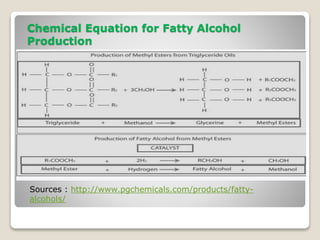
Chemical Equation for Fatty Alcohol
Production
Sources : http://www.pgchemicals.com/products/fatty-
alcohols/
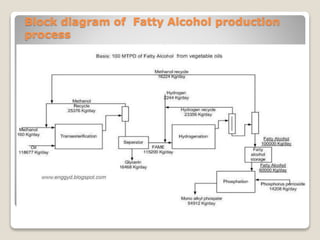
Block diagram of Fatty Alcohol production
process
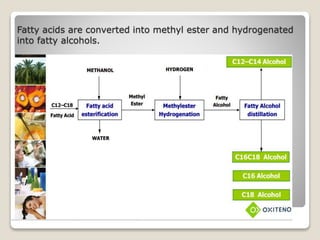
Fatty acids are converted into methyl ester and hydrogenated
into fatty alcohols.
Sources :
http://www.abq.org.br/workshop/11/ADRIANO-
SALES-%20FIRJAM_Oleochemicals-from-Palm-Kernel-
Oil.pdf
Hydrogenation
 All natural fatty alcohol processes are based on renewable
fats and oils like coconut, palm oil,palm kernel,rope seed
and soya bean oil.
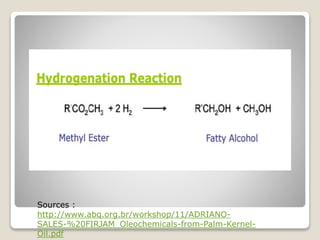
 It has been proven that hydrogenation of methyl esters are
preferred alternatives than hydrogenating the oils directly.
 Using fixed bed hydrogenation process offers the
advantage of lower hydrogenation temperatures and
pressures.
 Using special catalysts, this process is able to produce
unsaturated fatty alcohols too.
 To produce fatty alcohols, there are three routes which is
acid route,ester route and wax ester route that are shown
in the following block diagrams.
- Acid route
- Ester route
- Wax ester route
Acid Route
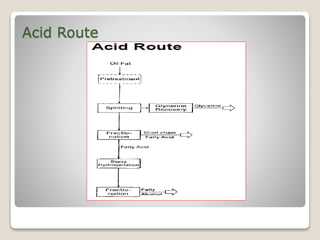
Acid route
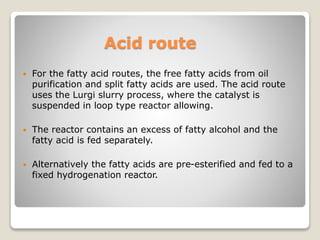
 For the fatty acid routes, the free fatty acids from oil
purification and split fatty acids are used. The acid route
uses the Lurgi slurry process, where the catalyst is
suspended in loop type reactor allowing.
 The reactor contains an excess of fatty alcohol and the
fatty acid is fed separately.
 Alternatively the fatty acids are pre-esterified and fed to a
fixed hydrogenation reactor.
Ester route
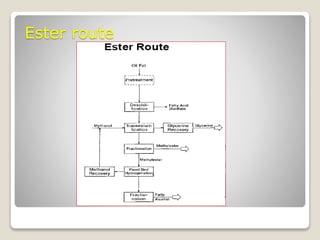
Ester route
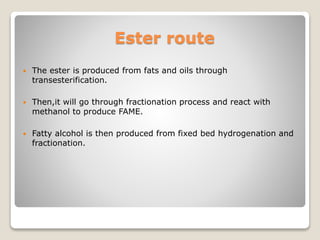
 The ester is produced from fats and oils through
transesterification.
 Then,it will go through fractionation process and react with
methanol to produce FAME.
 Fatty alcohol is then produced from fixed bed hydrogenation and
fractionation.
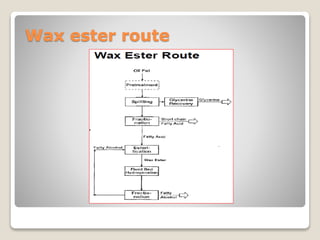
Wax ester route
Wax Ester route
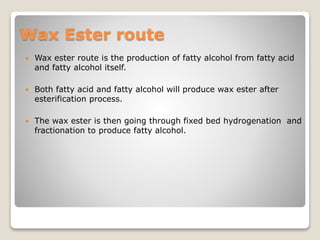
 Wax ester route is the production of fatty alcohol from fatty acid
and fatty alcohol itself.
 Both fatty acid and fatty alcohol will produce wax ester after
esterification process.
 The wax ester is then going through fixed bed hydrogenation and
fractionation to produce fatty alcohol.
Sources :
http://www.teckguan.com/cn/main.htmso
Uses and applications of fatty
alcohols
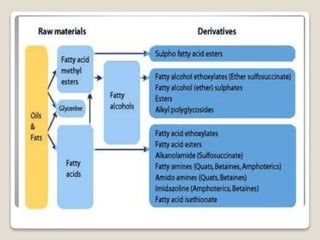
 Fatty Alcohols are widely used in surfactant,
in the form of fatty alcohol ethoxylates, fatty
alcohol sulfates and fatty alcohol ethoxy
sulfates. They are commonly found in
personal care, oral care, laundry detergents,
dish washing liquid, surface cleaners,
cosmetics creams and lotions.
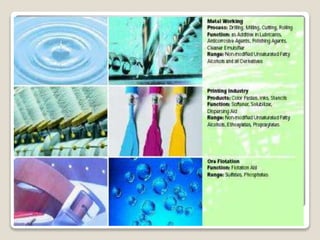
 Other industrial application includes anti
oxidant, falvour & fragrances, fabric softener,
plasticizer, metal working and agro chemical
intermediate.
Sources :
http://www.ecogreenoleo.com/products.html
REFERENCES
 http://www.pgchemicals.com/products/fatty-
alcohols
 http://www.pgchemicals.com/products/fatty-
alcohols/
 http://en.wikipedia.org/wiki/Palm_kernel_oil
 http://www.abq.org.br/workshop/11/ADRIAN
O-SALES-%20FIRJAM_Oleochemicals-from-
Palm-Kernel-Oil.pdf
 http://link.springer.com/article/10.1007%2Fs
11746-999-0151-y
 http://www.teckguan.com/cn/main.htmso
 http://www.ecogreenoleo.com/products.html
Fatty alcohol

Fatty alcohol

  • 1.
    FATTY ALCOHOLS Prepared by: NurulAfifah Binti Mohd Yusoff 2013275464 EH110 4B Faculty of Chemical Engineering Lecturer’s name : Miss NorKamruzita Saadon
  • 2.
     Define fattyalcohols  Describe the production processes of fatty alcohols and its derivatives  Draw the flow chart of fatty alcohol production  Explain the uses and application of fatty alcohols.
  • 3.
    Definitionof Fatty Alcohols Fatty alcohols are the workhorse raw materials that facilitate the existence of products such as shampoos, shaving creams, laundry detergents, etc, and are produced at a rate of about one-and-a-half million tonnes per year and growing.  Fatty alcohols are oleochemicals derived from vegetable feedstocks.  The feedstock raw materials include coconut and palm kernel oils.  These refined vegetable oils are first converted to a methyl ester or fatty acid.  This reaction generates crude glycerine.  The intermediate methyl ester or fatty acid are then fractionated and hydrogenated to produce fatty alcohol. Sources : http://www.pgchemicals.com/products/fatty-alcohols/
  • 4.
    Chemical Equation forFatty Alcohol Production Sources : http://www.pgchemicals.com/products/fatty- alcohols/
  • 5.
    Block diagram ofFatty Alcohol production process
  • 6.
    Fatty acids areconverted into methyl ester and hydrogenated into fatty alcohols.
  • 7.
  • 8.
    Hydrogenation  All naturalfatty alcohol processes are based on renewable fats and oils like coconut, palm oil,palm kernel,rope seed and soya bean oil.  It has been proven that hydrogenation of methyl esters are preferred alternatives than hydrogenating the oils directly.  Using fixed bed hydrogenation process offers the advantage of lower hydrogenation temperatures and pressures.  Using special catalysts, this process is able to produce unsaturated fatty alcohols too.  To produce fatty alcohols, there are three routes which is acid route,ester route and wax ester route that are shown in the following block diagrams.
  • 9.
    - Acid route -Ester route - Wax ester route
  • 10.
  • 11.
    Acid route  Forthe fatty acid routes, the free fatty acids from oil purification and split fatty acids are used. The acid route uses the Lurgi slurry process, where the catalyst is suspended in loop type reactor allowing.  The reactor contains an excess of fatty alcohol and the fatty acid is fed separately.  Alternatively the fatty acids are pre-esterified and fed to a fixed hydrogenation reactor.
  • 12.
  • 13.
    Ester route  Theester is produced from fats and oils through transesterification.  Then,it will go through fractionation process and react with methanol to produce FAME.  Fatty alcohol is then produced from fixed bed hydrogenation and fractionation.
  • 14.
  • 15.
    Wax Ester route Wax ester route is the production of fatty alcohol from fatty acid and fatty alcohol itself.  Both fatty acid and fatty alcohol will produce wax ester after esterification process.  The wax ester is then going through fixed bed hydrogenation and fractionation to produce fatty alcohol.
  • 18.
  • 19.
    Uses and applicationsof fatty alcohols  Fatty Alcohols are widely used in surfactant, in the form of fatty alcohol ethoxylates, fatty alcohol sulfates and fatty alcohol ethoxy sulfates. They are commonly found in personal care, oral care, laundry detergents, dish washing liquid, surface cleaners, cosmetics creams and lotions.  Other industrial application includes anti oxidant, falvour & fragrances, fabric softener, plasticizer, metal working and agro chemical intermediate. Sources : http://www.ecogreenoleo.com/products.html
  • 21.
  • 22.
     http://www.pgchemicals.com/products/fatty- alcohols  http://www.pgchemicals.com/products/fatty- alcohols/ http://en.wikipedia.org/wiki/Palm_kernel_oil  http://www.abq.org.br/workshop/11/ADRIAN O-SALES-%20FIRJAM_Oleochemicals-from- Palm-Kernel-Oil.pdf  http://link.springer.com/article/10.1007%2Fs 11746-999-0151-y  http://www.teckguan.com/cn/main.htmso  http://www.ecogreenoleo.com/products.html