ACIDS, BASES AND SALTS
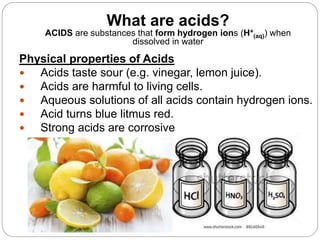
What are acids?
ACIDS are substances that form hydrogen ions (H+
(aq)) when
dissolved in water
Physical properties of Acids
 Acids taste sour (e.g. vinegar, lemon juice).
 Acids are harmful to living cells.
 Aqueous solutions of all acids contain hydrogen ions.
 Acid turns blue litmus red.
 Strong acids are corrosive
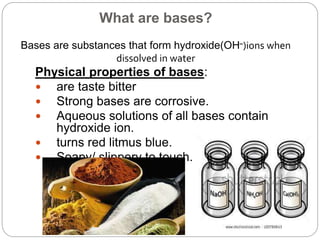
What are bases?
Bases are substances that form hydroxide(OH⁻)ions when
dissolved in water
Physical properties of bases:
 are taste bitter
 Strong bases are corrosive.
 Aqueous solutions of all bases contain
hydroxide ion.
 turns red litmus blue.
 Soapy/ slippery to touch.
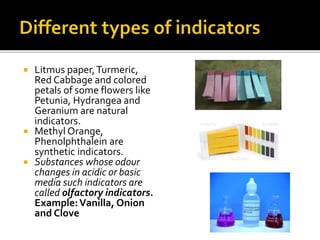
 Litmus paper,Turmeric,
Red Cabbage and colored
petals of some flowers like
Petunia, Hydrangea and
Geranium are natural
indicators.
 Methyl Orange,
Phenolphthalein are
synthetic indicators.
 Substances whose odour
changes in acidic or basic
media such indicators are
called olfactory indicators.
Example:Vanilla, Onion
and Clove
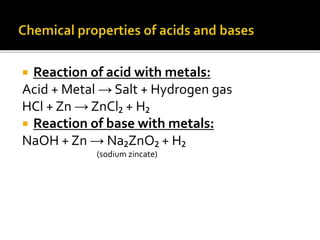
 Reaction of acid with metals:
Acid + Metal → Salt + Hydrogen gas
HCl + Zn → ZnCl₂ + H₂
 Reaction of base with metals:
NaOH + Zn → Na₂ZnO₂ + H₂
(sodium zincate)
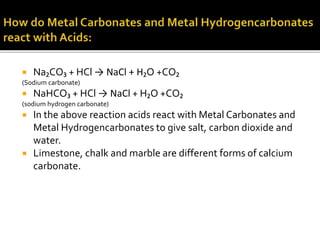
 Na₂CO₃ + HCl → NaCl + H₂O +CO₂
(Sodium carbonate)
 NaHCO₃ + HCl → NaCl + H₂O +CO₂
(sodium hydrogen carbonate)
 In the above reaction acids react with Metal Carbonates and
Metal Hydrogencarbonates to give salt, carbon dioxide and
water.
 Limestone, chalk and marble are different forms of calcium
carbonate.
Reaction between acids and
bases
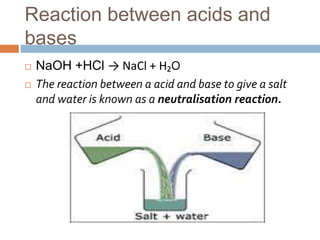
 NaOH +HCl → NaCl + H₂O
 The reaction between a acid and base to give a salt
and water is known as a neutralisation reaction.
Reaction with metallic oxides
 In this reaction metallic oxides react with acids
to give salts and water.
 Metallic oxides are said to be basic oxides.
Reaction of a non- metallic oxide with
base
• In this reaction non- metallic oxides react
with a base to give salts and water.
•Non- metallic oxides are said to be acidic
oxides.
 Acids react with water to give hydronium ions(H₃O⁺) or H⁺
ion in water.
 Bases react water to give hydroxide (OH⁻) ions.
 Bases which are soluble in water are called alkalis.
 The reaction with acid or base with water is a highly
exothermic.
 Heat generated may cause the mixture to splash out and
cause burns.The glass container may also break due to
excessive heat.
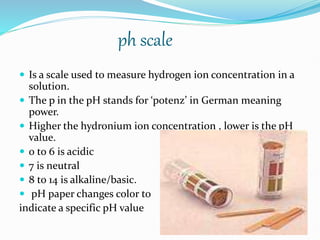
ph scale
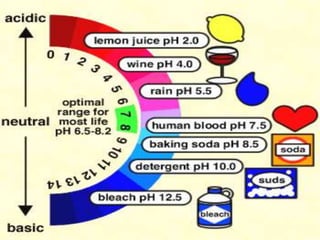
 Is a scale used to measure hydrogen ion concentration in a
solution.
 The p in the pH stands for ‘potenz’ in German meaning
power.
 Higher the hydronium ion concentration , lower is the pH
value.
 0 to 6 is acidic
 7 is neutral
 8 to 14 is alkaline/basic.
 pH paper changes color to
indicate a specific pH value
 Acids that give rise to
more hydronium ions
or hydrogen ions are
said to be strong acids.
 Acids that give rise to
less hydronium ions or
hydrogen ions are said
to be weak acids.
 Bases that give rise to
more hydroxide ions
are said to be strong
bases.
 Bases that give rise to
less hydroxide ions are
said to be weak bases.
Importance of pH in everyday life.
 Our body works within the pH of 7 to 7.8
 When pH of rain is less than 5.6 it is called acid
rain.
 Our stomach produces hydrochloric acid which
helps in digestion without harming our stomach.
 In case of indigestion our stomach produces
more acid and this causes pain and irritation. To
get rid of this we use bases called antacids..
These antacids neutralizes the excess acid.
 Magnesium hydroxide (milk of magnesia) is a
mild base.
 Tooth decay starts when the mouth pH is lower
than 5.5.
 Tooth enamel is made up of calcium phosphate
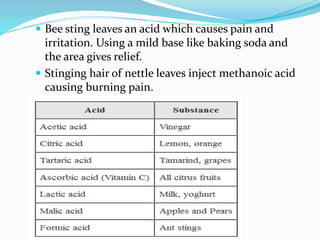
 Bee sting leaves an acid which causes pain and
irritation. Using a mild base like baking soda and
the area gives relief.
 Stinging hair of nettle leaves inject methanoic acid
causing burning pain.
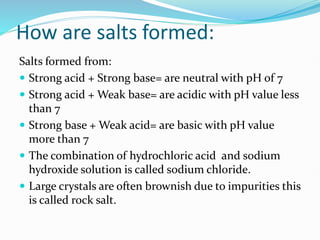
How are salts formed:
Salts formed from:
 Strong acid + Strong base= are neutral with pH of 7
 Strong acid + Weak base= are acidic with pH value less
than 7
 Strong base + Weak acid= are basic with pH value
more than 7
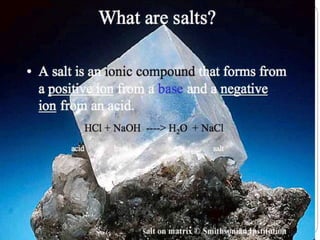
 The combination of hydrochloric acid and sodium
hydroxide solution is called sodium chloride.
 Large crystals are often brownish due to impurities this
is called rock salt.
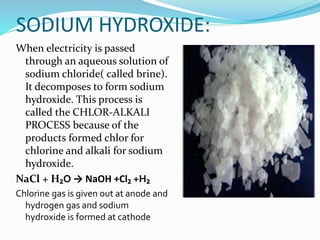
SODIUM HYDROXIDE:
When electricity is passed
through an aqueous solution of
sodium chloride( called brine).
It decomposes to form sodium
hydroxide. This process is
called the CHLOR-ALKALI
PROCESS because of the
products formed chlor for
chlorine and alkali for sodium
hydroxide.
NaCl + H₂O → NaOH +Cl₂ +H₂
Chlorine gas is given out at anode and
hydrogen gas and sodium
hydroxide is formed at cathode
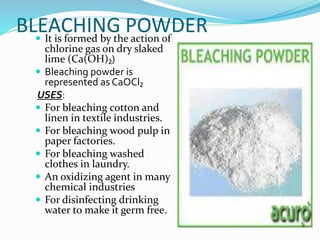
BLEACHING POWDER
 It is formed by the action of
chlorine gas on dry slaked
lime (Ca(OH)₂)
 Bleaching powder is
represented as CaOCl₂
USES:
 For bleaching cotton and
linen in textile industries.
 For bleaching wood pulp in
paper factories.
 For bleaching washed
clothes in laundry.
 An oxidizing agent in many
chemical industries
 For disinfecting drinking
water to make it germ free.
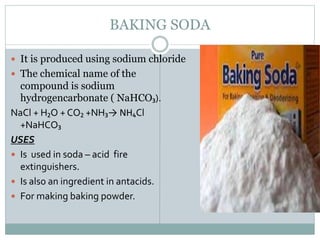
BAKING SODA
 It is produced using sodium chloride
 The chemical name of the
compound is sodium
hydrogencarbonate ( NaHCO₃).
NaCl + H₂O + CO₂ +NH₃→ NH₄Cl
+NaHCO₃
USES
 Is used in soda – acid fire
extinguishers.
 Is also an ingredient in antacids.
 For making baking powder.
Preparation of baking powder:
 A mixture of baking soda along with a mild edible
acid such as tartaric acid.When baking powder is
heated or mixed with water carbon dioxide is
produced which cause bread or cake to rise making
them soft and spongy.
NaHCO₃ + H⁺ → CO₂ +H₂O+ sodium salt of acid
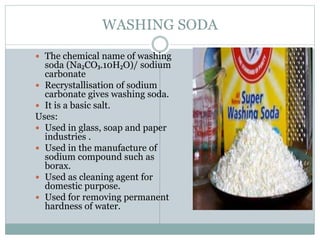
WASHING SODA
 The chemical name of washing
soda (Na₂CO₃.10H₂O)/ sodium
carbonate
 Recrystallisation of sodium
carbonate gives washing soda.
 It is a basic salt.
Uses:
 Used in glass, soap and paper
industries .
 Used in the manufacture of
sodium compound such as
borax.
 Used as cleaning agent for
domestic purpose.
 Used for removing permanent
hardness of water.
Are the crystals of salts dry:
 Copper sulphate crystals when heated lose water and
turn from blue to white.
 water of crystallization is the fixed number of water
molecules present in one formula unit of a salt.
 Chemicl formula of hydrated copper sulphate is
CuSO₄.5H₂O
 Gypsum chemical formula is CaSO₄.2H₂O
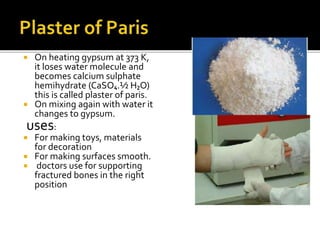
 On heating gypsum at 373 K,
it loses water molecule and
becomes calcium sulphate
hemihydrate (CaSO₄.½ H₂O)
this is called plaster of paris.
 On mixing again with water it
changes to gypsum.
uses:
 For making toys, materials
for decoration
 For making surfaces smooth.
 doctors use for supporting
fractured bones in the right
position
Acids Bases and Salts Class 10th Chapter 2

Acids Bases and Salts Class 10th Chapter 2

  • 1.
  • 2.
    What are acids? ACIDSare substances that form hydrogen ions (H+ (aq)) when dissolved in water Physical properties of Acids  Acids taste sour (e.g. vinegar, lemon juice).  Acids are harmful to living cells.  Aqueous solutions of all acids contain hydrogen ions.  Acid turns blue litmus red.  Strong acids are corrosive
  • 3.
    What are bases? Basesare substances that form hydroxide(OH⁻)ions when dissolved in water Physical properties of bases:  are taste bitter  Strong bases are corrosive.  Aqueous solutions of all bases contain hydroxide ion.  turns red litmus blue.  Soapy/ slippery to touch.
  • 4.
     Litmus paper,Turmeric, RedCabbage and colored petals of some flowers like Petunia, Hydrangea and Geranium are natural indicators.  Methyl Orange, Phenolphthalein are synthetic indicators.  Substances whose odour changes in acidic or basic media such indicators are called olfactory indicators. Example:Vanilla, Onion and Clove
  • 5.
     Reaction ofacid with metals: Acid + Metal → Salt + Hydrogen gas HCl + Zn → ZnCl₂ + H₂  Reaction of base with metals: NaOH + Zn → Na₂ZnO₂ + H₂ (sodium zincate)
  • 6.
     Na₂CO₃ +HCl → NaCl + H₂O +CO₂ (Sodium carbonate)  NaHCO₃ + HCl → NaCl + H₂O +CO₂ (sodium hydrogen carbonate)  In the above reaction acids react with Metal Carbonates and Metal Hydrogencarbonates to give salt, carbon dioxide and water.  Limestone, chalk and marble are different forms of calcium carbonate.
  • 7.
    Reaction between acidsand bases  NaOH +HCl → NaCl + H₂O  The reaction between a acid and base to give a salt and water is known as a neutralisation reaction.
  • 8.
    Reaction with metallicoxides  In this reaction metallic oxides react with acids to give salts and water.  Metallic oxides are said to be basic oxides. Reaction of a non- metallic oxide with base • In this reaction non- metallic oxides react with a base to give salts and water. •Non- metallic oxides are said to be acidic oxides.
  • 9.
     Acids reactwith water to give hydronium ions(H₃O⁺) or H⁺ ion in water.  Bases react water to give hydroxide (OH⁻) ions.  Bases which are soluble in water are called alkalis.  The reaction with acid or base with water is a highly exothermic.  Heat generated may cause the mixture to splash out and cause burns.The glass container may also break due to excessive heat.
  • 10.
    ph scale  Isa scale used to measure hydrogen ion concentration in a solution.  The p in the pH stands for ‘potenz’ in German meaning power.  Higher the hydronium ion concentration , lower is the pH value.  0 to 6 is acidic  7 is neutral  8 to 14 is alkaline/basic.  pH paper changes color to indicate a specific pH value
  • 12.
     Acids thatgive rise to more hydronium ions or hydrogen ions are said to be strong acids.  Acids that give rise to less hydronium ions or hydrogen ions are said to be weak acids.  Bases that give rise to more hydroxide ions are said to be strong bases.  Bases that give rise to less hydroxide ions are said to be weak bases.
  • 13.
    Importance of pHin everyday life.  Our body works within the pH of 7 to 7.8  When pH of rain is less than 5.6 it is called acid rain.  Our stomach produces hydrochloric acid which helps in digestion without harming our stomach.  In case of indigestion our stomach produces more acid and this causes pain and irritation. To get rid of this we use bases called antacids.. These antacids neutralizes the excess acid.  Magnesium hydroxide (milk of magnesia) is a mild base.  Tooth decay starts when the mouth pH is lower than 5.5.  Tooth enamel is made up of calcium phosphate
  • 14.
     Bee stingleaves an acid which causes pain and irritation. Using a mild base like baking soda and the area gives relief.  Stinging hair of nettle leaves inject methanoic acid causing burning pain.
  • 16.
    How are saltsformed: Salts formed from:  Strong acid + Strong base= are neutral with pH of 7  Strong acid + Weak base= are acidic with pH value less than 7  Strong base + Weak acid= are basic with pH value more than 7  The combination of hydrochloric acid and sodium hydroxide solution is called sodium chloride.  Large crystals are often brownish due to impurities this is called rock salt.
  • 17.
    SODIUM HYDROXIDE: When electricityis passed through an aqueous solution of sodium chloride( called brine). It decomposes to form sodium hydroxide. This process is called the CHLOR-ALKALI PROCESS because of the products formed chlor for chlorine and alkali for sodium hydroxide. NaCl + H₂O → NaOH +Cl₂ +H₂ Chlorine gas is given out at anode and hydrogen gas and sodium hydroxide is formed at cathode
  • 18.
    BLEACHING POWDER  Itis formed by the action of chlorine gas on dry slaked lime (Ca(OH)₂)  Bleaching powder is represented as CaOCl₂ USES:  For bleaching cotton and linen in textile industries.  For bleaching wood pulp in paper factories.  For bleaching washed clothes in laundry.  An oxidizing agent in many chemical industries  For disinfecting drinking water to make it germ free.
  • 19.
    BAKING SODA  Itis produced using sodium chloride  The chemical name of the compound is sodium hydrogencarbonate ( NaHCO₃). NaCl + H₂O + CO₂ +NH₃→ NH₄Cl +NaHCO₃ USES  Is used in soda – acid fire extinguishers.  Is also an ingredient in antacids.  For making baking powder.
  • 20.
    Preparation of bakingpowder:  A mixture of baking soda along with a mild edible acid such as tartaric acid.When baking powder is heated or mixed with water carbon dioxide is produced which cause bread or cake to rise making them soft and spongy. NaHCO₃ + H⁺ → CO₂ +H₂O+ sodium salt of acid
  • 21.
    WASHING SODA  Thechemical name of washing soda (Na₂CO₃.10H₂O)/ sodium carbonate  Recrystallisation of sodium carbonate gives washing soda.  It is a basic salt. Uses:  Used in glass, soap and paper industries .  Used in the manufacture of sodium compound such as borax.  Used as cleaning agent for domestic purpose.  Used for removing permanent hardness of water.
  • 22.
    Are the crystalsof salts dry:  Copper sulphate crystals when heated lose water and turn from blue to white.  water of crystallization is the fixed number of water molecules present in one formula unit of a salt.  Chemicl formula of hydrated copper sulphate is CuSO₄.5H₂O  Gypsum chemical formula is CaSO₄.2H₂O
  • 23.
     On heatinggypsum at 373 K, it loses water molecule and becomes calcium sulphate hemihydrate (CaSO₄.½ H₂O) this is called plaster of paris.  On mixing again with water it changes to gypsum. uses:  For making toys, materials for decoration  For making surfaces smooth.  doctors use for supporting fractured bones in the right position