Digestion
&
Absorption
Dr. Farhana Atia
Assistant Professor, Biochemistry
Nilphamari Medical College, Nilphamari
Learning objectives
Define digestion & absorption
Enumerate digestive juices, their composition & functions
Enumerate local hormones of GIT, their source & functions
State the names & sources of digestive enzymes & their
location
Process of digestion & absorption of carbohydrate
Process of digestion & absorption of protein
Process of digestion & absorption of lipids (TAG, phospholipids,
cholesterol esters)
Digestion
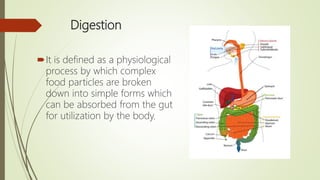
It is defined as a physiological
process by which complex
food particles are broken
down into simple forms which
can be absorbed from the gut
for utilization by the body.
Absorption
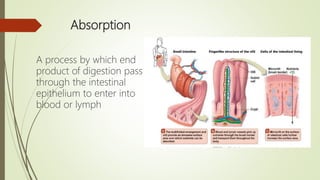
A process by which end
product of digestion pass
through the intestinal
epithelium to enter into
blood or lymph
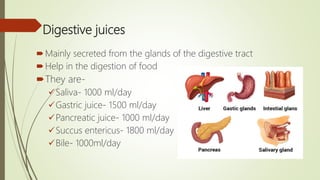
Digestive juices
Mainly secreted from the glands of the digestive tract
Help in the digestion of food
They are-
Saliva- 1000 ml/day
Gastric juice- 1500 ml/day
Pancreatic juice- 1000 ml/day
Succus entericus- 1800 ml/day
Bile- 1000ml/day
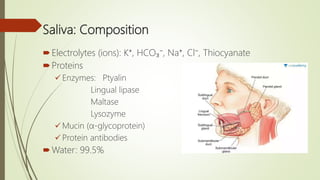
Saliva: Composition
Electrolytes (ions): K⁺, HCO₃⁻, Na⁺, Cl⁻, Thiocyanate
Proteins
 Enzymes: Ptyalin
Lingual lipase
Maltase
Lysozyme
 Mucin (α-glycoprotein)
 Protein antibodies
Water: 99.5%
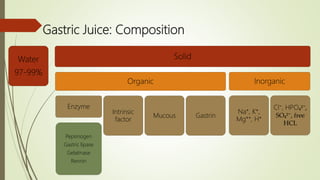
Gastric Juice: Composition
Water
97-99%
Solid
Organic
Enzyme
Pepsinogen
Gastric lipase
Gelatinase
Rennin
Intrinsic
factor
Mucous Gastrin
Inorganic
Na⁺, K⁺,
Mg⁺⁺, H⁺
Cl⁻, HPO₄²⁻,
SO₄²⁻, free
HCL
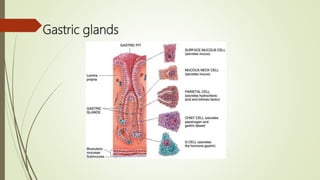
Gastric glands
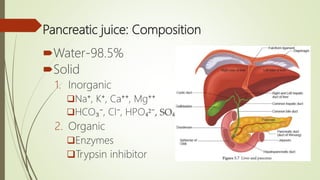
Pancreatic juice: Composition
Water-98.5%
Solid
1. Inorganic
Na⁺, K⁺, Ca⁺⁺, Mg⁺⁺
HCO₃⁻, Cl⁻, HPO₄²⁻, SO₄²⁻
2. Organic
Enzymes
Trypsin inhibitor
Pancreatic Enzymes
Proteolytic
Trypsin
Chymotrypsin
Carboxypeptidase
Elastase
Nuclease
Carbohydrate splitting
Pancreatic α-amylase
Fat splitting
Pancreatic lipase,
colipase
Cholesterol Esterase
Phospholipase
Bile
 Water
 Bile salt
 Bilirubin
 Cholesterol
 Fatty acid
 Lecithin
 Na⁺, K⁺, Ca⁺⁺
 HCO₃⁻, Cl⁻
 Bile salt
Na-taurocholate
K-taurocholate
Na-glycocholate
K-glycocholate
 Bile acid
Cholic acid
Cheno-deoxycholic acid
Deoxycholic acid
Lithocholic acid
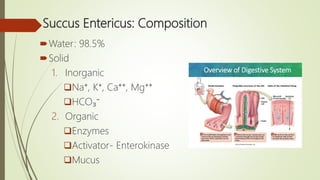
Succus Entericus: Composition
Water: 98.5%
Solid
1. Inorganic
Na⁺, K⁺, Ca⁺⁺, Mg⁺⁺
HCO₃⁻
2. Organic
Enzymes
Activator- Enterokinase
Mucus
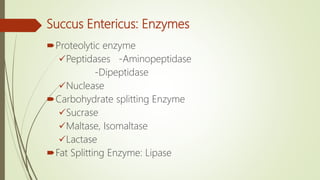
Succus Entericus: Enzymes
Proteolytic enzyme
Peptidases -Aminopeptidase
-Dipeptidase
Nuclease
Carbohydrate splitting Enzyme
Sucrase
Maltase, Isomaltase
Lactase
Fat Splitting Enzyme: Lipase
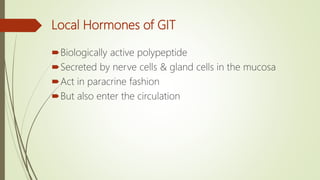
Local Hormones of GIT
Biologically active polypeptide
Secreted by nerve cells & gland cells in the mucosa
Act in paracrine fashion
But also enter the circulation
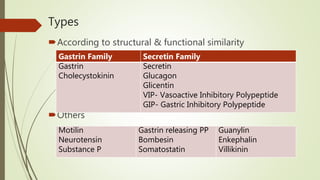
Types
According to structural & functional similarity
Others
Gastrin Family Secretin Family
Gastrin
Cholecystokinin
Secretin
Glucagon
Glicentin
VIP- Vasoactive Inhibitory Polypeptide
GIP- Gastric Inhibitory Polypeptide
Motilin
Neurotensin
Substance P
Gastrin releasing PP
Bombesin
Somatostatin
Guanylin
Enkephalin
Villikinin
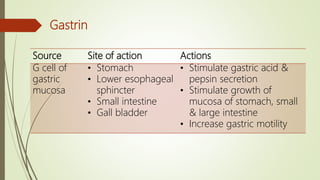
Gastrin
Source Site of action Actions
G cell of
gastric
mucosa
• Stomach
• Lower esophageal
sphincter
• Small intestine
• Gall bladder
• Stimulate gastric acid &
pepsin secretion
• Stimulate growth of
mucosa of stomach, small
& large intestine
• Increase gastric motility
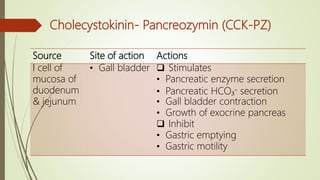
Cholecystokinin- Pancreozymin (CCK-PZ)
Source Site of action Actions
I cell of
mucosa of
duodenum
& jejunum
• Gall bladder  Stimulates
• Pancreatic enzyme secretion
• Pancreatic HCO₃⁻ secretion
• Gall bladder contraction
• Growth of exocrine pancreas
 Inhibit
• Gastric emptying
• Gastric motility
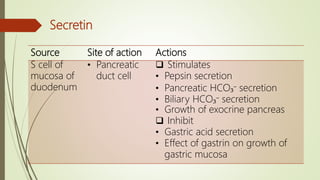
Secretin
Source Site of action Actions
S cell of
mucosa of
duodenum
• Pancreatic
duct cell
 Stimulates
• Pepsin secretion
• Pancreatic HCO₃⁻ secretion
• Biliary HCO₃⁻ secretion
• Growth of exocrine pancreas
 Inhibit
• Gastric acid secretion
• Effect of gastrin on growth of
gastric mucosa
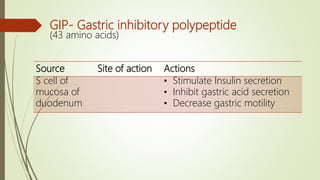
GIP- Gastric inhibitory polypeptide
(43 amino acids)
Source Site of action Actions
S cell of
mucosa of
duodenum
• Stimulate Insulin secretion
• Inhibit gastric acid secretion
• Decrease gastric motility
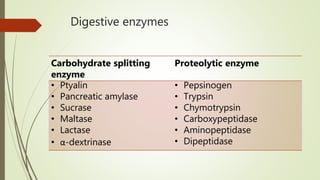
Digestive enzymes
Carbohydrate splitting
enzyme
Proteolytic enzyme
• Ptyalin
• Pancreatic amylase
• Sucrase
• Maltase
• Lactase
• α-dextrinase
• Pepsinogen
• Trypsin
• Chymotrypsin
• Carboxypeptidase
• Aminopeptidase
• Dipeptidase
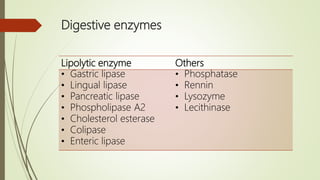
Digestive enzymes
Lipolytic enzyme Others
• Gastric lipase
• Lingual lipase
• Pancreatic lipase
• Phospholipase A2
• Cholesterol esterase
• Colipase
• Enteric lipase
• Phosphatase
• Rennin
• Lysozyme
• Lecithinase
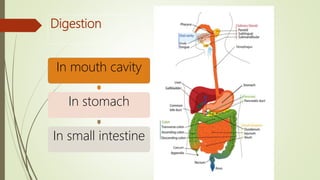
Digestion
In mouth cavity
In stomach
In small intestine
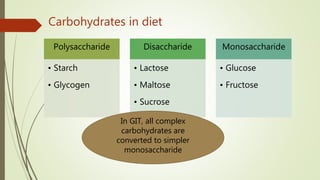
Carbohydrates in diet
Polysaccharide
• Starch
• Glycogen
Disaccharide
• Lactose
• Maltose
• Sucrose
Monosaccharide
• Glucose
• Fructose
In GIT, all complex
carbohydrates are
converted to simpler
monosaccharide
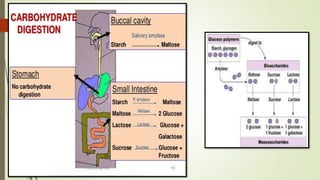
Digestion in mouth
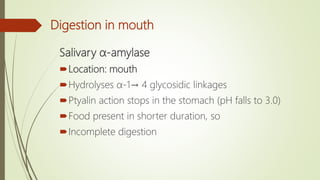
Salivary α-amylase
Location: mouth
Hydrolyses α-1→ 4 glycosidic linkages
Ptyalin action stops in the stomach (pH falls to 3.0)
Food present in shorter duration, so
Incomplete digestion
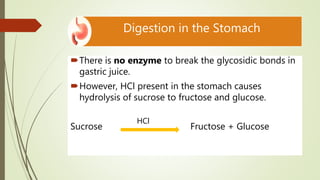
There is no enzyme to break the glycosidic bonds in
gastric juice.
However, HCl present in the stomach causes
hydrolysis of sucrose to fructose and glucose.
Sucrose Fructose + Glucose
Digestion in the Stomach
HCl
Digestion in Duodenum
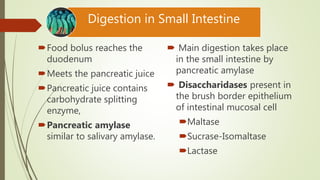
Food bolus reaches the
duodenum
Meets the pancreatic juice
Pancreatic juice contains
carbohydrate splitting
enzyme,
Pancreatic amylase
similar to salivary amylase.
 Main digestion takes place
in the small intestine by
pancreatic amylase
 Disaccharidases present in
the brush border epithelium
of intestinal mucosal cell
Maltase
Sucrase-Isomaltase
Lactase
Digestion in Small Intestine
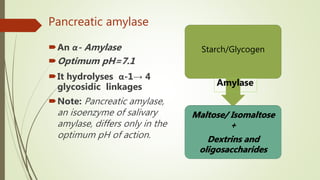
Pancreatic amylase
An α- Amylase
Optimum pH=7.1
It hydrolyses α-1→ 4
glycosidic linkages
Note: Pancreatic amylase,
an isoenzyme of salivary
amylase, differs only in the
optimum pH of action.
Starch/Glycogen
Maltose/ Isomaltose
+
Dextrins and
oligosaccharides
Amylase
Absorption of carbohydrates
Glucose transporter
1. Na+ dependent
transporter [SGLT]
2. Na+ independent
transporter [GLUT]
Lactose intolerance
Inability to digest lactose due to the deficiency of Lactase
enzyme.
Presents as abdominal cramps, distensions, diarrhea,
constipation, flatulence upon ingestion of milk or dairy
products
Undigested lactose in intestine is converted to CO2, H2, 2 &
3 carbon compounds [by bacteria]
CO2 & H2 causes distensions and flatulence
Lactose + 2C + 3C are osmotically active
Cause osmotic diarrhea or constipation because of
undigested bulk
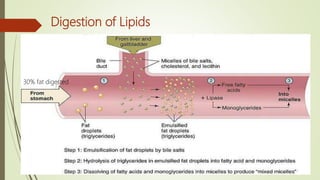
30% fat digested
Digestion of Lipids
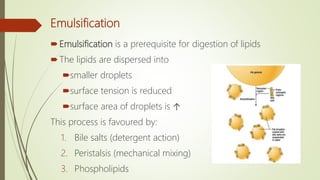
Emulsification
Emulsification is a prerequisite for digestion of lipids
The lipids are dispersed into
smaller droplets
surface tension is reduced
surface area of droplets is ↑
This process is favoured by:
1. Bile salts (detergent action)
2. Peristalsis (mechanical mixing)
3. Phospholipids
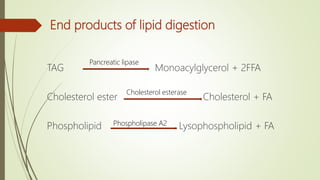
End products of lipid digestion
TAG Monoacylglycerol + 2FFA
Cholesterol ester Cholesterol + FA
Phospholipid Lysophospholipid + FA
Pancreatic lipase
Cholesterol esterase
Phospholipase A2
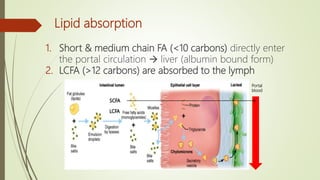
Lipid absorption
1. Short & medium chain FA (<10 carbons) directly enter
the portal circulation  liver (albumin bound form)
2. LCFA (>12 carbons) are absorbed to the lymph
Portal
blood
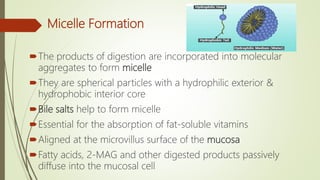
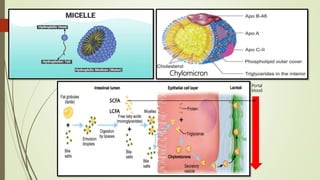
Micelle Formation
The products of digestion are incorporated into molecular
aggregates to form micelle
They are spherical particles with a hydrophilic exterior &
hydrophobic interior core
Bile salts help to form micelle
Essential for the absorption of fat-soluble vitamins
Aligned at the microvillus surface of the mucosa
Fatty acids, 2-MAG and other digested products passively
diffuse into the mucosal cell
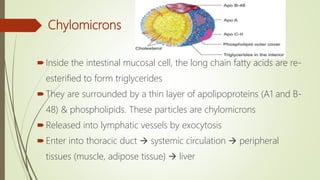
Chylomicrons
Inside the intestinal mucosal cell, the long chain fatty acids are re-
esterified to form triglycerides
They are surrounded by a thin layer of apolipoproteins (A1 and B-
48) & phospholipids. These particles are chylomicrons
Released into lymphatic vessels by exocytosis
Enter into thoracic duct  systemic circulation  peripheral
tissues (muscle, adipose tissue)  liver
Portal
blood
Chylomicron
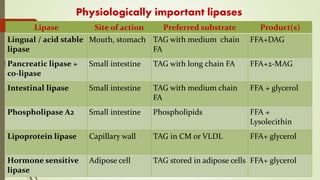
Physiologically important lipases
Lipase Site of action Preferred substrate Product(s)
Lingual / acid stable
lipase
Mouth, stomach TAG with medium chain
FA
FFA+DAG
Pancreatic lipase +
co-lipase
Small intestine TAG with long chain FA FFA+2-MAG
Intestinal lipase Small intestine TAG with medium chain
FA
FFA + glycerol
Phospholipase A2 Small intestine Phospholipids FFA +
Lysolecithin
Lipoprotein lipase Capillary wall TAG in CM or VLDL FFA+ glycerol
Hormone sensitive
lipase
Adipose cell TAG stored in adipose cells FFA+ glycerol
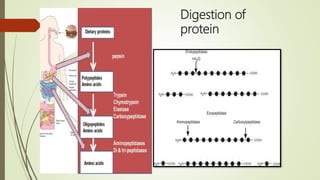
Digestion of
protein
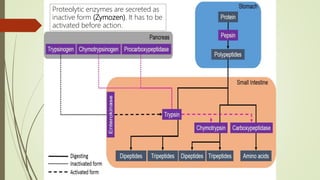
Proteolytic enzymes are secreted as
inactive form (Zymozen). It has to be
activated before action.
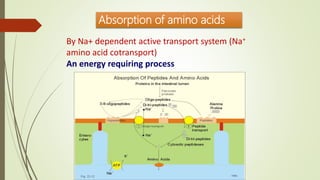
Absorption of amino acids
By Na+ dependent active transport system (Na+
amino acid cotransport)
An energy requiring process
Carbohydrate Lipid Protein
In diet Starch
Lactose
Sucrose
Cellulose
TAG (90%)
Cholesterol
Cholesterol ester
Phospholipids
Free fatty acid
Protein
Mouth [Salivary α-amylase]
Starch
Dextrins
Isomaltose
Maltose
Maltotriose
Lactose
Sucrose
Cellulose
Carbohydrate Lipid Protein
Stomach Low pH stop enzyme
action
[Lingual lipase]
[Gastric lipase]
TAG with short & medium
chain fatty acid
[HCl]+[Pepsin]
Denaturation
Polypeptides
Amino acids
Small
intestine
[Pancreatic α-amylase]
Isomaltose
Maltose
Maltotriose
Lactose
Sucrose
Cellulose
[Disaccharidase]
Emulsification
[Pancreatic lipase]
[Colipase]
[Cholesterol esterase]
[Phospholipase A2]
TAG
Cholesterol ester
Phospholipid
[Trypsin]
[Chymotrypsin]
[Elastase]
[Carboxypeptidase]
Oligopeptides
Amino acids
[Aminopeptidase]
[Di & tripeptidase]
Carbohydrate Lipid Protein
End
products
Glucose
Fructose
Galactose
Cellulose  colon &
excreted
FFA
2-Monoacyl glycerol
Cholesterol
Lysophospholipid  not
absorbed
Amino acids
Absorption Glucose
Galactose
[SGLT1]
↓
Enterocyte
[GLUT2]
↓
Portal blood
Fructose
[GLUT5]
↓
Enterocyte
[GLUT2]
↓
Portal
blood
SCFA(12)
↓
Portal blood
LCFA
Micelle(+bile salt
+ FSV)
↓
enterocyte
Chylomicron
↓
Lymphatics
↓
Blood
Seven different
active transport
process
Digestion and absorption

Digestion and absorption

  • 1.
    Digestion & Absorption Dr. Farhana Atia AssistantProfessor, Biochemistry Nilphamari Medical College, Nilphamari
  • 2.
    Learning objectives Define digestion& absorption Enumerate digestive juices, their composition & functions Enumerate local hormones of GIT, their source & functions State the names & sources of digestive enzymes & their location Process of digestion & absorption of carbohydrate Process of digestion & absorption of protein Process of digestion & absorption of lipids (TAG, phospholipids, cholesterol esters)
  • 3.
    Digestion It is definedas a physiological process by which complex food particles are broken down into simple forms which can be absorbed from the gut for utilization by the body.
  • 4.
    Absorption A process bywhich end product of digestion pass through the intestinal epithelium to enter into blood or lymph
  • 5.
    Digestive juices Mainly secretedfrom the glands of the digestive tract Help in the digestion of food They are- Saliva- 1000 ml/day Gastric juice- 1500 ml/day Pancreatic juice- 1000 ml/day Succus entericus- 1800 ml/day Bile- 1000ml/day
  • 6.
    Saliva: Composition Electrolytes (ions):K⁺, HCO₃⁻, Na⁺, Cl⁻, Thiocyanate Proteins  Enzymes: Ptyalin Lingual lipase Maltase Lysozyme  Mucin (α-glycoprotein)  Protein antibodies Water: 99.5%
  • 7.
    Gastric Juice: Composition Water 97-99% Solid Organic Enzyme Pepsinogen Gastriclipase Gelatinase Rennin Intrinsic factor Mucous Gastrin Inorganic Na⁺, K⁺, Mg⁺⁺, H⁺ Cl⁻, HPO₄²⁻, SO₄²⁻, free HCL
  • 8.
  • 9.
    Pancreatic juice: Composition Water-98.5% Solid 1.Inorganic Na⁺, K⁺, Ca⁺⁺, Mg⁺⁺ HCO₃⁻, Cl⁻, HPO₄²⁻, SO₄²⁻ 2. Organic Enzymes Trypsin inhibitor
  • 10.
    Pancreatic Enzymes Proteolytic Trypsin Chymotrypsin Carboxypeptidase Elastase Nuclease Carbohydrate splitting Pancreaticα-amylase Fat splitting Pancreatic lipase, colipase Cholesterol Esterase Phospholipase
  • 11.
    Bile  Water  Bilesalt  Bilirubin  Cholesterol  Fatty acid  Lecithin  Na⁺, K⁺, Ca⁺⁺  HCO₃⁻, Cl⁻  Bile salt Na-taurocholate K-taurocholate Na-glycocholate K-glycocholate  Bile acid Cholic acid Cheno-deoxycholic acid Deoxycholic acid Lithocholic acid
  • 12.
    Succus Entericus: Composition Water:98.5% Solid 1. Inorganic Na⁺, K⁺, Ca⁺⁺, Mg⁺⁺ HCO₃⁻ 2. Organic Enzymes Activator- Enterokinase Mucus
  • 13.
    Succus Entericus: Enzymes Proteolyticenzyme Peptidases -Aminopeptidase -Dipeptidase Nuclease Carbohydrate splitting Enzyme Sucrase Maltase, Isomaltase Lactase Fat Splitting Enzyme: Lipase
  • 14.
    Local Hormones ofGIT Biologically active polypeptide Secreted by nerve cells & gland cells in the mucosa Act in paracrine fashion But also enter the circulation
  • 15.
    Types According to structural& functional similarity Others Gastrin Family Secretin Family Gastrin Cholecystokinin Secretin Glucagon Glicentin VIP- Vasoactive Inhibitory Polypeptide GIP- Gastric Inhibitory Polypeptide Motilin Neurotensin Substance P Gastrin releasing PP Bombesin Somatostatin Guanylin Enkephalin Villikinin
  • 16.
    Gastrin Source Site ofaction Actions G cell of gastric mucosa • Stomach • Lower esophageal sphincter • Small intestine • Gall bladder • Stimulate gastric acid & pepsin secretion • Stimulate growth of mucosa of stomach, small & large intestine • Increase gastric motility
  • 17.
    Cholecystokinin- Pancreozymin (CCK-PZ) SourceSite of action Actions I cell of mucosa of duodenum & jejunum • Gall bladder  Stimulates • Pancreatic enzyme secretion • Pancreatic HCO₃⁻ secretion • Gall bladder contraction • Growth of exocrine pancreas  Inhibit • Gastric emptying • Gastric motility
  • 18.
    Secretin Source Site ofaction Actions S cell of mucosa of duodenum • Pancreatic duct cell  Stimulates • Pepsin secretion • Pancreatic HCO₃⁻ secretion • Biliary HCO₃⁻ secretion • Growth of exocrine pancreas  Inhibit • Gastric acid secretion • Effect of gastrin on growth of gastric mucosa
  • 19.
    GIP- Gastric inhibitorypolypeptide (43 amino acids) Source Site of action Actions S cell of mucosa of duodenum • Stimulate Insulin secretion • Inhibit gastric acid secretion • Decrease gastric motility
  • 20.
    Digestive enzymes Carbohydrate splitting enzyme Proteolyticenzyme • Ptyalin • Pancreatic amylase • Sucrase • Maltase • Lactase • α-dextrinase • Pepsinogen • Trypsin • Chymotrypsin • Carboxypeptidase • Aminopeptidase • Dipeptidase
  • 21.
    Digestive enzymes Lipolytic enzymeOthers • Gastric lipase • Lingual lipase • Pancreatic lipase • Phospholipase A2 • Cholesterol esterase • Colipase • Enteric lipase • Phosphatase • Rennin • Lysozyme • Lecithinase
  • 22.
    Digestion In mouth cavity Instomach In small intestine
  • 23.
    Carbohydrates in diet Polysaccharide •Starch • Glycogen Disaccharide • Lactose • Maltose • Sucrose Monosaccharide • Glucose • Fructose In GIT, all complex carbohydrates are converted to simpler monosaccharide
  • 25.
    Digestion in mouth Salivaryα-amylase Location: mouth Hydrolyses α-1→ 4 glycosidic linkages Ptyalin action stops in the stomach (pH falls to 3.0) Food present in shorter duration, so Incomplete digestion
  • 26.
    There is noenzyme to break the glycosidic bonds in gastric juice. However, HCl present in the stomach causes hydrolysis of sucrose to fructose and glucose. Sucrose Fructose + Glucose Digestion in the Stomach HCl
  • 27.
    Digestion in Duodenum Foodbolus reaches the duodenum Meets the pancreatic juice Pancreatic juice contains carbohydrate splitting enzyme, Pancreatic amylase similar to salivary amylase.  Main digestion takes place in the small intestine by pancreatic amylase  Disaccharidases present in the brush border epithelium of intestinal mucosal cell Maltase Sucrase-Isomaltase Lactase Digestion in Small Intestine
  • 28.
    Pancreatic amylase An α-Amylase Optimum pH=7.1 It hydrolyses α-1→ 4 glycosidic linkages Note: Pancreatic amylase, an isoenzyme of salivary amylase, differs only in the optimum pH of action. Starch/Glycogen Maltose/ Isomaltose + Dextrins and oligosaccharides Amylase
  • 29.
    Absorption of carbohydrates Glucosetransporter 1. Na+ dependent transporter [SGLT] 2. Na+ independent transporter [GLUT]
  • 30.
    Lactose intolerance Inability todigest lactose due to the deficiency of Lactase enzyme. Presents as abdominal cramps, distensions, diarrhea, constipation, flatulence upon ingestion of milk or dairy products Undigested lactose in intestine is converted to CO2, H2, 2 & 3 carbon compounds [by bacteria] CO2 & H2 causes distensions and flatulence Lactose + 2C + 3C are osmotically active Cause osmotic diarrhea or constipation because of undigested bulk
  • 31.
  • 32.
    Emulsification Emulsification is aprerequisite for digestion of lipids The lipids are dispersed into smaller droplets surface tension is reduced surface area of droplets is ↑ This process is favoured by: 1. Bile salts (detergent action) 2. Peristalsis (mechanical mixing) 3. Phospholipids
  • 33.
    End products oflipid digestion TAG Monoacylglycerol + 2FFA Cholesterol ester Cholesterol + FA Phospholipid Lysophospholipid + FA Pancreatic lipase Cholesterol esterase Phospholipase A2
  • 34.
    Lipid absorption 1. Short& medium chain FA (<10 carbons) directly enter the portal circulation  liver (albumin bound form) 2. LCFA (>12 carbons) are absorbed to the lymph Portal blood
  • 35.
    Micelle Formation The productsof digestion are incorporated into molecular aggregates to form micelle They are spherical particles with a hydrophilic exterior & hydrophobic interior core Bile salts help to form micelle Essential for the absorption of fat-soluble vitamins Aligned at the microvillus surface of the mucosa Fatty acids, 2-MAG and other digested products passively diffuse into the mucosal cell
  • 36.
    Chylomicrons Inside the intestinalmucosal cell, the long chain fatty acids are re- esterified to form triglycerides They are surrounded by a thin layer of apolipoproteins (A1 and B- 48) & phospholipids. These particles are chylomicrons Released into lymphatic vessels by exocytosis Enter into thoracic duct  systemic circulation  peripheral tissues (muscle, adipose tissue)  liver
  • 37.
  • 38.
    Physiologically important lipases LipaseSite of action Preferred substrate Product(s) Lingual / acid stable lipase Mouth, stomach TAG with medium chain FA FFA+DAG Pancreatic lipase + co-lipase Small intestine TAG with long chain FA FFA+2-MAG Intestinal lipase Small intestine TAG with medium chain FA FFA + glycerol Phospholipase A2 Small intestine Phospholipids FFA + Lysolecithin Lipoprotein lipase Capillary wall TAG in CM or VLDL FFA+ glycerol Hormone sensitive lipase Adipose cell TAG stored in adipose cells FFA+ glycerol
  • 39.
  • 40.
    Proteolytic enzymes aresecreted as inactive form (Zymozen). It has to be activated before action.
  • 41.
    Absorption of aminoacids By Na+ dependent active transport system (Na+ amino acid cotransport) An energy requiring process
  • 42.
    Carbohydrate Lipid Protein Indiet Starch Lactose Sucrose Cellulose TAG (90%) Cholesterol Cholesterol ester Phospholipids Free fatty acid Protein Mouth [Salivary α-amylase] Starch Dextrins Isomaltose Maltose Maltotriose Lactose Sucrose Cellulose
  • 43.
    Carbohydrate Lipid Protein StomachLow pH stop enzyme action [Lingual lipase] [Gastric lipase] TAG with short & medium chain fatty acid [HCl]+[Pepsin] Denaturation Polypeptides Amino acids Small intestine [Pancreatic α-amylase] Isomaltose Maltose Maltotriose Lactose Sucrose Cellulose [Disaccharidase] Emulsification [Pancreatic lipase] [Colipase] [Cholesterol esterase] [Phospholipase A2] TAG Cholesterol ester Phospholipid [Trypsin] [Chymotrypsin] [Elastase] [Carboxypeptidase] Oligopeptides Amino acids [Aminopeptidase] [Di & tripeptidase]
  • 44.
    Carbohydrate Lipid Protein End products Glucose Fructose Galactose Cellulose colon & excreted FFA 2-Monoacyl glycerol Cholesterol Lysophospholipid  not absorbed Amino acids Absorption Glucose Galactose [SGLT1] ↓ Enterocyte [GLUT2] ↓ Portal blood Fructose [GLUT5] ↓ Enterocyte [GLUT2] ↓ Portal blood SCFA(12) ↓ Portal blood LCFA Micelle(+bile salt + FSV) ↓ enterocyte Chylomicron ↓ Lymphatics ↓ Blood Seven different active transport process