DR FARHANA ATIA
ASSOCIATE PROFESSOR, BIOCHEMISTRY
NILPHAMARI MEDICAL COLLEGE, NILPHAMARI
Major Electrolytes &
Their Homeostasis
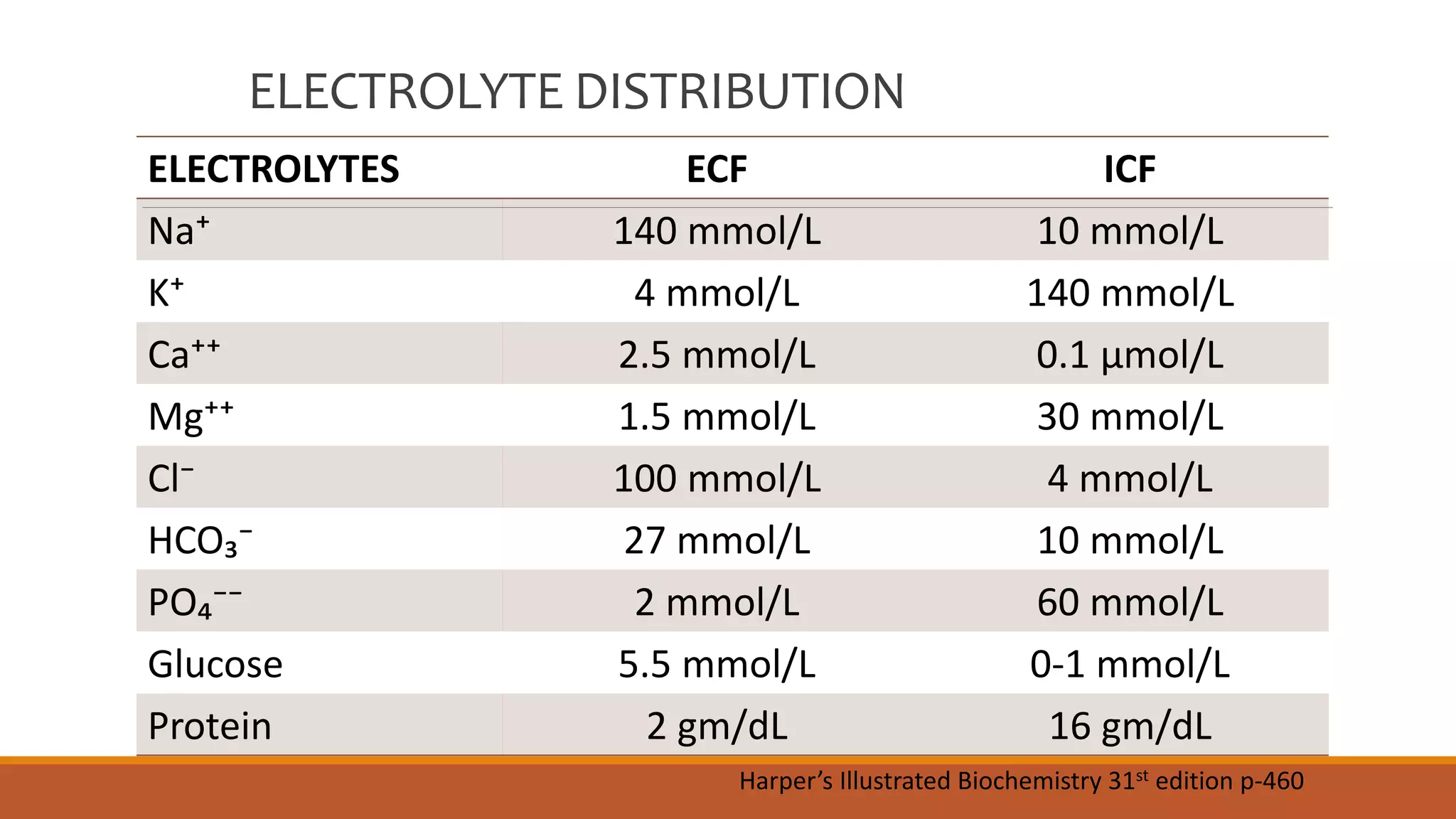
ELECTROLYTE DISTRIBUTION
ELECTROLYTES ECF ICF
Na⁺ 140 mmol/L 10 mmol/L
K⁺ 4 mmol/L 140 mmol/L
Ca⁺⁺ 2.5 mmol/L 0.1 μmol/L
Mg⁺⁺ 1.5 mmol/L 30 mmol/L
Cl⁻ 100 mmol/L 4 mmol/L
HCO₃⁻ 27 mmol/L 10 mmol/L
PO₄⁻⁻ 2 mmol/L 60 mmol/L
Glucose 5.5 mmol/L 0-1 mmol/L
Protein 2 gm/dL 16 gm/dL
Harper’s Illustrated Biochemistry 31st edition p-460
Calcium
Calcium is the most abundant mineral in our body
Body calcium content: 1-1.5 kg
In skeletal system (bones & teeth): >99% as hydroxyapatite
crystal
In soft tissue cell: 0.5%
In ECF: 0.1-0.2%
Hydroxyapatite crystal:
Ca₉(PO₄)₆ + Ca⁺⁺ + 2H₂O Ca₁₀(PO₄)₆ (OH)₂ + 2H⁺
Distribution of plasma Calcium
Total plasma Ca : 2.5 mmol/L
Diffusible: 1.34 mmol/L 60%
• 50% of total is ionized Ca: 1.18 mmol/L (active form/ free form)
• 10% of total as complex with HCO₃⁻, PO₄⁼, citrate: 0.16 mmol/L
Non diffusible (Protein-bound): 1.16 mmol/L 40%
• 80% (32% of total) bound to albumin: 0.92 mmol/L
• 20% (8% of total) bound to globulin: 0.24 mmol/L
Free Calcium is Physiologically Important
It is the biologically active form of calcium
This free calcium (not total calcium) is under hormonal
control
The free calcium concentration determine the body calcium
status
Normocalcemia
Hypocalcemia
Hypercalcemia
Assessment of Calcium Status
Direct method: Measure free Ca⁺⁺
conc.
Indirect method: Measure total
calcium conc. & albumin conc.
T [Ca] ↑↑
[Alb] ↑↑
Free Ca normal
No symptom
T [Ca] normal
[Alb] ↓
Free Ca ↑
Hypercalcaemia
T [Ca] normal
[Alb] ↑
Free Ca ↓
Hypocalcaemia
Adjusted Calcium level: In
abnormal serum albumin
concentration
Total [Ca] + 0.02X(47-A) gm/L
[Total body albumin= 47 gm
1 gm albumin binds with 0.02
mmol/L of Ca]
Calcium Balance
Intake: 800 mg/day (orally)
Output: 800 mg/day (Urine- 200 mg/day, Stool- 600 mg/day)
Renal Handling of Ca⁺⁺
Tubular Load: 250 mmol/day
Reabsorption: about 98%
PCT: 60-70%
ALLH: 20%
DCT & CD: 5-10% (Major site for regulation of Ca excretion)
 Excretion: 15-20 mmol/day; < 5% of TL
Regulation of Plasma Ca Homeostasis
Parathyroid Hormone (PTH): ↑Ca⁺⁺
Vitamin D/ Calcitriol [1,25(OH)₂D₃]: ↑Ca⁺⁺
Calcitonin: ↓Ca⁺⁺
Magnesium: ↓Mg⁺⁺ prevents PTH release & cause ↓Ca⁺⁺
Plasma binding: Approximately 40% of plasma Ca is
bound to plasma protein & remaining free Ca is
biologically active. Labs usually measure total plasma Ca.
So total Ca for albumin needs to be corrected.
Parathyroid Hormone (PTH)
Secretion: By four parathyroid gland
Stimulation: By ↓serum Ca⁺⁺
Overall effect: ↑Ca⁺⁺ & ↓PO₄³⁻
Actions:
↑ Osteoclast activity by releasing Ca⁺⁺ &
PO₄³⁻ from bones
↑Ca⁺⁺ & ↓PO₄³⁻ reabsorption in the
kidney
↑ Renal production of active vitamin D
Calcitriol
Biologically active form of vitamin D
Stimulation by ↓Ca⁺⁺, ↓PO₄³⁻ & ↑PTH
 Actions are:
↑Ca⁺⁺ & ↑PO₄³⁻ absorption from the
gut
Inhibition of PTH release
Enhance bone turnover
↑Ca⁺⁺ & ↑PO₄³⁻ reabsorption in the
kidney
Calcitriol
Calcitonin
Made in C cells of thyroid
Overall effect: ↓Ca⁺⁺ & ↓PO₄³⁻
Actions:
◦Opposite effect of Vit-D &
PTH
↓Ca mobilization from bone
↑ Ca excretion in kidney
Hypocalcemia
Causes of hypocalcemia (<2 mmol/L)
With ↑PO₄³⁻ With ↔ or ↓PO₄³⁻
Chronic kidney disease
Hypoparathyroidism
Pseudohypoparathyroidism
Acute rhabdomyolysis
Hypomagnesemia
Vitamin D deficiency
Osteomalacia
Acute pancreatitis
Overhydration
Respiratory alkalosis
Features of Hypocalcemia
Spasm (carpopedal spasm: Trousseau’s sign)
Perioral paresthesia
Seizure
Laryngospasm
Neuromuscular excitability
(Chvostek’s sign)
Cataract
Cardiomyopathy
Hypercalcemia (>2.5 mmol/L)
Dehydration
Hyperparathyroidism
(1⁰ or 3⁰)
Myeloma
Vitamin D excess
Sarcoidosis
Milk-alkali-syndrome
Bone metastases from
◦ Breast
◦ Lung
◦ Prostate
◦ Kidney
◦ Thyroid
Thyrotoxicosis
Lithium
Phosphate
Second most abundant mineral in the body (1% of total
body weight)
Body phosphate content
In skeletal system: 85% ; 500-700 gm; as hydroxyapatite
crystal
In soft tissue: as nucleic acid, cell membrane
phospholipid
In plasma: 0.81 to 1.45 mmol/L
Importance of Phosphate
Build and repair bones and teeth
 Integral component of several organic compounds, including
nucleic acids and cell membrane phospholipids
 Involved in aerobic and anaerobic energy metabolism (2,3-
DPG, ADP, ATP)
Major intracellular anion but is also present in plasma
Help nerves function, make muscles contract
Also help with the kidney function & Normal heartbeat
Renal Handling of Phosphate
Tubular load: 150-200 mmol/day
Reabsorption: About 90%
In PCT: 70-80% reabsorption
Mechanism: Na⁺-PO₄³⁻ symport
mechanism which is inhibited by
PTH hormone
Excretion: About 10%; 20 mmol/day
Regulation of Phosphate
The amount of phosphate in the blood affects the
level of calcium in the blood
Calcium and phosphate in the body react in opposite
ways: as blood calcium levels rise, phosphate levels fall
Parathyroid Hormone (PTH): ↓PO₄³⁻
Vitamin D/ Calcitriol [1,25(OH)₂D₃]: ↑PO₄³⁻
Calcitonin: ↓PO₄³⁻
Hypophosphatemia
Common & little significance unless severe (<0.4 mmol/L)
Causes:
Vitamin D deficiency
Inadequate oral intake
Severe diabetic ketoacidosis
Renal tubular dysfunction
Primary hyperparathyroidism
Hyperphosphatemia
Rare
Usually due to chronic kidney disease
Hypoparathyroidism
Metabolic acidosis
Respiratory acidosis
Magnesium
Distribution in body
In bone: 65%
In cells: 35%
Plasma concentration (0.85 to 1.10 mmol/L) tends to follow
that of Ca⁺⁺ & K⁺
Mg2+ homeostasis depends on three organs:
Intestine: facilitating Mg2+ uptake
Bone: main Mg2+ storage system of the body
Kidney: responsible for Mg2+ excretion
Disorder of Magnesium Homeostasis
Hypomagnesemia
Diuretics
Severe diarrhea
Ketoacidosis
Alcohol abuse
With ↓Ca⁺⁺, ↓K⁺, ↓PO₄³⁻
Hypermagnesemia
Little significance unless
severe (>7.5 mmol/L)
Renal failure
Iatrogenic (excessive
antacids)
Thank You

Major Electrolytes & Their Homeostasis Part-2

  • 1.
    DR FARHANA ATIA ASSOCIATEPROFESSOR, BIOCHEMISTRY NILPHAMARI MEDICAL COLLEGE, NILPHAMARI Major Electrolytes & Their Homeostasis
  • 2.
    ELECTROLYTE DISTRIBUTION ELECTROLYTES ECFICF Na⁺ 140 mmol/L 10 mmol/L K⁺ 4 mmol/L 140 mmol/L Ca⁺⁺ 2.5 mmol/L 0.1 μmol/L Mg⁺⁺ 1.5 mmol/L 30 mmol/L Cl⁻ 100 mmol/L 4 mmol/L HCO₃⁻ 27 mmol/L 10 mmol/L PO₄⁻⁻ 2 mmol/L 60 mmol/L Glucose 5.5 mmol/L 0-1 mmol/L Protein 2 gm/dL 16 gm/dL Harper’s Illustrated Biochemistry 31st edition p-460
  • 3.
    Calcium Calcium is themost abundant mineral in our body Body calcium content: 1-1.5 kg In skeletal system (bones & teeth): >99% as hydroxyapatite crystal In soft tissue cell: 0.5% In ECF: 0.1-0.2% Hydroxyapatite crystal: Ca₉(PO₄)₆ + Ca⁺⁺ + 2H₂O Ca₁₀(PO₄)₆ (OH)₂ + 2H⁺
  • 4.
    Distribution of plasmaCalcium Total plasma Ca : 2.5 mmol/L Diffusible: 1.34 mmol/L 60% • 50% of total is ionized Ca: 1.18 mmol/L (active form/ free form) • 10% of total as complex with HCO₃⁻, PO₄⁼, citrate: 0.16 mmol/L Non diffusible (Protein-bound): 1.16 mmol/L 40% • 80% (32% of total) bound to albumin: 0.92 mmol/L • 20% (8% of total) bound to globulin: 0.24 mmol/L
  • 5.
    Free Calcium isPhysiologically Important It is the biologically active form of calcium This free calcium (not total calcium) is under hormonal control The free calcium concentration determine the body calcium status Normocalcemia Hypocalcemia Hypercalcemia
  • 6.
    Assessment of CalciumStatus Direct method: Measure free Ca⁺⁺ conc. Indirect method: Measure total calcium conc. & albumin conc. T [Ca] ↑↑ [Alb] ↑↑ Free Ca normal No symptom T [Ca] normal [Alb] ↓ Free Ca ↑ Hypercalcaemia T [Ca] normal [Alb] ↑ Free Ca ↓ Hypocalcaemia Adjusted Calcium level: In abnormal serum albumin concentration Total [Ca] + 0.02X(47-A) gm/L [Total body albumin= 47 gm 1 gm albumin binds with 0.02 mmol/L of Ca]
  • 7.
    Calcium Balance Intake: 800mg/day (orally) Output: 800 mg/day (Urine- 200 mg/day, Stool- 600 mg/day) Renal Handling of Ca⁺⁺ Tubular Load: 250 mmol/day Reabsorption: about 98% PCT: 60-70% ALLH: 20% DCT & CD: 5-10% (Major site for regulation of Ca excretion)  Excretion: 15-20 mmol/day; < 5% of TL
  • 8.
    Regulation of PlasmaCa Homeostasis Parathyroid Hormone (PTH): ↑Ca⁺⁺ Vitamin D/ Calcitriol [1,25(OH)₂D₃]: ↑Ca⁺⁺ Calcitonin: ↓Ca⁺⁺ Magnesium: ↓Mg⁺⁺ prevents PTH release & cause ↓Ca⁺⁺ Plasma binding: Approximately 40% of plasma Ca is bound to plasma protein & remaining free Ca is biologically active. Labs usually measure total plasma Ca. So total Ca for albumin needs to be corrected.
  • 9.
    Parathyroid Hormone (PTH) Secretion:By four parathyroid gland Stimulation: By ↓serum Ca⁺⁺ Overall effect: ↑Ca⁺⁺ & ↓PO₄³⁻ Actions: ↑ Osteoclast activity by releasing Ca⁺⁺ & PO₄³⁻ from bones ↑Ca⁺⁺ & ↓PO₄³⁻ reabsorption in the kidney ↑ Renal production of active vitamin D
  • 10.
    Calcitriol Biologically active formof vitamin D Stimulation by ↓Ca⁺⁺, ↓PO₄³⁻ & ↑PTH  Actions are: ↑Ca⁺⁺ & ↑PO₄³⁻ absorption from the gut Inhibition of PTH release Enhance bone turnover ↑Ca⁺⁺ & ↑PO₄³⁻ reabsorption in the kidney Calcitriol
  • 11.
    Calcitonin Made in Ccells of thyroid Overall effect: ↓Ca⁺⁺ & ↓PO₄³⁻ Actions: ◦Opposite effect of Vit-D & PTH ↓Ca mobilization from bone ↑ Ca excretion in kidney
  • 12.
    Hypocalcemia Causes of hypocalcemia(<2 mmol/L) With ↑PO₄³⁻ With ↔ or ↓PO₄³⁻ Chronic kidney disease Hypoparathyroidism Pseudohypoparathyroidism Acute rhabdomyolysis Hypomagnesemia Vitamin D deficiency Osteomalacia Acute pancreatitis Overhydration Respiratory alkalosis
  • 13.
    Features of Hypocalcemia Spasm(carpopedal spasm: Trousseau’s sign) Perioral paresthesia Seizure Laryngospasm Neuromuscular excitability (Chvostek’s sign) Cataract Cardiomyopathy
  • 14.
    Hypercalcemia (>2.5 mmol/L) Dehydration Hyperparathyroidism (1⁰or 3⁰) Myeloma Vitamin D excess Sarcoidosis Milk-alkali-syndrome Bone metastases from ◦ Breast ◦ Lung ◦ Prostate ◦ Kidney ◦ Thyroid Thyrotoxicosis Lithium
  • 15.
    Phosphate Second most abundantmineral in the body (1% of total body weight) Body phosphate content In skeletal system: 85% ; 500-700 gm; as hydroxyapatite crystal In soft tissue: as nucleic acid, cell membrane phospholipid In plasma: 0.81 to 1.45 mmol/L
  • 16.
    Importance of Phosphate Buildand repair bones and teeth  Integral component of several organic compounds, including nucleic acids and cell membrane phospholipids  Involved in aerobic and anaerobic energy metabolism (2,3- DPG, ADP, ATP) Major intracellular anion but is also present in plasma Help nerves function, make muscles contract Also help with the kidney function & Normal heartbeat
  • 17.
    Renal Handling ofPhosphate Tubular load: 150-200 mmol/day Reabsorption: About 90% In PCT: 70-80% reabsorption Mechanism: Na⁺-PO₄³⁻ symport mechanism which is inhibited by PTH hormone Excretion: About 10%; 20 mmol/day
  • 18.
    Regulation of Phosphate Theamount of phosphate in the blood affects the level of calcium in the blood Calcium and phosphate in the body react in opposite ways: as blood calcium levels rise, phosphate levels fall Parathyroid Hormone (PTH): ↓PO₄³⁻ Vitamin D/ Calcitriol [1,25(OH)₂D₃]: ↑PO₄³⁻ Calcitonin: ↓PO₄³⁻
  • 19.
    Hypophosphatemia Common & littlesignificance unless severe (<0.4 mmol/L) Causes: Vitamin D deficiency Inadequate oral intake Severe diabetic ketoacidosis Renal tubular dysfunction Primary hyperparathyroidism
  • 20.
    Hyperphosphatemia Rare Usually due tochronic kidney disease Hypoparathyroidism Metabolic acidosis Respiratory acidosis
  • 21.
    Magnesium Distribution in body Inbone: 65% In cells: 35% Plasma concentration (0.85 to 1.10 mmol/L) tends to follow that of Ca⁺⁺ & K⁺ Mg2+ homeostasis depends on three organs: Intestine: facilitating Mg2+ uptake Bone: main Mg2+ storage system of the body Kidney: responsible for Mg2+ excretion
  • 22.
    Disorder of MagnesiumHomeostasis Hypomagnesemia Diuretics Severe diarrhea Ketoacidosis Alcohol abuse With ↓Ca⁺⁺, ↓K⁺, ↓PO₄³⁻ Hypermagnesemia Little significance unless severe (>7.5 mmol/L) Renal failure Iatrogenic (excessive antacids)
  • 23.