ACID-BASE
IMBALANCE
By Lwitiko Mwakagile Amos
Medical Laboratory Scientist
INTRODUCTION…….
An acid is defined as a substance, ion, molecule or
particle, that yields H + ions (protons) in solution.
A base is anything that combines or accept with H +
ions (protons).
Example: H2CO3 is an acid, dissociating into H + and
HCO3 ions, its anionic component HCO3 –is a base
Under normal conditions, the pH of Extracellular Fluid usually
does not vary beyond the range 7.35 to 7.5 and is maintained
approximately at 7.4, (pH of arterial blood is approx. 7.43 and
venous blood is 7.4).
Maintenance of this constant blood reaction is one of prime
requisites of life and any
material variation on either side, seriously disturbs the vital
process and may lead to death.
pH < 7.3 leads to acidosis and pH > 7.5 leads to alkalosis.
Large amounts of H+ are continually contributed to
these fluids from intracellular metabolic reactions,
hence to maintain a constancy it is necessary that they
are removed from the fluids effectively
The mechanisms of neutrality regulations are
concerned, therefore, with maintaining a state of equili-
brium between production, i.e. introduction of H + ions
and removal of the H + ions.
The physiological pH of the human body is essential for
many processes necessary to life including
• Oxygen delivery to tissues
• Correct protein structure
• Innumerable biochemical reactions rely on the
normal pH to be in equilibrium and complete.
ACIDS PRODUCED IN THE BODY
The following are the major sources of H + (protons) production in the human
body.
• Carbonic acid (H2CO3): It is the chief acid produced in the body in the
course of oxidation in the cells. Oxidation of C-compounds resulting in CO2
production.
• Sulphuric acid (H2SO4): A strong dissociable acid produced during
oxidation of S-containing amino acids, e.g. cysteine/cystine and methionine.
• Phosphoric acid: Products of metabolism of dietary phosphoproteins,
nucleoproteins, phosphatides and hydrolysis of phosphoesters.
• Organic acids: Abnormal production and accumulation
of certain intermediary organic acids from oxidation of
carbohydrates, fats and proteins, under certain
circumstances, e.g. pyruvic acid, lactic acid,
acetoacetic acid, β-OH-butyric acid, etc.
• Iatrogenic: Certain medicines like NH 4Cl, mandelic
acid, etc. may increase H + concentration of blood when
they are used as treatment, when administered in excess.
MECHANISMS OF REGULATION OF pH
The mechanisms of regulation of blood pH involves the
following factors:
(a) “Front-line” defence
• Buffer systems in the blood: Which restricts pH change in
body fluids.
• Respiratory mechanisms: Regulation of excretion of
CO2 and hence, regulation of H2CO 3 concentration in EC
fluid.
Cont….
(b) “Second-line” defence:
This is achieved by kidneys (Renal mechanisms).
Ultimate excretion of excess of acid or base and
thus ultimate regulation of concentration of H +
and HCO 3–ions in EC fluid.
BUFFERS
A buffer may be defined as a solution which resists the
change in pH which might be expected to occur upon
the addition of acid or base to the solution.
Buffers consist of mixtures of weak acids and their
corresponding salts, alternatively, weak bases and their
salts.
Example ?........
TYPE OF BLOOD BUFFER SYSTEM
1.Bicarbonate Buffer System
2.Phosphate Buffer System
3.Protein Buffer System
4.Hemoglobin as a Buffering Agent
BICARBONATE BUFFER SYSTEM
They are the chief buffers of blood
Neutralization of strong and non-volatile acids
entering the ECF is achieved by the bicarbonate buffers.
Such acids, e.g. HCl, H2SO 4, Lactic acid, etc. which
are
strong and non-volatile react with NaHCO3 component.
Thus, HCL will be buffered as follows:
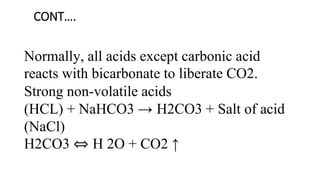
CONT….
Normally, all acids except carbonic acid
reacts with bicarbonate to liberate CO2.
Strong non-volatile acids
(HCL) + NaHCO3 → H2CO3 + Salt of acid
(NaCl)
H2CO3 ⇔ H 2O + CO2 ↑
A strong and non-volatile acid is converted into weak
(less dissociable) and volatile acid at the expense of
NaHCO3 (salt component of the buffer).
• H2CO3 thus formed, as it is volatile, is eliminated
by diffusion of CO2 through alveoli of lungs.
Hence, bicarbonate buffer system is directly linked
up with respiration.
Note: Proper lung functioning is important.
Similarly, when alkaline substance, e.g. NaOH
enters the ECF, it reacts with the acid component,
i.e. H2CO3 of the buffer system.
Create a chemical reaction and its product………?
ADVANTAGES OF BICARBONATE
BUFFER SYSTEM
Bicarbonate buffer system is efficient as
compared to other buffer systems as:
1. It is present in very high concentration than other
buffer systems. (26 to 28 millimole per litre)
2. Produces H2CO3, which is a weak acid and volatile
and CO 2 is exhaled out.
ROLE OF RESPIRATION IN
ACID-BASE REGULATION
Participation of the respiratory mechanism, in the regulation of acid-
base balance is depend upon:
i) The sensitivity of the respiratory centre (RC) in medulla oblongata
to very slight changes in pH and
pCO 2.
ii) The ready diffusibility of CO 2 from the blood, across the
pulmonary alveolar membrane, into the alveolar air.
Note: The lungs should be healthy so that diffusion of CO 2 take place
properly.
An increase in blood pCO2 and of only 1.5 mmHg
(0.2 per cent increase in CO2) results in 100 per cent
ROLE OF RESPIRATION IN
ACID-BASE REGULATION
Participation of the respiratory mechanism, in the regulation of acid-
base balance is depend upon:
i) The sensitivity of the respiratory centre (RC) in medulla oblongata
to very slight changes in pH and
pCO 2.
ii) The ready diffusibility of CO 2 from the blood, across the
pulmonary alveolar membrane, into the alveolar air.
Note: The lungs should be healthy so that diffusion of CO 2 take place
properly.
CONT…….
An increase in blood pCO2 whereby only 1.5 mmHg
(0.2 per cent increase in CO2) results in 100 per cent increase in
pulmonary ventilation which increases with slight increases in H + ion
concentration of the blood (acidosis).
The excess CO 2 is thereby promptly removed from the ECF in the
expired air.
A decrease in blood pCO2↓ or H+ ion concentration (alkalosis),
causes depression of respiratory centre, with consequent slow and
shallow respiration (hypoventilation) resulting to retention of CO2 in
the blood until the normal pCO 2 and pH are restored.
RENAL MECHANISMS FOR REGULATION
OF ACID-BASE BALANCE
• By providing for elimination of non-volatile acids.
Lactic acid, H2SO4 , ketonebodies, etc. after being
buffered with cations (principally Na + ) are first
removed by glomerular filtration.
• Body cannot afford to lose Na + , as its extremely
important. It is recovered in the renal tubules by
reabsorption in exchange of H+ ions which are
secreted.
There are three mechanisms by
which the above is achieved.
A. Bicarbonate mechanism
B. Phosphate mechanism
C. Ammonia mechanism
BICARBONATE MECHANISM
• Mobilisation of H + ions for tubular secretion is
accomplished by disociation of carbonic
acid(H2CO3)which itself is formed from metabolic CO2
and H2 O
• In proximal tubular epithelial cells, the exchange of H+ ions
proceed first against sodium bicarbonate.
• Hence, all the HCO3– ions are normally reabsorbed, while a
slight excess of H+ ions remains in the tubules to react with
other substances and to be excreted in urine
ACID-BASE IMBALANCE
Acid-Base imbalance can manifest as either
1. Acidosis
2. Alkalosis.
A. ACIDOSIS
Acidosis is an abnormal pathophysiological
condition characterized by the buildup of excess
acid in the body fluid such as Extracellular fluids
or tissue.
They are two classification of Acidosis which
are;
(1) metabolic acidosis.
(2) respiratory acidosis.
B. ALKALOSIS
Alkalosis is an abnormal pathophysiological condition
characterized by the buildup of excess base or alkali in the
body fluid such as Extracellular fluids or tissue.
They are two classification of Acidosis which are;
(1) Metabolic alkalosis
(2) Respiratory alkalosis.
All of the above may be in compensated phase and
uncompensated phase
ACIDOSIS
A. Metabolic Acidosis
• It is the commonest disturbance of acid-base balance
observed clinically.
• It is caused when there is a reduction in the plasma HCO3–
↓ with either no or little change in the H2CO3 fraction.
Mechanisms:
If primary deficit of HCO3– occurs the ratio [HCO –3 ]/ [H2
CO3] is decreased, i.e. pH is decreased resulting in metabolic
acidosis (primary bicarbonate deficit).
•
COMPENSATORY MECHANISM
(a)Primary compensatory mechanism (Respiratory)
• The respiratory centre is stimulated by acidosis causing deep
and rapid breathing (increased ventilation).
• This increased ventilation will result in CO2 loss and
reduction in [H2CO3]
↓ (carbonic acid).
• As a result, the ratio of [HCO–3]/[H2CO 3] is restored as
levels of both in blood are reduced.
NOTE: increased ventilation causes reduction in pCO2 ↓,
which in turn depresses the respiratory centre
(b) Secondary Compensatory Mechanism (Renal)
Renal mechanisms attempt to correct the disturbances as
follows:
By increasing;
• NH3 formation ↑
• H+ excretion compared to K + excretion in distal
tubule, and
• HCO –3 reabsorption
DIAGNOSIS AND BIOCHEMICAL
CHARACTERISTICS
(a)Uncompensated:
If uncompensated, it is characterized biochemically in
plasma or blood as follows:
• Disproportionate decrease in [HCO –3 ] ↓
• Decrease in [H 2CO 3 ] ↓ and pCO2 ↓
• Decrease in total CO 2 content [HCO –3] + [H 2 CO 3]
• Decrease in [HCO–3 ] : [H2CO 3 ] ratio ↓
• Decrease in pH ↓
(b) Fully compensated:
• If fully compensated the CO2 content is low
• Decrease in [HCO –3 ] and [H2CO3] is proportionate,
• [HCO–3 ] : [H2CO 3] ratio remain within normal
limits.
• pH remain within normal limits.
CAUSES
I. Abnormal increase in “anions”, other than
HCO 3 – (“acid-gain” acidosis) resulting from:
(a) Excessive endogenous production of acid ions as occurring in:
• Diabetic acidosis
• Lactic acidosis
• Starvation
• High fever
• Violent exercise
• Shock
• Haemorrhage and anoxia
(b) Ingestion of acid (dietary or iatrogenic)
May be produced by the administration of
excessive quantities of acids e.g. acetyl salicylic
acid, phosphoric acid, HCl, NH4Cl and
NH4NO3, Mandelic acid, etc.
(c) Renal insufficiency:
• This lead to retention of acids produced normally
• Acidosis is commonly observed in the
• terminal stages of nephritis, and
• Destructive renal lesions such as
• polycystic kidneys,
pyelonephritis,
• hydro and pyonephrosis, renal TB, etc.
II. Abnormal loss of HCO 3 –:
Metabolic acidosis due to loss of base, may occur due
to loss of excessive intestinal secretions, as in
 Severe diarrhoeas
 Small bowel fistulaes
 Severe biliary fistulaes
B. RESPIRATORY ACIDOSIS
• It is also called as “primary [H 2CO 3] carbonic acid
excess’’.
• The underlying abnormality here is increase in H2CO3 in
the blood, which follows decreased elimination of CO2 in
the pulmonary alveoli and result in increase in (pCO2 ↑)
This may result from:
1. Breathing air containing abnormally high percentage of
CO 2
2. Conditions in which elimination of CO2 through lungs is
retarded
MECHANISM
• If excretion of CO2 through lungs is impaired
(e.g. emphysema or depression of respiratory centre),
more CO 2 will accumulate in blood, resulting in excess
H2CO3 formation [H 2CO 3 ] ↑.
• This results in lowering the ratio of [HCO –3]/[H 2 CO 3 ],
resulting lowering in pH ↓and is described as “Respiratory
acidosis” (carbonic
acid excess).
COMPENSATORY MECHANISM
In this condition, the respiratory mechanism becomes
secondary and renal mechanism becomes of prime importance.
(a) Respiratory mechanism: Increased stimulation to respiratory
centre (RC) by the increased CO2 tension (pCO 2↑) results in
increased depth and rate of respiration with consequent increased
ventilation.
NOTE This mechanism becomes secondary in importance as the
defect may be with the RC, its depression/or some pathology in the
Lungs.
 As a result this compensatory mechanism becomes less
effective.
(b) Renal mechanism: It is of prime
importance. More HCO –3 are reabsorbed
from tubules in response to raised pCO 2 in
blood and ratio of [HCO–3 ]/[H2CO 3] is
restored as the levels of both in blood are
increased.
BIOCHEMICAL/DIAGNOSTIC
CHARACTERISTICS
(a) If uncompensated, it is characterised biochemically
(plasma or blood) as follows:
• Disproportionate increase in [H 2CO 3] ↑ (pCO 2) ↑
• Increase in [HCO–3 ] ↑
• Increase in total CO 2 content ↑
• Decrease in [HCO–3 ] : [H 2CO 3] ratio ↓
• Decrease in pH ↓
(b) If fully compensated,
• CO 2-content is high
Increase in [H2 CO 3] and [HCO –3] are
proportionate,
• [HCO –3 ] : [H2 CO 3] ratio remaining within
normal limits.
• pH remaining within normal limits.
CAUSES
I. Conditions in which there is depression or suppression
of respiration
(a) Damage to CNS:
i) Brain damage:
 Trauma
 Inflammation
Compression
 Convulsive disorders (Seizure).
ii) Drug poisoning
Morphine
Barbiturates.
iii) Excessive anaesthesia
iv) Bulbar polio.
b) Loss of “ventilatory functions”
 Tension pneumothorax
 Pulmonary and mediastinal tumours
 Emphysema
c) Effects of pain
 Pleurisy
II. Conditions causing impairment of
diffusion of CO 2 across alveolar
membrane
Emphysema
Pulmonary oedema
Congenital alveolar dysplasia
III. Conditions in which there is an obstacle to
the escape of CO2 from the alveoli:
a) Obstruction to respiratory tract
Laryngeal obstruction
Asthma.
b) Rebreathing from a closed space.
IV. Conditions in which pulmonary
blood flow is insufficient:
Certain congenital heart diseases.
Ayerza’s disease.
ALKALOSIS
A. Metabolic Alkalosis
• Also called as primary alkali excess.
• This condition results from an absolute or relative increase in [HCO
3].
Mechanism
1. Excess of HCO 3 accumulation (soluble alkali ingestion) causes
an increase in the ratio of [HCO3–]/[H2CO 3] (i.e. pH is increased
↑) and it is known as “Metabolic alkalosis” (“bicarbonate
excess”).
2. The respiratory centre (RC) is inhibited by alkalosis
causing shallow, irregular breathing.
• This reduced ventilation will result in CO2 retention and increases in
carbonic acid level [H2CO 3] ↑.
3. The ratio of [HCO–3]/[H2CO3] will be restored as the levels of both
in blood are increased.
4. However, decreased ventilation raises pCO 2, which
tends to stimulate the RC.
NOTE: Raised pCO 2 stimulating the RC are working simultaneously
and the respiratory compensation is incomplete
COMPENSATORY MECHANISM
Renal mechanisms:
• Increases the excretion of HCO –3
• Decrease H+ - Na + exchange.
• K+ excretion increases in the distal tubules instead of
H+.
• There is reduced NH3 ↓ formation and excretion of
non-volatile acids such as lactic acid and ketoacids.
FOLLOWING COMPENSATORY MECHANISMS
• Decreased pulmonary respiration ↓
• Increased alkali excretion ↑
• Decreased acid excretion ↓
• Decreased NH3 formation ↓
• Retention of acid metabolites
DIAGNOSTIC/BIOCHEMICAL
CHARACTERISTICS
(a) If uncompensated phase
• Disproportionate increase in [HCO –3] ↑
• Increase in [H2 CO 3] ↑, pCO 2 ↑
• Increase in total CO 2 content
• Increase in [HCO –3 ]:[H2 CO 3] ratio ↑
• Increase in pH ↑
(b) If fully compensated
• CO 2 content is high
• Increase in [HCO–3] and [H 2 CO 3] are
proportionate
• [HCO –3 ] : [H2 CO 3] ratio remaining within
normal limits
• pH remaining within normal limits.
CAUSES
1. Excessive loss of HCl from stomach:
The loss of excessive quantities of HCl from the stomach is
encountered most frequently in individuals with:
• Pyloric obstruction
• High intestinal obstruction
• Protracted (prolonged) gastric lavage without proper
provision of acid replacement, in infants with pylorospasm
•Sometimes in patients with generalised peritonitis
(inflammation of abdomen linings)
2. Alkali administration:
Excessive intake of bases like NaHCO 3 , Na and K acetates, lactates or
citrates.
NOTE: Lactates and citrates are converted into HCO–3.
3. Potassium deficiency.
4. Roentgen ray, UV irradiation and radium therapy:
A decrease in the H + ion concentration of the blood plasma (i.e. increased
pH) has been observed following deep X-ray therapy, radium therapy and
prolonged exposure to UV rays.
The mechanism is not clear. In some cases (radiation sickness), it may
be due to excessive voming.
RESPIRATORY ALKALOSIS…
Also called as primary H2CO3 deficit.
This condition occurs when there is a decrease in [H2CO3] ↓
fraction with no corresponding change in HCO–3 in plasma.
Excessive quantities of CO2 may be washed out of the blood by
hyperventilation.
Mechanism:
Increased loss of CO2 (due to hyperventilation), results in
diminution of [H2CO3] ↓. The ratio of [HCO–3]/[H2CO3] is
increased ↑ i.e. pH is increased and is termed “respiratory
alkalosis” (carbonic acid deficit)
COMPESATORY MECHANISMS
RENAL COMPENSATORY MECHANISMS
Renal(primary compensatory mechanism)
 Increase excretion of alkali in the form of HCO3
 Decrease excretion of acid
 Decrease execration of NH3 in the urine.
 Retention of CL- in the blood.
DIAGNOSTIC AND BIOCHEMICAL
CHARACTERISTIC
a. If UNCOMPENSATED
is characterized in the plasma or blood biochemically
as follow
 Disproportionate decrease in [H2CO3] and PCO2
 Decrease in [HCO3]
 Decrease in CO2 contents
 Increase in [HCO3]; [H2CO3] ratio disproportionate.
 Increase of the PH.
DIAGNOSTIC AND BIOCHEMICAL
CHARACTERISTIC….
b. If fully compensated
 Low CO2 contents
 Decrease in [HCO3] and [H2CO3] is proportionate
 Ratio of [HCO3]:[H2CO3] remain within normal
limits.
 PH remain within normal limits.
CAUSES OF RESPIRATORY ALKALOSIS
1. Stimulation of Respiratory Centre (RC)
In CNS diseases, e.g. meningitis, encephalitis. Alkalosis due to
hyperventilation has been observed in some cases of
meningitis/encephalitis. manifesting hyperpnoea, over prolonged periods of
time
• Salicylate poisoning: Large doses of salicylates, such as are sometimes
given in the treatment of acute rheumatic fever, produce stimulation of
Respiratory centre (RC) with consequent hyperventilation and tendency
towards alkalosis.
• Hyperpyrexia: Hyperventilation may occur as a result of the increased
respiratory rate associated with increase in body temperature.
Causes cont…….
2. Other Causes
Hysteria: Hyperventilation during hysterical attacks.
Apprehensive blood donors: Hyperventilation tetany with
alkalosis has been observed in apprehensive and
hyperexcitable donors.
High altitude effects: Hyperpnoea occurring in untrained
individuals ascending to high altitudes where the atmospheric
O2-tension is low (anoxicanoxaemia) commonly results in
primary H2CO3 deficit and alkalosis
Injudicious use of respirators.
Hepatic coma.
CLINICAL IMPLICATION
Here are some of the clinical implications of respiratory
alkalosis:
Cardiovascular effects: Respiratory alkalosis can lead to
decreased blood flow to vital organs such as the brain and heart
due to constriction of blood vessels. This can result in symptoms
such as dizziness, fainting, and chest pain.
Neuromuscular effects: Alkalosis can cause decreased nerve and
muscle function, leading to symptoms such as numbness and
tingling in the hands and feet, muscle twitching, and cramps.
Clinical impilcation cont….
Respiratory effects: The respiratory system can
compensate for respiratory alkalosis by decreasing the
respiratory rate and depth. However, this compensation
can lead to hypoventilation and hypoxemia, especially in
patients with underlying lung disease.
Metabolic effects: Chronic respiratory alkalosis can lead
to metabolic alkalosis, which is associated with low
potassium levels, calcium loss, and impaired bone
health.
SIGNS AND SYMPTOMS OF RESPIRATORY
ALKALOSIS
 Fatigue
 Nausea
 Muscles spasms
 Dizziness
 Dyspnea
REFERENCE
MN Chatterjea, Rana Shinde. Medical Biochemistry,
Eight Edition (2012)

ACID BASE IMBALANCE 2.pptx

  • 1.
    ACID-BASE IMBALANCE By Lwitiko MwakagileAmos Medical Laboratory Scientist
  • 2.
    INTRODUCTION……. An acid isdefined as a substance, ion, molecule or particle, that yields H + ions (protons) in solution. A base is anything that combines or accept with H + ions (protons). Example: H2CO3 is an acid, dissociating into H + and HCO3 ions, its anionic component HCO3 –is a base
  • 3.
    Under normal conditions,the pH of Extracellular Fluid usually does not vary beyond the range 7.35 to 7.5 and is maintained approximately at 7.4, (pH of arterial blood is approx. 7.43 and venous blood is 7.4). Maintenance of this constant blood reaction is one of prime requisites of life and any material variation on either side, seriously disturbs the vital process and may lead to death. pH < 7.3 leads to acidosis and pH > 7.5 leads to alkalosis.
  • 4.
    Large amounts ofH+ are continually contributed to these fluids from intracellular metabolic reactions, hence to maintain a constancy it is necessary that they are removed from the fluids effectively The mechanisms of neutrality regulations are concerned, therefore, with maintaining a state of equili- brium between production, i.e. introduction of H + ions and removal of the H + ions.
  • 5.
    The physiological pHof the human body is essential for many processes necessary to life including • Oxygen delivery to tissues • Correct protein structure • Innumerable biochemical reactions rely on the normal pH to be in equilibrium and complete.
  • 6.
    ACIDS PRODUCED INTHE BODY The following are the major sources of H + (protons) production in the human body. • Carbonic acid (H2CO3): It is the chief acid produced in the body in the course of oxidation in the cells. Oxidation of C-compounds resulting in CO2 production. • Sulphuric acid (H2SO4): A strong dissociable acid produced during oxidation of S-containing amino acids, e.g. cysteine/cystine and methionine. • Phosphoric acid: Products of metabolism of dietary phosphoproteins, nucleoproteins, phosphatides and hydrolysis of phosphoesters.
  • 7.
    • Organic acids:Abnormal production and accumulation of certain intermediary organic acids from oxidation of carbohydrates, fats and proteins, under certain circumstances, e.g. pyruvic acid, lactic acid, acetoacetic acid, β-OH-butyric acid, etc. • Iatrogenic: Certain medicines like NH 4Cl, mandelic acid, etc. may increase H + concentration of blood when they are used as treatment, when administered in excess.
  • 8.
    MECHANISMS OF REGULATIONOF pH The mechanisms of regulation of blood pH involves the following factors: (a) “Front-line” defence • Buffer systems in the blood: Which restricts pH change in body fluids. • Respiratory mechanisms: Regulation of excretion of CO2 and hence, regulation of H2CO 3 concentration in EC fluid.
  • 9.
    Cont…. (b) “Second-line” defence: Thisis achieved by kidneys (Renal mechanisms). Ultimate excretion of excess of acid or base and thus ultimate regulation of concentration of H + and HCO 3–ions in EC fluid.
  • 10.
    BUFFERS A buffer maybe defined as a solution which resists the change in pH which might be expected to occur upon the addition of acid or base to the solution. Buffers consist of mixtures of weak acids and their corresponding salts, alternatively, weak bases and their salts. Example ?........
  • 11.
    TYPE OF BLOODBUFFER SYSTEM 1.Bicarbonate Buffer System 2.Phosphate Buffer System 3.Protein Buffer System 4.Hemoglobin as a Buffering Agent
  • 12.
    BICARBONATE BUFFER SYSTEM Theyare the chief buffers of blood Neutralization of strong and non-volatile acids entering the ECF is achieved by the bicarbonate buffers. Such acids, e.g. HCl, H2SO 4, Lactic acid, etc. which are strong and non-volatile react with NaHCO3 component. Thus, HCL will be buffered as follows:
  • 13.
    CONT…. Normally, all acidsexcept carbonic acid reacts with bicarbonate to liberate CO2. Strong non-volatile acids (HCL) + NaHCO3 → H2CO3 + Salt of acid (NaCl) H2CO3 ⇔ H 2O + CO2 ↑
  • 14.
    A strong andnon-volatile acid is converted into weak (less dissociable) and volatile acid at the expense of NaHCO3 (salt component of the buffer). • H2CO3 thus formed, as it is volatile, is eliminated by diffusion of CO2 through alveoli of lungs. Hence, bicarbonate buffer system is directly linked up with respiration. Note: Proper lung functioning is important.
  • 15.
    Similarly, when alkalinesubstance, e.g. NaOH enters the ECF, it reacts with the acid component, i.e. H2CO3 of the buffer system. Create a chemical reaction and its product………?
  • 16.
    ADVANTAGES OF BICARBONATE BUFFERSYSTEM Bicarbonate buffer system is efficient as compared to other buffer systems as: 1. It is present in very high concentration than other buffer systems. (26 to 28 millimole per litre) 2. Produces H2CO3, which is a weak acid and volatile and CO 2 is exhaled out.
  • 17.
    ROLE OF RESPIRATIONIN ACID-BASE REGULATION Participation of the respiratory mechanism, in the regulation of acid- base balance is depend upon: i) The sensitivity of the respiratory centre (RC) in medulla oblongata to very slight changes in pH and pCO 2. ii) The ready diffusibility of CO 2 from the blood, across the pulmonary alveolar membrane, into the alveolar air. Note: The lungs should be healthy so that diffusion of CO 2 take place properly. An increase in blood pCO2 and of only 1.5 mmHg (0.2 per cent increase in CO2) results in 100 per cent
  • 18.
    ROLE OF RESPIRATIONIN ACID-BASE REGULATION Participation of the respiratory mechanism, in the regulation of acid- base balance is depend upon: i) The sensitivity of the respiratory centre (RC) in medulla oblongata to very slight changes in pH and pCO 2. ii) The ready diffusibility of CO 2 from the blood, across the pulmonary alveolar membrane, into the alveolar air. Note: The lungs should be healthy so that diffusion of CO 2 take place properly.
  • 19.
    CONT……. An increase inblood pCO2 whereby only 1.5 mmHg (0.2 per cent increase in CO2) results in 100 per cent increase in pulmonary ventilation which increases with slight increases in H + ion concentration of the blood (acidosis). The excess CO 2 is thereby promptly removed from the ECF in the expired air. A decrease in blood pCO2↓ or H+ ion concentration (alkalosis), causes depression of respiratory centre, with consequent slow and shallow respiration (hypoventilation) resulting to retention of CO2 in the blood until the normal pCO 2 and pH are restored.
  • 20.
    RENAL MECHANISMS FORREGULATION OF ACID-BASE BALANCE • By providing for elimination of non-volatile acids. Lactic acid, H2SO4 , ketonebodies, etc. after being buffered with cations (principally Na + ) are first removed by glomerular filtration. • Body cannot afford to lose Na + , as its extremely important. It is recovered in the renal tubules by reabsorption in exchange of H+ ions which are secreted.
  • 21.
    There are threemechanisms by which the above is achieved. A. Bicarbonate mechanism B. Phosphate mechanism C. Ammonia mechanism
  • 22.
    BICARBONATE MECHANISM • Mobilisationof H + ions for tubular secretion is accomplished by disociation of carbonic acid(H2CO3)which itself is formed from metabolic CO2 and H2 O • In proximal tubular epithelial cells, the exchange of H+ ions proceed first against sodium bicarbonate. • Hence, all the HCO3– ions are normally reabsorbed, while a slight excess of H+ ions remains in the tubules to react with other substances and to be excreted in urine
  • 23.
    ACID-BASE IMBALANCE Acid-Base imbalancecan manifest as either 1. Acidosis 2. Alkalosis.
  • 24.
    A. ACIDOSIS Acidosis isan abnormal pathophysiological condition characterized by the buildup of excess acid in the body fluid such as Extracellular fluids or tissue. They are two classification of Acidosis which are; (1) metabolic acidosis. (2) respiratory acidosis.
  • 25.
    B. ALKALOSIS Alkalosis isan abnormal pathophysiological condition characterized by the buildup of excess base or alkali in the body fluid such as Extracellular fluids or tissue. They are two classification of Acidosis which are; (1) Metabolic alkalosis (2) Respiratory alkalosis. All of the above may be in compensated phase and uncompensated phase
  • 26.
    ACIDOSIS A. Metabolic Acidosis •It is the commonest disturbance of acid-base balance observed clinically. • It is caused when there is a reduction in the plasma HCO3– ↓ with either no or little change in the H2CO3 fraction. Mechanisms: If primary deficit of HCO3– occurs the ratio [HCO –3 ]/ [H2 CO3] is decreased, i.e. pH is decreased resulting in metabolic acidosis (primary bicarbonate deficit). •
  • 27.
    COMPENSATORY MECHANISM (a)Primary compensatorymechanism (Respiratory) • The respiratory centre is stimulated by acidosis causing deep and rapid breathing (increased ventilation). • This increased ventilation will result in CO2 loss and reduction in [H2CO3] ↓ (carbonic acid). • As a result, the ratio of [HCO–3]/[H2CO 3] is restored as levels of both in blood are reduced. NOTE: increased ventilation causes reduction in pCO2 ↓, which in turn depresses the respiratory centre
  • 28.
    (b) Secondary CompensatoryMechanism (Renal) Renal mechanisms attempt to correct the disturbances as follows: By increasing; • NH3 formation ↑ • H+ excretion compared to K + excretion in distal tubule, and • HCO –3 reabsorption
  • 29.
    DIAGNOSIS AND BIOCHEMICAL CHARACTERISTICS (a)Uncompensated: Ifuncompensated, it is characterized biochemically in plasma or blood as follows: • Disproportionate decrease in [HCO –3 ] ↓ • Decrease in [H 2CO 3 ] ↓ and pCO2 ↓ • Decrease in total CO 2 content [HCO –3] + [H 2 CO 3] • Decrease in [HCO–3 ] : [H2CO 3 ] ratio ↓ • Decrease in pH ↓
  • 30.
    (b) Fully compensated: •If fully compensated the CO2 content is low • Decrease in [HCO –3 ] and [H2CO3] is proportionate, • [HCO–3 ] : [H2CO 3] ratio remain within normal limits. • pH remain within normal limits.
  • 31.
    CAUSES I. Abnormal increasein “anions”, other than HCO 3 – (“acid-gain” acidosis) resulting from: (a) Excessive endogenous production of acid ions as occurring in: • Diabetic acidosis • Lactic acidosis • Starvation • High fever • Violent exercise • Shock • Haemorrhage and anoxia
  • 32.
    (b) Ingestion ofacid (dietary or iatrogenic) May be produced by the administration of excessive quantities of acids e.g. acetyl salicylic acid, phosphoric acid, HCl, NH4Cl and NH4NO3, Mandelic acid, etc.
  • 33.
    (c) Renal insufficiency: •This lead to retention of acids produced normally • Acidosis is commonly observed in the • terminal stages of nephritis, and • Destructive renal lesions such as • polycystic kidneys, pyelonephritis, • hydro and pyonephrosis, renal TB, etc.
  • 34.
    II. Abnormal lossof HCO 3 –: Metabolic acidosis due to loss of base, may occur due to loss of excessive intestinal secretions, as in  Severe diarrhoeas  Small bowel fistulaes  Severe biliary fistulaes
  • 35.
    B. RESPIRATORY ACIDOSIS •It is also called as “primary [H 2CO 3] carbonic acid excess’’. • The underlying abnormality here is increase in H2CO3 in the blood, which follows decreased elimination of CO2 in the pulmonary alveoli and result in increase in (pCO2 ↑) This may result from: 1. Breathing air containing abnormally high percentage of CO 2 2. Conditions in which elimination of CO2 through lungs is retarded
  • 36.
    MECHANISM • If excretionof CO2 through lungs is impaired (e.g. emphysema or depression of respiratory centre), more CO 2 will accumulate in blood, resulting in excess H2CO3 formation [H 2CO 3 ] ↑. • This results in lowering the ratio of [HCO –3]/[H 2 CO 3 ], resulting lowering in pH ↓and is described as “Respiratory acidosis” (carbonic acid excess).
  • 37.
    COMPENSATORY MECHANISM In thiscondition, the respiratory mechanism becomes secondary and renal mechanism becomes of prime importance. (a) Respiratory mechanism: Increased stimulation to respiratory centre (RC) by the increased CO2 tension (pCO 2↑) results in increased depth and rate of respiration with consequent increased ventilation. NOTE This mechanism becomes secondary in importance as the defect may be with the RC, its depression/or some pathology in the Lungs.  As a result this compensatory mechanism becomes less effective.
  • 38.
    (b) Renal mechanism:It is of prime importance. More HCO –3 are reabsorbed from tubules in response to raised pCO 2 in blood and ratio of [HCO–3 ]/[H2CO 3] is restored as the levels of both in blood are increased.
  • 39.
    BIOCHEMICAL/DIAGNOSTIC CHARACTERISTICS (a) If uncompensated,it is characterised biochemically (plasma or blood) as follows: • Disproportionate increase in [H 2CO 3] ↑ (pCO 2) ↑ • Increase in [HCO–3 ] ↑ • Increase in total CO 2 content ↑ • Decrease in [HCO–3 ] : [H 2CO 3] ratio ↓ • Decrease in pH ↓
  • 40.
    (b) If fullycompensated, • CO 2-content is high Increase in [H2 CO 3] and [HCO –3] are proportionate, • [HCO –3 ] : [H2 CO 3] ratio remaining within normal limits. • pH remaining within normal limits.
  • 41.
    CAUSES I. Conditions inwhich there is depression or suppression of respiration (a) Damage to CNS: i) Brain damage:  Trauma  Inflammation Compression  Convulsive disorders (Seizure).
  • 42.
    ii) Drug poisoning Morphine Barbiturates. iii)Excessive anaesthesia iv) Bulbar polio.
  • 43.
    b) Loss of“ventilatory functions”  Tension pneumothorax  Pulmonary and mediastinal tumours  Emphysema c) Effects of pain  Pleurisy
  • 44.
    II. Conditions causingimpairment of diffusion of CO 2 across alveolar membrane Emphysema Pulmonary oedema Congenital alveolar dysplasia
  • 45.
    III. Conditions inwhich there is an obstacle to the escape of CO2 from the alveoli: a) Obstruction to respiratory tract Laryngeal obstruction Asthma. b) Rebreathing from a closed space.
  • 46.
    IV. Conditions inwhich pulmonary blood flow is insufficient: Certain congenital heart diseases. Ayerza’s disease.
  • 47.
    ALKALOSIS A. Metabolic Alkalosis •Also called as primary alkali excess. • This condition results from an absolute or relative increase in [HCO 3]. Mechanism 1. Excess of HCO 3 accumulation (soluble alkali ingestion) causes an increase in the ratio of [HCO3–]/[H2CO 3] (i.e. pH is increased ↑) and it is known as “Metabolic alkalosis” (“bicarbonate excess”).
  • 48.
    2. The respiratorycentre (RC) is inhibited by alkalosis causing shallow, irregular breathing. • This reduced ventilation will result in CO2 retention and increases in carbonic acid level [H2CO 3] ↑. 3. The ratio of [HCO–3]/[H2CO3] will be restored as the levels of both in blood are increased. 4. However, decreased ventilation raises pCO 2, which tends to stimulate the RC. NOTE: Raised pCO 2 stimulating the RC are working simultaneously and the respiratory compensation is incomplete
  • 49.
    COMPENSATORY MECHANISM Renal mechanisms: •Increases the excretion of HCO –3 • Decrease H+ - Na + exchange. • K+ excretion increases in the distal tubules instead of H+. • There is reduced NH3 ↓ formation and excretion of non-volatile acids such as lactic acid and ketoacids.
  • 50.
    FOLLOWING COMPENSATORY MECHANISMS •Decreased pulmonary respiration ↓ • Increased alkali excretion ↑ • Decreased acid excretion ↓ • Decreased NH3 formation ↓ • Retention of acid metabolites
  • 51.
    DIAGNOSTIC/BIOCHEMICAL CHARACTERISTICS (a) If uncompensatedphase • Disproportionate increase in [HCO –3] ↑ • Increase in [H2 CO 3] ↑, pCO 2 ↑ • Increase in total CO 2 content • Increase in [HCO –3 ]:[H2 CO 3] ratio ↑ • Increase in pH ↑
  • 52.
    (b) If fullycompensated • CO 2 content is high • Increase in [HCO–3] and [H 2 CO 3] are proportionate • [HCO –3 ] : [H2 CO 3] ratio remaining within normal limits • pH remaining within normal limits.
  • 53.
    CAUSES 1. Excessive lossof HCl from stomach: The loss of excessive quantities of HCl from the stomach is encountered most frequently in individuals with: • Pyloric obstruction • High intestinal obstruction • Protracted (prolonged) gastric lavage without proper provision of acid replacement, in infants with pylorospasm •Sometimes in patients with generalised peritonitis (inflammation of abdomen linings)
  • 54.
    2. Alkali administration: Excessiveintake of bases like NaHCO 3 , Na and K acetates, lactates or citrates. NOTE: Lactates and citrates are converted into HCO–3. 3. Potassium deficiency. 4. Roentgen ray, UV irradiation and radium therapy: A decrease in the H + ion concentration of the blood plasma (i.e. increased pH) has been observed following deep X-ray therapy, radium therapy and prolonged exposure to UV rays. The mechanism is not clear. In some cases (radiation sickness), it may be due to excessive voming.
  • 55.
    RESPIRATORY ALKALOSIS… Also calledas primary H2CO3 deficit. This condition occurs when there is a decrease in [H2CO3] ↓ fraction with no corresponding change in HCO–3 in plasma. Excessive quantities of CO2 may be washed out of the blood by hyperventilation. Mechanism: Increased loss of CO2 (due to hyperventilation), results in diminution of [H2CO3] ↓. The ratio of [HCO–3]/[H2CO3] is increased ↑ i.e. pH is increased and is termed “respiratory alkalosis” (carbonic acid deficit)
  • 56.
    COMPESATORY MECHANISMS RENAL COMPENSATORYMECHANISMS Renal(primary compensatory mechanism)  Increase excretion of alkali in the form of HCO3  Decrease excretion of acid  Decrease execration of NH3 in the urine.  Retention of CL- in the blood.
  • 57.
    DIAGNOSTIC AND BIOCHEMICAL CHARACTERISTIC a.If UNCOMPENSATED is characterized in the plasma or blood biochemically as follow  Disproportionate decrease in [H2CO3] and PCO2  Decrease in [HCO3]  Decrease in CO2 contents  Increase in [HCO3]; [H2CO3] ratio disproportionate.  Increase of the PH.
  • 58.
    DIAGNOSTIC AND BIOCHEMICAL CHARACTERISTIC…. b.If fully compensated  Low CO2 contents  Decrease in [HCO3] and [H2CO3] is proportionate  Ratio of [HCO3]:[H2CO3] remain within normal limits.  PH remain within normal limits.
  • 59.
    CAUSES OF RESPIRATORYALKALOSIS 1. Stimulation of Respiratory Centre (RC) In CNS diseases, e.g. meningitis, encephalitis. Alkalosis due to hyperventilation has been observed in some cases of meningitis/encephalitis. manifesting hyperpnoea, over prolonged periods of time • Salicylate poisoning: Large doses of salicylates, such as are sometimes given in the treatment of acute rheumatic fever, produce stimulation of Respiratory centre (RC) with consequent hyperventilation and tendency towards alkalosis. • Hyperpyrexia: Hyperventilation may occur as a result of the increased respiratory rate associated with increase in body temperature.
  • 60.
    Causes cont……. 2. OtherCauses Hysteria: Hyperventilation during hysterical attacks. Apprehensive blood donors: Hyperventilation tetany with alkalosis has been observed in apprehensive and hyperexcitable donors. High altitude effects: Hyperpnoea occurring in untrained individuals ascending to high altitudes where the atmospheric O2-tension is low (anoxicanoxaemia) commonly results in primary H2CO3 deficit and alkalosis Injudicious use of respirators. Hepatic coma.
  • 61.
    CLINICAL IMPLICATION Here aresome of the clinical implications of respiratory alkalosis: Cardiovascular effects: Respiratory alkalosis can lead to decreased blood flow to vital organs such as the brain and heart due to constriction of blood vessels. This can result in symptoms such as dizziness, fainting, and chest pain. Neuromuscular effects: Alkalosis can cause decreased nerve and muscle function, leading to symptoms such as numbness and tingling in the hands and feet, muscle twitching, and cramps.
  • 62.
    Clinical impilcation cont…. Respiratoryeffects: The respiratory system can compensate for respiratory alkalosis by decreasing the respiratory rate and depth. However, this compensation can lead to hypoventilation and hypoxemia, especially in patients with underlying lung disease. Metabolic effects: Chronic respiratory alkalosis can lead to metabolic alkalosis, which is associated with low potassium levels, calcium loss, and impaired bone health.
  • 63.
    SIGNS AND SYMPTOMSOF RESPIRATORY ALKALOSIS  Fatigue  Nausea  Muscles spasms  Dizziness  Dyspnea
  • 64.
    REFERENCE MN Chatterjea, RanaShinde. Medical Biochemistry, Eight Edition (2012)