A PRESENTATION ON
555 TIMER IC & its APPLICATION
For the subject of
ANALOG CIRCUIT DESIGN (code:2141002)
DEPARTMENT OF
ELECTRONICS ENGINEERING
Presented by:
Subham Dhar
(130070110081)
BIRLA VISHVAKARMA
MAHAVIDYALAYA
555 TIMER & ITS
APPLICATION
 Timer IC 555 is a monolithic timer IC
 The basic building blocks of 555 timer
are:-
a)RS Flip Flop, b)two comparators
c)Reference Voltage Source
d) Discharge transistor
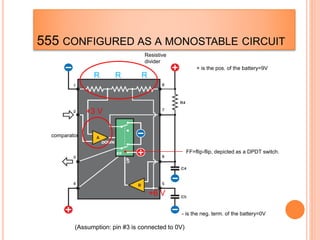
555 CONFIGURED AS A MONOSTABLE CIRCUIT
FF=flip-flip, depicted as a DPDT switch.
Resistive
divider
comparator
+ is the pos. of the battery=9V
- is the neg. term. of the battery=0V
R R R
+6 V
+3 V
(Assumption: pin #3 is connected to 0V)
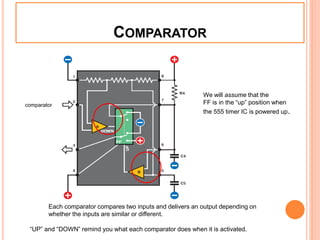
COMPARATOR
comparator
Each comparator compares two inputs and delivers an output depending on
whether the inputs are similar or different.
“UP” and “DOWN” remind you what each comparator does when it is activated.
We will assume that the
FF is in the “up” position when
the 555 timer IC is powered up.
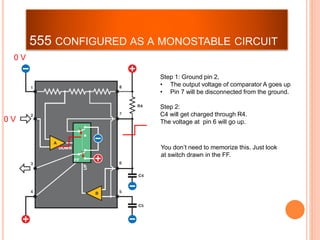
555 CONFIGURED AS A MONOSTABLE CIRCUIT
Step 1: Ground pin 2,
• The output voltage of comparator A goes up
• Pin 7 will be disconnected from the ground.
Step 2:
C4 will get charged through R4.
The voltage at pin 6 will go up.
You don’t need to memorize this. Just look
at switch drawn in the FF.
0 V
0 V
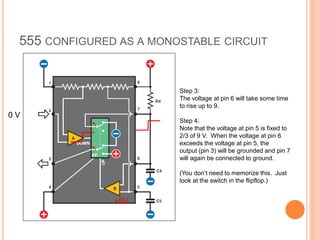
555 CONFIGURED AS A MONOSTABLE CIRCUIT
Step 3:
The voltage at pin 6 will take some time
to rise up to 9.
Step 4:
Note that the voltage at pin 5 is fixed to
2/3 of 9 V. When the voltage at pin 6
exceeds the voltage at pin 5, the
output (pin 3) will be grounded and pin 7
will again be connected to ground.
(You don’t need to memorize this. Just
look at the switch in the flipflop.)
0 V
+6V
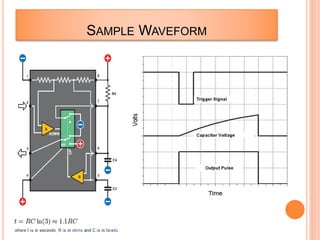
SAMPLE WAVEFORM
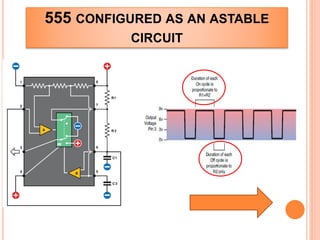
555 CONFIGURED AS AN ASTABLE
CIRCUIT
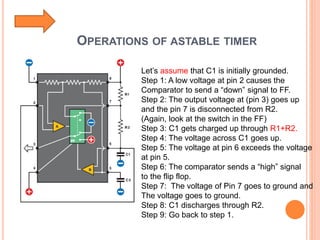
OPERATIONS OF ASTABLE TIMER
Let’s assume that C1 is initially grounded.
Step 1: A low voltage at pin 2 causes the
Comparator to send a “down” signal to FF.
Step 2: The output voltage at (pin 3) goes up
and the pin 7 is disconnected from R2.
(Again, look at the switch in the FF)
Step 3: C1 gets charged up through R1+R2.
Step 4: The voltage across C1 goes up.
Step 5: The voltage at pin 6 exceeds the voltage
at pin 5.
Step 6: The comparator sends a “high” signal
to the flip flop.
Step 7: The voltage of Pin 7 goes to ground and
The voltage goes to ground.
Step 8: C1 discharges through R2.
Step 9: Go back to step 1.
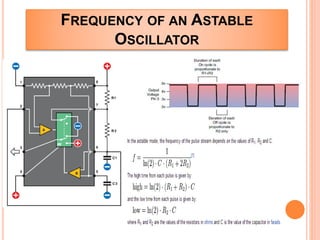
FREQUENCY OF AN ASTABLE
OSCILLATOR
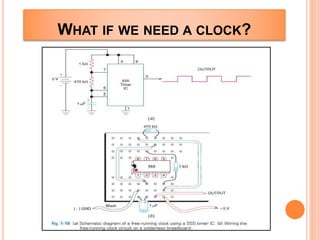
WHAT IF WE NEED A CLOCK?
SQUARE WAVE OSCILLATOR USING 555
TIMER IC
A CLOSER LOOK AT THE SQUARE
WAVE GENERATOR
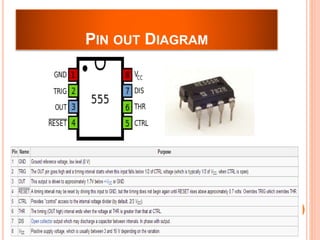
PIN OUT DIAGRAM
REFERENCE
www.falstad.com
www.microelectronics.com
www.stelectronics.com
IEEE signal processing magazine(2008)
http://www.falstad.com/circuit/e-555int.html
THANK YOU

555 TIMER IC & its APPLICATION

  • 1.
    A PRESENTATION ON 555TIMER IC & its APPLICATION For the subject of ANALOG CIRCUIT DESIGN (code:2141002) DEPARTMENT OF ELECTRONICS ENGINEERING Presented by: Subham Dhar (130070110081) BIRLA VISHVAKARMA MAHAVIDYALAYA
  • 2.
    555 TIMER &ITS APPLICATION  Timer IC 555 is a monolithic timer IC  The basic building blocks of 555 timer are:- a)RS Flip Flop, b)two comparators c)Reference Voltage Source d) Discharge transistor
  • 3.
    555 CONFIGURED ASA MONOSTABLE CIRCUIT FF=flip-flip, depicted as a DPDT switch. Resistive divider comparator + is the pos. of the battery=9V - is the neg. term. of the battery=0V R R R +6 V +3 V (Assumption: pin #3 is connected to 0V)
  • 4.
    COMPARATOR comparator Each comparator comparestwo inputs and delivers an output depending on whether the inputs are similar or different. “UP” and “DOWN” remind you what each comparator does when it is activated. We will assume that the FF is in the “up” position when the 555 timer IC is powered up.
  • 5.
    555 CONFIGURED ASA MONOSTABLE CIRCUIT Step 1: Ground pin 2, • The output voltage of comparator A goes up • Pin 7 will be disconnected from the ground. Step 2: C4 will get charged through R4. The voltage at pin 6 will go up. You don’t need to memorize this. Just look at switch drawn in the FF. 0 V 0 V
  • 6.
    555 CONFIGURED ASA MONOSTABLE CIRCUIT Step 3: The voltage at pin 6 will take some time to rise up to 9. Step 4: Note that the voltage at pin 5 is fixed to 2/3 of 9 V. When the voltage at pin 6 exceeds the voltage at pin 5, the output (pin 3) will be grounded and pin 7 will again be connected to ground. (You don’t need to memorize this. Just look at the switch in the flipflop.) 0 V +6V
  • 7.
  • 8.
    555 CONFIGURED ASAN ASTABLE CIRCUIT
  • 9.
    OPERATIONS OF ASTABLETIMER Let’s assume that C1 is initially grounded. Step 1: A low voltage at pin 2 causes the Comparator to send a “down” signal to FF. Step 2: The output voltage at (pin 3) goes up and the pin 7 is disconnected from R2. (Again, look at the switch in the FF) Step 3: C1 gets charged up through R1+R2. Step 4: The voltage across C1 goes up. Step 5: The voltage at pin 6 exceeds the voltage at pin 5. Step 6: The comparator sends a “high” signal to the flip flop. Step 7: The voltage of Pin 7 goes to ground and The voltage goes to ground. Step 8: C1 discharges through R2. Step 9: Go back to step 1.
  • 10.
    FREQUENCY OF ANASTABLE OSCILLATOR
  • 11.
    WHAT IF WENEED A CLOCK?
  • 12.
    SQUARE WAVE OSCILLATORUSING 555 TIMER IC
  • 13.
    A CLOSER LOOKAT THE SQUARE WAVE GENERATOR
  • 14.
  • 15.
  • 16.