LINEAR INTEGRATED CIRCUIT
555
Timers
2
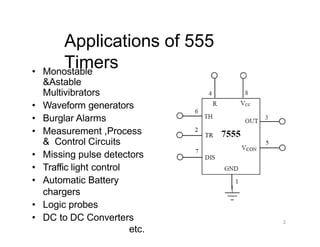
Applications of 555
Timers
• Monostable
&Astable
Multivibrators
• Waveform generators
• Burglar Alarms
• Measurement ,Process
& Control Circuits
• Missing pulse detectors
• Traffic light control
• Automatic Battery
chargers
• Logic probes
• DC to DC Converters
etc.
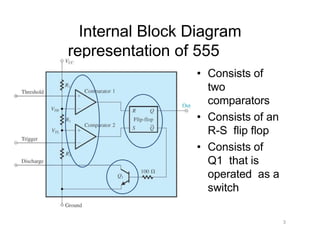
Internal Block Diagram
representation of 555
Timer • Consists of
two
comparators
• Consists of an
R-S flip flop
• Consists of
Q1 that is
operated as a
switch
3
R-S flip Flop
Review
R S Q
Actio
n
0 0 Last Value No change
0 1 1 Set
1 0 0 Reset
1 1 ? Indeterminate(forbidde
n)
4
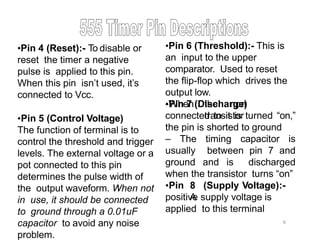
•Pin 1 (Ground):- All voltages are
measured w.r.t. this terminal. This is
the most negative supply potential
of the device
•Pin 2 (Trigger Terminal )
This pin is an inverting input to a
lower comparator. This is used to
set the flip flop which causes the
output to go high
•Pin 3 (Output Terminal)
There are 2 ways to connect load to
the output terminal.
Pin 3 & Vcc :- Normally On load
Pin 3 & Ground:- Normally off
load 5
•Pin 4 (Reset):- To disable or
reset the timer a negative
pulse is applied to this pin.
When this pin isn’t used, it’s
connected to Vcc.
•Pin 5 (Control Voltage)
The function of terminal is to
control the threshold and trigger
levels. The external voltage or a
pot connected to this pin
determines the pulse width of
the output waveform. When not
in use, it should be connected
to ground through a 0.01uF
capacitor to avoid any noise
problem.
6
•Pin 6 (Threshold):- This is
an input to the upper
comparator. Used to reset
the flip-flop which drives the
output low.
•Pin 7 (Discharge)
-When the npn
transistor
connected to it is turned “on,”
the pin is shorted to ground
– The timing capacitor is
usually between pin 7 and
ground and is discharged
when the transistor turns “on”
•Pin 8 (Supply Voltage):-
A
positive supply voltage is
applied to this terminal
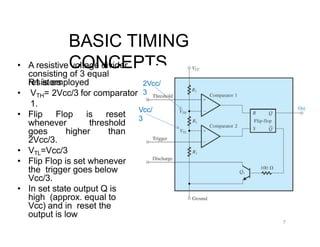
BASIC TIMING
CONCEPTS
• A resistive voltage divider
consisting of 3 equal
resistors
R1 is employed
• VTH= 2Vcc/3 for comparator
1.
• Flip Flop is reset
whenever threshold
goes higher than
2Vcc/3.
• VTL=Vcc/3
• Flip Flop is set whenever
the trigger goes below
Vcc/3.
• In set state output Q is
high (approx. equal to
Vcc) and in reset the
output is low
2Vcc/
3
Vcc/
3
7
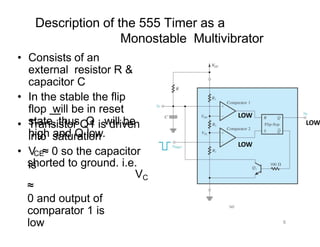
Description of the 555 Timer as a
Monostable Multivibrator
• Consists of an
external resistor R &
capacitor C
• In the stable the flip
flop will be in reset
state, thus Q will be
high and Q low.
• Transistor Q1 is driven
into saturation
• V ≈ 0 so the capacitor
is
CE
shorted to ground. i.e.
VC
≈
0 and output of
comparator 1 is
low
LO
W
8
LOW
LOW
LOW
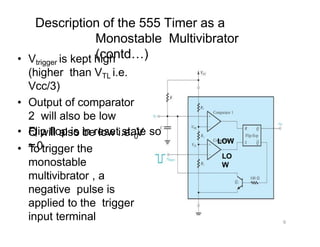
Description of the 555 Timer as a
Monostable Multivibrator
(contd…)
Q will also be low i.e. V
≈ 0
0
• To trigger the
monostable
multivibrator , a
negative pulse is
applied to the trigger
input terminal
• Vtrigger is kept high
(higher than VTL i.e.
Vcc/3)
• Output of comparator
2 will also be low
• Flip flop is in reset state so
LOW
9
LO
W
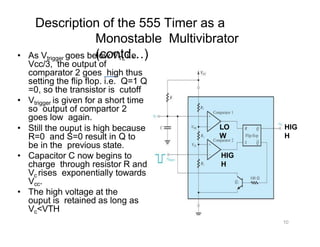
Description of the 555 Timer as a
Monostable Multivibrator
(contd…)
• As Vtrigger goes below VTL i.e.
Vcc/3, the output of
comparator 2 goes high thus
setting the flip flop. i.e. Q=1 Q
=0, so the transistor is cutoff
• Vtrigger is given for a short time
so output of compartor 2
goes low again.
• Still the ouput is high because
R=0 and S=0 result in Q to
be in the previous state.
• Capacitor C now begins to
charge through resistor R and
Vc rises exponentially towards
Vcc.
• The high voltage at the
ouput is retained as long as
Vc<VTH
LO
W
10
HIG
H
HIG
H
Description of the 555 Timer as a
Monostable Multivibrator
(contd…)
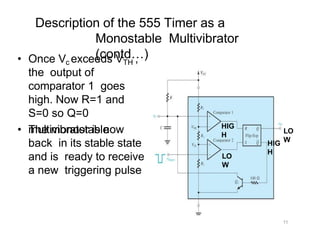
• Once Vc exceeds VTH ,
the output of
comparator 1 goes
high. Now R=1 and
S=0 so Q=0
• The monostable
multivibrator is now
back in its stable state
and is ready to receive
a new triggering pulse
LO
W
11
HIG
H
HIG
H
LO
W
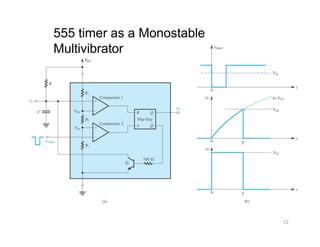
555 timer as a Monostable
Multivibrator
12
Derivation for the width of the pulse
in monostable multivibrator
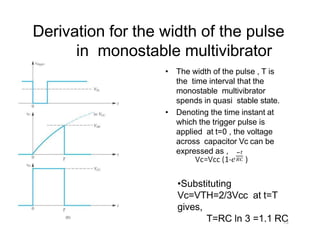
• The width of the pulse , T is
the time interval that the
monostable multivibrator
spends in quasi stable state.
• Denoting the time instant at
which the trigger pulse is
applied at t=0 , the voltage
across capacitor Vc can be
expressed as ,
•Substituting
Vc=VTH=2/3Vcc at t=T
gives,
T=RC ln 3 =1.1 RC
13
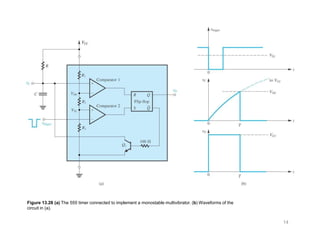
Figure 13.28 (a) The 555 timer connected to implement a monostable multivibrator. (b) Waveforms of the
circuit in (a).
14
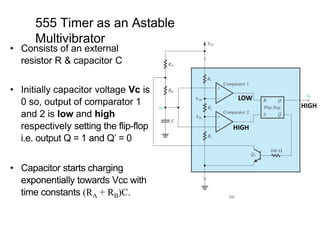
• Consists of an external
resistor R & capacitor C
• Initially capacitor voltage Vc is
0 so, output of comparator 1
and 2 is low and high
respectively setting the flip-flop
i.e. output Q = 1 and Q’ = 0
• Capacitor starts charging
exponentially towards Vcc with
time constants (RA + RB)C.
555 Timer as an Astable
Multivibrator
LOW
HIGH
HIGH
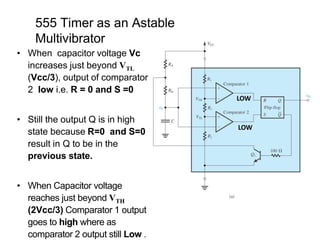
• When capacitor voltage Vc
increases just beyond VTL
(Vcc/3), output of comparator
2 low i.e. R = 0 and S =0
• Still the output Q is in high
state because R=0 and S=0
result in Q to be in the
previous state.
• When Capacitor voltage
reaches just beyond VTH
(2Vcc/3) Comparator 1 output
goes to high where as
comparator 2 output still Low .
555 Timer as an Astable
Multivibrator
LOW
LOW
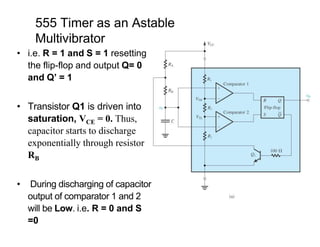
• i.e. R = 1 and S = 1 resetting
the flip-flop and output Q= 0
and Q’ = 1
• Transistor Q1 is driven into
saturation, VCE = 0. Thus,
capacitor starts to discharge
exponentially through resistor
RB
• During discharging of capacitor
output of comparator 1 and 2
will be Low. i.e. R = 0 and S
=0
555 Timer as an Astable
Multivibrator
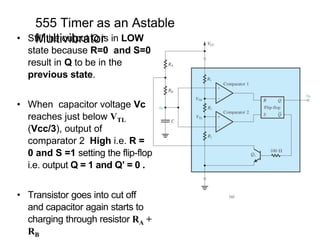
• Still the output Q is in LOW
state because R=0 and S=0
result in Q to be in the
previous state.
• When capacitor voltage Vc
reaches just below VTL
(Vcc/3), output of
comparator 2 High i.e. R =
0 and S =1 setting the flip-flop
i.e. output Q = 1 and Q’ = 0 .
• Transistor goes into cut off
and capacitor again starts to
charging through resistor RA +
RB
555 Timer as an Astable
Multivibrator
555 Timer as an Astable
Multivibrator
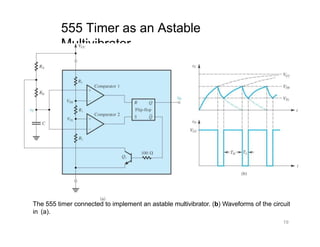
The 555 timer connected to implement an astable multivibrator. (b) Waveforms of the circuit
in (a).
19

555 timer

  • 1.
  • 2.
    2 Applications of 555 Timers •Monostable &Astable Multivibrators • Waveform generators • Burglar Alarms • Measurement ,Process & Control Circuits • Missing pulse detectors • Traffic light control • Automatic Battery chargers • Logic probes • DC to DC Converters etc.
  • 3.
    Internal Block Diagram representationof 555 Timer • Consists of two comparators • Consists of an R-S flip flop • Consists of Q1 that is operated as a switch 3
  • 4.
    R-S flip Flop Review RS Q Actio n 0 0 Last Value No change 0 1 1 Set 1 0 0 Reset 1 1 ? Indeterminate(forbidde n) 4
  • 5.
    •Pin 1 (Ground):-All voltages are measured w.r.t. this terminal. This is the most negative supply potential of the device •Pin 2 (Trigger Terminal ) This pin is an inverting input to a lower comparator. This is used to set the flip flop which causes the output to go high •Pin 3 (Output Terminal) There are 2 ways to connect load to the output terminal. Pin 3 & Vcc :- Normally On load Pin 3 & Ground:- Normally off load 5
  • 6.
    •Pin 4 (Reset):-To disable or reset the timer a negative pulse is applied to this pin. When this pin isn’t used, it’s connected to Vcc. •Pin 5 (Control Voltage) The function of terminal is to control the threshold and trigger levels. The external voltage or a pot connected to this pin determines the pulse width of the output waveform. When not in use, it should be connected to ground through a 0.01uF capacitor to avoid any noise problem. 6 •Pin 6 (Threshold):- This is an input to the upper comparator. Used to reset the flip-flop which drives the output low. •Pin 7 (Discharge) -When the npn transistor connected to it is turned “on,” the pin is shorted to ground – The timing capacitor is usually between pin 7 and ground and is discharged when the transistor turns “on” •Pin 8 (Supply Voltage):- A positive supply voltage is applied to this terminal
  • 7.
    BASIC TIMING CONCEPTS • Aresistive voltage divider consisting of 3 equal resistors R1 is employed • VTH= 2Vcc/3 for comparator 1. • Flip Flop is reset whenever threshold goes higher than 2Vcc/3. • VTL=Vcc/3 • Flip Flop is set whenever the trigger goes below Vcc/3. • In set state output Q is high (approx. equal to Vcc) and in reset the output is low 2Vcc/ 3 Vcc/ 3 7
  • 8.
    Description of the555 Timer as a Monostable Multivibrator • Consists of an external resistor R & capacitor C • In the stable the flip flop will be in reset state, thus Q will be high and Q low. • Transistor Q1 is driven into saturation • V ≈ 0 so the capacitor is CE shorted to ground. i.e. VC ≈ 0 and output of comparator 1 is low LO W 8 LOW LOW LOW
  • 9.
    Description of the555 Timer as a Monostable Multivibrator (contd…) Q will also be low i.e. V ≈ 0 0 • To trigger the monostable multivibrator , a negative pulse is applied to the trigger input terminal • Vtrigger is kept high (higher than VTL i.e. Vcc/3) • Output of comparator 2 will also be low • Flip flop is in reset state so LOW 9 LO W
  • 10.
    Description of the555 Timer as a Monostable Multivibrator (contd…) • As Vtrigger goes below VTL i.e. Vcc/3, the output of comparator 2 goes high thus setting the flip flop. i.e. Q=1 Q =0, so the transistor is cutoff • Vtrigger is given for a short time so output of compartor 2 goes low again. • Still the ouput is high because R=0 and S=0 result in Q to be in the previous state. • Capacitor C now begins to charge through resistor R and Vc rises exponentially towards Vcc. • The high voltage at the ouput is retained as long as Vc<VTH LO W 10 HIG H HIG H
  • 11.
    Description of the555 Timer as a Monostable Multivibrator (contd…) • Once Vc exceeds VTH , the output of comparator 1 goes high. Now R=1 and S=0 so Q=0 • The monostable multivibrator is now back in its stable state and is ready to receive a new triggering pulse LO W 11 HIG H HIG H LO W
  • 12.
    555 timer asa Monostable Multivibrator 12
  • 13.
    Derivation for thewidth of the pulse in monostable multivibrator • The width of the pulse , T is the time interval that the monostable multivibrator spends in quasi stable state. • Denoting the time instant at which the trigger pulse is applied at t=0 , the voltage across capacitor Vc can be expressed as , •Substituting Vc=VTH=2/3Vcc at t=T gives, T=RC ln 3 =1.1 RC 13
  • 14.
    Figure 13.28 (a)The 555 timer connected to implement a monostable multivibrator. (b) Waveforms of the circuit in (a). 14
  • 15.
    • Consists ofan external resistor R & capacitor C • Initially capacitor voltage Vc is 0 so, output of comparator 1 and 2 is low and high respectively setting the flip-flop i.e. output Q = 1 and Q’ = 0 • Capacitor starts charging exponentially towards Vcc with time constants (RA + RB)C. 555 Timer as an Astable Multivibrator LOW HIGH HIGH
  • 16.
    • When capacitorvoltage Vc increases just beyond VTL (Vcc/3), output of comparator 2 low i.e. R = 0 and S =0 • Still the output Q is in high state because R=0 and S=0 result in Q to be in the previous state. • When Capacitor voltage reaches just beyond VTH (2Vcc/3) Comparator 1 output goes to high where as comparator 2 output still Low . 555 Timer as an Astable Multivibrator LOW LOW
  • 17.
    • i.e. R= 1 and S = 1 resetting the flip-flop and output Q= 0 and Q’ = 1 • Transistor Q1 is driven into saturation, VCE = 0. Thus, capacitor starts to discharge exponentially through resistor RB • During discharging of capacitor output of comparator 1 and 2 will be Low. i.e. R = 0 and S =0 555 Timer as an Astable Multivibrator
  • 18.
    • Still theoutput Q is in LOW state because R=0 and S=0 result in Q to be in the previous state. • When capacitor voltage Vc reaches just below VTL (Vcc/3), output of comparator 2 High i.e. R = 0 and S =1 setting the flip-flop i.e. output Q = 1 and Q’ = 0 . • Transistor goes into cut off and capacitor again starts to charging through resistor RA + RB 555 Timer as an Astable Multivibrator
  • 19.
    555 Timer asan Astable Multivibrator The 555 timer connected to implement an astable multivibrator. (b) Waveforms of the circuit in (a). 19