Accounting for Depreciation
M. Awais Yaqoob
2011-ch-32
(University of Engineering and Technology, Lahore)
Accounting for Depreciation
 Fixed assets other than land lose their ability over
time to provide services
 Costs of equipment, buildings, and land
improvements should be transferred to expense
accounts in a systematic manner during their
expected useful lives.
 DEPRECIATION
 Adjusting entry to record depreciation is usually
made at the end of each month or at the end of
the year Fixed assets other than land lose their
ability over time to provide services
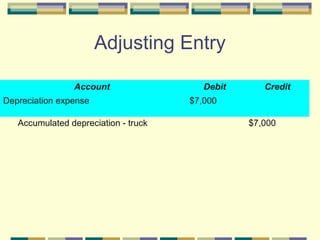
Adjusting Entry
Account Debit Credit
Depreciation expense $7,000
Accumulated depreciation - truck $7,000
Depreciation
Accumulated depreciation
 Shows the amount that the asset has lost in value since its
purchase
Depreciation expense
 Shows the amount that the asset has lost in value this
period.
Factors that cause a decline the ability of a fixed
asset to provide services may be identified as
 Physical depreciation
 Occurs from the wear and tear while in use and from the action
of the weather
 Functional depreciation
 Occurs when a fixed asset is no longer able to provide services
at the level for which it was intended.
Factors in Computing
Depreciation Expense
The fixed asset’s initial cost
Its expected useful life
Its estimated value at the end of
its useful life.
Depreciation Methods
Straight line
Declining balance
Units of production
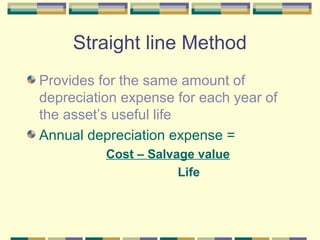
Straight line Method
Provides for the same amount of
depreciation expense for each year of
the asset’s useful life
Annual depreciation expense =
Cost – Salvage value
Life
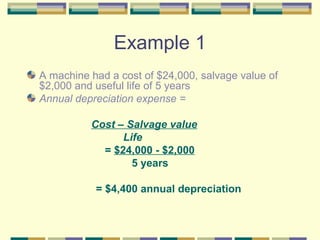
Example 1
A machine had a cost of $24,000, salvage value of
$2,000 and useful life of 5 years
Annual depreciation expense =
Cost – Salvage value
Life
= $24,000 - $2,000
5 years
= $4,400 annual depreciation
Adjusting entry
Account Debit Credit
Depreciation expense $4,400
Accumulated depreciation - truck $4,400
Example 2
A machine had a cost of $30,000,
salvage of $5,000 and useful life of 6
years. Compute depreciation under the
straight line method?
What is depreciation expense in year 3?
Units of Production
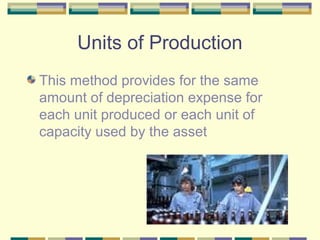
This method provides for the same
amount of depreciation expense for
each unit produced or each unit of
capacity used by the asset
Units of Production
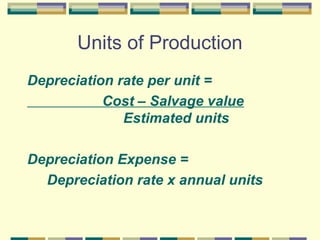
Depreciation rate per unit =
Cost – Salvage value
Estimated units
Depreciation Expense =
Depreciation rate x annual units
Example 3
A machine had a cost of $24,000,
salvage value of $2,000, estimated total
hours of production of 10,000 and
annual hours used of 2,100 hours.
Compute depreciation for the period
under the units of production method.
Example 3
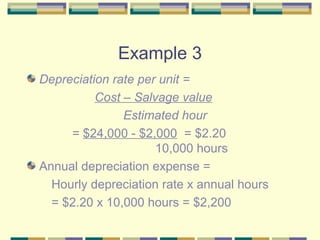
Depreciation rate per unit =
Cost – Salvage value
Estimated hour
= $24,000 - $2,000 = $2.20
10,000 hours
Annual depreciation expense =
Hourly depreciation rate x annual hours
= $2.20 x 10,000 hours = $2,200
Example 4
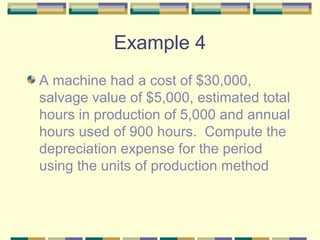
A machine had a cost of $30,000,
salvage value of $5,000, estimated total
hours in production of 5,000 and annual
hours used of 900 hours. Compute the
depreciation expense for the period
using the units of production method
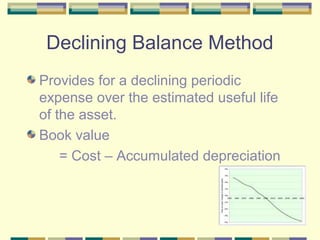
Declining Balance Method
Provides for a declining periodic
expense over the estimated useful life
of the asset.
Book value
= Cost – Accumulated depreciation
Declining Balance Method
Steps
 Compute the DB rate = 100/Life of asset
 For double declining balance
 Multiply rate time 2
 Depreciation expense =
Beg. book value X Rate
 Rule: the book value may never by less than
the salvage value of the asset
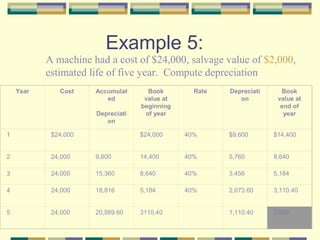
Example 5:
A machine had a cost of $24,000, salvage value of $2,000,
estimated life of five year. Compute depreciation
Year Cost Accumulat
ed
Depreciati
on
Book
value at
beginning
of year
Rate Depreciati
on
Book
value at
end of
year
1 $24,000 $24,000 40% $9,600 $14,400
2 24,000 9,600 14,400 40% 5,760 8,640
3 24,000 15,360 8,640 40% 3,456 5,184
4 24,000 18,816 5,184 40% 2,073.60 3,110.40
5 24,000 20,889.60 3110.40 1,110.40 2,000
Example 6
Example 6: A machine had a cost of $30,000, salvage value of
$5,000, estimated life of 6 years. Compute depreciation
using the double declining balance method.
Revision of Depreciation
Revising the estimates of the residual
value and the useful life is normal
Used to determine depreciation
expense in future periods
Example 7
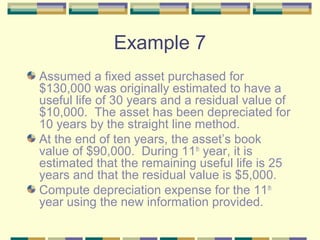
Assumed a fixed asset purchased for
$130,000 was originally estimated to have a
useful life of 30 years and a residual value of
$10,000. The asset has been depreciated for
10 years by the straight line method.
At the end of ten years, the asset’s book
value of $90,000. During 11th
year, it is
estimated that the remaining useful life is 25
years and that the residual value is $5,000.
Compute depreciation expense for the 11th
year using the new information provided.
Example 7
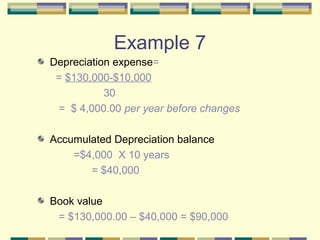
Depreciation expense=
= $130,000-$10,000
30
= $ 4,000.00 per year before changes
Accumulated Depreciation balance
=$4,000 X 10 years
= $40,000
Book value
= $130,000.00 – $40,000 = $90,000
Example 7
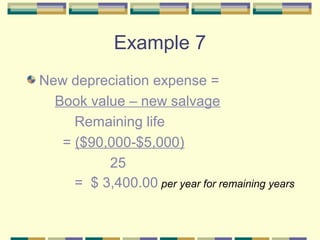
New depreciation expense =
Book value – new salvage
Remaining life
= ($90,000-$5,000)
25
= $ 3,400.00 per year for remaining years
Disposal of Fixed Assets
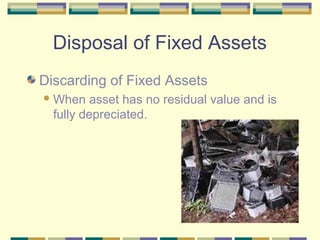
Discarding of Fixed Assets
When asset has no residual value and is
fully depreciated.
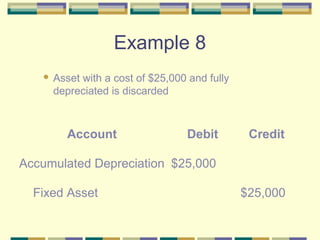
Example 8
 Asset with a cost of $25,000 and fully
depreciated is discarded
Account Debit Credit
Accumulated Depreciation $25,000
Fixed Asset $25,000
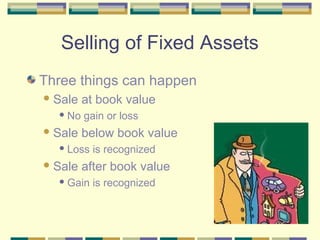
Selling of Fixed Assets
Three things can happen
Sale at book value
 No gain or loss
Sale below book value
 Loss is recognized
Sale after book value
 Gain is recognized
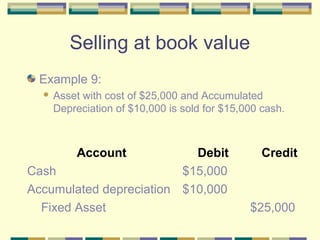
Selling at book value
Example 9:
 Asset with cost of $25,000 and Accumulated
Depreciation of $10,000 is sold for $15,000 cash.
Account Debit Credit
Cash $15,000
Accumulated depreciation $10,000
Fixed Asset $25,000
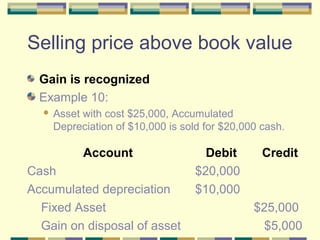
Selling price above book value
Gain is recognized
Example 10:
 Asset with cost $25,000, Accumulated
Depreciation of $10,000 is sold for $20,000 cash.
Account Debit Credit
Cash $20,000
Accumulated depreciation $10,000
Fixed Asset $25,000
Gain on disposal of asset $5,000
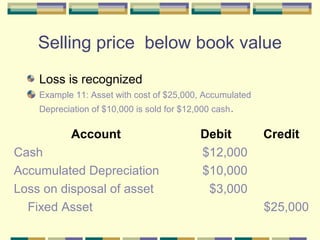
Selling price below book value
Loss is recognized
Example 11: Asset with cost of $25,000, Accumulated
Depreciation of $10,000 is sold for $12,000 cash.
Account Debit Credit
Cash $12,000
Accumulated Depreciation $10,000
Loss on disposal of asset $3,000
Fixed Asset $25,000
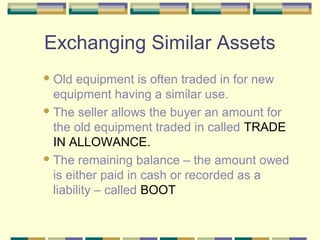
Exchanging Similar Assets
Old equipment is often traded in for new
equipment having a similar use.
The seller allows the buyer an amount for
the old equipment traded in called TRADE
IN ALLOWANCE.
The remaining balance – the amount owed
is either paid in cash or recorded as a
liability – called BOOT
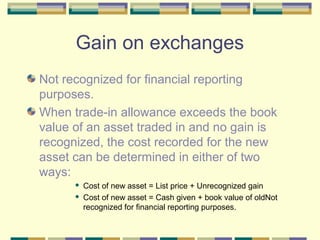
Gain on exchanges
Not recognized for financial reporting
purposes.
When trade-in allowance exceeds the book
value of an asset traded in and no gain is
recognized, the cost recorded for the new
asset can be determined in either of two
ways:
 Cost of new asset = List price + Unrecognized gain
 Cost of new asset = Cash given + book value of oldNot
recognized for financial reporting purposes.
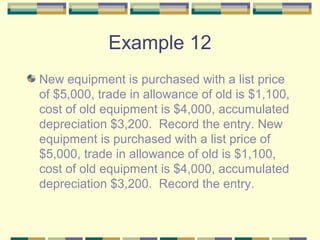
Example 12
New equipment is purchased with a list price
of $5,000, trade in allowance of old is $1,100,
cost of old equipment is $4,000, accumulated
depreciation $3,200. Record the entry. New
equipment is purchased with a list price of
$5,000, trade in allowance of old is $1,100,
cost of old equipment is $4,000, accumulated
depreciation $3,200. Record the entry.
Example 12
Account Debit Credit
Fixed Asset – new $800
Accumulated Depreciation $3,200
Fixed Asset – old $4,000
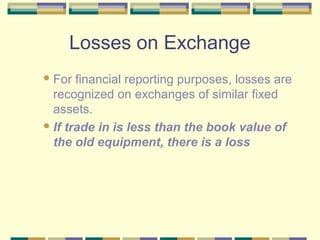
Losses on Exchange
For financial reporting purposes, losses are
recognized on exchanges of similar fixed
assets.
If trade in is less than the book value of
the old equipment, there is a loss
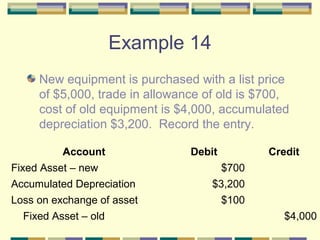
Example 14
New equipment is purchased with a list price
of $5,000, trade in allowance of old is $700,
cost of old equipment is $4,000, accumulated
depreciation $3,200. Record the entry.
Account Debit Credit
Fixed Asset – new $700
Accumulated Depreciation $3,200
Loss on exchange of asset $100
Fixed Asset – old $4,000

Accounting for Depreciation

  • 1.
    Accounting for Depreciation M.Awais Yaqoob 2011-ch-32 (University of Engineering and Technology, Lahore)
  • 2.
    Accounting for Depreciation Fixed assets other than land lose their ability over time to provide services  Costs of equipment, buildings, and land improvements should be transferred to expense accounts in a systematic manner during their expected useful lives.  DEPRECIATION  Adjusting entry to record depreciation is usually made at the end of each month or at the end of the year Fixed assets other than land lose their ability over time to provide services
  • 3.
    Adjusting Entry Account DebitCredit Depreciation expense $7,000 Accumulated depreciation - truck $7,000
  • 4.
    Depreciation Accumulated depreciation  Showsthe amount that the asset has lost in value since its purchase Depreciation expense  Shows the amount that the asset has lost in value this period. Factors that cause a decline the ability of a fixed asset to provide services may be identified as  Physical depreciation  Occurs from the wear and tear while in use and from the action of the weather  Functional depreciation  Occurs when a fixed asset is no longer able to provide services at the level for which it was intended.
  • 5.
    Factors in Computing DepreciationExpense The fixed asset’s initial cost Its expected useful life Its estimated value at the end of its useful life.
  • 6.
  • 7.
    Straight line Method Providesfor the same amount of depreciation expense for each year of the asset’s useful life Annual depreciation expense = Cost – Salvage value Life
  • 8.
    Example 1 A machinehad a cost of $24,000, salvage value of $2,000 and useful life of 5 years Annual depreciation expense = Cost – Salvage value Life = $24,000 - $2,000 5 years = $4,400 annual depreciation
  • 9.
    Adjusting entry Account DebitCredit Depreciation expense $4,400 Accumulated depreciation - truck $4,400
  • 10.
    Example 2 A machinehad a cost of $30,000, salvage of $5,000 and useful life of 6 years. Compute depreciation under the straight line method? What is depreciation expense in year 3?
  • 11.
    Units of Production Thismethod provides for the same amount of depreciation expense for each unit produced or each unit of capacity used by the asset
  • 12.
    Units of Production Depreciationrate per unit = Cost – Salvage value Estimated units Depreciation Expense = Depreciation rate x annual units
  • 13.
    Example 3 A machinehad a cost of $24,000, salvage value of $2,000, estimated total hours of production of 10,000 and annual hours used of 2,100 hours. Compute depreciation for the period under the units of production method.
  • 14.
    Example 3 Depreciation rateper unit = Cost – Salvage value Estimated hour = $24,000 - $2,000 = $2.20 10,000 hours Annual depreciation expense = Hourly depreciation rate x annual hours = $2.20 x 10,000 hours = $2,200
  • 15.
    Example 4 A machinehad a cost of $30,000, salvage value of $5,000, estimated total hours in production of 5,000 and annual hours used of 900 hours. Compute the depreciation expense for the period using the units of production method
  • 16.
    Declining Balance Method Providesfor a declining periodic expense over the estimated useful life of the asset. Book value = Cost – Accumulated depreciation
  • 17.
    Declining Balance Method Steps Compute the DB rate = 100/Life of asset  For double declining balance  Multiply rate time 2  Depreciation expense = Beg. book value X Rate  Rule: the book value may never by less than the salvage value of the asset
  • 18.
    Example 5: A machinehad a cost of $24,000, salvage value of $2,000, estimated life of five year. Compute depreciation Year Cost Accumulat ed Depreciati on Book value at beginning of year Rate Depreciati on Book value at end of year 1 $24,000 $24,000 40% $9,600 $14,400 2 24,000 9,600 14,400 40% 5,760 8,640 3 24,000 15,360 8,640 40% 3,456 5,184 4 24,000 18,816 5,184 40% 2,073.60 3,110.40 5 24,000 20,889.60 3110.40 1,110.40 2,000
  • 19.
    Example 6 Example 6:A machine had a cost of $30,000, salvage value of $5,000, estimated life of 6 years. Compute depreciation using the double declining balance method.
  • 20.
    Revision of Depreciation Revisingthe estimates of the residual value and the useful life is normal Used to determine depreciation expense in future periods
  • 21.
    Example 7 Assumed afixed asset purchased for $130,000 was originally estimated to have a useful life of 30 years and a residual value of $10,000. The asset has been depreciated for 10 years by the straight line method. At the end of ten years, the asset’s book value of $90,000. During 11th year, it is estimated that the remaining useful life is 25 years and that the residual value is $5,000. Compute depreciation expense for the 11th year using the new information provided.
  • 22.
    Example 7 Depreciation expense= =$130,000-$10,000 30 = $ 4,000.00 per year before changes Accumulated Depreciation balance =$4,000 X 10 years = $40,000 Book value = $130,000.00 – $40,000 = $90,000
  • 23.
    Example 7 New depreciationexpense = Book value – new salvage Remaining life = ($90,000-$5,000) 25 = $ 3,400.00 per year for remaining years
  • 24.
    Disposal of FixedAssets Discarding of Fixed Assets When asset has no residual value and is fully depreciated.
  • 25.
    Example 8  Assetwith a cost of $25,000 and fully depreciated is discarded Account Debit Credit Accumulated Depreciation $25,000 Fixed Asset $25,000
  • 26.
    Selling of FixedAssets Three things can happen Sale at book value  No gain or loss Sale below book value  Loss is recognized Sale after book value  Gain is recognized
  • 27.
    Selling at bookvalue Example 9:  Asset with cost of $25,000 and Accumulated Depreciation of $10,000 is sold for $15,000 cash. Account Debit Credit Cash $15,000 Accumulated depreciation $10,000 Fixed Asset $25,000
  • 28.
    Selling price abovebook value Gain is recognized Example 10:  Asset with cost $25,000, Accumulated Depreciation of $10,000 is sold for $20,000 cash. Account Debit Credit Cash $20,000 Accumulated depreciation $10,000 Fixed Asset $25,000 Gain on disposal of asset $5,000
  • 29.
    Selling price belowbook value Loss is recognized Example 11: Asset with cost of $25,000, Accumulated Depreciation of $10,000 is sold for $12,000 cash. Account Debit Credit Cash $12,000 Accumulated Depreciation $10,000 Loss on disposal of asset $3,000 Fixed Asset $25,000
  • 30.
    Exchanging Similar Assets Oldequipment is often traded in for new equipment having a similar use. The seller allows the buyer an amount for the old equipment traded in called TRADE IN ALLOWANCE. The remaining balance – the amount owed is either paid in cash or recorded as a liability – called BOOT
  • 31.
    Gain on exchanges Notrecognized for financial reporting purposes. When trade-in allowance exceeds the book value of an asset traded in and no gain is recognized, the cost recorded for the new asset can be determined in either of two ways:  Cost of new asset = List price + Unrecognized gain  Cost of new asset = Cash given + book value of oldNot recognized for financial reporting purposes.
  • 32.
    Example 12 New equipmentis purchased with a list price of $5,000, trade in allowance of old is $1,100, cost of old equipment is $4,000, accumulated depreciation $3,200. Record the entry. New equipment is purchased with a list price of $5,000, trade in allowance of old is $1,100, cost of old equipment is $4,000, accumulated depreciation $3,200. Record the entry.
  • 33.
    Example 12 Account DebitCredit Fixed Asset – new $800 Accumulated Depreciation $3,200 Fixed Asset – old $4,000
  • 34.
    Losses on Exchange Forfinancial reporting purposes, losses are recognized on exchanges of similar fixed assets. If trade in is less than the book value of the old equipment, there is a loss
  • 35.
    Example 14 New equipmentis purchased with a list price of $5,000, trade in allowance of old is $700, cost of old equipment is $4,000, accumulated depreciation $3,200. Record the entry. Account Debit Credit Fixed Asset – new $700 Accumulated Depreciation $3,200 Loss on exchange of asset $100 Fixed Asset – old $4,000