DEPRECIATION 
PRESENTED BY :- 
1) NIKHIL MHATRE 
2) ROSHAN TUPE
What does Depreciation 
means….? 
The word depreciation has derived from 
Latin word ‘Depretium’ which means 
“decline "or “reduction "in price or value. 
Depreciation is concerned with fixed assets 
only. Fixed assets have Long life and loose 
their value due to usages. Even if the asset is 
not put to use, its value goes on reducing 
due to time span. 
In Simple Words :- 
a reduction in the value of an asset over 
time, due to particular wear and tear.
Assets which gets 
Depreciated…? 
1) Machinery 
2) Furniture
3) Vehicles 
4) All Electronics 
Items use for 
Business purpose
Objectives of Depreciation 
 To calculate proper profits. 
 To show the asset at its reasonable value. 
 To maintain the original monetary investment 
of the asset intact. 
 Provision of depreciation results in some 
incidental advantages also. 
 To provide for replacement of an asset. 
 Depreciation is permitted to be deducted from 
profits for tax purposes.
Causes of Depreciation 
 .Internal causes : wear and tear, disuse, maintenance, change in 
production, restriction of production, reduced demand, technical 
progress & depletion. 
 .External causes : obsolescence and efflux ion of time
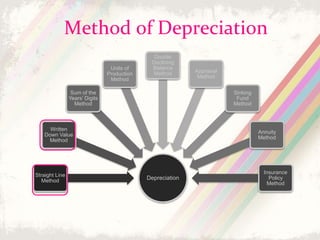
Method of Depreciation 
Depreciation 
Written 
Down Value 
Method 
Straight Line 
Method 
Sum of the 
Years’ Digits 
Method 
Units of 
Production 
Method 
Double 
Declining 
Balance 
Method Appraisal 
Method 
Sinking 
Fund 
Method 
Annuity 
Method 
Insurance 
Policy 
Method
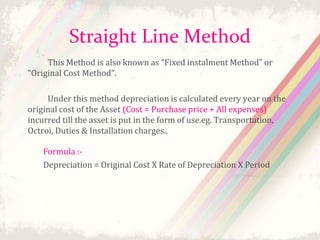
Straight Line Method 
This Method is also known as “Fixed instalment Method” or 
“Original Cost Method”. 
Under this method depreciation is calculated every year on the 
original cost of the Asset (Cost = Purchase price + All expenses) 
incurred till the asset is put in the form of use.eg. Transportation, 
Octroi, Duties & Installation charges.. 
Formula :- 
Depreciation = Original Cost X Rate of Depreciation X Period
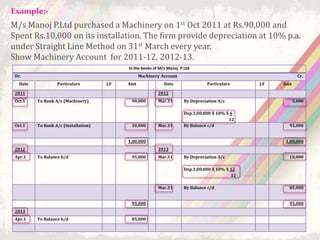
Example:- 
M/s Manoj P.Ltd purchased a Machinery on 1st Oct 2011 at Rs.90,000 and 
Spent Rs.10,000 on its installation. The firm provide depreciation at 10% p.a. 
under Straight Line Method on 31st March every year. 
Show Machinery Account for 2011-12, 2012-13. 
In the books of M/s Manoj P.Ltd 
Dr. Machinery Account Cr. 
Date Particulars J.F Amt Date Particulars J.F Amt 
2011 2012 
Oct.1 To Bank A/c (Machinery) 90,000 Mar.31 By Depreciation A/c 
Dep.1,00,000 X 10% X 6 
12 
5,000 
Oct.1 To Bank A/c (Installation) 10,000 Mar.31 By Balance c/d 95,000 
1,00,000 1,00,000 
2012 2013 
Apr.1 To Balance b/d 95,000 Mar.31 By Depreciation A/c 
Dep.1,00,000 X 10% X 12 
12 
10,000 
Mar.31 By Balance c/d 85,000 
95,000 95,000 
2013 
Apr.1 To Balance b/d 85,000
Advantages & Disadvantages 
of Straight line method 
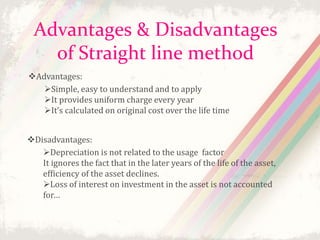
Advantages: 
Simple, easy to understand and to apply 
It provides uniform charge every year 
It’s calculated on original cost over the life time 
Disadvantages: 
Depreciation is not related to the usage factor 
It ignores the fact that in the later years of the life of the asset, 
efficiency of the asset declines. 
Loss of interest on investment in the asset is not accounted 
for…
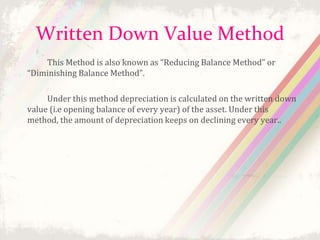
Written Down Value Method 
This Method is also known as “Reducing Balance Method” or 
“Diminishing Balance Method”. 
Under this method depreciation is calculated on the written down 
value (i.e opening balance of every year) of the asset. Under this 
method, the amount of depreciation keeps on declining every year..
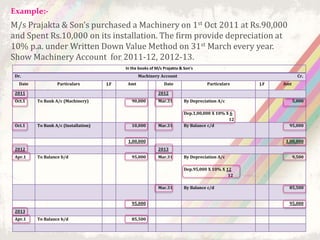
Example:- 
M/s Prajakta & Son’s purchased a Machinery on 1st Oct 2011 at Rs.90,000 
and Spent Rs.10,000 on its installation. The firm provide depreciation at 
10% p.a. under Written Down Value Method on 31st March every year. 
Show Machinery Account for 2011-12, 2012-13. 
In the books of M/s Prajakta & Son's 
Dr. Machinery Account Cr. 
Date Particulars J.F Amt Date Particulars J.F Amt 
2011 2012 
Oct.1 To Bank A/c (Machinery) 90,000 Mar.31 By Depreciation A/c 
Dep.1,00,000 X 10% X 6 
12 
5,000 
Oct.1 To Bank A/c (Installation) 10,000 Mar.31 By Balance c/d 95,000 
1,00,000 1,00,000 
2012 2013 
Apr.1 To Balance b/d 95,000 Mar.31 By Depreciation A/c 
Dep.95,000 X 10% X 12 
12 
9,500 
Mar.31 By Balance c/d 85,500 
95,000 95,000 
2013 
Apr.1 To Balance b/d 85,500
Advantages & Disadvantages 
of Written down value method 
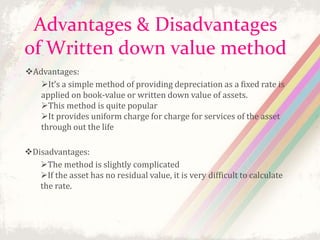
Advantages: 
It’s a simple method of providing depreciation as a fixed rate is 
applied on book-value or written down value of assets. 
This method is quite popular 
It provides uniform charge for charge for services of the asset 
through out the life 
Disadvantages: 
The method is slightly complicated 
If the asset has no residual value, it is very difficult to calculate 
the rate.
Depreciation

Depreciation

  • 1.
    DEPRECIATION PRESENTED BY:- 1) NIKHIL MHATRE 2) ROSHAN TUPE
  • 2.
    What does Depreciation means….? The word depreciation has derived from Latin word ‘Depretium’ which means “decline "or “reduction "in price or value. Depreciation is concerned with fixed assets only. Fixed assets have Long life and loose their value due to usages. Even if the asset is not put to use, its value goes on reducing due to time span. In Simple Words :- a reduction in the value of an asset over time, due to particular wear and tear.
  • 3.
    Assets which gets Depreciated…? 1) Machinery 2) Furniture
  • 4.
    3) Vehicles 4)All Electronics Items use for Business purpose
  • 5.
    Objectives of Depreciation  To calculate proper profits.  To show the asset at its reasonable value.  To maintain the original monetary investment of the asset intact.  Provision of depreciation results in some incidental advantages also.  To provide for replacement of an asset.  Depreciation is permitted to be deducted from profits for tax purposes.
  • 6.
    Causes of Depreciation  .Internal causes : wear and tear, disuse, maintenance, change in production, restriction of production, reduced demand, technical progress & depletion.  .External causes : obsolescence and efflux ion of time
  • 7.
    Method of Depreciation Depreciation Written Down Value Method Straight Line Method Sum of the Years’ Digits Method Units of Production Method Double Declining Balance Method Appraisal Method Sinking Fund Method Annuity Method Insurance Policy Method
  • 8.
    Straight Line Method This Method is also known as “Fixed instalment Method” or “Original Cost Method”. Under this method depreciation is calculated every year on the original cost of the Asset (Cost = Purchase price + All expenses) incurred till the asset is put in the form of use.eg. Transportation, Octroi, Duties & Installation charges.. Formula :- Depreciation = Original Cost X Rate of Depreciation X Period
  • 9.
    Example:- M/s ManojP.Ltd purchased a Machinery on 1st Oct 2011 at Rs.90,000 and Spent Rs.10,000 on its installation. The firm provide depreciation at 10% p.a. under Straight Line Method on 31st March every year. Show Machinery Account for 2011-12, 2012-13. In the books of M/s Manoj P.Ltd Dr. Machinery Account Cr. Date Particulars J.F Amt Date Particulars J.F Amt 2011 2012 Oct.1 To Bank A/c (Machinery) 90,000 Mar.31 By Depreciation A/c Dep.1,00,000 X 10% X 6 12 5,000 Oct.1 To Bank A/c (Installation) 10,000 Mar.31 By Balance c/d 95,000 1,00,000 1,00,000 2012 2013 Apr.1 To Balance b/d 95,000 Mar.31 By Depreciation A/c Dep.1,00,000 X 10% X 12 12 10,000 Mar.31 By Balance c/d 85,000 95,000 95,000 2013 Apr.1 To Balance b/d 85,000
  • 10.
    Advantages & Disadvantages of Straight line method Advantages: Simple, easy to understand and to apply It provides uniform charge every year It’s calculated on original cost over the life time Disadvantages: Depreciation is not related to the usage factor It ignores the fact that in the later years of the life of the asset, efficiency of the asset declines. Loss of interest on investment in the asset is not accounted for…
  • 11.
    Written Down ValueMethod This Method is also known as “Reducing Balance Method” or “Diminishing Balance Method”. Under this method depreciation is calculated on the written down value (i.e opening balance of every year) of the asset. Under this method, the amount of depreciation keeps on declining every year..
  • 12.
    Example:- M/s Prajakta& Son’s purchased a Machinery on 1st Oct 2011 at Rs.90,000 and Spent Rs.10,000 on its installation. The firm provide depreciation at 10% p.a. under Written Down Value Method on 31st March every year. Show Machinery Account for 2011-12, 2012-13. In the books of M/s Prajakta & Son's Dr. Machinery Account Cr. Date Particulars J.F Amt Date Particulars J.F Amt 2011 2012 Oct.1 To Bank A/c (Machinery) 90,000 Mar.31 By Depreciation A/c Dep.1,00,000 X 10% X 6 12 5,000 Oct.1 To Bank A/c (Installation) 10,000 Mar.31 By Balance c/d 95,000 1,00,000 1,00,000 2012 2013 Apr.1 To Balance b/d 95,000 Mar.31 By Depreciation A/c Dep.95,000 X 10% X 12 12 9,500 Mar.31 By Balance c/d 85,500 95,000 95,000 2013 Apr.1 To Balance b/d 85,500
  • 13.
    Advantages & Disadvantages of Written down value method Advantages: It’s a simple method of providing depreciation as a fixed rate is applied on book-value or written down value of assets. This method is quite popular It provides uniform charge for charge for services of the asset through out the life Disadvantages: The method is slightly complicated If the asset has no residual value, it is very difficult to calculate the rate.