Let’s look at… what we did in the last class…
We started with…   ACCOUNTING FOR DEPRECIATION
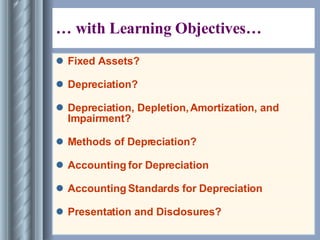
… with Learning Objectives… Fixed Assets? Depreciation? Depreciation, Depletion, Amortization, and Impairment? Methods of Depreciation? Accounting for Depreciation  Accounting Standards for Depreciation Presentation and Disclosures?
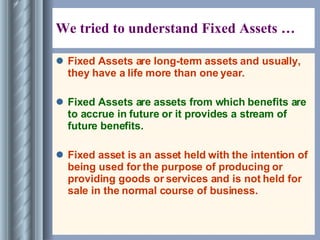
We tried to understand Fixed Assets … Fixed Assets are long-term assets and usually, they have a life more than one year. Fixed Assets are assets from which benefits are to accrue in future or it provides a stream of future benefits. Fixed asset is an asset held with the intention of being used for the purpose of producing or providing goods or services and is not held for sale in the normal course of business.
We appreciated difference between  Capital Expenditure vs  Revenue Expenses
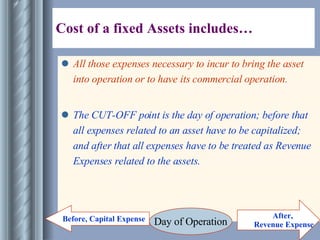
Cost of a fixed Assets includes… All those expenses necessary to incur to bring the asset into operation or to have its commercial operation. The CUT-OFF point is the day of operation; before that all expenses related to an asset have to be capitalized; and after that all expenses have to be treated as Revenue Expenses related to the assets. Day of Operation Before, Capital Expense After,  Revenue Expense
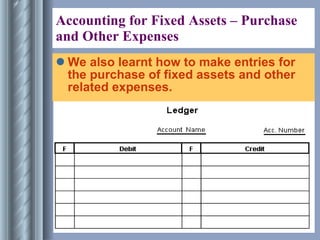
Accounting for Fixed Assets – Purchase and Other Expenses We also learnt how to make entries for the purchase of fixed assets and other related expenses.
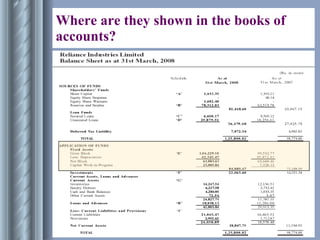
Where are they shown in the books of accounts?
Depreciation … Please note that  all fixed assets  are subject to Depreciation  except freehold land .
We tried to understand Depreciation… Depreciation involves: … allocating  the cost of tangible assets   to expense  in a  systematic and rational manner  to  periods expected to benefit from use of its depreciable assets .
We also tried to learn – ‘ Why Depreciation ’?  Fixed Assets are subject to depreciation and thus, depreciation needs to be provided so as to  Ensure allocation of original cost of a fixed asset over its useful life; Ascertaining the true cost of operations; and  Providing current valuation of fixed assets in the Balance Sheet.
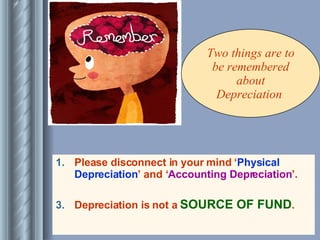
Please disconnect in your mind ‘ Physical Depreciation ’ and ‘ Accounting Depreciation ’. Depreciation is not a  SOURCE OF FUND . Two things are to be remembered about Depreciation
Now, let’s move with Today’s Agenda…
To begin with, let’s understand completely the nature of Depreciation… All fixed assets except  land  lose their capacity to provide services with passage of time. This loss of productive capacity is recognized as  Depreciation Expense  which is taken to  Profit and Loss Account . #1
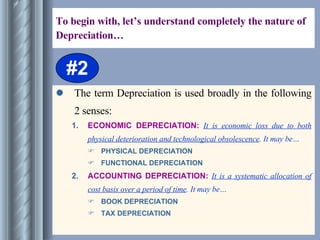
To begin with, let’s understand completely the nature of Depreciation… The term Depreciation is used broadly in the following 2 senses: ECONOMIC DEPRECIATION:  It is economic loss due to both physical deterioration and technological obsolescence . It may be… PHYSICAL DEPRECIATION FUNCTIONAL DEPRECIATION   ACCOUNTING DEPRECIATION:  It is a systematic allocation of cost basis over a period of time . It may be… BOOK DEPRECIATION TAX DEPRECIATION #2
Asset Depreciation Depreciation Economic Depreciation the gradual decrease in utility in an asset with  use and time Accounting depreciation The systematic allocation of an asset’s value in portions over its depreciable life—often used in engineering economic analysis Physical Depreciation Functional Depreciation Book  depreciation Tax Depreciation
Our next step is… How to determine the amount of depreciation each year so that it can be expensed to Profit and Loss Account?
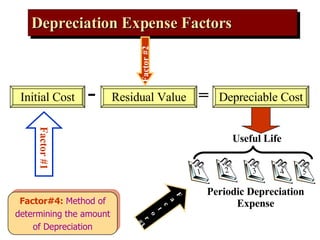
What are the factors determining the depreciation expenses?
Depreciation Expense Factors Initial Cost Residual Value - Factor #1 Factor #2 F a c t o r #3 Factor#4:  Method of determining the amount of Depreciation = Depreciable Cost Useful Life 1 Periodic Depreciation Expense 2 3 4 5
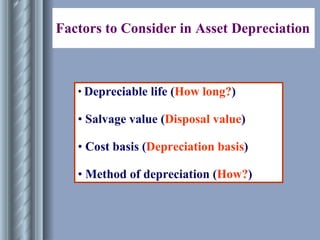
Factors to Consider in Asset Depreciation Depreciable life ( How long? ) Salvage value ( Disposal value ) Cost basis ( Depreciation basis ) Method of depreciation ( How? )
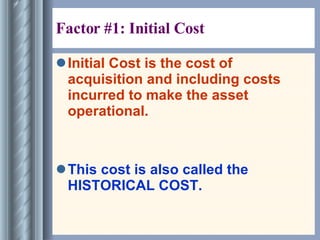
Factor #1: Initial Cost  Initial Cost is the cost of acquisition and including costs incurred to make the asset operational. This cost is also called the HISTORICAL COST.
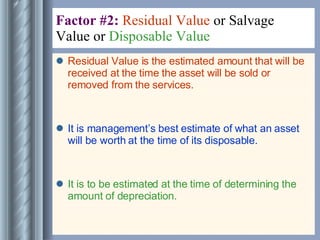
Factor #2:  Residual Value  or Salvage Value or  Disposable Value   Residual Value is the estimated amount that will be received at the time the asset will be sold or removed from the services. It is management’s best estimate of what an asset will be worth at the time of its disposable. It is to be estimated at the time of determining the amount of depreciation.
Depreciable Amount or Cost Initial cost  minus  resale value is called the Depreciable amount and it is this amount that has to be allocated as depreciation over the estimated life of an asset. Depreciable Amount  of a depreciable asset is its historical cost, or other amount substituted for historical cost in the financial statements, less the estimated residual value. This amount is also known as  DEPRECIATION BASE .
Factor #3:  Estimated Life or Useful Life   The asset’s estimated life is a measure of the service potential that the current user may expect from the asset. Many times, an asset physical life is taken as estimated life. Useful life is either (i) the period over which a depreciable asset is expected to be used by the enterprise; or (ii) the number of production or similar units expected to be obtained from the use of the asset by the enterprise. Useful life of an asset should be determined based on –  Expected use of the asset Expected physical wear and tear Expected commercial or technical obsolescence Legal or other limits on the use of the asset.
Factor #4: Methods of Depreciation  The following four depreciation methods are acceptable for  Financial Accounting  purposes: 1.  Straight-Line 2.  Units-of-Production 3.  Declining-Balance 4.  Sum-of-Years-Digits Straight-line  is far more widely used than other methods.  Declining-balance  and  sum-of-years-digits  are known as Accelerated Depreciation Methods.
Straight Line Method  (SLM) The  Straight-Line-Method  provides for the same amount of depreciation expense for each year of useful life.
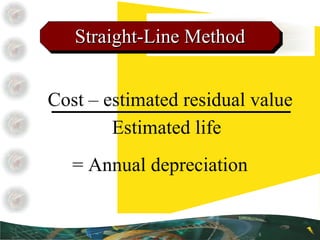
Straight-Line Method Cost  –  estimated residual value Estimated life = Annual depreciation
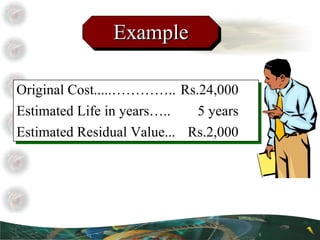
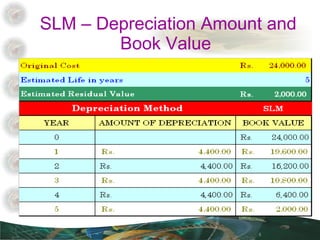
Example Original Cost.....…………..  Rs.24,000 Estimated Life in years….. 5 years Estimated Residual Value... Rs.2,000
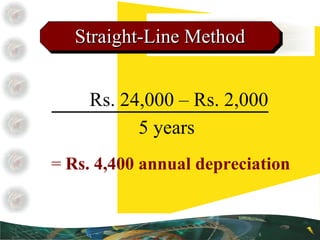
Straight-Line Method Rs. 24,000  –  Rs. 2,000 5 years =   Rs. 4,400 annual depreciation
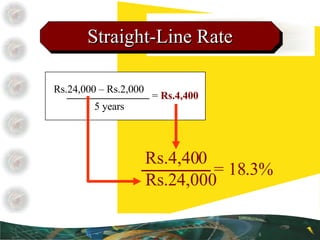
Straight-Line Rate Rs.24,000  –  Rs.2,000 5 years =   Rs.4,400 Rs.4,400 Rs.24,000 = 18.3%
SLM – Depreciation Amount and Book Value
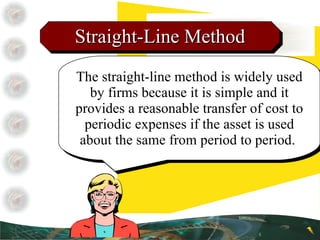
Straight-Line Method The straight-line method is widely used by firms because it is simple and it provides a reasonable transfer of cost to periodic expenses if the asset is used about the same from period to period.
Units-of-Production Method Cost  –  estimated residual value Estimated life in units, hours, etc. = Depreciation per unit, hour, etc.
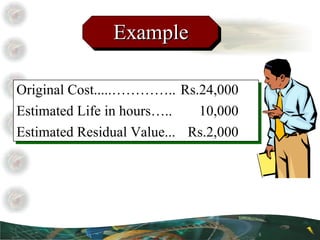
Example Original Cost.....…………..  Rs.24,000 Estimated Life in hours…..  10,000 Estimated Residual Value... Rs.2,000
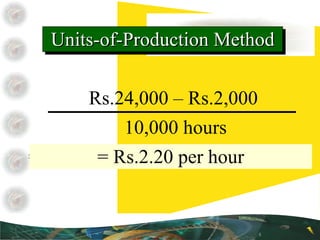
Rs.24,000  –  Rs.2,000 10,000 hours = Depreciation per unit, hour, etc. = Rs.2.20 per hour Units-of-Production Method
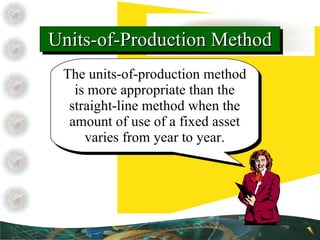
The units-of-production method is more appropriate than the straight-line method when the amount of use of a fixed asset varies from year to year. Units-of-Production Method
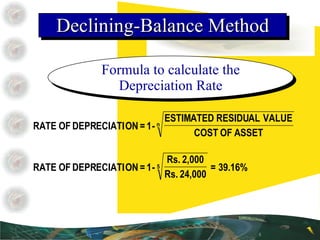
Declining-Balance Method Formula to calculate the Depreciation Rate
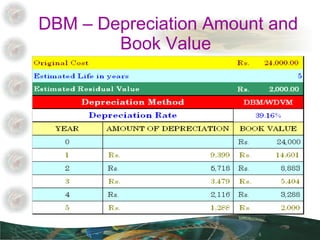
DBM – Depreciation Amount and Book Value
Physical Depreciation … Physical Depreciation   occurs from wear and tear while in use and from the action of the weather and environmental conditions.
Functional Depreciation Functional Depreciation   occurs when a fixed asset is longer able to provide services at the level for which it was intended, e.g., personal computer; that is to say,  when an asset life is mentioned in terms of its usage, then we have a concept of Functional Depreciation.
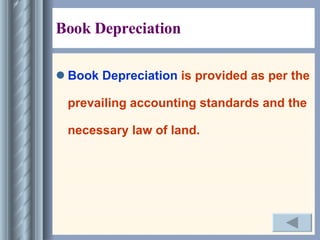
Book Depreciation  Book Depreciation  is provided as per the prevailing accounting standards and the necessary law of land.
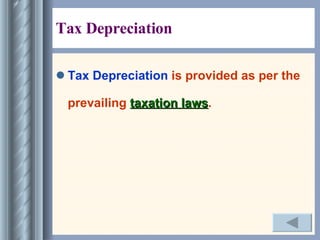
Tax Depreciation  Tax Depreciation  is provided as per the prevailing  taxation laws .

Depreciation 2

  • 1.
    Let’s look at…what we did in the last class…
  • 2.
    We started with… ACCOUNTING FOR DEPRECIATION
  • 3.
    … with LearningObjectives… Fixed Assets? Depreciation? Depreciation, Depletion, Amortization, and Impairment? Methods of Depreciation? Accounting for Depreciation Accounting Standards for Depreciation Presentation and Disclosures?
  • 4.
    We tried tounderstand Fixed Assets … Fixed Assets are long-term assets and usually, they have a life more than one year. Fixed Assets are assets from which benefits are to accrue in future or it provides a stream of future benefits. Fixed asset is an asset held with the intention of being used for the purpose of producing or providing goods or services and is not held for sale in the normal course of business.
  • 5.
    We appreciated differencebetween Capital Expenditure vs Revenue Expenses
  • 6.
    Cost of afixed Assets includes… All those expenses necessary to incur to bring the asset into operation or to have its commercial operation. The CUT-OFF point is the day of operation; before that all expenses related to an asset have to be capitalized; and after that all expenses have to be treated as Revenue Expenses related to the assets. Day of Operation Before, Capital Expense After, Revenue Expense
  • 7.
    Accounting for FixedAssets – Purchase and Other Expenses We also learnt how to make entries for the purchase of fixed assets and other related expenses.
  • 8.
    Where are theyshown in the books of accounts?
  • 9.
    Depreciation … Pleasenote that all fixed assets are subject to Depreciation except freehold land .
  • 10.
    We tried tounderstand Depreciation… Depreciation involves: … allocating the cost of tangible assets to expense in a systematic and rational manner to periods expected to benefit from use of its depreciable assets .
  • 11.
    We also triedto learn – ‘ Why Depreciation ’? Fixed Assets are subject to depreciation and thus, depreciation needs to be provided so as to Ensure allocation of original cost of a fixed asset over its useful life; Ascertaining the true cost of operations; and Providing current valuation of fixed assets in the Balance Sheet.
  • 12.
    Please disconnect inyour mind ‘ Physical Depreciation ’ and ‘ Accounting Depreciation ’. Depreciation is not a SOURCE OF FUND . Two things are to be remembered about Depreciation
  • 13.
    Now, let’s movewith Today’s Agenda…
  • 14.
    To begin with,let’s understand completely the nature of Depreciation… All fixed assets except land lose their capacity to provide services with passage of time. This loss of productive capacity is recognized as Depreciation Expense which is taken to Profit and Loss Account . #1
  • 15.
    To begin with,let’s understand completely the nature of Depreciation… The term Depreciation is used broadly in the following 2 senses: ECONOMIC DEPRECIATION: It is economic loss due to both physical deterioration and technological obsolescence . It may be… PHYSICAL DEPRECIATION FUNCTIONAL DEPRECIATION ACCOUNTING DEPRECIATION: It is a systematic allocation of cost basis over a period of time . It may be… BOOK DEPRECIATION TAX DEPRECIATION #2
  • 16.
    Asset Depreciation DepreciationEconomic Depreciation the gradual decrease in utility in an asset with use and time Accounting depreciation The systematic allocation of an asset’s value in portions over its depreciable life—often used in engineering economic analysis Physical Depreciation Functional Depreciation Book depreciation Tax Depreciation
  • 17.
    Our next stepis… How to determine the amount of depreciation each year so that it can be expensed to Profit and Loss Account?
  • 18.
    What are thefactors determining the depreciation expenses?
  • 19.
    Depreciation Expense FactorsInitial Cost Residual Value - Factor #1 Factor #2 F a c t o r #3 Factor#4: Method of determining the amount of Depreciation = Depreciable Cost Useful Life 1 Periodic Depreciation Expense 2 3 4 5
  • 20.
    Factors to Considerin Asset Depreciation Depreciable life ( How long? ) Salvage value ( Disposal value ) Cost basis ( Depreciation basis ) Method of depreciation ( How? )
  • 21.
    Factor #1: InitialCost Initial Cost is the cost of acquisition and including costs incurred to make the asset operational. This cost is also called the HISTORICAL COST.
  • 22.
    Factor #2: Residual Value or Salvage Value or Disposable Value Residual Value is the estimated amount that will be received at the time the asset will be sold or removed from the services. It is management’s best estimate of what an asset will be worth at the time of its disposable. It is to be estimated at the time of determining the amount of depreciation.
  • 23.
    Depreciable Amount orCost Initial cost minus resale value is called the Depreciable amount and it is this amount that has to be allocated as depreciation over the estimated life of an asset. Depreciable Amount of a depreciable asset is its historical cost, or other amount substituted for historical cost in the financial statements, less the estimated residual value. This amount is also known as DEPRECIATION BASE .
  • 24.
    Factor #3: Estimated Life or Useful Life The asset’s estimated life is a measure of the service potential that the current user may expect from the asset. Many times, an asset physical life is taken as estimated life. Useful life is either (i) the period over which a depreciable asset is expected to be used by the enterprise; or (ii) the number of production or similar units expected to be obtained from the use of the asset by the enterprise. Useful life of an asset should be determined based on – Expected use of the asset Expected physical wear and tear Expected commercial or technical obsolescence Legal or other limits on the use of the asset.
  • 25.
    Factor #4: Methodsof Depreciation The following four depreciation methods are acceptable for Financial Accounting purposes: 1. Straight-Line 2. Units-of-Production 3. Declining-Balance 4. Sum-of-Years-Digits Straight-line is far more widely used than other methods. Declining-balance and sum-of-years-digits are known as Accelerated Depreciation Methods.
  • 26.
    Straight Line Method (SLM) The Straight-Line-Method provides for the same amount of depreciation expense for each year of useful life.
  • 27.
    Straight-Line Method Cost – estimated residual value Estimated life = Annual depreciation
  • 28.
    Example Original Cost.....………….. Rs.24,000 Estimated Life in years….. 5 years Estimated Residual Value... Rs.2,000
  • 29.
    Straight-Line Method Rs.24,000 – Rs. 2,000 5 years = Rs. 4,400 annual depreciation
  • 30.
    Straight-Line Rate Rs.24,000 – Rs.2,000 5 years = Rs.4,400 Rs.4,400 Rs.24,000 = 18.3%
  • 31.
    SLM – DepreciationAmount and Book Value
  • 32.
    Straight-Line Method Thestraight-line method is widely used by firms because it is simple and it provides a reasonable transfer of cost to periodic expenses if the asset is used about the same from period to period.
  • 33.
    Units-of-Production Method Cost – estimated residual value Estimated life in units, hours, etc. = Depreciation per unit, hour, etc.
  • 34.
    Example Original Cost.....………….. Rs.24,000 Estimated Life in hours….. 10,000 Estimated Residual Value... Rs.2,000
  • 35.
    Rs.24,000 – Rs.2,000 10,000 hours = Depreciation per unit, hour, etc. = Rs.2.20 per hour Units-of-Production Method
  • 36.
    The units-of-production methodis more appropriate than the straight-line method when the amount of use of a fixed asset varies from year to year. Units-of-Production Method
  • 37.
    Declining-Balance Method Formulato calculate the Depreciation Rate
  • 38.
    DBM – DepreciationAmount and Book Value
  • 39.
    Physical Depreciation …Physical Depreciation occurs from wear and tear while in use and from the action of the weather and environmental conditions.
  • 40.
    Functional Depreciation FunctionalDepreciation occurs when a fixed asset is longer able to provide services at the level for which it was intended, e.g., personal computer; that is to say, when an asset life is mentioned in terms of its usage, then we have a concept of Functional Depreciation.
  • 41.
    Book Depreciation Book Depreciation is provided as per the prevailing accounting standards and the necessary law of land.
  • 42.
    Tax Depreciation Tax Depreciation is provided as per the prevailing taxation laws .