LearnSAP.com
     Your SAP Training Partner


            SAP FICO
Asset Accounting Configuration


    Call Toll Free 866-836-1700
5101 Camden Lane, Pearland, TX 77584
www.LearnSAP.com


                        Intentionally Left Blank


Ver ECC6.0 – 02- 2010                              Page 2
www.LearnSAP.com


                             Table Of Contents
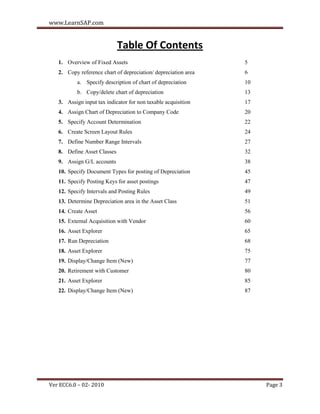
   1. Overview of Fixed Assets                                  5
   2. Copy reference chart of depreciation/ depreciation area   6
           a. Specify description of chart of depreciation      10
           b. Copy/delete chart of depreciation                 13
   3. Assign input tax indicator for non taxable acquisition    17
   4. Assign Chart of Depreciation to Company Code              20
   5. Specify Account Determination                             22
   6. Create Screen Layout Rules                                24
   7. Define Number Range Intervals                             27
   8. Define Asset Classes                                      32
   9. Assign G/L accounts                                       38
   10. Specify Document Types for posting of Depreciation       45
   11. Specify Posting Keys for asset postings                  47
   12. Specify Intervals and Posting Rules                      49
   13. Determine Depreciation area in the Asset Class           51
   14. Create Asset                                             56
   15. External Acquisition with Vendor                         60
   16. Asset Explorer                                           65
   17. Run Depreciation                                         68
   18. Asset Explorer                                           75
   19. Display/Change Item (New)                                77
   20. Retirement with Customer                                 80
   21. Asset Explorer                                           85
   22. Display/Change Item (New)                                87


Ver ECC6.0 – 02- 2010                                                Page 3
www.LearnSAP.com


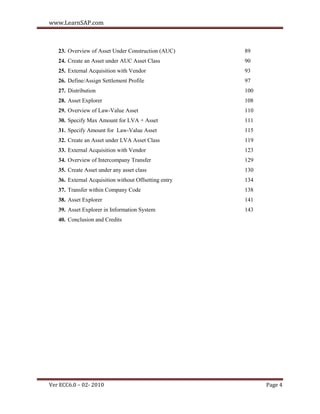
   23. Overview of Asset Under Construction (AUC)      89
   24. Create an Asset under AUC Asset Class           90
   25. External Acquisition with Vendor                93
   26. Define/Assign Settlement Profile                97
   27. Distribution                                    100
   28. Asset Explorer                                  108
   29. Overview of Law-Value Asset                     110
   30. Specify Max Amount for LVA + Asset              111
   31. Specify Amount for Law-Value Asset              115
   32. Create an Asset under LVA Asset Class           119
   33. External Acquisition with Vendor                123
   34. Overview of Intercompany Transfer               129
   35. Create Asset under any asset class              130
   36. External Acquisition without Offsetting entry   134
   37. Transfer within Company Code                    138
   38. Asset Explorer                                  141
   39. Asset Explorer in Information System            143
   40. Conclusion and Credits


Ver ECC6.0 – 02- 2010                                        Page 4
www.LearnSAP.com


1. Overview of Fixed Assets:
  The Asset Accounting (FI-AA) component is used for managing and supervising fixed assets
  with the SAP R/3 System. In SAP R/3 Financial Accounting, it serves as a subsidiary ledger to
  the FI General Ledger, providing detailed information on transactions involving fixed assets.

  As a result of the integration in the R/3 System, Asset Accounting (FI-AA) transfers data directly
  to and from other R/3 components. For example, it is possible to post from the Materials
  Management (MM) component directly to FI-AA. When an asset is purchased or produced in-
  house, you can directly post the invoice receipt or goods receipt, or the withdrawal from the
  warehouse, to assets in the Asset Accounting component. At the same time, you can pass on
  depreciation and interest directly to the Financial Accounting (FI) and Controlling (CO)
  components. From the Plant Maintenance (PM) component, you can settle maintenance activities
  that require capitalization to assets.

  Types of Assets:

         Tangible Asset: Assets having a physical existence, such as cash, equipment, and real
          estate; accounts receivable are also usually considered tangible assets for accounting
          purposes.
         Intangible Asset: You can manage intangible assets, such as patents, the same as tangible
          assets in the system. There are no special system functions for handling the needs of
          intangible assets.
         Asset under construction: They are usually displayed as a separate balance sheet item and
          therefore need a separate account determination in their asset classes.
         Low value asset: LVAs are fully depreciated in the year of purchase or in the period of
          acquisition.
         Leased Asset: Leased assets create special accounting requirements for the lessee. During
          the term of the lease, leased assets remain the property of the lesser or manufacturer.


Ver ECC6.0 – 02- 2010                                                                        Page 5
www.LearnSAP.com


2. Copy Reference Chart of Depreciation:
  Charts of depreciation are used in order to manage various legal requirements for the depreciation
  and valuation of assets. These charts of depreciation are usually country-specific and are defined
  independently of the other organizational units.

  SAP supplies typical reference charts of depreciation for each country. They have different
  depreciation areas and depreciation keys depending on that country’s specific requirements. You
  cannot use these charts of depreciation directly. You must create your own chart of depreciation
  by copying the reference chart of depreciation. Delete any depreciation areas that are not needed.

  Each depreciation area represents a specific type of valuation (for example, book depreciation or
  tax depreciation). You can also define your own depreciation

  The depreciation areas are defined with a two-digit numeric key. The numeric keys represent
  depreciation terms that you can enter in the asset master record or in the asset classes. Values and
  depreciation are posted to the general ledger.


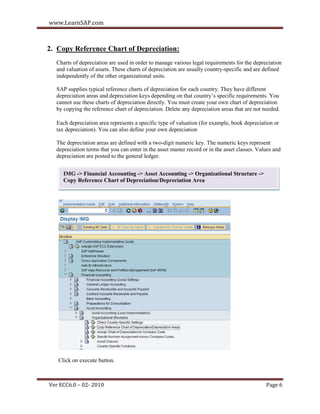
     IMG -> Financial Accounting -> Asset Accounting -> Organizational Structure ->
     Copy Reference Chart of Depreciation/Depreciation Area


   Click on execute button.


Ver ECC6.0 – 02- 2010                                                                          Page 6
www.LearnSAP.com


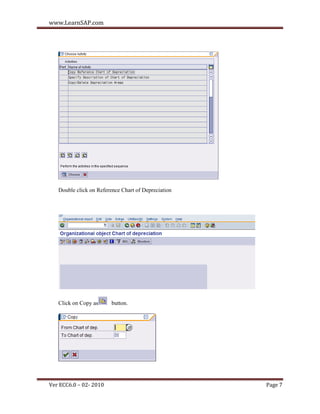
   Double click on Reference Chart of Depreciation


   Click on Copy as      button.


Ver ECC6.0 – 02- 2010                                Page 7
www.LearnSAP.com

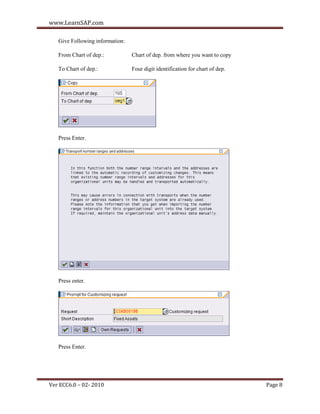
   Give Following information:

   From Chart of dep.:           Chart of dep. from where you want to copy

   To Chart of dep.:             Four digit identification for chart of dep.


   Press Enter.


   Press enter.


   Press Enter.


Ver ECC6.0 – 02- 2010                                                          Page 8
www.LearnSAP.com


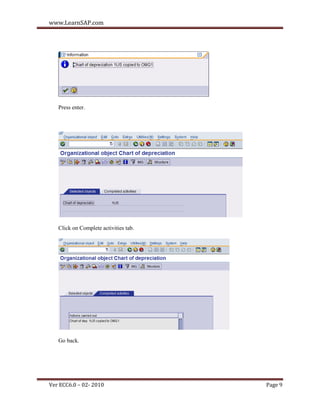
   Press enter.


   Click on Complete activities tab.


   Go back.


Ver ECC6.0 – 02- 2010                  Page 9
www.LearnSAP.com


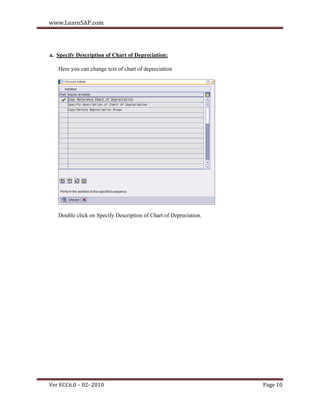
a. Specify Description of Chart of Depreciation:

   Here you can change text of chart of depreciation


   Double click on Specify Description of Chart of Depreciation.


Ver ECC6.0 – 02- 2010                                              Page 10
www.LearnSAP.com


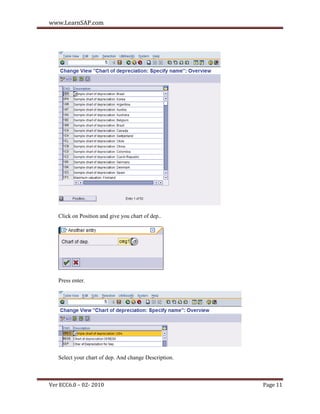
   Click on Position and give you chart of dep..


   Press enter.


   Select your chart of dep. And change Description.


Ver ECC6.0 – 02- 2010                                  Page 11
www.LearnSAP.com


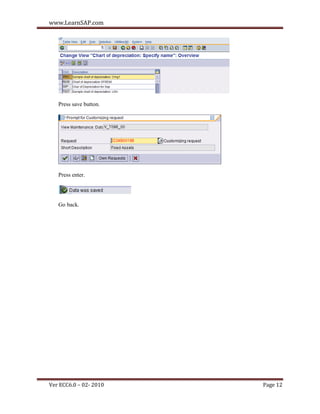
   Press save button.


   Press enter.


   Go back.


Ver ECC6.0 – 02- 2010   Page 12
www.LearnSAP.com


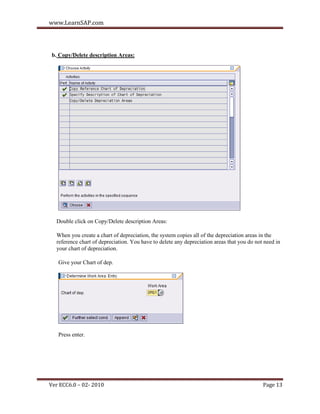
 b. Copy/Delete description Areas:


  Double click on Copy/Delete description Areas:

  When you create a chart of depreciation, the system copies all of the depreciation areas in the
  reference chart of depreciation. You have to delete any depreciation areas that you do not need in
  your chart of depreciation.

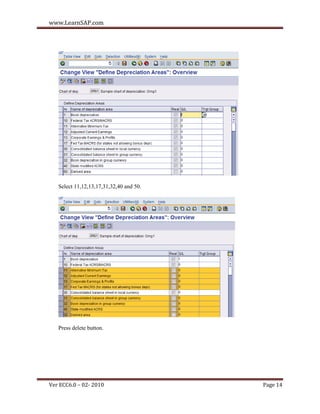
   Give your Chart of dep.


   Press enter.


Ver ECC6.0 – 02- 2010                                                                       Page 13
www.LearnSAP.com


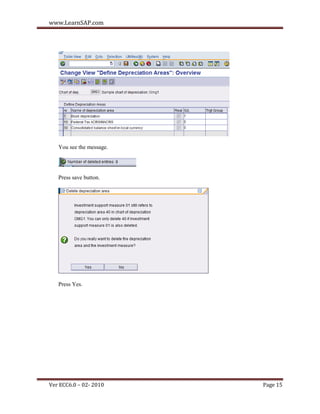
   Select 11,12,13,17,31,32,40 and 50.


   Press delete button.


Ver ECC6.0 – 02- 2010                    Page 14
www.LearnSAP.com


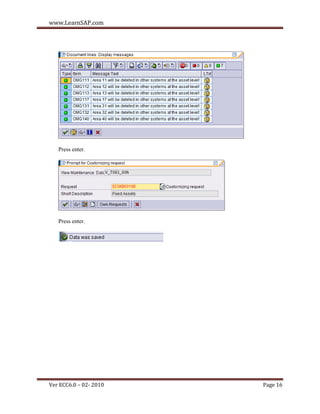
   You see the message.


   Press save button.


   Press Yes.


Ver ECC6.0 – 02- 2010     Page 15
www.LearnSAP.com


   Press enter.


   Press enter.


Ver ECC6.0 – 02- 2010   Page 16
www.LearnSAP.com


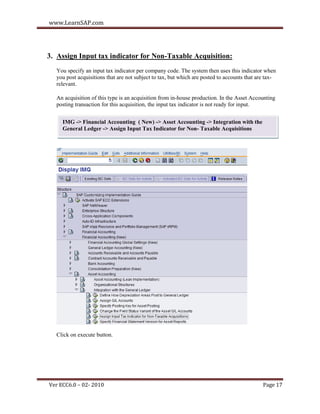
3. Assign Input tax indicator for Non-Taxable Acquisition:
  You specify an input tax indicator per company code. The system then uses this indicator when
  you post acquisitions that are not subject to tax, but which are posted to accounts that are tax-
  relevant.

  An acquisition of this type is an acquisition from in-house production. In the Asset Accounting
  posting transaction for this acquisition, the input tax indicator is not ready for input.


     IMG -> Financial Accounting ( New) -> Asset Accounting -> Integration with the
     General Ledger -> Assign Input Tax Indicator for Non- Taxable Acquisitions


  Click on execute button.


Ver ECC6.0 – 02- 2010                                                                        Page 17
www.LearnSAP.com


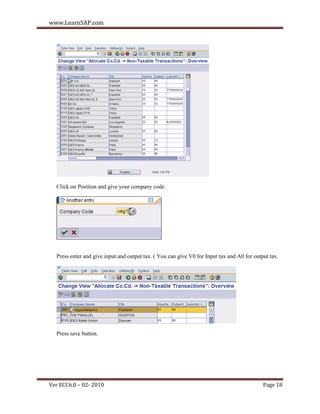
  Click on Position and give your company code.


  Press enter and give input and output tax. ( You can give V0 for Input tax and A0 for output tax.


  Press save button.


Ver ECC6.0 – 02- 2010                                                                       Page 18
www.LearnSAP.com


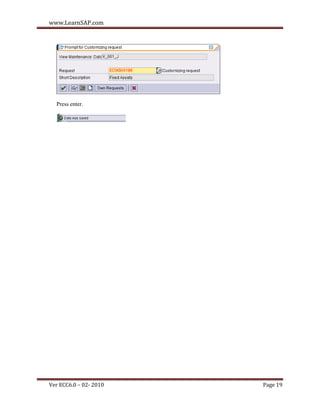
  Press enter.


Ver ECC6.0 – 02- 2010   Page 19
www.LearnSAP.com


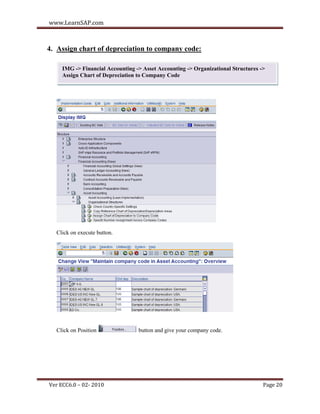
4. Assign chart of depreciation to company code:

     IMG -> Financial Accounting -> Asset Accounting -> Organizational Structures ->
     Assign Chart of Depreciation to Company Code


  Click on execute button.


  Click on Position               button and give your company code.


Ver ECC6.0 – 02- 2010                                                              Page 20
www.LearnSAP.com


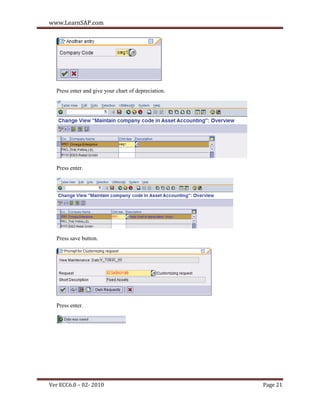
  Press enter and give your chart of depreciation.


  Press enter.


  Press save button.


  Press enter.


Ver ECC6.0 – 02- 2010                                Page 21
www.LearnSAP.com


5. Specify Account Determination:
  Using the Asset Accounting component, you can automatically update all relevant transactions to
  the general ledger. These include all accounting transactions that are posted to assets, and all
  changes to asset values that are automatically calculated by the system. This update takes place
  immediately online for the master depreciation area.

  You enter the account determination key in the general master data for the asset class. The
  account determination key defines the accounts in Financial Accounting that should be posted
  during asset transactions, for each chart of accounts and depreciation area (defined as an
  automatic posting area) in the chart of depreciation.


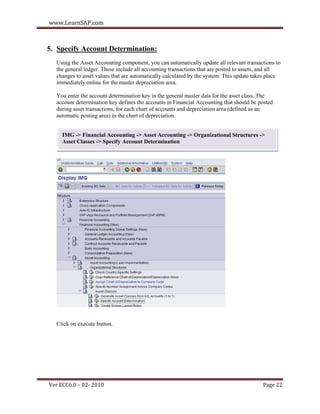
     IMG -> Financial Accounting -> Asset Accounting -> Organizational Structures ->
     Asset Classes -> Specify Account Determination


  Click on execute button.


Ver ECC6.0 – 02- 2010                                                                     Page 22
www.LearnSAP.com


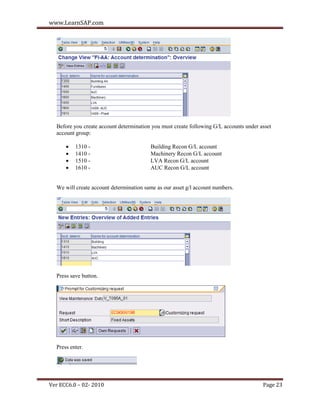
  Before you create account determination you must create following G/L accounts under asset
  account group:

         1310 -                         Building Recon G/L account
         1410 -                         Machinery Recon G/L account
         1510 -                         LVA Recon G/L account
         1610 -                         AUC Recon G/L account


  We will create account determination same as our asset g/l account numbers.


  Press save button.


  Press enter.


Ver ECC6.0 – 02- 2010                                                                   Page 23
www.LearnSAP.com


6. Create Screen Layout Rules:
  The screen layout specifies the status of the fields in the asset master record. You use the screen
  layout to determine if fields are required entry or optional entry fields, or if they are suppressed
  completely, for example.

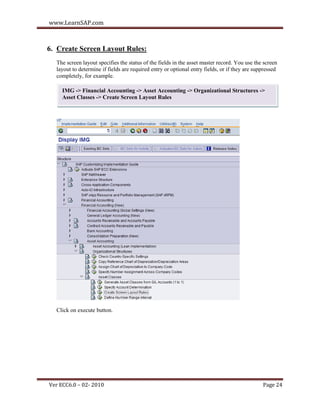
     IMG -> Financial Accounting -> Asset Accounting -> Organizational Structures ->
     Asset Classes -> Create Screen Layout Rules


  Click on execute button.


Ver ECC6.0 – 02- 2010                                                                          Page 24
www.LearnSAP.com


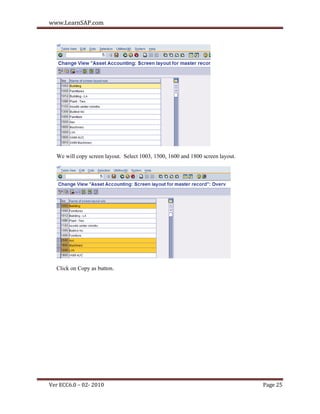
  We will copy screen layout. Select 1003, 1500, 1600 and 1800 screen layout.


  Click on Copy as button.


Ver ECC6.0 – 02- 2010                                                           Page 25

Asset accounting

  • 1.
    LearnSAP.com Your SAP Training Partner SAP FICO Asset Accounting Configuration Call Toll Free 866-836-1700 5101 Camden Lane, Pearland, TX 77584
  • 2.
    www.LearnSAP.com Intentionally Left Blank Ver ECC6.0 – 02- 2010 Page 2
  • 3.
    www.LearnSAP.com Table Of Contents 1. Overview of Fixed Assets 5 2. Copy reference chart of depreciation/ depreciation area 6 a. Specify description of chart of depreciation 10 b. Copy/delete chart of depreciation 13 3. Assign input tax indicator for non taxable acquisition 17 4. Assign Chart of Depreciation to Company Code 20 5. Specify Account Determination 22 6. Create Screen Layout Rules 24 7. Define Number Range Intervals 27 8. Define Asset Classes 32 9. Assign G/L accounts 38 10. Specify Document Types for posting of Depreciation 45 11. Specify Posting Keys for asset postings 47 12. Specify Intervals and Posting Rules 49 13. Determine Depreciation area in the Asset Class 51 14. Create Asset 56 15. External Acquisition with Vendor 60 16. Asset Explorer 65 17. Run Depreciation 68 18. Asset Explorer 75 19. Display/Change Item (New) 77 20. Retirement with Customer 80 21. Asset Explorer 85 22. Display/Change Item (New) 87 Ver ECC6.0 – 02- 2010 Page 3
  • 4.
    www.LearnSAP.com 23. Overview of Asset Under Construction (AUC) 89 24. Create an Asset under AUC Asset Class 90 25. External Acquisition with Vendor 93 26. Define/Assign Settlement Profile 97 27. Distribution 100 28. Asset Explorer 108 29. Overview of Law-Value Asset 110 30. Specify Max Amount for LVA + Asset 111 31. Specify Amount for Law-Value Asset 115 32. Create an Asset under LVA Asset Class 119 33. External Acquisition with Vendor 123 34. Overview of Intercompany Transfer 129 35. Create Asset under any asset class 130 36. External Acquisition without Offsetting entry 134 37. Transfer within Company Code 138 38. Asset Explorer 141 39. Asset Explorer in Information System 143 40. Conclusion and Credits Ver ECC6.0 – 02- 2010 Page 4
  • 5.
    www.LearnSAP.com 1. Overview ofFixed Assets: The Asset Accounting (FI-AA) component is used for managing and supervising fixed assets with the SAP R/3 System. In SAP R/3 Financial Accounting, it serves as a subsidiary ledger to the FI General Ledger, providing detailed information on transactions involving fixed assets. As a result of the integration in the R/3 System, Asset Accounting (FI-AA) transfers data directly to and from other R/3 components. For example, it is possible to post from the Materials Management (MM) component directly to FI-AA. When an asset is purchased or produced in- house, you can directly post the invoice receipt or goods receipt, or the withdrawal from the warehouse, to assets in the Asset Accounting component. At the same time, you can pass on depreciation and interest directly to the Financial Accounting (FI) and Controlling (CO) components. From the Plant Maintenance (PM) component, you can settle maintenance activities that require capitalization to assets. Types of Assets:  Tangible Asset: Assets having a physical existence, such as cash, equipment, and real estate; accounts receivable are also usually considered tangible assets for accounting purposes.  Intangible Asset: You can manage intangible assets, such as patents, the same as tangible assets in the system. There are no special system functions for handling the needs of intangible assets.  Asset under construction: They are usually displayed as a separate balance sheet item and therefore need a separate account determination in their asset classes.  Low value asset: LVAs are fully depreciated in the year of purchase or in the period of acquisition.  Leased Asset: Leased assets create special accounting requirements for the lessee. During the term of the lease, leased assets remain the property of the lesser or manufacturer. Ver ECC6.0 – 02- 2010 Page 5
  • 6.
    www.LearnSAP.com 2. Copy ReferenceChart of Depreciation: Charts of depreciation are used in order to manage various legal requirements for the depreciation and valuation of assets. These charts of depreciation are usually country-specific and are defined independently of the other organizational units. SAP supplies typical reference charts of depreciation for each country. They have different depreciation areas and depreciation keys depending on that country’s specific requirements. You cannot use these charts of depreciation directly. You must create your own chart of depreciation by copying the reference chart of depreciation. Delete any depreciation areas that are not needed. Each depreciation area represents a specific type of valuation (for example, book depreciation or tax depreciation). You can also define your own depreciation The depreciation areas are defined with a two-digit numeric key. The numeric keys represent depreciation terms that you can enter in the asset master record or in the asset classes. Values and depreciation are posted to the general ledger. IMG -> Financial Accounting -> Asset Accounting -> Organizational Structure -> Copy Reference Chart of Depreciation/Depreciation Area Click on execute button. Ver ECC6.0 – 02- 2010 Page 6
  • 7.
    www.LearnSAP.com Double click on Reference Chart of Depreciation Click on Copy as button. Ver ECC6.0 – 02- 2010 Page 7
  • 8.
    www.LearnSAP.com Give Following information: From Chart of dep.: Chart of dep. from where you want to copy To Chart of dep.: Four digit identification for chart of dep. Press Enter. Press enter. Press Enter. Ver ECC6.0 – 02- 2010 Page 8
  • 9.
    www.LearnSAP.com Press enter. Click on Complete activities tab. Go back. Ver ECC6.0 – 02- 2010 Page 9
  • 10.
    www.LearnSAP.com a. Specify Descriptionof Chart of Depreciation: Here you can change text of chart of depreciation Double click on Specify Description of Chart of Depreciation. Ver ECC6.0 – 02- 2010 Page 10
  • 11.
    www.LearnSAP.com Click on Position and give you chart of dep.. Press enter. Select your chart of dep. And change Description. Ver ECC6.0 – 02- 2010 Page 11
  • 12.
    www.LearnSAP.com Press save button. Press enter. Go back. Ver ECC6.0 – 02- 2010 Page 12
  • 13.
    www.LearnSAP.com b. Copy/Deletedescription Areas: Double click on Copy/Delete description Areas: When you create a chart of depreciation, the system copies all of the depreciation areas in the reference chart of depreciation. You have to delete any depreciation areas that you do not need in your chart of depreciation. Give your Chart of dep. Press enter. Ver ECC6.0 – 02- 2010 Page 13
  • 14.
    www.LearnSAP.com Select 11,12,13,17,31,32,40 and 50. Press delete button. Ver ECC6.0 – 02- 2010 Page 14
  • 15.
    www.LearnSAP.com You see the message. Press save button. Press Yes. Ver ECC6.0 – 02- 2010 Page 15
  • 16.
    www.LearnSAP.com Press enter. Press enter. Ver ECC6.0 – 02- 2010 Page 16
  • 17.
    www.LearnSAP.com 3. Assign Inputtax indicator for Non-Taxable Acquisition: You specify an input tax indicator per company code. The system then uses this indicator when you post acquisitions that are not subject to tax, but which are posted to accounts that are tax- relevant. An acquisition of this type is an acquisition from in-house production. In the Asset Accounting posting transaction for this acquisition, the input tax indicator is not ready for input. IMG -> Financial Accounting ( New) -> Asset Accounting -> Integration with the General Ledger -> Assign Input Tax Indicator for Non- Taxable Acquisitions Click on execute button. Ver ECC6.0 – 02- 2010 Page 17
  • 18.
    www.LearnSAP.com Clickon Position and give your company code. Press enter and give input and output tax. ( You can give V0 for Input tax and A0 for output tax. Press save button. Ver ECC6.0 – 02- 2010 Page 18
  • 19.
    www.LearnSAP.com Pressenter. Ver ECC6.0 – 02- 2010 Page 19
  • 20.
    www.LearnSAP.com 4. Assign chartof depreciation to company code: IMG -> Financial Accounting -> Asset Accounting -> Organizational Structures -> Assign Chart of Depreciation to Company Code Click on execute button. Click on Position button and give your company code. Ver ECC6.0 – 02- 2010 Page 20
  • 21.
    www.LearnSAP.com Pressenter and give your chart of depreciation. Press enter. Press save button. Press enter. Ver ECC6.0 – 02- 2010 Page 21
  • 22.
    www.LearnSAP.com 5. Specify AccountDetermination: Using the Asset Accounting component, you can automatically update all relevant transactions to the general ledger. These include all accounting transactions that are posted to assets, and all changes to asset values that are automatically calculated by the system. This update takes place immediately online for the master depreciation area. You enter the account determination key in the general master data for the asset class. The account determination key defines the accounts in Financial Accounting that should be posted during asset transactions, for each chart of accounts and depreciation area (defined as an automatic posting area) in the chart of depreciation. IMG -> Financial Accounting -> Asset Accounting -> Organizational Structures -> Asset Classes -> Specify Account Determination Click on execute button. Ver ECC6.0 – 02- 2010 Page 22
  • 23.
    www.LearnSAP.com Beforeyou create account determination you must create following G/L accounts under asset account group:  1310 - Building Recon G/L account  1410 - Machinery Recon G/L account  1510 - LVA Recon G/L account  1610 - AUC Recon G/L account We will create account determination same as our asset g/l account numbers. Press save button. Press enter. Ver ECC6.0 – 02- 2010 Page 23
  • 24.
    www.LearnSAP.com 6. Create ScreenLayout Rules: The screen layout specifies the status of the fields in the asset master record. You use the screen layout to determine if fields are required entry or optional entry fields, or if they are suppressed completely, for example. IMG -> Financial Accounting -> Asset Accounting -> Organizational Structures -> Asset Classes -> Create Screen Layout Rules Click on execute button. Ver ECC6.0 – 02- 2010 Page 24
  • 25.
    www.LearnSAP.com Wewill copy screen layout. Select 1003, 1500, 1600 and 1800 screen layout. Click on Copy as button. Ver ECC6.0 – 02- 2010 Page 25