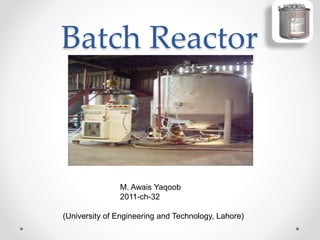
Batch Reactor
M. Awais Yaqoob
2011-ch-32
(University of Engineering and Technology, Lahore)
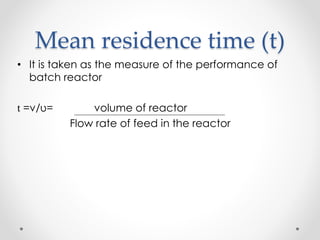
Mean residence time (t)
• It is taken as the measure of the performance of
batch reactor
t =v/υ= volume of reactor
Flow rate of feed in the reactor
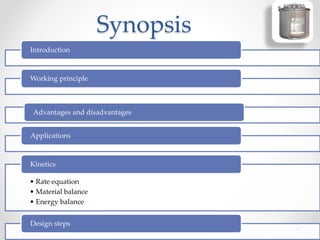
Synopsis
Introduction
Working principle
Advantages and disadvantages
Applications
• Rate equation
• Material balance
• Energy balance
Kinetics
Design steps
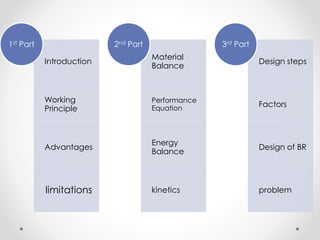
Introduction
Working
Principle
Advantages
limitations
1st Part
Material
Balance
Performance
Equation
Energy
Balance
kinetics
2nd Part
Design steps
Factors
Design of BR
problem
3rd Part
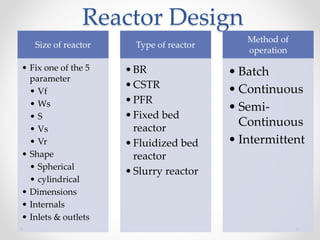
Reactor Design
Size of reactor
• Fix one of the 5
parameter
• Vf
• Ws
• S
• Vs
• Vr
• Shape
• Spherical
• cylindrical
• Dimensions
• Internals
• Inlets & outlets
Type of reactor
•BR
•CSTR
•PFR
•Fixed bed
reactor
•Fluidized bed
reactor
•Slurry reactor
Method of
operation
• Batch
• Continuous
• Semi-
Continuous
• Intermittent
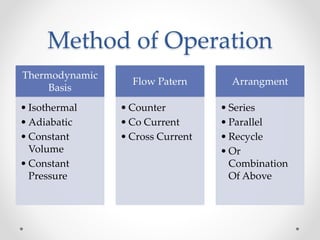
Method of Operation
Thermodynamic
Basis
• Isothermal
• Adiabatic
• Constant
Volume
• Constant
Pressure
Flow Patern
• Counter
• Co Current
• Cross Current
Arrangment
• Series
• Parallel
• Recycle
• Or
Combination
Of Above
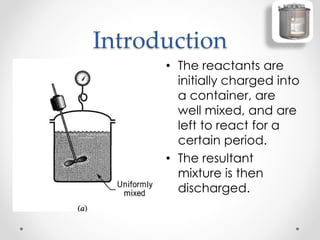
Introduction
• The reactants are
initially charged into
a container, are
well mixed, and are
left to react for a
certain period.
• The resultant
mixture is then
discharged.
Working Principle
• A batch reactor has neither inflow nor
outflow of reactants or products while
the reaction is being carried out
• This is an unsteady-state operation
where composition changes with time;
however, at any instant the
composition throughout the reactor is
uniform
Advantages
• They are preferred for establishing or
verifying kinetics because they are
o Simple in construction
o Require little or no auxiliary equipments
• Data can be collected easily if Isothermal
reactions are carried out under constant
volume condition
• High conversions
Disadvantages/limitations
• Intensity of process is localized and not the
global one
• Preferred for homogenous reactions only
• high labor costs per batch
• difficulty of large-scale production.
• Long idle time (Charging & Discharging
times) leads to periods of no production
• No instrumentation – Poor product quality
Application
• Typically for liquid phase reactions that
require long reaction times
• Used only when small amount of product is
required
• Favored when a process is in
developmental stage or to produce
expensive products
• Used to make a variety of products at
different times
Material Balance
• Also called mass balance.
• Is an application of law of
conservation of mass for the analysis
of physical systems.
• It states that:
• The mass that enters a system must, by
conservation of mass, either leave the
system or accumulate within the
system
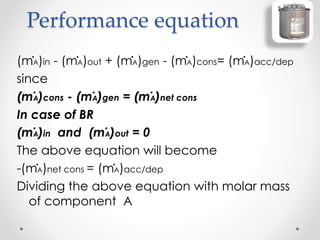
Performance equation
(ṁA)in - (ṁA)out + (ṁA)gen - (ṁA)cons= (ṁA)acc/dep
since
(ṁA)cons - (ṁA)gen = (ṁA)net cons
In case of BR
(ṁA)in and (ṁA)out = 0
The above equation will become
-(ṁA)net cons = (ṁA)acc/dep
Dividing the above equation with molar mass
of component A
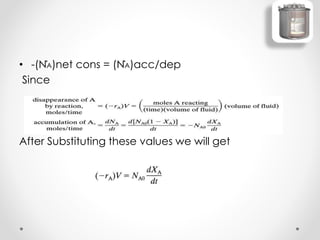
• -(ṄA)net cons = (ṄA)acc/dep
Since
After Substituting these values we will get
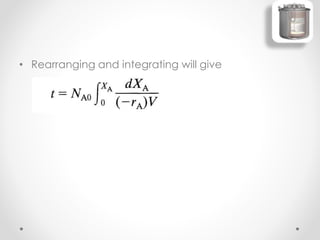
• Rearranging and integrating will give
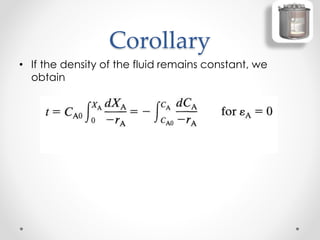
Corollary
• If the density of the fluid remains constant, we
obtain
Energy Balance
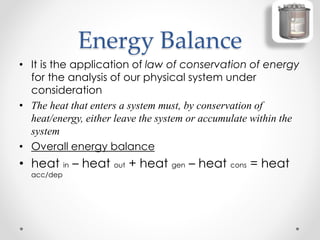
• It is the application of law of conservation of energy
for the analysis of our physical system under
consideration
• The heat that enters a system must, by conservation of
heat/energy, either leave the system or accumulate within the
system
• Overall energy balance
• heat in – heat out + heat gen – heat cons = heat
acc/dep
Kinetics
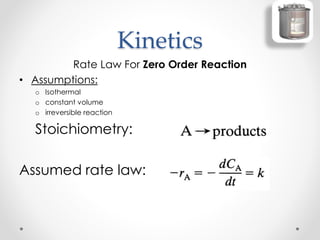
Rate Law For Zero Order Reaction
• Assumptions:
o Isothermal
o constant volume
o irreversible reaction
Stoichiometry:
Assumed rate law:
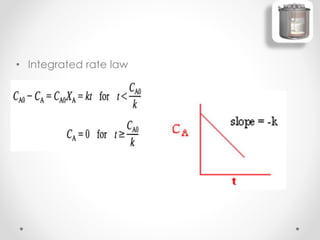
• Integrated rate law
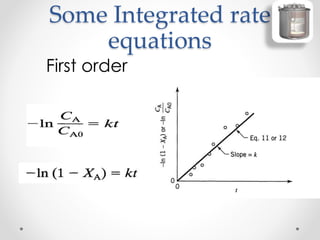
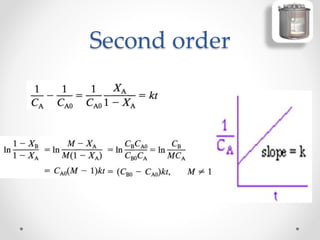
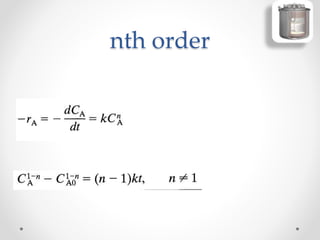
Some Integrated rate
equations
First order
Second order
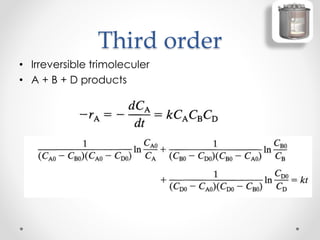
Third order
• Irreversible trimoleculer
• A + B + D products
nth order
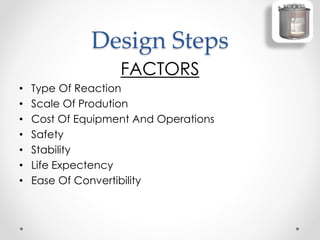
Design Steps
FACTORS
• Type Of Reaction
• Scale Of Prodution
• Cost Of Equipment And Operations
• Safety
• Stability
• Life Expectency
• Ease Of Convertibility
Design steps
• There is no particular formula for selecting the
parameters of a reactor
•Experience
•knowledge of characteristics of reactors
•literature survey
Helps us in selection of parameters
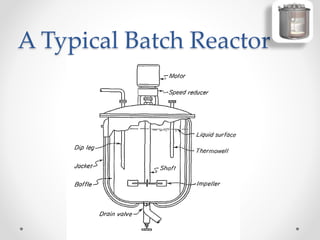
A Typical Batch Reactor
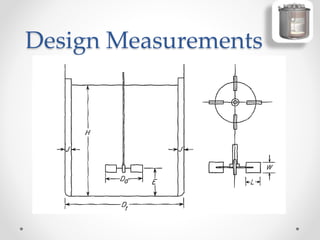
Design Measurements
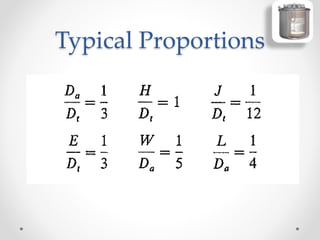
Typical Proportions

Batch Reactor

  • 1.
    Batch Reactor M. AwaisYaqoob 2011-ch-32 (University of Engineering and Technology, Lahore)
  • 2.
    Mean residence time(t) • It is taken as the measure of the performance of batch reactor t =v/υ= volume of reactor Flow rate of feed in the reactor
  • 3.
    Synopsis Introduction Working principle Advantages anddisadvantages Applications • Rate equation • Material balance • Energy balance Kinetics Design steps
  • 4.
  • 5.
    Reactor Design Size ofreactor • Fix one of the 5 parameter • Vf • Ws • S • Vs • Vr • Shape • Spherical • cylindrical • Dimensions • Internals • Inlets & outlets Type of reactor •BR •CSTR •PFR •Fixed bed reactor •Fluidized bed reactor •Slurry reactor Method of operation • Batch • Continuous • Semi- Continuous • Intermittent
  • 6.
    Method of Operation Thermodynamic Basis •Isothermal • Adiabatic • Constant Volume • Constant Pressure Flow Patern • Counter • Co Current • Cross Current Arrangment • Series • Parallel • Recycle • Or Combination Of Above
  • 7.
    Introduction • The reactantsare initially charged into a container, are well mixed, and are left to react for a certain period. • The resultant mixture is then discharged.
  • 8.
    Working Principle • Abatch reactor has neither inflow nor outflow of reactants or products while the reaction is being carried out • This is an unsteady-state operation where composition changes with time; however, at any instant the composition throughout the reactor is uniform
  • 9.
    Advantages • They arepreferred for establishing or verifying kinetics because they are o Simple in construction o Require little or no auxiliary equipments • Data can be collected easily if Isothermal reactions are carried out under constant volume condition • High conversions
  • 10.
    Disadvantages/limitations • Intensity ofprocess is localized and not the global one • Preferred for homogenous reactions only • high labor costs per batch • difficulty of large-scale production. • Long idle time (Charging & Discharging times) leads to periods of no production • No instrumentation – Poor product quality
  • 11.
    Application • Typically forliquid phase reactions that require long reaction times • Used only when small amount of product is required • Favored when a process is in developmental stage or to produce expensive products • Used to make a variety of products at different times
  • 12.
    Material Balance • Alsocalled mass balance. • Is an application of law of conservation of mass for the analysis of physical systems. • It states that: • The mass that enters a system must, by conservation of mass, either leave the system or accumulate within the system
  • 13.
    Performance equation (ṁA)in -(ṁA)out + (ṁA)gen - (ṁA)cons= (ṁA)acc/dep since (ṁA)cons - (ṁA)gen = (ṁA)net cons In case of BR (ṁA)in and (ṁA)out = 0 The above equation will become -(ṁA)net cons = (ṁA)acc/dep Dividing the above equation with molar mass of component A
  • 14.
    • -(ṄA)net cons= (ṄA)acc/dep Since After Substituting these values we will get
  • 15.
    • Rearranging andintegrating will give
  • 16.
    Corollary • If thedensity of the fluid remains constant, we obtain
  • 17.
    Energy Balance • Itis the application of law of conservation of energy for the analysis of our physical system under consideration • The heat that enters a system must, by conservation of heat/energy, either leave the system or accumulate within the system • Overall energy balance • heat in – heat out + heat gen – heat cons = heat acc/dep
  • 18.
    Kinetics Rate Law ForZero Order Reaction • Assumptions: o Isothermal o constant volume o irreversible reaction Stoichiometry: Assumed rate law:
  • 19.
  • 20.
  • 21.
  • 22.
    Third order • Irreversibletrimoleculer • A + B + D products
  • 23.
  • 24.
    Design Steps FACTORS • TypeOf Reaction • Scale Of Prodution • Cost Of Equipment And Operations • Safety • Stability • Life Expectency • Ease Of Convertibility
  • 25.
    Design steps • Thereis no particular formula for selecting the parameters of a reactor •Experience •knowledge of characteristics of reactors •literature survey Helps us in selection of parameters
  • 26.
  • 27.
  • 28.