DEPRECIATION
   CONCEPT
   OBJECTIVES
   CAUSES
   DEPRECIATION METHODS


                 vikas vadakara
CONCEPT
   Depreciation is the cost of lost usefulness
    or cost of diminution of service yield from
    a use of fixed assets.

   A permanent fall in the value of fixed
    assets arising through wear and tear from
    the use of those assets in business.


                      vikas vadakara
Definition
   “Depreciation is a measure of the wearing
    out, consumption or other loss of value of
    depreciation asset arising from use, efflux ion of
    time or obsolescence through technology and
    market changes. Depreciation is allocated so as
    to charge a fair proportion of the depreciable
    amount in each accounting period during the
    expected useful life of the asset. Depreciation
    includes amortization of assets whose useful life
    is predetermined.”


                         vikas vadakara
objectives
 To calculate proper profits.
 To show the asset at its reasonable value
 To maintain the original monetary
  investment of the asset intact.
 Provision of depreciation results in some
  incidental advantages also.
 To provide for replacement of an asset.
 Depreciation is permitted to be deducted
  from profits for tax purposes.


                   vikas vadakara
Causes of Depreciation
   Internal causes: wear and
    tear, disuse, maintenance, change in
    production, restriction of
    production, reduced demand, technical
    progress & depletion.

   External causes: obsolescence and efflux
    ion of time


                     vikas vadakara
Factors in measurement of
       depreciation

   Total cost of asset
   Estimated useful service life or economic life
   The estimated turn-in (residual) value.


                      vikas vadakara
Methods of recording depreciation


   Straight line method or fixed installment
   Declining charge method or diminishing or
    WDV
   Sum of years digit method
   Inventory or revaluation method
   Annuity method
   Depreciation fund method
   Machine hour method/ Production unit
    method
   Depletion method

                    vikas vadakara
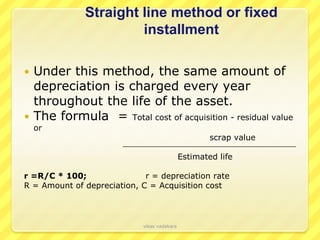
Straight line method or fixed
                       installment

 Under this method, the same amount of
  depreciation is charged every year
  throughout the life of the asset.
 The formula = Total cost of acquisition - residual value
    or
                                                      scrap value

                                              Estimated life

r =R/C * 100;                r = depreciation rate
R = Amount of depreciation, C = Acquisition cost


                             vikas vadakara
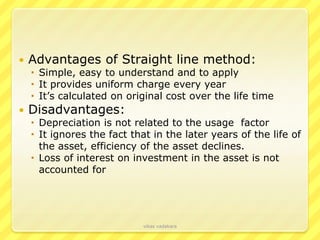
   Advantages of Straight line method:
     Simple, easy to understand and to apply
     It provides uniform charge every year
     It’s calculated on original cost over the life time
   Disadvantages:
     Depreciation is not related to the usage factor
     It ignores the fact that in the later years of the life of
      the asset, efficiency of the asset declines.
     Loss of interest on investment in the asset is not
      accounted for


                            vikas vadakara
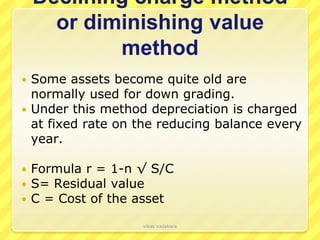
Declining charge method
      or diminishing value
            method
 Some assets become quite old are
  normally used for down grading.
 Under this method depreciation is charged
  at fixed rate on the reducing balance every
  year.

   Formula r = 1-n √ S/C
   S= Residual value
   C = Cost of the asset

                    vikas vadakara
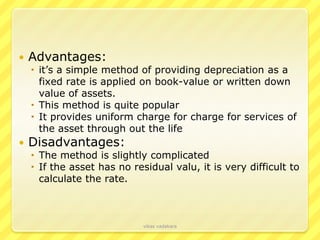
   Advantages:
     it’s a simple method of providing depreciation as a
      fixed rate is applied on book-value or written down
      value of assets.
     This method is quite popular
     It provides uniform charge for charge for services of
      the asset through out the life
   Disadvantages:
     The method is slightly complicated
     If the asset has no residual valu, it is very difficult to
      calculate the rate.


                             vikas vadakara
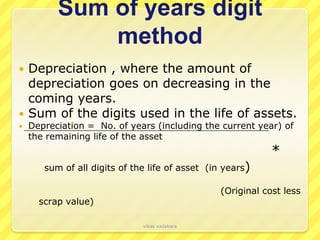
Sum of years digit
              method
 Depreciation , where the amount of
  depreciation goes on decreasing in the
  coming years.
 Sum of the digits used in the life of assets.
   Depreciation = No. of years (including the current year) of
    the remaining life of the asset
                                                            *
       sum of all digits of the life of asset (in years)

                                                (Original cost less
      scrap value)

                              vikas vadakara

Depreciation

  • 1.
    DEPRECIATION  CONCEPT  OBJECTIVES  CAUSES  DEPRECIATION METHODS vikas vadakara
  • 2.
    CONCEPT  Depreciation is the cost of lost usefulness or cost of diminution of service yield from a use of fixed assets.  A permanent fall in the value of fixed assets arising through wear and tear from the use of those assets in business. vikas vadakara
  • 3.
    Definition  “Depreciation is a measure of the wearing out, consumption or other loss of value of depreciation asset arising from use, efflux ion of time or obsolescence through technology and market changes. Depreciation is allocated so as to charge a fair proportion of the depreciable amount in each accounting period during the expected useful life of the asset. Depreciation includes amortization of assets whose useful life is predetermined.” vikas vadakara
  • 4.
    objectives  To calculateproper profits.  To show the asset at its reasonable value  To maintain the original monetary investment of the asset intact.  Provision of depreciation results in some incidental advantages also.  To provide for replacement of an asset.  Depreciation is permitted to be deducted from profits for tax purposes. vikas vadakara
  • 5.
    Causes of Depreciation  Internal causes: wear and tear, disuse, maintenance, change in production, restriction of production, reduced demand, technical progress & depletion.  External causes: obsolescence and efflux ion of time vikas vadakara
  • 6.
    Factors in measurementof depreciation  Total cost of asset  Estimated useful service life or economic life  The estimated turn-in (residual) value. vikas vadakara
  • 7.
    Methods of recordingdepreciation  Straight line method or fixed installment  Declining charge method or diminishing or WDV  Sum of years digit method  Inventory or revaluation method  Annuity method  Depreciation fund method  Machine hour method/ Production unit method  Depletion method vikas vadakara
  • 8.
    Straight line methodor fixed installment  Under this method, the same amount of depreciation is charged every year throughout the life of the asset.  The formula = Total cost of acquisition - residual value or scrap value Estimated life r =R/C * 100; r = depreciation rate R = Amount of depreciation, C = Acquisition cost vikas vadakara
  • 9.
    Advantages of Straight line method:  Simple, easy to understand and to apply  It provides uniform charge every year  It’s calculated on original cost over the life time  Disadvantages:  Depreciation is not related to the usage factor  It ignores the fact that in the later years of the life of the asset, efficiency of the asset declines.  Loss of interest on investment in the asset is not accounted for vikas vadakara
  • 10.
    Declining charge method or diminishing value method  Some assets become quite old are normally used for down grading.  Under this method depreciation is charged at fixed rate on the reducing balance every year.  Formula r = 1-n √ S/C  S= Residual value  C = Cost of the asset vikas vadakara
  • 11.
    Advantages:  it’s a simple method of providing depreciation as a fixed rate is applied on book-value or written down value of assets.  This method is quite popular  It provides uniform charge for charge for services of the asset through out the life  Disadvantages:  The method is slightly complicated  If the asset has no residual valu, it is very difficult to calculate the rate. vikas vadakara
  • 12.
    Sum of yearsdigit method  Depreciation , where the amount of depreciation goes on decreasing in the coming years.  Sum of the digits used in the life of assets.  Depreciation = No. of years (including the current year) of the remaining life of the asset * sum of all digits of the life of asset (in years) (Original cost less scrap value) vikas vadakara