Depreciation
Depreciation is defined as “Allocating the cost
of plant and equipment over the years of use.
Diagrammatic description of depreciation
Cost of a plant asset Balance Sheet
Assets:
Plant and
equipment
As services are received
Income
Statement
Revenue:
Expenses:
Depreciation
Depreciation
– The allowance for wear and tear on equipment and
machinery
– Amount of decreasing value in a capital asset allowed to
be deducted from a business tax return
– Cost Recovery
– Depreciation is a non-cash expense on your schedule F
(farm profit or loss statement)
• Depreciable property can be either tangible or
intangible
Depreciation
– The allowance for wear and tear on equipment and
machinery
– Amount of decreasing value in a capital asset allowed to
be deducted from a business tax return
– Cost Recovery
– Depreciation is a non-cash expense on your schedule F
(farm profit or loss statement)
• Depreciable property can be either tangible or
intangible
Intangible Depreciable Property
• Purchased property that has value that you
cannot readily see or touch
– Computer Software
– Copyrights, patents, etc
What cannot be depreciated?
• Property placed into service and disposed of in the
same year.
• Land (land can never be depreciated)
• Inventory
– You cannot depreciate property held for resale in the
normal course of business
• Leased property
– The value of the lease is already showing up as a rental
expense
When depreciation begins & ends?
• Begins
– When you “place the property in service”.
– When it is ready and available for a specific use in the business
• Example
– When it was bought for the business
• Ends
– When the cost of the item has been recovered or when it is retired
from service, whichever happens first
• Example
– When it is sold or is not longer useable
Causes Of Depreciation
There are three major causes of depreciation;
Physical deterioration:
It results from the use of asset-wear and tear
and the action of elements.
Inadequacy of a plant asset:
It is the inability of an asset to meet future
needs because it doesn’t provide sufficient
product or services.
Obsolescence:
It is the decline in usefulness of an asset due to
inventions and technological advancements.
Methods Of Depreciation
1 straight-Line Method
In this method an equal amount of the cost of
plant asset is charged to each accounting
period.
it can be determined as
Depreciation Per period =
Asset cost – Estimated salvage value
Number of accounting periods in estimated
useful life
Contd……
Example:
Let us consider the asset of cost = 54,000
Estimated salvage value = 4,000
Number of accounting periods = 10 years
Putting the values in the formula
54,000-4,000/10 year = 5,000 per year
End Of Year Depreciation
Expense Dr ;
Accumulated
Depreciation Cr
Total
Accumulated
Depreciation
Book Value
Rs.54,000
1 5,000 5,000 49,000
2 5,000 10,000 44,000
3 5,000 15,000 39,000
4 5,000 20,000 34,000
5 5,000 25,000 29,000
6 5,000 30,000 24,000
7 5,000 35,000 19,000
8 5,000 40,000 14,000
9 5,000 45,000 9,000
10 5,000 50,000 4,000
Rs.50,000
2.Units-of-Production(Output) Method
• It assigns equal amount of depreciation to
each unit of product manufactured or
service rendered by an asset.
• This method is based on physical output.
• It is applied in situation where usage rather
than obsolescence leads to the demise of
asset.
Contd…
The formula to calculate depreciation under this
method is given as under;
Depreciation per unit = Asset cost- Estimated
salvage value ÷ Estimated total units of production
Depreciation per period = 〔Depreciation per
unit× Number of units of goods or services
provided〕
Example :
54,000-4,000÷50,000 = 1 per unit
3.Accelerated Depreciation Methods:
In this method higher amounts of depreciation
are recorded during the early year of an asset's
life while lower amounts are recorded in later
years of an asset.
Reasons for the use of this method:
1. The value of the benefits received from the
asset decline with age.
2. The asset is a high technology asset subject
to rapid obsolescence.
3. Repairs increase substantially in the asset's
later year.
Types of accelerated depreciation
method
It has of two types;
1. Sum-of-the-years-digits method(SOYD)
It adds the consecutive digits for each year of an
asset's estimated life together and uses that as
the denominator of a friction.
Contd…..
The formula is
𝐷𝑒𝑝𝑟𝑒𝑐𝑖𝑎𝑡𝑖𝑜𝑛 𝑝𝑒𝑟 𝑝𝑒𝑟𝑖𝑜𝑑
= 𝑁𝑢𝑚𝑏𝑒𝑟𝑠 𝑜𝑓 𝑦𝑒𝑎𝑟𝑠 𝑜𝑓 𝑢𝑒𝑠𝑓𝑢𝑙 𝑙𝑖𝑓𝑒 𝑟𝑒𝑚𝑎𝑖𝑛𝑖𝑛𝑔 𝑎𝑡 𝑏𝑒𝑔𝑖𝑛𝑖𝑛𝑔 𝑜𝑓 𝑎𝑐𝑐𝑜𝑢𝑛𝑡𝑖𝑛𝑔 𝑝𝑒𝑟𝑖𝑜𝑑 ÷ 𝑆𝑂𝑌𝐷
× 〔𝐴𝑠𝑠𝑒𝑡 𝑐𝑜𝑠𝑡 − 𝐸𝑠𝑡𝑖𝑚𝑎𝑡𝑒𝑑 𝑠𝑎𝑙𝑣𝑎𝑔𝑒 𝑣𝑎𝑙𝑢𝑒 〕
Example
Let us consider the useful life of an asset is 10
years
SOYD will be calculated as
SOYD = n (n+1) = 10(10+1)/2 = 55
2
Illustration sum of the year-digit
Depreciation Schedule
End Of Year Depreciation Expense Dr;
Accumulated Depreciation Cr
Total Accumulated
Depreciation
Book Value
54,000
1 50,000 × 10/55 = 9,091 9,091 44,909
2 50,000 × 9/55 = 8,182 17,273 36,727
3 50,000 × 8/55 =7,273 24,546 29,454
4 50,000 × 7/55 = 6,634 30,910 23,090
5 50,000 × 6/55 = 5,455 36,365 17,635
6 50,000 × 5/55 = 4,545 40,910 13,090
7 50,000 × 4/55 = 3,636 44,546 9,454
8 50,000 × 3/55 = 2,727 47,273 6,727
9 50,000 × 2/55 = 1,818 49,091 4,909
10 50,000 × 1/55 = 909 50,000 4,000
Rs.50,000
Double declining balance method
• To apply the double-declining-balance (DDB) method,
calculate the straight-line depreciation rate.
• ie divide 100% by the number of useful life,
• Eg 100%/5 20%,
• Then multiply that rate by 2
• 20% × 2 = 40%
• Next, apply, the DDB rate to the assets book value.
• Ignore salvage value.
• The formula is = [2× straight line rate × asset cost –
accumulated depreciation]
Illustration Of Double-Declining-Balance
(DDB) Depreciation Schedule
Depreciation expense Dr ;
Accumulated Depreciation Cr
Total
Accumulated
depreciation
Book
Value
1 20 % of 54,000 = Rs 10,800 10,800 43,200
2 20 % of 43,200 = Rs 8,640 19,440 34,560
3 20 % of 34,560 = Rs 6,912 26,352 27,648
4 20 % of 27,648= Rs 5,530 31,882 22,648
5 20 % of 22,118 = Rs 4,424 36,306 17,694
6 20 % of 17,694 = Rs 3,359 39,845 14,155
7 20 % of 14,155= Rs 2,831 42,676 11,324
8 20 % of 11324= Rs 2,265 44,941 9,059
9 20 % of 9,059= Rs 1,812 46,753 7,247
10 20 % of 7,247 = Rs 1,449 48,202 5,798
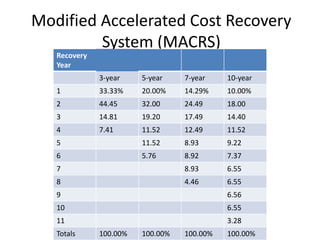
Modified accelerated cost recovery
system (MACRS)
• Companies used some time a particular type
of depreciation for tax purposes known as
Modified accelerated cost recovery system.
• Under this method, a company uses one of
the eight classes for recovery purposes.
• For example, next slide
Modified Accelerated Cost Recovery
System (MACRS)
Recovery
Year
3-year 5-year 7-year 10-year
1 33.33% 20.00% 14.29% 10.00%
2 44.45 32.00 24.49 18.00
3 14.81 19.20 17.49 14.40
4 7.41 11.52 12.49 11.52
5 11.52 8.93 9.22
6 5.76 8.92 7.37
7 8.93 6.55
8 4.46 6.55
9 6.56
10 6.55
11 3.28
Totals 100.00% 100.00% 100.00% 100.00%
Year Depreciation
Calculation Using
Formula
Calculation Using Table
2009 $20 million $100 × 1/5 × 200% × 0.5 $100 million × 20%
2010 $32 million
($100 − $20) × 1/5 ×
200%
$100 million × 32%
2011 $19.2 million
($100 − $20 − $32
million) × 1/5 × 200%
$100 million × 19.2%
2012 $11.52 million
($100 − $20 − $32 −
$19.2) × 1/5 × 200%
$100 million × 11.52%
2013 $11.52 million (Note A) $100 million × 11.52%
2014 $5.76 million
$11.52 million × 0.5
(Note B)
$100 million × 5.76%
Partial depreciation
• So far we have discussed depreciation by putting the asset
into service at the beginning of the accounting period.
• what if, we put the asset into service during the accounting
period.
• when assets are acquired during an accounting period, the
first depreciation is for a partial year.
• Round off to the nearest full month, eg;
• If the asset is purchased on or before the 15th day of the
month, treat it as it were purchased on the first day of the
month.
• Or treat the asset in the following month 1st date if it was
purchased on 15th or after date.
Example
• To calculate partial year depreciation for each
of the four methods, consider a machine
which
• Cost = Rs 7,600 on sep 1, 1997
• Salvage value = Rs 400
• Useful life = 5 years
• Total unit of production = 25000
Straight line Method
• Partial year depreciation calculation is very easy
for straight line method
• For example
• The annual depreciation is = (7600-400)/5years =
Rs 1440
• The machine would operate for four months prior
to the end of accounting period, hence covering
one third of the year,
• The 1997, depreciation is Rs 1440× 1/3 = Rs 480
Units of production method
• No unusual computation is required to record
depreciation for the partial year
• Just multiply the depreciation charge per unit
by the unit produced.
• The charge for partial year will be less because
few unit of goods produced.
Units of production method
• No unusual computation is required to record
depreciation for the partial year
• Just multiply the depreciation charge per unit
by the unit produced.
• The charge for partial year will be less because
few unit of goods produced.
Sum of the years digits method
• Under this method, the computation is complex a little bit.
• Problems occur because the 12 months of the depreciation does
not correspond with the 12 month of financial statements.
• For example
• Depreciation for the four months of 1997 is
• (7600-400)× 5/15 × 1/3 = Rs 800.
• In 1998, the depreciation is recorded as follows;
• For the first two third of the year. (Rs 7,200 × 5/15 × 2/3) = Rs 1,600
• For the last one third of the year. (Rs 7,200 × 4/15 × 1/3) = Rs 640
• Total depreciation for the year 1998 = Rs 2240
Double declining balance method
• Under this method, it is relatively easy to
determine depreciation for a partial year and
then for subsequent full years.
• For example
• Partial year depreciation for 1997 is (Rs 7600 ×
0.4 × 1/3) = Rs 1,013.
• For subsequent years, use the regular procedure
for computation.
• eg 1998, depreciation would be = [(Rs 7600- Rs
1,013) × 0.4] = Rs 2,635.
Sum-Of-The-Years’-Digits Methods
1.Rs 7,200×5/15=Rs.2,400
Year Depreciation for each year of life of asset
(September 1-August 31)
Depreciation for each
calendar year (Jan 1-
December 31)

Depreciation 2 (1)

  • 1.
    Depreciation Depreciation is definedas “Allocating the cost of plant and equipment over the years of use.
  • 2.
    Diagrammatic description ofdepreciation Cost of a plant asset Balance Sheet Assets: Plant and equipment As services are received Income Statement Revenue: Expenses: Depreciation
  • 3.
    Depreciation – The allowancefor wear and tear on equipment and machinery – Amount of decreasing value in a capital asset allowed to be deducted from a business tax return – Cost Recovery – Depreciation is a non-cash expense on your schedule F (farm profit or loss statement) • Depreciable property can be either tangible or intangible
  • 4.
    Depreciation – The allowancefor wear and tear on equipment and machinery – Amount of decreasing value in a capital asset allowed to be deducted from a business tax return – Cost Recovery – Depreciation is a non-cash expense on your schedule F (farm profit or loss statement) • Depreciable property can be either tangible or intangible
  • 5.
    Intangible Depreciable Property •Purchased property that has value that you cannot readily see or touch – Computer Software – Copyrights, patents, etc
  • 6.
    What cannot bedepreciated? • Property placed into service and disposed of in the same year. • Land (land can never be depreciated) • Inventory – You cannot depreciate property held for resale in the normal course of business • Leased property – The value of the lease is already showing up as a rental expense
  • 7.
    When depreciation begins& ends? • Begins – When you “place the property in service”. – When it is ready and available for a specific use in the business • Example – When it was bought for the business • Ends – When the cost of the item has been recovered or when it is retired from service, whichever happens first • Example – When it is sold or is not longer useable
  • 8.
    Causes Of Depreciation Thereare three major causes of depreciation; Physical deterioration: It results from the use of asset-wear and tear and the action of elements. Inadequacy of a plant asset: It is the inability of an asset to meet future needs because it doesn’t provide sufficient product or services.
  • 9.
    Obsolescence: It is thedecline in usefulness of an asset due to inventions and technological advancements.
  • 10.
    Methods Of Depreciation 1straight-Line Method In this method an equal amount of the cost of plant asset is charged to each accounting period. it can be determined as Depreciation Per period = Asset cost – Estimated salvage value Number of accounting periods in estimated useful life
  • 11.
    Contd…… Example: Let us considerthe asset of cost = 54,000 Estimated salvage value = 4,000 Number of accounting periods = 10 years Putting the values in the formula 54,000-4,000/10 year = 5,000 per year
  • 12.
    End Of YearDepreciation Expense Dr ; Accumulated Depreciation Cr Total Accumulated Depreciation Book Value Rs.54,000 1 5,000 5,000 49,000 2 5,000 10,000 44,000 3 5,000 15,000 39,000 4 5,000 20,000 34,000 5 5,000 25,000 29,000 6 5,000 30,000 24,000 7 5,000 35,000 19,000 8 5,000 40,000 14,000 9 5,000 45,000 9,000 10 5,000 50,000 4,000 Rs.50,000
  • 13.
    2.Units-of-Production(Output) Method • Itassigns equal amount of depreciation to each unit of product manufactured or service rendered by an asset. • This method is based on physical output. • It is applied in situation where usage rather than obsolescence leads to the demise of asset.
  • 14.
    Contd… The formula tocalculate depreciation under this method is given as under; Depreciation per unit = Asset cost- Estimated salvage value ÷ Estimated total units of production Depreciation per period = 〔Depreciation per unit× Number of units of goods or services provided〕 Example : 54,000-4,000÷50,000 = 1 per unit
  • 15.
    3.Accelerated Depreciation Methods: Inthis method higher amounts of depreciation are recorded during the early year of an asset's life while lower amounts are recorded in later years of an asset. Reasons for the use of this method: 1. The value of the benefits received from the asset decline with age. 2. The asset is a high technology asset subject to rapid obsolescence. 3. Repairs increase substantially in the asset's later year.
  • 16.
    Types of accelerateddepreciation method It has of two types; 1. Sum-of-the-years-digits method(SOYD) It adds the consecutive digits for each year of an asset's estimated life together and uses that as the denominator of a friction.
  • 17.
    Contd….. The formula is 𝐷𝑒𝑝𝑟𝑒𝑐𝑖𝑎𝑡𝑖𝑜𝑛𝑝𝑒𝑟 𝑝𝑒𝑟𝑖𝑜𝑑 = 𝑁𝑢𝑚𝑏𝑒𝑟𝑠 𝑜𝑓 𝑦𝑒𝑎𝑟𝑠 𝑜𝑓 𝑢𝑒𝑠𝑓𝑢𝑙 𝑙𝑖𝑓𝑒 𝑟𝑒𝑚𝑎𝑖𝑛𝑖𝑛𝑔 𝑎𝑡 𝑏𝑒𝑔𝑖𝑛𝑖𝑛𝑔 𝑜𝑓 𝑎𝑐𝑐𝑜𝑢𝑛𝑡𝑖𝑛𝑔 𝑝𝑒𝑟𝑖𝑜𝑑 ÷ 𝑆𝑂𝑌𝐷 × 〔𝐴𝑠𝑠𝑒𝑡 𝑐𝑜𝑠𝑡 − 𝐸𝑠𝑡𝑖𝑚𝑎𝑡𝑒𝑑 𝑠𝑎𝑙𝑣𝑎𝑔𝑒 𝑣𝑎𝑙𝑢𝑒 〕 Example Let us consider the useful life of an asset is 10 years SOYD will be calculated as SOYD = n (n+1) = 10(10+1)/2 = 55 2
  • 18.
    Illustration sum ofthe year-digit Depreciation Schedule End Of Year Depreciation Expense Dr; Accumulated Depreciation Cr Total Accumulated Depreciation Book Value 54,000 1 50,000 × 10/55 = 9,091 9,091 44,909 2 50,000 × 9/55 = 8,182 17,273 36,727 3 50,000 × 8/55 =7,273 24,546 29,454 4 50,000 × 7/55 = 6,634 30,910 23,090 5 50,000 × 6/55 = 5,455 36,365 17,635 6 50,000 × 5/55 = 4,545 40,910 13,090 7 50,000 × 4/55 = 3,636 44,546 9,454 8 50,000 × 3/55 = 2,727 47,273 6,727 9 50,000 × 2/55 = 1,818 49,091 4,909 10 50,000 × 1/55 = 909 50,000 4,000 Rs.50,000
  • 19.
    Double declining balancemethod • To apply the double-declining-balance (DDB) method, calculate the straight-line depreciation rate. • ie divide 100% by the number of useful life, • Eg 100%/5 20%, • Then multiply that rate by 2 • 20% × 2 = 40% • Next, apply, the DDB rate to the assets book value. • Ignore salvage value. • The formula is = [2× straight line rate × asset cost – accumulated depreciation]
  • 20.
    Illustration Of Double-Declining-Balance (DDB)Depreciation Schedule Depreciation expense Dr ; Accumulated Depreciation Cr Total Accumulated depreciation Book Value 1 20 % of 54,000 = Rs 10,800 10,800 43,200 2 20 % of 43,200 = Rs 8,640 19,440 34,560 3 20 % of 34,560 = Rs 6,912 26,352 27,648 4 20 % of 27,648= Rs 5,530 31,882 22,648 5 20 % of 22,118 = Rs 4,424 36,306 17,694 6 20 % of 17,694 = Rs 3,359 39,845 14,155 7 20 % of 14,155= Rs 2,831 42,676 11,324 8 20 % of 11324= Rs 2,265 44,941 9,059 9 20 % of 9,059= Rs 1,812 46,753 7,247 10 20 % of 7,247 = Rs 1,449 48,202 5,798
  • 21.
    Modified accelerated costrecovery system (MACRS) • Companies used some time a particular type of depreciation for tax purposes known as Modified accelerated cost recovery system. • Under this method, a company uses one of the eight classes for recovery purposes. • For example, next slide
  • 22.
    Modified Accelerated CostRecovery System (MACRS) Recovery Year 3-year 5-year 7-year 10-year 1 33.33% 20.00% 14.29% 10.00% 2 44.45 32.00 24.49 18.00 3 14.81 19.20 17.49 14.40 4 7.41 11.52 12.49 11.52 5 11.52 8.93 9.22 6 5.76 8.92 7.37 7 8.93 6.55 8 4.46 6.55 9 6.56 10 6.55 11 3.28 Totals 100.00% 100.00% 100.00% 100.00%
  • 23.
    Year Depreciation Calculation Using Formula CalculationUsing Table 2009 $20 million $100 × 1/5 × 200% × 0.5 $100 million × 20% 2010 $32 million ($100 − $20) × 1/5 × 200% $100 million × 32% 2011 $19.2 million ($100 − $20 − $32 million) × 1/5 × 200% $100 million × 19.2% 2012 $11.52 million ($100 − $20 − $32 − $19.2) × 1/5 × 200% $100 million × 11.52% 2013 $11.52 million (Note A) $100 million × 11.52% 2014 $5.76 million $11.52 million × 0.5 (Note B) $100 million × 5.76%
  • 24.
    Partial depreciation • Sofar we have discussed depreciation by putting the asset into service at the beginning of the accounting period. • what if, we put the asset into service during the accounting period. • when assets are acquired during an accounting period, the first depreciation is for a partial year. • Round off to the nearest full month, eg; • If the asset is purchased on or before the 15th day of the month, treat it as it were purchased on the first day of the month. • Or treat the asset in the following month 1st date if it was purchased on 15th or after date.
  • 25.
    Example • To calculatepartial year depreciation for each of the four methods, consider a machine which • Cost = Rs 7,600 on sep 1, 1997 • Salvage value = Rs 400 • Useful life = 5 years • Total unit of production = 25000
  • 26.
    Straight line Method •Partial year depreciation calculation is very easy for straight line method • For example • The annual depreciation is = (7600-400)/5years = Rs 1440 • The machine would operate for four months prior to the end of accounting period, hence covering one third of the year, • The 1997, depreciation is Rs 1440× 1/3 = Rs 480
  • 27.
    Units of productionmethod • No unusual computation is required to record depreciation for the partial year • Just multiply the depreciation charge per unit by the unit produced. • The charge for partial year will be less because few unit of goods produced.
  • 28.
    Units of productionmethod • No unusual computation is required to record depreciation for the partial year • Just multiply the depreciation charge per unit by the unit produced. • The charge for partial year will be less because few unit of goods produced.
  • 29.
    Sum of theyears digits method • Under this method, the computation is complex a little bit. • Problems occur because the 12 months of the depreciation does not correspond with the 12 month of financial statements. • For example • Depreciation for the four months of 1997 is • (7600-400)× 5/15 × 1/3 = Rs 800. • In 1998, the depreciation is recorded as follows; • For the first two third of the year. (Rs 7,200 × 5/15 × 2/3) = Rs 1,600 • For the last one third of the year. (Rs 7,200 × 4/15 × 1/3) = Rs 640 • Total depreciation for the year 1998 = Rs 2240
  • 30.
    Double declining balancemethod • Under this method, it is relatively easy to determine depreciation for a partial year and then for subsequent full years. • For example • Partial year depreciation for 1997 is (Rs 7600 × 0.4 × 1/3) = Rs 1,013. • For subsequent years, use the regular procedure for computation. • eg 1998, depreciation would be = [(Rs 7600- Rs 1,013) × 0.4] = Rs 2,635.
  • 31.
    Sum-Of-The-Years’-Digits Methods 1.Rs 7,200×5/15=Rs.2,400 YearDepreciation for each year of life of asset (September 1-August 31) Depreciation for each calendar year (Jan 1- December 31)