16-1
Lecture slides to accompany
Engineering Economy
7th
edition
Leland Blank
Anthony Tarquin
Chapter 16Chapter 16
DepreciationDepreciation
MethodsMethods
© 2012 by McGraw-Hill All Rights Reserved
16-2
LEARNINGLEARNING OUTCOMESOUTCOMES
1. Understand basic terms of asset
depreciation
2. Apply straight line method of depreciation
3. Apply DB and DDB methods of
depreciation; switch between DDB and SL
methods
4. Apply MACRS method of depreciation
5. Select asset recovery period for MACRS
6. Explain depletion and apply cost depletion
& percentage depletion methods© 2012 by McGraw-Hill All Rights Reserved
© 2012 by McGraw-Hill All Rights Reserved
16-3
Depreciation TerminologyDepreciation Terminology
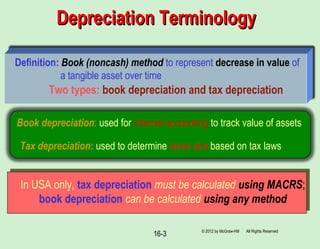
Definition: Book (noncash) method to represent decrease in value of
a tangible asset over time
Two types: book depreciation and tax depreciation
Book depreciation: used for internal accounting to track value of assets
Tax depreciation: used to determine taxes due based on tax laws
In USA only, tax depreciation must be calculated using MACRS;
book depreciation can be calculated using any method
16-4
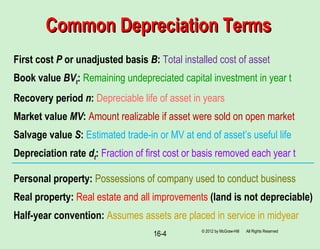
Common Depreciation TermsCommon Depreciation Terms
© 2012 by McGraw-Hill All Rights Reserved
First cost P or unadjusted basis B: Total installed cost of asset
Book value BVt: Remaining undepreciated capital investment in year t
Recovery period n: Depreciable life of asset in years
Market value MV: Amount realizable if asset were sold on open market
Salvage value S: Estimated trade-in or MV at end of asset’s useful life
Depreciation rate dt: Fraction of first cost or basis removed each year t
Personal property: Possessions of company used to conduct business
Real property: Real estate and all improvements (land is not depreciable)
Half-year convention: Assumes assets are placed in service in midyear
16-5
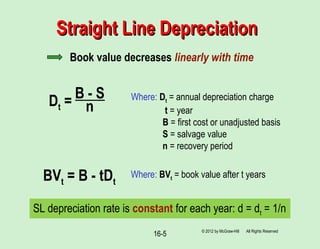
Straight Line DepreciationStraight Line Depreciation
© 2012 by McGraw-Hill All Rights Reserved
Book value decreases linearly with time
Dt = B - S
n
Where: Dt = annual depreciation charge
t = year
B = first cost or unadjusted basis
S = salvage value
n = recovery period
BVt = B - tDt
Where: BVt = book value after t years
SL depreciation rate is constant for each year: d = dt = 1/n
16-6
Example: SL DepreciationExample: SL Depreciation
© 2012 by McGraw-Hill All Rights Reserved
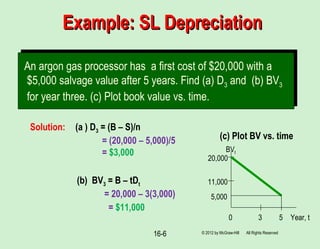
Solution: (a ) D3 = (B – S)/n
= (20,000 – 5,000)/5
= $3,000
(b) BV3 = B – tDt
= 20,000 – 3(3,000)
= $11,000
An argon gas processor has a first cost of $20,000 with a
$5,000 salvage value after 5 years. Find (a) D3 and (b) BV3
for year three. (c) Plot book value vs. time.
(c) Plot BV vs. time
20,000
11,000
3 5
5,000
0 Year, t
BVt
16-7
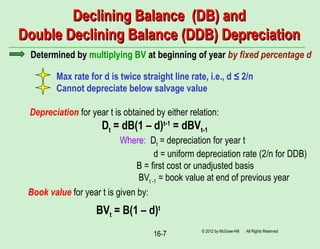
Declining Balance (DB) andDeclining Balance (DB) and
Double Declining Balance (DDB) DepreciationDouble Declining Balance (DDB) Depreciation
© 2012 by McGraw-Hill All Rights Reserved
Determined by multiplying BV at beginning of year by fixed percentage d
Max rate for d is twice straight line rate, i.e., d ≤ 2/n
Cannot depreciate below salvage value
Depreciation for year t is obtained by either relation:
Dt = dB(1 – d)t-1
= dBVt-1
Where: Dt = depreciation for year t
d = uniform depreciation rate (2/n for DDB)
B = first cost or unadjusted basis
BVt -1 = book value at end of previous year
Book value for year t is given by:
BVt = B(1 – d)t
16-8
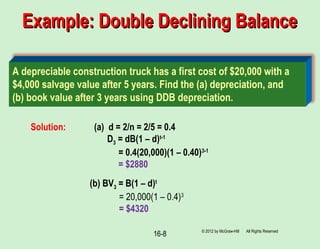
Example: Double Declining BalanceExample: Double Declining Balance
© 2012 by McGraw-Hill All Rights Reserved
(b) BV3 = B(1 – d)t
= 20,000(1 – 0.4)3
= $4320
A depreciable construction truck has a first cost of $20,000 with a
$4,000 salvage value after 5 years. Find the (a) depreciation, and
(b) book value after 3 years using DDB depreciation.
Solution: (a) d = 2/n = 2/5 = 0.4
D3 = dB(1 – d)t-1
= 0.4(20,000)(1 – 0.40)3-1
= $2880
16-9
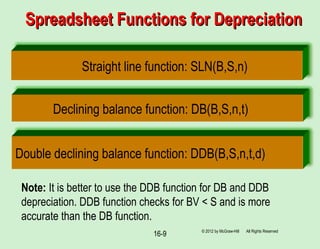
Spreadsheet Functions for DepreciationSpreadsheet Functions for Depreciation
© 2012 by McGraw-Hill All Rights Reserved
Straight line function: SLN(B,S,n)
Declining balance function: DB(B,S,n,t)
Double declining balance function: DDB(B,S,n,t,d)
Note: It is better to use the DDB function for DB and DDB
depreciation. DDB function checks for BV < S and is more
accurate than the DB function.
Switching Between Depreciation MethodsSwitching Between Depreciation Methods
Switch between methods to maximize PW of depreciation
PWD = ∑ Dt (P/F,i%,t)
A switch from DDB to SL in latter part of life is usually better
Can switch only one time during recovery period
16-10 © 2012 by McGraw-Hill All Rights Reserved
t = 1
t = n
Procedure to switch from DDB to SL:
1) Each year t compute DDB and SL depreciation using the relations
DDDB = d(BVt-1) and DSL = BVt-1 / (n-t+1)
2) Select larger depreciation amount, i.e., Dt = max[DDDB, DSL]
3) If required, calculate PWD
Procedure to switch from DDB to SL:
1) Each year t compute DDB and SL depreciation using the relations
DDDB = d(BVt-1) and DSL = BVt-1 / (n-t+1)
2) Select larger depreciation amount, i.e., Dt = max[DDDB, DSL]
3) If required, calculate PWD
Alternatively, use spreadsheet function VDB(B,S,n,start_t,end_t) to determine Dt
16-11
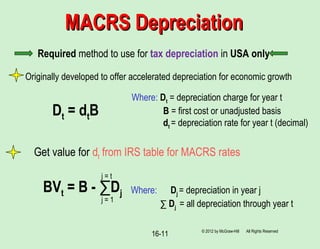
MACRS DepreciationMACRS Depreciation
© 2012 by McGraw-Hill All Rights Reserved
Required method to use for tax depreciation in USA only
Originally developed to offer accelerated depreciation for economic growth
Dt = dtB
Where: Dt = depreciation charge for year t
B = first cost or unadjusted basis
dt = depreciation rate for year t (decimal)
BVt = B - ∑Dj Where: Dj = depreciation in year j
∑ Dj = all depreciation through year tj = 1
j = t
Get value for dt from IRS table for MACRS rates
16-12
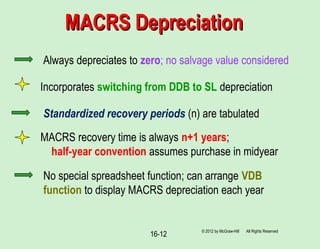
MACRS DepreciationMACRS Depreciation
© 2012 by McGraw-Hill All Rights Reserved
Always depreciates to zero; no salvage value considered
Incorporates switching from DDB to SL depreciation
MACRS recovery time is always n+1 years;
half-year convention assumes purchase in midyear
Standardized recovery periods (n) are tabulated
No special spreadsheet function; can arrange VDB
function to display MACRS depreciation each year
16-13
Example: MACRS DepreciationExample: MACRS Depreciation
© 2012 by McGraw-Hill All Rights Reserved
Solution:
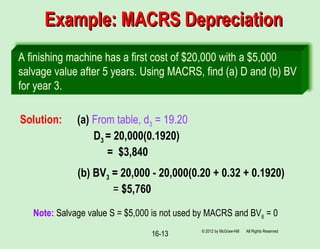
A finishing machine has a first cost of $20,000 with a $5,000
salvage value after 5 years. Using MACRS, find (a) D and (b) BV
for year 3.
(a) From table, d3 = 19.20
D3 = 20,000(0.1920)
= $3,840
(b) BV3 = 20,000 - 20,000(0.20 + 0.32 + 0.1920)
= $5,760
Note: Salvage value S = $5,000 is not used by MACRS and BV6 = 0
© 2012 by McGraw-Hill All Rights Reserved
16-14
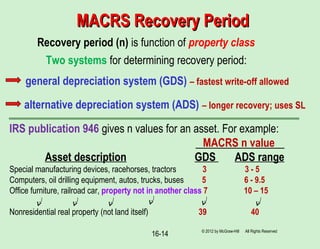
MACRS Recovery PeriodMACRS Recovery Period
Recovery period (n) is function of property class
Two systems for determining recovery period:
general depreciation system (GDS) – fastest write-off allowed
alternative depreciation system (ADS) – longer recovery; uses SL
IRS publication 946 gives n values for an asset. For example:
MACRS n value
Asset description GDS ADS range
Special manufacturing devices, racehorses, tractors 3 3 - 5
Computers, oil drilling equipment, autos, trucks, buses 5 6 - 9.5
Office furniture, railroad car, property not in another class 7 10 – 15
Nonresidential real property (not land itself) 39 40
Unit-of-Production (UOP) DepreciationUnit-of-Production (UOP) Depreciation
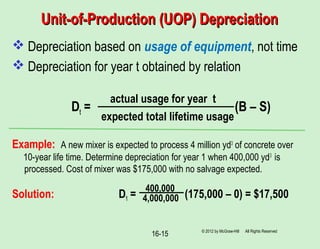
 Depreciation based on usage of equipment, not time
 Depreciation for year t obtained by relation
Dt = (B – S)
Example: A new mixer is expected to process 4 million yd3
of concrete over
10-year life time. Determine depreciation for year 1 when 400,000 yd3
is
processed. Cost of mixer was $175,000 with no salvage expected.
Solution: D1 = (175,000 – 0) = $17,500
© 2012 by McGraw-Hill All Rights Reserved
16-15
actual usage for year t
expected total lifetime usage
400,000
4,000,000
16-16 © 2012 by McGraw-Hill All Rights Reserved
Depletion MethodsDepletion Methods
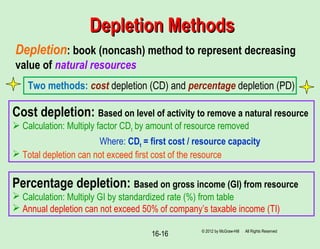
Depletion: book (noncash) method to represent decreasing
value of natural resources
Two methods: cost depletion (CD) and percentage depletion (PD)
Cost depletion: Based on level of activity to remove a natural resource
 Calculation: Multiply factor CDt by amount of resource removed
Where: CDt = first cost / resource capacity
 Total depletion can not exceed first cost of the resource
Percentage depletion: Based on gross income (GI) from resource
 Calculation: Multiply GI by standardized rate (%) from table
 Annual depletion can not exceed 50% of company’s taxable income (TI)
© 2012 by McGraw-Hill All Rights Reserved
16-17
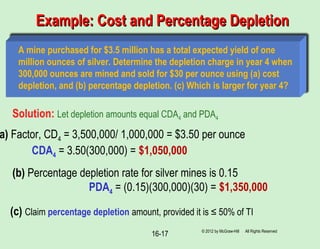
Example: Cost and Percentage DepletionExample: Cost and Percentage Depletion
A mine purchased for $3.5 million has a total expected yield of one
million ounces of silver. Determine the depletion charge in year 4 when
300,000 ounces are mined and sold for $30 per ounce using (a) cost
depletion, and (b) percentage depletion. (c) Which is larger for year 4?
Solution: Let depletion amounts equal CDA4 and PDA4
a) Factor, CD4 = 3,500,000/ 1,000,000 = $3.50 per ounce
CDA4 = 3.50(300,000) = $1,050,000
(b) Percentage depletion rate for silver mines is 0.15
PDA4 = (0.15)(300,000)(30) = $1,350,000
(c) Claim percentage depletion amount, provided it is ≤ 50% of TI
16-18
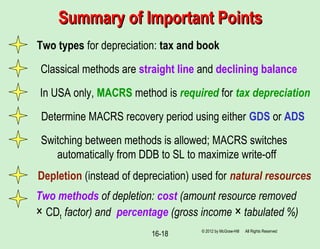
Summary of Important PointsSummary of Important Points
© 2012 by McGraw-Hill All Rights Reserved
Two methods of depletion: cost (amount resource removed
× CDt factor) and percentage (gross income × tabulated %)
Two types for depreciation: tax and book
In USA only, MACRS method is required for tax depreciation
Determine MACRS recovery period using either GDS or ADS
Depletion (instead of depreciation) used for natural resources
Classical methods are straight line and declining balance
Switching between methods is allowed; MACRS switches
automatically from DDB to SL to maximize write-off

Chapter 16 depreciation methods

  • 1.
    16-1 Lecture slides toaccompany Engineering Economy 7th edition Leland Blank Anthony Tarquin Chapter 16Chapter 16 DepreciationDepreciation MethodsMethods © 2012 by McGraw-Hill All Rights Reserved
  • 2.
    16-2 LEARNINGLEARNING OUTCOMESOUTCOMES 1. Understandbasic terms of asset depreciation 2. Apply straight line method of depreciation 3. Apply DB and DDB methods of depreciation; switch between DDB and SL methods 4. Apply MACRS method of depreciation 5. Select asset recovery period for MACRS 6. Explain depletion and apply cost depletion & percentage depletion methods© 2012 by McGraw-Hill All Rights Reserved
  • 3.
    © 2012 byMcGraw-Hill All Rights Reserved 16-3 Depreciation TerminologyDepreciation Terminology Definition: Book (noncash) method to represent decrease in value of a tangible asset over time Two types: book depreciation and tax depreciation Book depreciation: used for internal accounting to track value of assets Tax depreciation: used to determine taxes due based on tax laws In USA only, tax depreciation must be calculated using MACRS; book depreciation can be calculated using any method
  • 4.
    16-4 Common Depreciation TermsCommonDepreciation Terms © 2012 by McGraw-Hill All Rights Reserved First cost P or unadjusted basis B: Total installed cost of asset Book value BVt: Remaining undepreciated capital investment in year t Recovery period n: Depreciable life of asset in years Market value MV: Amount realizable if asset were sold on open market Salvage value S: Estimated trade-in or MV at end of asset’s useful life Depreciation rate dt: Fraction of first cost or basis removed each year t Personal property: Possessions of company used to conduct business Real property: Real estate and all improvements (land is not depreciable) Half-year convention: Assumes assets are placed in service in midyear
  • 5.
    16-5 Straight Line DepreciationStraightLine Depreciation © 2012 by McGraw-Hill All Rights Reserved Book value decreases linearly with time Dt = B - S n Where: Dt = annual depreciation charge t = year B = first cost or unadjusted basis S = salvage value n = recovery period BVt = B - tDt Where: BVt = book value after t years SL depreciation rate is constant for each year: d = dt = 1/n
  • 6.
    16-6 Example: SL DepreciationExample:SL Depreciation © 2012 by McGraw-Hill All Rights Reserved Solution: (a ) D3 = (B – S)/n = (20,000 – 5,000)/5 = $3,000 (b) BV3 = B – tDt = 20,000 – 3(3,000) = $11,000 An argon gas processor has a first cost of $20,000 with a $5,000 salvage value after 5 years. Find (a) D3 and (b) BV3 for year three. (c) Plot book value vs. time. (c) Plot BV vs. time 20,000 11,000 3 5 5,000 0 Year, t BVt
  • 7.
    16-7 Declining Balance (DB)andDeclining Balance (DB) and Double Declining Balance (DDB) DepreciationDouble Declining Balance (DDB) Depreciation © 2012 by McGraw-Hill All Rights Reserved Determined by multiplying BV at beginning of year by fixed percentage d Max rate for d is twice straight line rate, i.e., d ≤ 2/n Cannot depreciate below salvage value Depreciation for year t is obtained by either relation: Dt = dB(1 – d)t-1 = dBVt-1 Where: Dt = depreciation for year t d = uniform depreciation rate (2/n for DDB) B = first cost or unadjusted basis BVt -1 = book value at end of previous year Book value for year t is given by: BVt = B(1 – d)t
  • 8.
    16-8 Example: Double DecliningBalanceExample: Double Declining Balance © 2012 by McGraw-Hill All Rights Reserved (b) BV3 = B(1 – d)t = 20,000(1 – 0.4)3 = $4320 A depreciable construction truck has a first cost of $20,000 with a $4,000 salvage value after 5 years. Find the (a) depreciation, and (b) book value after 3 years using DDB depreciation. Solution: (a) d = 2/n = 2/5 = 0.4 D3 = dB(1 – d)t-1 = 0.4(20,000)(1 – 0.40)3-1 = $2880
  • 9.
    16-9 Spreadsheet Functions forDepreciationSpreadsheet Functions for Depreciation © 2012 by McGraw-Hill All Rights Reserved Straight line function: SLN(B,S,n) Declining balance function: DB(B,S,n,t) Double declining balance function: DDB(B,S,n,t,d) Note: It is better to use the DDB function for DB and DDB depreciation. DDB function checks for BV < S and is more accurate than the DB function.
  • 10.
    Switching Between DepreciationMethodsSwitching Between Depreciation Methods Switch between methods to maximize PW of depreciation PWD = ∑ Dt (P/F,i%,t) A switch from DDB to SL in latter part of life is usually better Can switch only one time during recovery period 16-10 © 2012 by McGraw-Hill All Rights Reserved t = 1 t = n Procedure to switch from DDB to SL: 1) Each year t compute DDB and SL depreciation using the relations DDDB = d(BVt-1) and DSL = BVt-1 / (n-t+1) 2) Select larger depreciation amount, i.e., Dt = max[DDDB, DSL] 3) If required, calculate PWD Procedure to switch from DDB to SL: 1) Each year t compute DDB and SL depreciation using the relations DDDB = d(BVt-1) and DSL = BVt-1 / (n-t+1) 2) Select larger depreciation amount, i.e., Dt = max[DDDB, DSL] 3) If required, calculate PWD Alternatively, use spreadsheet function VDB(B,S,n,start_t,end_t) to determine Dt
  • 11.
    16-11 MACRS DepreciationMACRS Depreciation ©2012 by McGraw-Hill All Rights Reserved Required method to use for tax depreciation in USA only Originally developed to offer accelerated depreciation for economic growth Dt = dtB Where: Dt = depreciation charge for year t B = first cost or unadjusted basis dt = depreciation rate for year t (decimal) BVt = B - ∑Dj Where: Dj = depreciation in year j ∑ Dj = all depreciation through year tj = 1 j = t Get value for dt from IRS table for MACRS rates
  • 12.
    16-12 MACRS DepreciationMACRS Depreciation ©2012 by McGraw-Hill All Rights Reserved Always depreciates to zero; no salvage value considered Incorporates switching from DDB to SL depreciation MACRS recovery time is always n+1 years; half-year convention assumes purchase in midyear Standardized recovery periods (n) are tabulated No special spreadsheet function; can arrange VDB function to display MACRS depreciation each year
  • 13.
    16-13 Example: MACRS DepreciationExample:MACRS Depreciation © 2012 by McGraw-Hill All Rights Reserved Solution: A finishing machine has a first cost of $20,000 with a $5,000 salvage value after 5 years. Using MACRS, find (a) D and (b) BV for year 3. (a) From table, d3 = 19.20 D3 = 20,000(0.1920) = $3,840 (b) BV3 = 20,000 - 20,000(0.20 + 0.32 + 0.1920) = $5,760 Note: Salvage value S = $5,000 is not used by MACRS and BV6 = 0
  • 14.
    © 2012 byMcGraw-Hill All Rights Reserved 16-14 MACRS Recovery PeriodMACRS Recovery Period Recovery period (n) is function of property class Two systems for determining recovery period: general depreciation system (GDS) – fastest write-off allowed alternative depreciation system (ADS) – longer recovery; uses SL IRS publication 946 gives n values for an asset. For example: MACRS n value Asset description GDS ADS range Special manufacturing devices, racehorses, tractors 3 3 - 5 Computers, oil drilling equipment, autos, trucks, buses 5 6 - 9.5 Office furniture, railroad car, property not in another class 7 10 – 15 Nonresidential real property (not land itself) 39 40
  • 15.
    Unit-of-Production (UOP) DepreciationUnit-of-Production(UOP) Depreciation  Depreciation based on usage of equipment, not time  Depreciation for year t obtained by relation Dt = (B – S) Example: A new mixer is expected to process 4 million yd3 of concrete over 10-year life time. Determine depreciation for year 1 when 400,000 yd3 is processed. Cost of mixer was $175,000 with no salvage expected. Solution: D1 = (175,000 – 0) = $17,500 © 2012 by McGraw-Hill All Rights Reserved 16-15 actual usage for year t expected total lifetime usage 400,000 4,000,000
  • 16.
    16-16 © 2012by McGraw-Hill All Rights Reserved Depletion MethodsDepletion Methods Depletion: book (noncash) method to represent decreasing value of natural resources Two methods: cost depletion (CD) and percentage depletion (PD) Cost depletion: Based on level of activity to remove a natural resource  Calculation: Multiply factor CDt by amount of resource removed Where: CDt = first cost / resource capacity  Total depletion can not exceed first cost of the resource Percentage depletion: Based on gross income (GI) from resource  Calculation: Multiply GI by standardized rate (%) from table  Annual depletion can not exceed 50% of company’s taxable income (TI)
  • 17.
    © 2012 byMcGraw-Hill All Rights Reserved 16-17 Example: Cost and Percentage DepletionExample: Cost and Percentage Depletion A mine purchased for $3.5 million has a total expected yield of one million ounces of silver. Determine the depletion charge in year 4 when 300,000 ounces are mined and sold for $30 per ounce using (a) cost depletion, and (b) percentage depletion. (c) Which is larger for year 4? Solution: Let depletion amounts equal CDA4 and PDA4 a) Factor, CD4 = 3,500,000/ 1,000,000 = $3.50 per ounce CDA4 = 3.50(300,000) = $1,050,000 (b) Percentage depletion rate for silver mines is 0.15 PDA4 = (0.15)(300,000)(30) = $1,350,000 (c) Claim percentage depletion amount, provided it is ≤ 50% of TI
  • 18.
    16-18 Summary of ImportantPointsSummary of Important Points © 2012 by McGraw-Hill All Rights Reserved Two methods of depletion: cost (amount resource removed × CDt factor) and percentage (gross income × tabulated %) Two types for depreciation: tax and book In USA only, MACRS method is required for tax depreciation Determine MACRS recovery period using either GDS or ADS Depletion (instead of depreciation) used for natural resources Classical methods are straight line and declining balance Switching between methods is allowed; MACRS switches automatically from DDB to SL to maximize write-off