Chapter 5
Depreciation
Million G.
1
Depreciation and Income Taxes
The objective of this Chapter is to explain how
depreciation affects income taxes, and how
income taxes affect economic decision making
2
LEARNING OUTCOMES





Understand basic terms of asset depreciation
Apply straight line method of depreciation
Apply DB and DDB methods of depreciation;
switch between DDB and SL methods
Apply sum of digits methods of depreciation.
Units of production Method
3
Depreciation is the decrease in value
of physical properties with the
passage of time.


Depreciation: the decline in the value of
the asset.
As time elapses, every asset undergoes a
progressive loss of value resulting from:
1) Physical factors: wear and tear,
2) Functional factors: technological change
4
5
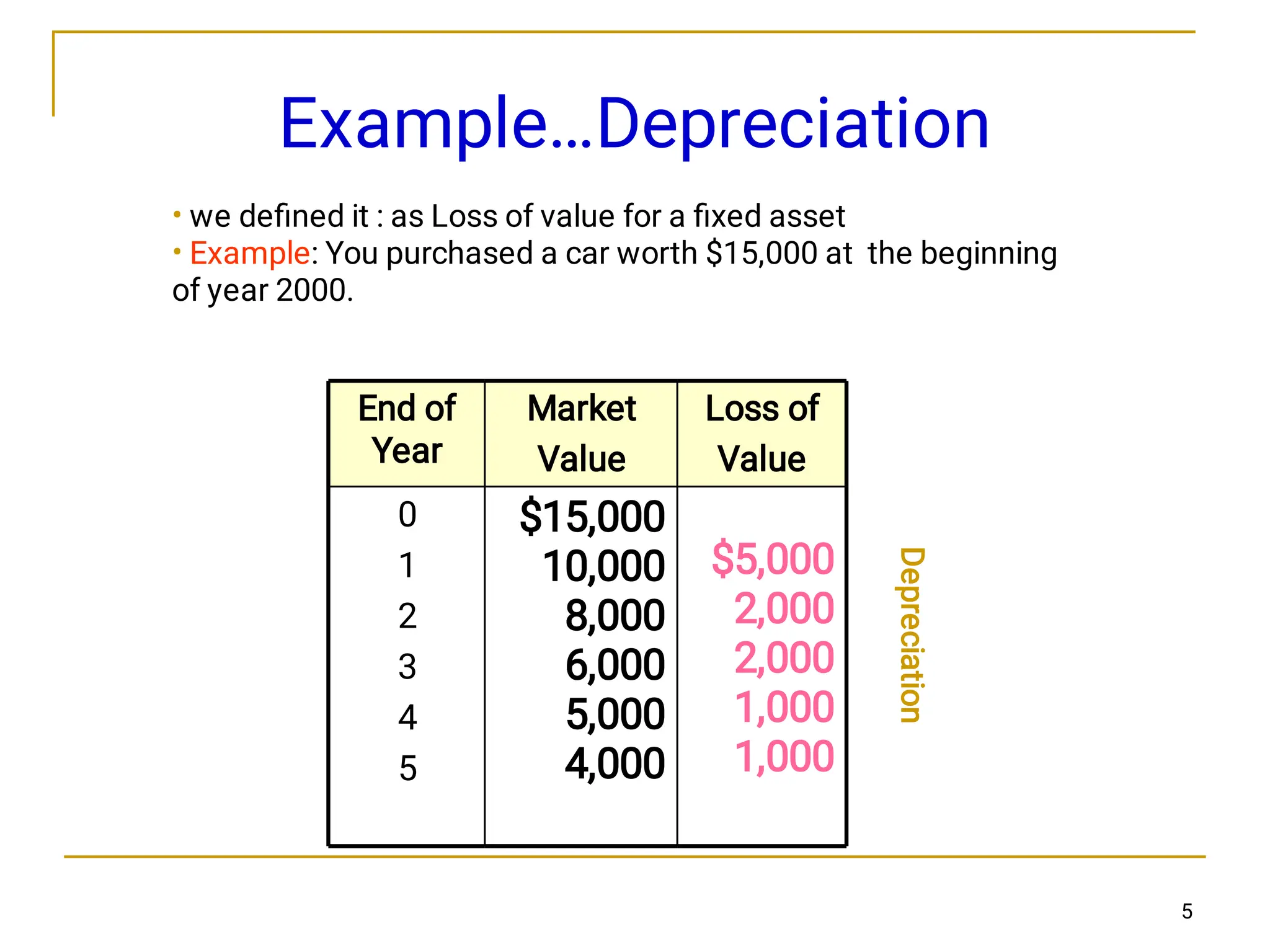
Example…Depreciation
•
•
we defined it : as Loss of value for a fixed asset
Example: You purchased a car worth $15,000 at the beginning
of year 2000.
D
e
p
r
e
c
i
a
t
i
o
n
End of
Year
Market
Value
Loss of
Value
0
1
2
3
4
5
$15,000
10,000
8,000
6,000
5,000
4,000
$5,000
2,000
2,000
1,000
1,000




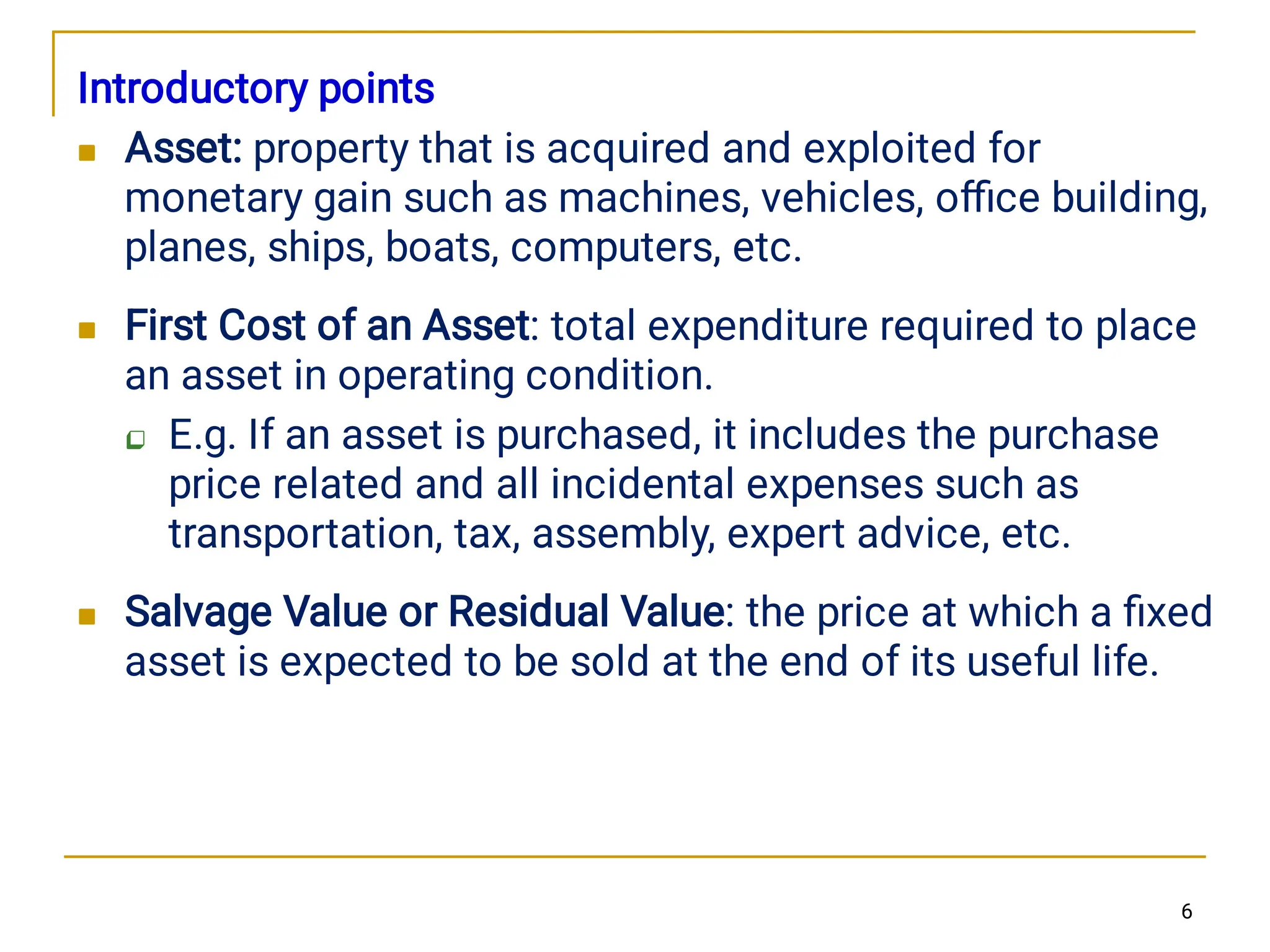
Introductory points
Asset: property that is acquired and exploited for
monetary gain such as machines, vehicles, office building,
planes, ships, boats, computers, etc.
First Cost of an Asset: total expenditure required to place
an asset in operating condition.
E.g. If an asset is purchased, it includes the purchase
price related and all incidental expenses such as
transportation, tax, assembly, expert advice, etc.
Salvage Value or Residual Value: the price at which a fixed
asset is expected to be sold at the end of its useful life.
6



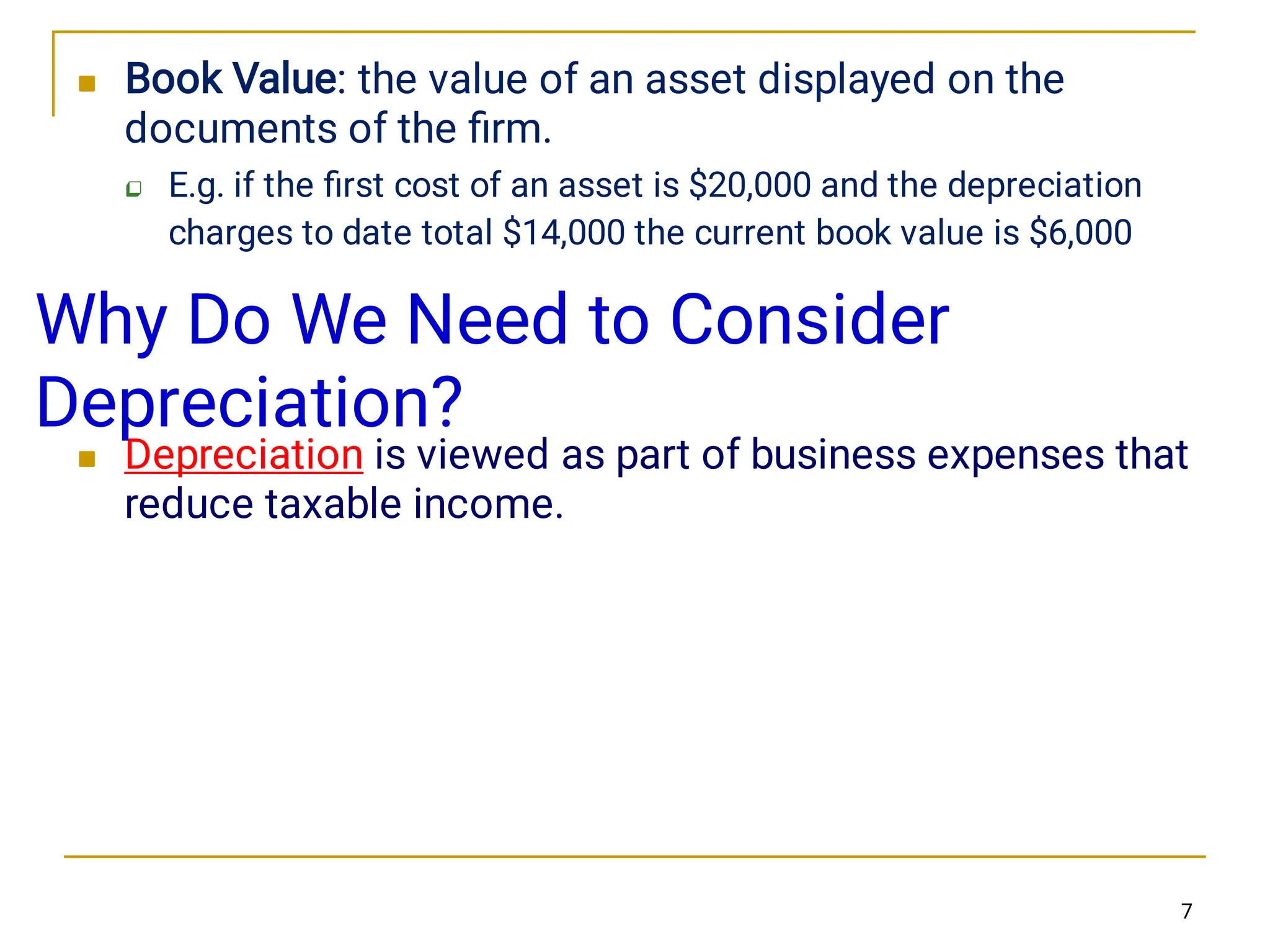
Book Value: the value of an asset displayed on the
documents of the firm.
E.g. if the first cost of an asset is $20,000 and the depreciation
charges to date total $14,000 the current book value is $6,000
Depreciation is viewed as part of business expenses that
reduce taxable income.
7
Why Do We Need to Consider
Depreciation?
8
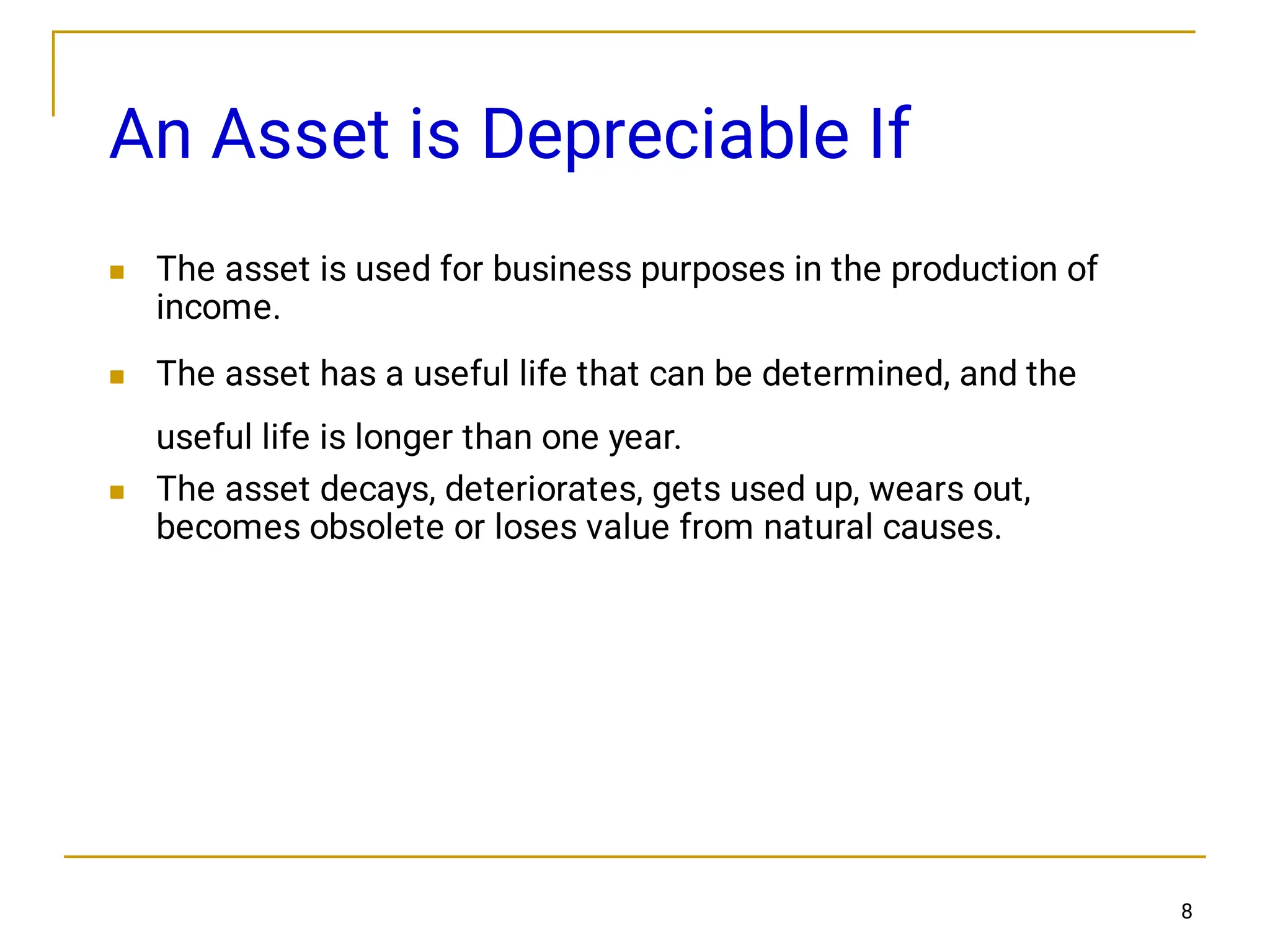
An Asset is Depreciable If



The asset is used for business purposes in the production of
income.
The asset has a useful life that can be determined, and the
useful life is longer than one year.
The asset decays, deteriorates, gets used up, wears out,
becomes obsolete or loses value from natural causes.
9
Depreciation and Expenses








Expenses - subtracted from business revenues as they occur
(time frame  one year).
Labor
Utilities
Materials
Insurance, etc.
Depreciation - subtracted from business expenses over time as
the asset is used up (applies to assets with  1 year useful life).
Machinery
Installation and Maintenance costs
10
Classification of Assets




Tangible - can be seen, touched, and felt.
Real - land, buildings, and things growing on, or attached to
the land.
Personal - equipment, furnishings, vehicles, office machinery,
or not defined as real property.
Intangible - has value but cannot be seen or touched, examples
include patents, copyrights, and trade marks.
In general buildings and equipment are
depreciable; land is not.
11
Depreciation for Tax Purposes


Depreciation is used to allocate an asset’s loss of value over time.
Depreciation is deducted or subtracted from revenue and reduces the
taxable income of a business over time which produces a cash f l
ow on an
after tax-basis.


Tax Effects of Depreciation
Since depreciation is a recognized business expense, it
reduces the taxes the firm is required to pay.
Thus, every depreciation charge creates a tax savings for
that year, and amount of the savings is the function of
the amount of the depreciation charge and the rate at
which the firm's profits are taxed.
12
13
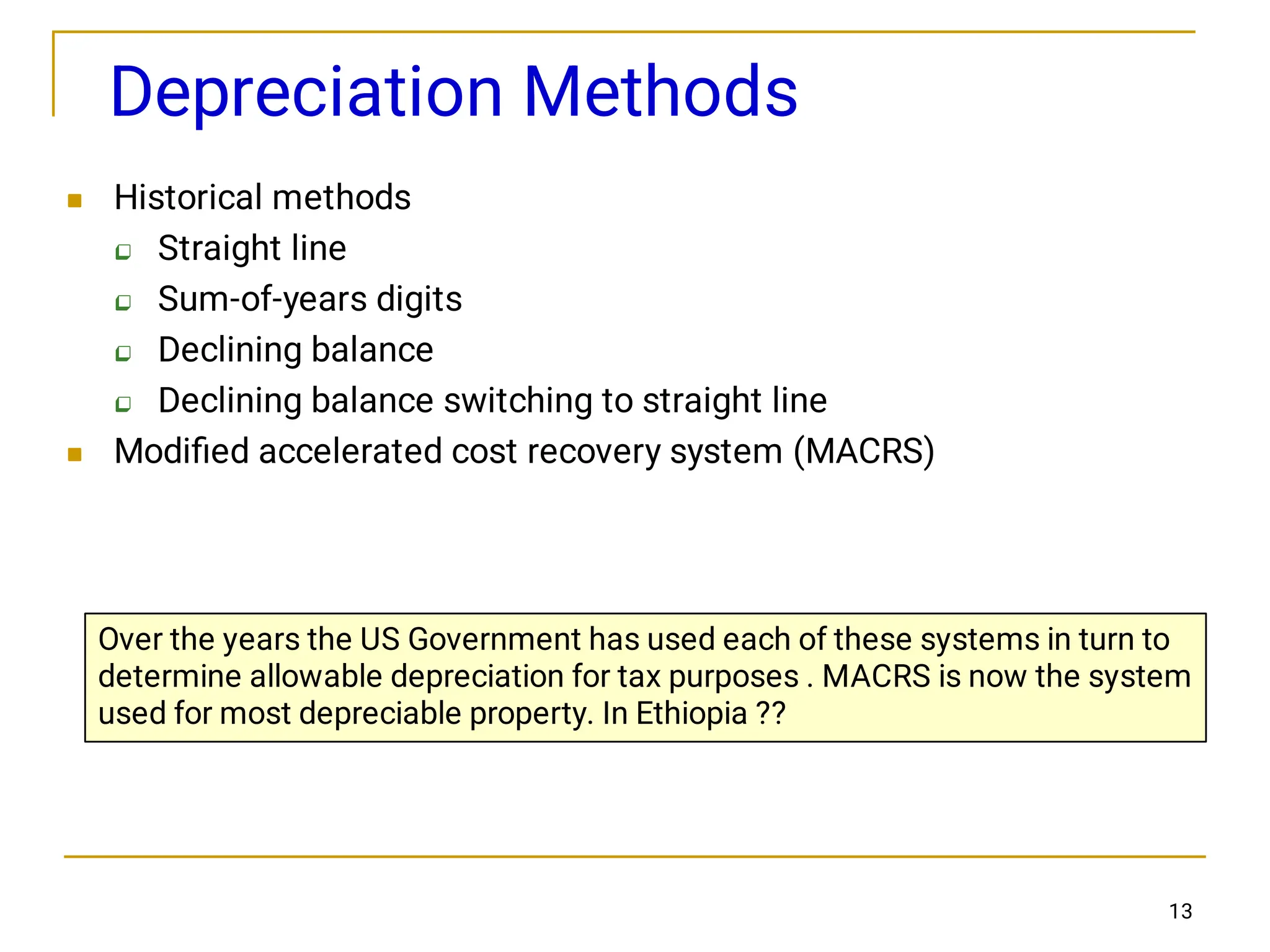
Depreciation Methods






Historical methods
Straight line
Sum-of-years digits
Declining balance
Declining balance switching to straight line
Modified accelerated cost recovery system (MACRS)
Over the years the US Government has used each of these systems in turn to
determine allowable depreciation for tax purposes . MACRS is now the system
used for most depreciable property. In Ethiopia ??





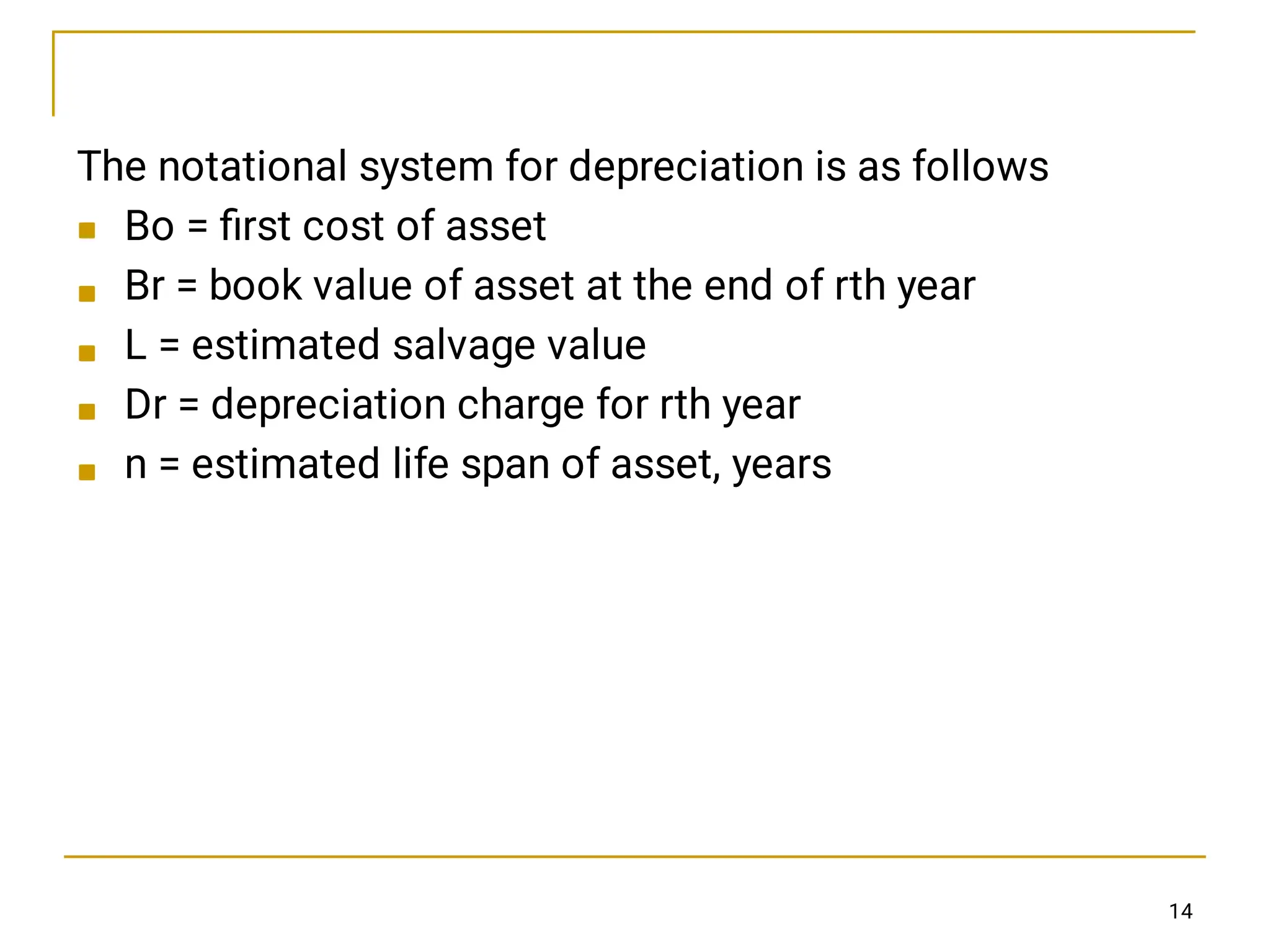
The notational system for depreciation is as follows
Bo = first cost of asset
Br = book value of asset at the end of rth year
L = estimated salvage value
Dr = depreciation charge for rth year
n = estimated life span of asset, years
14





1. Straight- Line Method
Principle: A fixed asset provides its service in a uniform
fashion over its life
=constant amount of depreciation each year over the
depreciable life of the asset.
It is the simplest method of depreciation.
It is almost rough estimate.
It has the disadvantage of yielding a slow write-off of
the asset.
15
16
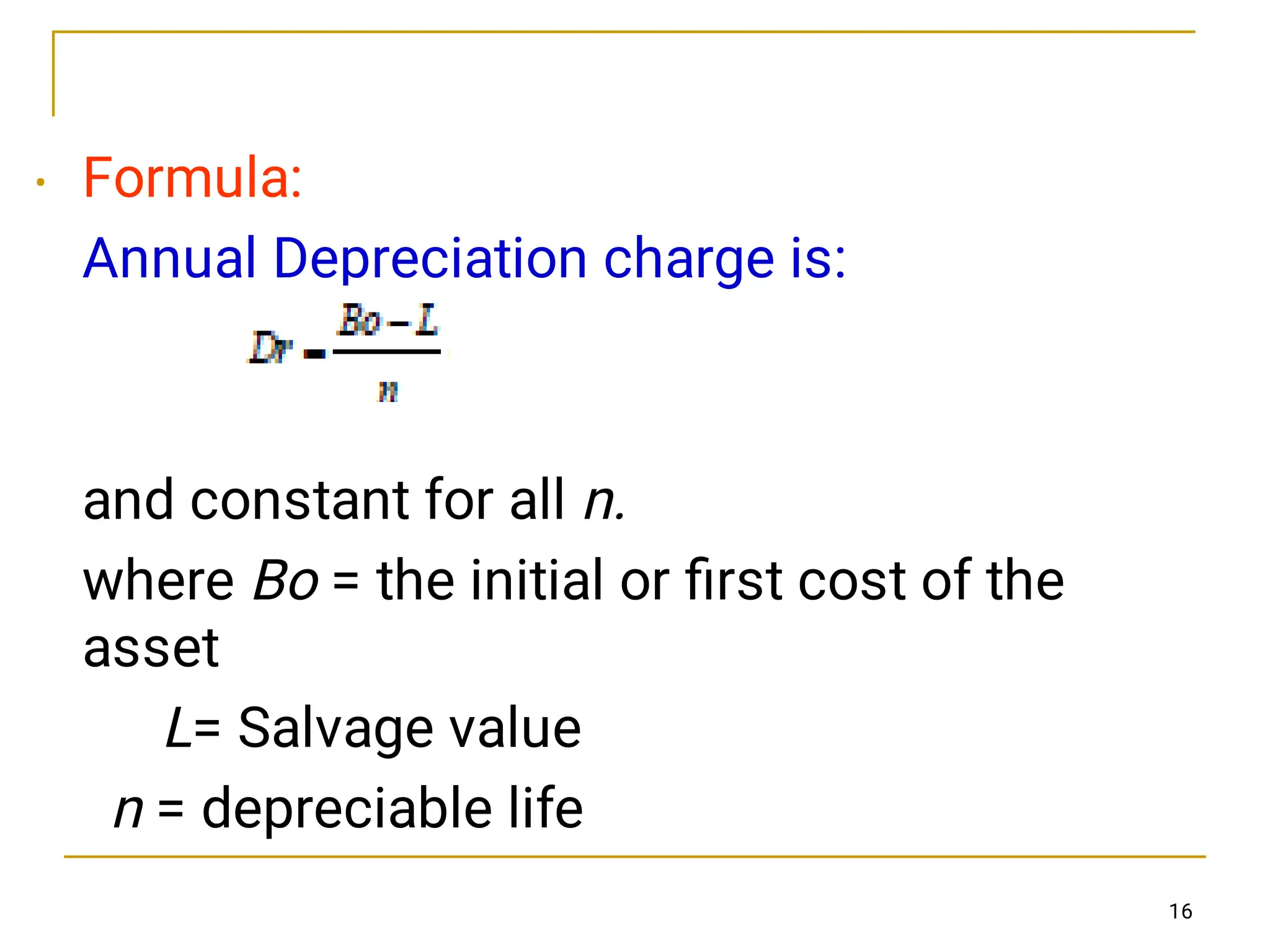
• Formula:
Annual Depreciation charge is:
and constant for all n.
where Bo = the initial or first cost of the
asset
L= Salvage value
n = depreciable life
17
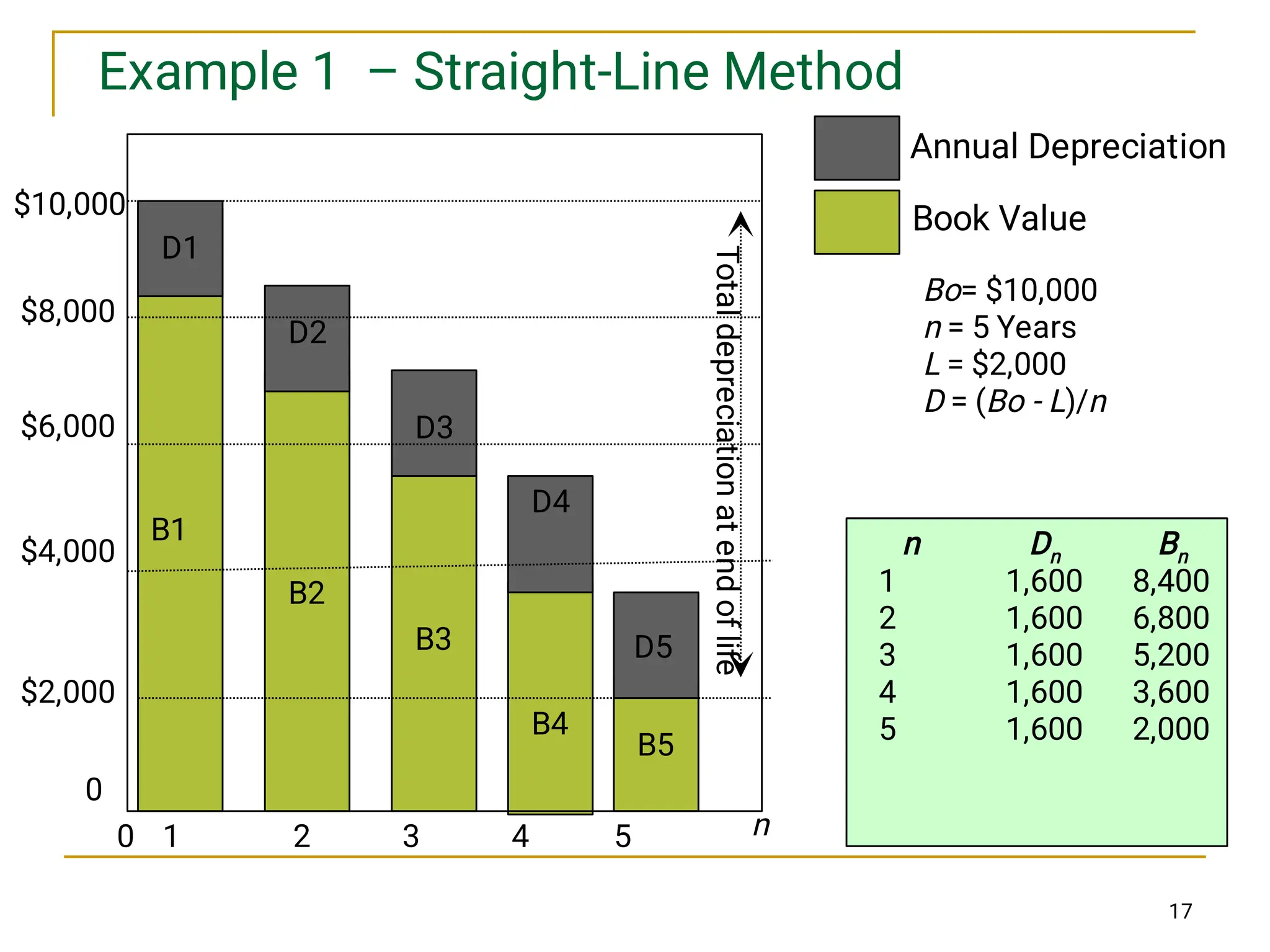
Example 1 – Straight-Line Method
n Dn Bn
1 1,600 8,400
2 1,600 6,800
3 1,600 5,200
4 1,600 3,600
5 1,600 2,000
Bo= $10,000
n = 5 Years
L = $2,000
D = (Bo - L)/n
D1
D2
D3
D4
D5
B1
B2
B3
B4
B5
$10,000
$8,000
$6,000
$4,000
$2,000
0
0 1 2 3 4 5
T
o
t
a
l
d
e
p
r
e
c
i
a
t
i
o
n
a
t
e
n
d
o
f
l
i
f
e
n
Annual Depreciation
Book Value
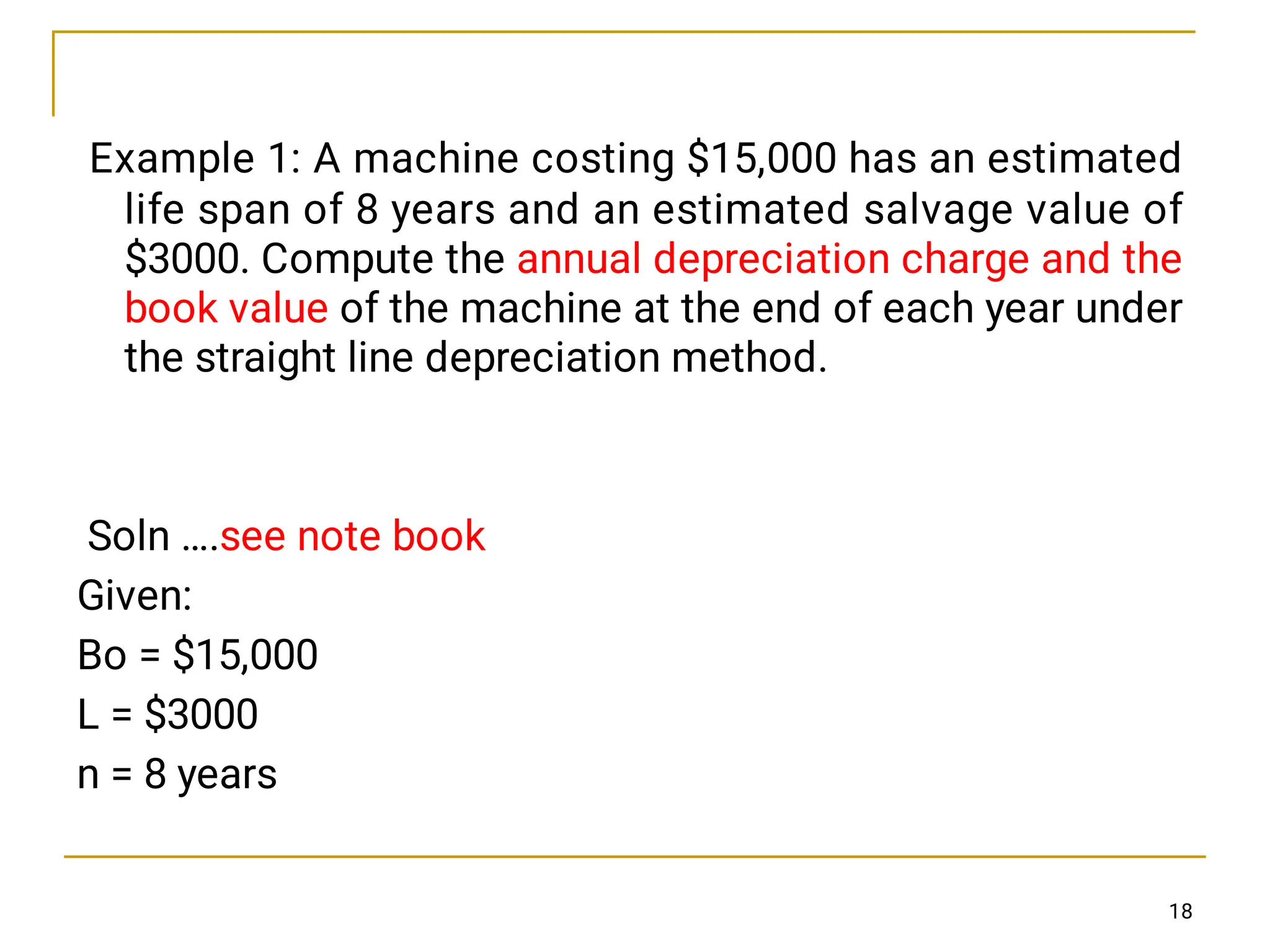
Example 1: A machine costing $15,000 has an estimated
life span of 8 years and an estimated salvage value of
$3000. Compute the annual depreciation charge and the
book value of the machine at the end of each year under
the straight line depreciation method.
Soln ….see note book
Given:
Bo = $15,000
L = $3000
n = 8 years
18









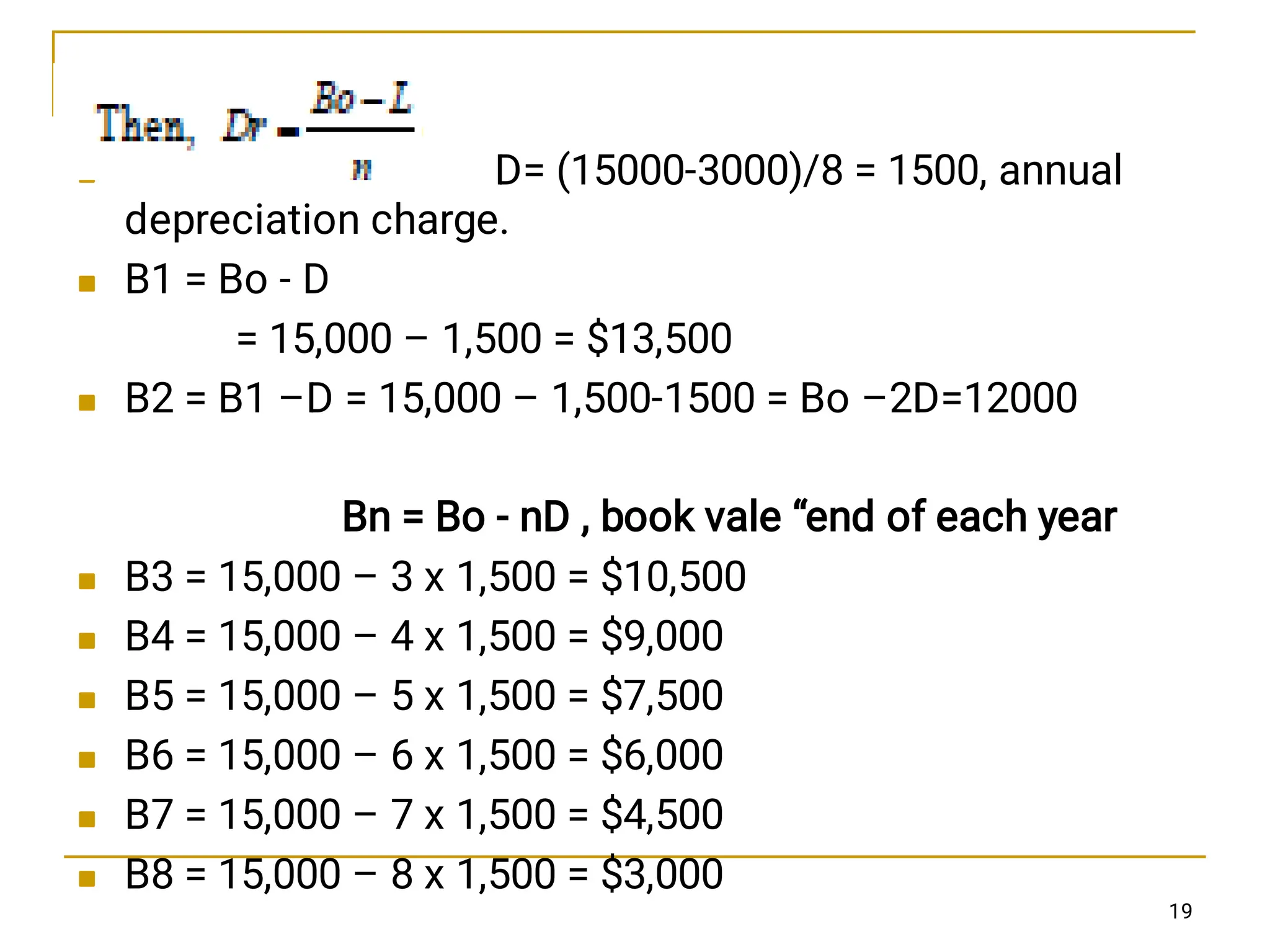
D= (15000-3000)/8 = 1500, annual
depreciation charge.
B1 = Bo - D
= 15,000 – 1,500 = $13,500
B2 = B1 –D = 15,000 – 1,500-1500 = Bo –2D=12000
Bn = Bo - nD , book vale “end of each year
B3 = 15,000 – 3 x 1,500 = $10,500
B4 = 15,000 – 4 x 1,500 = $9,000
B5 = 15,000 – 5 x 1,500 = $7,500
B6 = 15,000 – 6 x 1,500 = $6,000
B7 = 15,000 – 7 x 1,500 = $4,500
B8 = 15,000 – 8 x 1,500 = $3,000
19
20
Accelerated Depreciation




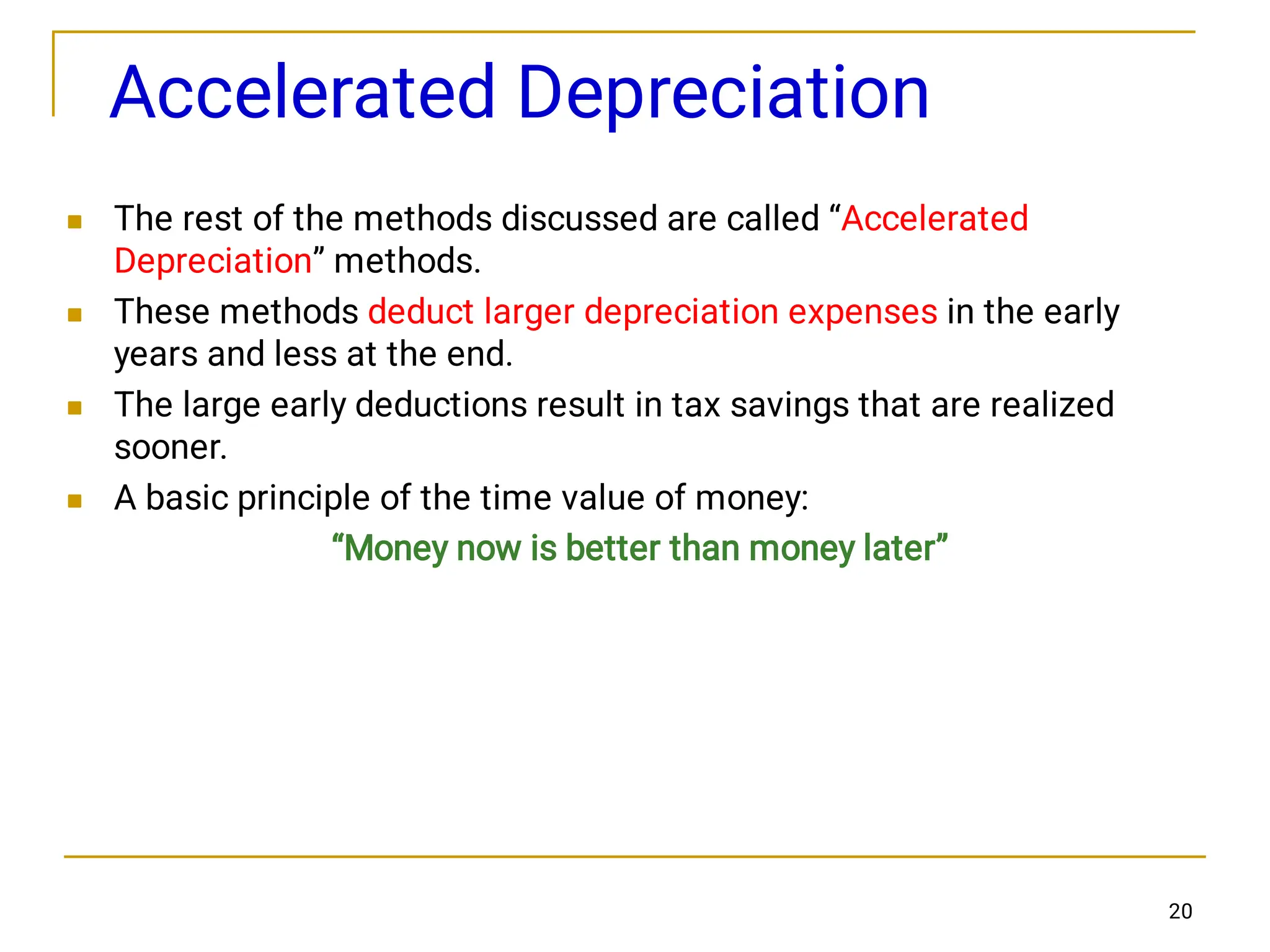
The rest of the methods discussed are called “Accelerated
Depreciation” methods.
These methods deduct larger depreciation expenses in the early
years and less at the end.
The large early deductions result in tax savings that are realized
sooner.
A basic principle of the time value of money:
“Money now is better than money later”




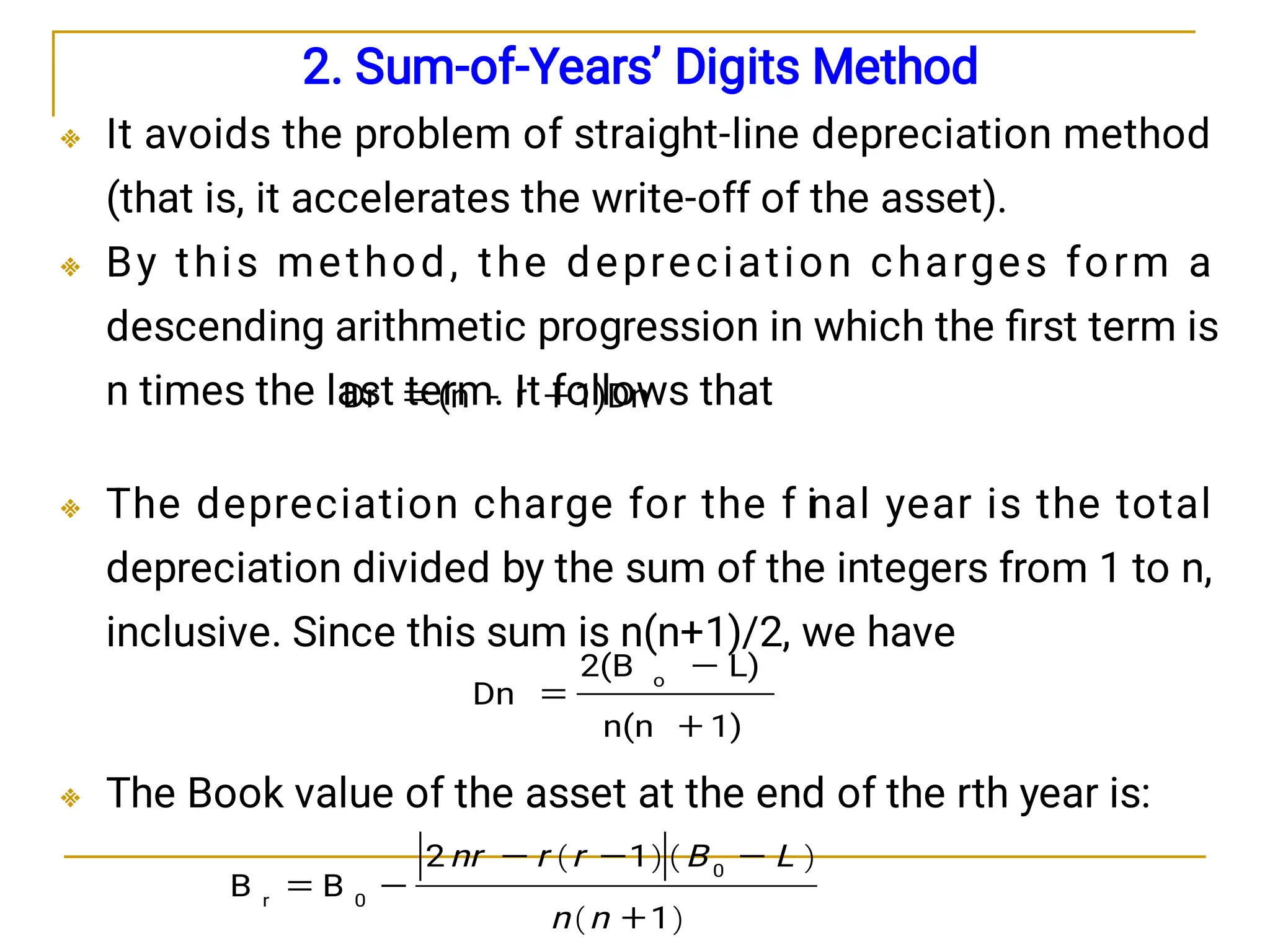
2. Sum-of-Years’ Digits Method
It avoids the problem of straight-line depreciation method
(that is, it accelerates the write-off of the asset).
By this method, the depreciation charges form a
descending arithmetic progression in which the first term is
n times the last term. It follows that
The depreciation charge for the f i
nal year is the total
depreciation divided by the sum of the integers from 1 to n,
inclusive. Since this sum is n(n+1)/2, we have
The Book value of the asset at the end of the rth year is:
1)Dn
r
-
(n
Dr 

1)
n(n
L)
2(B
Dn
o



   
 
1
1
2
B
B
0
0
r






n
n
L
B
r
r
nr
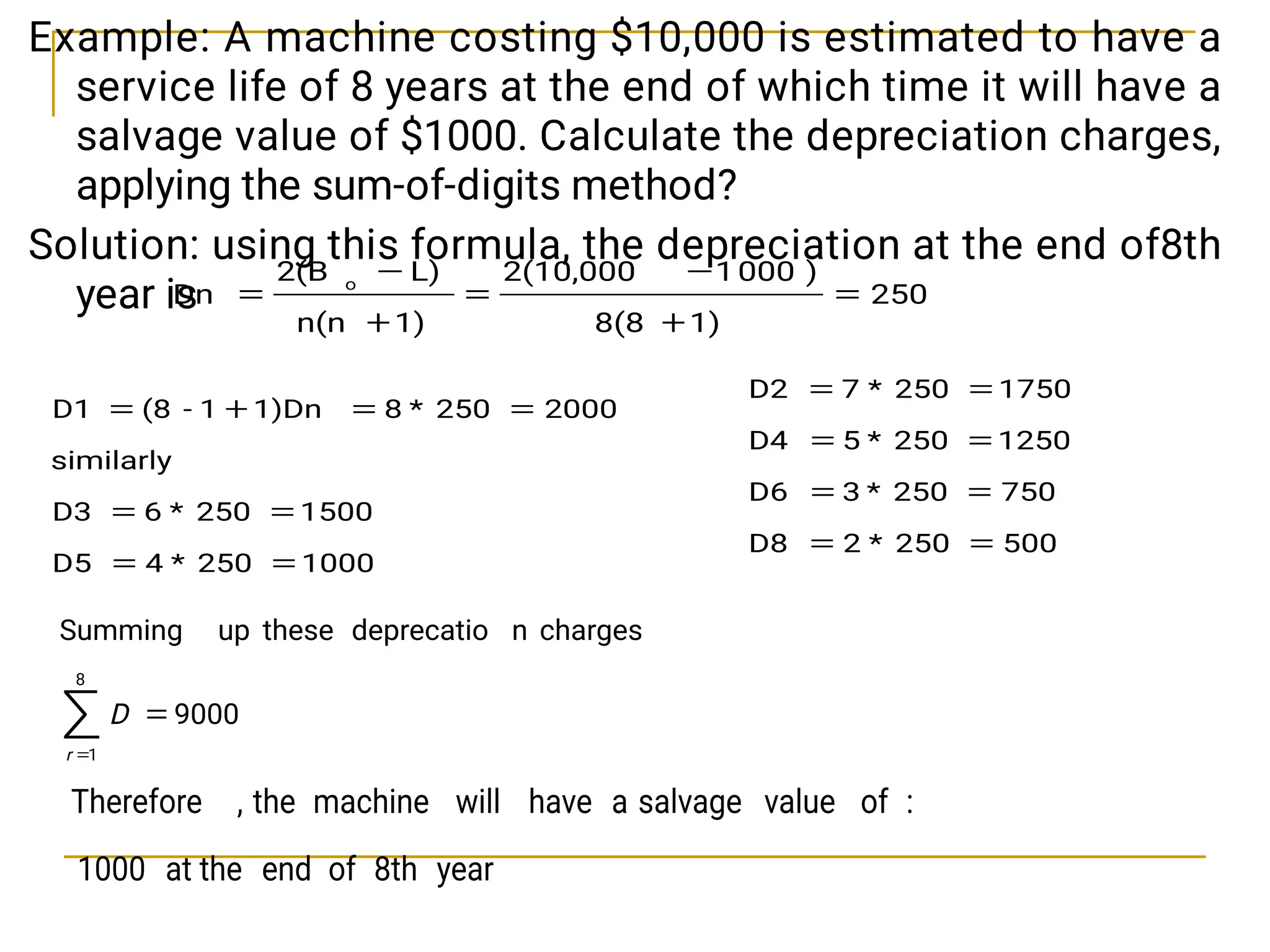
Example: A machine costing $10,000 is estimated to have a
service life of 8 years at the end of which time it will have a
salvage value of $1000. Calculate the depreciation charges,
applying the sum-of-digits method?
Solution: using this formula, the depreciation at the end of8th
year is
1000
250
*
4
D5
1500
250
*
6
D3
similarly
2000
250
*
8
1)Dn
1
-
(8
D1








250
1)
8(8
)
000
1
2(10,000
1)
n(n
L)
2(B
Dn
o







500
250
*
2
D8
750
250
*
3
D6
1250
250
*
5
D4
1750
250
*
7
D2








9000
charges
n
deprecatio
these
up
Summing
8
1



r
D
year
8th
of
end
at the
1000
:
of
value
salvage
a
have
will
machine
the
,
Therefore
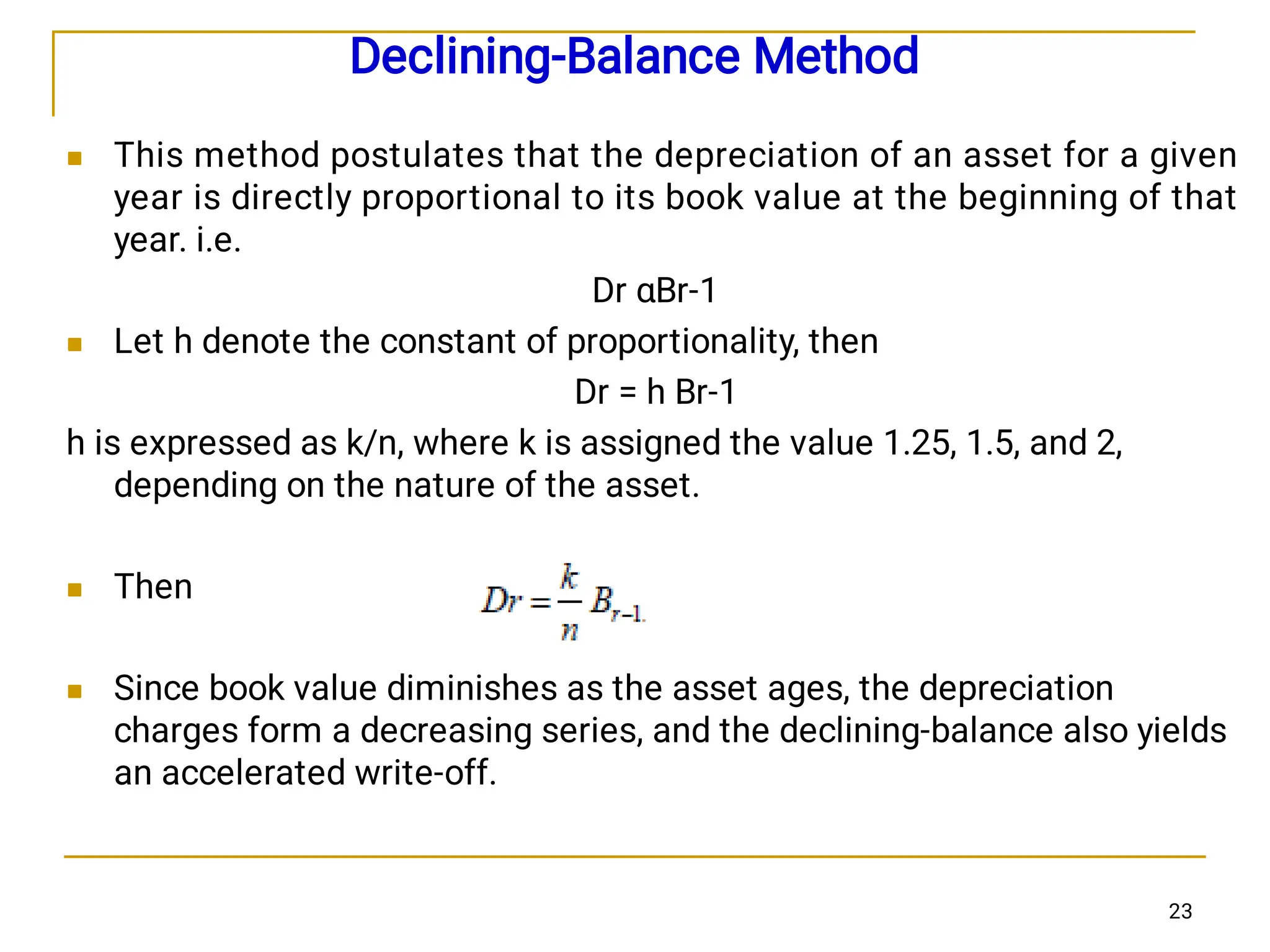
Declining-Balance Method




This method postulates that the depreciation of an asset for a given
year is directly proportional to its book value at the beginning of that
year. i.e.
Dr αBr-1
Let h denote the constant of proportionality, then
Dr = h Br-1
h is expressed as k/n, where k is assigned the value 1.25, 1.5, and 2,
depending on the nature of the asset.
Then
Since book value diminishes as the asset ages, the depreciation
charges form a decreasing series, and the declining-balance also yields
an accelerated write-off.
23




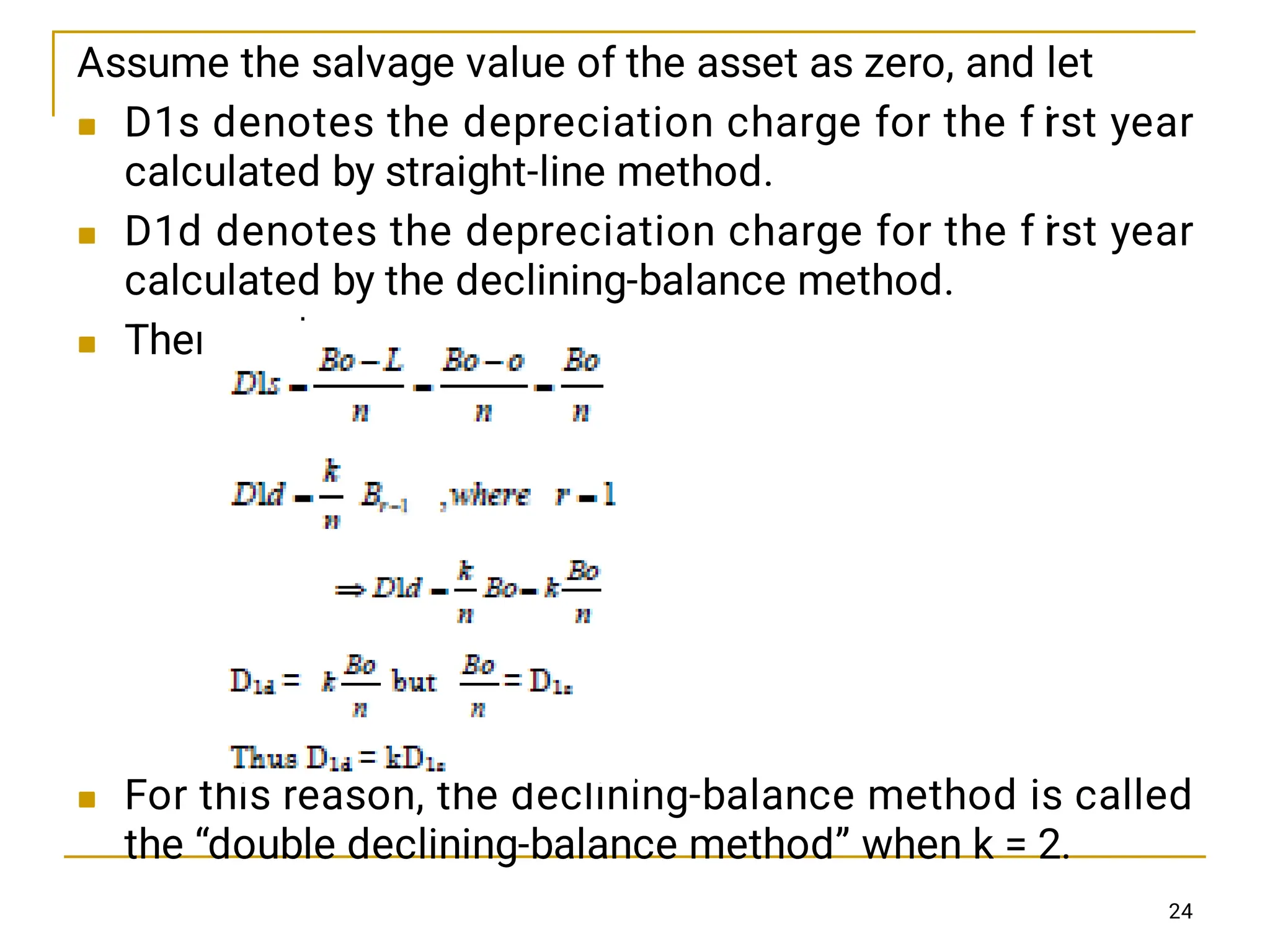
Assume the salvage value of the asset as zero, and let
D1s denotes the depreciation charge for the f i
rst year
calculated by straight-line method.
D1d denotes the depreciation charge for the f i
rst year
calculated by the declining-balance method.
Then
For this reason, the declining-balance method is called
the “double declining-balance method” when k = 2.
24


Since the value of h bears no relation to salvage value,
the f i
nal book value obtained by applying h consistently
will generally differ from the estimated salvage value.
As a result, it is necessary to abandon the declining-
balance method at some point, and the straight-line
method is applied for the reaming life.
25
 Example 3: Applying the double-declining-balance method
, calculate the depreciation charges for an asset having a
f irst cost of $20,000, a life span of 8 years and an
estimated salvage value of
a) $4000 b) $500
Soln a) given Bo =$20,000
L= $4,000
k = 2, n = 8
Required: Depreciation charges
We shall first establish the depreciation charges  final book
value that result if the declining-balance method is
applied throughout the life of the asset
h = k/n = 2/8 = 0.25
Dr = h Br-1
26
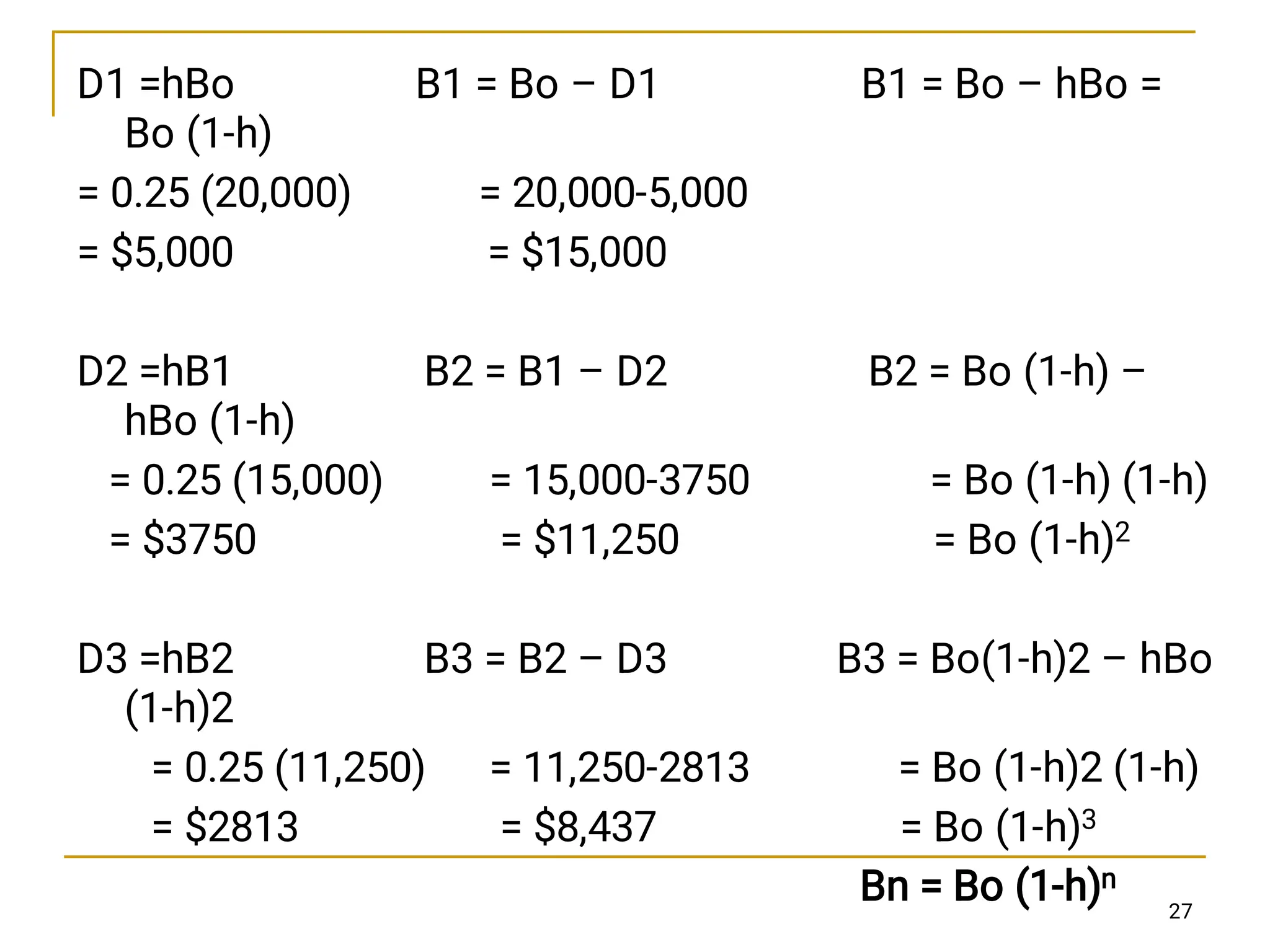
D1 =hBo B1 = Bo – D1 B1 = Bo – hBo =
Bo (1-h)
= 0.25 (20,000) = 20,000-5,000
= $5,000 = $15,000
D2 =hB1 B2 = B1 – D2 B2 = Bo (1-h) –
hBo (1-h)
= 0.25 (15,000) = 15,000-3750 = Bo (1-h) (1-h)
= $3750 = $11,250 = Bo (1-h)2
D3 =hB2 B3 = B2 – D3 B3 = Bo(1-h)2 – hBo
(1-h)2
= 0.25 (11,250) = 11,250-2813 = Bo (1-h)2 (1-h)
= $2813 = $8,437 = Bo (1-h)3
Bn = Bo (1-h)n
27
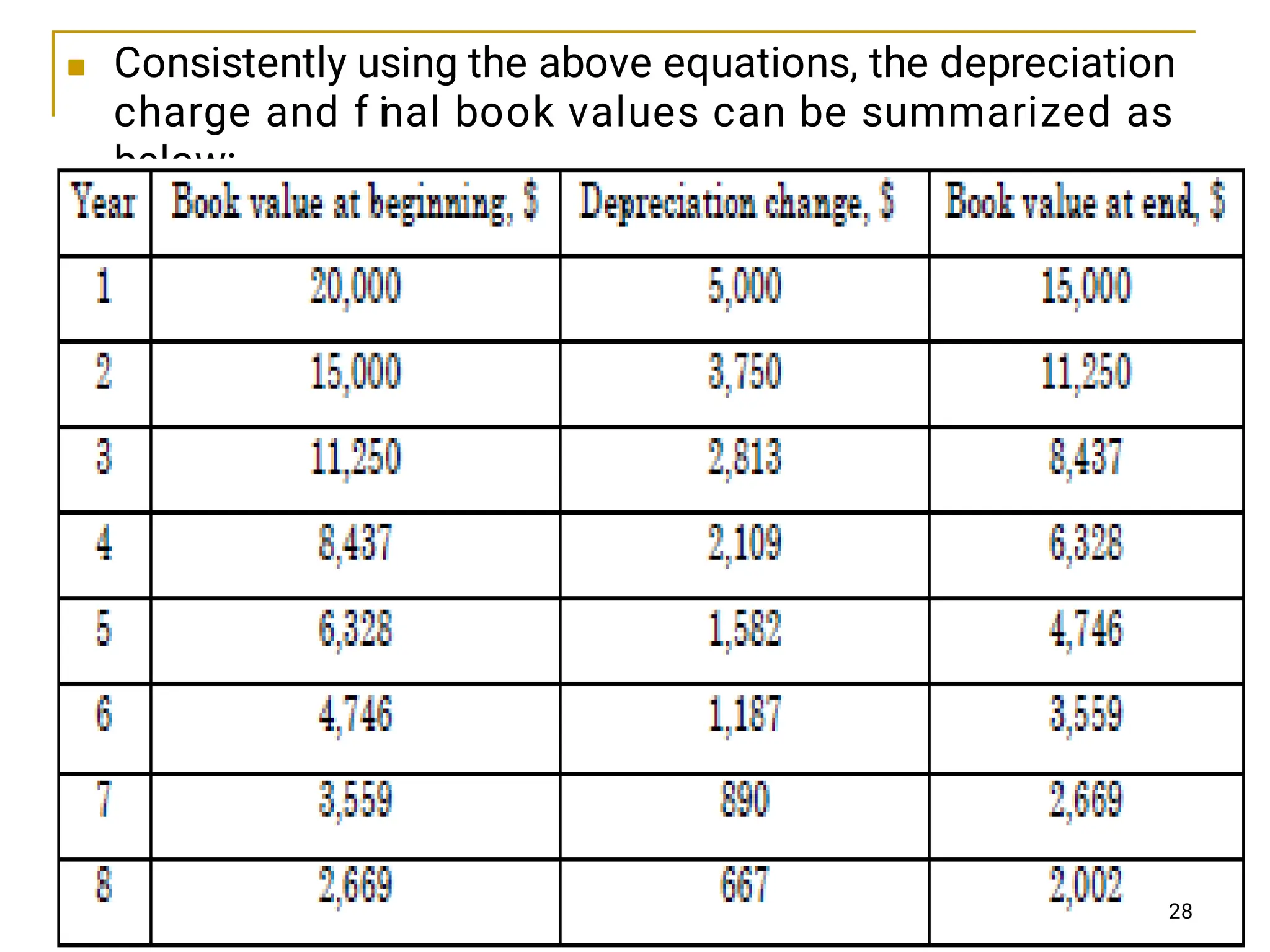
 Consistently using the above equations, the depreciation
charge and f i
nal book values can be summarized as
below:
28
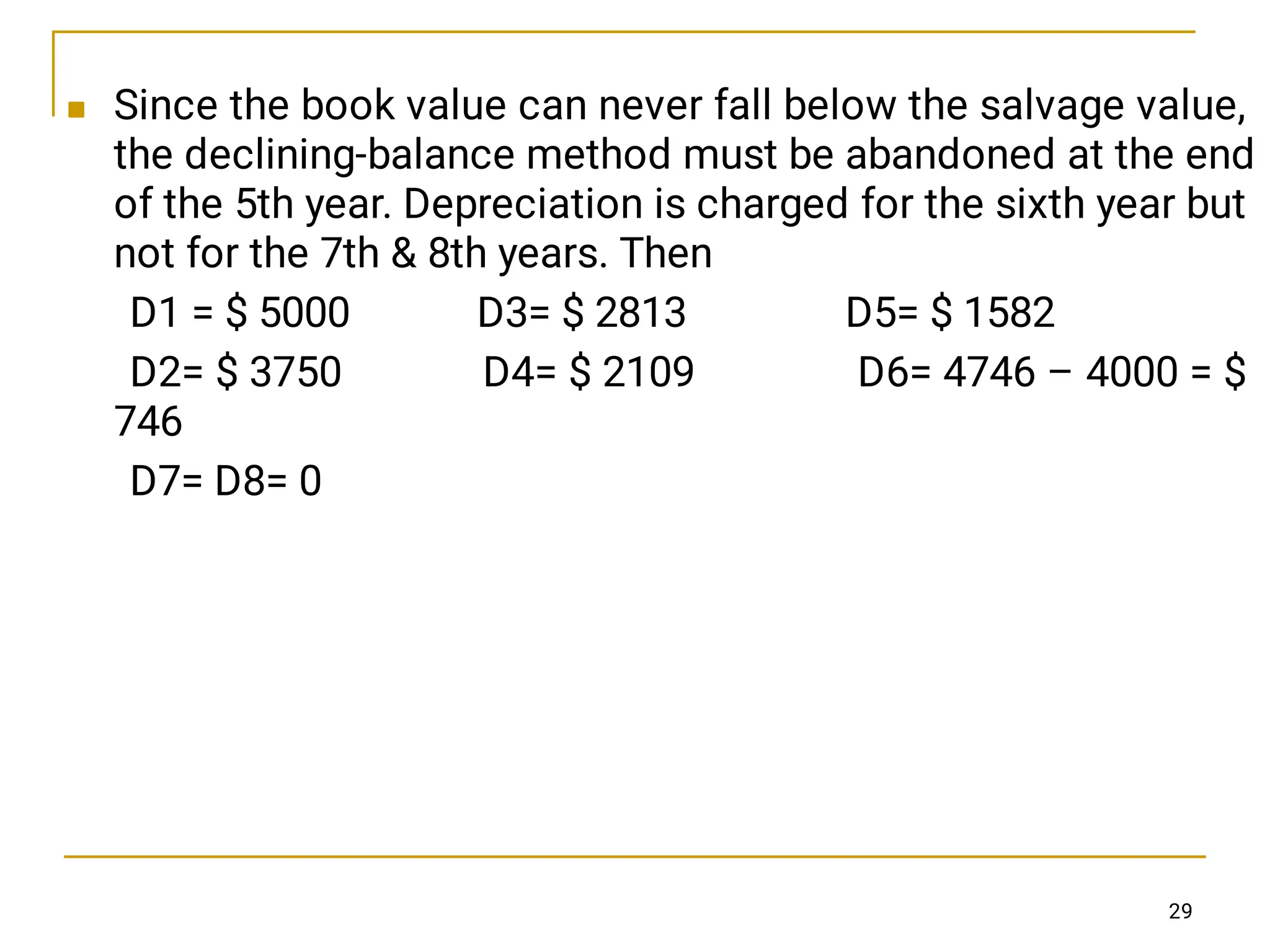
 Since the book value can never fall below the salvage value,
the declining-balance method must be abandoned at the end
of the 5th year. Depreciation is charged for the sixth year but
not for the 7th  8th years. Then
D1 = $ 5000 D3= $ 2813 D5= $ 1582
D2= $ 3750 D4= $ 2109 D6= 4746 – 4000 = $
746
D7= D8= 0
29
Units-of Production Method
•
•
•
•
If deterioration of an asset is primarily of exploitation rather
than obsolescence, we have to use production volume as the
base of depreciation charge.
Moreover, if the asset is a machine that is used to produce a
standard commodity, the magnitude of its use can be
measured by the number of units it produces.
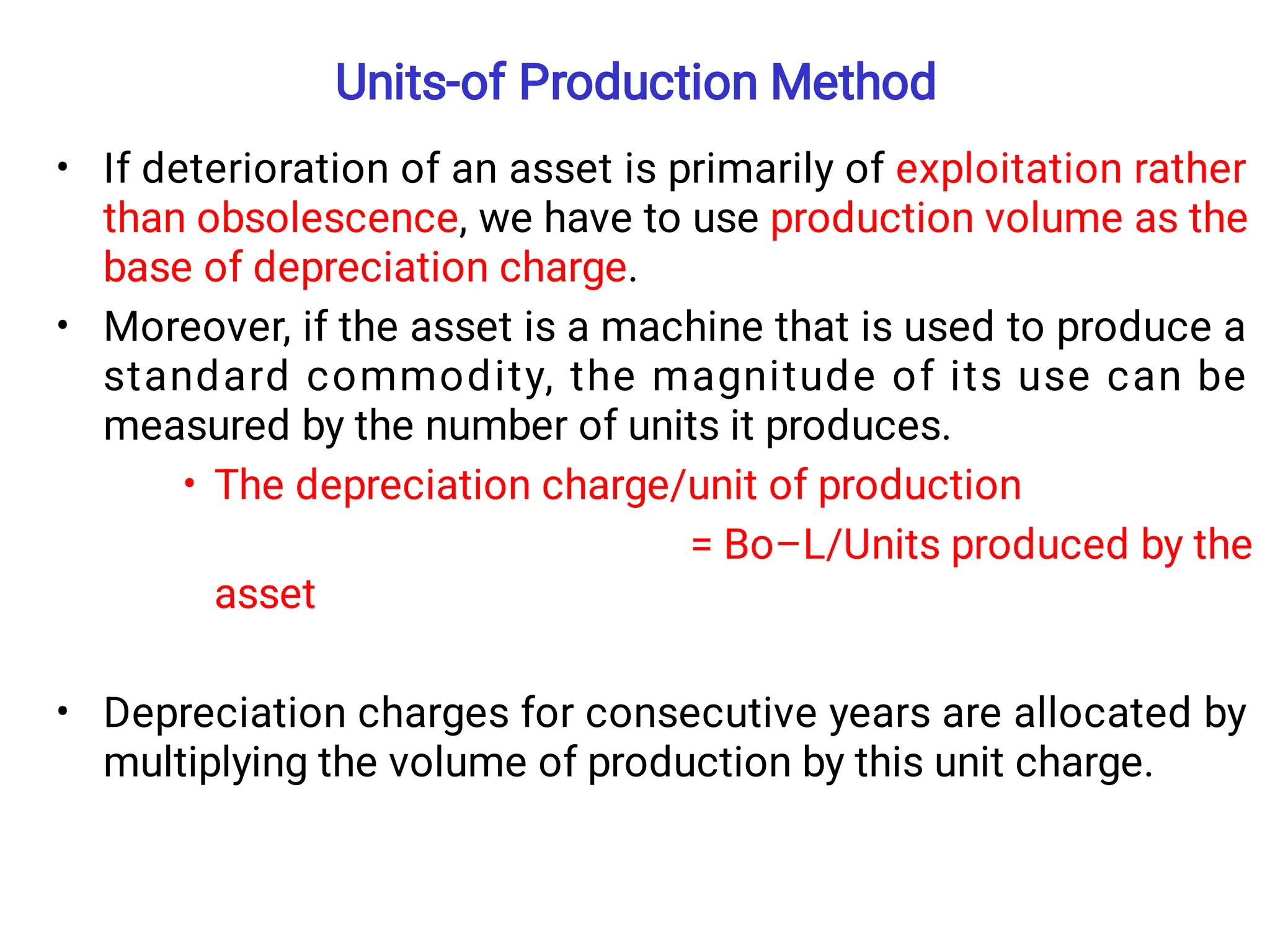
The depreciation charge/unit of production
= Bo–L/Units produced by the
asset
Depreciation charges for consecutive years are allocated by
multiplying the volume of production by this unit charge.


N.B Depreciation can be allocated on the basis of
profitability rather than production alone.
Assume that the net prof i
t per unit of production
declines as the asset ages. Each unit can be
assigned a weight proportional to its net prof i
t,
and the depreciation charges are then calculated
on the basis of these weighted units, which are
termed depreciation units.
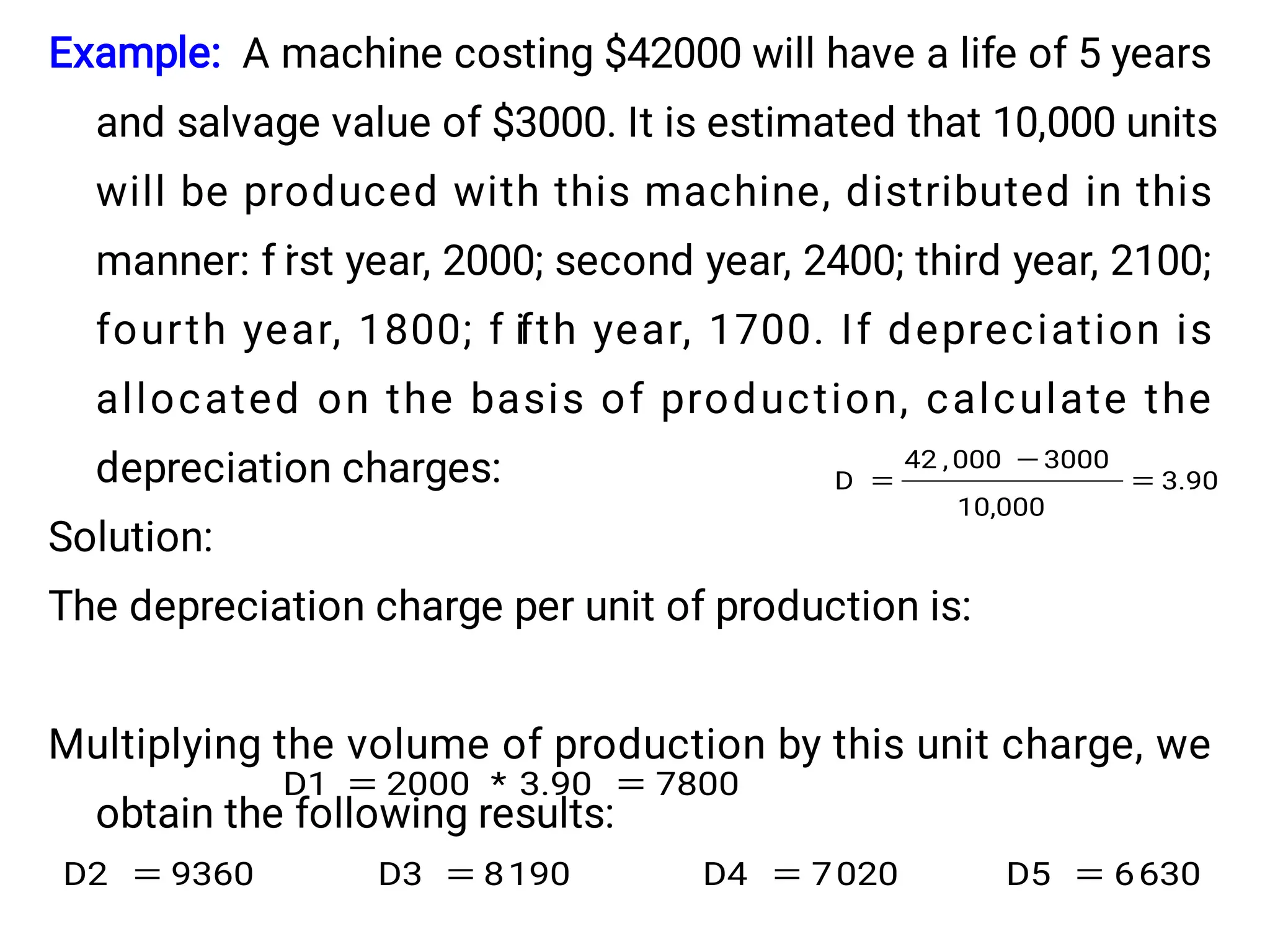
Example: A machine costing $42000 will have a life of 5 years
and salvage value of $3000. It is estimated that 10,000 units
will be produced with this machine, distributed in this
manner: f i
rst year, 2000; second year, 2400; third year, 2100;
fourth year, 1800; f ifth year, 1700. If depreciation is
allocated on the basis of production, calculate the
depreciation charges:
Solution:
The depreciation charge per unit of production is:
Multiplying the volume of production by this unit charge, we
obtain the following results:
3.90
10,000
3000
000
,
42
D 


7800
3.90
*
2000
D1 

630
6
D5
020
7
D4
190
8
D3
9360
D2 




Depreciation for database Chapter 5 (1).pdf

  • 1.
  • 2.
    Depreciation and IncomeTaxes The objective of this Chapter is to explain how depreciation affects income taxes, and how income taxes affect economic decision making 2
  • 3.
    LEARNING OUTCOMES      Understand basicterms of asset depreciation Apply straight line method of depreciation Apply DB and DDB methods of depreciation; switch between DDB and SL methods Apply sum of digits methods of depreciation. Units of production Method 3
  • 4.
    Depreciation is thedecrease in value of physical properties with the passage of time.   Depreciation: the decline in the value of the asset. As time elapses, every asset undergoes a progressive loss of value resulting from: 1) Physical factors: wear and tear, 2) Functional factors: technological change 4
  • 5.
    5 Example…Depreciation • • we defined it: as Loss of value for a fixed asset Example: You purchased a car worth $15,000 at the beginning of year 2000. D e p r e c i a t i o n End of Year Market Value Loss of Value 0 1 2 3 4 5 $15,000 10,000 8,000 6,000 5,000 4,000 $5,000 2,000 2,000 1,000 1,000
  • 6.
        Introductory points Asset: propertythat is acquired and exploited for monetary gain such as machines, vehicles, office building, planes, ships, boats, computers, etc. First Cost of an Asset: total expenditure required to place an asset in operating condition. E.g. If an asset is purchased, it includes the purchase price related and all incidental expenses such as transportation, tax, assembly, expert advice, etc. Salvage Value or Residual Value: the price at which a fixed asset is expected to be sold at the end of its useful life. 6
  • 7.
       Book Value: thevalue of an asset displayed on the documents of the firm. E.g. if the first cost of an asset is $20,000 and the depreciation charges to date total $14,000 the current book value is $6,000 Depreciation is viewed as part of business expenses that reduce taxable income. 7 Why Do We Need to Consider Depreciation?
  • 8.
    8 An Asset isDepreciable If    The asset is used for business purposes in the production of income. The asset has a useful life that can be determined, and the useful life is longer than one year. The asset decays, deteriorates, gets used up, wears out, becomes obsolete or loses value from natural causes.
  • 9.
    9 Depreciation and Expenses         Expenses- subtracted from business revenues as they occur (time frame one year). Labor Utilities Materials Insurance, etc. Depreciation - subtracted from business expenses over time as the asset is used up (applies to assets with 1 year useful life). Machinery Installation and Maintenance costs
  • 10.
    10 Classification of Assets     Tangible- can be seen, touched, and felt. Real - land, buildings, and things growing on, or attached to the land. Personal - equipment, furnishings, vehicles, office machinery, or not defined as real property. Intangible - has value but cannot be seen or touched, examples include patents, copyrights, and trade marks. In general buildings and equipment are depreciable; land is not.
  • 11.
    11 Depreciation for TaxPurposes   Depreciation is used to allocate an asset’s loss of value over time. Depreciation is deducted or subtracted from revenue and reduces the taxable income of a business over time which produces a cash f l ow on an after tax-basis.
  • 12.
      Tax Effects ofDepreciation Since depreciation is a recognized business expense, it reduces the taxes the firm is required to pay. Thus, every depreciation charge creates a tax savings for that year, and amount of the savings is the function of the amount of the depreciation charge and the rate at which the firm's profits are taxed. 12
  • 13.
    13 Depreciation Methods       Historical methods Straightline Sum-of-years digits Declining balance Declining balance switching to straight line Modified accelerated cost recovery system (MACRS) Over the years the US Government has used each of these systems in turn to determine allowable depreciation for tax purposes . MACRS is now the system used for most depreciable property. In Ethiopia ??
  • 14.
         The notational systemfor depreciation is as follows Bo = first cost of asset Br = book value of asset at the end of rth year L = estimated salvage value Dr = depreciation charge for rth year n = estimated life span of asset, years 14
  • 15.
         1. Straight- LineMethod Principle: A fixed asset provides its service in a uniform fashion over its life =constant amount of depreciation each year over the depreciable life of the asset. It is the simplest method of depreciation. It is almost rough estimate. It has the disadvantage of yielding a slow write-off of the asset. 15
  • 16.
    16 • Formula: Annual Depreciationcharge is: and constant for all n. where Bo = the initial or first cost of the asset L= Salvage value n = depreciable life
  • 17.
    17 Example 1 –Straight-Line Method n Dn Bn 1 1,600 8,400 2 1,600 6,800 3 1,600 5,200 4 1,600 3,600 5 1,600 2,000 Bo= $10,000 n = 5 Years L = $2,000 D = (Bo - L)/n D1 D2 D3 D4 D5 B1 B2 B3 B4 B5 $10,000 $8,000 $6,000 $4,000 $2,000 0 0 1 2 3 4 5 T o t a l d e p r e c i a t i o n a t e n d o f l i f e n Annual Depreciation Book Value
  • 18.
    Example 1: Amachine costing $15,000 has an estimated life span of 8 years and an estimated salvage value of $3000. Compute the annual depreciation charge and the book value of the machine at the end of each year under the straight line depreciation method. Soln ….see note book Given: Bo = $15,000 L = $3000 n = 8 years 18
  • 19.
             D= (15000-3000)/8 =1500, annual depreciation charge. B1 = Bo - D = 15,000 – 1,500 = $13,500 B2 = B1 –D = 15,000 – 1,500-1500 = Bo –2D=12000 Bn = Bo - nD , book vale “end of each year B3 = 15,000 – 3 x 1,500 = $10,500 B4 = 15,000 – 4 x 1,500 = $9,000 B5 = 15,000 – 5 x 1,500 = $7,500 B6 = 15,000 – 6 x 1,500 = $6,000 B7 = 15,000 – 7 x 1,500 = $4,500 B8 = 15,000 – 8 x 1,500 = $3,000 19
  • 20.
    20 Accelerated Depreciation     The restof the methods discussed are called “Accelerated Depreciation” methods. These methods deduct larger depreciation expenses in the early years and less at the end. The large early deductions result in tax savings that are realized sooner. A basic principle of the time value of money: “Money now is better than money later”
  • 21.
        2. Sum-of-Years’ DigitsMethod It avoids the problem of straight-line depreciation method (that is, it accelerates the write-off of the asset). By this method, the depreciation charges form a descending arithmetic progression in which the first term is n times the last term. It follows that The depreciation charge for the f i nal year is the total depreciation divided by the sum of the integers from 1 to n, inclusive. Since this sum is n(n+1)/2, we have The Book value of the asset at the end of the rth year is: 1)Dn r - (n Dr   1) n(n L) 2(B Dn o          1 1 2 B B 0 0 r       n n L B r r nr
  • 22.
    Example: A machinecosting $10,000 is estimated to have a service life of 8 years at the end of which time it will have a salvage value of $1000. Calculate the depreciation charges, applying the sum-of-digits method? Solution: using this formula, the depreciation at the end of8th year is 1000 250 * 4 D5 1500 250 * 6 D3 similarly 2000 250 * 8 1)Dn 1 - (8 D1         250 1) 8(8 ) 000 1 2(10,000 1) n(n L) 2(B Dn o        500 250 * 2 D8 750 250 * 3 D6 1250 250 * 5 D4 1750 250 * 7 D2         9000 charges n deprecatio these up Summing 8 1    r D year 8th of end at the 1000 : of value salvage a have will machine the , Therefore
  • 23.
    Declining-Balance Method     This methodpostulates that the depreciation of an asset for a given year is directly proportional to its book value at the beginning of that year. i.e. Dr αBr-1 Let h denote the constant of proportionality, then Dr = h Br-1 h is expressed as k/n, where k is assigned the value 1.25, 1.5, and 2, depending on the nature of the asset. Then Since book value diminishes as the asset ages, the depreciation charges form a decreasing series, and the declining-balance also yields an accelerated write-off. 23
  • 24.
        Assume the salvagevalue of the asset as zero, and let D1s denotes the depreciation charge for the f i rst year calculated by straight-line method. D1d denotes the depreciation charge for the f i rst year calculated by the declining-balance method. Then For this reason, the declining-balance method is called the “double declining-balance method” when k = 2. 24
  • 25.
      Since the valueof h bears no relation to salvage value, the f i nal book value obtained by applying h consistently will generally differ from the estimated salvage value. As a result, it is necessary to abandon the declining- balance method at some point, and the straight-line method is applied for the reaming life. 25
  • 26.
     Example 3:Applying the double-declining-balance method , calculate the depreciation charges for an asset having a f irst cost of $20,000, a life span of 8 years and an estimated salvage value of a) $4000 b) $500 Soln a) given Bo =$20,000 L= $4,000 k = 2, n = 8 Required: Depreciation charges We shall first establish the depreciation charges final book value that result if the declining-balance method is applied throughout the life of the asset h = k/n = 2/8 = 0.25 Dr = h Br-1 26
  • 27.
    D1 =hBo B1= Bo – D1 B1 = Bo – hBo = Bo (1-h) = 0.25 (20,000) = 20,000-5,000 = $5,000 = $15,000 D2 =hB1 B2 = B1 – D2 B2 = Bo (1-h) – hBo (1-h) = 0.25 (15,000) = 15,000-3750 = Bo (1-h) (1-h) = $3750 = $11,250 = Bo (1-h)2 D3 =hB2 B3 = B2 – D3 B3 = Bo(1-h)2 – hBo (1-h)2 = 0.25 (11,250) = 11,250-2813 = Bo (1-h)2 (1-h) = $2813 = $8,437 = Bo (1-h)3 Bn = Bo (1-h)n 27
  • 28.
     Consistently usingthe above equations, the depreciation charge and f i nal book values can be summarized as below: 28
  • 29.
     Since thebook value can never fall below the salvage value, the declining-balance method must be abandoned at the end of the 5th year. Depreciation is charged for the sixth year but not for the 7th 8th years. Then D1 = $ 5000 D3= $ 2813 D5= $ 1582 D2= $ 3750 D4= $ 2109 D6= 4746 – 4000 = $ 746 D7= D8= 0 29
  • 30.
    Units-of Production Method • • • • Ifdeterioration of an asset is primarily of exploitation rather than obsolescence, we have to use production volume as the base of depreciation charge. Moreover, if the asset is a machine that is used to produce a standard commodity, the magnitude of its use can be measured by the number of units it produces. The depreciation charge/unit of production = Bo–L/Units produced by the asset Depreciation charges for consecutive years are allocated by multiplying the volume of production by this unit charge.
  • 31.
      N.B Depreciation canbe allocated on the basis of profitability rather than production alone. Assume that the net prof i t per unit of production declines as the asset ages. Each unit can be assigned a weight proportional to its net prof i t, and the depreciation charges are then calculated on the basis of these weighted units, which are termed depreciation units.
  • 32.
    Example: A machinecosting $42000 will have a life of 5 years and salvage value of $3000. It is estimated that 10,000 units will be produced with this machine, distributed in this manner: f i rst year, 2000; second year, 2400; third year, 2100; fourth year, 1800; f ifth year, 1700. If depreciation is allocated on the basis of production, calculate the depreciation charges: Solution: The depreciation charge per unit of production is: Multiplying the volume of production by this unit charge, we obtain the following results: 3.90 10,000 3000 000 , 42 D    7800 3.90 * 2000 D1   630 6 D5 020 7 D4 190 8 D3 9360 D2    