SUBMITTED TO :-
Dr. Sunil Kumar Verma
SUBMITTED BY :-
Gurkirat Singh
 Modern Accounting System is based on double entry
system which is based on the fundamental
accounting equation.
 Assets = Liabilities + Equity.
 The double-entry accounting system ensures
that the accounting equation always remains in
balance.
 Debits must be equal Credits.
 The system is called Double Entry because every business
transaction has dual aspect and affects at least two accounts.
Every transaction must contain at least one account debited
and at least one account credited thus posted in at least two
different ledger accounts.
 For every financial transaction recorded in the accounts of a
business, there is a debit entry and a credit entry.
Furthermore, the total of the entries on the debit side must
always equal the total of the entries on the credit side
 All business transactions consist of an exchange of one thing
for another, double entry accounting system uses debits and
credits, to show this two-fold effect.
 The original entry into the books of the business that
records the debit and credit aspects of the source
documents that evidence a financial event is called
transaction . Purchasing goods, paying bills, receiving
cash, selling goods, recording depreciation, making
payments, adjusting prepayments etc are the examples
of business events which are need to be recorded in term
of transaction. Every transaction must include at least
one account debited and at least one account credited.
Debits and Credits are system of notation used in
bookkeeping to determine how to record any financial
transaction.
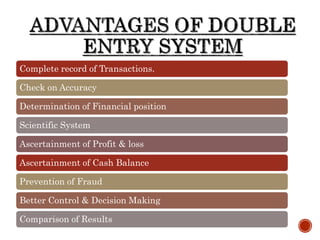
Complete record of Transactions.
Check on Accuracy
Determination of Financial position
Scientific System
Ascertainment of Profit & loss
Ascertainment of Cash Balance
Prevention of Fraud
Better Control & Decision Making
Comparison of Results
Requires thorough
knowledge
Increases the
volume of
accounting work
Only records
financial
information
Records
historical costs
only i.e. does not
consider time
value of money
• An Accounting Equation is a mathematical expression which shows that the
assets and liabilities of a firm are equal.
• An Accounting Equation is based on the dual aspect concept of accounting
meaning, every transaction has two aspects-debit and credit.
• That further means in every business transaction for every debit there is a
credit of equal amount and Vice Versa.
• It means total claims (those of outsiders and of the proprietors) will always
be equal to the total assets of the firm.
• The claims, also known as equities, are of two types:
1. Owner's equity or capital and
2. Liabilities or amounts due to outsiders (i.e., Outsiders Equity).
ASSETS are the
RESOURCES OWNED BY A BUSINESS.
Here are some types of assets that might be
owned by a business company:
Land
Equipment
Buildings
Cash
Vehicles
Store
Supplies
Notes
Receivable
Accounts
Receivable
ASSET
S
9
LIABILITIES are the
CREDITOR’S CLAIMS ON ASSETS.
• Creditors are the people or companies to whom a business
owes something (like money).
• Here are some types of liabilities that a company might owe:
Taxes
Payable
Wages
Payable
Notes
Payable
Accounts
Payable
LIABILITI
ES
10
EQUITY is the OWNER’S CLAIM ON ASSETS
In a business EQUITY is composed of four parts
that either increase or decrease equity:
CAPITAL:
What the
owner puts
into the
business
−
WITHDRAWALS:
What the owner
takes out of the
business
+
REVENUE
S:
What the
company
receives for
sales
−
EXPENSES
:
What the
company
pays to
operate the
business.
INCREASE DECREASE INCREASE DECREASE
EQUITY
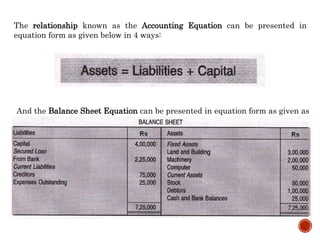
The relationship known as the Accounting Equation can be presented in
equation form as given below in 4 ways:
And the Balance Sheet Equation can be presented in equation form as given as
below:
An Accounting Equation always holds true with every change that
occurs due to transaction entered into. It is because of this reason that
it is based on the dual aspect concept of accounting.
A transaction may affect either both sides of the equation by the same
amount or one side of the equation only, by both increasing or
decreasing it by equal amounts.
Transactions from the Accounting Equation viewpoint, can be divided
into two, i.e.,
1. Transactions Affecting Two Items and
2. Transactions Affecting More Than Two Items.
As the title suggests, these are those transactions that affect two items of the
accounting equation or Balance Sheet.
(a) Transactions affecting opposite sides are:
• Increase in Asset, Increase in Liability.' Transaction such as credit purchases
increase asset (stock) and also increase liability (creditor). Similarly, loans
from bank increase asset (cash) and also increase liability (Loan).
• Decrease in Liability, Decrease in Asset: Transaction of payment to a creditor
decreases Liability (creditor) and also reduces asset (cash or bank).
• Increase in Asset, Increase in Owner's Equity: Introduction of capital by the
proprietor increases asset (cash or bank) and also liability (capital).
• Decrease in owner's Capital, Decrease in Asset: Drawings by the proprietor
decreases liability (capital) and also asset (cash or bank).
(b) Transactions affecting same side but in
opposite direction are:
• Increase in one Asset, Decrease in Another Asset: Transactions such
as cash purchases or receipt from debtors increase one asset (goods
and cash or bank, respectively) and decrease another asset (cash or
bank and debtors).
• Decrease in one Liability, Increase in Another Liability: Settlement
of creditor by issue of Bill of Exchange decreases a liability (creditor)
and increases another liability (BiII of Exchange).
Some transactions affect more than two items of the accounting
equation or a Balance Sheet.
For example, when a sale is made in cash for Rs. 30,000, it is made at cost (Rs.
25,000) plus profit (Rs. 5,000).
• Cost of goods (Rs. 25,000) reduces asset (stock of goods);
• Cash increases by Rs. 30,000; and
• Owner's capital increases by the profit (Rs. 5,000).
It should be noted that profit increases the owner's capital and loss decreases
it.
The procedure to workout an Accounting Equation is:
Analyze the transaction in terms of such variables as assets, liabilities, capital,
revenues and expenses.
Decide the effect of the transactions in terms of increase or decrease on
variables assets, liabilities, capital, revenues and expenses.
Record the effect on the relevant side of the equation.
Transaction 1:
Mr. Riaz commences his business with cash Rs.50,000.
This is an example of investment of asset in the business by the owner. The
effect of this transaction on the accounting equation is that cash asset is
increased by Rs.50,000 and the proprietorship (Riaz’s capital) is also increased
by the same amount such as:
Assets = Liabilities + O.E/ Capital
Cash Riaz, Capital
+ 50,000 = — + 50,000
Note that assets and equities increased by equal
amounts
Transaction 2:
Purchased furniture on cash Rs.10,000.
This transaction effected accounting equation as the increase in one new asset
furniture and decreases in assets cash with the same amount. Thus
Assets = Liabilities + O.E / Capital
Cash Furniture Riaz, Capital
+ 50,000 = — + 50,000
- 10,000 + 10,000
40,000 + 10,000 = 50,000
Note that this transaction has affected assets side only and no change is
made in equities side of the equation.
Transaction 3:
Purchased merchandise for cash Rs.10,000.
This transaction will introduce a new element (merchandise) on the assets
side and decrease the cash by Rs.10,000.
Assets = Liabilities + O.E / Capital
Cash Furniture Merchandise Riaz, Capital
+ 40,000 + 10,000 = — + 50,000
-10,000 – + 10,000
30,000 10,000 + 10,000 = 50,000
Note that this transaction has affected assets side only and no change is
made in equities side of the equation.
Transaction 4:
Purchased merchandise on account (on credit) Rs.5,000.
Assets = Liabilities + O.E / Capital
Cash Furniture Merchandise Creditors Riaz, Capital
+ 30,000 + 10,000 + 10,000 = + 50,000
+ 5,000 + 5,000
30,000 +10,000 + 15,000 = + 5,000 + 50,000
Note that this transaction has affected assets side and liabilities. Both the
sides of equation has increased with the same amount.
Transaction 5:
Sold merchandise for cash Rs.2,000 cost of these merchandise were Rs.1,500
Assets = Liabilities + O.E / Capital
Cash Furniture Merchandise Creditors Riaz, Capital
+ 30,000 + 10,000 + 15,000 = + 5,000 + 50,000
+ 2,000 - 1,500 + 500 (Profit)
+ 32,000 +10,000 + 13,500 = + 5,000 + 50,500
Note that this transaction has affected assets side and also the proprietorship.
Difference between sales price and cost price is treated as profit and has been
added to capital.
Assets = Liabilities + O.E / Capital
Cash Furniture Merchandise Debtors Creditors Riaz, Capital
+ 32,000 + 10,000 + 13,500 = + 5,000 + 50,500
- 3,000 + 4,000 + 1,000
32,000 +10,000 + 10,500 + 4000 = + 5,000 + 51,500
Transaction 6:
Sold merchandise on credit for Rs.4,000 costing Rs.3,000.
Note that this transaction has affected assets side and also the
proprietorship. Anew element “debtors” has been introduced. Difference
between sales price and cost price is treated as profit and has been added to
capital.
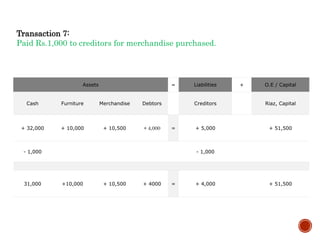
Transaction 7:
Paid Rs.1,000 to creditors for merchandise purchased.
Assets = Liabilities + O.E / Capital
Cash Furniture Merchandise Debtors Creditors Riaz, Capital
+ 32,000 + 10,000 + 10,500 + 4,000 = + 5,000 + 51,500
- 1,000 - 1,000
31,000 +10,000 + 10,500 + 4000 = + 4,000 + 51,500
Transaction 8:
Received cash from a debtor Rs 1,000 whom a sale on credit was made
earlier.
This is an example of collection from debtors. This transaction is an exchange
of one asset for another. the effect is on one side of the equation, i.e., asset
side. Thus:
Assets Liabilities + O.E / Capital
Cash Furniture Merchandise Debtors Creditors Riaz, Capital
+ 31,000 + 10,000 + 10,500 + 4,000 + 4,000 + 51,500
+ 1,000 - 1,000
32,000 +10,000 + 10,500 + 3000 = + 4,000 + 51,500

Double Entry System & Accountin Equation

  • 1.
    SUBMITTED TO :- Dr.Sunil Kumar Verma SUBMITTED BY :- Gurkirat Singh
  • 2.
     Modern AccountingSystem is based on double entry system which is based on the fundamental accounting equation.  Assets = Liabilities + Equity.  The double-entry accounting system ensures that the accounting equation always remains in balance.  Debits must be equal Credits.
  • 3.
     The systemis called Double Entry because every business transaction has dual aspect and affects at least two accounts. Every transaction must contain at least one account debited and at least one account credited thus posted in at least two different ledger accounts.  For every financial transaction recorded in the accounts of a business, there is a debit entry and a credit entry. Furthermore, the total of the entries on the debit side must always equal the total of the entries on the credit side  All business transactions consist of an exchange of one thing for another, double entry accounting system uses debits and credits, to show this two-fold effect.
  • 4.
     The originalentry into the books of the business that records the debit and credit aspects of the source documents that evidence a financial event is called transaction . Purchasing goods, paying bills, receiving cash, selling goods, recording depreciation, making payments, adjusting prepayments etc are the examples of business events which are need to be recorded in term of transaction. Every transaction must include at least one account debited and at least one account credited. Debits and Credits are system of notation used in bookkeeping to determine how to record any financial transaction.
  • 5.
    Complete record ofTransactions. Check on Accuracy Determination of Financial position Scientific System Ascertainment of Profit & loss Ascertainment of Cash Balance Prevention of Fraud Better Control & Decision Making Comparison of Results
  • 6.
    Requires thorough knowledge Increases the volumeof accounting work Only records financial information Records historical costs only i.e. does not consider time value of money
  • 7.
    • An AccountingEquation is a mathematical expression which shows that the assets and liabilities of a firm are equal. • An Accounting Equation is based on the dual aspect concept of accounting meaning, every transaction has two aspects-debit and credit. • That further means in every business transaction for every debit there is a credit of equal amount and Vice Versa. • It means total claims (those of outsiders and of the proprietors) will always be equal to the total assets of the firm. • The claims, also known as equities, are of two types: 1. Owner's equity or capital and 2. Liabilities or amounts due to outsiders (i.e., Outsiders Equity).
  • 8.
    ASSETS are the RESOURCESOWNED BY A BUSINESS. Here are some types of assets that might be owned by a business company: Land Equipment Buildings Cash Vehicles Store Supplies Notes Receivable Accounts Receivable ASSET S
  • 9.
    9 LIABILITIES are the CREDITOR’SCLAIMS ON ASSETS. • Creditors are the people or companies to whom a business owes something (like money). • Here are some types of liabilities that a company might owe: Taxes Payable Wages Payable Notes Payable Accounts Payable LIABILITI ES
  • 10.
    10 EQUITY is theOWNER’S CLAIM ON ASSETS In a business EQUITY is composed of four parts that either increase or decrease equity: CAPITAL: What the owner puts into the business − WITHDRAWALS: What the owner takes out of the business + REVENUE S: What the company receives for sales − EXPENSES : What the company pays to operate the business. INCREASE DECREASE INCREASE DECREASE EQUITY
  • 11.
    The relationship knownas the Accounting Equation can be presented in equation form as given below in 4 ways: And the Balance Sheet Equation can be presented in equation form as given as below:
  • 12.
    An Accounting Equationalways holds true with every change that occurs due to transaction entered into. It is because of this reason that it is based on the dual aspect concept of accounting. A transaction may affect either both sides of the equation by the same amount or one side of the equation only, by both increasing or decreasing it by equal amounts. Transactions from the Accounting Equation viewpoint, can be divided into two, i.e., 1. Transactions Affecting Two Items and 2. Transactions Affecting More Than Two Items.
  • 13.
    As the titlesuggests, these are those transactions that affect two items of the accounting equation or Balance Sheet. (a) Transactions affecting opposite sides are: • Increase in Asset, Increase in Liability.' Transaction such as credit purchases increase asset (stock) and also increase liability (creditor). Similarly, loans from bank increase asset (cash) and also increase liability (Loan). • Decrease in Liability, Decrease in Asset: Transaction of payment to a creditor decreases Liability (creditor) and also reduces asset (cash or bank). • Increase in Asset, Increase in Owner's Equity: Introduction of capital by the proprietor increases asset (cash or bank) and also liability (capital). • Decrease in owner's Capital, Decrease in Asset: Drawings by the proprietor decreases liability (capital) and also asset (cash or bank).
  • 14.
    (b) Transactions affectingsame side but in opposite direction are: • Increase in one Asset, Decrease in Another Asset: Transactions such as cash purchases or receipt from debtors increase one asset (goods and cash or bank, respectively) and decrease another asset (cash or bank and debtors). • Decrease in one Liability, Increase in Another Liability: Settlement of creditor by issue of Bill of Exchange decreases a liability (creditor) and increases another liability (BiII of Exchange).
  • 15.
    Some transactions affectmore than two items of the accounting equation or a Balance Sheet. For example, when a sale is made in cash for Rs. 30,000, it is made at cost (Rs. 25,000) plus profit (Rs. 5,000). • Cost of goods (Rs. 25,000) reduces asset (stock of goods); • Cash increases by Rs. 30,000; and • Owner's capital increases by the profit (Rs. 5,000). It should be noted that profit increases the owner's capital and loss decreases it.
  • 16.
    The procedure toworkout an Accounting Equation is: Analyze the transaction in terms of such variables as assets, liabilities, capital, revenues and expenses. Decide the effect of the transactions in terms of increase or decrease on variables assets, liabilities, capital, revenues and expenses. Record the effect on the relevant side of the equation.
  • 18.
    Transaction 1: Mr. Riazcommences his business with cash Rs.50,000. This is an example of investment of asset in the business by the owner. The effect of this transaction on the accounting equation is that cash asset is increased by Rs.50,000 and the proprietorship (Riaz’s capital) is also increased by the same amount such as: Assets = Liabilities + O.E/ Capital Cash Riaz, Capital + 50,000 = — + 50,000 Note that assets and equities increased by equal amounts
  • 19.
    Transaction 2: Purchased furnitureon cash Rs.10,000. This transaction effected accounting equation as the increase in one new asset furniture and decreases in assets cash with the same amount. Thus Assets = Liabilities + O.E / Capital Cash Furniture Riaz, Capital + 50,000 = — + 50,000 - 10,000 + 10,000 40,000 + 10,000 = 50,000 Note that this transaction has affected assets side only and no change is made in equities side of the equation.
  • 20.
    Transaction 3: Purchased merchandisefor cash Rs.10,000. This transaction will introduce a new element (merchandise) on the assets side and decrease the cash by Rs.10,000. Assets = Liabilities + O.E / Capital Cash Furniture Merchandise Riaz, Capital + 40,000 + 10,000 = — + 50,000 -10,000 – + 10,000 30,000 10,000 + 10,000 = 50,000 Note that this transaction has affected assets side only and no change is made in equities side of the equation.
  • 21.
    Transaction 4: Purchased merchandiseon account (on credit) Rs.5,000. Assets = Liabilities + O.E / Capital Cash Furniture Merchandise Creditors Riaz, Capital + 30,000 + 10,000 + 10,000 = + 50,000 + 5,000 + 5,000 30,000 +10,000 + 15,000 = + 5,000 + 50,000 Note that this transaction has affected assets side and liabilities. Both the sides of equation has increased with the same amount.
  • 22.
    Transaction 5: Sold merchandisefor cash Rs.2,000 cost of these merchandise were Rs.1,500 Assets = Liabilities + O.E / Capital Cash Furniture Merchandise Creditors Riaz, Capital + 30,000 + 10,000 + 15,000 = + 5,000 + 50,000 + 2,000 - 1,500 + 500 (Profit) + 32,000 +10,000 + 13,500 = + 5,000 + 50,500 Note that this transaction has affected assets side and also the proprietorship. Difference between sales price and cost price is treated as profit and has been added to capital.
  • 23.
    Assets = Liabilities+ O.E / Capital Cash Furniture Merchandise Debtors Creditors Riaz, Capital + 32,000 + 10,000 + 13,500 = + 5,000 + 50,500 - 3,000 + 4,000 + 1,000 32,000 +10,000 + 10,500 + 4000 = + 5,000 + 51,500 Transaction 6: Sold merchandise on credit for Rs.4,000 costing Rs.3,000. Note that this transaction has affected assets side and also the proprietorship. Anew element “debtors” has been introduced. Difference between sales price and cost price is treated as profit and has been added to capital.
  • 24.
    Transaction 7: Paid Rs.1,000to creditors for merchandise purchased. Assets = Liabilities + O.E / Capital Cash Furniture Merchandise Debtors Creditors Riaz, Capital + 32,000 + 10,000 + 10,500 + 4,000 = + 5,000 + 51,500 - 1,000 - 1,000 31,000 +10,000 + 10,500 + 4000 = + 4,000 + 51,500
  • 25.
    Transaction 8: Received cashfrom a debtor Rs 1,000 whom a sale on credit was made earlier. This is an example of collection from debtors. This transaction is an exchange of one asset for another. the effect is on one side of the equation, i.e., asset side. Thus: Assets Liabilities + O.E / Capital Cash Furniture Merchandise Debtors Creditors Riaz, Capital + 31,000 + 10,000 + 10,500 + 4,000 + 4,000 + 51,500 + 1,000 - 1,000 32,000 +10,000 + 10,500 + 3000 = + 4,000 + 51,500