CHAPTER ONE
DEVELOPMENT OF ACCOUNTING PRINCIPLES
AND PROFESSIONAL PRACTICE
1
The Environment of Accounting
• The environment of accounting consists of social,
economic, political, legal conditions, and
influences that vary from time to time.
• As a result, accounting objectives and practices are
not the same today as they were in the past.
2
Cont.…
• Accounting theory and practices have evolved to meet
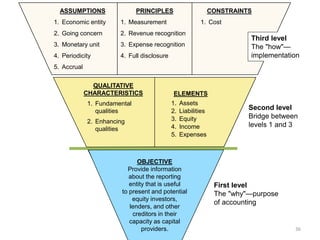
changing demands and influences
• Three of which deserve special consideration are
• First, accounting recognizes that people live in a world of
scarce resources
• ACCTING - helps to identify efficient and inefficient
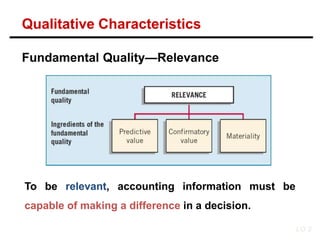
users of resources.
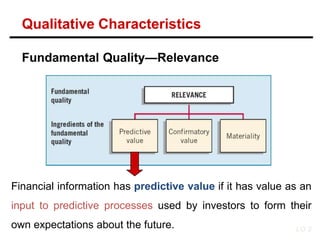
• Second, accounting recognizes and accepts society’s
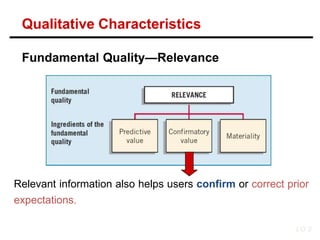
current and ethical concepts of property and other rights
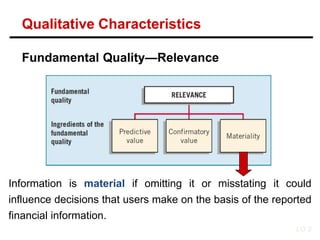
when determining equity.
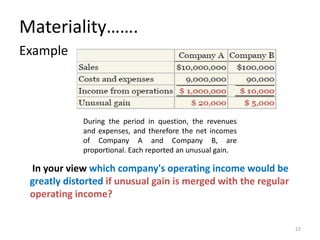
» what property rights society protects,
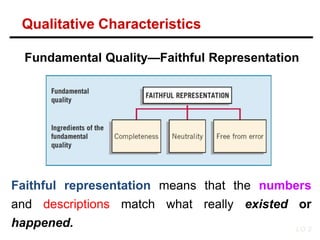
» what society recognizes as value, and
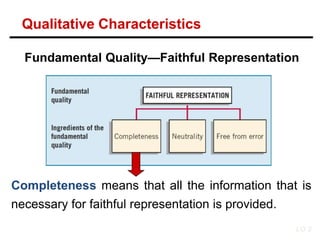
» what society acknowledges as equitable and fair.
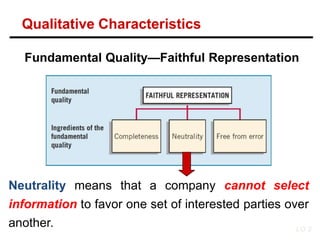
3
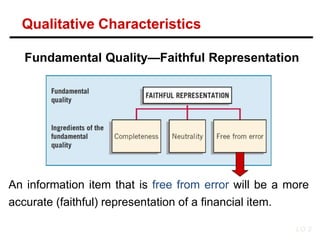
Cont…
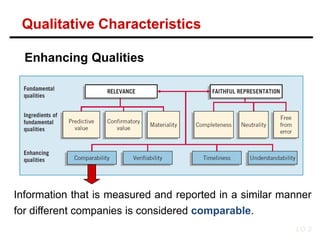
• Third, accounting recognizes that in highly developed,
complex economic systems, some (owners and investors)
entrusts the custodianship of and control over property to
others (managers).
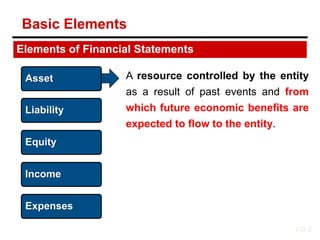
• Thus, the function of measuring and reporting information
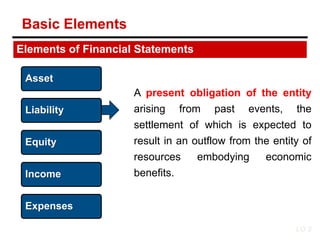
to absentee investors (e.g. Shareholders) has been added
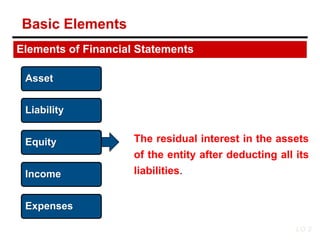
to that of recording and presenting financial data for owner –
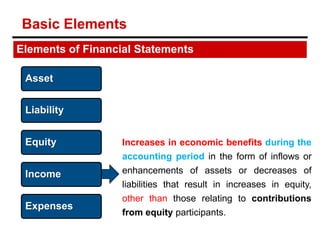
manager use
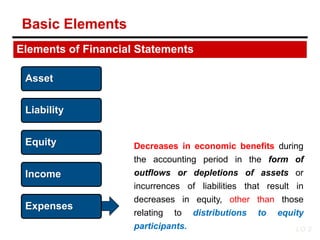
• This development greatly increased the need for accounting
standards (rules of practice governing the contents,
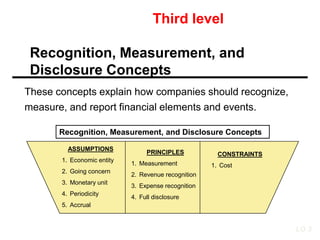
measurements, and disclosures in financial statements).
4
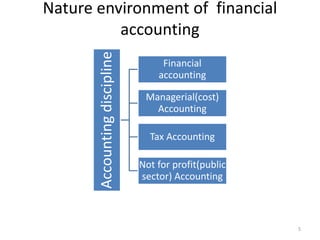
Nature environment of financial
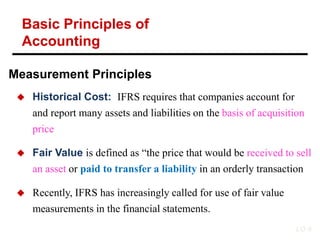
accounting
5
Accounting
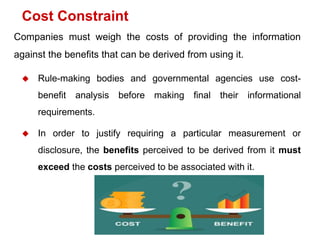
discipline
Financial
accounting
Managerial(cost)
Accounting
Tax Accounting
Not for profit(public
sector) Accounting
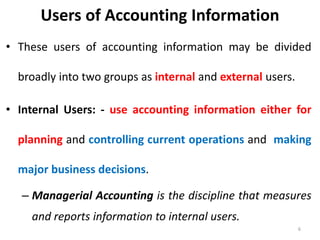
Users of Accounting Information
• These users of accounting information may be divided
broadly into two groups as internal and external users.
• Internal Users: - use accounting information either for
planning and controlling current operations and making
major business decisions.
– Managerial Accounting is the discipline that measures
and reports information to internal users.
6
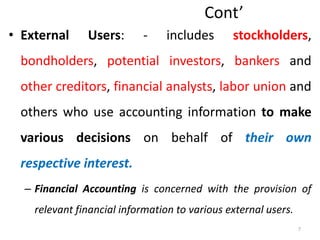
Cont’
• External Users: - includes stockholders,
bondholders, potential investors, bankers and
other creditors, financial analysts, labor union and
others who use accounting information to make
various decisions on behalf of their own
respective interest.
– Financial Accounting is concerned with the provision of
relevant financial information to various external users.
7
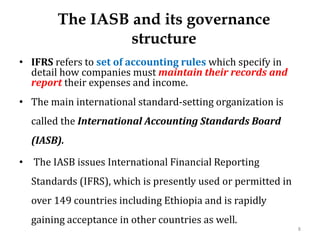
The IASB and its governance
structure
• IFRS refers to set of accounting rules which specify in
detail how companies must maintain their records and
report their expenses and income.
• The main international standard-setting organization is
called the International Accounting Standards Board
(IASB).
• The IASB issues International Financial Reporting
Standards (IFRS), which is presently used or permitted in
over 149 countries including Ethiopia and is rapidly
gaining acceptance in other countries as well.
8
Cont…
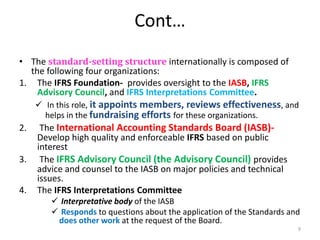
• The standard-setting structure internationally is composed of
the following four organizations:
1. The IFRS Foundation- provides oversight to the IASB, IFRS
Advisory Council, and IFRS Interpretations Committee.
 In this role, it appoints members, reviews effectiveness, and
helps in the fundraising efforts for these organizations.
2. The International Accounting Standards Board (IASB)-
Develop high quality and enforceable IFRS based on public
interest
3. The IFRS Advisory Council (the Advisory Council) provides
advice and counsel to the IASB on major policies and technical
issues.
4. The IFRS Interpretations Committee
 Interpretative body of the IASB
 Responds to questions about the application of the Standards and
does other work at the request of the Board.
9
10
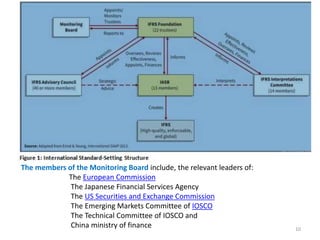
The members of the Monitoring Board include, the relevant leaders of:
The European Commission
The Japanese Financial Services Agency
The US Securities and Exchange Commission
The Emerging Markets Committee of IOSCO
The Technical Committee of IOSCO and
China ministry of finance
1.3. List of IASB pronouncements
• The IASB issues three major types of
pronouncements:
1. International Financial Reporting Standards.
2. Conceptual Framework for Financial
Reporting.
3. International Financial Reporting Standards
Interpretations
11
Cont…
1. International Financial Reporting Standards
• Standards issued by the IASB are referred to as International
Financial Reporting Standards (IFRS).
• The IASB has issued 17 of these standards to date, covering such
subjects as
 Business combinations,
 Share-based payments, and
Leases etc..
• Prior to the IASB (formed in 2001), standard-setting on the
international level was done by the International Accounting
Standards Committee, which issued International Accounting
Standards (IAS).
• The committee issued 41 IASs, many of which have been
amended or superseded by the IASB.
• Those still remaining are considered under the umbrella of IFRS.
12
Cont.…
2. Conceptual Framework for Financial Reporting
• The Framework's purpose is to
 Assist the IASB in developing and revising IFRSs that are based on consistent
concepts,
 To help preparers to develop consistent accounting policies for areas that are not
covered by a standard or where there is choice of accounting policy, and
 To assist all parties to understand and interpret IFRS.
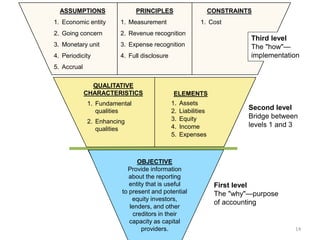
Three levels:
– First Level: Objectives of Financial Reporting.
– Second Level: Qualitative Characteristics and Elements of Financial Statements.
– Third Level: Recognition, Measurement, and Disclosure Concepts.
13
ASSUMPTIONS
1. Economic entity
2. Going concern
3. Monetary unit
4. Periodicity
5. Accrual
PRINCIPLES
1. Measurement
2. Revenue recognition
3. Expense recognition
4. Full disclosure
CONSTRAINTS
1. Cost
OBJECTIVE
Provide information
about the reporting
entity that is useful
to present and potential
equity investors,
lenders, and other
creditors in their
capacity as capital
providers.
ELEMENTS
1. Assets
2. Liabilities
3. Equity
4. Income
5. Expenses
First level
The "why"—purpose
of accounting
Second level
Bridge between
levels 1 and 3
Third level
The "how"—
implementation
QUALITATIVE
CHARACTERISTICS
1. Fundamental
qualities
2. Enhancing
qualities
14
First Level: Basic Objective
• The objective of financial reporting is the foundation of the
conceptual framework.
• The objective of financial reporting is to provide financial
information about the reporting entity that is useful to present
and potential equity investors, lenders, and other creditors in
making decisions about providing resources to the entity.
15
Second Level: Fundamental Concepts
• The second level provides conceptual building blocks that
explain the qualitative characteristics of accounting
information and define the elements of financial
statements.
• That is, the second level forms a bridge between the why
of accounting (the objective) and the how of accounting
(recognition, measurement, and financial statement
presentation).
16
Qualitative Characteristics of
Accounting Information
• IASB identified the Qualitative Characteristics of
accounting information that distinguish better
(more useful) information from inferior (less
useful) information for decision-making
purposes.
17
Fundamental Quality—Relevance
To be relevant, accounting information must be
capable of making a difference in a decision.
LO 2
Qualitative Characteristics
Financial information has predictive value if it has value as an
input to predictive processes used by investors to form their
own expectations about the future.
Fundamental Quality—Relevance
LO 2
Qualitative Characteristics
Relevant information also helps users confirm or correct prior
expectations.
Fundamental Quality—Relevance
LO 2
Qualitative Characteristics
Information is material if omitting it or misstating it could
influence decisions that users make on the basis of the reported
financial information.
Fundamental Quality—Relevance
LO 2
Qualitative Characteristics
Materiality…….
Example
22
During the period in question, the revenues
and expenses, and therefore the net incomes
of Company A and Company B, are
proportional. Each reported an unusual gain.
In your view which company's operating income would be
greatly distorted if unusual gain is merged with the regular
operating income?
Fundamental Quality—Faithful Representation
Faithful representation means that the numbers
and descriptions match what really existed or
happened. LO 2
Qualitative Characteristics
Completeness means that all the information that is
necessary for faithful representation is provided.
Fundamental Quality—Faithful Representation
LO 2
Qualitative Characteristics
Neutrality means that a company cannot select
information to favor one set of interested parties over
another.
Fundamental Quality—Faithful Representation
LO 2
Qualitative Characteristics
An information item that is free from error will be a more
accurate (faithful) representation of a financial item.
Fundamental Quality—Faithful Representation
LO 2
Qualitative Characteristics
Enhancing Qualities
Information that is measured and reported in a similar manner
for different companies is considered comparable.
LO 2
Qualitative Characteristics
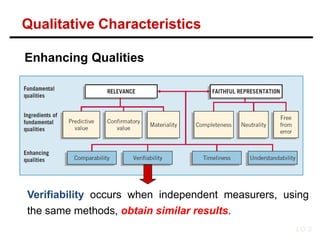
Enhancing Qualities
Verifiability occurs when independent measurers, using
the same methods, obtain similar results.
LO 2
Qualitative Characteristics
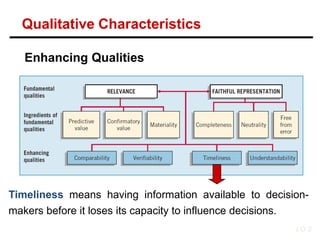
Enhancing Qualities
Timeliness means having information available to decision-
makers before it loses its capacity to influence decisions.
LO 2
Qualitative Characteristics
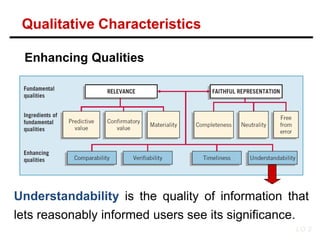
Enhancing Qualities
Understandability is the quality of information that
lets reasonably informed users see its significance.
LO 2
Qualitative Characteristics
A resource controlled by the entity
as a result of past events and from
which future economic benefits are
expected to flow to the entity.
Elements of Financial Statements
Asset
Liability
Equity
Income
Expenses
LO 2
Basic Elements
A present obligation of the entity
arising from past events, the
settlement of which is expected to
result in an outflow from the entity of
resources embodying economic
benefits.
Elements of Financial Statements
Asset
Liability
Equity
Income
Expenses
LO 2
Basic Elements
The residual interest in the assets
of the entity after deducting all its
liabilities.
Elements of Financial Statements
Asset
Liability
Equity
Income
Expenses
LO 2
Basic Elements
Increases in economic benefits during the
accounting period in the form of inflows or
enhancements of assets or decreases of
liabilities that result in increases in equity,
other than those relating to contributions
from equity participants.
Elements of Financial Statements
Asset
Liability
Equity
Income
Expenses
Basic Elements
Decreases in economic benefits during
the accounting period in the form of
outflows or depletions of assets or
incurrences of liabilities that result in
decreases in equity, other than those
relating to distributions to equity
participants.
Elements of Financial Statements
Asset
Liability
Equity
Income
Expenses
LO 2
Basic Elements
ASSUMPTIONS
1. Economic entity
2. Going concern
3. Monetary unit
4. Periodicity
5. Accrual
PRINCIPLES
1. Measurement
2. Revenue recognition
3. Expense recognition
4. Full disclosure
CONSTRAINTS
1. Cost
OBJECTIVE
Provide information
about the reporting
entity that is useful
to present and potential
equity investors,
lenders, and other
creditors in their
capacity as capital
providers.
ELEMENTS
1. Assets
2. Liabilities
3. Equity
4. Income
5. Expenses
First level
The "why"—purpose
of accounting
Second level
Bridge between
levels 1 and 3
Third level
The "how"—
implementation
QUALITATIVE
CHARACTERISTICS
1. Fundamental
qualities
2. Enhancing
qualities
36
These concepts explain how companies should recognize,
measure, and report financial elements and events.
ASSUMPTIONS
1. Economic entity
2. Going concern
3. Monetary unit
4. Periodicity
5. Accrual
PRINCIPLES
1. Measurement
2. Revenue recognition
3. Expense recognition
4. Full disclosure
CONSTRAINTS
1. Cost
Recognition, Measurement, and Disclosure Concepts
LO 3
Third level
Recognition, Measurement, and
Disclosure Concepts
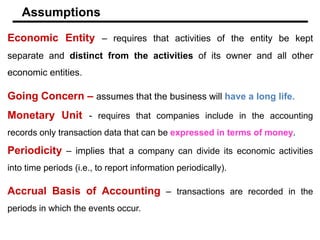
Economic Entity – requires that activities of the entity be kept
separate and distinct from the activities of its owner and all other
economic entities.
Going Concern – assumes that the business will have a long life.
Monetary Unit - requires that companies include in the accounting
records only transaction data that can be expressed in terms of money.
Periodicity – implies that a company can divide its economic activities
into time periods (i.e., to report information periodically).
Accrual Basis of Accounting – transactions are recorded in the
periods in which the events occur.
Assumptions
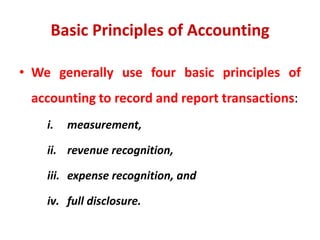
Basic Principles of Accounting
• We generally use four basic principles of
accounting to record and report transactions:
i. measurement,
ii. revenue recognition,
iii. expense recognition, and
iv. full disclosure.
Measurement Principles
 Historical Cost: IFRS requires that companies account for
and report many assets and liabilities on the basis of acquisition
price
 Fair Value is defined as “the price that would be received to sell
an asset or paid to transfer a liability in an orderly transaction
 Recently, IFRS has increasingly called for use of fair value
measurements in the financial statements.
LO 4
Basic Principles of
Accounting
Revenue Recognition Principle: When a company agrees
to perform a service or sell a product to a customer, it has a
performance obligation.
 Requires that companies recognize revenue in the accounting
period in which the performance obligation is satisfied (i.e., when
the Co. performed the service).
Expense Recognition – In practice, the approach for recognizing
expenses is, “Let the expense follow the revenues.” This
the expense recognition principle.
 Recognize expense when the work (service) or the product actually
contributes to revenue.
Full Disclosure Principle
 Requires that companies disclose all circumstances and
events that would make a difference to financial statement
users.
Provided through:
 Financial Statements
 Notes to the Financial Statements- e.g explain the items
presented in the main body of the statements.
 Supplementary information- e.g an expanded table containing
Basic Principles of Accounting
Companies must weigh the costs of providing the information
against the benefits that can be derived from using it.
 Rule-making bodies and governmental agencies use cost-
benefit analysis before making final their informational
requirements.
 In order to justify requiring a particular measurement or
disclosure, the benefits perceived to be derived from it must
exceed the costs perceived to be associated with it.
Cost Constraint
IFRS-based Financial Statements
(IAS 1)
• IAS 1 Presentation of Financial Statements
sets out the overall requirements for financial
statements, including how they should be
structured, the minimum requirements for
their content and overriding concepts
44
Cont…
• Objective of financial statements
• The objective of general purpose financial statements is to provide
information about the financial position, financial performance, and
cash flows of an entity
• To meet that objective, financial statements provide
information about an entity's: [IAS 1.9]
• Assets
• Liabilities
• Equity
• Income and expenses, including gains and losses
• Contributions by and distributions to owners (in their capacity as
owners)
• Cash flows.
45
• Components of financial statements
• A complete set of financial statements includes: [IAS 1.10]
1. A statement of financial position (balance sheet) at the end of the period
2. A statement of profit or loss and other comprehensive income for the period
(Income statement)
3. A statement of changes in equity for the period a statement of cash flows for
the period
4. Notes to the financial statement, comprising a summary of significant
accounting policies and other explanatory notes
5. Comparative information prescribed by the standard.
46
The End!
47

Chapter 1

  • 1.
    CHAPTER ONE DEVELOPMENT OFACCOUNTING PRINCIPLES AND PROFESSIONAL PRACTICE 1
  • 2.
    The Environment ofAccounting • The environment of accounting consists of social, economic, political, legal conditions, and influences that vary from time to time. • As a result, accounting objectives and practices are not the same today as they were in the past. 2
  • 3.
    Cont.… • Accounting theoryand practices have evolved to meet changing demands and influences • Three of which deserve special consideration are • First, accounting recognizes that people live in a world of scarce resources • ACCTING - helps to identify efficient and inefficient users of resources. • Second, accounting recognizes and accepts society’s current and ethical concepts of property and other rights when determining equity. » what property rights society protects, » what society recognizes as value, and » what society acknowledges as equitable and fair. 3
  • 4.
    Cont… • Third, accountingrecognizes that in highly developed, complex economic systems, some (owners and investors) entrusts the custodianship of and control over property to others (managers). • Thus, the function of measuring and reporting information to absentee investors (e.g. Shareholders) has been added to that of recording and presenting financial data for owner – manager use • This development greatly increased the need for accounting standards (rules of practice governing the contents, measurements, and disclosures in financial statements). 4
  • 5.
    Nature environment offinancial accounting 5 Accounting discipline Financial accounting Managerial(cost) Accounting Tax Accounting Not for profit(public sector) Accounting
  • 6.
    Users of AccountingInformation • These users of accounting information may be divided broadly into two groups as internal and external users. • Internal Users: - use accounting information either for planning and controlling current operations and making major business decisions. – Managerial Accounting is the discipline that measures and reports information to internal users. 6
  • 7.
    Cont’ • External Users:- includes stockholders, bondholders, potential investors, bankers and other creditors, financial analysts, labor union and others who use accounting information to make various decisions on behalf of their own respective interest. – Financial Accounting is concerned with the provision of relevant financial information to various external users. 7
  • 8.
    The IASB andits governance structure • IFRS refers to set of accounting rules which specify in detail how companies must maintain their records and report their expenses and income. • The main international standard-setting organization is called the International Accounting Standards Board (IASB). • The IASB issues International Financial Reporting Standards (IFRS), which is presently used or permitted in over 149 countries including Ethiopia and is rapidly gaining acceptance in other countries as well. 8
  • 9.
    Cont… • The standard-settingstructure internationally is composed of the following four organizations: 1. The IFRS Foundation- provides oversight to the IASB, IFRS Advisory Council, and IFRS Interpretations Committee.  In this role, it appoints members, reviews effectiveness, and helps in the fundraising efforts for these organizations. 2. The International Accounting Standards Board (IASB)- Develop high quality and enforceable IFRS based on public interest 3. The IFRS Advisory Council (the Advisory Council) provides advice and counsel to the IASB on major policies and technical issues. 4. The IFRS Interpretations Committee  Interpretative body of the IASB  Responds to questions about the application of the Standards and does other work at the request of the Board. 9
  • 10.
    10 The members ofthe Monitoring Board include, the relevant leaders of: The European Commission The Japanese Financial Services Agency The US Securities and Exchange Commission The Emerging Markets Committee of IOSCO The Technical Committee of IOSCO and China ministry of finance
  • 11.
    1.3. List ofIASB pronouncements • The IASB issues three major types of pronouncements: 1. International Financial Reporting Standards. 2. Conceptual Framework for Financial Reporting. 3. International Financial Reporting Standards Interpretations 11
  • 12.
    Cont… 1. International FinancialReporting Standards • Standards issued by the IASB are referred to as International Financial Reporting Standards (IFRS). • The IASB has issued 17 of these standards to date, covering such subjects as  Business combinations,  Share-based payments, and Leases etc.. • Prior to the IASB (formed in 2001), standard-setting on the international level was done by the International Accounting Standards Committee, which issued International Accounting Standards (IAS). • The committee issued 41 IASs, many of which have been amended or superseded by the IASB. • Those still remaining are considered under the umbrella of IFRS. 12
  • 13.
    Cont.… 2. Conceptual Frameworkfor Financial Reporting • The Framework's purpose is to  Assist the IASB in developing and revising IFRSs that are based on consistent concepts,  To help preparers to develop consistent accounting policies for areas that are not covered by a standard or where there is choice of accounting policy, and  To assist all parties to understand and interpret IFRS. Three levels: – First Level: Objectives of Financial Reporting. – Second Level: Qualitative Characteristics and Elements of Financial Statements. – Third Level: Recognition, Measurement, and Disclosure Concepts. 13
  • 14.
    ASSUMPTIONS 1. Economic entity 2.Going concern 3. Monetary unit 4. Periodicity 5. Accrual PRINCIPLES 1. Measurement 2. Revenue recognition 3. Expense recognition 4. Full disclosure CONSTRAINTS 1. Cost OBJECTIVE Provide information about the reporting entity that is useful to present and potential equity investors, lenders, and other creditors in their capacity as capital providers. ELEMENTS 1. Assets 2. Liabilities 3. Equity 4. Income 5. Expenses First level The "why"—purpose of accounting Second level Bridge between levels 1 and 3 Third level The "how"— implementation QUALITATIVE CHARACTERISTICS 1. Fundamental qualities 2. Enhancing qualities 14
  • 15.
    First Level: BasicObjective • The objective of financial reporting is the foundation of the conceptual framework. • The objective of financial reporting is to provide financial information about the reporting entity that is useful to present and potential equity investors, lenders, and other creditors in making decisions about providing resources to the entity. 15
  • 16.
    Second Level: FundamentalConcepts • The second level provides conceptual building blocks that explain the qualitative characteristics of accounting information and define the elements of financial statements. • That is, the second level forms a bridge between the why of accounting (the objective) and the how of accounting (recognition, measurement, and financial statement presentation). 16
  • 17.
    Qualitative Characteristics of AccountingInformation • IASB identified the Qualitative Characteristics of accounting information that distinguish better (more useful) information from inferior (less useful) information for decision-making purposes. 17
  • 18.
    Fundamental Quality—Relevance To berelevant, accounting information must be capable of making a difference in a decision. LO 2 Qualitative Characteristics
  • 19.
    Financial information haspredictive value if it has value as an input to predictive processes used by investors to form their own expectations about the future. Fundamental Quality—Relevance LO 2 Qualitative Characteristics
  • 20.
    Relevant information alsohelps users confirm or correct prior expectations. Fundamental Quality—Relevance LO 2 Qualitative Characteristics
  • 21.
    Information is materialif omitting it or misstating it could influence decisions that users make on the basis of the reported financial information. Fundamental Quality—Relevance LO 2 Qualitative Characteristics
  • 22.
    Materiality……. Example 22 During the periodin question, the revenues and expenses, and therefore the net incomes of Company A and Company B, are proportional. Each reported an unusual gain. In your view which company's operating income would be greatly distorted if unusual gain is merged with the regular operating income?
  • 23.
    Fundamental Quality—Faithful Representation Faithfulrepresentation means that the numbers and descriptions match what really existed or happened. LO 2 Qualitative Characteristics
  • 24.
    Completeness means thatall the information that is necessary for faithful representation is provided. Fundamental Quality—Faithful Representation LO 2 Qualitative Characteristics
  • 25.
    Neutrality means thata company cannot select information to favor one set of interested parties over another. Fundamental Quality—Faithful Representation LO 2 Qualitative Characteristics
  • 26.
    An information itemthat is free from error will be a more accurate (faithful) representation of a financial item. Fundamental Quality—Faithful Representation LO 2 Qualitative Characteristics
  • 27.
    Enhancing Qualities Information thatis measured and reported in a similar manner for different companies is considered comparable. LO 2 Qualitative Characteristics
  • 28.
    Enhancing Qualities Verifiability occurswhen independent measurers, using the same methods, obtain similar results. LO 2 Qualitative Characteristics
  • 29.
    Enhancing Qualities Timeliness meanshaving information available to decision- makers before it loses its capacity to influence decisions. LO 2 Qualitative Characteristics
  • 30.
    Enhancing Qualities Understandability isthe quality of information that lets reasonably informed users see its significance. LO 2 Qualitative Characteristics
  • 31.
    A resource controlledby the entity as a result of past events and from which future economic benefits are expected to flow to the entity. Elements of Financial Statements Asset Liability Equity Income Expenses LO 2 Basic Elements
  • 32.
    A present obligationof the entity arising from past events, the settlement of which is expected to result in an outflow from the entity of resources embodying economic benefits. Elements of Financial Statements Asset Liability Equity Income Expenses LO 2 Basic Elements
  • 33.
    The residual interestin the assets of the entity after deducting all its liabilities. Elements of Financial Statements Asset Liability Equity Income Expenses LO 2 Basic Elements
  • 34.
    Increases in economicbenefits during the accounting period in the form of inflows or enhancements of assets or decreases of liabilities that result in increases in equity, other than those relating to contributions from equity participants. Elements of Financial Statements Asset Liability Equity Income Expenses Basic Elements
  • 35.
    Decreases in economicbenefits during the accounting period in the form of outflows or depletions of assets or incurrences of liabilities that result in decreases in equity, other than those relating to distributions to equity participants. Elements of Financial Statements Asset Liability Equity Income Expenses LO 2 Basic Elements
  • 36.
    ASSUMPTIONS 1. Economic entity 2.Going concern 3. Monetary unit 4. Periodicity 5. Accrual PRINCIPLES 1. Measurement 2. Revenue recognition 3. Expense recognition 4. Full disclosure CONSTRAINTS 1. Cost OBJECTIVE Provide information about the reporting entity that is useful to present and potential equity investors, lenders, and other creditors in their capacity as capital providers. ELEMENTS 1. Assets 2. Liabilities 3. Equity 4. Income 5. Expenses First level The "why"—purpose of accounting Second level Bridge between levels 1 and 3 Third level The "how"— implementation QUALITATIVE CHARACTERISTICS 1. Fundamental qualities 2. Enhancing qualities 36
  • 37.
    These concepts explainhow companies should recognize, measure, and report financial elements and events. ASSUMPTIONS 1. Economic entity 2. Going concern 3. Monetary unit 4. Periodicity 5. Accrual PRINCIPLES 1. Measurement 2. Revenue recognition 3. Expense recognition 4. Full disclosure CONSTRAINTS 1. Cost Recognition, Measurement, and Disclosure Concepts LO 3 Third level Recognition, Measurement, and Disclosure Concepts
  • 38.
    Economic Entity –requires that activities of the entity be kept separate and distinct from the activities of its owner and all other economic entities. Going Concern – assumes that the business will have a long life. Monetary Unit - requires that companies include in the accounting records only transaction data that can be expressed in terms of money. Periodicity – implies that a company can divide its economic activities into time periods (i.e., to report information periodically). Accrual Basis of Accounting – transactions are recorded in the periods in which the events occur. Assumptions
  • 39.
    Basic Principles ofAccounting • We generally use four basic principles of accounting to record and report transactions: i. measurement, ii. revenue recognition, iii. expense recognition, and iv. full disclosure.
  • 40.
    Measurement Principles  HistoricalCost: IFRS requires that companies account for and report many assets and liabilities on the basis of acquisition price  Fair Value is defined as “the price that would be received to sell an asset or paid to transfer a liability in an orderly transaction  Recently, IFRS has increasingly called for use of fair value measurements in the financial statements. LO 4 Basic Principles of Accounting
  • 41.
    Revenue Recognition Principle:When a company agrees to perform a service or sell a product to a customer, it has a performance obligation.  Requires that companies recognize revenue in the accounting period in which the performance obligation is satisfied (i.e., when the Co. performed the service). Expense Recognition – In practice, the approach for recognizing expenses is, “Let the expense follow the revenues.” This the expense recognition principle.  Recognize expense when the work (service) or the product actually contributes to revenue.
  • 42.
    Full Disclosure Principle Requires that companies disclose all circumstances and events that would make a difference to financial statement users. Provided through:  Financial Statements  Notes to the Financial Statements- e.g explain the items presented in the main body of the statements.  Supplementary information- e.g an expanded table containing Basic Principles of Accounting
  • 43.
    Companies must weighthe costs of providing the information against the benefits that can be derived from using it.  Rule-making bodies and governmental agencies use cost- benefit analysis before making final their informational requirements.  In order to justify requiring a particular measurement or disclosure, the benefits perceived to be derived from it must exceed the costs perceived to be associated with it. Cost Constraint
  • 44.
    IFRS-based Financial Statements (IAS1) • IAS 1 Presentation of Financial Statements sets out the overall requirements for financial statements, including how they should be structured, the minimum requirements for their content and overriding concepts 44
  • 45.
    Cont… • Objective offinancial statements • The objective of general purpose financial statements is to provide information about the financial position, financial performance, and cash flows of an entity • To meet that objective, financial statements provide information about an entity's: [IAS 1.9] • Assets • Liabilities • Equity • Income and expenses, including gains and losses • Contributions by and distributions to owners (in their capacity as owners) • Cash flows. 45
  • 46.
    • Components offinancial statements • A complete set of financial statements includes: [IAS 1.10] 1. A statement of financial position (balance sheet) at the end of the period 2. A statement of profit or loss and other comprehensive income for the period (Income statement) 3. A statement of changes in equity for the period a statement of cash flows for the period 4. Notes to the financial statement, comprising a summary of significant accounting policies and other explanatory notes 5. Comparative information prescribed by the standard. 46
  • 47.

Editor's Notes

  • #32 Assets are economic resources that provide a future benefit for a business. Most firms use the following asset accounts: Cash: money and any medium of exchange including bank account balances, paper currency, coins, certificates of deposit, and checks. Accounts receivable: a company sells its goods and services and receives a promise for future collection of cash. The agreement to allow customers to pay in the future is informal and usually for a short period of time. The Accounts receivable account holds these amounts. Notes receivable: a company may receive a note receivable from a customer, who signed the note promising to pay. A note receivable is similar to an account receivable, but a note receivable is more binding because the customer signed the note. Notes receivable usually specify an interest rate.
  • #33 Assets are economic resources that provide a future benefit for a business. Most firms use the following asset accounts: Cash: money and any medium of exchange including bank account balances, paper currency, coins, certificates of deposit, and checks. Accounts receivable: a company sells its goods and services and receives a promise for future collection of cash. The agreement to allow customers to pay in the future is informal and usually for a short period of time. The Accounts receivable account holds these amounts. Notes receivable: a company may receive a note receivable from a customer, who signed the note promising to pay. A note receivable is similar to an account receivable, but a note receivable is more binding because the customer signed the note. Notes receivable usually specify an interest rate.
  • #34 Assets are economic resources that provide a future benefit for a business. Most firms use the following asset accounts: Cash: money and any medium of exchange including bank account balances, paper currency, coins, certificates of deposit, and checks. Accounts receivable: a company sells its goods and services and receives a promise for future collection of cash. The agreement to allow customers to pay in the future is informal and usually for a short period of time. The Accounts receivable account holds these amounts. Notes receivable: a company may receive a note receivable from a customer, who signed the note promising to pay. A note receivable is similar to an account receivable, but a note receivable is more binding because the customer signed the note. Notes receivable usually specify an interest rate.
  • #35 Assets are economic resources that provide a future benefit for a business. Most firms use the following asset accounts: Cash: money and any medium of exchange including bank account balances, paper currency, coins, certificates of deposit, and checks. Accounts receivable: a company sells its goods and services and receives a promise for future collection of cash. The agreement to allow customers to pay in the future is informal and usually for a short period of time. The Accounts receivable account holds these amounts. Notes receivable: a company may receive a note receivable from a customer, who signed the note promising to pay. A note receivable is similar to an account receivable, but a note receivable is more binding because the customer signed the note. Notes receivable usually specify an interest rate.