Getting Started with Access 2013
Objectives
• Understand relational databases
• Explore a database
• Create a database
• Create a table
(continued)
Microsoft Office 2013-Illustrated 2
Objectives (continued)
• Create primary keys
• Relate two tables
• Enter data
• Edit data
Microsoft Office 2013-Illustrated 3
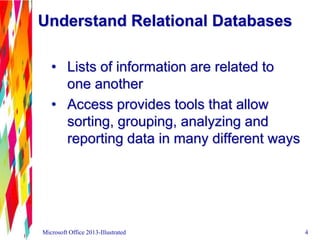
Understand Relational Databases
• Lists of information are related to
one another
• Access provides tools that allow
sorting, grouping, analyzing and
reporting data in many different ways
Microsoft Office 2013-Illustrated 4
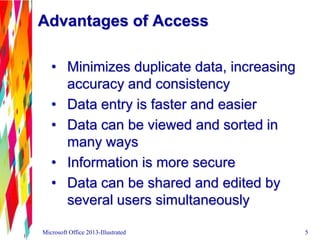
Advantages of Access
• Minimizes duplicate data, increasing
accuracy and consistency
• Data entry is faster and easier
• Data can be viewed and sorted in
many ways
• Information is more secure
• Data can be shared and edited by
several users simultaneously
Microsoft Office 2013-Illustrated 5
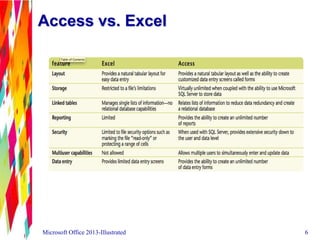
Access vs. Excel
Microsoft Office 2013-Illustrated 6
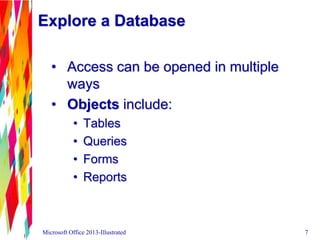
Explore a Database
• Access can be opened in multiple
ways
• Objects include:
• Tables
• Queries
• Forms
• Reports
Microsoft Office 2013-Illustrated 7
Access Objects
Microsoft Office 2013-Illustrated 8
Create a Database
• Start by using an Access template or
by opening a blank database
• Table Design View provides the
most options for defining fields
• Datasheet View is a spreadsheet-
like view of the data in a table
Microsoft Office 2013-Illustrated 9
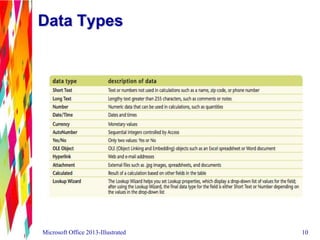
Data Types
Microsoft Office 2013-Illustrated 10
Create a Table
• Essential tasks in creating a table:
• Defining the fields
• Selecting data type for each field
(e.g., numbers, text, dates)
• Naming the table
• Determining how the table will
participate in the relational database
Microsoft Office 2013-Illustrated 11
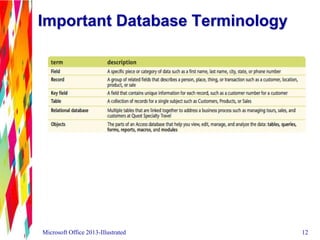
Important Database Terminology
Microsoft Office 2013-Illustrated 12
Create Primary Keys
• Primary key field: Contains data
that uniquely identifies each record;
no 2 records can have the same
entry in this field
• Primary key field relates one table to
another in a one-to-many
relationship; one record in the 1st
table is related to many records in
the 2nd table
Microsoft Office 2013-Illustrated 13
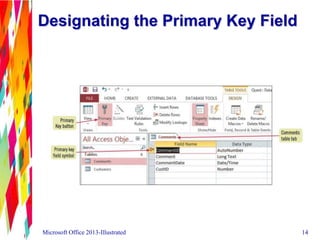
Designating the Primary Key Field
Microsoft Office 2013-Illustrated 14
Learning about field properties
• Properties = characteristics of a field
• 2 properties required for every field:
Field Name and Data Type
• You can add other properties, such
as Field Size, Format and Caption
• More properties = more restrictions
= more data entry accuracy
Microsoft Office 2013-Illustrated 15
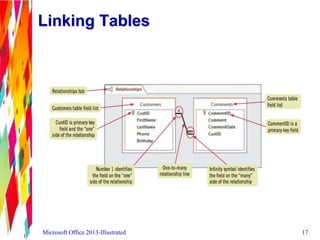
Relate Two Tables
• Tables must be linked before
queries, forms, or reports can be
created that utilize fields from more
than one table
• Tables are linked in a one-to-many
relationship
Microsoft Office 2013-Illustrated 16
Linking Tables
Microsoft Office 2013-Illustrated 17
Enter Data
• Focus:
• Refers to which data would be entered
or edited if you started typing
Microsoft Office 2013-Illustrated 18
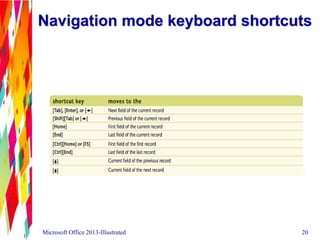
Moving the Focus to Navigate Data
Options
• [Tab]
• [Enter]
• Navigation buttons:
Previous record
Next record
Microsoft Office 2013-Illustrated 19
Navigation mode keyboard shortcuts
Microsoft Office 2013-Illustrated 20
Edit Data
• Access automatically saves new
data and changes to existing data
as soon as you move to another
record OR close the datasheet
• To change the contents of an
existing record, navigate to the field
you want to change and type the
new information
Microsoft Office 2013-Illustrated 21
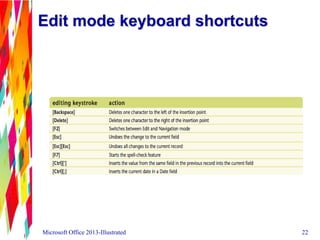
Edit mode keyboard shortcuts
Microsoft Office 2013-Illustrated 22
Resizing & Moving Datasheet
Columns
• Click and drag column separators to
manually widen or narrow columns
• Double-click the column separator to
automatically adjust width to the
widest entry in the field
• Click the field name and drag it left
or right to move a column
Microsoft Office 2013-Illustrated 23
Summary
• Understanding relational databases
• Exploring databases
• Creating databases
• Creating tables
• Creating primary keys
• Relating two tables
• Entering and editing data
Microsoft Office 2013-Illustrated 24

Access 2013 Unit A

  • 1.
  • 2.
    Objectives • Understand relationaldatabases • Explore a database • Create a database • Create a table (continued) Microsoft Office 2013-Illustrated 2
  • 3.
    Objectives (continued) • Createprimary keys • Relate two tables • Enter data • Edit data Microsoft Office 2013-Illustrated 3
  • 4.
    Understand Relational Databases •Lists of information are related to one another • Access provides tools that allow sorting, grouping, analyzing and reporting data in many different ways Microsoft Office 2013-Illustrated 4
  • 5.
    Advantages of Access •Minimizes duplicate data, increasing accuracy and consistency • Data entry is faster and easier • Data can be viewed and sorted in many ways • Information is more secure • Data can be shared and edited by several users simultaneously Microsoft Office 2013-Illustrated 5
  • 6.
    Access vs. Excel MicrosoftOffice 2013-Illustrated 6
  • 7.
    Explore a Database •Access can be opened in multiple ways • Objects include: • Tables • Queries • Forms • Reports Microsoft Office 2013-Illustrated 7
  • 8.
  • 9.
    Create a Database •Start by using an Access template or by opening a blank database • Table Design View provides the most options for defining fields • Datasheet View is a spreadsheet- like view of the data in a table Microsoft Office 2013-Illustrated 9
  • 10.
    Data Types Microsoft Office2013-Illustrated 10
  • 11.
    Create a Table •Essential tasks in creating a table: • Defining the fields • Selecting data type for each field (e.g., numbers, text, dates) • Naming the table • Determining how the table will participate in the relational database Microsoft Office 2013-Illustrated 11
  • 12.
    Important Database Terminology MicrosoftOffice 2013-Illustrated 12
  • 13.
    Create Primary Keys •Primary key field: Contains data that uniquely identifies each record; no 2 records can have the same entry in this field • Primary key field relates one table to another in a one-to-many relationship; one record in the 1st table is related to many records in the 2nd table Microsoft Office 2013-Illustrated 13
  • 14.
    Designating the PrimaryKey Field Microsoft Office 2013-Illustrated 14
  • 15.
    Learning about fieldproperties • Properties = characteristics of a field • 2 properties required for every field: Field Name and Data Type • You can add other properties, such as Field Size, Format and Caption • More properties = more restrictions = more data entry accuracy Microsoft Office 2013-Illustrated 15
  • 16.
    Relate Two Tables •Tables must be linked before queries, forms, or reports can be created that utilize fields from more than one table • Tables are linked in a one-to-many relationship Microsoft Office 2013-Illustrated 16
  • 17.
  • 18.
    Enter Data • Focus: •Refers to which data would be entered or edited if you started typing Microsoft Office 2013-Illustrated 18
  • 19.
    Moving the Focusto Navigate Data Options • [Tab] • [Enter] • Navigation buttons: Previous record Next record Microsoft Office 2013-Illustrated 19
  • 20.
    Navigation mode keyboardshortcuts Microsoft Office 2013-Illustrated 20
  • 21.
    Edit Data • Accessautomatically saves new data and changes to existing data as soon as you move to another record OR close the datasheet • To change the contents of an existing record, navigate to the field you want to change and type the new information Microsoft Office 2013-Illustrated 21
  • 22.
    Edit mode keyboardshortcuts Microsoft Office 2013-Illustrated 22
  • 23.
    Resizing & MovingDatasheet Columns • Click and drag column separators to manually widen or narrow columns • Double-click the column separator to automatically adjust width to the widest entry in the field • Click the field name and drag it left or right to move a column Microsoft Office 2013-Illustrated 23
  • 24.
    Summary • Understanding relationaldatabases • Exploring databases • Creating databases • Creating tables • Creating primary keys • Relating two tables • Entering and editing data Microsoft Office 2013-Illustrated 24