FIRST COURSE
Access Tutorial 1
Creating a Database
XPObjectives
• Define the terms field, record, table, relational
database, primary key, and foreign key
• Create a blank database
• Identify the components of the Microsoft Access
window
• Create and save a table in Datasheet view
• Enter field names and records in a table
datasheet
• Open a table using the Navigation Pane
New Perspectives on Microsoft Office 2007: Windows XP Edition 2
XPObjectives
• Open an Access database
• Copy and paste records from another Access database
• Navigate a table datasheet
• Create and navigate a simple query
• Create and navigate a simple form
• Create, preview, navigate, and print a simple report
• Learn how to manage a database by compacting,
backing up, and restoring a database
New Perspectives on Microsoft Office 2007: Windows XP Edition 3
XPOrganizing Data
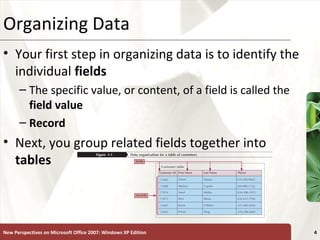
• Your first step in organizing data is to identify the
individual fields
– The specific value, or content, of a field is called the
field value
– Record
• Next, you group related fields together into
tables
New Perspectives on Microsoft Office 2007: Windows XP Edition 4
XPDatabases and Relationships
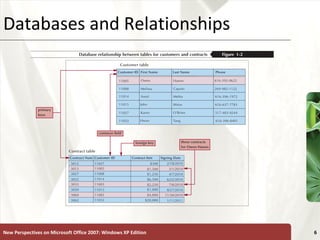
• A collection of related tables is called a database, or a
relational database
• You connect the records in the separate tables through
a common field
• A primary key is a field, or a collection of fields, whose
values uniquely identify each record in a table
• When you include the primary key from one table as a
field in a second table to form a relationship between
the two tables, it is called a foreign key in the second
table
New Perspectives on Microsoft Office 2007: Windows XP Edition 5
XPDatabases and Relationships
New Perspectives on Microsoft Office 2007: Windows XP Edition 6
XP
Relational Database
Management Systems
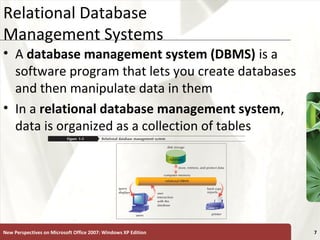
• A database management system (DBMS) is a
software program that lets you create databases
and then manipulate data in them
• In a relational database management system,
data is organized as a collection of tables
New Perspectives on Microsoft Office 2007: Windows XP Edition 7
XP
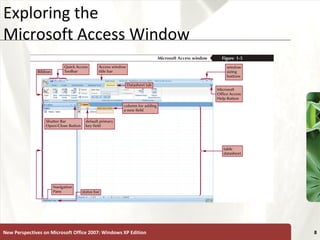
Exploring the
Microsoft Access Window
New Perspectives on Microsoft Office 2007: Windows XP Edition 8
XPCreating a Table in Datasheet View
• Click the Create tab on the Ribbon
• In the Tables group, click the Table button
• Accept the default ID primary key field with the
AutoNumber data type, or rename the field and
change its data type, if necessary
• Double-click the Add New Field column heading,
and then type the name for the field you are
adding to the table
• Press the Tab key or the Enter key
New Perspectives on Microsoft Office 2007: Windows XP Edition 9
XPCreating a Table in Datasheet View
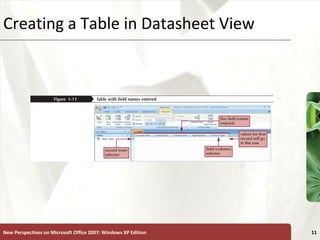
• Add all the fields to your table by typing the field names in
the column headings and pressing the Tab key or the
Enter key to move to the next column
• In the first row below the field names, enter the value for
each field in the first record, pressing the Tab key or the
Enter key to move from field to field
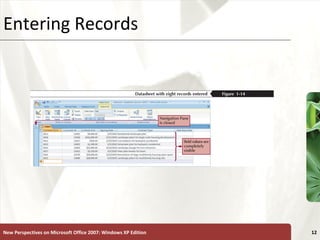
• After entering the value for the last field in the first
record, press the Tab key or the Enter key to move to the
next row, and then enter the values for the next record.
Continue this process until you have entered all the
records for the table
• Click the Save button on the Quick Access Toolbar, enter a
name for the table, and then click the OK button
New Perspectives on Microsoft Office 2007: Windows XP Edition 10
XPCreating a Table in Datasheet View
New Perspectives on Microsoft Office 2007: Windows XP Edition 11
XPEntering Records
New Perspectives on Microsoft Office 2007: Windows XP Edition 12
XPSaving a Table
• Click the Save button on the Quick Access
Toolbar. The Save As dialog box opens
• In the Table Name text box, type the name for
the table
• Click the OK button
New Perspectives on Microsoft Office 2007: Windows XP Edition 13
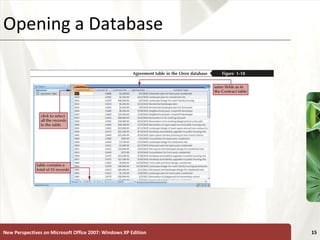
XPOpening a Database
• Start Access and display the Getting Started with
Microsoft Office Access page
• Click the More option to display the Open dialog
box
• Navigate to the database file you want to open,
and then click the file
• Click the Open button
New Perspectives on Microsoft Office 2007: Windows XP Edition 14
XPOpening a Database
New Perspectives on Microsoft Office 2007: Windows XP Edition 15
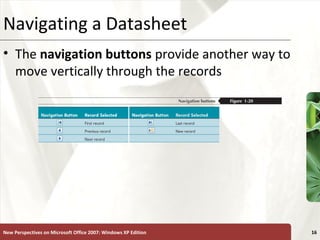
XPNavigating a Datasheet
• The navigation buttons provide another way to
move vertically through the records
New Perspectives on Microsoft Office 2007: Windows XP Edition 16
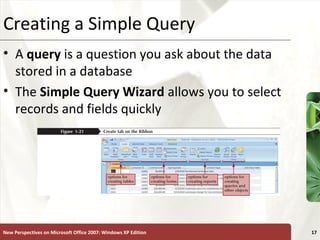
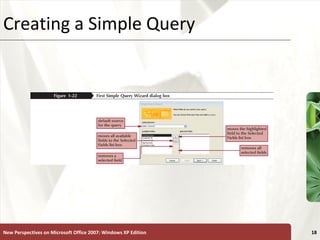
XPCreating a Simple Query
• A query is a question you ask about the data
stored in a database
• The Simple Query Wizard allows you to select
records and fields quickly
New Perspectives on Microsoft Office 2007: Windows XP Edition 17
XPCreating a Simple Query
New Perspectives on Microsoft Office 2007: Windows XP Edition 18
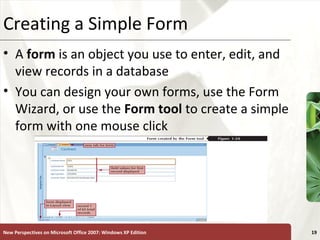
XPCreating a Simple Form
• A form is an object you use to enter, edit, and
view records in a database
• You can design your own forms, use the Form
Wizard, or use the Form tool to create a simple
form with one mouse click
New Perspectives on Microsoft Office 2007: Windows XP Edition 19
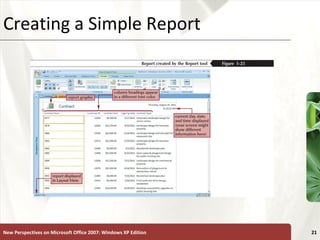
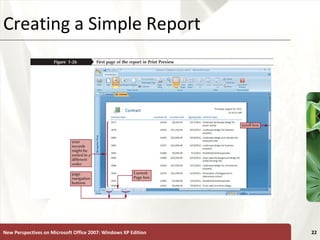
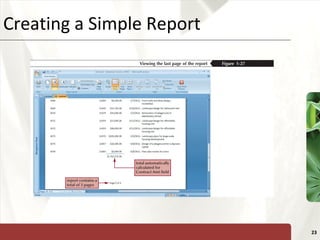
XPCreating a Simple Report
• A report is a formatted printout (or screen
display) of the contents of one or more tables in
a database
• The Report tool places all the fields from a
selected table (or query) on a report, making it
the quickest way to create a report
New Perspectives on Microsoft Office 2007: Windows XP Edition 20
XPCreating a Simple Report
New Perspectives on Microsoft Office 2007: Windows XP Edition 21
XPCreating a Simple Report
New Perspectives on Microsoft Office 2007: Windows XP Edition 22
XPCreating a Simple Report
23
XPPrinting a Report
• Open the report in any view, or select the report in the
Navigation Pane
• To print the report with the default print settings, click
the Office Button, point to Print, and then click Quick
Print
or
• To display the Print dialog box and select the options
you want for printing the report, click the Office Button,
point to Print, and then click Print (or, if the report is
displayed in Print Preview, click the Print button in the
Print group on the Print Preview tab)
24
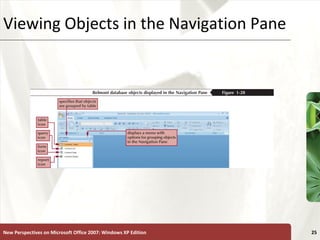
XPViewing Objects in the Navigation Pane
New Perspectives on Microsoft Office 2007: Windows XP Edition 25
XPCompacting and Repairing a Database
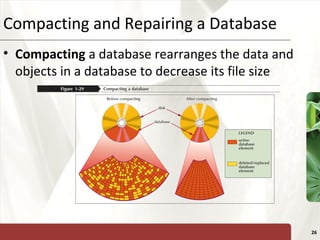
• Compacting a database rearranges the data and
objects in a database to decrease its file size
26
XPCompacting and Repairing a Database
• Make sure the database file you want to
compact and repair is open
• Click the Office Button, point to Manage, and
then click Compact and Repair Database
27
XPBacking Up and Restoring a Database
• Backing up a database is the process of making a
copy of the database file to protect your
database against loss or damage
• The Back Up Database command enables you to
back up your database file from within the
Access program, while you are working on your
database
• To restore a backup database file, you simply
copy the backup from the drive on which it is
stored to your hard drive
28

Access Introduction

  • 1.
    FIRST COURSE Access Tutorial1 Creating a Database
  • 2.
    XPObjectives • Define theterms field, record, table, relational database, primary key, and foreign key • Create a blank database • Identify the components of the Microsoft Access window • Create and save a table in Datasheet view • Enter field names and records in a table datasheet • Open a table using the Navigation Pane New Perspectives on Microsoft Office 2007: Windows XP Edition 2
  • 3.
    XPObjectives • Open anAccess database • Copy and paste records from another Access database • Navigate a table datasheet • Create and navigate a simple query • Create and navigate a simple form • Create, preview, navigate, and print a simple report • Learn how to manage a database by compacting, backing up, and restoring a database New Perspectives on Microsoft Office 2007: Windows XP Edition 3
  • 4.
    XPOrganizing Data • Yourfirst step in organizing data is to identify the individual fields – The specific value, or content, of a field is called the field value – Record • Next, you group related fields together into tables New Perspectives on Microsoft Office 2007: Windows XP Edition 4
  • 5.
    XPDatabases and Relationships •A collection of related tables is called a database, or a relational database • You connect the records in the separate tables through a common field • A primary key is a field, or a collection of fields, whose values uniquely identify each record in a table • When you include the primary key from one table as a field in a second table to form a relationship between the two tables, it is called a foreign key in the second table New Perspectives on Microsoft Office 2007: Windows XP Edition 5
  • 6.
    XPDatabases and Relationships NewPerspectives on Microsoft Office 2007: Windows XP Edition 6
  • 7.
    XP Relational Database Management Systems •A database management system (DBMS) is a software program that lets you create databases and then manipulate data in them • In a relational database management system, data is organized as a collection of tables New Perspectives on Microsoft Office 2007: Windows XP Edition 7
  • 8.
    XP Exploring the Microsoft AccessWindow New Perspectives on Microsoft Office 2007: Windows XP Edition 8
  • 9.
    XPCreating a Tablein Datasheet View • Click the Create tab on the Ribbon • In the Tables group, click the Table button • Accept the default ID primary key field with the AutoNumber data type, or rename the field and change its data type, if necessary • Double-click the Add New Field column heading, and then type the name for the field you are adding to the table • Press the Tab key or the Enter key New Perspectives on Microsoft Office 2007: Windows XP Edition 9
  • 10.
    XPCreating a Tablein Datasheet View • Add all the fields to your table by typing the field names in the column headings and pressing the Tab key or the Enter key to move to the next column • In the first row below the field names, enter the value for each field in the first record, pressing the Tab key or the Enter key to move from field to field • After entering the value for the last field in the first record, press the Tab key or the Enter key to move to the next row, and then enter the values for the next record. Continue this process until you have entered all the records for the table • Click the Save button on the Quick Access Toolbar, enter a name for the table, and then click the OK button New Perspectives on Microsoft Office 2007: Windows XP Edition 10
  • 11.
    XPCreating a Tablein Datasheet View New Perspectives on Microsoft Office 2007: Windows XP Edition 11
  • 12.
    XPEntering Records New Perspectiveson Microsoft Office 2007: Windows XP Edition 12
  • 13.
    XPSaving a Table •Click the Save button on the Quick Access Toolbar. The Save As dialog box opens • In the Table Name text box, type the name for the table • Click the OK button New Perspectives on Microsoft Office 2007: Windows XP Edition 13
  • 14.
    XPOpening a Database •Start Access and display the Getting Started with Microsoft Office Access page • Click the More option to display the Open dialog box • Navigate to the database file you want to open, and then click the file • Click the Open button New Perspectives on Microsoft Office 2007: Windows XP Edition 14
  • 15.
    XPOpening a Database NewPerspectives on Microsoft Office 2007: Windows XP Edition 15
  • 16.
    XPNavigating a Datasheet •The navigation buttons provide another way to move vertically through the records New Perspectives on Microsoft Office 2007: Windows XP Edition 16
  • 17.
    XPCreating a SimpleQuery • A query is a question you ask about the data stored in a database • The Simple Query Wizard allows you to select records and fields quickly New Perspectives on Microsoft Office 2007: Windows XP Edition 17
  • 18.
    XPCreating a SimpleQuery New Perspectives on Microsoft Office 2007: Windows XP Edition 18
  • 19.
    XPCreating a SimpleForm • A form is an object you use to enter, edit, and view records in a database • You can design your own forms, use the Form Wizard, or use the Form tool to create a simple form with one mouse click New Perspectives on Microsoft Office 2007: Windows XP Edition 19
  • 20.
    XPCreating a SimpleReport • A report is a formatted printout (or screen display) of the contents of one or more tables in a database • The Report tool places all the fields from a selected table (or query) on a report, making it the quickest way to create a report New Perspectives on Microsoft Office 2007: Windows XP Edition 20
  • 21.
    XPCreating a SimpleReport New Perspectives on Microsoft Office 2007: Windows XP Edition 21
  • 22.
    XPCreating a SimpleReport New Perspectives on Microsoft Office 2007: Windows XP Edition 22
  • 23.
  • 24.
    XPPrinting a Report •Open the report in any view, or select the report in the Navigation Pane • To print the report with the default print settings, click the Office Button, point to Print, and then click Quick Print or • To display the Print dialog box and select the options you want for printing the report, click the Office Button, point to Print, and then click Print (or, if the report is displayed in Print Preview, click the Print button in the Print group on the Print Preview tab) 24
  • 25.
    XPViewing Objects inthe Navigation Pane New Perspectives on Microsoft Office 2007: Windows XP Edition 25
  • 26.
    XPCompacting and Repairinga Database • Compacting a database rearranges the data and objects in a database to decrease its file size 26
  • 27.
    XPCompacting and Repairinga Database • Make sure the database file you want to compact and repair is open • Click the Office Button, point to Manage, and then click Compact and Repair Database 27
  • 28.
    XPBacking Up andRestoring a Database • Backing up a database is the process of making a copy of the database file to protect your database against loss or damage • The Back Up Database command enables you to back up your database file from within the Access program, while you are working on your database • To restore a backup database file, you simply copy the backup from the drive on which it is stored to your hard drive 28