Lesson 25
AC Power and
Power Triangle
Learning Objectives
 Define real (active) power, reactive power, average, and
apparent power.
 Calculate the real, reactive, and apparent power in AC
series parallel networks.
 Graph the real and reactive power of purely resistive,
inductive, or capacitive loads in AC series parallel networks
as a function of time.
 Determine when power is dissipated, stored, or released in
purely resistive, inductive, or capacitive loads in AC series
parallel networks.
 Use the power triangle determine relationships between
real, reactive and apparent power.
AC Power
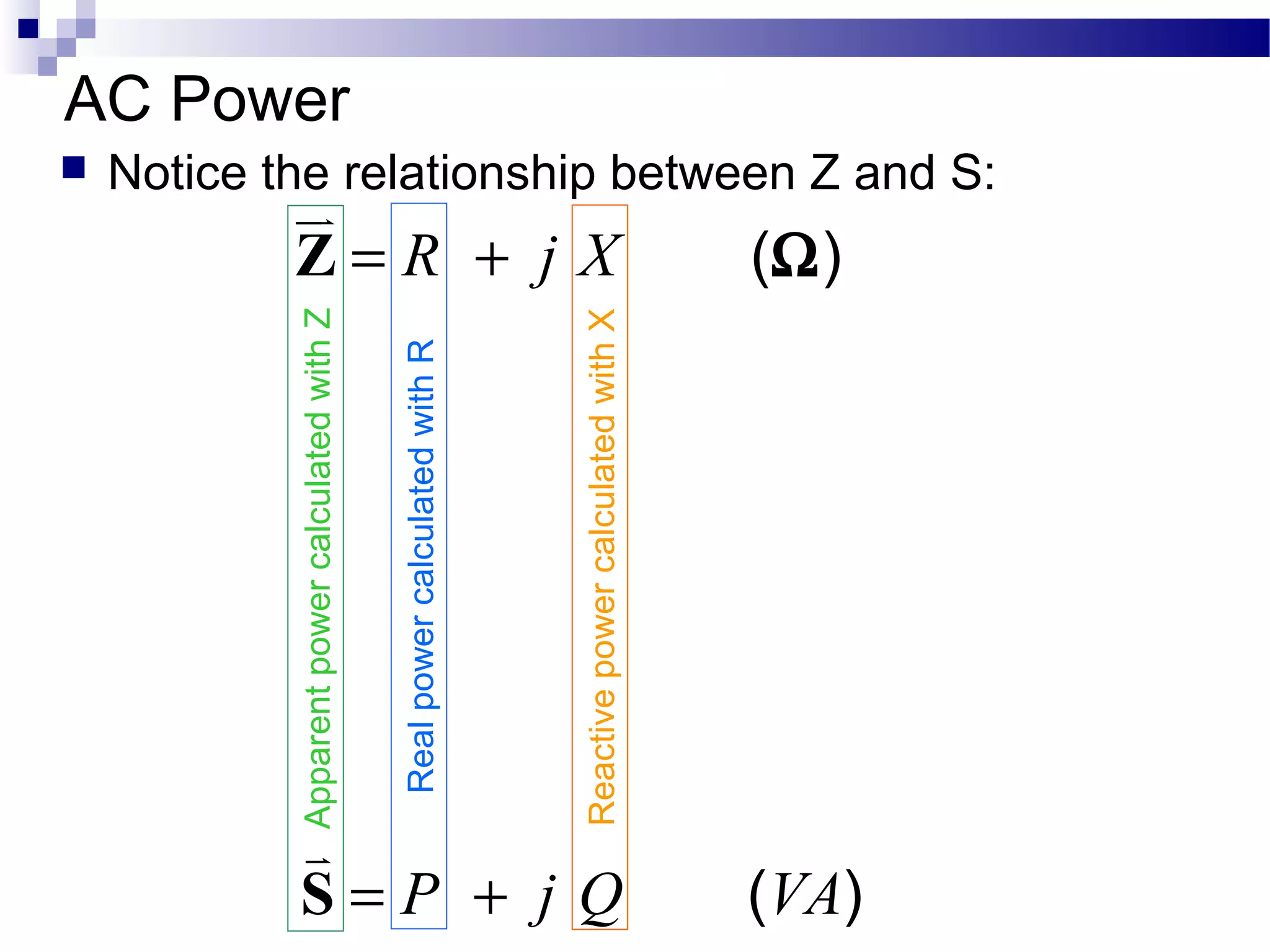
 AC Impedance is a complex quantity made up
of real resistance and imaginary reactance.
 AC Apparent Power is a complex quantity made
up of real active power and imaginary reactive
power:
R jX= +Z
uv
( )Ω
jQ AP V= +S
v
( )
AC Real (Active) Power (P)
 The Active power is the power that is dissipated
in the resistance of the load.
 It uses the same formula used for DC (V & I are
the magnitudes, not the phasors):
2
2
[watts, W]P I R
V
R
= =
WARNING! #1 mistake with AC power calculations!
The Voltage in the above equation is the Voltage drop across the resistor, not
across the entire circuit!
CAUTION!
REAL value of resistance (R) is used in REAL power calculations, not
IMPEDANCE (Z)!
AC Imaginary (Reactive) Power (Q)
 The reactive power is the power that is exchanged
between reactive components (inductors and capacitors)
 The formulas look similar to those used by the active
power, but use reactance instead of resistances.
 Units: Volts-Amps-Reactive (VAR)
 Q is negative for a capacitor by convention and positive
for inductor.
 Just like X is negative for a capacitor! (-Xcj)
2
2
[VAR]Q I X
X
V
= =
WARNING! #1 mistake with AC power calculations!
The Voltage in the above equation is the Voltage drop across the reactance,
not across the entire circuit!
AC Apparent Power (S)
 The apparent power is the power that is
“appears” to flow to the load.
 The magnitude of apparent power can be
calculated using similar formulas to those for
active or reactive power:
 Units: Volts-Amps (VA)
 V & I are the magnitudes, not the phasors
2
2
[VA]
V
S VI I Z
Z
= = =
AC Power
 Notice the relationship between Z and S:
R j X= +Z
uv
( )Ω
P j Q VA= +S
v
( )
RealpowercalculatedwithR
ReactivepowercalculatedwithX
ApparentpowercalculatedwithZ
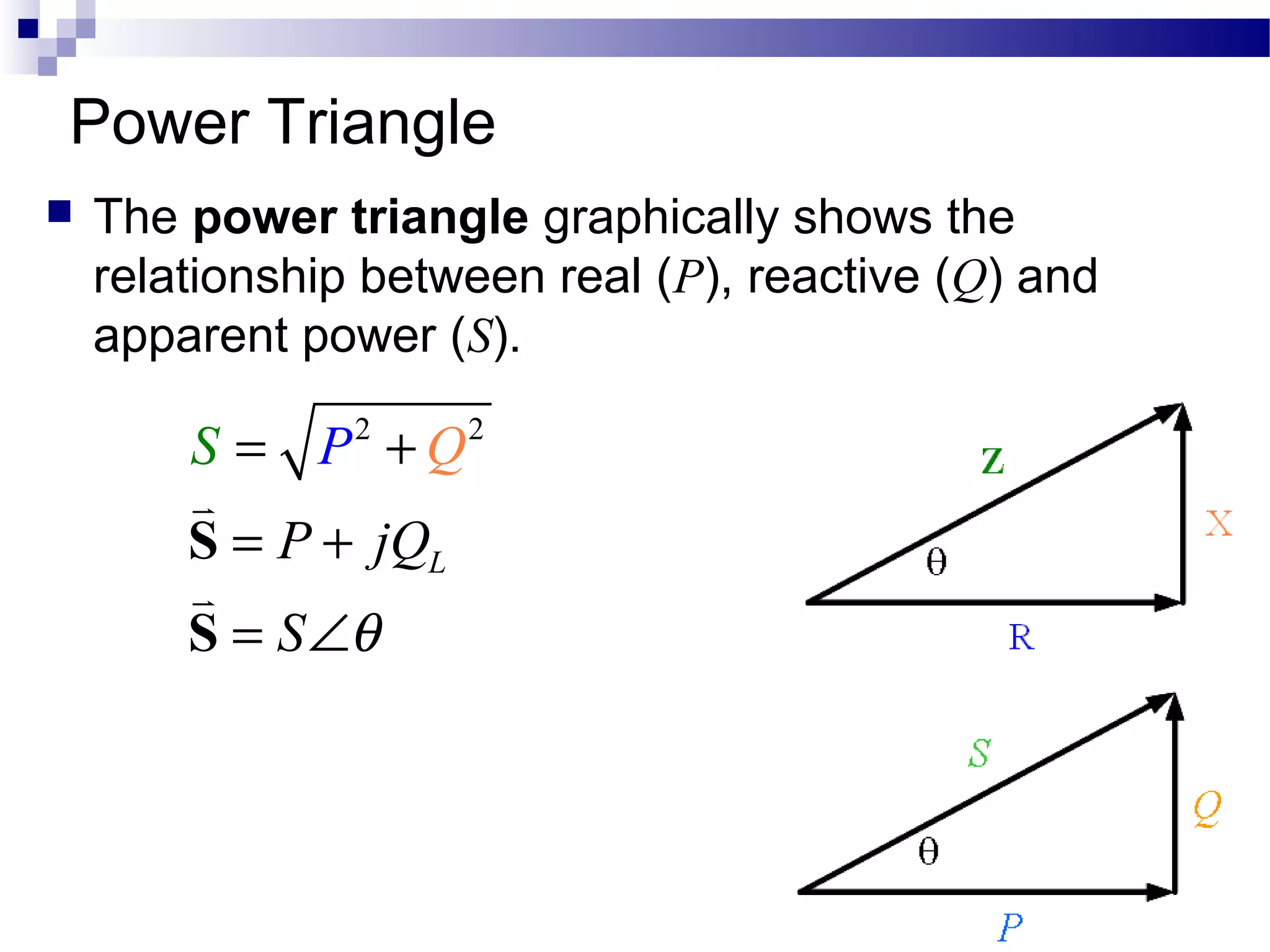
Power Triangle
 The power triangle graphically shows the
relationship between real (P), reactive (Q) and
apparent power (S).
2 2
LP jQ
QPS
S θ
= +
= +
= ∠
S
S
v
v
Example Problem 1
Determine the real and reactive power of each
component.
Determine the apparent power delivered by the
source.
Real and Reactive Power
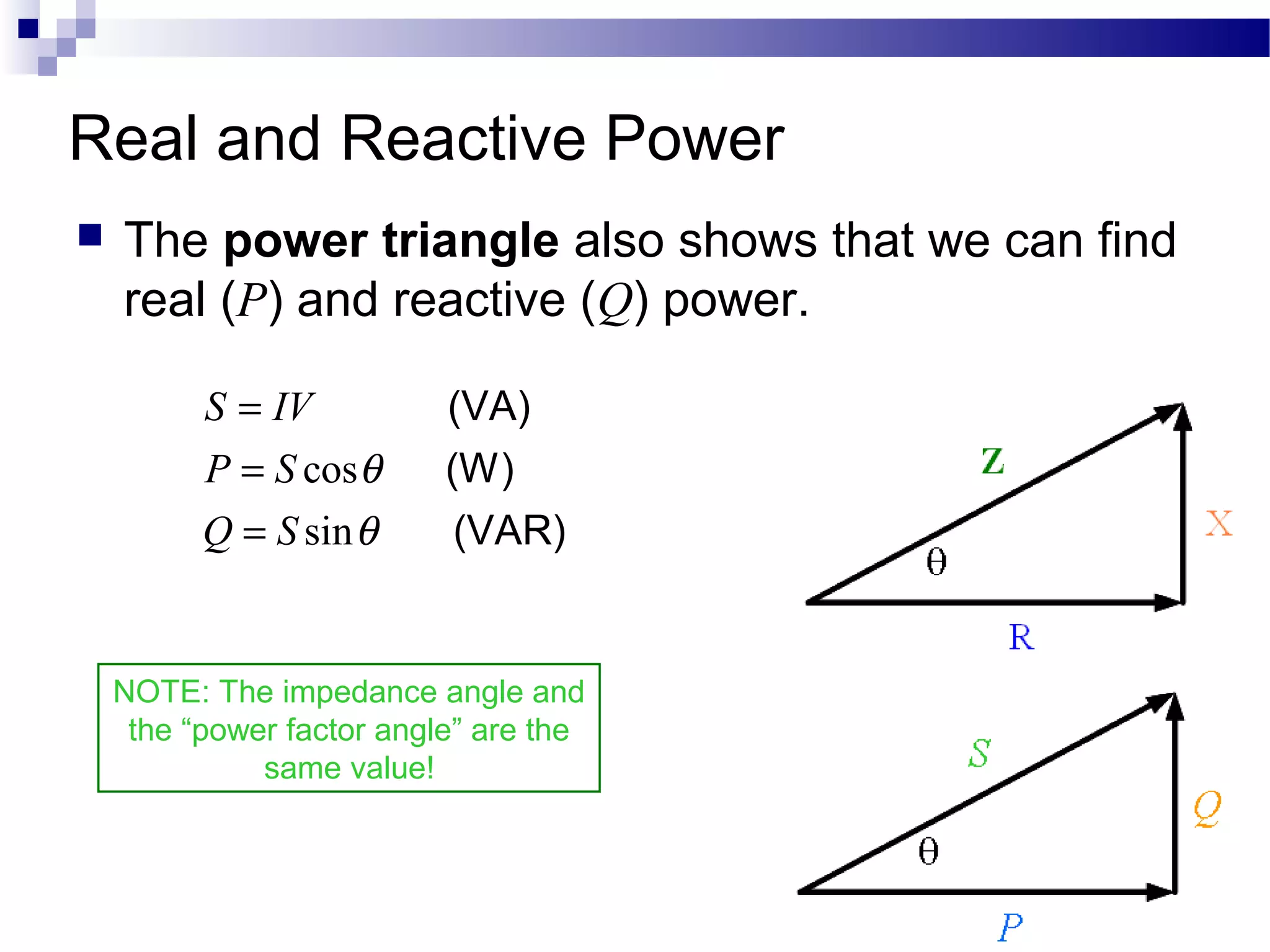
 The power triangle also shows that we can find
real (P) and reactive (Q) power.
cos
sin
S IV
P S
Q S
θ
θ
=
=
=
(VA)
(W)
(VAR)
NOTE: The impedance angle and
the “power factor angle” are the
same value!
Example Problem 2
Determine the apparent power, total real and
reactive power using the following equations:
cos
sin
S VI
P S
Q S
θ
θ
=
=
=
(VA)
(W)
(VAR)
Total Power in AC Circuits
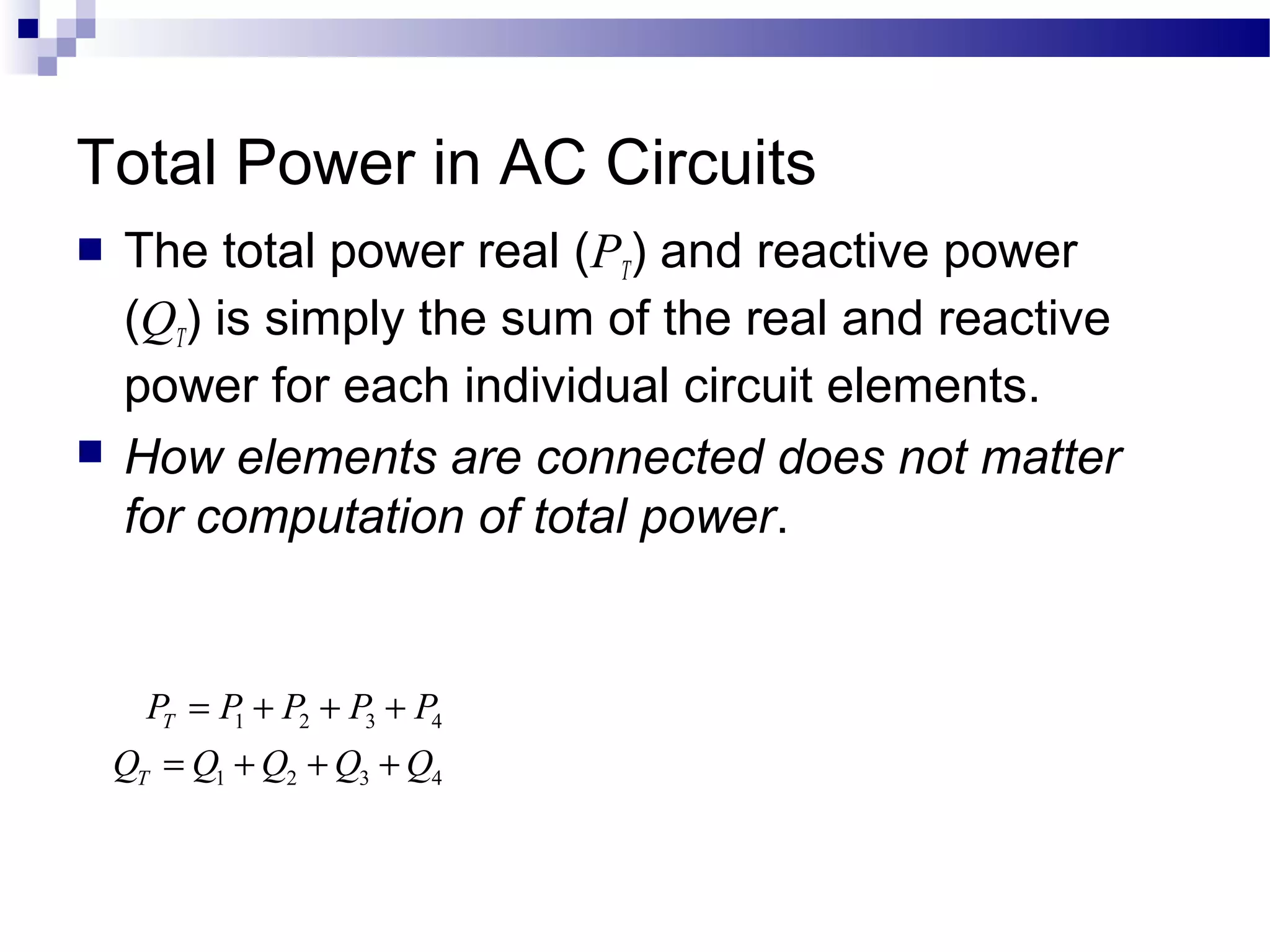
 The total power real (PT) and reactive power
(QT) is simply the sum of the real and reactive
power for each individual circuit elements.
 How elements are connected does not matter
for computation of total power.
1 2 3 4
1 2 3 4
T
T
P P P P P
Q Q Q Q Q
= + + +
= + + +
Total Power in AC Circuits
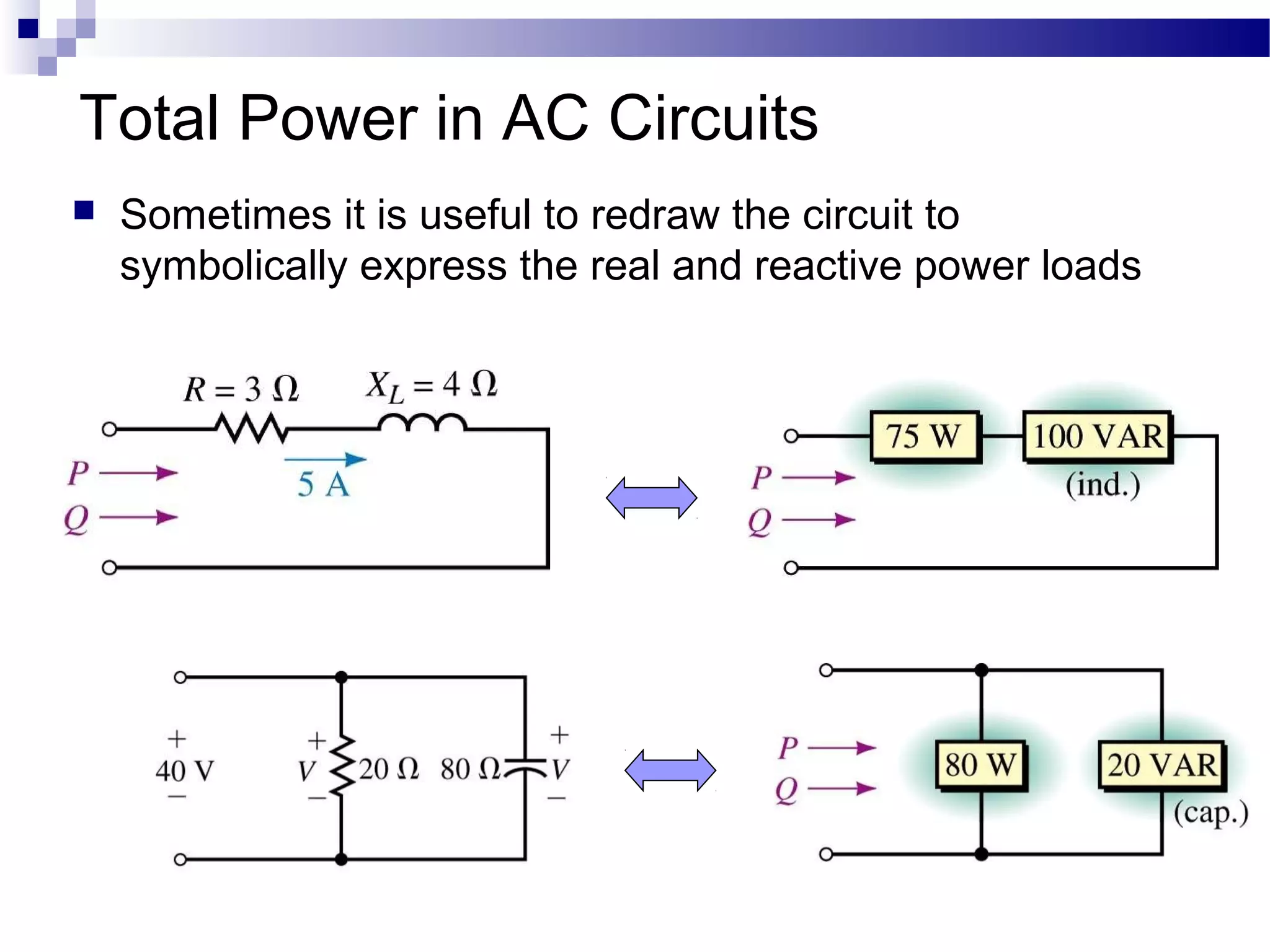
 Sometimes it is useful to redraw the circuit to
symbolically express the real and reactive power loads
Example Problem 3
a. Determine the unknown real (P2) and reactive powers
(Q3) in the circuit below.
b. Determine total apparent power
c. Draw the power triangle
d. Is the unknown element in Load #3 an inductor or
capacitor?
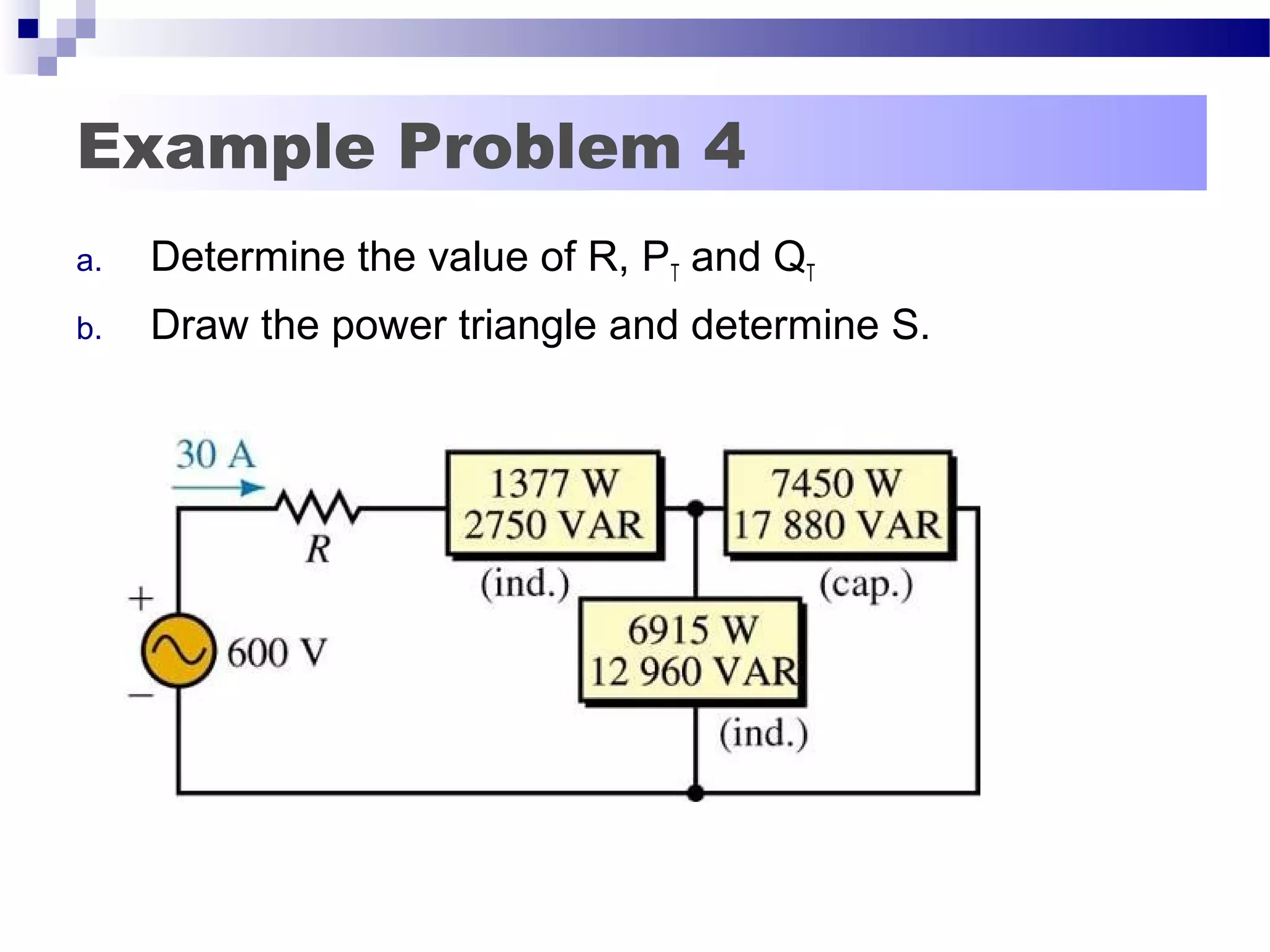
Example Problem 4
a. Determine the value of R, PT and QT
b. Draw the power triangle and determine S.
WARNING…
Proofs for Real and reactive
Power calculations follow…
AC Power to a Resistive Load
 In ac circuits, voltage and current are functions of time.
 Power at a particular instant in time is given
This is called instantaneous power.
( )2
( sin )( sin ) sin 1 cos2
2
m m
m m m m
V I
p vi V t I t V I t tω ω ω ω= = = = −
Average Power to a Resistive Load
 p is always positive
 All of the power delivered by the source is
absorbed by the load.
 Average power P = VmIm / 2
Average Power to a Resistive Load
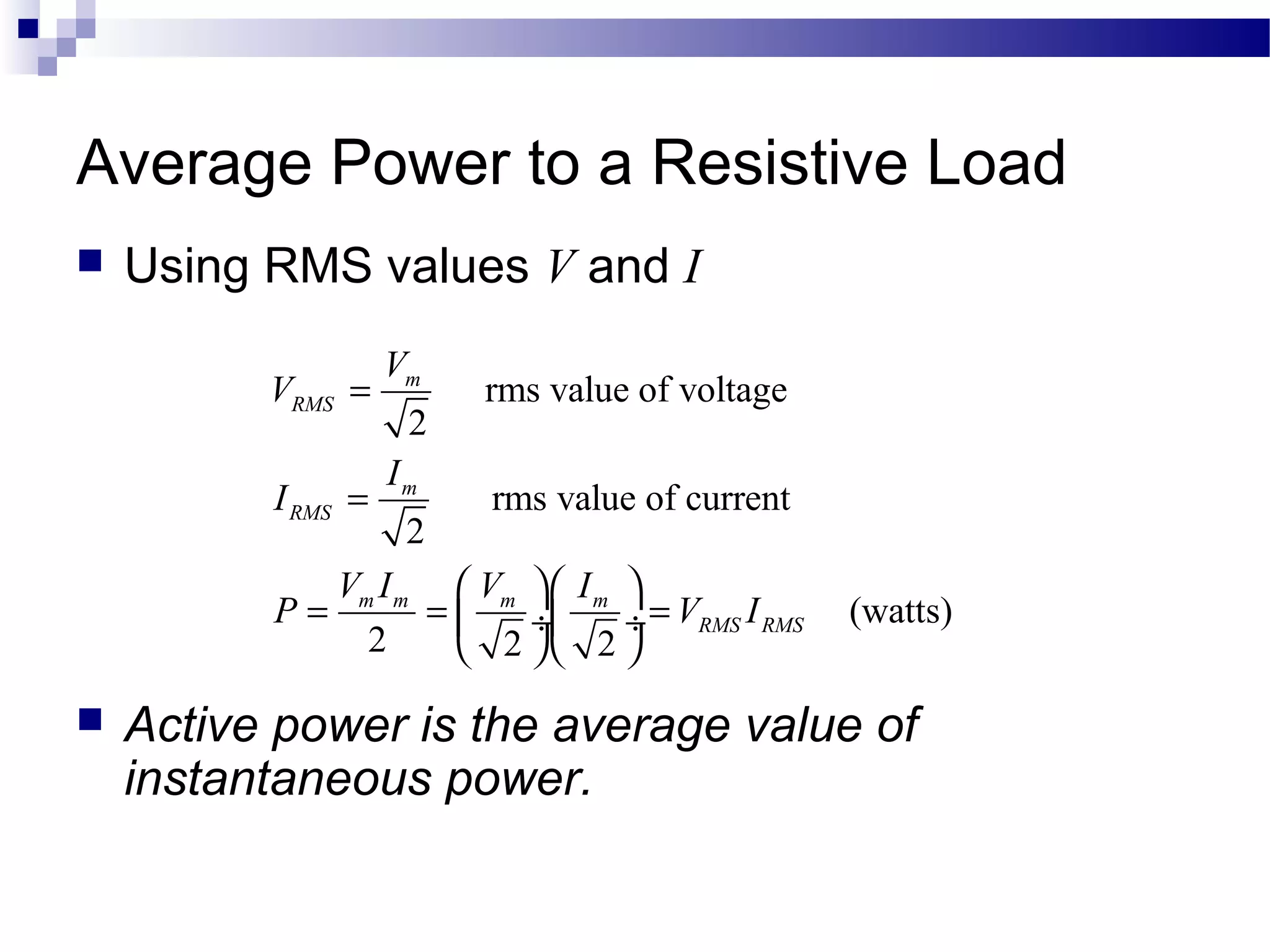
 Using RMS values V and I
 Active power is the average value of
instantaneous power.
rms value of voltage
2
rms value of current
2
(watts)
2 2 2
m
RMS
m
RMS
m m m m
RMS RMS
V
V
I
I
V I V I
P V I
=
=
  
= = = ÷ ÷
  
Power to an Inductive Load
 Consider the following circuit where
i = Im sin ωt .
 Can we write an expression
instantaneous power or pL(t) ?
Power to an Inductive Load
( )
sin
sin( 90)
( sin 90 )( sin ) cos sin
sin 2 sin 2 sin 2
2 2 2
m
m
m m m m
m m m m
RMS RMS
i I t
v V t
p vi V t I t V I t t
V I V I
t t V I t
ω
ω
ω ω ω ω
ω ω ω
=
= +
= = + =
  
= = = ÷ ÷
  
o
Power to an Inductive Load
 p is equally positive and negative.
 All of the power delivered by the source is
returned.
 Average power PL = 0 W
Reactive Power
 Reactive power is the portion of power
that flows into load and then back out.
 It contributes nothing to average power.
 The power that flows into and out of a
pure inductor is reactive power only.
Power to a Capacitive Load
 Consider the following circuit where
i = Im sin ωt .
 Can we write an expression
instantaneous power or pC(t) ?
Power to a Capacitive Load
( )
sin
sin( 90)
( sin 90 )( sin ) cos sin
sin 2 sin 2 sin 2
2 2 2
m
m
m m m m
m m m m
RMS RMS
i I t
v V t
p vi V t I t V I t t
V I V I
t t V I t
ω
ω
ω ω ω ω
ω ω ω
=
= −
= = − = −
  
= − = − = − ÷ ÷
  
o
Power to a Capacitive Load
 p is equally positive and negative
 All of the power delivered by the source is returned
(no power losses with a pure reactive load).
 Average power PC = 0 W
AC Power to a Resistive Load
AC Power to a Inductive Load
AC Power to a Capacitive Load

Ee301 lesson 25 ac power and pwr triangle

  • 1.
    Lesson 25 AC Powerand Power Triangle
  • 2.
    Learning Objectives  Definereal (active) power, reactive power, average, and apparent power.  Calculate the real, reactive, and apparent power in AC series parallel networks.  Graph the real and reactive power of purely resistive, inductive, or capacitive loads in AC series parallel networks as a function of time.  Determine when power is dissipated, stored, or released in purely resistive, inductive, or capacitive loads in AC series parallel networks.  Use the power triangle determine relationships between real, reactive and apparent power.
  • 3.
    AC Power  ACImpedance is a complex quantity made up of real resistance and imaginary reactance.  AC Apparent Power is a complex quantity made up of real active power and imaginary reactive power: R jX= +Z uv ( )Ω jQ AP V= +S v ( )
  • 4.
    AC Real (Active)Power (P)  The Active power is the power that is dissipated in the resistance of the load.  It uses the same formula used for DC (V & I are the magnitudes, not the phasors): 2 2 [watts, W]P I R V R = = WARNING! #1 mistake with AC power calculations! The Voltage in the above equation is the Voltage drop across the resistor, not across the entire circuit! CAUTION! REAL value of resistance (R) is used in REAL power calculations, not IMPEDANCE (Z)!
  • 5.
    AC Imaginary (Reactive)Power (Q)  The reactive power is the power that is exchanged between reactive components (inductors and capacitors)  The formulas look similar to those used by the active power, but use reactance instead of resistances.  Units: Volts-Amps-Reactive (VAR)  Q is negative for a capacitor by convention and positive for inductor.  Just like X is negative for a capacitor! (-Xcj) 2 2 [VAR]Q I X X V = = WARNING! #1 mistake with AC power calculations! The Voltage in the above equation is the Voltage drop across the reactance, not across the entire circuit!
  • 6.
    AC Apparent Power(S)  The apparent power is the power that is “appears” to flow to the load.  The magnitude of apparent power can be calculated using similar formulas to those for active or reactive power:  Units: Volts-Amps (VA)  V & I are the magnitudes, not the phasors 2 2 [VA] V S VI I Z Z = = =
  • 7.
    AC Power  Noticethe relationship between Z and S: R j X= +Z uv ( )Ω P j Q VA= +S v ( ) RealpowercalculatedwithR ReactivepowercalculatedwithX ApparentpowercalculatedwithZ
  • 8.
    Power Triangle  Thepower triangle graphically shows the relationship between real (P), reactive (Q) and apparent power (S). 2 2 LP jQ QPS S θ = + = + = ∠ S S v v
  • 9.
    Example Problem 1 Determinethe real and reactive power of each component. Determine the apparent power delivered by the source.
  • 10.
    Real and ReactivePower  The power triangle also shows that we can find real (P) and reactive (Q) power. cos sin S IV P S Q S θ θ = = = (VA) (W) (VAR) NOTE: The impedance angle and the “power factor angle” are the same value!
  • 11.
    Example Problem 2 Determinethe apparent power, total real and reactive power using the following equations: cos sin S VI P S Q S θ θ = = = (VA) (W) (VAR)
  • 12.
    Total Power inAC Circuits  The total power real (PT) and reactive power (QT) is simply the sum of the real and reactive power for each individual circuit elements.  How elements are connected does not matter for computation of total power. 1 2 3 4 1 2 3 4 T T P P P P P Q Q Q Q Q = + + + = + + +
  • 13.
    Total Power inAC Circuits  Sometimes it is useful to redraw the circuit to symbolically express the real and reactive power loads
  • 14.
    Example Problem 3 a.Determine the unknown real (P2) and reactive powers (Q3) in the circuit below. b. Determine total apparent power c. Draw the power triangle d. Is the unknown element in Load #3 an inductor or capacitor?
  • 15.
    Example Problem 4 a.Determine the value of R, PT and QT b. Draw the power triangle and determine S.
  • 16.
    WARNING… Proofs for Realand reactive Power calculations follow…
  • 17.
    AC Power toa Resistive Load  In ac circuits, voltage and current are functions of time.  Power at a particular instant in time is given This is called instantaneous power. ( )2 ( sin )( sin ) sin 1 cos2 2 m m m m m m V I p vi V t I t V I t tω ω ω ω= = = = −
  • 18.
    Average Power toa Resistive Load  p is always positive  All of the power delivered by the source is absorbed by the load.  Average power P = VmIm / 2
  • 19.
    Average Power toa Resistive Load  Using RMS values V and I  Active power is the average value of instantaneous power. rms value of voltage 2 rms value of current 2 (watts) 2 2 2 m RMS m RMS m m m m RMS RMS V V I I V I V I P V I = =    = = = ÷ ÷   
  • 20.
    Power to anInductive Load  Consider the following circuit where i = Im sin ωt .  Can we write an expression instantaneous power or pL(t) ?
  • 21.
    Power to anInductive Load ( ) sin sin( 90) ( sin 90 )( sin ) cos sin sin 2 sin 2 sin 2 2 2 2 m m m m m m m m m m RMS RMS i I t v V t p vi V t I t V I t t V I V I t t V I t ω ω ω ω ω ω ω ω ω = = + = = + =    = = = ÷ ÷    o
  • 22.
    Power to anInductive Load  p is equally positive and negative.  All of the power delivered by the source is returned.  Average power PL = 0 W
  • 23.
    Reactive Power  Reactivepower is the portion of power that flows into load and then back out.  It contributes nothing to average power.  The power that flows into and out of a pure inductor is reactive power only.
  • 24.
    Power to aCapacitive Load  Consider the following circuit where i = Im sin ωt .  Can we write an expression instantaneous power or pC(t) ?
  • 25.
    Power to aCapacitive Load ( ) sin sin( 90) ( sin 90 )( sin ) cos sin sin 2 sin 2 sin 2 2 2 2 m m m m m m m m m m RMS RMS i I t v V t p vi V t I t V I t t V I V I t t V I t ω ω ω ω ω ω ω ω ω = = − = = − = −    = − = − = − ÷ ÷    o
  • 26.
    Power to aCapacitive Load  p is equally positive and negative  All of the power delivered by the source is returned (no power losses with a pure reactive load).  Average power PC = 0 W
  • 27.
    AC Power toa Resistive Load AC Power to a Inductive Load AC Power to a Capacitive Load