Absenteeism &Turnover of
nursing staff
Prepared by : Ahmed Mohammed Zinhom.
NURSING ADMINISTRATION MASTER
F.O.N CAIRO UNIVERSITY
Objectives:
Objectives(cont,):
• Define turnover.
• Compute turnover rate.
• Differentiate between types of turnover.
• Discuss the causes of turnover .
• Produce one or more methods of reducing
turnover rate.
• Explain how to increase staff retention
8. Definition of turnover.
9. Computation of turnover.
10. Types of turnover.
11. Causes of turnover.
12. How to reduce the turnover rate.
13. Retention definition and methods.
What is Absenteeism?
• Failure of employees to report for work
when they are scheduled to work.
• Absenteeism is the term generally used
to refer to scheduled employee absences
from the workplace.
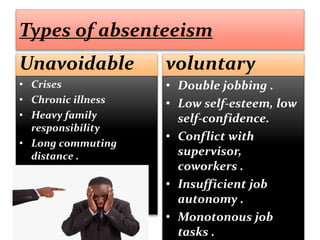
Types of absenteeism
Unavoidable
• Crises
• Chronic illness
• Heavy family
responsibility
• Long commuting
distance .
voluntary
• Double jobbing .
• Low self-esteem, low
self-confidence.
• Conflict with
supervisor,
coworkers .
• Insufficient job
autonomy .
• Monotonous job
tasks .
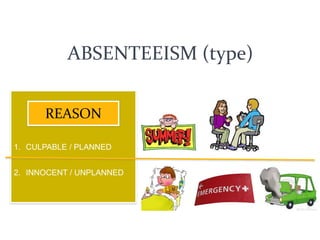
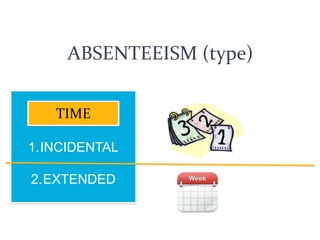
ABSENTEEISM (type)
1. CULPABLE / PLANNED
2. INNOCENT / UNPLANNED
REASON
ABSENTEEISM (type)
1.INCIDENTAL
2.EXTENDED
TIME
Absenteeism theory
• Economic theory .
• Psychological theory .
• Sociological theory .
• Jurisprudential theory .(‫القانون‬ ‫استخدام‬)
• Disability theory .
Cont, Absenteeism theory
• Economic theory :
according to Economic theory,
people dislike work and will work only if
they have to money.
If the income generated by working full-
time is more than individual needs to
maintain an adequate standard of living,
the individual every day.
Cont, Absenteeism theory
• Psychological theory :
according to Psychological
theory, absenteeism is a work’s behavioral
response to job dissatisfaction, doesn't
receive appropriate recognition or reword
for work achievements.
Cot, Absenteeism theory
• Sociological theory:
according Sociological theory, multiple
societal, organization, and work groups
factors facilitate Or impede an employee's
ability and desire to attend work.
• EX. In some work group job attendance
is a highly value norm.
Cont, Absenteeism theory
• Jurisprudential theory .( ‫استخدام‬
‫القانون‬)
according to Jurisprudential
theory, the ideal use to law that will
decrease the level of absenteeism.
Cont, Absenteeism theory
• Disability theory :
according disability theory,
employee’s will make absent days due to
illness or injury or health problems .
Computing absenteeism
• Common methods for quantifying
absenteeism are time lost
percentage and absence frequency
rate.
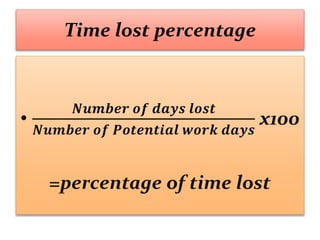
Time lost percentage
•
𝑵𝒖𝒎𝒃𝒆𝒓 𝒐𝒇 𝒅𝒂𝒚𝒔 𝒍𝒐𝒔𝒕
𝑵𝒖𝒎𝒃𝒆𝒓 𝒐𝒇 𝑷𝒐𝒕𝒆𝒏𝒕𝒊𝒂𝒍 𝒘𝒐𝒓𝒌 𝒅𝒂𝒚𝒔
x100
=percentage of time lost
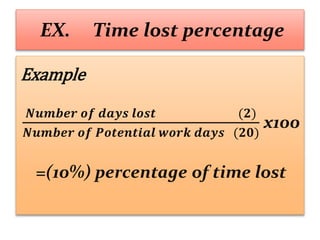
EX. Time lost percentage
Example
𝑵𝒖𝒎𝒃𝒆𝒓 𝒐𝒇 𝒅𝒂𝒚𝒔 𝒍𝒐𝒔𝒕 (𝟐)
𝑵𝒖𝒎𝒃𝒆𝒓 𝒐𝒇 𝑷𝒐𝒕𝒆𝒏𝒕𝒊𝒂𝒍 𝒘𝒐𝒓𝒌 𝒅𝒂𝒚𝒔 (𝟐𝟎)
x100
=(10%) percentage of time lost
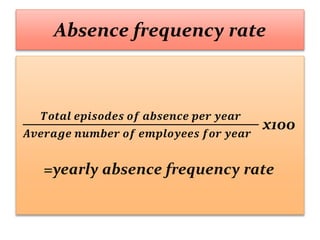
Absence frequency rate
𝑻𝒐𝒕𝒂𝒍 𝒆𝒑𝒊𝒔𝒐𝒅𝒆𝒔 𝒐𝒇 𝒂𝒃𝒔𝒆𝒏𝒄𝒆 𝒑𝒆𝒓 𝒚𝒆𝒂𝒓
𝑨𝒗𝒆𝒓𝒂𝒈𝒆 𝒏𝒖𝒎𝒃𝒆𝒓 𝒐𝒇 𝒆𝒎𝒑𝒍𝒐𝒚𝒆𝒆𝒔 𝒇𝒐𝒓 𝒚𝒆𝒂𝒓
x100
=yearly absence frequency rate
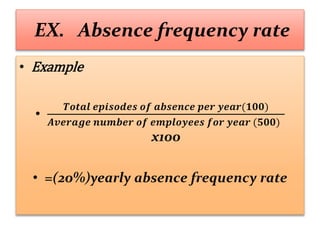
EX. Absence frequency rate
• Example
•
𝑻𝒐𝒕𝒂𝒍 𝒆𝒑𝒊𝒔𝒐𝒅𝒆𝒔 𝒐𝒇 𝒂𝒃𝒔𝒆𝒏𝒄𝒆 𝒑𝒆𝒓 𝒚𝒆𝒂𝒓(𝟏𝟎𝟎)
𝑨𝒗𝒆𝒓𝒂𝒈𝒆 𝒏𝒖𝒎𝒃𝒆𝒓 𝒐𝒇 𝒆𝒎𝒑𝒍𝒐𝒚𝒆𝒆𝒔 𝒇𝒐𝒓 𝒚𝒆𝒂𝒓 (𝟓𝟎𝟎)
x100
• =(20%)yearly absence frequency rate
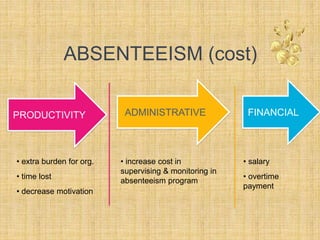
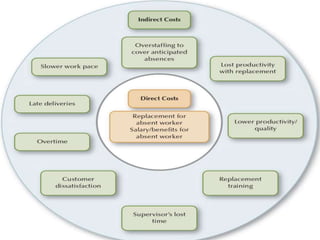
ABSENTEEISM (cost)
PRODUCTIVITY ADMINISTRATIVE FINANCIAL
• extra burden for org.
• time lost
• decrease motivation
• increase cost in
supervising & monitoring in
absenteeism program
• salary
• overtime
payment
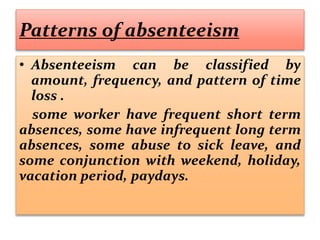
Patterns of absenteeism
• Absenteeism can be classified by
amount, frequency, and pattern of time
loss .
some worker have frequent short term
absences, some have infrequent long term
absences, some abuse to sick leave, and
some conjunction with weekend, holiday,
vacation period, paydays.
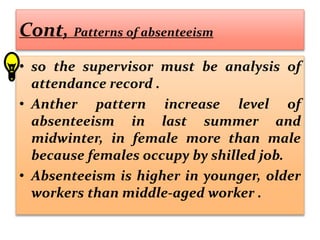
Cont, Patterns of absenteeism
• so the supervisor must be analysis of
attendance record .
• Anther pattern increase level of
absenteeism in last summer and
midwinter, in female more than male
because females occupy by shilled job.
• Absenteeism is higher in younger, older
workers than middle-aged worker .
Methods of reducing absenteeism
• Several methods have been used to
combat absenteeism, with varying
degrees of success.
Cont. Methods of reducing absenteeism
• First step in reducing absenteeism make
accurate records of employee
attendance and calculate absenteeism
rates at regular intervals to identify
each employees pattern of attendance .
Cont. Methods of reducing absenteeism
• After analysis the record make
counseled by employees have excessive
absenteeism and discover causes of
absenteeism and eliminate those causes
.
Cont. Methods of reducing absenteeism
• Any absenteeism rate of 4% is excessive
and should signal the need for
counseling .
• In one agency annual sick time between
24-48.5 hours per employee this is signal
to sick abuse manager should observe
the litter of sick time .
Cont. Methods of reducing absenteeism
• The Mangers should establish a formal
and procedure to excuse of absent from
work this procedure must be document
.
Cont. Methods of reducing absenteeism
• Make visiting nurse was assigned to
contact each employee who absent from
work because of illness, this nurse was
responsible assessing the worker’s
health needs, help him to contact with
medical time and give health teaching
.(castillo, 1997).
Cont. Methods of reducing absenteeism
• Another method for reducing employees
illness absence through provide free
health care programs in local clinic .
Cont. Methods of reducing absenteeism
Advantages
1-deacres financial lode on employee
and agency.
2-save time to employee and agence
.
3- reduce absenteeism rate .
(plunkett,1975)
Cont. Methods of reducing absenteeism
• Incisor safety work environment .
• Increase motivation on the staff.
• Increase self-esteem .
• Resolve the staff conflicts .
• Increase norm of cooperation between
the staff .
Memo Capsule
Decrease Absenteeism
• Require worker phone supervisor,
explain reason for absence .
• Public health nurse visits ill employee at
home.
• Safety and accidental prevention
programs .
Cont. Decrease Absenteeism
• Flexible staffing policies .
• Reward good attendance .
• Punishment for excessive,
inappropriate absence.
Turnover
• Definition :
turnover is the percentage of
employed nurses who are separated from
their jobs during a year time . (ferguson
1986).
Types of turnover
• Four types of turnover:
Voluntary, Involuntary,
Functional,
Dysfunctional.
Cont. Types of turnover
• Voluntary turnover consists of
employees exercising their free choice to
leave
• Involuntary turnover consists of
separations where an employee
unwilling leaves.

Cot. Types of turnover
• Functional turnover is when low
performing employees leave
• Dysfunctional turnover is when high
performing employees leave
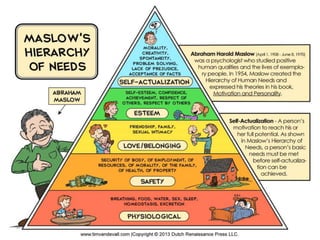
Causes of turnover
• Incongruity between agency’s and
employee’s goals.
• Low status, low autonomy of nursing
personal.
Cont. Causes of turnover
• Negative sanctions for nurse’s assertive
behavior.
• Misunderstanding between older
nonprofessional and younger
professional worker.
Cont. Causes of turnover
• Job role ambiguity, confusion .
• Discrepancy between expected and
experienced work schedule .
Cont. Causes of turnover
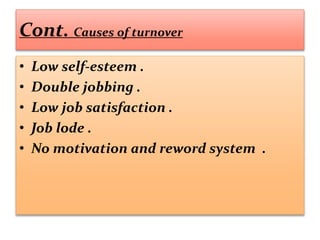
• Low self-esteem .
• Double jobbing .
• Low job satisfaction .
• Job lode .
• No motivation and reword system .
Cont. Causes of turnover
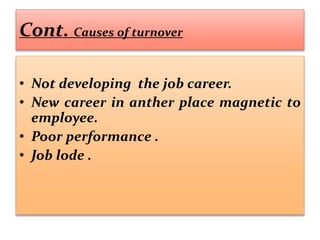
• Not developing the job career.
• New career in anther place magnetic to
employee.
• Poor performance .
• Job lode .
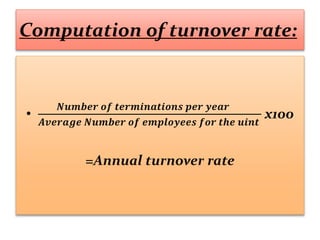
Computation of turnover rate:
•
𝑵𝒖𝒎𝒃𝒆𝒓 𝒐𝒇 𝒕𝒆𝒓𝒎𝒊𝒏𝒂𝒕𝒊𝒐𝒏𝒔 𝒑𝒆𝒓 𝒚𝒆𝒂𝒓
𝑨𝒗𝒆𝒓𝒂𝒈𝒆 𝑵𝒖𝒎𝒃𝒆𝒓 𝒐𝒇 𝒆𝒎𝒑𝒍𝒐𝒚𝒆𝒆𝒔 𝒇𝒐𝒓 𝒕𝒉𝒆 𝒖𝒊𝒏𝒕
x100
=Annual turnover rate
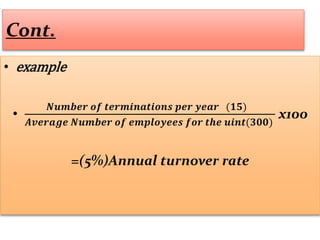
Cont.
• example
•
𝑵𝒖𝒎𝒃𝒆𝒓 𝒐𝒇 𝒕𝒆𝒓𝒎𝒊𝒏𝒂𝒕𝒊𝒐𝒏𝒔 𝒑𝒆𝒓 𝒚𝒆𝒂𝒓 (𝟏𝟓)
𝑨𝒗𝒆𝒓𝒂𝒈𝒆 𝑵𝒖𝒎𝒃𝒆𝒓 𝒐𝒇 𝒆𝒎𝒑𝒍𝒐𝒚𝒆𝒆𝒔 𝒇𝒐𝒓 𝒕𝒉𝒆 𝒖𝒊𝒏𝒕(𝟑𝟎𝟎)
x100
=(5%)Annual turnover rate
How reduce turnover rate ?
• Accurate job description: include
positive and negative aspects of
position .
• Pre-employment tour of unit :
orientation period to allow applicant to
visit unit, talk with staff.
Cont.
• Individualize orientation provide
information, practice to increase self
confidence .
• Teambuilding : group development
activity .
Cont.
• Relation leadership : managers provide
consideration and task direction .
• Supportive performance evaluation :
provide self, peer, and manager
evaluation .
Cont.
• Prevent verbal abuse : offer
assertiveness training for nurses, joint
practice committees.
• Participative management :
decentralize clinical decision making to
staff nurse level.
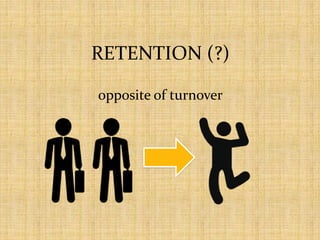
RETENTION (?)
opposite of turnover
Absenteeism and turn over

Absenteeism and turn over

  • 1.
    Absenteeism &Turnover of nursingstaff Prepared by : Ahmed Mohammed Zinhom. NURSING ADMINISTRATION MASTER F.O.N CAIRO UNIVERSITY
  • 2.
  • 3.
    Objectives(cont,): • Define turnover. •Compute turnover rate. • Differentiate between types of turnover. • Discuss the causes of turnover . • Produce one or more methods of reducing turnover rate. • Explain how to increase staff retention
  • 5.
    8. Definition ofturnover. 9. Computation of turnover. 10. Types of turnover. 11. Causes of turnover. 12. How to reduce the turnover rate. 13. Retention definition and methods.
  • 6.
    What is Absenteeism? •Failure of employees to report for work when they are scheduled to work. • Absenteeism is the term generally used to refer to scheduled employee absences from the workplace.
  • 7.
    Types of absenteeism Unavoidable •Crises • Chronic illness • Heavy family responsibility • Long commuting distance . voluntary • Double jobbing . • Low self-esteem, low self-confidence. • Conflict with supervisor, coworkers . • Insufficient job autonomy . • Monotonous job tasks .
  • 8.
    ABSENTEEISM (type) 1. CULPABLE/ PLANNED 2. INNOCENT / UNPLANNED REASON
  • 9.
  • 10.
    Absenteeism theory • Economictheory . • Psychological theory . • Sociological theory . • Jurisprudential theory .(‫القانون‬ ‫استخدام‬) • Disability theory .
  • 11.
    Cont, Absenteeism theory •Economic theory : according to Economic theory, people dislike work and will work only if they have to money. If the income generated by working full- time is more than individual needs to maintain an adequate standard of living, the individual every day.
  • 12.
    Cont, Absenteeism theory •Psychological theory : according to Psychological theory, absenteeism is a work’s behavioral response to job dissatisfaction, doesn't receive appropriate recognition or reword for work achievements.
  • 13.
    Cot, Absenteeism theory •Sociological theory: according Sociological theory, multiple societal, organization, and work groups factors facilitate Or impede an employee's ability and desire to attend work. • EX. In some work group job attendance is a highly value norm.
  • 14.
    Cont, Absenteeism theory •Jurisprudential theory .( ‫استخدام‬ ‫القانون‬) according to Jurisprudential theory, the ideal use to law that will decrease the level of absenteeism.
  • 15.
    Cont, Absenteeism theory •Disability theory : according disability theory, employee’s will make absent days due to illness or injury or health problems .
  • 16.
    Computing absenteeism • Commonmethods for quantifying absenteeism are time lost percentage and absence frequency rate.
  • 17.
    Time lost percentage • 𝑵𝒖𝒎𝒃𝒆𝒓𝒐𝒇 𝒅𝒂𝒚𝒔 𝒍𝒐𝒔𝒕 𝑵𝒖𝒎𝒃𝒆𝒓 𝒐𝒇 𝑷𝒐𝒕𝒆𝒏𝒕𝒊𝒂𝒍 𝒘𝒐𝒓𝒌 𝒅𝒂𝒚𝒔 x100 =percentage of time lost
  • 18.
    EX. Time lostpercentage Example 𝑵𝒖𝒎𝒃𝒆𝒓 𝒐𝒇 𝒅𝒂𝒚𝒔 𝒍𝒐𝒔𝒕 (𝟐) 𝑵𝒖𝒎𝒃𝒆𝒓 𝒐𝒇 𝑷𝒐𝒕𝒆𝒏𝒕𝒊𝒂𝒍 𝒘𝒐𝒓𝒌 𝒅𝒂𝒚𝒔 (𝟐𝟎) x100 =(10%) percentage of time lost
  • 19.
    Absence frequency rate 𝑻𝒐𝒕𝒂𝒍𝒆𝒑𝒊𝒔𝒐𝒅𝒆𝒔 𝒐𝒇 𝒂𝒃𝒔𝒆𝒏𝒄𝒆 𝒑𝒆𝒓 𝒚𝒆𝒂𝒓 𝑨𝒗𝒆𝒓𝒂𝒈𝒆 𝒏𝒖𝒎𝒃𝒆𝒓 𝒐𝒇 𝒆𝒎𝒑𝒍𝒐𝒚𝒆𝒆𝒔 𝒇𝒐𝒓 𝒚𝒆𝒂𝒓 x100 =yearly absence frequency rate
  • 20.
    EX. Absence frequencyrate • Example • 𝑻𝒐𝒕𝒂𝒍 𝒆𝒑𝒊𝒔𝒐𝒅𝒆𝒔 𝒐𝒇 𝒂𝒃𝒔𝒆𝒏𝒄𝒆 𝒑𝒆𝒓 𝒚𝒆𝒂𝒓(𝟏𝟎𝟎) 𝑨𝒗𝒆𝒓𝒂𝒈𝒆 𝒏𝒖𝒎𝒃𝒆𝒓 𝒐𝒇 𝒆𝒎𝒑𝒍𝒐𝒚𝒆𝒆𝒔 𝒇𝒐𝒓 𝒚𝒆𝒂𝒓 (𝟓𝟎𝟎) x100 • =(20%)yearly absence frequency rate
  • 21.
    ABSENTEEISM (cost) PRODUCTIVITY ADMINISTRATIVEFINANCIAL • extra burden for org. • time lost • decrease motivation • increase cost in supervising & monitoring in absenteeism program • salary • overtime payment
  • 23.
    Patterns of absenteeism •Absenteeism can be classified by amount, frequency, and pattern of time loss . some worker have frequent short term absences, some have infrequent long term absences, some abuse to sick leave, and some conjunction with weekend, holiday, vacation period, paydays.
  • 24.
    Cont, Patterns ofabsenteeism • so the supervisor must be analysis of attendance record . • Anther pattern increase level of absenteeism in last summer and midwinter, in female more than male because females occupy by shilled job. • Absenteeism is higher in younger, older workers than middle-aged worker .
  • 25.
    Methods of reducingabsenteeism • Several methods have been used to combat absenteeism, with varying degrees of success.
  • 26.
    Cont. Methods ofreducing absenteeism • First step in reducing absenteeism make accurate records of employee attendance and calculate absenteeism rates at regular intervals to identify each employees pattern of attendance .
  • 27.
    Cont. Methods ofreducing absenteeism • After analysis the record make counseled by employees have excessive absenteeism and discover causes of absenteeism and eliminate those causes .
  • 28.
    Cont. Methods ofreducing absenteeism • Any absenteeism rate of 4% is excessive and should signal the need for counseling . • In one agency annual sick time between 24-48.5 hours per employee this is signal to sick abuse manager should observe the litter of sick time .
  • 29.
    Cont. Methods ofreducing absenteeism • The Mangers should establish a formal and procedure to excuse of absent from work this procedure must be document .
  • 30.
    Cont. Methods ofreducing absenteeism • Make visiting nurse was assigned to contact each employee who absent from work because of illness, this nurse was responsible assessing the worker’s health needs, help him to contact with medical time and give health teaching .(castillo, 1997).
  • 31.
    Cont. Methods ofreducing absenteeism • Another method for reducing employees illness absence through provide free health care programs in local clinic .
  • 32.
    Cont. Methods ofreducing absenteeism Advantages 1-deacres financial lode on employee and agency. 2-save time to employee and agence . 3- reduce absenteeism rate . (plunkett,1975)
  • 33.
    Cont. Methods ofreducing absenteeism • Incisor safety work environment . • Increase motivation on the staff. • Increase self-esteem . • Resolve the staff conflicts . • Increase norm of cooperation between the staff .
  • 34.
    Memo Capsule Decrease Absenteeism •Require worker phone supervisor, explain reason for absence . • Public health nurse visits ill employee at home. • Safety and accidental prevention programs .
  • 35.
    Cont. Decrease Absenteeism •Flexible staffing policies . • Reward good attendance . • Punishment for excessive, inappropriate absence.
  • 37.
    Turnover • Definition : turnoveris the percentage of employed nurses who are separated from their jobs during a year time . (ferguson 1986).
  • 38.
    Types of turnover •Four types of turnover: Voluntary, Involuntary, Functional, Dysfunctional.
  • 39.
    Cont. Types ofturnover • Voluntary turnover consists of employees exercising their free choice to leave • Involuntary turnover consists of separations where an employee unwilling leaves.
  • 40.
    Cot. Types ofturnover • Functional turnover is when low performing employees leave • Dysfunctional turnover is when high performing employees leave
  • 41.
  • 42.
    • Incongruity betweenagency’s and employee’s goals. • Low status, low autonomy of nursing personal.
  • 43.
    Cont. Causes ofturnover • Negative sanctions for nurse’s assertive behavior. • Misunderstanding between older nonprofessional and younger professional worker.
  • 44.
    Cont. Causes ofturnover • Job role ambiguity, confusion . • Discrepancy between expected and experienced work schedule .
  • 45.
    Cont. Causes ofturnover • Low self-esteem . • Double jobbing . • Low job satisfaction . • Job lode . • No motivation and reword system .
  • 46.
    Cont. Causes ofturnover • Not developing the job career. • New career in anther place magnetic to employee. • Poor performance . • Job lode .
  • 47.
    Computation of turnoverrate: • 𝑵𝒖𝒎𝒃𝒆𝒓 𝒐𝒇 𝒕𝒆𝒓𝒎𝒊𝒏𝒂𝒕𝒊𝒐𝒏𝒔 𝒑𝒆𝒓 𝒚𝒆𝒂𝒓 𝑨𝒗𝒆𝒓𝒂𝒈𝒆 𝑵𝒖𝒎𝒃𝒆𝒓 𝒐𝒇 𝒆𝒎𝒑𝒍𝒐𝒚𝒆𝒆𝒔 𝒇𝒐𝒓 𝒕𝒉𝒆 𝒖𝒊𝒏𝒕 x100 =Annual turnover rate
  • 48.
    Cont. • example • 𝑵𝒖𝒎𝒃𝒆𝒓 𝒐𝒇𝒕𝒆𝒓𝒎𝒊𝒏𝒂𝒕𝒊𝒐𝒏𝒔 𝒑𝒆𝒓 𝒚𝒆𝒂𝒓 (𝟏𝟓) 𝑨𝒗𝒆𝒓𝒂𝒈𝒆 𝑵𝒖𝒎𝒃𝒆𝒓 𝒐𝒇 𝒆𝒎𝒑𝒍𝒐𝒚𝒆𝒆𝒔 𝒇𝒐𝒓 𝒕𝒉𝒆 𝒖𝒊𝒏𝒕(𝟑𝟎𝟎) x100 =(5%)Annual turnover rate
  • 49.
  • 50.
    How reduce turnoverrate ? • Accurate job description: include positive and negative aspects of position . • Pre-employment tour of unit : orientation period to allow applicant to visit unit, talk with staff.
  • 51.
    Cont. • Individualize orientationprovide information, practice to increase self confidence . • Teambuilding : group development activity .
  • 52.
    Cont. • Relation leadership: managers provide consideration and task direction . • Supportive performance evaluation : provide self, peer, and manager evaluation .
  • 53.
    Cont. • Prevent verbalabuse : offer assertiveness training for nurses, joint practice committees. • Participative management : decentralize clinical decision making to staff nurse level.
  • 54.

Editor's Notes

  • #9 to avoid number of absence, first we have to know the type of absenteeism itself if we talk about the reason, we can divided to two different types : absence can be planned / culpable - innocent / unplanned – illness, death in family, family emergencies, transportation breakdown, and so on.
  • #10 if we talk about period of time, there are incidental which is less than a week, and extended (lasting beyond a week)
  • #22 can impact in 3 aspect, productivity, administrative and financial FINANCIAL absent staff give an extra burden on the organization because the company will need extra time in the sourcing and training of new or replacement staff it also can decrease the work motivation for another worker in administrative aspect, this can make increasing cost in supervising & monitoring in management of absenteeism program it also increased cost related with securing replacement staff and next, absence obviously will affect financialy salary cost for new or replacement staff overtime payment.
  • #55 to keep employee and automatically attract new talent