1
Research Project Report
(RMB- 451)
EMPLOYEE’S ABSENTEEISM
Submitted to Dr. A.P.J. Abdul Kalam Technical University, Lucknow.
In a Partial Fulfillment of requirement for the award of degree of
Master of Business Administration (M.B.A.)
Under of Guidance of: Submitted By:
Dr. Jitin Seghal Shristhi Gupta
(Asst. Professor) Roll. No:-1761770143
Research Project Guide M.B.A IV sem
Uttam Ins. Of Management
Studies ( Agra) Batch no. 2017-2019
Uttam Institute of Management Studies
Runakta, Agra.
2
ACKNOWLEDGEMENT
This is great opportunity to acknowledge and to thanks all those persons without
whose support and help this project would have been impossible. We would like to
add few heartfelt words for the people who were part of the project in numerous
ways.
I thank my HOD Mr. Narendra Saraswat (Uttam Institute of Management
Studies, Agra) for his indispensible supportand encouragement through the
project.
I would like to thank my project guide Dr. Jitin Seghal (Asst. Professor)
for his indefatigable guidance, valuable suggestion, moral support, constant
encouragement and contribution of time for the for the successful completion of
project development
I thank my counselors for their indispensible support and encouragement
throughout the project. I would like to thank project guide and all those help me
directly or indirectly.
Shristhi Gupta
MBA IV Sem
Roll No. 1761770143
3
PREFACE
Professional course not be considered completed until the student has practical
knowledge about it. To fulfill this requirement a project report must done.
No doubt, business of any enterprises differs from the other but basic concept are
more or less the same. A student learns from the experiences of the person whom
he/she placed his or her project report. This helps the student to develop the habit of
analyzing critically what he/she is required to perform.
The project accomplished by me as a part of my post-graduation to fulfill the
requirement of completion of the degree, course of the degree course that I have
done keeping in my mind the importance and relevance of the project of my future
professional life. In the fourth-coming pages, an attempt made to present a
comprehensive report on the different aspect of my development works.
I came out with the research project title “Employee’s Absenteeism” in this
report I have put my finest efforts to compile the data with Utmost accuracy and
hope this report will give complete satisfaction.
4
DECLARATION
I,Shristhi Gupta student of MBA IV semester from Uttam Institute Of
Management Studies, Runakta affiliated to Dr. A.P.J. Abdul Kalam Technical
University , Lucknow hereby declare that all information, facts and figures
presented in this report are first hand in nature.
They are in fact based on my research report titled “Employee’s Absenteeism”.
The project work was not earlier submitted elsewhere for the Award of any degree,
or equivalent.
Shristhi Gupta
MBA IV Sem
5
TABLE OF CONTENTS
EXECUTIVE SUMMARY: .......................................................................................... 6
EMPLOYEE’S ABSENTEEISM:................................................................................ 7
THEORETICAL FRAMEWORK .................................................................................
LITERATURE REVIEW ...............................................................................................
OBJECTIVE OF THE STUDY………………………………………………………..36
SCOPE OF THE STUDY………………………………………………....................
RESEARCH METHODOLGY……………………………………………..............
DATA ANALYSIS ....................................................................................................... 33
CONCLUSION ............................................................................................................ 78
ANNEXURE
QUESTIONNAIRE…………………………………………………………………
BIBLIOGRAPHY……………………………………………………………………
6
EXECUTIVE SUMMARY:
Employees Absenteeism is the hot issue faced by most of the organizations now days because
employee’s absenteeism leads to the reduction in productivity. Many organizations set aside
approximately 3% of budget for absenteeism. This makes an average of about eight (8) days a
year per employee. As pressure increase on the budget of the social protection system and on the
competitiveness of companies, so more attention is being paid to measures to reduce workplace
absenteeism and its cost.
For conducting this research we have developed a good research design to identify the reasons of
Employees absenteeism. The main source of data gathering is the Questionnaire and Pilot studies
in which face to face interviews will be conducted with the employees of different sectors
(Government and Private).
This research does not attempt to give all the answers to every possible situation but rather,
offers suggestions and guidelines on which answers can be built. Positive motivation should be
the main body of any attendance management program because it produces the best results. If an
employee's experiences in the work place are pleasant, if he/she feels valued and appreciated, if
supervision is fair but firm, that employee will be more motivated to attend work regularly.
Implementing and maintaining a work environment where open communication and team spirit
can thrive will at first sometimes seem a mammoth and somewhat unrealistic task. If you need
encouragement just consider some of the benefits; reduced absenteeism, open communication,
team spirit, reduced grievances and greater employee satisfaction.
7
EMPLOYEE’S ABSENTEEISM:
Absenteeism is referred to herein as failure of employees to report for work when they are
scheduled to work. Employees who are away from work on recognized holidays, vacations,
approved leaves of absence, or leaves of absence allowed for under the collective agreement
provisions would not be included.
The definition of absenteeism, its causes, its affects on productivity, and its costs in terms of
finances and administrative effectiveness are quite clear. What is not as clear is how to take
affirmative action to control absenteeism in such a way as not to create mistrust, costly
administration and systems avoidance (game players). Traditional methods of absenteeism
control based only on disciplinary procedures have proven to be ineffective. It is almost
impossible to create a fair disciplinary procedure because even well run disciplinary systems,
which treat similar actions in consistently similar ways, are usually seen as unfair. The reason for
this is discipline alone usually does not identify or address the root causes of absenteeism. Every
employee who takes time off in defiance of company regulations has reasons, right or wrong,
which justify to themselves the legitimacy of their actions. Unless a management attendance
program identifies and addresses the causes of employee absenteeism it will be ineffective and
unfair. Traditional disciplinary programs alone can, at best, give the illusion of control. It is no
secret that there are ways to beat even the best systems. The fear of discipline often only
increases the desire to avoid management systems.
TYPES OF ABSENTEEISM
There are two types of absenteeism, each of which requires a different type of approach.
INNOCENT ABSENTEEISM
Innocent absenteeism refers to employees who are absent for reasons beyond their control; like
sickness and injury. Innocent absenteeism is not culpable which means that it is blameless. In a
labor relations context this means that it can not be remedied or treated by disciplinary measures.
CULPABLE ABSENTEEISM
8
Culpable absenteeism refers to employees who are absent without authorization for reasons
which are within their control. For instance, an employee who is on sick leave even though
he/she is not sick but it can be proven that the employee was not sick, is guilty of culpable
absenteeism. To be culpable is to be blameworthy. In a labor relations context this means that
progressive discipline can be applied.
For the large majority of employees, absenteeism is legitimate, innocent absenteeism which
occurs infrequently. Procedures for disciplinary action apply only to culpable absenteeism.
Many organizations take the view that through the process of individual absentee counseling
and treatment, the majority of employees will overcome their problems and return to an
acceptable level of regular attendance.
THE CAUSES OF ABSENTEEISM
The causes of absenteeism are many and include:
Serious accidents and illness
Poor working conditions
Lack of job satisfaction
Inadequate leadership and Poor supervision
Personal problems (financial, marital, substance abuse, child care etc.)
Poor Physical Fitness
Transportation Problems
Workload
THE COST OF ABSENTEEISM
DECREASE IN PRODUCTIVITY
Employees may be carrying an extra workload or supporting new or replacement staff
9
Employees may be required to train and orientate new or replacement workers
Staff morale and employee service may suffer
FINANCIAL COSTS
Payment of overtime may result
Cost of self-insured income protection plans must be borne plus the wage costs of
replacement employees
Premium costs may rise for insured plans
ADMINISTRATIVE COSTS
Staff time is required to secure replacement employees or to re-assign the remaining
employees
Staff time is required to maintain and control absenteeism
IDENTIFYING EXCESSIVE ABSENTEEISM
Attendance records should be reviewed regularly to be sure that an employee's sick-leave days
are excessive compared to other employees. If a supervisor suspects that an employee is
excessively absent, this can be confirmed through reviewing the attendance records.
If all indications show that an employee is excessively absent, the next step is to gather as much
information as possible in order to get a clearer picture of the situation. The employees' files
should be reviewed and the employee’s immediate supervisor should document all available
information on the particular employee's history.
INDIVIDUAL COMMUNICATION
After all available information has been gathered, the administrator or supervisor should
individually meet with each employee whom has been identified as having higher than average
10
or questionable (or pattern) absences. This first meeting should be used to bring concerns
regarding attendance to the employee's attention. It is also an opportunity to discuss with the
employee, in some depth, the causes of his or her attendance problem and possible steps he or
she can take to remedy or control the absences. Listen carefully to the employee's responses.
The tone of the meeting should not be adversarial, but a major purpose of the interview is to let
the employee know that management treats attendance as a very important component of overall
work performance. Keep your comments non-threatening and work-oriented. Stick to the facts
(i.e. patters, profiles, rates etc.). The employee should be given a copy of there attendance report
with absences highlighted for discussion.
This interview will give you the opportunity to explore in depth with the employee the reasons
for his or her absence. Gather facts - do not make any assumptions. Provide support and
counseling and offer guidance as the occasion demands to assist the employee to deal with the
specific cause of the absence.
Often, after the initial meeting employees reduce their absenteeism. The meeting shows that you
are concerned and that absenteeism is taken seriously. The employee's attendance should be
closely monitored until it has been reduced to acceptable levels. Appropriate counseling should
take place as is thought necessary. If a marked improvement has been shown, commend the
employee. The meeting should be documented and a copy placed in the employee's file.
PROOF OF ILLNESS
11
Sometimes it is helpful in counseling employees with excessive innocent or culpable
absenteeism to inquire or verify the nature and reasons of their absence.
The extent to which an employer may inquire into the nature of and reasons for an employee's
absence from the workplace is a delicate issue. The concepts of an employee's privacy and an
employer's need for information affecting the workplace often come into conflict. Seldom is the
conflict more difficult to resolve than where personal medical information is involved.
Unions will often strongly object to any efforts by management to inquire more deeply into the
nature of an employee's illness. You will need to consider the restraints of any language in
collective agreements in relation to this issue.
Generally speaking, however, the following "rules of thumb" can be derived from the existing
jurisprudence:
There is a prevailing right to privacy on the part of an employee unless the employer can
demonstrate that its legitimate business interests necessitate some intrusion into the
employee's personal affairs.
When such intrusion is justified it should be strictly limited to the degree of intrusion
necessitated by the employer's interests.
An employee has a duty to notify his employer of an intended absence, the cause of the
absence and its expected duration. This information is required by the employer to meet
its legitimate concerns to have at its disposal facts which will enable it to schedule work
and organize its operation.
An absent employee has an obligation to provide his employer with information
regarding any change to his condition or circumstances relating to it which may affect the
employer's needs as described in item #3 above. As such, the interest of the employer in
having this information outweighs the individual employee's right to privacy.
An employer rule requiring proof for every absence is unreasonable if an absenteeism
problem does not exist.
12
A mere assertion by the person claiming to be sick is not satisfactory proof.
The obligation to prove sickness, where the employer requires proof, rests with the
employee.
An employer is entitled upon reasonable and probable grounds to refuse to accept a
physician's certificate until it contains sufficient information to satisfy the employer's
reservations. (i.e. seen by physician, some indication of return to work, etc.). Non-
production of a required medical certificate could result in loss of pay until the certificate
is produced.
Where a medical certificate is rejected by an employer (as in #8 above) the employer
must state the grounds for rejection and must point out to the employee what it requires to
satisfy the onus of proof.
An employer may require an employee to prove fitness for work where it has reasonable
grounds to do so. In a health care setting the nature of the employer's business gives it a
reasonably irresistible interest in this personal information for the purpose of assessing
fitness.
Where any unusual circumstances raise reasonable suspicion that an employee might
have committed an abuse of an income protection program an employer may require an
employee to explain such circumstances. For example, an employer may require
responses as to whether the illness confined an employee to his/her bed or home; whether
an employee engaged in any outside activity and the reasons for the activity.
In summary then, any intrusion into the employee's privacy must be shown to be reasonable,
based on the individual circumstances and in relation to the operation of the employer's business.
If income protection abuse is suspected the extent to which such intrusion is "reasonable" would
be far greater than in the case where it is not. If you are not clear on whether an inquiry is legally
justified it is advisable to consult your superior.
13
AFTER THE INITIAL INTERVIEW
If after the initial interview, enough time and counseling efforts, as appropriate, have passed and
the employee's absenteeism has not improved, it may be necessary to take further action. Further
action must be handled with extreme caution - a mistake in approach, timing or severity can be
crippling from both an administration and labor relation's point of view.
Determining whether counseling or disciplinary action is appropriate, depends on whether the
employee's absences are innocent or culpable. If the employee's absenteeism is made up of both
innocent and culpable absences, then each type must be dealt with as a separate issue. In a labor
relation's context innocent absenteeism and culpable absenteeism are mutually exclusive. One in
no way affects the other.
14
THEORETICAL FRAMEWORK
A theoretical framework is a conceptual model of how one theorizes or makes logical sense of
the relationships among the several factors that have been identified as important to the problem.
Developing such a conceptual framework helps us to hypothesize and test certain relationship
and thus to improve our understanding of the dynamics of the situation. In our project the
variables that have been identified as important to the problem are:
DEPENDENT VARIABLE
Absenteeism of Employees.
INDEPENDENT VARIABLES
Personal Problems (Family Care)
Social Events
Health Problems (Physical & Psychological)
Serious Accident
Lack of Job Satisfaction
Transportation Problems
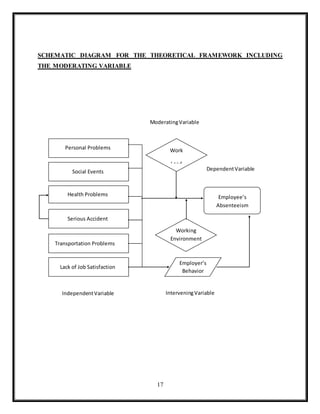
MODERATING VARIABLE
Poor Working Environment
Work Load
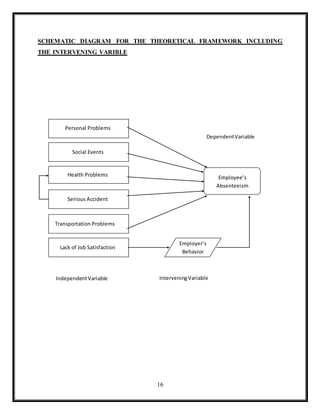
INTERVENING VARIABLE
Employer’s Behavior (Poor Supervision, Inadequate Leadership)
15
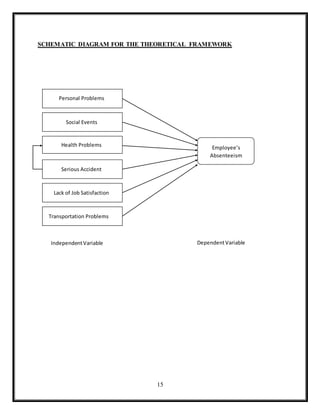
SCHEMATIC DIAGRAM FOR THE THEORETICAL FRAMEWORK
Personal Problems
Social Events
Health Problems
Serious Accident
Lack of Job Satisfaction
Transportation Problems
Employee’s
Absenteeism
IndependentVariable DependentVariable
16
SCHEMATIC DIAGRAM FOR THE THEORETICAL FRAMEWORK INCLUDING
THE INTERVENING VARIBLE
Employer’s
Behavior
Personal Problems
Social Events
Health Problems
Serious Accident
Lack of Job Satisfaction
Transportation Problems
Employee’s
Absenteeism
IndependentVariable InterveningVariable
DependentVariable
17
SCHEMATIC DIAGRAM FOR THE THEORETICAL FRAMEWORK INCLUDING
THE MODERATING VARIABLE
Working
Environment
Employer’s
Behavior
Personal Problems
Social Events
Health Problems
Serious Accident
Lack of Job Satisfaction
Transportation Problems
Employee’s
Absenteeism
Work
Load
IndependentVariable InterveningVariable
DependentVariable
ModeratingVariable
18
LITERATURE REVIEW
Gary Vikesland, MA LP CEAP
Recently, I was asked by a manager how he should deal with the fact that on any given day 10%
of his employees are absent from work. I informed the manager that the problem of employee
absenteeism is a problem best resolved by taking the following four positive interventions versus
taking a negative or punitive approach.
CHANGE MANAGEMENT STYLE
We are all aware of the fact that when employees call in ill, it does not mean they are truly too
physically ill to work. One reason, outside of illness, that employees are absent is stress, and the
number one reason employees are stressed has to do with their relationship with their
manager/supervisor.
Management styles that are too authoritarian tend to promote high levels of absenteeism among
employees. Authoritarian managers are managers who have poor listening skills, set unreachable
goals, have poor communication skills, and are inflexible. In other words, they yell too much,
blame others for problems, and make others feel that it must be their way or the "highway."
Authoritarian managers tend to produce high absenteeism rates. By identifying managers who
use an authoritarian style, and providing them with management training, you will be taking a
positive step not only toward reducing absenteeism, but also reducing turnover, job burnout, and
employee health problems such as backaches and headaches.
19
CHANGE WORKING CONDITIONS
The employees in your company probably work in a well-lighted climate controlled building.
The working conditions I am referring to relate to coworker relationships. Not only does
relationship stress occur between the employee and manager, but it also exists between
employees. Frequently I hear employees say they did not go to work because they are fearful of
or angry with another employee. These employees usually report they just could not deal with
"so and so" today, so they called in ill. Companies that adopted policies and values that promote
employee respect and professionalism, and promote an internal conflict resolution procedure, are
companies that reduce employee stress. A reduction in employee stress reduces employee
absenteeism.
PROVIDE INCENTIVES
Giving employees incentives for reduced absenteeism is not the same as rewarding or giving
employees bonuses for reduced absenteeism. An incentive provides an employee with a boost to
their motivation to avoid unnecessary absenteeism. It simply helps the employee decide to go to
work versus staying home and watching Jerry Springer.
The types of incentive programs used by companies are numerous. Some companies allow
employees to cash-in unused sick days at the end of every quarter, others give an employee two
hours of bonus pay for every month of perfect attendance; and still others provide employees
with a buffet lunch, a certificate of achievement, or even a scratch-off card concealing prizes.
The type of incentive program that your company uses should be one created especially for your
company. You can create an incentive program tailored to your unique company by allowing
employees to help you develop the incentive program. For example, your employees may not
care about receiving a $25.00 U.S. saving bond for perfect attendance, but they might respond
very well to being able to leave one hour early on Friday if they have perfect attendance all
week.
The duration of the incentive program is also very important. Once again allow your employees
20
to help guide you to determine the length of time between incentives. Some companies find that
they can simply reward employees with perfect attendance once a year, while others decide once
a month is best, and still others decide once a week works best. The general rule of thumb is to
reward workers more frequently the younger they are and the more difficult the work is to
perform. Also, it is best to start with small incentives and work up to larger ones if necessary.
DEVELOP AN ATTENDANCE POLICY
Every company should have an attendance policy. An attendance policy allows a manager to
intervene with an employee who is frequently absent. Besides stress as a primary reason for
employee absenteeism, other causes relate to alcoholism, domestic violence, and family
problems. If you confront an employee about his or her frequent absenteeism, and they inform
you it is due to personal problems, consider referring the employee to an Employee Assistance
Program (EAP).
21
DEALING WITH ABSENTEEISM
22/ 04/ 2019
By UJJAVAL CHAUDHARY
By TANYA ANNAND
Even the best employees miss a day of work now and then. When calling in sick becomes the
rule rather than the exception, however, you have a problem. Absenteeism can cause all sorts of
serious problems for your business, from other employees having to cover for the missing
worker to missed deadlines to dissatisfied customers.
Here are some steps to control absenteeism:
Keep track of absences.
It is important that you keep careful records so you can compare the absences of all your
employees. Check back over your records and see if any patterns emerge, such as an employee
who seems to call in sick only on Fridays or warm summer days.
Find out if absenteeism is voluntary or unavoidable
Has the employee been missing work due to an unavoidable problem, such as a serious illness in
the family? Or does the employee seem to be lacking a good reason? Talk to the employee to
find out what the specific problem is. Ask the employee what you can do to help. However, if
you suspect your employee isn’t being straight with you, you may want to ask for validation of
future absences.
Schedule a meeting with the employee.
22
If youÆre not satisfied with the initial conversation, have a private meeting. Have your facts in
front of you and don't yell or scold--try to keep the discussion friendly. Tell the employee that
you want to understand and solve the problem. Don't discipline the employee at this meeting.
If things donÆt get better, hold another meeting. Explain how the employee's absence is
affecting others, and tell him you need an improved performance and better attendance on the
job.
Write a report.
It is important to document what has occurred with this employee. Create a written report that is
placed in the employee's personnel file. Include the date of all the absences, the meeting dates
and the gist of the two conversations. Be sure to give a copy of this written report to the
employee as well.
Give an ultimatum
The employee has two choices at this time: start coming to work regularly or find another place
of employment. If the employee decides to leave at this time, know that letting the employee stay
would have been a detriment to you and your other employees.
23
ATTENDANCE MANAGEMENT
The management of attendance is an important aspect of supervision in the workplace.
The cost of absenteeism is greater than the direct payment of wages and benefits paid durance
the absence. Organizations must also consider the indirect cost of staffing, scheduling, re-
training, lost productivity, diminished moral, turnover, opportunity cost. The indirect costs often
exceed the direct cost of absenteeism.
Every person day of absence costs $2,500 (based on 9 days absent out of 250 working days and
an average payroll of $35,000).
Effective supervisory efforts in attendance management will affect a relatively small percentage
of employees but will generate substantial savings, increased productivity and morale.
PURPOSE OF ATTENDANCE MANAGEMENT
The purpose of attendance management is to develop a willingness on the part of all our
employees to attend work regularly and to assist them in motivating their coworkers to attend
work regularly. This can be done through;
1. addressing the physical and emotional needs of our employees
2. communicating the attendance goals of the organization so employees can understand
and identify with them
3. dealing with cases of excessive absenteeism effectively and fairly so deterrence can occur
Successful administration of an attendance management program requires managers and
supervisors to be aware of, and create work environments in which the following can be
actualized.
24
1. The greater the extent to which individuals identify their goals with the goals of the
organization and care what happens to it, the greater their motivation to be regular in
attendance.
2. The more people find their jobs meaningful to them, the greater their motivation to be
regular in attendance.
3. As employees workload increases due to the absence of a co-worker, peer pressure is
exerted on the absent co-worker to attend work on a regular basis.
4. The more people like working for the organization the higher their motivation to attend
regularly. Recognition of good employee attendance helps improve attendance.
5. Employees will have a lower absence ratio if they feel free to discuss their on-the-job
problems with their immediate supervisor.
6. Employees with a low absence ratio have attitudes of confidence and "team" spirit.
7. Low absence ratio employees are found to be more satisfied with their opportunity for
promotion and upgrading.
ATTENDANCE MANAGEMENT PROGRAM
An attendance management program can be split into three basic parts:
1. Development of information/communication systems
2. Information Testing
3. Taking appropriate group action
1. Information Communication Systems
The first step of an effective attendance management program is to identify specific areas which
are affecting attendance.. The best way to find which specific areas are affecting absenteeism in
a specific work environment is to develop open communication between managers, supervisors
and employees. The reason for this is that it is not really the physical realities of the work place
that influence employees’ willingness to work but rather their perceptions of these realities. For
example, workload is only a problem if it is thought to be one. It is important that employees are
encouraged to voice their concerns so their perceptions of the work place are clear and can be
25
dealt with. This type of communication is especially important in unionized environments as
employees often tend to communicate only with their union representatives. The result is that
vital feed back necessary for effective management is lost. Cooperation with union
representatives can be very helpful in attendance management and should be encouraged if
possible.
Formal communications networks such as regularly scheduled department meetings are an
excellent way not only to hear employee perceptions and concerns but also to communicate
organizational goals. When employees are encouraged to make a difference they are less likely
to withdraw their participation through absenteeism. Employees must not only be heard, they
must be answered in such ways as to assure them their input is worthwhile. Staff development
meetings are important in molding company ideals with employee needs. They are also
important in developing a sense of team spirit among coworkers. Full participation in such
meetings is to be encouraged if they are to be effective.
Informal communications are also very effective in identifying and dealing with employee needs
and perceptions. Informal communication involves all levels of managers and supervisors.
Supervisors are especially important because of their hands-on approach and contact with
employees. An employee's relationship with their supervisor can greatly influence their feelings
about their work, their coworkers and thus their attendance at work.
Insight, intuition, creative thinking and listening are all powerful ways of finding areas which
affect attendance. Ideas and information should be encouraged from all sources. The
establishment of varied communication channels is useful in gathering information and to an
extent, in confirming it. Effective communication in itself can effectively reduce absenteeism.
2. Information Testing
Once communication networks are established, information on perceived problems from
employees will be bountiful. Before taking action on any issue, no matter what the source of
information, it should be confirmed.
26
A simple and effective way to check whether a specific issue truly affects absenteeism is by
finding correlations through using attendance records. If it is suggested, for instance, that
absenteeism is increasing due to employee dissatisfaction with their workload, all one need do is
match the attendance records during a period of "high" workload to a period of "normal"
workload. If absenteeism is found to be significantly higher during increased workload periods,
then it has been confirmed that actual workload "is related to" absenteeism levels. If no
correlation exists it may be that employee perception of workload affects absenteeism. In this
case the importance of the employee perception could be confirmed through staff development
meetings. In any case two different problems have been distinguished which require different
types of attention.
Attendance records also should be used to monitor attendance trends. Are long term or short term
absences more common? What percentage of employees have excessive absences?
Attendance record forms are designed to facilitate the determination of whether or not
absenteeism patterns exist.
3. Taking Appropriate Group Action
The best way to handle any given situation is to handle it on its own merits and within the
guidelines of the goals one is trying to achieve. This paper does not attempt to give all the
answers to every possible situation but rather, offers suggestions and guidelines on which
answers can be built.
In summary, to run an effective attendance management program it is important to:
1. develop ways for each and every employee to feel free to contribute ideas and
suggestions even though these may be outside the scope of their job responsibilities
2. make each employee aware that they are a valued member of the "team", that they play
an important role in your organization and that their attendance is critical
3. hold regular meetings, keep your staff informed and involved
4. know your employees; without prying show an interest in their personal lives
5. be aware of problems that may effect employee attendance or performance
27
6. familiarize yourself with community programs which you can recommend to an
employee if he/she has a need for assistance (i.e. marital or financial counselling)
7. awareness, commitment and involvement by all levels of staff
Positive motivation should be the main body of any attendance management program because it
produces the best results. If an employee's experiences in the work place are pleasant, if he/she
feels valued and appreciated, if supervision is fair but firm, that employee will be more
motivated to attend work regularly.
28
GUIDELINES FOR ABSENTEEISM CONTROL
COUNSELING INNOCENT ABSENTEEISM
Innocent absenteeism is not blameworthy and therefore disciplinary action is not justified. It is
obviously unfair to punish someone for conduct which is beyond his/her control. Absenteeism,
no matter what the cause, imposes losses on the employer who is also not at fault. The damage
suffered by the employer must be weighed against the employee's right to be sick. There is a
point at which the employer's right to expect the employee to attend regularly and fulfill the
employment contract will outweigh the employee's right to be sick. At such a point the
termination of the employee may be justified, as will be discussed.
The procedure an employer may take for innocent absenteeism is as follows:
1. Initial counseling(s)
2. Written counseling(s)
3. Reduction(s) of hours and/or job reclassification
4. Discharge
Initial Counseling
Presuming you have communicated attendance expectations generally and have already
identified an employee as a problem, you will have met with him or her as part of your
attendance program and you should now continue to monitor the effect of these efforts on his or
her attendance.
If the absences are intermittent, meet with the employee each time he/she returns to work. If
absence is prolonged, keep in touch with the employee regularly and stay updated on the status
of his/her condition. (Indicate your willingness to assist.)
You may require the employee to provide you with regular medical assessments. This will
enable you to judge whether or not there is any likelihood of the employee providing regular
attendance in future. Regular medical assessments will also give you an idea of what steps the
employee is taking to seek medical or other assistance. Formal meetings in which verbal
29
warnings are given should be given as appropriate and documented. If no improvement occurs
written warning may be necessary.
Written Counseling
If the absences persist, you should meet with the employee formally and provide him/her with a
letter of concern. If the absenteeism still continues to persist then the employee should be given a
second letter of concern during another formal meeting. This letter would be stronger worded in
that it would warn the employee that unless attendance improves, termination may be necessary.
Reduction(s) of hours and or job reclassification
In between the first and second letters the employee may be given the option to reduce his/her
hours to better fit his/her personal circumstances. This option must be voluntarily accepted by
the employee and can not be offered as an ultimatum, as a reduction in hours is a reduction in
pay and therefore can be looked upon as discipline.
If the nature of the illness or injury is such that the employee is unable to fulfill the requirements
of his/her job, but could for example benefit from modified work, counsel the employee to bid on
jobs of such type if they become available.
Discharge
Only when all the previously noted needs and conditions have been met and everything has been
done to accommodate the employee can termination be considered. An Arbitrator would
consider the following in ruling on an innocent absenteeism dismissal case.
1. Has the employee done everything possible to regain their health and return to work?
2. Has the employer provided every assistance possible? (i.e. counseling, support, time off.)
3. Has the employer informed the employee of the unworkable situation resulting from their
sickness?
4. Has the employer attempted to accommodate the employee by offering a more suitable
position (if available) or a reduction of hours?
30
5. Has enough time elapsed to allow for every possible chance of recovery?
6. Has the employer treated the employee prejudicially in any way?
As is evident, a great deal of time and effort must elapse before dismissal can take place.
These points would be used to substantiate or disprove the following two fold test.
1. The absences must be shown to be clearly excessive.
It must be proven that the employee will be unable to attend work on a regular basis in the future.
CORRECTIVE ACTION FOR CULPABLE ABSENTEEISM
As already indicated, culpable absenteeism consists of absences where it can be demonstrated
that the employee is not actually ill and is able to improve his/her attendance.
Presuming you have communicated attendance expectations generally, have identified the
employee as a problem, have met with him/her as part of your attendance program, made your
concerns on his specific absenteeism known and have offered counseling as appropriate, with no
improvement despite your positive efforts, disciplinary procedures may be appropriate.
The procedures for corrective/progressive discipline for culpable absenteeism are generally the
same as for other progressive discipline problems. The discipline should not be prejudicial in any
way. The general procedure is as follows:
1. Initial Warning(s)
2. Written Warning(s)
3. Suspension(s)
4. Discharge
Verbal Warning
Formally meet with the employee and explain that income protection is to be used only when an
employee is legitimately ill. Advise the employees that his/her attendance record must improve
and be maintained at an improved level or further disciplinary action will result. Offer any
31
counseling or guidance as is appropriate. Give further verbal warnings as required. Review the
employee's income protection records at regular intervals. Where a marked improvement has
been shown, commend the employee. Where there is no improvement a written warning should
be issued.
Written Warning
Interview the employee again. Show him/her the statistics and point out that there has been no
noticeable (or sufficient) improvement. Listen to the employee to see if there is a valid reason
and offer any assistance you can. If no satisfactory explanation is given, advise the employee that
he/she will be given a written warning. Be specific in your discussion with him/her and in the
counseling memorandum as to the type of action to be taken and when it will be taken if the
record does not improve. As soon as possible after this meeting provide the employee personally
with the written warning and place a copy of his/her file. The written warning should identify
any noticeable pattern
If the amount and/or pattern continue, the next step in progressive discipline may be a second,
stronger written warning. Your decision to provide a second written warning as an alternative to
proceeding to a higher level of discipline (i.e. suspension) will depend on a number of factors.
Such factors are the severity of the problem, the credibility of the employee's explanations, the
employee's general work performance and length of service.
Suspension (only after consultation with the appropriate superiors)
If the problem of culpable absenteeism persists, following the next interview period and
immediately following an absence, the employee should be interviewed and advised that he/she
is to be suspended. The length of the suspension will depend again on the severity of the
problem, the credibility of the employee's explanation, the employee's general work performance
and length of service. Subsequent suspensions are optional depending on the above condition.
Dismissal (only after consultation with the appropriate superiors)
32
Dismissals should only be considered when all of the above conditions and procedures have been
met. The employee, upon displaying no satisfactory improvement, would be dismissed on the
grounds of his/her unwillingness to correct his/her absence record.
33
OBJECTIVE OF THE STUDY
1.To identify the reason of being absent
2.To identify the steps required to decrease the absenteeism.
3.To study Employees working conditions
4.To identify factors that motivates employees, which minimize absenteeism.
5.To measure the employee absenteeism level.
SCOPE OF THE STUDY
The development of any organisations depend on the regularity of the employees. The
study is conducted to know the various level and the reason of getting absent in an
organization.
By looking it, one can adopt corrective measures to decrease the irregularities in an
organization, leads to an organization growth.
34
RESEARCH METHODOLOGY
Introduction
This chapter talks about the various types of research, sources of data collection, research
objectives, sampling and various types of sampling methods used in this research.
The study will be conducted to achieve the aforesaid objectives including both exploratory and
descriptive in nature and involve personal interviews that will be based on the questionnaire
format.
Research Methodology
A Research Methodology defines the purpose of the research, how it proceeds, how to measure
progress and what constitute success with respect to the objectives determined for carrying out
the research study. Research methodology is a science of studying how research is to be
35
carried out. Essentially, the procedures by which researchers go about their work of describing,
explaining and predicting phenomena are called research methodology. It is also defined as the
study of methods by which knowledge is gained.
 The research methodology for the present study has been adopted to reflect these
realties and help reach the logical conclusion in an objective and scientific manner.
Research method
A research method is a systematic plan for conducting research. Sociologists draw on a variety of
both qualitative and quantitative research methods, including experiments, survey research,
participant observation, and secondary data. Quantitative methods aim to classify features, count
them, and create statistical models to test hypotheses and explain observations. Qualitative
methods aim for a complete, detailed description of observations, including the context of events
and circumstances.
TYPE OF RESEARCH:
EXPLORATORY RESEARCH
A research design is the specification of methods and procedures for acquiring the information
needed to structure or solve the problem. It is the overall operational pattern or framework of
the project that stimulates what information is to be collected from which source and by what
procedure. On the basis of major purpose of our investigation the EXPLORATORY
RESEARCH was found to be most suitable. This kind of research has the primary objective of
development of insights into the problem. It studies the main area where the problem lies and
also tries to evaluate some appropriate courses of action.
DATA COLLECTION
The task of data collection begins after a research problem has been identified and the research
design has been chalked out. While deciding the method of data collection to be used for the
study, the researcher should keep in mind two types of data:
36
a. Primary data
b. Secondary data
In this research project the data being collected is as follows:
Primary Data: The survey method is used to collect the primary data in this research as it is the
Analytical research to find out the shortcomings and area of improvements according to the skill
required for recruitment team. The data that is collected first hand by someone specifically for
the purpose of facilitating the study is known as primary data. So in this research the data is
collected from respondents through QUESTIONNAIRE.
 Primary source of data :
(i). Questionnaire technique.
QUESTIONNAIRE – We prepared a questionnaire and our respondent constitutes age group of
20-35 years
Secondary Data:
The secondary data is also used in a lesser proportion to find out the name and designation of the
employer who are working with this organization and the company profile. Secondary data refer
to information gathered by someone other than the researcher conducting the current study. Such
data can be internal or external to the organization and accessed through the Internet or perusal
of recorded or published information.
Secondary sources of data provide a lot of information for research and problem solving. Such
data are as we have seen mostly qualitative in nature.
 Secondary source of data :
 Internet.
 Websites
37
SAMPLING TECHNIQUE
SIMPLE SAMPLING
Simple sampling is a sampling process that utilizes some form of random selection. In
probability sampling, each unit is drawn with known probability, or has a nonzero chance of
being selected in the sample. Such samples are usually selected with the help of random
numbers. With probability sampling, a measure of sampling variation can be obtained
objectively from the sample itself. Simple Random sampling has been adopted for this research.
Under which we have considered the sampling which has been done for a specific designated
population, because here a small cluster of professionals has been considered out of the total
universe which has been divided in small group like recruitment team & employee.
SIMPLE RANDOM SAMPLING
A simple random sample is a subset of individuals (a sample) chosen from a
larger set (a population). Each individual is chosen randomly and entirely by chance, such that
each individual has the same probability of being chosen at any stage during the sampling
process, and each subset of k individuals has the same probability of being chosen for the
sample as any other subset of k individuals. This process and technique is known as simple
random sampling, and should not be confused with systematic random sampling. A simple
random sample is an unbiased surveying technique.
Simple random sampling is a basic type of sampling, since it can be a component of other more
complex sampling methods. The principle of simple random sampling is that every object has the
same probability of being chosen.
4.5.2 SAMPLE SIZE
Sample size refers to the number of items to be selected from Agra to constitute a sample. The
sample size should be optimum as it should fulfill the objective of the research.
38
Which 15 number of questionnaires filled by the employees and interns from Agra company.
4.5.3 SAMPLE AREA
The sample area refers to the universe to be studied under our research project. The area denotes
the place or the region to be studied and taken into research consideration
DATA ANALYSIS
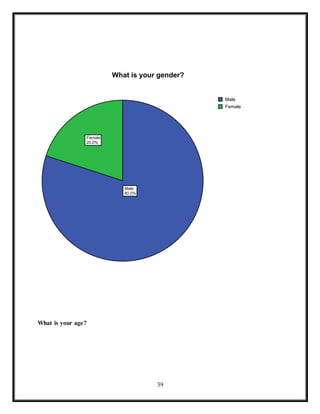
What is your gender?
Frequenc
y Percent
Valid
Percent
Cumulative
Percent
Valid Male 80 80.0 80.0 80.0
Femal
e
20 20.0 20.0 100.0
Total 100 100.0 100.0
39
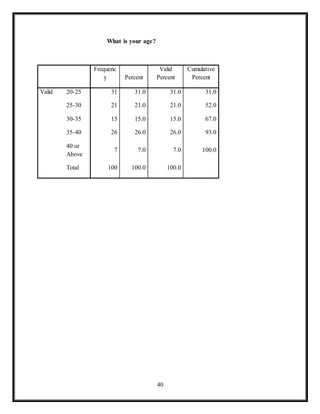
What is your age?
Male
80.0%
Female
20.0%
Male
Female
What is your gender?
40
What is your age?
Frequenc
y Percent
Valid
Percent
Cumulative
Percent
Valid 20-25 31 31.0 31.0 31.0
25-30 21 21.0 21.0 52.0
30-35 15 15.0 15.0 67.0
35-40 26 26.0 26.0 93.0
40 or
Above
7 7.0 7.0 100.0
Total 100 100.0 100.0
41
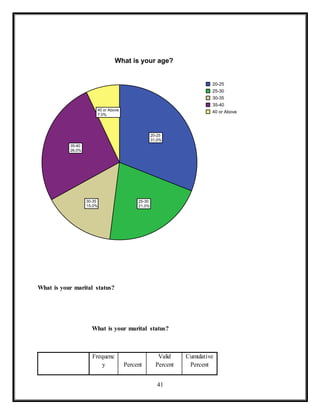
What is your marital status?
Frequenc
y Percent
Valid
Percent
Cumulative
Percent
20-25
31.0%
25-30
21.0%
30-35
15.0%
35-40
26.0%
40 or Above
7.0%
20-25
25-30
30-35
35-40
40 or Above
What is your age?
42
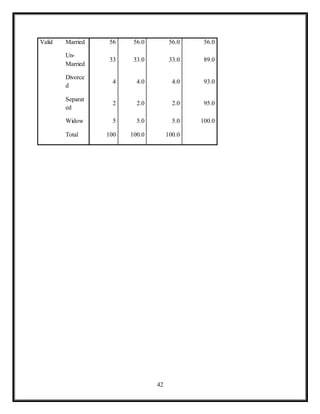
Valid Married 56 56.0 56.0 56.0
Un-
Married
33 33.0 33.0 89.0
Divorce
d
4 4.0 4.0 93.0
Separat
ed
2 2.0 2.0 95.0
Widow 5 5.0 5.0 100.0
Total 100 100.0 100.0
43
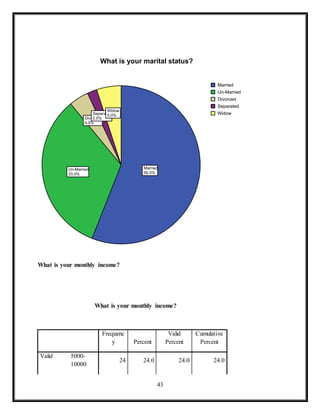
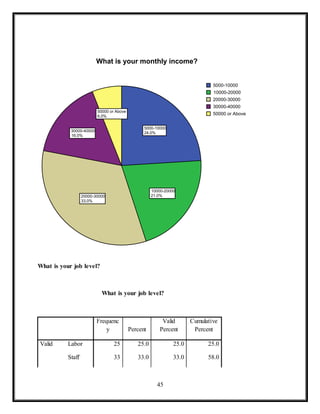
What is your monthly income?
Frequenc
y Percent
Valid
Percent
Cumulative
Percent
Valid 5000-
10000
24 24.0 24.0 24.0
Married
56.0%
Un-Married
33.0%
Divorced
4.0%
Separated
2.0%
Widow
5.0%
Married
Un-Married
Divorced
Separated
Widow
What is your marital status?
44
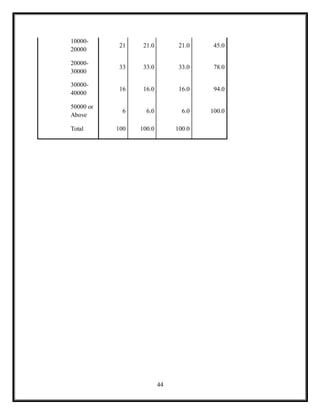
10000-
20000
21 21.0 21.0 45.0
20000-
30000
33 33.0 33.0 78.0
30000-
40000
16 16.0 16.0 94.0
50000 or
Above
6 6.0 6.0 100.0
Total 100 100.0 100.0
45
What is your job level?
Frequenc
y Percent
Valid
Percent
Cumulative
Percent
Valid Labor 25 25.0 25.0 25.0
Staff 33 33.0 33.0 58.0
5000-10000
24.0%
10000-20000
21.0%20000-30000
33.0%
30000-40000
16.0%
50000 or Above
6.0%
5000-10000
10000-20000
20000-30000
30000-40000
50000 or Above
What is your monthly income?
46
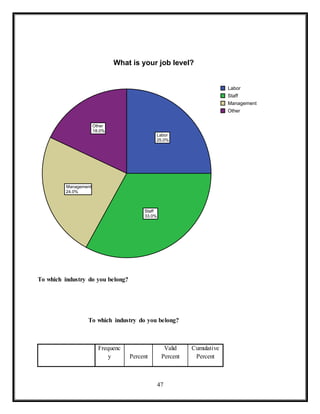
Manage
ment
24 24.0 24.0 82.0
Other 18 18.0 18.0 100.0
Total 100 100.0 100.0
47
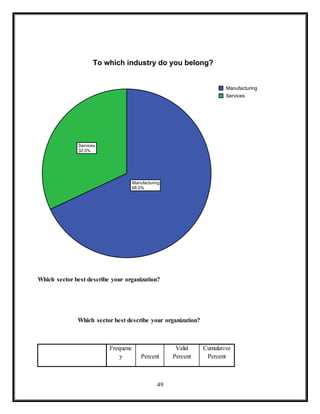
To which industry do you belong?
Frequenc
y Percent
Valid
Percent
Cumulative
Percent
Labor
25.0%
Staff
33.0%
Management
24.0%
Other
18.0%
Labor
Staff
Management
Other
What is your job level?
48
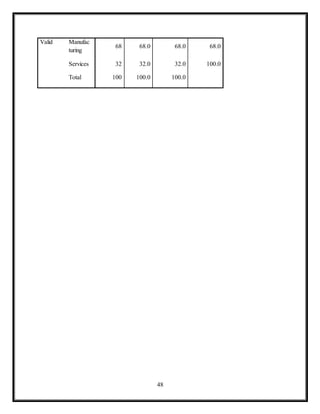
Valid Manufac
turing
68 68.0 68.0 68.0
Services 32 32.0 32.0 100.0
Total 100 100.0 100.0
49
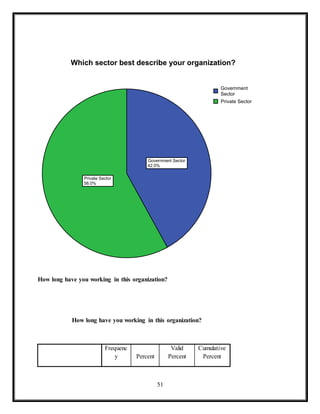
Which sector best describe your organization?
Frequenc
y Percent
Valid
Percent
Cumulative
Percent
Manufacturing
68.0%
Services
32.0%
Manufacturing
Services
To which industry do you belong?
50
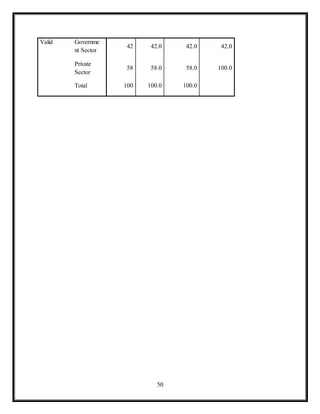
Valid Governme
nt Sector
42 42.0 42.0 42.0
Private
Sector
58 58.0 58.0 100.0
Total 100 100.0 100.0
51
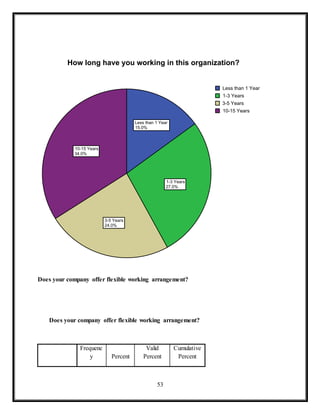
How long have you working in this organization?
Frequenc
y Percent
Valid
Percent
Cumulative
Percent
Government Sector
42.0%
Private Sector
58.0%
Government
Sector
Private Sector
Which sector best describe your organization?
52
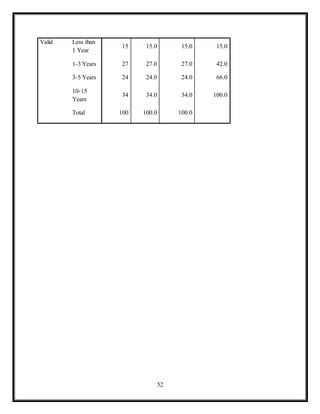
Valid Less than
1 Year
15 15.0 15.0 15.0
1-3 Years 27 27.0 27.0 42.0
3-5 Years 24 24.0 24.0 66.0
10-15
Years
34 34.0 34.0 100.0
Total 100 100.0 100.0
53
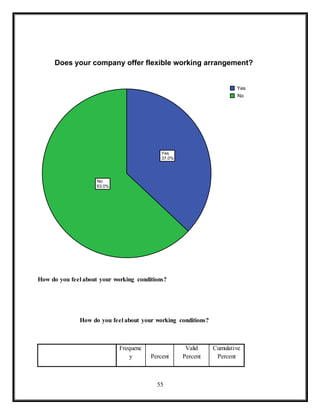
Does your company offer flexible working arrangement?
Frequenc
y Percent
Valid
Percent
Cumulative
Percent
Less than 1 Year
15.0%
1-3 Years
27.0%
3-5 Years
24.0%
10-15 Years
34.0%
Less than 1 Year
1-3 Years
3-5 Years
10-15 Years
How long have you working in this organization?
54
Valid Yes 37 37.0 37.0 37.0
No 63 63.0 63.0 100.0
Total 100 100.0 100.0
55
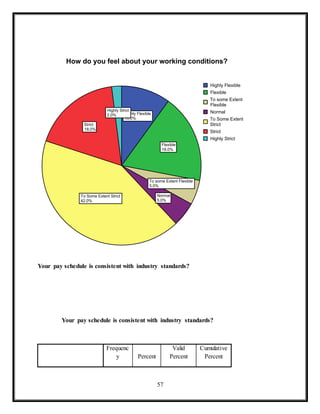
How do you feel about your working conditions?
Frequenc
y Percent
Valid
Percent
Cumulative
Percent
Yes
37.0%
No
63.0%
Yes
No
Does your company offer flexible working arrangement?
56
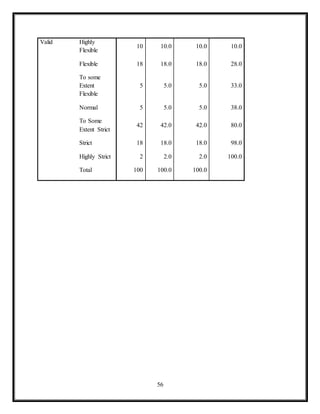
Valid Highly
Flexible
10 10.0 10.0 10.0
Flexible 18 18.0 18.0 28.0
To some
Extent
Flexible
5 5.0 5.0 33.0
Normal 5 5.0 5.0 38.0
To Some
Extent Strict
42 42.0 42.0 80.0
Strict 18 18.0 18.0 98.0
Highly Strict 2 2.0 2.0 100.0
Total 100 100.0 100.0
57
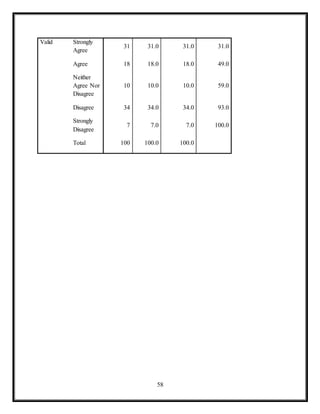
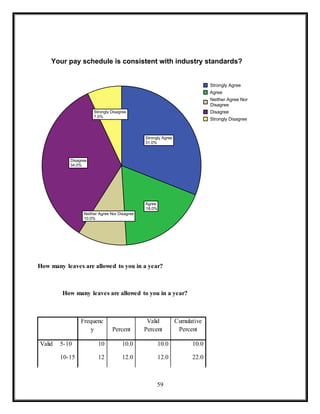
Your pay schedule is consistent with industry standards?
Frequenc
y Percent
Valid
Percent
Cumulative
Percent
Highly Flexible
10.0%
Flexible
18.0%
To some Extent Flexible
5.0%
Normal
5.0%
To Some Extent Strict
42.0%
Strict
18.0%
Highly Strict
2.0%
Highly Flexible
Flexible
To some Extent
Flexible
Normal
To Some Extent
Strict
Strict
Highly Strict
How do you feel about your working conditions?
58
Valid Strongly
Agree
31 31.0 31.0 31.0
Agree 18 18.0 18.0 49.0
Neither
Agree Nor
Disagree
10 10.0 10.0 59.0
Disagree 34 34.0 34.0 93.0
Strongly
Disagree
7 7.0 7.0 100.0
Total 100 100.0 100.0
59
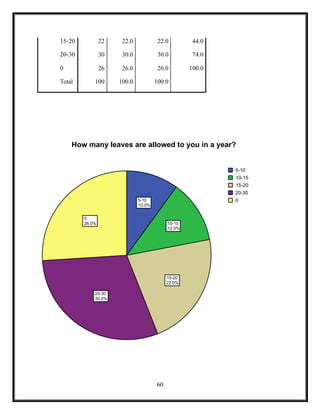
How many leaves are allowed to you in a year?
Frequenc
y Percent
Valid
Percent
Cumulative
Percent
Valid 5-10 10 10.0 10.0 10.0
10-15 12 12.0 12.0 22.0
Strongly Agree
31.0%
Agree
18.0%
Neither Agree Nor Disagree
10.0%
Disagree
34.0%
Strongly Disagree
7.0%
Strongly Agree
Agree
Neither Agree Nor
Disagree
Disagree
Strongly Disagree
Your pay schedule is consistent with industry standards?
60
15-20 22 22.0 22.0 44.0
20-30 30 30.0 30.0 74.0
0 26 26.0 26.0 100.0
Total 100 100.0 100.0
5-10
10.0%
10-15
12.0%
15-20
22.0%
20-30
30.0%
0
26.0%
5-10
10-15
15-20
20-30
0
How many leaves are allowed to you in a year?
61
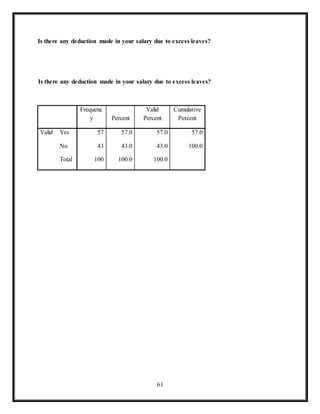
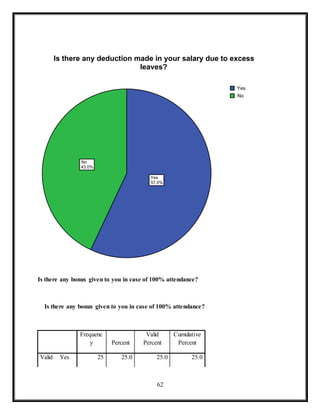
Is there any deduction made in your salary due to excess leaves?
Frequenc
y Percent
Valid
Percent
Cumulative
Percent
Valid Yes 57 57.0 57.0 57.0
No 43 43.0 43.0 100.0
Total 100 100.0 100.0
62
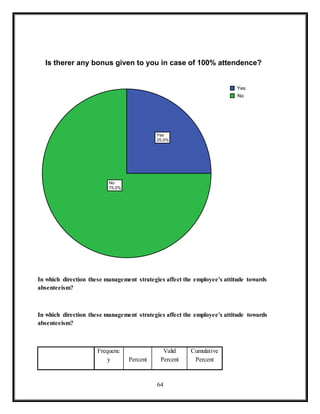
Is there any bonus given to you in case of 100% attendance?
Frequenc
y Percent
Valid
Percent
Cumulative
Percent
Valid Yes 25 25.0 25.0 25.0
Yes
57.0%
No
43.0%
Yes
No
Is there any deduction made in your salary due to excess
leaves?
63
No 75 75.0 75.0 100.0
Total 100 100.0 100.0
64
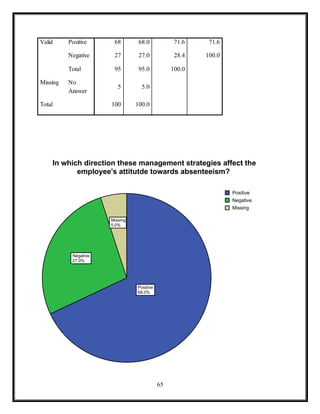
In which direction these management strategies affect the employee's attitude towards
absenteeism?
In which direction these management strategies affect the employee's attitude towards
absenteeism?
Frequenc
y Percent
Valid
Percent
Cumulative
Percent
Yes
25.0%
No
75.0%
Yes
No
Is therer any bonus given to you in case of 100% attendence?
65
Valid Positive 68 68.0 71.6 71.6
Negative 27 27.0 28.4 100.0
Total 95 95.0 100.0
Missing No
Answer
5 5.0
Total 100 100.0
Positive
68.0%
Negative
27.0%
Missing
5.0%
Positive
Negative
Missing
In which direction these management strategies affect the
employee's attitutde towards absenteeism?
66
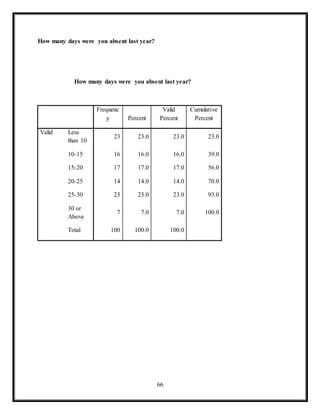
How many days were you absent last year?
Frequenc
y Percent
Valid
Percent
Cumulative
Percent
Valid Less
than 10
23 23.0 23.0 23.0
10-15 16 16.0 16.0 39.0
15-20 17 17.0 17.0 56.0
20-25 14 14.0 14.0 70.0
25-30 23 23.0 23.0 93.0
30 or
Above
7 7.0 7.0 100.0
Total 100 100.0 100.0
67
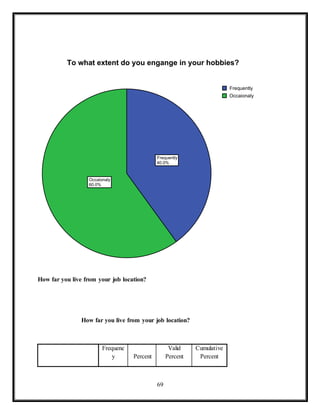
To what extent do you engange in your hobbies?
Frequenc
y Percent
Valid
Percent
Cumulative
Percent
Valid Frequen 40 40.0 40.0 40.0
Less than 10
23.0%
10-15
16.0%
15-20
17.0%
20-25
14.0%
25-30
23.0%
30 or Above
7.0%
Less than 10
10-15
15-20
20-25
25-30
30 or Above
How many days were you absent last year?
68
tly
Occaio
naly
60 60.0 60.0 100.0
Total 100 100.0 100.0
69
How far you live from your job location?
Frequenc
y Percent
Valid
Percent
Cumulative
Percent
Frequently
40.0%
Occaionaly
60.0%
Frequently
Occaionaly
To what extent do you engange in your hobbies?
70
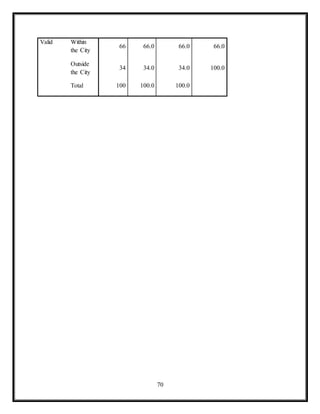
Valid Within
the City
66 66.0 66.0 66.0
Outside
the City
34 34.0 34.0 100.0
Total 100 100.0 100.0
71
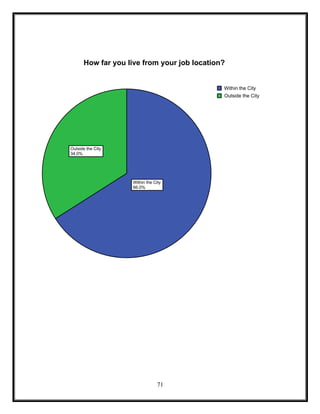
Within the City
66.0%
Outside the City
34.0%
Within the City
Outside the City
How far you live from your job location?
72
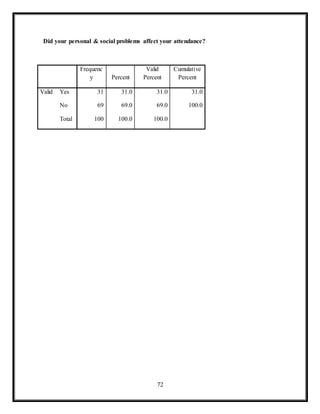
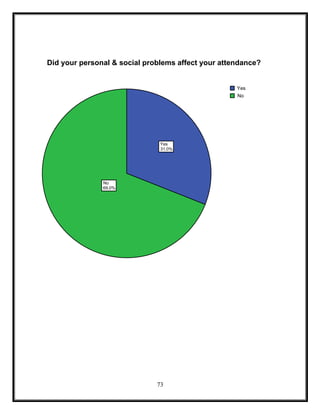
Did your personal & social problems affect your attendance?
Frequenc
y Percent
Valid
Percent
Cumulative
Percent
Valid Yes 31 31.0 31.0 31.0
No 69 69.0 69.0 100.0
Total 100 100.0 100.0
73
Yes
31.0%
No
69.0%
Yes
No
Did your personal & social problems affect your attendance?
74
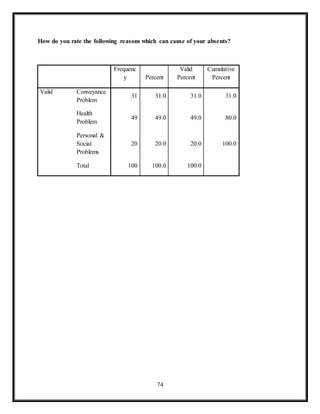
How do you rate the following reasons which can cause of your absents?
Frequenc
y Percent
Valid
Percent
Cumulative
Percent
Valid Conveyance
Problem
31 31.0 31.0 31.0
Health
Problem
49 49.0 49.0 80.0
Personal &
Social
Problems
20 20.0 20.0 100.0
Total 100 100.0 100.0
75
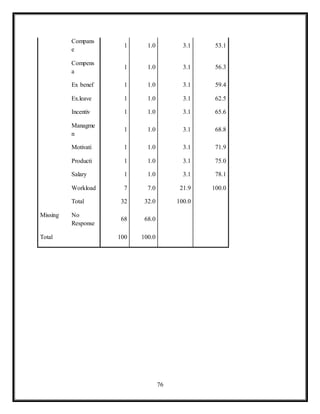
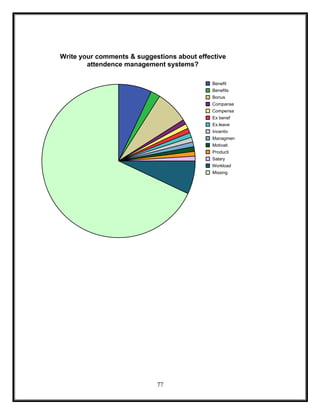
Write your comments & suggestions about effective attendance management systems?
Frequenc
y Percent
Valid
Percent
Cumulative
Percent
Valid Benefit 7 7.0 21.9 21.9
Benefits 2 2.0 6.3 28.1
Bonus 7 7.0 21.9 50.0
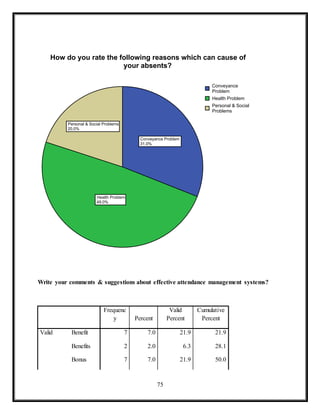
Conveyance Problem
31.0%
Health Problem
49.0%
Personal & Social Problems
20.0%
Conveyance
Problem
Health Problem
Personal & Social
Problems
How do you rate the following reasons which can cause of
your absents?
76
Compans
e
1 1.0 3.1 53.1
Compens
a
1 1.0 3.1 56.3
Ex benef 1 1.0 3.1 59.4
Ex.leave 1 1.0 3.1 62.5
Incentiv 1 1.0 3.1 65.6
Managme
n
1 1.0 3.1 68.8
Motivati 1 1.0 3.1 71.9
Producti 1 1.0 3.1 75.0
Salary 1 1.0 3.1 78.1
Workload 7 7.0 21.9 100.0
Total 32 32.0 100.0
Missing No
Response
68 68.0
Total 100 100.0
77
Benefit
Benefits
Bonus
Companse
Compensa
Ex benef
Ex.leave
Incentiv
Managmen
Motivati
Producti
Salary
Workload
Missing
Write your comments & suggestions about effective
attendence management systems?
78
CONCLUSION
Attendance improvement programs can work! What the employees require is commitment and
support from all levels of management, an effective attendance record-keeping system,
consultation and open communication on the reasons for the attendance program.
Implementing and maintaining a work environment where open communication and team spirit
can thrive will at first sometimes seem a mammoth and somewhat unrealistic task. If you need
encouragement just consider some of the benefits; reduced absenteeism, open communication,
team spirit, reduced grievances and greater employee satisfaction.
Only when the positive approach is unsuccessful does the employer need to use the remedial
approach to deal with habitual abusers or with excessive absentee cases. In all cases the
employer's actions must be fair and reasonable and consistently applied.
With a well communicated, implemented, and administered program, the majority of the
employees should agree with the attendance management program and cooperation should
follow.
79
80
81
BIBLIOGRAPHY
1. Web sites
 www.citehr.com
 www.economicstimes.com
2. BOOKS
 K Ashwathapa, (1997) Human Resource and personnel Management
 C R Kothari, Research Methodology
82
83
84

Research Report on Employee's Absenteeism

  • 1.
    1 Research Project Report (RMB-451) EMPLOYEE’S ABSENTEEISM Submitted to Dr. A.P.J. Abdul Kalam Technical University, Lucknow. In a Partial Fulfillment of requirement for the award of degree of Master of Business Administration (M.B.A.) Under of Guidance of: Submitted By: Dr. Jitin Seghal Shristhi Gupta (Asst. Professor) Roll. No:-1761770143 Research Project Guide M.B.A IV sem Uttam Ins. Of Management Studies ( Agra) Batch no. 2017-2019 Uttam Institute of Management Studies Runakta, Agra.
  • 2.
    2 ACKNOWLEDGEMENT This is greatopportunity to acknowledge and to thanks all those persons without whose support and help this project would have been impossible. We would like to add few heartfelt words for the people who were part of the project in numerous ways. I thank my HOD Mr. Narendra Saraswat (Uttam Institute of Management Studies, Agra) for his indispensible supportand encouragement through the project. I would like to thank my project guide Dr. Jitin Seghal (Asst. Professor) for his indefatigable guidance, valuable suggestion, moral support, constant encouragement and contribution of time for the for the successful completion of project development I thank my counselors for their indispensible support and encouragement throughout the project. I would like to thank project guide and all those help me directly or indirectly. Shristhi Gupta MBA IV Sem Roll No. 1761770143
  • 3.
    3 PREFACE Professional course notbe considered completed until the student has practical knowledge about it. To fulfill this requirement a project report must done. No doubt, business of any enterprises differs from the other but basic concept are more or less the same. A student learns from the experiences of the person whom he/she placed his or her project report. This helps the student to develop the habit of analyzing critically what he/she is required to perform. The project accomplished by me as a part of my post-graduation to fulfill the requirement of completion of the degree, course of the degree course that I have done keeping in my mind the importance and relevance of the project of my future professional life. In the fourth-coming pages, an attempt made to present a comprehensive report on the different aspect of my development works. I came out with the research project title “Employee’s Absenteeism” in this report I have put my finest efforts to compile the data with Utmost accuracy and hope this report will give complete satisfaction.
  • 4.
    4 DECLARATION I,Shristhi Gupta studentof MBA IV semester from Uttam Institute Of Management Studies, Runakta affiliated to Dr. A.P.J. Abdul Kalam Technical University , Lucknow hereby declare that all information, facts and figures presented in this report are first hand in nature. They are in fact based on my research report titled “Employee’s Absenteeism”. The project work was not earlier submitted elsewhere for the Award of any degree, or equivalent. Shristhi Gupta MBA IV Sem
  • 5.
    5 TABLE OF CONTENTS EXECUTIVESUMMARY: .......................................................................................... 6 EMPLOYEE’S ABSENTEEISM:................................................................................ 7 THEORETICAL FRAMEWORK ................................................................................. LITERATURE REVIEW ............................................................................................... OBJECTIVE OF THE STUDY………………………………………………………..36 SCOPE OF THE STUDY……………………………………………….................... RESEARCH METHODOLGY…………………………………………….............. DATA ANALYSIS ....................................................................................................... 33 CONCLUSION ............................................................................................................ 78 ANNEXURE QUESTIONNAIRE………………………………………………………………… BIBLIOGRAPHY……………………………………………………………………
  • 6.
    6 EXECUTIVE SUMMARY: Employees Absenteeismis the hot issue faced by most of the organizations now days because employee’s absenteeism leads to the reduction in productivity. Many organizations set aside approximately 3% of budget for absenteeism. This makes an average of about eight (8) days a year per employee. As pressure increase on the budget of the social protection system and on the competitiveness of companies, so more attention is being paid to measures to reduce workplace absenteeism and its cost. For conducting this research we have developed a good research design to identify the reasons of Employees absenteeism. The main source of data gathering is the Questionnaire and Pilot studies in which face to face interviews will be conducted with the employees of different sectors (Government and Private). This research does not attempt to give all the answers to every possible situation but rather, offers suggestions and guidelines on which answers can be built. Positive motivation should be the main body of any attendance management program because it produces the best results. If an employee's experiences in the work place are pleasant, if he/she feels valued and appreciated, if supervision is fair but firm, that employee will be more motivated to attend work regularly. Implementing and maintaining a work environment where open communication and team spirit can thrive will at first sometimes seem a mammoth and somewhat unrealistic task. If you need encouragement just consider some of the benefits; reduced absenteeism, open communication, team spirit, reduced grievances and greater employee satisfaction.
  • 7.
    7 EMPLOYEE’S ABSENTEEISM: Absenteeism isreferred to herein as failure of employees to report for work when they are scheduled to work. Employees who are away from work on recognized holidays, vacations, approved leaves of absence, or leaves of absence allowed for under the collective agreement provisions would not be included. The definition of absenteeism, its causes, its affects on productivity, and its costs in terms of finances and administrative effectiveness are quite clear. What is not as clear is how to take affirmative action to control absenteeism in such a way as not to create mistrust, costly administration and systems avoidance (game players). Traditional methods of absenteeism control based only on disciplinary procedures have proven to be ineffective. It is almost impossible to create a fair disciplinary procedure because even well run disciplinary systems, which treat similar actions in consistently similar ways, are usually seen as unfair. The reason for this is discipline alone usually does not identify or address the root causes of absenteeism. Every employee who takes time off in defiance of company regulations has reasons, right or wrong, which justify to themselves the legitimacy of their actions. Unless a management attendance program identifies and addresses the causes of employee absenteeism it will be ineffective and unfair. Traditional disciplinary programs alone can, at best, give the illusion of control. It is no secret that there are ways to beat even the best systems. The fear of discipline often only increases the desire to avoid management systems. TYPES OF ABSENTEEISM There are two types of absenteeism, each of which requires a different type of approach. INNOCENT ABSENTEEISM Innocent absenteeism refers to employees who are absent for reasons beyond their control; like sickness and injury. Innocent absenteeism is not culpable which means that it is blameless. In a labor relations context this means that it can not be remedied or treated by disciplinary measures. CULPABLE ABSENTEEISM
  • 8.
    8 Culpable absenteeism refersto employees who are absent without authorization for reasons which are within their control. For instance, an employee who is on sick leave even though he/she is not sick but it can be proven that the employee was not sick, is guilty of culpable absenteeism. To be culpable is to be blameworthy. In a labor relations context this means that progressive discipline can be applied. For the large majority of employees, absenteeism is legitimate, innocent absenteeism which occurs infrequently. Procedures for disciplinary action apply only to culpable absenteeism. Many organizations take the view that through the process of individual absentee counseling and treatment, the majority of employees will overcome their problems and return to an acceptable level of regular attendance. THE CAUSES OF ABSENTEEISM The causes of absenteeism are many and include: Serious accidents and illness Poor working conditions Lack of job satisfaction Inadequate leadership and Poor supervision Personal problems (financial, marital, substance abuse, child care etc.) Poor Physical Fitness Transportation Problems Workload THE COST OF ABSENTEEISM DECREASE IN PRODUCTIVITY Employees may be carrying an extra workload or supporting new or replacement staff
  • 9.
    9 Employees may berequired to train and orientate new or replacement workers Staff morale and employee service may suffer FINANCIAL COSTS Payment of overtime may result Cost of self-insured income protection plans must be borne plus the wage costs of replacement employees Premium costs may rise for insured plans ADMINISTRATIVE COSTS Staff time is required to secure replacement employees or to re-assign the remaining employees Staff time is required to maintain and control absenteeism IDENTIFYING EXCESSIVE ABSENTEEISM Attendance records should be reviewed regularly to be sure that an employee's sick-leave days are excessive compared to other employees. If a supervisor suspects that an employee is excessively absent, this can be confirmed through reviewing the attendance records. If all indications show that an employee is excessively absent, the next step is to gather as much information as possible in order to get a clearer picture of the situation. The employees' files should be reviewed and the employee’s immediate supervisor should document all available information on the particular employee's history. INDIVIDUAL COMMUNICATION After all available information has been gathered, the administrator or supervisor should individually meet with each employee whom has been identified as having higher than average
  • 10.
    10 or questionable (orpattern) absences. This first meeting should be used to bring concerns regarding attendance to the employee's attention. It is also an opportunity to discuss with the employee, in some depth, the causes of his or her attendance problem and possible steps he or she can take to remedy or control the absences. Listen carefully to the employee's responses. The tone of the meeting should not be adversarial, but a major purpose of the interview is to let the employee know that management treats attendance as a very important component of overall work performance. Keep your comments non-threatening and work-oriented. Stick to the facts (i.e. patters, profiles, rates etc.). The employee should be given a copy of there attendance report with absences highlighted for discussion. This interview will give you the opportunity to explore in depth with the employee the reasons for his or her absence. Gather facts - do not make any assumptions. Provide support and counseling and offer guidance as the occasion demands to assist the employee to deal with the specific cause of the absence. Often, after the initial meeting employees reduce their absenteeism. The meeting shows that you are concerned and that absenteeism is taken seriously. The employee's attendance should be closely monitored until it has been reduced to acceptable levels. Appropriate counseling should take place as is thought necessary. If a marked improvement has been shown, commend the employee. The meeting should be documented and a copy placed in the employee's file. PROOF OF ILLNESS
  • 11.
    11 Sometimes it ishelpful in counseling employees with excessive innocent or culpable absenteeism to inquire or verify the nature and reasons of their absence. The extent to which an employer may inquire into the nature of and reasons for an employee's absence from the workplace is a delicate issue. The concepts of an employee's privacy and an employer's need for information affecting the workplace often come into conflict. Seldom is the conflict more difficult to resolve than where personal medical information is involved. Unions will often strongly object to any efforts by management to inquire more deeply into the nature of an employee's illness. You will need to consider the restraints of any language in collective agreements in relation to this issue. Generally speaking, however, the following "rules of thumb" can be derived from the existing jurisprudence: There is a prevailing right to privacy on the part of an employee unless the employer can demonstrate that its legitimate business interests necessitate some intrusion into the employee's personal affairs. When such intrusion is justified it should be strictly limited to the degree of intrusion necessitated by the employer's interests. An employee has a duty to notify his employer of an intended absence, the cause of the absence and its expected duration. This information is required by the employer to meet its legitimate concerns to have at its disposal facts which will enable it to schedule work and organize its operation. An absent employee has an obligation to provide his employer with information regarding any change to his condition or circumstances relating to it which may affect the employer's needs as described in item #3 above. As such, the interest of the employer in having this information outweighs the individual employee's right to privacy. An employer rule requiring proof for every absence is unreasonable if an absenteeism problem does not exist.
  • 12.
    12 A mere assertionby the person claiming to be sick is not satisfactory proof. The obligation to prove sickness, where the employer requires proof, rests with the employee. An employer is entitled upon reasonable and probable grounds to refuse to accept a physician's certificate until it contains sufficient information to satisfy the employer's reservations. (i.e. seen by physician, some indication of return to work, etc.). Non- production of a required medical certificate could result in loss of pay until the certificate is produced. Where a medical certificate is rejected by an employer (as in #8 above) the employer must state the grounds for rejection and must point out to the employee what it requires to satisfy the onus of proof. An employer may require an employee to prove fitness for work where it has reasonable grounds to do so. In a health care setting the nature of the employer's business gives it a reasonably irresistible interest in this personal information for the purpose of assessing fitness. Where any unusual circumstances raise reasonable suspicion that an employee might have committed an abuse of an income protection program an employer may require an employee to explain such circumstances. For example, an employer may require responses as to whether the illness confined an employee to his/her bed or home; whether an employee engaged in any outside activity and the reasons for the activity. In summary then, any intrusion into the employee's privacy must be shown to be reasonable, based on the individual circumstances and in relation to the operation of the employer's business. If income protection abuse is suspected the extent to which such intrusion is "reasonable" would be far greater than in the case where it is not. If you are not clear on whether an inquiry is legally justified it is advisable to consult your superior.
  • 13.
    13 AFTER THE INITIALINTERVIEW If after the initial interview, enough time and counseling efforts, as appropriate, have passed and the employee's absenteeism has not improved, it may be necessary to take further action. Further action must be handled with extreme caution - a mistake in approach, timing or severity can be crippling from both an administration and labor relation's point of view. Determining whether counseling or disciplinary action is appropriate, depends on whether the employee's absences are innocent or culpable. If the employee's absenteeism is made up of both innocent and culpable absences, then each type must be dealt with as a separate issue. In a labor relation's context innocent absenteeism and culpable absenteeism are mutually exclusive. One in no way affects the other.
  • 14.
    14 THEORETICAL FRAMEWORK A theoreticalframework is a conceptual model of how one theorizes or makes logical sense of the relationships among the several factors that have been identified as important to the problem. Developing such a conceptual framework helps us to hypothesize and test certain relationship and thus to improve our understanding of the dynamics of the situation. In our project the variables that have been identified as important to the problem are: DEPENDENT VARIABLE Absenteeism of Employees. INDEPENDENT VARIABLES Personal Problems (Family Care) Social Events Health Problems (Physical & Psychological) Serious Accident Lack of Job Satisfaction Transportation Problems MODERATING VARIABLE Poor Working Environment Work Load INTERVENING VARIABLE Employer’s Behavior (Poor Supervision, Inadequate Leadership)
  • 15.
    15 SCHEMATIC DIAGRAM FORTHE THEORETICAL FRAMEWORK Personal Problems Social Events Health Problems Serious Accident Lack of Job Satisfaction Transportation Problems Employee’s Absenteeism IndependentVariable DependentVariable
  • 16.
    16 SCHEMATIC DIAGRAM FORTHE THEORETICAL FRAMEWORK INCLUDING THE INTERVENING VARIBLE Employer’s Behavior Personal Problems Social Events Health Problems Serious Accident Lack of Job Satisfaction Transportation Problems Employee’s Absenteeism IndependentVariable InterveningVariable DependentVariable
  • 17.
    17 SCHEMATIC DIAGRAM FORTHE THEORETICAL FRAMEWORK INCLUDING THE MODERATING VARIABLE Working Environment Employer’s Behavior Personal Problems Social Events Health Problems Serious Accident Lack of Job Satisfaction Transportation Problems Employee’s Absenteeism Work Load IndependentVariable InterveningVariable DependentVariable ModeratingVariable
  • 18.
    18 LITERATURE REVIEW Gary Vikesland,MA LP CEAP Recently, I was asked by a manager how he should deal with the fact that on any given day 10% of his employees are absent from work. I informed the manager that the problem of employee absenteeism is a problem best resolved by taking the following four positive interventions versus taking a negative or punitive approach. CHANGE MANAGEMENT STYLE We are all aware of the fact that when employees call in ill, it does not mean they are truly too physically ill to work. One reason, outside of illness, that employees are absent is stress, and the number one reason employees are stressed has to do with their relationship with their manager/supervisor. Management styles that are too authoritarian tend to promote high levels of absenteeism among employees. Authoritarian managers are managers who have poor listening skills, set unreachable goals, have poor communication skills, and are inflexible. In other words, they yell too much, blame others for problems, and make others feel that it must be their way or the "highway." Authoritarian managers tend to produce high absenteeism rates. By identifying managers who use an authoritarian style, and providing them with management training, you will be taking a positive step not only toward reducing absenteeism, but also reducing turnover, job burnout, and employee health problems such as backaches and headaches.
  • 19.
    19 CHANGE WORKING CONDITIONS Theemployees in your company probably work in a well-lighted climate controlled building. The working conditions I am referring to relate to coworker relationships. Not only does relationship stress occur between the employee and manager, but it also exists between employees. Frequently I hear employees say they did not go to work because they are fearful of or angry with another employee. These employees usually report they just could not deal with "so and so" today, so they called in ill. Companies that adopted policies and values that promote employee respect and professionalism, and promote an internal conflict resolution procedure, are companies that reduce employee stress. A reduction in employee stress reduces employee absenteeism. PROVIDE INCENTIVES Giving employees incentives for reduced absenteeism is not the same as rewarding or giving employees bonuses for reduced absenteeism. An incentive provides an employee with a boost to their motivation to avoid unnecessary absenteeism. It simply helps the employee decide to go to work versus staying home and watching Jerry Springer. The types of incentive programs used by companies are numerous. Some companies allow employees to cash-in unused sick days at the end of every quarter, others give an employee two hours of bonus pay for every month of perfect attendance; and still others provide employees with a buffet lunch, a certificate of achievement, or even a scratch-off card concealing prizes. The type of incentive program that your company uses should be one created especially for your company. You can create an incentive program tailored to your unique company by allowing employees to help you develop the incentive program. For example, your employees may not care about receiving a $25.00 U.S. saving bond for perfect attendance, but they might respond very well to being able to leave one hour early on Friday if they have perfect attendance all week. The duration of the incentive program is also very important. Once again allow your employees
  • 20.
    20 to help guideyou to determine the length of time between incentives. Some companies find that they can simply reward employees with perfect attendance once a year, while others decide once a month is best, and still others decide once a week works best. The general rule of thumb is to reward workers more frequently the younger they are and the more difficult the work is to perform. Also, it is best to start with small incentives and work up to larger ones if necessary. DEVELOP AN ATTENDANCE POLICY Every company should have an attendance policy. An attendance policy allows a manager to intervene with an employee who is frequently absent. Besides stress as a primary reason for employee absenteeism, other causes relate to alcoholism, domestic violence, and family problems. If you confront an employee about his or her frequent absenteeism, and they inform you it is due to personal problems, consider referring the employee to an Employee Assistance Program (EAP).
  • 21.
    21 DEALING WITH ABSENTEEISM 22/04/ 2019 By UJJAVAL CHAUDHARY By TANYA ANNAND Even the best employees miss a day of work now and then. When calling in sick becomes the rule rather than the exception, however, you have a problem. Absenteeism can cause all sorts of serious problems for your business, from other employees having to cover for the missing worker to missed deadlines to dissatisfied customers. Here are some steps to control absenteeism: Keep track of absences. It is important that you keep careful records so you can compare the absences of all your employees. Check back over your records and see if any patterns emerge, such as an employee who seems to call in sick only on Fridays or warm summer days. Find out if absenteeism is voluntary or unavoidable Has the employee been missing work due to an unavoidable problem, such as a serious illness in the family? Or does the employee seem to be lacking a good reason? Talk to the employee to find out what the specific problem is. Ask the employee what you can do to help. However, if you suspect your employee isn’t being straight with you, you may want to ask for validation of future absences. Schedule a meeting with the employee.
  • 22.
    22 If youÆre notsatisfied with the initial conversation, have a private meeting. Have your facts in front of you and don't yell or scold--try to keep the discussion friendly. Tell the employee that you want to understand and solve the problem. Don't discipline the employee at this meeting. If things donÆt get better, hold another meeting. Explain how the employee's absence is affecting others, and tell him you need an improved performance and better attendance on the job. Write a report. It is important to document what has occurred with this employee. Create a written report that is placed in the employee's personnel file. Include the date of all the absences, the meeting dates and the gist of the two conversations. Be sure to give a copy of this written report to the employee as well. Give an ultimatum The employee has two choices at this time: start coming to work regularly or find another place of employment. If the employee decides to leave at this time, know that letting the employee stay would have been a detriment to you and your other employees.
  • 23.
    23 ATTENDANCE MANAGEMENT The managementof attendance is an important aspect of supervision in the workplace. The cost of absenteeism is greater than the direct payment of wages and benefits paid durance the absence. Organizations must also consider the indirect cost of staffing, scheduling, re- training, lost productivity, diminished moral, turnover, opportunity cost. The indirect costs often exceed the direct cost of absenteeism. Every person day of absence costs $2,500 (based on 9 days absent out of 250 working days and an average payroll of $35,000). Effective supervisory efforts in attendance management will affect a relatively small percentage of employees but will generate substantial savings, increased productivity and morale. PURPOSE OF ATTENDANCE MANAGEMENT The purpose of attendance management is to develop a willingness on the part of all our employees to attend work regularly and to assist them in motivating their coworkers to attend work regularly. This can be done through; 1. addressing the physical and emotional needs of our employees 2. communicating the attendance goals of the organization so employees can understand and identify with them 3. dealing with cases of excessive absenteeism effectively and fairly so deterrence can occur Successful administration of an attendance management program requires managers and supervisors to be aware of, and create work environments in which the following can be actualized.
  • 24.
    24 1. The greaterthe extent to which individuals identify their goals with the goals of the organization and care what happens to it, the greater their motivation to be regular in attendance. 2. The more people find their jobs meaningful to them, the greater their motivation to be regular in attendance. 3. As employees workload increases due to the absence of a co-worker, peer pressure is exerted on the absent co-worker to attend work on a regular basis. 4. The more people like working for the organization the higher their motivation to attend regularly. Recognition of good employee attendance helps improve attendance. 5. Employees will have a lower absence ratio if they feel free to discuss their on-the-job problems with their immediate supervisor. 6. Employees with a low absence ratio have attitudes of confidence and "team" spirit. 7. Low absence ratio employees are found to be more satisfied with their opportunity for promotion and upgrading. ATTENDANCE MANAGEMENT PROGRAM An attendance management program can be split into three basic parts: 1. Development of information/communication systems 2. Information Testing 3. Taking appropriate group action 1. Information Communication Systems The first step of an effective attendance management program is to identify specific areas which are affecting attendance.. The best way to find which specific areas are affecting absenteeism in a specific work environment is to develop open communication between managers, supervisors and employees. The reason for this is that it is not really the physical realities of the work place that influence employees’ willingness to work but rather their perceptions of these realities. For example, workload is only a problem if it is thought to be one. It is important that employees are encouraged to voice their concerns so their perceptions of the work place are clear and can be
  • 25.
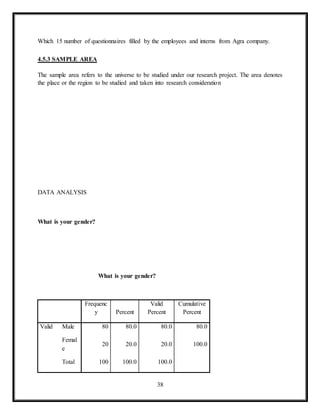
    25 dealt with. Thistype of communication is especially important in unionized environments as employees often tend to communicate only with their union representatives. The result is that vital feed back necessary for effective management is lost. Cooperation with union representatives can be very helpful in attendance management and should be encouraged if possible. Formal communications networks such as regularly scheduled department meetings are an excellent way not only to hear employee perceptions and concerns but also to communicate organizational goals. When employees are encouraged to make a difference they are less likely to withdraw their participation through absenteeism. Employees must not only be heard, they must be answered in such ways as to assure them their input is worthwhile. Staff development meetings are important in molding company ideals with employee needs. They are also important in developing a sense of team spirit among coworkers. Full participation in such meetings is to be encouraged if they are to be effective. Informal communications are also very effective in identifying and dealing with employee needs and perceptions. Informal communication involves all levels of managers and supervisors. Supervisors are especially important because of their hands-on approach and contact with employees. An employee's relationship with their supervisor can greatly influence their feelings about their work, their coworkers and thus their attendance at work. Insight, intuition, creative thinking and listening are all powerful ways of finding areas which affect attendance. Ideas and information should be encouraged from all sources. The establishment of varied communication channels is useful in gathering information and to an extent, in confirming it. Effective communication in itself can effectively reduce absenteeism. 2. Information Testing Once communication networks are established, information on perceived problems from employees will be bountiful. Before taking action on any issue, no matter what the source of information, it should be confirmed.
  • 26.
    26 A simple andeffective way to check whether a specific issue truly affects absenteeism is by finding correlations through using attendance records. If it is suggested, for instance, that absenteeism is increasing due to employee dissatisfaction with their workload, all one need do is match the attendance records during a period of "high" workload to a period of "normal" workload. If absenteeism is found to be significantly higher during increased workload periods, then it has been confirmed that actual workload "is related to" absenteeism levels. If no correlation exists it may be that employee perception of workload affects absenteeism. In this case the importance of the employee perception could be confirmed through staff development meetings. In any case two different problems have been distinguished which require different types of attention. Attendance records also should be used to monitor attendance trends. Are long term or short term absences more common? What percentage of employees have excessive absences? Attendance record forms are designed to facilitate the determination of whether or not absenteeism patterns exist. 3. Taking Appropriate Group Action The best way to handle any given situation is to handle it on its own merits and within the guidelines of the goals one is trying to achieve. This paper does not attempt to give all the answers to every possible situation but rather, offers suggestions and guidelines on which answers can be built. In summary, to run an effective attendance management program it is important to: 1. develop ways for each and every employee to feel free to contribute ideas and suggestions even though these may be outside the scope of their job responsibilities 2. make each employee aware that they are a valued member of the "team", that they play an important role in your organization and that their attendance is critical 3. hold regular meetings, keep your staff informed and involved 4. know your employees; without prying show an interest in their personal lives 5. be aware of problems that may effect employee attendance or performance
  • 27.
    27 6. familiarize yourselfwith community programs which you can recommend to an employee if he/she has a need for assistance (i.e. marital or financial counselling) 7. awareness, commitment and involvement by all levels of staff Positive motivation should be the main body of any attendance management program because it produces the best results. If an employee's experiences in the work place are pleasant, if he/she feels valued and appreciated, if supervision is fair but firm, that employee will be more motivated to attend work regularly.
  • 28.
    28 GUIDELINES FOR ABSENTEEISMCONTROL COUNSELING INNOCENT ABSENTEEISM Innocent absenteeism is not blameworthy and therefore disciplinary action is not justified. It is obviously unfair to punish someone for conduct which is beyond his/her control. Absenteeism, no matter what the cause, imposes losses on the employer who is also not at fault. The damage suffered by the employer must be weighed against the employee's right to be sick. There is a point at which the employer's right to expect the employee to attend regularly and fulfill the employment contract will outweigh the employee's right to be sick. At such a point the termination of the employee may be justified, as will be discussed. The procedure an employer may take for innocent absenteeism is as follows: 1. Initial counseling(s) 2. Written counseling(s) 3. Reduction(s) of hours and/or job reclassification 4. Discharge Initial Counseling Presuming you have communicated attendance expectations generally and have already identified an employee as a problem, you will have met with him or her as part of your attendance program and you should now continue to monitor the effect of these efforts on his or her attendance. If the absences are intermittent, meet with the employee each time he/she returns to work. If absence is prolonged, keep in touch with the employee regularly and stay updated on the status of his/her condition. (Indicate your willingness to assist.) You may require the employee to provide you with regular medical assessments. This will enable you to judge whether or not there is any likelihood of the employee providing regular attendance in future. Regular medical assessments will also give you an idea of what steps the employee is taking to seek medical or other assistance. Formal meetings in which verbal
  • 29.
    29 warnings are givenshould be given as appropriate and documented. If no improvement occurs written warning may be necessary. Written Counseling If the absences persist, you should meet with the employee formally and provide him/her with a letter of concern. If the absenteeism still continues to persist then the employee should be given a second letter of concern during another formal meeting. This letter would be stronger worded in that it would warn the employee that unless attendance improves, termination may be necessary. Reduction(s) of hours and or job reclassification In between the first and second letters the employee may be given the option to reduce his/her hours to better fit his/her personal circumstances. This option must be voluntarily accepted by the employee and can not be offered as an ultimatum, as a reduction in hours is a reduction in pay and therefore can be looked upon as discipline. If the nature of the illness or injury is such that the employee is unable to fulfill the requirements of his/her job, but could for example benefit from modified work, counsel the employee to bid on jobs of such type if they become available. Discharge Only when all the previously noted needs and conditions have been met and everything has been done to accommodate the employee can termination be considered. An Arbitrator would consider the following in ruling on an innocent absenteeism dismissal case. 1. Has the employee done everything possible to regain their health and return to work? 2. Has the employer provided every assistance possible? (i.e. counseling, support, time off.) 3. Has the employer informed the employee of the unworkable situation resulting from their sickness? 4. Has the employer attempted to accommodate the employee by offering a more suitable position (if available) or a reduction of hours?
  • 30.
    30 5. Has enoughtime elapsed to allow for every possible chance of recovery? 6. Has the employer treated the employee prejudicially in any way? As is evident, a great deal of time and effort must elapse before dismissal can take place. These points would be used to substantiate or disprove the following two fold test. 1. The absences must be shown to be clearly excessive. It must be proven that the employee will be unable to attend work on a regular basis in the future. CORRECTIVE ACTION FOR CULPABLE ABSENTEEISM As already indicated, culpable absenteeism consists of absences where it can be demonstrated that the employee is not actually ill and is able to improve his/her attendance. Presuming you have communicated attendance expectations generally, have identified the employee as a problem, have met with him/her as part of your attendance program, made your concerns on his specific absenteeism known and have offered counseling as appropriate, with no improvement despite your positive efforts, disciplinary procedures may be appropriate. The procedures for corrective/progressive discipline for culpable absenteeism are generally the same as for other progressive discipline problems. The discipline should not be prejudicial in any way. The general procedure is as follows: 1. Initial Warning(s) 2. Written Warning(s) 3. Suspension(s) 4. Discharge Verbal Warning Formally meet with the employee and explain that income protection is to be used only when an employee is legitimately ill. Advise the employees that his/her attendance record must improve and be maintained at an improved level or further disciplinary action will result. Offer any
  • 31.
    31 counseling or guidanceas is appropriate. Give further verbal warnings as required. Review the employee's income protection records at regular intervals. Where a marked improvement has been shown, commend the employee. Where there is no improvement a written warning should be issued. Written Warning Interview the employee again. Show him/her the statistics and point out that there has been no noticeable (or sufficient) improvement. Listen to the employee to see if there is a valid reason and offer any assistance you can. If no satisfactory explanation is given, advise the employee that he/she will be given a written warning. Be specific in your discussion with him/her and in the counseling memorandum as to the type of action to be taken and when it will be taken if the record does not improve. As soon as possible after this meeting provide the employee personally with the written warning and place a copy of his/her file. The written warning should identify any noticeable pattern If the amount and/or pattern continue, the next step in progressive discipline may be a second, stronger written warning. Your decision to provide a second written warning as an alternative to proceeding to a higher level of discipline (i.e. suspension) will depend on a number of factors. Such factors are the severity of the problem, the credibility of the employee's explanations, the employee's general work performance and length of service. Suspension (only after consultation with the appropriate superiors) If the problem of culpable absenteeism persists, following the next interview period and immediately following an absence, the employee should be interviewed and advised that he/she is to be suspended. The length of the suspension will depend again on the severity of the problem, the credibility of the employee's explanation, the employee's general work performance and length of service. Subsequent suspensions are optional depending on the above condition. Dismissal (only after consultation with the appropriate superiors)
  • 32.
    32 Dismissals should onlybe considered when all of the above conditions and procedures have been met. The employee, upon displaying no satisfactory improvement, would be dismissed on the grounds of his/her unwillingness to correct his/her absence record.
  • 33.
    33 OBJECTIVE OF THESTUDY 1.To identify the reason of being absent 2.To identify the steps required to decrease the absenteeism. 3.To study Employees working conditions 4.To identify factors that motivates employees, which minimize absenteeism. 5.To measure the employee absenteeism level. SCOPE OF THE STUDY The development of any organisations depend on the regularity of the employees. The study is conducted to know the various level and the reason of getting absent in an organization. By looking it, one can adopt corrective measures to decrease the irregularities in an organization, leads to an organization growth.
  • 34.
    34 RESEARCH METHODOLOGY Introduction This chaptertalks about the various types of research, sources of data collection, research objectives, sampling and various types of sampling methods used in this research. The study will be conducted to achieve the aforesaid objectives including both exploratory and descriptive in nature and involve personal interviews that will be based on the questionnaire format. Research Methodology A Research Methodology defines the purpose of the research, how it proceeds, how to measure progress and what constitute success with respect to the objectives determined for carrying out the research study. Research methodology is a science of studying how research is to be
  • 35.
    35 carried out. Essentially,the procedures by which researchers go about their work of describing, explaining and predicting phenomena are called research methodology. It is also defined as the study of methods by which knowledge is gained.  The research methodology for the present study has been adopted to reflect these realties and help reach the logical conclusion in an objective and scientific manner. Research method A research method is a systematic plan for conducting research. Sociologists draw on a variety of both qualitative and quantitative research methods, including experiments, survey research, participant observation, and secondary data. Quantitative methods aim to classify features, count them, and create statistical models to test hypotheses and explain observations. Qualitative methods aim for a complete, detailed description of observations, including the context of events and circumstances. TYPE OF RESEARCH: EXPLORATORY RESEARCH A research design is the specification of methods and procedures for acquiring the information needed to structure or solve the problem. It is the overall operational pattern or framework of the project that stimulates what information is to be collected from which source and by what procedure. On the basis of major purpose of our investigation the EXPLORATORY RESEARCH was found to be most suitable. This kind of research has the primary objective of development of insights into the problem. It studies the main area where the problem lies and also tries to evaluate some appropriate courses of action. DATA COLLECTION The task of data collection begins after a research problem has been identified and the research design has been chalked out. While deciding the method of data collection to be used for the study, the researcher should keep in mind two types of data:
  • 36.
    36 a. Primary data b.Secondary data In this research project the data being collected is as follows: Primary Data: The survey method is used to collect the primary data in this research as it is the Analytical research to find out the shortcomings and area of improvements according to the skill required for recruitment team. The data that is collected first hand by someone specifically for the purpose of facilitating the study is known as primary data. So in this research the data is collected from respondents through QUESTIONNAIRE.  Primary source of data : (i). Questionnaire technique. QUESTIONNAIRE – We prepared a questionnaire and our respondent constitutes age group of 20-35 years Secondary Data: The secondary data is also used in a lesser proportion to find out the name and designation of the employer who are working with this organization and the company profile. Secondary data refer to information gathered by someone other than the researcher conducting the current study. Such data can be internal or external to the organization and accessed through the Internet or perusal of recorded or published information. Secondary sources of data provide a lot of information for research and problem solving. Such data are as we have seen mostly qualitative in nature.  Secondary source of data :  Internet.  Websites
  • 37.
    37 SAMPLING TECHNIQUE SIMPLE SAMPLING Simplesampling is a sampling process that utilizes some form of random selection. In probability sampling, each unit is drawn with known probability, or has a nonzero chance of being selected in the sample. Such samples are usually selected with the help of random numbers. With probability sampling, a measure of sampling variation can be obtained objectively from the sample itself. Simple Random sampling has been adopted for this research. Under which we have considered the sampling which has been done for a specific designated population, because here a small cluster of professionals has been considered out of the total universe which has been divided in small group like recruitment team & employee. SIMPLE RANDOM SAMPLING A simple random sample is a subset of individuals (a sample) chosen from a larger set (a population). Each individual is chosen randomly and entirely by chance, such that each individual has the same probability of being chosen at any stage during the sampling process, and each subset of k individuals has the same probability of being chosen for the sample as any other subset of k individuals. This process and technique is known as simple random sampling, and should not be confused with systematic random sampling. A simple random sample is an unbiased surveying technique. Simple random sampling is a basic type of sampling, since it can be a component of other more complex sampling methods. The principle of simple random sampling is that every object has the same probability of being chosen. 4.5.2 SAMPLE SIZE Sample size refers to the number of items to be selected from Agra to constitute a sample. The sample size should be optimum as it should fulfill the objective of the research.
  • 38.
    38 Which 15 numberof questionnaires filled by the employees and interns from Agra company. 4.5.3 SAMPLE AREA The sample area refers to the universe to be studied under our research project. The area denotes the place or the region to be studied and taken into research consideration DATA ANALYSIS What is your gender? What is your gender? Frequenc y Percent Valid Percent Cumulative Percent Valid Male 80 80.0 80.0 80.0 Femal e 20 20.0 20.0 100.0 Total 100 100.0 100.0
  • 39.
    39 What is yourage? Male 80.0% Female 20.0% Male Female What is your gender?
  • 40.
    40 What is yourage? Frequenc y Percent Valid Percent Cumulative Percent Valid 20-25 31 31.0 31.0 31.0 25-30 21 21.0 21.0 52.0 30-35 15 15.0 15.0 67.0 35-40 26 26.0 26.0 93.0 40 or Above 7 7.0 7.0 100.0 Total 100 100.0 100.0
  • 41.
    41 What is yourmarital status? What is your marital status? Frequenc y Percent Valid Percent Cumulative Percent 20-25 31.0% 25-30 21.0% 30-35 15.0% 35-40 26.0% 40 or Above 7.0% 20-25 25-30 30-35 35-40 40 or Above What is your age?
  • 42.
    42 Valid Married 5656.0 56.0 56.0 Un- Married 33 33.0 33.0 89.0 Divorce d 4 4.0 4.0 93.0 Separat ed 2 2.0 2.0 95.0 Widow 5 5.0 5.0 100.0 Total 100 100.0 100.0
  • 43.
    43 What is yourmonthly income? What is your monthly income? Frequenc y Percent Valid Percent Cumulative Percent Valid 5000- 10000 24 24.0 24.0 24.0 Married 56.0% Un-Married 33.0% Divorced 4.0% Separated 2.0% Widow 5.0% Married Un-Married Divorced Separated Widow What is your marital status?
  • 44.
    44 10000- 20000 21 21.0 21.045.0 20000- 30000 33 33.0 33.0 78.0 30000- 40000 16 16.0 16.0 94.0 50000 or Above 6 6.0 6.0 100.0 Total 100 100.0 100.0
  • 45.
    45 What is yourjob level? What is your job level? Frequenc y Percent Valid Percent Cumulative Percent Valid Labor 25 25.0 25.0 25.0 Staff 33 33.0 33.0 58.0 5000-10000 24.0% 10000-20000 21.0%20000-30000 33.0% 30000-40000 16.0% 50000 or Above 6.0% 5000-10000 10000-20000 20000-30000 30000-40000 50000 or Above What is your monthly income?
  • 46.
    46 Manage ment 24 24.0 24.082.0 Other 18 18.0 18.0 100.0 Total 100 100.0 100.0
  • 47.
    47 To which industrydo you belong? To which industry do you belong? Frequenc y Percent Valid Percent Cumulative Percent Labor 25.0% Staff 33.0% Management 24.0% Other 18.0% Labor Staff Management Other What is your job level?
  • 48.
    48 Valid Manufac turing 68 68.068.0 68.0 Services 32 32.0 32.0 100.0 Total 100 100.0 100.0
  • 49.
    49 Which sector bestdescribe your organization? Which sector best describe your organization? Frequenc y Percent Valid Percent Cumulative Percent Manufacturing 68.0% Services 32.0% Manufacturing Services To which industry do you belong?
  • 50.
    50 Valid Governme nt Sector 4242.0 42.0 42.0 Private Sector 58 58.0 58.0 100.0 Total 100 100.0 100.0
  • 51.
    51 How long haveyou working in this organization? How long have you working in this organization? Frequenc y Percent Valid Percent Cumulative Percent Government Sector 42.0% Private Sector 58.0% Government Sector Private Sector Which sector best describe your organization?
  • 52.
    52 Valid Less than 1Year 15 15.0 15.0 15.0 1-3 Years 27 27.0 27.0 42.0 3-5 Years 24 24.0 24.0 66.0 10-15 Years 34 34.0 34.0 100.0 Total 100 100.0 100.0
  • 53.
    53 Does your companyoffer flexible working arrangement? Does your company offer flexible working arrangement? Frequenc y Percent Valid Percent Cumulative Percent Less than 1 Year 15.0% 1-3 Years 27.0% 3-5 Years 24.0% 10-15 Years 34.0% Less than 1 Year 1-3 Years 3-5 Years 10-15 Years How long have you working in this organization?
  • 54.
    54 Valid Yes 3737.0 37.0 37.0 No 63 63.0 63.0 100.0 Total 100 100.0 100.0
  • 55.
    55 How do youfeel about your working conditions? How do you feel about your working conditions? Frequenc y Percent Valid Percent Cumulative Percent Yes 37.0% No 63.0% Yes No Does your company offer flexible working arrangement?
  • 56.
    56 Valid Highly Flexible 10 10.010.0 10.0 Flexible 18 18.0 18.0 28.0 To some Extent Flexible 5 5.0 5.0 33.0 Normal 5 5.0 5.0 38.0 To Some Extent Strict 42 42.0 42.0 80.0 Strict 18 18.0 18.0 98.0 Highly Strict 2 2.0 2.0 100.0 Total 100 100.0 100.0
  • 57.
    57 Your pay scheduleis consistent with industry standards? Your pay schedule is consistent with industry standards? Frequenc y Percent Valid Percent Cumulative Percent Highly Flexible 10.0% Flexible 18.0% To some Extent Flexible 5.0% Normal 5.0% To Some Extent Strict 42.0% Strict 18.0% Highly Strict 2.0% Highly Flexible Flexible To some Extent Flexible Normal To Some Extent Strict Strict Highly Strict How do you feel about your working conditions?
  • 58.
    58 Valid Strongly Agree 31 31.031.0 31.0 Agree 18 18.0 18.0 49.0 Neither Agree Nor Disagree 10 10.0 10.0 59.0 Disagree 34 34.0 34.0 93.0 Strongly Disagree 7 7.0 7.0 100.0 Total 100 100.0 100.0
  • 59.
    59 How many leavesare allowed to you in a year? How many leaves are allowed to you in a year? Frequenc y Percent Valid Percent Cumulative Percent Valid 5-10 10 10.0 10.0 10.0 10-15 12 12.0 12.0 22.0 Strongly Agree 31.0% Agree 18.0% Neither Agree Nor Disagree 10.0% Disagree 34.0% Strongly Disagree 7.0% Strongly Agree Agree Neither Agree Nor Disagree Disagree Strongly Disagree Your pay schedule is consistent with industry standards?
  • 60.
    60 15-20 22 22.022.0 44.0 20-30 30 30.0 30.0 74.0 0 26 26.0 26.0 100.0 Total 100 100.0 100.0 5-10 10.0% 10-15 12.0% 15-20 22.0% 20-30 30.0% 0 26.0% 5-10 10-15 15-20 20-30 0 How many leaves are allowed to you in a year?
  • 61.
    61 Is there anydeduction made in your salary due to excess leaves? Is there any deduction made in your salary due to excess leaves? Frequenc y Percent Valid Percent Cumulative Percent Valid Yes 57 57.0 57.0 57.0 No 43 43.0 43.0 100.0 Total 100 100.0 100.0
  • 62.
    62 Is there anybonus given to you in case of 100% attendance? Is there any bonus given to you in case of 100% attendance? Frequenc y Percent Valid Percent Cumulative Percent Valid Yes 25 25.0 25.0 25.0 Yes 57.0% No 43.0% Yes No Is there any deduction made in your salary due to excess leaves?
  • 63.
    63 No 75 75.075.0 100.0 Total 100 100.0 100.0
  • 64.
    64 In which directionthese management strategies affect the employee's attitude towards absenteeism? In which direction these management strategies affect the employee's attitude towards absenteeism? Frequenc y Percent Valid Percent Cumulative Percent Yes 25.0% No 75.0% Yes No Is therer any bonus given to you in case of 100% attendence?
  • 65.
    65 Valid Positive 6868.0 71.6 71.6 Negative 27 27.0 28.4 100.0 Total 95 95.0 100.0 Missing No Answer 5 5.0 Total 100 100.0 Positive 68.0% Negative 27.0% Missing 5.0% Positive Negative Missing In which direction these management strategies affect the employee's attitutde towards absenteeism?
  • 66.
    66 How many dayswere you absent last year? How many days were you absent last year? Frequenc y Percent Valid Percent Cumulative Percent Valid Less than 10 23 23.0 23.0 23.0 10-15 16 16.0 16.0 39.0 15-20 17 17.0 17.0 56.0 20-25 14 14.0 14.0 70.0 25-30 23 23.0 23.0 93.0 30 or Above 7 7.0 7.0 100.0 Total 100 100.0 100.0
  • 67.
    67 To what extentdo you engange in your hobbies? To what extent do you engange in your hobbies? Frequenc y Percent Valid Percent Cumulative Percent Valid Frequen 40 40.0 40.0 40.0 Less than 10 23.0% 10-15 16.0% 15-20 17.0% 20-25 14.0% 25-30 23.0% 30 or Above 7.0% Less than 10 10-15 15-20 20-25 25-30 30 or Above How many days were you absent last year?
  • 68.
    68 tly Occaio naly 60 60.0 60.0100.0 Total 100 100.0 100.0
  • 69.
    69 How far youlive from your job location? How far you live from your job location? Frequenc y Percent Valid Percent Cumulative Percent Frequently 40.0% Occaionaly 60.0% Frequently Occaionaly To what extent do you engange in your hobbies?
  • 70.
    70 Valid Within the City 6666.0 66.0 66.0 Outside the City 34 34.0 34.0 100.0 Total 100 100.0 100.0
  • 71.
    71 Within the City 66.0% Outsidethe City 34.0% Within the City Outside the City How far you live from your job location?
  • 72.
    72 Did your personal& social problems affect your attendance? Frequenc y Percent Valid Percent Cumulative Percent Valid Yes 31 31.0 31.0 31.0 No 69 69.0 69.0 100.0 Total 100 100.0 100.0
  • 73.
    73 Yes 31.0% No 69.0% Yes No Did your personal& social problems affect your attendance?
  • 74.
    74 How do yourate the following reasons which can cause of your absents? Frequenc y Percent Valid Percent Cumulative Percent Valid Conveyance Problem 31 31.0 31.0 31.0 Health Problem 49 49.0 49.0 80.0 Personal & Social Problems 20 20.0 20.0 100.0 Total 100 100.0 100.0
  • 75.
    75 Write your comments& suggestions about effective attendance management systems? Frequenc y Percent Valid Percent Cumulative Percent Valid Benefit 7 7.0 21.9 21.9 Benefits 2 2.0 6.3 28.1 Bonus 7 7.0 21.9 50.0 Conveyance Problem 31.0% Health Problem 49.0% Personal & Social Problems 20.0% Conveyance Problem Health Problem Personal & Social Problems How do you rate the following reasons which can cause of your absents?
  • 76.
    76 Compans e 1 1.0 3.153.1 Compens a 1 1.0 3.1 56.3 Ex benef 1 1.0 3.1 59.4 Ex.leave 1 1.0 3.1 62.5 Incentiv 1 1.0 3.1 65.6 Managme n 1 1.0 3.1 68.8 Motivati 1 1.0 3.1 71.9 Producti 1 1.0 3.1 75.0 Salary 1 1.0 3.1 78.1 Workload 7 7.0 21.9 100.0 Total 32 32.0 100.0 Missing No Response 68 68.0 Total 100 100.0
  • 77.
  • 78.
    78 CONCLUSION Attendance improvement programscan work! What the employees require is commitment and support from all levels of management, an effective attendance record-keeping system, consultation and open communication on the reasons for the attendance program. Implementing and maintaining a work environment where open communication and team spirit can thrive will at first sometimes seem a mammoth and somewhat unrealistic task. If you need encouragement just consider some of the benefits; reduced absenteeism, open communication, team spirit, reduced grievances and greater employee satisfaction. Only when the positive approach is unsuccessful does the employer need to use the remedial approach to deal with habitual abusers or with excessive absentee cases. In all cases the employer's actions must be fair and reasonable and consistently applied. With a well communicated, implemented, and administered program, the majority of the employees should agree with the attendance management program and cooperation should follow.
  • 79.
  • 80.
  • 81.
    81 BIBLIOGRAPHY 1. Web sites www.citehr.com  www.economicstimes.com 2. BOOKS  K Ashwathapa, (1997) Human Resource and personnel Management  C R Kothari, Research Methodology
  • 82.
  • 83.
  • 84.