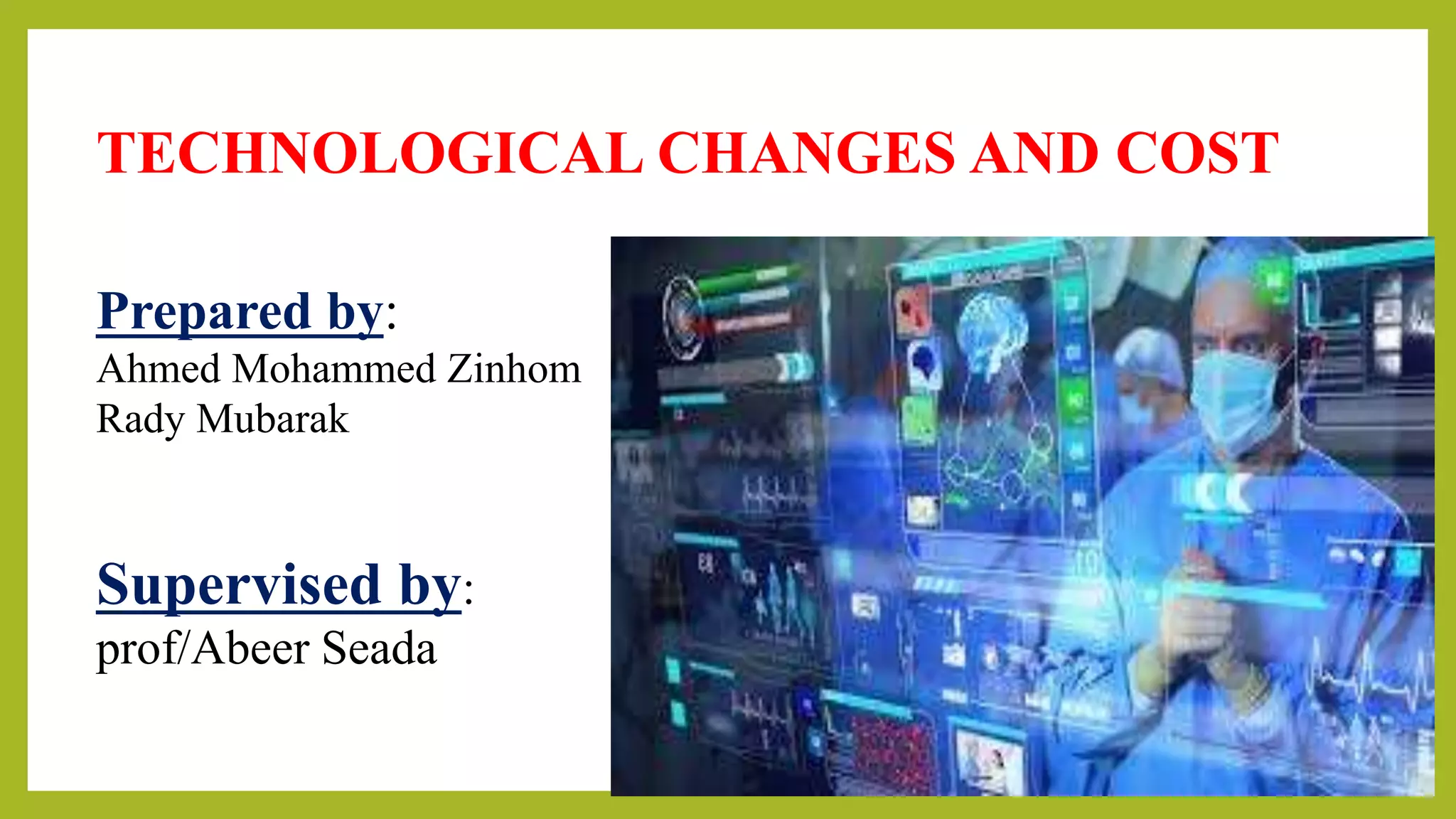
TECHNOLOGICAL CHANGES AND COST
Prepared by:
Ahmed Mohammed Zinhom
Rady Mubarak
Supervised by:
prof/Abeer Seada
Objectives:
At the end of this session each participant will be able to:
1- Discuss factors affecting technology adoption in medical
fields
2- Explain the Lifetime Impact of Medical Technology
3- Discuss technological advancements in healthcare that have
emerged over the last ten year.
4- Identify the Advantages of Technological Innovation
5- Determine the Dark Side of Technology
OUTLINES:
1- Factors affecting technology adoption in medical fields.
2- The Lifetime Impact of Medical Technology.
3- Technological advancements in healthcare that have emerged
over the last ten year.
4- The Advantages of Technological Innovation.
5- The Dark Side of Technology.
Introduction
It is commonly accepted that technological change has been
one of the most important drivers of health care spending
growth over the past decades.
for instance, suggests that 50% of health care growth in the US
can be attributed to the introduction of new technologies over
the past five decades.
Factors affecting technology adoption in medical fields
Several factors have been shown to affect the adoption of medical
technologies. They include
- the adopters’ characteristics (demand for medical technologies),
- the characteristics of medical device companies (supply of medical
technologies)
- the regulatory and geographic environments where they develop.
1- The characteristics of adopters
The demand for medical technologies is driven by
both the care consumers (patients) and the care
providers (physicians) With respect to patients.
2- The supply of medical technologies
With respect to the medical device industry, three strategic aspects are
considered as being influential in the adoption and diffusion of technologies: -
competition among technologies, competition among suppliers and availability
of complementary goods or services.
- Competition among technologies involves: competition between old and new
technologies.
3- Regulation and geography
The regulatory environment is an important determinant of
medical technology adoption in terms of regulation of both
technology and health care financing.
Technology regulation ranges from requiring advance
approval of technology acquisition to detailed reviews of the
use of the technology.
The Lifetime Impact of Medical Technology
A natural desire is to estimate the costs and benefits of the new
technology.
Short-run costs and health impacts are relatively easy to measure, if
one has the right data.
One looks at how spending and health for people with the
treatment compare to similar people without the treatment.
The following are ten technological advancements in
healthcare that have emerged over the last ten year.
1- The electronic health record:
In 2009, only 16 percent of U.S. hospitals were using an EHR.
By 2013, about 80 percent of hospitals eligible for CMS' meaningful use
incentives program had incorporated an EHR into their organizations.
2- Mobile health:
is freeing healthcare devices of wires and cords and enabling
physicians and patients alike to check on healthcare processes on-
the-go.
Smart phones and tablets allow healthcare providers to more freely
access and send information.
Physicians and service providers can use mobile Health tools for
orders, documentation and simply to reach more information when
with patients.
3- Telemedicine/telehealth:
Studies consistently show the benefit of telehealth, especially in
rural settings that do not have access to the same resources
metropolitan areas may have.
A large-scale study published in CHEST Journal shows patients in an
intensive care unit equipped with telehealth services were
discharged from the ICU 20 percent more quickly and saw a 26
percent lower mortality rate than patients in a regular ICU.
4- Portal technology:
Patients are increasingly becoming active players in their own
healthcare, and portal technology is one tool helping them to do
so.
Portal technology allows physicians and patients to access medical
records and interact online.
5- Self-service kiosks: ‫الخدمة‬ ‫اكشاك‬‫الذاتية‬
Similar to portal technology, self-service kiosks can help
expedite processes like hospital registration. Patients can
increasingly do everything related to registration without
having to talk to anyone.
However, hospitals need to be cautious when integrating it
to ensure human to human communication is not entirely
eliminated.
6- Remote monitoring tools:
At the end of 2012, 2.8 million patients worldwide were
using a home monitoring system, according to a Research
and Markets report. Monitoring patients' health at home can
reduce costs and unnecessary visits to a physician's office.
For example: a cardiac cast with a pacemaker automatically
transmitting data to a remote center.
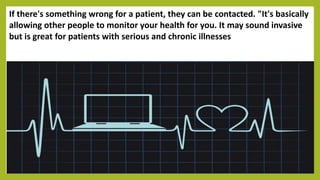
If there's something wrong for a patient, they can be contacted. "It's basically
allowing other people to monitor your health for you. It may sound invasive
but is great for patients with serious and chronic illnesses
7- Sensors and wearable technology:
The wearable medical device market is growing.
Wearable medical devices and sensors are simply another
way to collect data, it is one of the aims and purposes of
healthcare.
8- Wireless communication:
"Hospitals are catching up to the 21st century with staff communicating to
one another, adding that internal communication advancements in hospitals
followed a slower development timeline since they had to account for
security.
9- Real-time locating services:
Another growing data monitoring tool, real-time locating
services, are helping hospitals focus on efficiency and
instantly identify problem areas. Hospitals can implement
tracking systems for instruments, devices and even clinical
staff.
10- Pharmacogenomics/genome sequencing:
Personalized medicine continues to edge closer to the forefront of
the healthcare industry.
Tailoring treatment plans to individuals and anticipating the onset of
certain diseases offers promising benefits for healthcare efficiency
and diagnostic accuracy.
The Advantages of Technological Innovation
- Without doubt, medical technology is essential to people’s health and
improved quality of life.
- It also contributes billions of dollars to the economy. There are many
benefits that innovative technology brings to the table when it comes to
healthcare.
For example,
- the widespread adoption of electronic health records has resulted in
significant savings in health care costs as well as improved patient health and
safety.
- This is not only a time saver but it also results in better data coordination and
management.

- It is also technological innovation that has opened the door to more non-invasive
procedures.
-- Diagnostics have never been easier and more accurate, especially due to advancements
in areas like nuclear medicine. Nowadays, numerous methods of imaging allow for
technicians and physicians to examine a patient’s anatomy without needing invasive
procedures to form a diagnosis.
- The development of better instruments and more
advanced technology have allowed surgeons to
perform procedures in minimally invasive ways that
just wasn’t possible a few years ago.
The Dark Side of Technology
- Technology can also bring hidden dangers if you aren’t careful. The
internet in particular is known for this. Though some would disagree,
the infinite stream of medical knowledge available online is not
necessarily a good thing.
- Websites like WebMD can be a great resource for living a healthy
lifestyle, but they should never be used to replace your physician. Far
too often a simple ache can be misconstrued as something far more
serious.
Self diagnosis is a dangerous road to go down. At best you’ll scare yourself into
thinking something is seriously wrong when it isn’t.
-At worst you’ll misdiagnose yourself and cause serious damage to your
health and well being.
-- Unfortunately the internet provides a cheap and “easy” way to avoid going
to the doctor. In the long term, however, it may wind up costing you much
more than you ever expected.
Technological changes and cost

Technological changes and cost

  • 1.
    TECHNOLOGICAL CHANGES ANDCOST Prepared by: Ahmed Mohammed Zinhom Rady Mubarak Supervised by: prof/Abeer Seada
  • 2.
    Objectives: At the endof this session each participant will be able to: 1- Discuss factors affecting technology adoption in medical fields 2- Explain the Lifetime Impact of Medical Technology 3- Discuss technological advancements in healthcare that have emerged over the last ten year. 4- Identify the Advantages of Technological Innovation 5- Determine the Dark Side of Technology
  • 3.
    OUTLINES: 1- Factors affectingtechnology adoption in medical fields. 2- The Lifetime Impact of Medical Technology. 3- Technological advancements in healthcare that have emerged over the last ten year. 4- The Advantages of Technological Innovation. 5- The Dark Side of Technology.
  • 4.
    Introduction It is commonlyaccepted that technological change has been one of the most important drivers of health care spending growth over the past decades. for instance, suggests that 50% of health care growth in the US can be attributed to the introduction of new technologies over the past five decades.
  • 5.
    Factors affecting technologyadoption in medical fields Several factors have been shown to affect the adoption of medical technologies. They include - the adopters’ characteristics (demand for medical technologies), - the characteristics of medical device companies (supply of medical technologies) - the regulatory and geographic environments where they develop.
  • 6.
    1- The characteristicsof adopters The demand for medical technologies is driven by both the care consumers (patients) and the care providers (physicians) With respect to patients.
  • 7.
    2- The supplyof medical technologies With respect to the medical device industry, three strategic aspects are considered as being influential in the adoption and diffusion of technologies: - competition among technologies, competition among suppliers and availability of complementary goods or services. - Competition among technologies involves: competition between old and new technologies.
  • 8.
    3- Regulation andgeography The regulatory environment is an important determinant of medical technology adoption in terms of regulation of both technology and health care financing. Technology regulation ranges from requiring advance approval of technology acquisition to detailed reviews of the use of the technology.
  • 9.
    The Lifetime Impactof Medical Technology A natural desire is to estimate the costs and benefits of the new technology. Short-run costs and health impacts are relatively easy to measure, if one has the right data. One looks at how spending and health for people with the treatment compare to similar people without the treatment.
  • 10.
    The following areten technological advancements in healthcare that have emerged over the last ten year.
  • 11.
    1- The electronichealth record: In 2009, only 16 percent of U.S. hospitals were using an EHR. By 2013, about 80 percent of hospitals eligible for CMS' meaningful use incentives program had incorporated an EHR into their organizations.
  • 13.
    2- Mobile health: isfreeing healthcare devices of wires and cords and enabling physicians and patients alike to check on healthcare processes on- the-go. Smart phones and tablets allow healthcare providers to more freely access and send information. Physicians and service providers can use mobile Health tools for orders, documentation and simply to reach more information when with patients.
  • 14.
    3- Telemedicine/telehealth: Studies consistentlyshow the benefit of telehealth, especially in rural settings that do not have access to the same resources metropolitan areas may have. A large-scale study published in CHEST Journal shows patients in an intensive care unit equipped with telehealth services were discharged from the ICU 20 percent more quickly and saw a 26 percent lower mortality rate than patients in a regular ICU.
  • 15.
    4- Portal technology: Patientsare increasingly becoming active players in their own healthcare, and portal technology is one tool helping them to do so. Portal technology allows physicians and patients to access medical records and interact online.
  • 16.
    5- Self-service kiosks:‫الخدمة‬ ‫اكشاك‬‫الذاتية‬ Similar to portal technology, self-service kiosks can help expedite processes like hospital registration. Patients can increasingly do everything related to registration without having to talk to anyone. However, hospitals need to be cautious when integrating it to ensure human to human communication is not entirely eliminated.
  • 17.
    6- Remote monitoringtools: At the end of 2012, 2.8 million patients worldwide were using a home monitoring system, according to a Research and Markets report. Monitoring patients' health at home can reduce costs and unnecessary visits to a physician's office. For example: a cardiac cast with a pacemaker automatically transmitting data to a remote center.
  • 18.
    If there's somethingwrong for a patient, they can be contacted. "It's basically allowing other people to monitor your health for you. It may sound invasive but is great for patients with serious and chronic illnesses
  • 19.
    7- Sensors andwearable technology: The wearable medical device market is growing. Wearable medical devices and sensors are simply another way to collect data, it is one of the aims and purposes of healthcare.
  • 20.
    8- Wireless communication: "Hospitalsare catching up to the 21st century with staff communicating to one another, adding that internal communication advancements in hospitals followed a slower development timeline since they had to account for security.
  • 21.
    9- Real-time locatingservices: Another growing data monitoring tool, real-time locating services, are helping hospitals focus on efficiency and instantly identify problem areas. Hospitals can implement tracking systems for instruments, devices and even clinical staff.
  • 22.
    10- Pharmacogenomics/genome sequencing: Personalizedmedicine continues to edge closer to the forefront of the healthcare industry. Tailoring treatment plans to individuals and anticipating the onset of certain diseases offers promising benefits for healthcare efficiency and diagnostic accuracy.
  • 23.
    The Advantages ofTechnological Innovation - Without doubt, medical technology is essential to people’s health and improved quality of life. - It also contributes billions of dollars to the economy. There are many benefits that innovative technology brings to the table when it comes to healthcare. For example, - the widespread adoption of electronic health records has resulted in significant savings in health care costs as well as improved patient health and safety.
  • 24.
    - This isnot only a time saver but it also results in better data coordination and management. - It is also technological innovation that has opened the door to more non-invasive procedures. -- Diagnostics have never been easier and more accurate, especially due to advancements in areas like nuclear medicine. Nowadays, numerous methods of imaging allow for technicians and physicians to examine a patient’s anatomy without needing invasive procedures to form a diagnosis.

  • 25.
    - The developmentof better instruments and more advanced technology have allowed surgeons to perform procedures in minimally invasive ways that just wasn’t possible a few years ago.
  • 26.
    The Dark Sideof Technology - Technology can also bring hidden dangers if you aren’t careful. The internet in particular is known for this. Though some would disagree, the infinite stream of medical knowledge available online is not necessarily a good thing. - Websites like WebMD can be a great resource for living a healthy lifestyle, but they should never be used to replace your physician. Far too often a simple ache can be misconstrued as something far more serious.
  • 27.
    Self diagnosis isa dangerous road to go down. At best you’ll scare yourself into thinking something is seriously wrong when it isn’t. -At worst you’ll misdiagnose yourself and cause serious damage to your health and well being. -- Unfortunately the internet provides a cheap and “easy” way to avoid going to the doctor. In the long term, however, it may wind up costing you much more than you ever expected.

Editor's Notes

  • #14 اثناء التنقل on-the-go.
  • #15 Telemedicine التطبيب عن بعد