Absenteeism,
Destructive Workplace
Behaviour, Root Causes

     3:40 Weds Dec 5, 2012
   Infonex 1045 Whitehorse

          Chris Hylton
 800 449-5866 chris@hylton.ca
Agenda
2      • Types of absenteeism: culpable, innocent:
        making the distinction
       • Addressing the root causes of absenteeism to
        determine if it is a symptom of stress, burn-out,
        addictions etc.
       • Proactive strategies and guidance to rectify
        the behaviour
       • Attendance policy: tips and strategies
       • Ignoring it won't make it go away: how to
        communicate expectations, policy and confront
        the issue
       • Determining when termination is appropriate
What attendance issues we
can try and solve for you in
       this session?


     Open discussion           3
4


     Employers must be knowledgeable about
                 absences, how
    much they have to tolerate and how they can
               respond effectively.
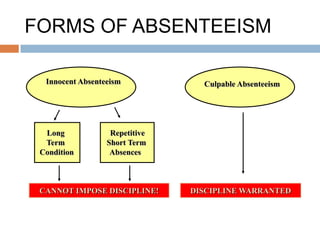
FORMS OF ABSENTEEISM

  Innocent Absenteeism            Culpable Absenteeism


  Long             Repetitive
  Term            Short Term
 Condition         Absences


 CANNOT IMPOSE DISCIPLINE!      DISCIPLINE WARRANTED
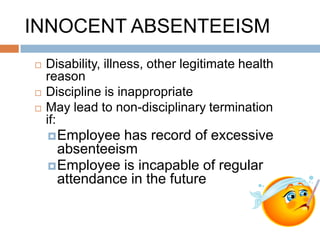
INNOCENT ABSENTEEISM
   Disability, illness, other legitimate health
    reason
   Discipline is inappropriate
   May lead to non-disciplinary termination
    if:
     Employee  has record of excessive
      absenteeism
     Employee is incapable of regular
      attendance in the future
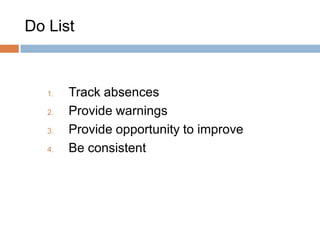
Do List


   1.   Track absences
   2.   Provide warnings
   3.   Provide opportunity to improve
   4.   Be consistent
MONITORING
INNOCENT ABSENTEEISM
   Institute attendance management program AMP
   Understand the actual levels of absenteeism
   Analyze and determine where problems are
   Record all incidents of absenteeism and lates
MANAGING
CULPABLE ABSENTEEISM
    Don‟t rigidly adhere to defined policies
    Disciplinary policies are helpful
    All absences are presumed innocent unless
     proven culpable (although the employer may
     put employees on notice that they need to
     substantiate the reasons for an absence)
    If culpable, then discipline may be warranted
    Use progressive discipline
FEATURES OF ATTENDANCE
MANAGEMENT PROGRAMS
   Direct attention to improving health and safety;
   Provide health services and facilities;
   Provide employee assistance programs;
   Provide attendance incentive programs;
   Collect and publish attendance statistics;
   Set attendance goals and monitor achievement;
FEATURES OF Program
   Provide feedback, counselling and other forms
    of support;

   Impose discipline when warranted; and

   Implement last chance agreements when all
    else fails (more common in the unionized
    setting).
Termination:
THE LAST RESORT
    Employer has to demonstrate:
      Record of excessive absenteeism
      Incapable of regular attendance in the future
      Accommodation to the point of undue hardship

    Follow program of progressive discipline
    Terminate with caution = there is always a
     risk of a grievance or a human rights
     complaint
DOCTRINE OF FRUSTRATION

   Absenteeism resulting from illness or disability is not
    cause to terminate
   Test for frustration of contract:
       Is it temporary or permanent
       Does it prevents performance of essential duties of position,
        even after accommodation
FACTORS TO CONSIDER
   Terms of any existing contract
   Anticipated term of employment
   Nature of the employment
   Nature of the illness or injury & prospects for
    recovery
   Period of past employment
BOTTOM LINE

   The longer the relationship
                +
    The greater indicators of
     commitment and loyalty
                =
  The more difficult it will be to
       establish frustration
TERMINATION & SEVERANCE

    Even if frustrated, employer will have to pay
     termination and severance pay in accordance
     with Employement Standards
    Ontario Nurses’ Association v. St. Joseph’s
     General Hospital, [2006] O.L.A.A. No. 155
     (Randall)
    Now reflected in changes to Reg. 288/01 – no
     longer an exemption from termination or
     severance pay under Employement Standards
REINSTATEMENT OF EXCESSIVELY
    ABSENT EMPLOYEES
   Was there a triggering absence?
   Were the absences blameworthy or innocent?
     Ifinnocent, what is the prognosis for future
      attendance?
   Did the employer adequately notify the employee
    of expectations with respect to attendance?
   Did the employer warn the employee that
    discharge may result if attendance did not
    improve?
   What was the workplace average absenteeism
LAST CHANCE AGREEMENT
   Similar to a last chance award, but avoids the
    time, expense of arbitration – negotiated by
    the parties;
   Usually establish a very high attendance
    standard;
   Additional conditions, as applicable;
     Complete   abstinence from the substance at
      issue;
     Completion   of recovery program;
     Random   drug testing;
LAST CHANCE AGREEMENTS

Purpose:
 Keeps employee in the
  workplace, but imposes
  stringent conditions
 Ensures employee knows job is
  in jeopardy if performance does
  not improve
 May promote rehabilitation
When Are Last Chance
Agreements Appropriate?
 Where an employee has been
  unresponsive to progressive discipline or
  efforts to address an attendance problem
  (particularly if it‟s related to an addiction or
  other disability)
 Should not be used too early in the
  process of dealing with a problem
  employee and is not a substitute for other
  accommodation options
 A last chance agreement should only be
  part of a broader effort to accommodate
Last Chance Agreements should Include

•   An express recognition of the nature of the employee‟s
    problem (e.g., addiction or alcoholism) and efforts the
    employer has made to accommodate the employee
•   Recognition that the employer and, if applicable, union
    have taken all reasonable steps necessary to
    accommodate the employee to the point of undue
    hardship
•   Specific details of the conditions applied to the
    employee‟s continued employment, including details of
    any treatment, after-care, attendance expectations, etc.,
    as well as the employee‟s
    commitment to comply with these conditions
Last Chance Agreements:
    What They Should Include (cont‟d)
   A provision expressly stating that breach of any
    condition of the agreement will result in the
    employee‟s discharge
   Agreement that reinstatement of the employee
    following a breach of the agreement would amount
    to undue hardship
   Agreement that failure to discharge for breach of
    the agreement does not constitute waiver
   An express prohibition on an arbitrator substituting
    any lesser penalty in the event that there is a
    breach
Benefits of an Enforceable
Last Chance Agreement
   Provides an additional opportunity for an
    employee to salvage his/her employment
   Provides the employee with a „wake-up call‟ –
    often those who suffer from addictions will not
    seek and pursue treatment until they lose their
    employment
   May be viewed as being one aspect of the
    employer‟s duty to accommodate (provided that
    it is complements other efforts)
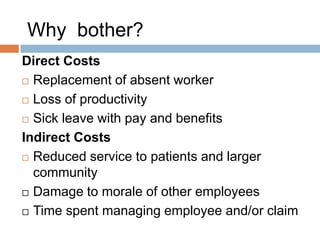
Why bother?
Direct Costs
 Replacement of absent worker

 Loss of productivity

 Sick leave with pay and benefits

Indirect Costs
 Reduced service to patients and larger

  community
 Damage to morale of other employees

 Time spent managing employee and/or claim
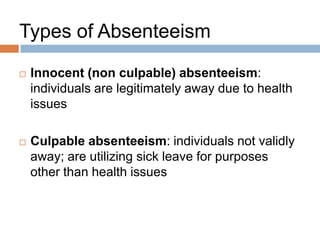
Types of Absenteeism

   Innocent (non culpable) absenteeism:
    individuals are legitimately away due to health
    issues

   Culpable absenteeism: individuals not validly
    away; are utilizing sick leave for purposes
    other than health issues
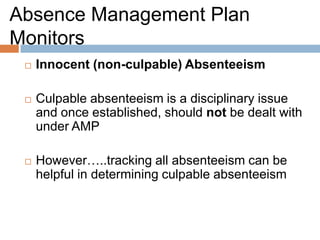
Absence Management Plan
Monitors
    Innocent (non-culpable) Absenteeism

    Culpable absenteeism is a disciplinary issue
     and once established, should not be dealt with
     under AMP

    However…..tracking all absenteeism can be
     helpful in determining culpable absenteeism
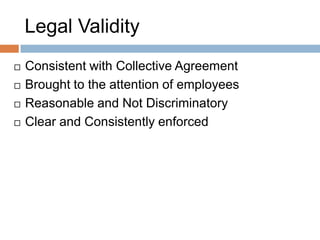
Legal Validity
   Consistent with Collective Agreement
   Brought to the attention of employees
   Reasonable and Not Discriminatory
   Clear and Consistently enforced
Legal Validity
 Absenteeism Management Process
 must allow for:
  Flexibility and consideration of individual
   circumstances
  “Progressive escalating response”

  Not disciplinary


 (Hospital Employees Union v. Health Employers
   Association of BC (2002) BCLRBD No. 112)
Facts about CLS‟ AMP Program

   Implemented May 2005
   Revisions July 2008
   Four Step Program
   Target 3.5% absenteeism (9 days/year)
   Absenteeism rate range 3.73% to 4.5%
   Includes Sick with pay; Sick without pay;
    Medical Appointments
CLS ISSUES

   People working when sick
   Targeting right people
   Target vs. Average
   How to exit the program
   Ownership and accountability
   Time required to manage program
   EDUCATION!!!
UNION ISSUES
   People working when sick
   Targeting right people
   Target vs. Average
   How to exit the program
   Concern singling people out
   Early intervention – intrusive
   Supervisor abuse – “I‟ll be watching you”
   EDUCATION!!!
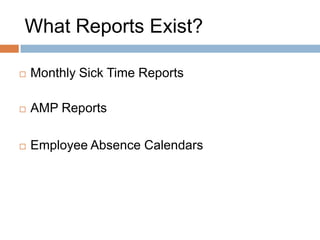
What Reports Exist?

   Monthly Sick Time Reports

   AMP Reports

   Employee Absence Calendars
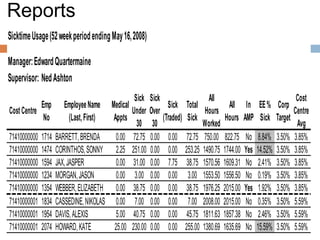
Reports
Sicktime Usage (52 week period ending May 16, 2008)

Manager: Edward Quartermaine
Supervisor: Ned Ashton
                                                   Sick    Sick                       All                                      Cost
              Emp      Employee Name    Medical                     Sick Total                All In EE % Corp
Cost Centre                                       Under    Over                     Hours                                     Centre
               No       (Last, First)    Appts                    (Traded) Sick              Hours AMP Sick Target
                                                     30     30                     Worked                                      Avg
71410000000   1714   BARRETT, BRENDA     0.00      72.75   0.00    0.00    72.75    750.00    822.75   No     8.84%   3.50%   3.85%
71410000000   1474   CORINTHOS, SONNY 2.25        251.00   0.00    0.00   253.25   1490.75   1744.00   Yes   14.52%   3.50%   3.85%
71410000000   1594   JAX, JASPER         0.00      31.00   0.00    7.75    38.75   1570.56   1609.31   No     2.41%   3.50%   3.85%
71410000000   1234   MORGAN, JASON       0.00       3.00   0.00    0.00     3.00   1553.50   1556.50   No     0.19%   3.50%   3.85%
71410000000   1354   WEBBER, ELIZABETH 0.00        38.75   0.00    0.00    38.75   1976.25   2015.00   Yes    1.92%   3.50%   3.85%
71410000001   1834   CASSEDINE, NIKOLAS 0.00        7.00   0.00    0.00     7.00   2008.00   2015.00   No     0.35%   3.50%   5.59%
71410000001   1954   DAVIS, ALEXIS       5.00      40.75   0.00    0.00    45.75   1811.63   1857.38   No     2.46%   3.50%   5.59%
71410000001   2074   HOWARD, KATE       25.00     230.00   0.00    0.00   255.00   1380.69   1635.69   No    15.59%   3.50%   5.59%
Reports
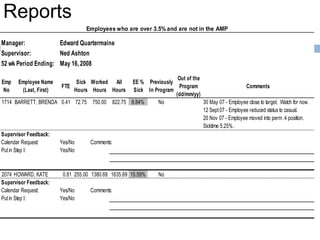
                                   Employees who are over 3.5% and are not in the AMP

Manager:             Edward Quartermaine
Supervisor:          Ned Ashton
52 wk Period Ending: May 16, 2008

                                                                Out of the
Emp    Employee Name         Sick Worked All   EE % Previously
                        FTE                                     Program                        Comments
 No     (Last, First)       Hours Hours Hours  Sick In Program
                                                               (dd/mm/yy)
1714 BARRETT, BRENDA 0.41 72.75 750.00 822.75 8.84%     No                 30 May 07 - Employee close to target. Watch for now.
                                                                           12 Sept 07 - Employee reduced status to casual.
                                                                           20 Nov 07 - Employee moved into perm .4 position.
                                                                           Sicktime 5.25% .
Supervisor Feedback:
Calendar Request:    Yes/No     Comments:
Put in Step I:       Yes/No


2074 HOWARD, KATE        0.81 255.00 1380.69 1635.69 15.59%     No
Supervisor Feedback:
Calendar Request:       Yes/No      Comments:
Put in Step I:          Yes/No
Reports
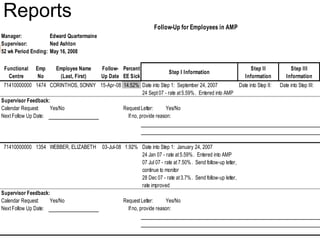
                                                                     Follow-Up for Employees in AMP
Manager:             Edward Quartermaine
Supervisor:          Ned Ashton
52 wk Period Ending: May 16, 2008

 Functional    Emp      Employee Name       Follow- Percent                                                         Step II         Step III
                                                                            Step I Information
   Centre       No       (Last, First)      Up Date EE Sick                                                      Information      Information
 71410000000 1474 CORINTHOS, SONNY 15-Apr-08 14.52% Date into Step 1: September 24, 2007             Date into Step II:        Date into Step III:
                                                       24 Sept 07 - rate at 5.59% . Entered into AMP
Supervisor Feedback:
Calendar Request:    Yes/No                  Request Letter:       Yes/No
Next Follow Up Date:                           If no, provide reason:


 71410000000 1354 WEBBER, ELIZABETH         03-Jul-08 1.92% Date into Step 1: January 24, 2007
                                                            24 Jan 07 - rate at 5.59% . Entered into AMP
                                                            07 Jul 07 - rate at 7.50% . Send follow-up letter,
                                                            continue to monitor
                                                            28 Dec 07 - rate at 3.7% . Send follow-up letter,
                                                            rate improved
Supervisor Feedback:
Calendar Request:    Yes/No                           Request Letter:      Yes/No
Next Follow Up Date:                                    If no, provide reason:
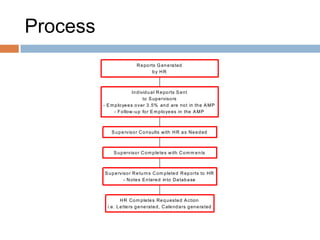
Process
                            R e po rts G en e ra ted
                                     by HR


                           In d ivid u a l R e po rts S e nt
                                  to S up e rviso rs
          - E m p lo ye e s o ver 3 .5% an d are no t in th e A M P
               - F o llow -u p fo r E m p lo ye es in the A M P


              S u p e rviso r C o n sults with H R a s Ne e d ed


               S u p erviso r C o m p le te s w ith C o m m e n ts


          S u p e rviso r R e tu rn s C om p lete d R ep o rts to HR
                     - N ote s E n tere d in to Da tab a se


                    H R Co m p lete s Re q u este d A ction
            i.e . L e tte rs g e ne rate d, C ale nd a rs g en e ra ted
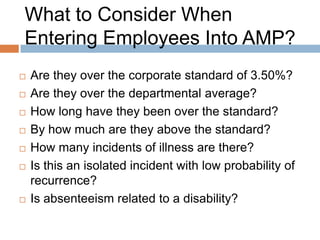
What to Consider When
Entering Employees Into AMP?
   Are they over the corporate standard of 3.50%?
   Are they over the departmental average?
   How long have they been over the standard?
   By how much are they above the standard?
   How many incidents of illness are there?
   Is this an isolated incident with low probability of
    recurrence?
   Is absenteeism related to a disability?
What to Consider When
Entering Employees Into AMP?
   What is their length of service?
   Is the employee participating in a graduated
    RTW plan?
   Has the employee achieved a full RTW with no
    restrictions?
   Are there any unusual circumstances that may
    have precipitated a spike in absenteeism?
   Has the person be at Step 1 or 2 previously?
   Does the employee have a chronic illness?
What to Consider When
Entering Employees Into AMP?

   Consideration for enrolment is over the
    corporate standard for a period of at least six
    months

   If you have initial concerns in determining
    entrance into AMP, contact your HR consultant
Step 1
   Step 1: Informal Notification, Initial Concern

     Notification package provided to employee
     Contains absence history, AMP process, internal
      and external support
     Goal is to inform employee and offer education
Step 2
   Formal Discussion, Continued Concern

     Supervisor   and employee meet
     Union representation is offered

     Purpose is to determine of there are underlying
      health issues
     A referral to Occupational Health and Wellness
      may be made
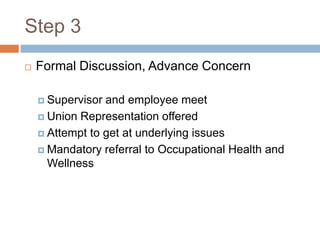
Step 3
   Formal Discussion, Advance Concern

     Supervisor and employee meet
     Union Representation offered

     Attempt to get at underlying issues

     Mandatory referral to Occupational Health and
      Wellness
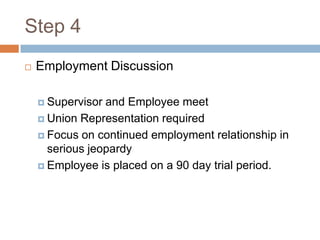
Step 4
   Employment Discussion

     Supervisor and Employee meet
     Union Representation required

     Focus on continued employment relationship in
      serious jeopardy
     Employee is placed on a 90 day trial period.
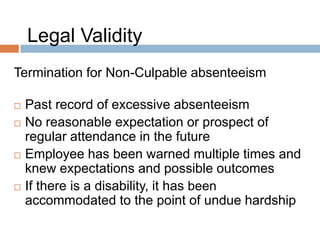
Legal Validity
Termination for Non-Culpable absenteeism

   Past record of excessive absenteeism
   No reasonable expectation or prospect of
    regular attendance in the future
   Employee has been warned multiple times and
    knew expectations and possible outcomes
   If there is a disability, it has been
    accommodated to the point of undue hardship
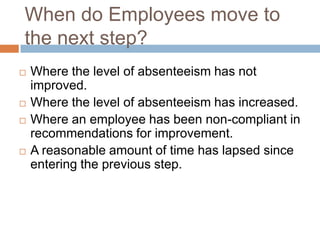
When do Employees move to
the next step?
   Where the level of absenteeism has not
    improved.
   Where the level of absenteeism has increased.
   Where an employee has been non-compliant in
    recommendations for improvement.
   A reasonable amount of time has lapsed since
    entering the previous step.
AMP Letters

   Follow up letters should be sent every 3-6
    months so the employee can see their
    progress – Employer obligation!!

   A separate file is kept in HR for each employee
    in AMP
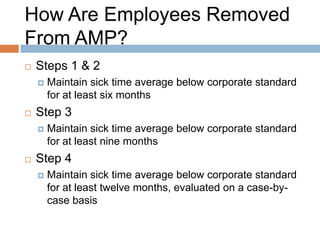
How Are Employees Removed
From AMP?
   Steps 1 & 2
       Maintain sick time average below corporate standard
        for at least six months
   Step 3
       Maintain sick time average below corporate standard
        for at least nine months
   Step 4
       Maintain sick time average below corporate standard
        for at least twelve months, evaluated on a case-by-
        case basis
What Works?
   Metrics
   Organizational Target (ie. 3.5%)
   Regular Communication
   Supervisor Buy-In and Education
   Consistency in the message and actions
   Involving the Union
What Works (Cont‟d.)
   Not one size fits all approach.
   Absenteeism Management Policy
   Supervisor tools: Guidelines, Letter
    Templates, Discussion Templates
   Highlighting the Exit strategy for employees as
    the goal.
What Doesn‟t Work?
   Lack of supervisor buy-in and education
   Not being on top of the program
   Blanket policies or actions
   Chronic Illness Employees
   High maintenance – Do the Cost-Benefit
    Analysis
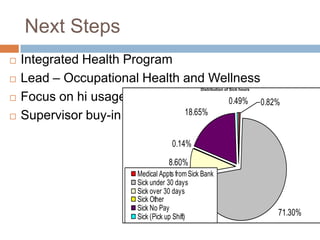
Next Steps
   Integrated Health Program
   Lead – Occupational Health and Wellness
                                               Distribution of Sick hours

   Focus on hi usage                 0.49% 0.82%
   Supervisor buy-in          18.65%


                                    0.14%

                                   8.60%
                        Medical Appts from Sick Bank
                        Sick under 30 days
                        Sick over 30 days
                        Sick Other
                        Sick No Pay
                        Sick (Pick up Shift)                                71.30%
Sick Notes
Guidelines:
1. Is the employee in AMP?
2. What is the employee’s current
    absenteeism rate?
3. Does the employee have patterns of
    calling in sick on certain days/weekends?
4. Is there a written requirement to provide
    sick notes as a result of an agreement?
5. Has the employee requested the same
    time off and been denied?
Question & Answer
Q: If an employee is placed in the program, is
that considered disciplinary?

A: Absolutely not! The purpose of the program
is to provide support and assistance to
employees with a goal of achieving regular
attendance at work and meeting the corporate
absenteeism standards.
Question & Answer
Q    The letters to the employees may give the
     impression of being punitive. Is there a
     different approach?

A    It is the employer’s obligation to follow up
     with employees so they can see their
     progress. In addition to the standard letters,
     supervisors may choose to meet with
     employees for a verbal follow up and
     discussion or they can work with HR to tailor
     the follow up letter.
Question & Answer
Q: What do you do when you have employees
that continually run without any sick time in their
banks, and they don’t care if they are still sick
and don’t get paid for it?

A: If this is the case, they are likely a good
candidate for AMP. However, they would get
coded unpaid sick for this time – not vacation,
banked OT, etc.
Question & Answer
Q: What if I have an employee who self-identifies
an underlying medical condition that affects their
attendance?

A: The employee should be referred to the
OH&W office as per the Disability Management
process. Employee’s may or may not continue to
be managed through the AMP program
depending on the nature of the illness. You may
be required to accommodate to the point of
undue hardship.
Question & Answer

Q: What can you do if proof of illness is required
and the employee does not provide it?

A: The employee should not be paid from their
sick bank unless the note is provided. They
should be coded unpaid leave of absence,
unless you can prove abuse of sick leave.
Thank you for the opportunity to
61
      meet today!
      Tel 403 264 5288
      or 800 449 5866 (800 4hylton)
      chris@hylton.ca


                      CG Hylton Inc
References
   http://iweb/library/CorporateManuals/HR/5.7.pdf
   http://iweb/Library/HRRefGuideIndex.htm

   Slides adapted from Calgary Lab Services &
    Filion Wakely Thorup Angeletti presentations

Absenteeism, Destructive Workplace Behaviour

  • 1.
    Absenteeism, Destructive Workplace Behaviour, RootCauses 3:40 Weds Dec 5, 2012 Infonex 1045 Whitehorse Chris Hylton 800 449-5866 chris@hylton.ca
  • 2.
    Agenda 2  • Types of absenteeism: culpable, innocent: making the distinction  • Addressing the root causes of absenteeism to determine if it is a symptom of stress, burn-out, addictions etc.  • Proactive strategies and guidance to rectify the behaviour  • Attendance policy: tips and strategies  • Ignoring it won't make it go away: how to communicate expectations, policy and confront the issue  • Determining when termination is appropriate
  • 3.
    What attendance issueswe can try and solve for you in this session? Open discussion 3
  • 4.
    4 Employers must be knowledgeable about absences, how much they have to tolerate and how they can respond effectively.
  • 5.
    FORMS OF ABSENTEEISM Innocent Absenteeism Culpable Absenteeism Long Repetitive Term Short Term Condition Absences CANNOT IMPOSE DISCIPLINE! DISCIPLINE WARRANTED
  • 6.
    INNOCENT ABSENTEEISM  Disability, illness, other legitimate health reason  Discipline is inappropriate  May lead to non-disciplinary termination if:  Employee has record of excessive absenteeism  Employee is incapable of regular attendance in the future
  • 7.
    Do List 1. Track absences 2. Provide warnings 3. Provide opportunity to improve 4. Be consistent
  • 8.
    MONITORING INNOCENT ABSENTEEISM  Institute attendance management program AMP  Understand the actual levels of absenteeism  Analyze and determine where problems are  Record all incidents of absenteeism and lates
  • 9.
    MANAGING CULPABLE ABSENTEEISM  Don‟t rigidly adhere to defined policies  Disciplinary policies are helpful  All absences are presumed innocent unless proven culpable (although the employer may put employees on notice that they need to substantiate the reasons for an absence)  If culpable, then discipline may be warranted  Use progressive discipline
  • 10.
    FEATURES OF ATTENDANCE MANAGEMENTPROGRAMS  Direct attention to improving health and safety;  Provide health services and facilities;  Provide employee assistance programs;  Provide attendance incentive programs;  Collect and publish attendance statistics;  Set attendance goals and monitor achievement;
  • 11.
    FEATURES OF Program  Provide feedback, counselling and other forms of support;  Impose discipline when warranted; and  Implement last chance agreements when all else fails (more common in the unionized setting).
  • 12.
    Termination: THE LAST RESORT  Employer has to demonstrate:  Record of excessive absenteeism  Incapable of regular attendance in the future  Accommodation to the point of undue hardship  Follow program of progressive discipline  Terminate with caution = there is always a risk of a grievance or a human rights complaint
  • 13.
    DOCTRINE OF FRUSTRATION  Absenteeism resulting from illness or disability is not cause to terminate  Test for frustration of contract:  Is it temporary or permanent  Does it prevents performance of essential duties of position, even after accommodation
  • 14.
    FACTORS TO CONSIDER  Terms of any existing contract  Anticipated term of employment  Nature of the employment  Nature of the illness or injury & prospects for recovery  Period of past employment
  • 15.
    BOTTOM LINE The longer the relationship + The greater indicators of commitment and loyalty = The more difficult it will be to establish frustration
  • 16.
    TERMINATION & SEVERANCE  Even if frustrated, employer will have to pay termination and severance pay in accordance with Employement Standards  Ontario Nurses’ Association v. St. Joseph’s General Hospital, [2006] O.L.A.A. No. 155 (Randall)  Now reflected in changes to Reg. 288/01 – no longer an exemption from termination or severance pay under Employement Standards
  • 17.
    REINSTATEMENT OF EXCESSIVELY ABSENT EMPLOYEES  Was there a triggering absence?  Were the absences blameworthy or innocent?  Ifinnocent, what is the prognosis for future attendance?  Did the employer adequately notify the employee of expectations with respect to attendance?  Did the employer warn the employee that discharge may result if attendance did not improve?  What was the workplace average absenteeism
  • 18.
    LAST CHANCE AGREEMENT  Similar to a last chance award, but avoids the time, expense of arbitration – negotiated by the parties;  Usually establish a very high attendance standard;  Additional conditions, as applicable;  Complete abstinence from the substance at issue;  Completion of recovery program;  Random drug testing;
  • 19.
    LAST CHANCE AGREEMENTS Purpose: Keeps employee in the workplace, but imposes stringent conditions Ensures employee knows job is in jeopardy if performance does not improve May promote rehabilitation
  • 20.
    When Are LastChance Agreements Appropriate?  Where an employee has been unresponsive to progressive discipline or efforts to address an attendance problem (particularly if it‟s related to an addiction or other disability)  Should not be used too early in the process of dealing with a problem employee and is not a substitute for other accommodation options  A last chance agreement should only be part of a broader effort to accommodate
  • 21.
    Last Chance Agreementsshould Include • An express recognition of the nature of the employee‟s problem (e.g., addiction or alcoholism) and efforts the employer has made to accommodate the employee • Recognition that the employer and, if applicable, union have taken all reasonable steps necessary to accommodate the employee to the point of undue hardship • Specific details of the conditions applied to the employee‟s continued employment, including details of any treatment, after-care, attendance expectations, etc., as well as the employee‟s commitment to comply with these conditions
  • 22.
    Last Chance Agreements: What They Should Include (cont‟d)  A provision expressly stating that breach of any condition of the agreement will result in the employee‟s discharge  Agreement that reinstatement of the employee following a breach of the agreement would amount to undue hardship  Agreement that failure to discharge for breach of the agreement does not constitute waiver  An express prohibition on an arbitrator substituting any lesser penalty in the event that there is a breach
  • 23.
    Benefits of anEnforceable Last Chance Agreement  Provides an additional opportunity for an employee to salvage his/her employment  Provides the employee with a „wake-up call‟ – often those who suffer from addictions will not seek and pursue treatment until they lose their employment  May be viewed as being one aspect of the employer‟s duty to accommodate (provided that it is complements other efforts)
  • 25.
    Why bother? Direct Costs Replacement of absent worker  Loss of productivity  Sick leave with pay and benefits Indirect Costs  Reduced service to patients and larger community  Damage to morale of other employees  Time spent managing employee and/or claim
  • 26.
    Types of Absenteeism  Innocent (non culpable) absenteeism: individuals are legitimately away due to health issues  Culpable absenteeism: individuals not validly away; are utilizing sick leave for purposes other than health issues
  • 27.
    Absence Management Plan Monitors  Innocent (non-culpable) Absenteeism  Culpable absenteeism is a disciplinary issue and once established, should not be dealt with under AMP  However…..tracking all absenteeism can be helpful in determining culpable absenteeism
  • 28.
    Legal Validity  Consistent with Collective Agreement  Brought to the attention of employees  Reasonable and Not Discriminatory  Clear and Consistently enforced
  • 29.
    Legal Validity AbsenteeismManagement Process must allow for:  Flexibility and consideration of individual circumstances  “Progressive escalating response”  Not disciplinary (Hospital Employees Union v. Health Employers Association of BC (2002) BCLRBD No. 112)
  • 30.
    Facts about CLS‟AMP Program  Implemented May 2005  Revisions July 2008  Four Step Program  Target 3.5% absenteeism (9 days/year)  Absenteeism rate range 3.73% to 4.5%  Includes Sick with pay; Sick without pay; Medical Appointments
  • 31.
    CLS ISSUES  People working when sick  Targeting right people  Target vs. Average  How to exit the program  Ownership and accountability  Time required to manage program  EDUCATION!!!
  • 32.
    UNION ISSUES  People working when sick  Targeting right people  Target vs. Average  How to exit the program  Concern singling people out  Early intervention – intrusive  Supervisor abuse – “I‟ll be watching you”  EDUCATION!!!
  • 33.
    What Reports Exist?  Monthly Sick Time Reports  AMP Reports  Employee Absence Calendars
  • 34.
    Reports Sicktime Usage (52week period ending May 16, 2008) Manager: Edward Quartermaine Supervisor: Ned Ashton Sick Sick All Cost Emp Employee Name Medical Sick Total All In EE % Corp Cost Centre Under Over Hours Centre No (Last, First) Appts (Traded) Sick Hours AMP Sick Target 30 30 Worked Avg 71410000000 1714 BARRETT, BRENDA 0.00 72.75 0.00 0.00 72.75 750.00 822.75 No 8.84% 3.50% 3.85% 71410000000 1474 CORINTHOS, SONNY 2.25 251.00 0.00 0.00 253.25 1490.75 1744.00 Yes 14.52% 3.50% 3.85% 71410000000 1594 JAX, JASPER 0.00 31.00 0.00 7.75 38.75 1570.56 1609.31 No 2.41% 3.50% 3.85% 71410000000 1234 MORGAN, JASON 0.00 3.00 0.00 0.00 3.00 1553.50 1556.50 No 0.19% 3.50% 3.85% 71410000000 1354 WEBBER, ELIZABETH 0.00 38.75 0.00 0.00 38.75 1976.25 2015.00 Yes 1.92% 3.50% 3.85% 71410000001 1834 CASSEDINE, NIKOLAS 0.00 7.00 0.00 0.00 7.00 2008.00 2015.00 No 0.35% 3.50% 5.59% 71410000001 1954 DAVIS, ALEXIS 5.00 40.75 0.00 0.00 45.75 1811.63 1857.38 No 2.46% 3.50% 5.59% 71410000001 2074 HOWARD, KATE 25.00 230.00 0.00 0.00 255.00 1380.69 1635.69 No 15.59% 3.50% 5.59%
  • 35.
    Reports Employees who are over 3.5% and are not in the AMP Manager: Edward Quartermaine Supervisor: Ned Ashton 52 wk Period Ending: May 16, 2008 Out of the Emp Employee Name Sick Worked All EE % Previously FTE Program Comments No (Last, First) Hours Hours Hours Sick In Program (dd/mm/yy) 1714 BARRETT, BRENDA 0.41 72.75 750.00 822.75 8.84% No 30 May 07 - Employee close to target. Watch for now. 12 Sept 07 - Employee reduced status to casual. 20 Nov 07 - Employee moved into perm .4 position. Sicktime 5.25% . Supervisor Feedback: Calendar Request: Yes/No Comments: Put in Step I: Yes/No 2074 HOWARD, KATE 0.81 255.00 1380.69 1635.69 15.59% No Supervisor Feedback: Calendar Request: Yes/No Comments: Put in Step I: Yes/No
  • 36.
    Reports Follow-Up for Employees in AMP Manager: Edward Quartermaine Supervisor: Ned Ashton 52 wk Period Ending: May 16, 2008 Functional Emp Employee Name Follow- Percent Step II Step III Step I Information Centre No (Last, First) Up Date EE Sick Information Information 71410000000 1474 CORINTHOS, SONNY 15-Apr-08 14.52% Date into Step 1: September 24, 2007 Date into Step II: Date into Step III: 24 Sept 07 - rate at 5.59% . Entered into AMP Supervisor Feedback: Calendar Request: Yes/No Request Letter: Yes/No Next Follow Up Date: If no, provide reason: 71410000000 1354 WEBBER, ELIZABETH 03-Jul-08 1.92% Date into Step 1: January 24, 2007 24 Jan 07 - rate at 5.59% . Entered into AMP 07 Jul 07 - rate at 7.50% . Send follow-up letter, continue to monitor 28 Dec 07 - rate at 3.7% . Send follow-up letter, rate improved Supervisor Feedback: Calendar Request: Yes/No Request Letter: Yes/No Next Follow Up Date: If no, provide reason:
  • 38.
    Process R e po rts G en e ra ted by HR In d ivid u a l R e po rts S e nt to S up e rviso rs - E m p lo ye e s o ver 3 .5% an d are no t in th e A M P - F o llow -u p fo r E m p lo ye es in the A M P S u p e rviso r C o n sults with H R a s Ne e d ed S u p erviso r C o m p le te s w ith C o m m e n ts S u p e rviso r R e tu rn s C om p lete d R ep o rts to HR - N ote s E n tere d in to Da tab a se H R Co m p lete s Re q u este d A ction i.e . L e tte rs g e ne rate d, C ale nd a rs g en e ra ted
  • 40.
    What to ConsiderWhen Entering Employees Into AMP?  Are they over the corporate standard of 3.50%?  Are they over the departmental average?  How long have they been over the standard?  By how much are they above the standard?  How many incidents of illness are there?  Is this an isolated incident with low probability of recurrence?  Is absenteeism related to a disability?
  • 41.
    What to ConsiderWhen Entering Employees Into AMP?  What is their length of service?  Is the employee participating in a graduated RTW plan?  Has the employee achieved a full RTW with no restrictions?  Are there any unusual circumstances that may have precipitated a spike in absenteeism?  Has the person be at Step 1 or 2 previously?  Does the employee have a chronic illness?
  • 42.
    What to ConsiderWhen Entering Employees Into AMP?  Consideration for enrolment is over the corporate standard for a period of at least six months  If you have initial concerns in determining entrance into AMP, contact your HR consultant
  • 43.
    Step 1  Step 1: Informal Notification, Initial Concern  Notification package provided to employee  Contains absence history, AMP process, internal and external support  Goal is to inform employee and offer education
  • 44.
    Step 2  Formal Discussion, Continued Concern  Supervisor and employee meet  Union representation is offered  Purpose is to determine of there are underlying health issues  A referral to Occupational Health and Wellness may be made
  • 45.
    Step 3  Formal Discussion, Advance Concern  Supervisor and employee meet  Union Representation offered  Attempt to get at underlying issues  Mandatory referral to Occupational Health and Wellness
  • 46.
    Step 4  Employment Discussion  Supervisor and Employee meet  Union Representation required  Focus on continued employment relationship in serious jeopardy  Employee is placed on a 90 day trial period.
  • 47.
    Legal Validity Termination forNon-Culpable absenteeism  Past record of excessive absenteeism  No reasonable expectation or prospect of regular attendance in the future  Employee has been warned multiple times and knew expectations and possible outcomes  If there is a disability, it has been accommodated to the point of undue hardship
  • 48.
    When do Employeesmove to the next step?  Where the level of absenteeism has not improved.  Where the level of absenteeism has increased.  Where an employee has been non-compliant in recommendations for improvement.  A reasonable amount of time has lapsed since entering the previous step.
  • 49.
    AMP Letters  Follow up letters should be sent every 3-6 months so the employee can see their progress – Employer obligation!!  A separate file is kept in HR for each employee in AMP
  • 50.
    How Are EmployeesRemoved From AMP?  Steps 1 & 2  Maintain sick time average below corporate standard for at least six months  Step 3  Maintain sick time average below corporate standard for at least nine months  Step 4  Maintain sick time average below corporate standard for at least twelve months, evaluated on a case-by- case basis
  • 51.
    What Works?  Metrics  Organizational Target (ie. 3.5%)  Regular Communication  Supervisor Buy-In and Education  Consistency in the message and actions  Involving the Union
  • 52.
    What Works (Cont‟d.)  Not one size fits all approach.  Absenteeism Management Policy  Supervisor tools: Guidelines, Letter Templates, Discussion Templates  Highlighting the Exit strategy for employees as the goal.
  • 53.
    What Doesn‟t Work?  Lack of supervisor buy-in and education  Not being on top of the program  Blanket policies or actions  Chronic Illness Employees  High maintenance – Do the Cost-Benefit Analysis
  • 54.
    Next Steps  Integrated Health Program  Lead – Occupational Health and Wellness Distribution of Sick hours  Focus on hi usage 0.49% 0.82%  Supervisor buy-in 18.65% 0.14% 8.60% Medical Appts from Sick Bank Sick under 30 days Sick over 30 days Sick Other Sick No Pay Sick (Pick up Shift) 71.30%
  • 55.
    Sick Notes Guidelines: 1. Isthe employee in AMP? 2. What is the employee’s current absenteeism rate? 3. Does the employee have patterns of calling in sick on certain days/weekends? 4. Is there a written requirement to provide sick notes as a result of an agreement? 5. Has the employee requested the same time off and been denied?
  • 56.
    Question & Answer Q:If an employee is placed in the program, is that considered disciplinary? A: Absolutely not! The purpose of the program is to provide support and assistance to employees with a goal of achieving regular attendance at work and meeting the corporate absenteeism standards.
  • 57.
    Question & Answer Q The letters to the employees may give the impression of being punitive. Is there a different approach? A It is the employer’s obligation to follow up with employees so they can see their progress. In addition to the standard letters, supervisors may choose to meet with employees for a verbal follow up and discussion or they can work with HR to tailor the follow up letter.
  • 58.
    Question & Answer Q:What do you do when you have employees that continually run without any sick time in their banks, and they don’t care if they are still sick and don’t get paid for it? A: If this is the case, they are likely a good candidate for AMP. However, they would get coded unpaid sick for this time – not vacation, banked OT, etc.
  • 59.
    Question & Answer Q:What if I have an employee who self-identifies an underlying medical condition that affects their attendance? A: The employee should be referred to the OH&W office as per the Disability Management process. Employee’s may or may not continue to be managed through the AMP program depending on the nature of the illness. You may be required to accommodate to the point of undue hardship.
  • 60.
    Question & Answer Q:What can you do if proof of illness is required and the employee does not provide it? A: The employee should not be paid from their sick bank unless the note is provided. They should be coded unpaid leave of absence, unless you can prove abuse of sick leave.
  • 61.
    Thank you forthe opportunity to 61 meet today! Tel 403 264 5288 or 800 449 5866 (800 4hylton) chris@hylton.ca CG Hylton Inc
  • 62.
    References  http://iweb/library/CorporateManuals/HR/5.7.pdf  http://iweb/Library/HRRefGuideIndex.htm  Slides adapted from Calgary Lab Services & Filion Wakely Thorup Angeletti presentations

Editor's Notes

  • #3 Addressing Absenteeism, Destructive Workplace Behaviours, and Their Root CausesChris Hylton, President, CG Hylton Inc. • Types of absenteeism: culpable, innocent: making the distinction• Addressing the root causes of absenteeism to determine if it is a symptom of stress, burn-out, addictions etc.• Proactive strategies and guidance to rectify the behaviour• Attendance policy: tips and strategies• Ignoring it won't make it go away: how to communicate expectations, policy and confront the issue• Determining when termination is appropriate