








STAFFING
Meaning
Staffing means number and composition of
personnel assigned to work on a unit at a
given time
DEFINITION
It is a process of planning, employing and
developing human resources at different
levels of an organization for carrying out
the various managerial and other
functions required.
Definition
According to Koontz ,O’donnell and
weihrich staffing involves manning the
organisational structure through proper and
effective selection ,appraisal estimate and
development of personnel to fill the roles
designed in to the structure
staffing
Definition –staffing is the systematic
approach to the problem of selecting
training , motivating ,and retaining
professional and non professional personal
in any organisation.
It involves manpower planning to have the
right person in the right placeand avoid
square peg in round hole.
Reasons increased the significance of
staffing
Advancement of technology
Increased size of the organisation
Long range need for manpower-future
labour turn over
High wage bill ---if right type of person is
not appointed then management has to
spend on wages and procedure ,even though
poor work out put
Recognition of human relations –financial
and nonfinancial incentives
MISSION
1. To ensure maximum utilization of human
resources.
2. To discover & obtain competent personnel
for various jobs.
3. To ensure the continuity & growth of the
enterprise through adequate staffing.
5. To be able to meet crisis/emergency
situations.
6. To deliver good quality of care & attain
job & patient satisfaction
7. To improve job satisfaction & morale of
the employees through objective
assessment.
objectives
Provide a professional staff nurse in critical
care unit operating room and emergency
unit
Provide sufficient staff to permit a 1:1 nurse
patient ratio for each shift in critical care
unit
Staff the general medical surgical paediatric
maternity and psychiatric units to achieve
2:1 ratio
Provide sufficient in general medical
surgical units to permit 1:5 nurse patient
ratio on a day and afternoon shift and 1:10
on night shift
Involve the head nurse and all nursing
person designing the departments staffing
programmes
design a staffing plan that specifies number
of personal in each classification assigned
to each ward in each shift
Head nurse is responsible for translating
master plan to weekly schedule
Empower head nurse to adjust extra
personal
Reward employee for long time services
PHILOSOPHY OF STAFFING
• Nurse administrator believes that
1. The knowledge & skill of the staff can
adequately fulfill the needs of the patient &
thereby ensure both job satisfaction &
quality care.
• Only professional trained nurses can
provide a high quality of patient care &
handle critically ill patients by providing
both technical & intrapersonal skills.
3. A professional nurse cannot only treat
chronically ill patients, but also provide
health education & rehabilitative care,
which is more complex.
4. Job quantification & analysis could be done
based on patient needs & doing assignments.
• 5. All sorts of nursing-related problems,
e.g. master rotation plan, duty roster,
etc., should be done only by nursing
heads.
6. A staffing plan should be delegated to
each unit-level head nurse so that the
activities of each ward & details of each
shift are planned well.
IMPORTANCE OF STAFFING PATTERN
.
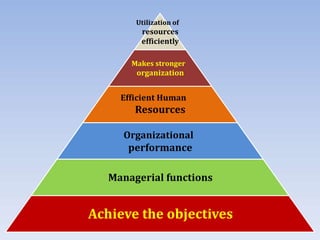
Utilization of
resources
efficiently
Makes stronger
organization
Efficient Human
Resources
Organizational
performance
Managerial functions
Achieve the objectives
Safe staffing
• safe staffing means that an appropriate staff
with a suitable mix of skill levels is available
at all the times to ensure the patient care
needs are met and are hazard free working
environment and working conditions are
maintained .
( International Council of Nurses)
• safe staffing is appropriate levels of
Registered nurses (RNs) to always meet the
care as per needs of the patients. (ANA)
Nature of staffing
• Staffing is staff centered
• It is applicable for all types of organization.
• It is concerned with all the categories of personnel from top
to operational levels.
• Its basic function of management ; like management also
needs the directing , organizing coordinating the controlling
functions.
• Manager in each level is engaged in performing the staffing
function.
• Staffing is a continuous activity as the manager is to guide
and train the subordinates and also evaluate their
performance.
• Each manager is required to have human relation skills in
performing the staffing functions.
FEATURES OF STAFFING:
• Staffing is management of manpower or
human resource.
• Staffing function is related to the
employment of nursing personnel of all
types.
• It includes various type of activities to get
the right type of nurses on the right job.
• It is concerned with the filling of various
type of positions or jobs in the nursing
organization with suitable nursing
personnel.
• Its every nurse managers Job.
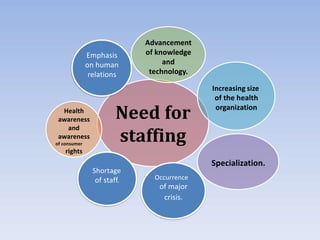
Need for
staffing
Advancement
of knowledge
and
technology.
Specialization.
Increasing size
of the health
organization
Health
awareness
and
awareness
of consumer
rights
Shortage
of staff.
Emphasis
on human
relations
Occurrence
of major
crisis.
Importance of safe staffing
• RELATED TO THE PATIENTS:
Staffing leads to
lower patient mortality and morbidity.
Reduce incidents of adverse events
Shorten the hospital length of stay
Increase the patient satisfaction.
Importance of safe staffing
• RELATED TO NURSES :
• Safe staffing increases the nurse’s Job
satisfaction.
• It reduces the stress among the nurses and
the cases of Burn out .
• The absenteeism and the turn-over rates are
reduced.
• It has a positive impact on the continuity
and the quality of care by the nurses.
Importance of safe staffing
• COST OF CARE
System approach to staffing
Input Process Output
Controls and feedback
Components / steps of staffing
MONPOWER
PLANNING
JOB
ANALYSIS
RECRUTMENT
SELECTION
PLACEMENT
INDUCTION
AND
ORIENTATION
TRAINING AND
DEVELOPMENT
REMUNERATION
PERFORMANCE
APPRAISAL
PROMOTION AND
TRANSFER
Staffing pattern
Factors
effecting
staffing
pattern
Types of
nursing
services
Numbe
r of
patient
s
Standa
rd of
care:
Role
defined by
profession
Qualificatio
n and Job
specificatio
n
Supply
of the
person
nel
Patient’
s
conditi
on
Fluctuatio
n of the
work load
Method of
assignment
Nursin
g unit
Suppor
ting
staff
Policies
Budget
Factors influencing staffing pattern
Pattern of delivery services
Standard of nursing care
Different type of activties performed
Size and type of unit
NORMS & ACTIVITIES
• Recommendations of the Staff Inspection
Unit.
• Recommendations of the Patient
Classification System.
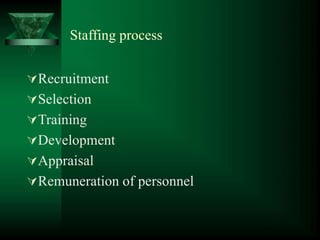
Staffing process
Recruitment
Selection
Training
Development
Appraisal
Remuneration of personnel
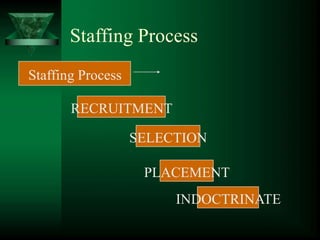
Staffing Process
Staffing Process
RECRUITMENT
SELECTION
PLACEMENT
INDOCTRINATE
Selection Adequate applicant pool
Process Pre employment Screening
Complication of application
Reference Employment interview
Pre employment Physical
testing Examinant
Employer decision
Notification of application
Recruitment
Process of attracting the potential
employees to the organisation

Sources of recruitment
Internal sources
External sources
Internal sources
present permanent employees
Present temporary employees
Retired employees
Dependent of deceased, disabled, retired
and present employees
advantages
Improves employ-employer relationship
Develops sense of security
Costs less
Labour turnover is reduced
Employees are motivated to perform better
Suitability of internal candidate judged
better than external
Suitability of employment can be ensured
External sources
Purposes
Offers wide choices
New entrants
Invitation without any discremination
Best utilization of experience and trained
personnel
Expertise, experience ,excellence in other
organisation
sources
Campus recruitment
Own data bank
Advertisements
Third party method-employment exchange
Present employer
Deputation
Word of mouth—present employees
Trade union
Casual applicant
Educational institutions—placement cell
Recruitment process
Identifying the need to recruit
Identifying the job requirements
Deciding the sources of potential recruits
Deciding the selectionmethod
Short listing the candidates
Selection of the succesful candidates
Notifying the candidates of outcome
Appointing the succesful candidate
Selection
Selection is the process of choosing the
right candidate from the pool of applicants
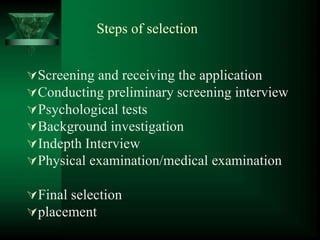
Steps of selection
Screening and receiving the application
Conducting preliminary screening interview
Psychological tests
Background investigation
Indepth Interview
Physical examination/medical examination
Final selection
placement
Training and development
Is the process of developing
knowledge,skills and behaviour in people
that enable them to better perform their
current and future jobs
Training techniques
On the job
Off the job
On the job training
Coaching
Job rotation
Planned work activities
Off the job
Class room lecture
Case studies
Roleplaying
Programmed learning
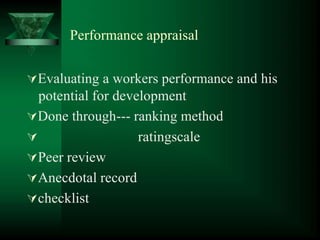
Performance appraisal
Evaluating a workers performance and his
potential for development
Done through--- ranking method
 ratingscale
Peer review
Anecdotal record
checklist
Recruitment and selection of students
1. Admission policies—policies based on
kind of programme .
Carefully formulated and made known to
the person concerned with selection,
recruitment
Policies in relation to academic
qualification
What will be the educational requirement
for admission be the minimum required by
the statutory bodies
Are any specific subjects required, like
science, english
May any of the requirements be relaxed
under special circumstances ? If so what are
these?
Relation to personal and social
fitness
Will there be maximum age limit?if so
under what circumstances may it be
relaxed?
Will married students be eligible for
admission ?
Will male candidates be admitted?
Do the philosophy of the school requiees
the candidate to have any personal
qualification ?
Is admission subject to satisfactory medical
others
Will student be admittted from other school
or college
Ploicie regarding repeatedly failure of the
students in the final exam and not eligible.
Will they go home and come for exam or
will they be permitted tocontinue with the
junior students
2. Recruitment of the student
Notification in the local/national dailies or
other media
Students with good aptitude ,interest can
apply
Talks on t. v. through feature film on
nursing ,publishing article in the journals,
Individual college can do this by various
ways
Conducting function in which selected
members of the public participate
Broad casting such function in the radio, T.
V. news paper, journals etc.
Arranging talk by the nursing college in the
community organisation ,local school and
colleges
Arranging or celebrating important events
Publishing articles reports and pictures of
the activites in the local press.
Publication of the college brochure
Selection of students
1.Selection policies
How much and what information required
Whethe medical certificate be produced by
the student
Who all will be the members of the
selection committee
Will there be any interview
Will there be any aptitude test
2. application form
It is the administrative responsibility,
handled by the clerical staff under the
direction of administrative head
Analyze the entrance test,
Assessing the academic achievement
Information in the application form
3. selection committee
Representatives of the college
Head of the college
Nursing professors
Representative of the local controlling
authority
Educational psychologist
4. procedure
personal interview
Interview with the parents
Written test
Medical report
After the selection
Orientation programme
Staff recruitment and selection
Recruitment procedure
Selection procedure
Staffing pattern as per INC
After the selection
Orientation
Placement
Job description
Staff welfare programme
Inservice education
THANKYOU

staffing

  • 1.
  • 2.
    Meaning Staffing means numberand composition of personnel assigned to work on a unit at a given time
  • 3.
    DEFINITION It is aprocess of planning, employing and developing human resources at different levels of an organization for carrying out the various managerial and other functions required.
  • 4.
    Definition According to Koontz,O’donnell and weihrich staffing involves manning the organisational structure through proper and effective selection ,appraisal estimate and development of personnel to fill the roles designed in to the structure
  • 5.
    staffing Definition –staffing isthe systematic approach to the problem of selecting training , motivating ,and retaining professional and non professional personal in any organisation. It involves manpower planning to have the right person in the right placeand avoid square peg in round hole.
  • 6.
    Reasons increased thesignificance of staffing Advancement of technology Increased size of the organisation Long range need for manpower-future labour turn over
  • 7.
    High wage bill---if right type of person is not appointed then management has to spend on wages and procedure ,even though poor work out put Recognition of human relations –financial and nonfinancial incentives
  • 8.
    MISSION 1. To ensuremaximum utilization of human resources. 2. To discover & obtain competent personnel for various jobs. 3. To ensure the continuity & growth of the enterprise through adequate staffing.
  • 9.
    5. To beable to meet crisis/emergency situations. 6. To deliver good quality of care & attain job & patient satisfaction 7. To improve job satisfaction & morale of the employees through objective assessment.
  • 10.
    objectives Provide a professionalstaff nurse in critical care unit operating room and emergency unit Provide sufficient staff to permit a 1:1 nurse patient ratio for each shift in critical care unit Staff the general medical surgical paediatric maternity and psychiatric units to achieve 2:1 ratio
  • 11.
    Provide sufficient ingeneral medical surgical units to permit 1:5 nurse patient ratio on a day and afternoon shift and 1:10 on night shift Involve the head nurse and all nursing person designing the departments staffing programmes design a staffing plan that specifies number of personal in each classification assigned to each ward in each shift
  • 12.
    Head nurse isresponsible for translating master plan to weekly schedule Empower head nurse to adjust extra personal Reward employee for long time services
  • 13.
    PHILOSOPHY OF STAFFING •Nurse administrator believes that 1. The knowledge & skill of the staff can adequately fulfill the needs of the patient & thereby ensure both job satisfaction & quality care.
  • 14.
    • Only professionaltrained nurses can provide a high quality of patient care & handle critically ill patients by providing both technical & intrapersonal skills.
  • 15.
    3. A professionalnurse cannot only treat chronically ill patients, but also provide health education & rehabilitative care, which is more complex.
  • 16.
    4. Job quantification& analysis could be done based on patient needs & doing assignments.
  • 17.
    • 5. Allsorts of nursing-related problems, e.g. master rotation plan, duty roster, etc., should be done only by nursing heads.
  • 18.
    6. A staffingplan should be delegated to each unit-level head nurse so that the activities of each ward & details of each shift are planned well.
  • 19.
  • 20.
    Utilization of resources efficiently Makes stronger organization EfficientHuman Resources Organizational performance Managerial functions Achieve the objectives
  • 21.
    Safe staffing • safestaffing means that an appropriate staff with a suitable mix of skill levels is available at all the times to ensure the patient care needs are met and are hazard free working environment and working conditions are maintained . ( International Council of Nurses) • safe staffing is appropriate levels of Registered nurses (RNs) to always meet the care as per needs of the patients. (ANA)
  • 22.
    Nature of staffing •Staffing is staff centered • It is applicable for all types of organization. • It is concerned with all the categories of personnel from top to operational levels. • Its basic function of management ; like management also needs the directing , organizing coordinating the controlling functions. • Manager in each level is engaged in performing the staffing function. • Staffing is a continuous activity as the manager is to guide and train the subordinates and also evaluate their performance. • Each manager is required to have human relation skills in performing the staffing functions.
  • 23.
    FEATURES OF STAFFING: •Staffing is management of manpower or human resource. • Staffing function is related to the employment of nursing personnel of all types. • It includes various type of activities to get the right type of nurses on the right job. • It is concerned with the filling of various type of positions or jobs in the nursing organization with suitable nursing personnel. • Its every nurse managers Job.
  • 24.
    Need for staffing Advancement of knowledge and technology. Specialization. Increasingsize of the health organization Health awareness and awareness of consumer rights Shortage of staff. Emphasis on human relations Occurrence of major crisis.
  • 25.
    Importance of safestaffing • RELATED TO THE PATIENTS: Staffing leads to lower patient mortality and morbidity. Reduce incidents of adverse events Shorten the hospital length of stay Increase the patient satisfaction.
  • 26.
    Importance of safestaffing • RELATED TO NURSES : • Safe staffing increases the nurse’s Job satisfaction. • It reduces the stress among the nurses and the cases of Burn out . • The absenteeism and the turn-over rates are reduced. • It has a positive impact on the continuity and the quality of care by the nurses.
  • 27.
    Importance of safestaffing • COST OF CARE
  • 28.
    System approach tostaffing Input Process Output Controls and feedback
  • 29.
    Components / stepsof staffing MONPOWER PLANNING JOB ANALYSIS RECRUTMENT SELECTION PLACEMENT INDUCTION AND ORIENTATION TRAINING AND DEVELOPMENT REMUNERATION PERFORMANCE APPRAISAL PROMOTION AND TRANSFER
  • 30.
  • 31.
    Factors effecting staffing pattern Types of nursing services Numbe r of patient s Standa rdof care: Role defined by profession Qualificatio n and Job specificatio n Supply of the person nel Patient’ s conditi on Fluctuatio n of the work load Method of assignment Nursin g unit Suppor ting staff Policies Budget
  • 32.
    Factors influencing staffingpattern Pattern of delivery services Standard of nursing care Different type of activties performed Size and type of unit
  • 33.
    NORMS & ACTIVITIES •Recommendations of the Staff Inspection Unit. • Recommendations of the Patient Classification System.
  • 34.
  • 35.
  • 36.
    Selection Adequate applicantpool Process Pre employment Screening Complication of application Reference Employment interview Pre employment Physical testing Examinant Employer decision Notification of application
  • 37.
    Recruitment Process of attractingthe potential employees to the organisation 
  • 38.
    Sources of recruitment Internalsources External sources
  • 39.
    Internal sources present permanentemployees Present temporary employees Retired employees Dependent of deceased, disabled, retired and present employees
  • 40.
    advantages Improves employ-employer relationship Developssense of security Costs less Labour turnover is reduced Employees are motivated to perform better Suitability of internal candidate judged better than external Suitability of employment can be ensured
  • 41.
    External sources Purposes Offers widechoices New entrants Invitation without any discremination Best utilization of experience and trained personnel Expertise, experience ,excellence in other organisation
  • 42.
    sources Campus recruitment Own databank Advertisements Third party method-employment exchange Present employer Deputation Word of mouth—present employees Trade union Casual applicant Educational institutions—placement cell
  • 43.
    Recruitment process Identifying theneed to recruit Identifying the job requirements Deciding the sources of potential recruits Deciding the selectionmethod Short listing the candidates Selection of the succesful candidates Notifying the candidates of outcome Appointing the succesful candidate
  • 44.
    Selection Selection is theprocess of choosing the right candidate from the pool of applicants
  • 45.
    Steps of selection Screeningand receiving the application Conducting preliminary screening interview Psychological tests Background investigation Indepth Interview Physical examination/medical examination Final selection placement
  • 46.
    Training and development Isthe process of developing knowledge,skills and behaviour in people that enable them to better perform their current and future jobs
  • 47.
  • 48.
    On the jobtraining Coaching Job rotation Planned work activities
  • 49.
    Off the job Classroom lecture Case studies Roleplaying Programmed learning
  • 50.
    Performance appraisal Evaluating aworkers performance and his potential for development Done through--- ranking method  ratingscale Peer review Anecdotal record checklist
  • 51.
    Recruitment and selectionof students 1. Admission policies—policies based on kind of programme . Carefully formulated and made known to the person concerned with selection, recruitment
  • 52.
    Policies in relationto academic qualification What will be the educational requirement for admission be the minimum required by the statutory bodies Are any specific subjects required, like science, english May any of the requirements be relaxed under special circumstances ? If so what are these?
  • 53.
    Relation to personaland social fitness Will there be maximum age limit?if so under what circumstances may it be relaxed? Will married students be eligible for admission ? Will male candidates be admitted? Do the philosophy of the school requiees the candidate to have any personal qualification ? Is admission subject to satisfactory medical
  • 54.
    others Will student beadmittted from other school or college Ploicie regarding repeatedly failure of the students in the final exam and not eligible. Will they go home and come for exam or will they be permitted tocontinue with the junior students
  • 55.
    2. Recruitment ofthe student Notification in the local/national dailies or other media Students with good aptitude ,interest can apply Talks on t. v. through feature film on nursing ,publishing article in the journals,
  • 56.
    Individual college cando this by various ways Conducting function in which selected members of the public participate Broad casting such function in the radio, T. V. news paper, journals etc. Arranging talk by the nursing college in the community organisation ,local school and colleges Arranging or celebrating important events
  • 57.
    Publishing articles reportsand pictures of the activites in the local press. Publication of the college brochure
  • 58.
    Selection of students 1.Selectionpolicies How much and what information required Whethe medical certificate be produced by the student Who all will be the members of the selection committee Will there be any interview Will there be any aptitude test
  • 59.
    2. application form Itis the administrative responsibility, handled by the clerical staff under the direction of administrative head Analyze the entrance test, Assessing the academic achievement
  • 60.
    Information in theapplication form 3. selection committee Representatives of the college Head of the college Nursing professors Representative of the local controlling authority Educational psychologist
  • 61.
    4. procedure personal interview Interviewwith the parents Written test Medical report
  • 62.
  • 63.
    Staff recruitment andselection Recruitment procedure Selection procedure Staffing pattern as per INC After the selection Orientation Placement Job description Staff welfare programme Inservice education
  • 64.