Bivin Jose
Department of Psychiatric Nursing
Mar Baselios college of Nursing
Introduction





A force that promotes individuals or groups
to observe the rules, regulations and
procedures.
Necessary for the effective functioning of an
organization
“Disciplina” (Latin)= teaching, learning and
growing.
Meaning



Discipline- disciples (Pupils) + Descipere (to
comprehend).
Applying standards in a consistent, flexible
& fair manner.
Definition


Orderly conduct of affairs by the members of an
organization who adhere to its necessary
regulations because they desire to cooperate
harmoniously in forwarding the end which the
group has in view and willingly recognize that, to
do this, their wishes must be brought into a
reasonable unison with the requirements on the
group in action.
• Ordway Teads
Continues..
• Discipline consists in the submission of
one’s impulses & powers to a regulation
which imposes from chaos & brings
efficiency & economy where there would
otherwise it is ineffective and waste.
• Percununn
Continues…


Discipline is a control mechanism employed
to ensure compliance with the organizational
objectives. It is used to control those who
deviate from performance and behavioral
standards
• ILO
Objectives





To make the organizational climate adhere
to the organizational goals
To impart an element of uniformity despite
several differences in informal behaviours &
other related changes in an organization.
To develop a spirit of tolerance & a desire
to make adjustments.
Continues…





To give & seek direction & responsibility
To create an atmosphere of respect for the
human personality and human relations
To increase the working efficiency and
morale among the employees
To improve the productivity
Types
1)

Self controlled discipline
Employee brings her or his behavior in to
agreement with the organizations official behavior
code

2)

Enforced Discipline
Action being enforced by the organization and
employee compliance with organization’s rules
and regulation
Aspects of discipline
Positive aspects
• Employees believe & support to discipline
• Adhere to the rules, regulations & desired standards of
performance
• Positive support & reinforcement is being imparted

Negative aspects
• Employees doesn’t believe in & support the discipline
• Forces & constraints in obeying the rules & regulations is
being made
• Often termed as punitive approach
Principles for effective discipline




All the rules should be framed in cooperation and collaboration with the
representatives of employees.
All the rules should be appraised at
frequent and regular interval to ensure that
they are, and continue to be, appropriate,
sensible and useful.







Rules should vary with changes in the
working conditions of employees.
Rules should be uniformly enforced if they
are to be effective.
Penalties should be clearly stated.
A disciplinary policy should be preventive
rather than punitive.
Extreme caution should be exercised to
ensure that infringements are not
encouraged.




If violations of a particular rule are fairly
frequent, the circumstances surrounding them
should be carefully investigated and studied
in order to discover the causes of such
violations.
Definite and precise provisions for appeal
and review of all disciplinary actions should
be expressly mentioned in the employees’
handbook or collective agreements.
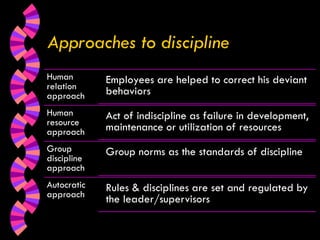
Approaches to discipline
Human
relation
approach

Employees are helped to correct his deviant
behaviors

Human
resource
approach

Act of indiscipline as failure in development,
maintenance or utilization of resources

Group
discipline
approach

Group norms as the standards of discipline

Autocratic
approach

Rules & disciplines are set and regulated by
the leader/supervisors
Guidelines for effective discipline
1.
2.
3.
4.

5.
6.

Get the facts before acting
Do not act while you are angry
Do not suddenly tighten your enforcement
rules
Do not apply penalties inconsistently
Discipline in private
Make the offenses clear. Specify the
accepted behavior
Continues…
Get the other side of the story
8. Do not let the disciplining become personal
9. Do not back down when you are right
10. Inform HRD & administration of the
outcome & other pertinent details
7.
Self discipline




The ability to regulate ones conduct by
principle and sound judgment, rather than
by impulse, desire, or social custom.
Self discipline can be considered a type of
selective training, creating new habits of
thought, action, and speech toward
improving yourself and reaching goals.
Five pillars of self discipline
Acceptance
Willpower

Hard work
Industry
Persistence
To be self disciplined
Get yourself organized
Don’t constantly seek to be entertained
Be on time
Keep your word
Do the most difficult tasks first
Finish what you start
Accept correction
Practice self denial
Welcome responsibility
Factors influencing self-discipline





Employee awareness and understanding of
rules and regulations that govern behavior
There must exist an atmosphere of mutual
trust
Formal authority must be used judiciously
Employees should identify with the goals of
the organization
Indiscipline




Disorderliness, insubordination and not
following the rules and regulation of an
organization.
Features
• Change in the normal behaviour
• Absenteeism, apathy, go-slow at work, increase in
number and severity of grievances
• Persistent and continuous demand for overtime
allowance, and lack of concern for performance.
Causes of indiscipline






Non-placement of the right person on the
right job
Undesirable behaviour of senior officials.
Faulty evaluation of persons and situations
by executives leads of favoritism.
Lack of upward communication.
Leadership which is weak, flexible,
incompetent and distrustful.







Defective supervision
Lack of properly drawn rules and
regulations.
Workers’ personal problems, their fears,
apprehensions, hopes and aspirations; and
their lack of confidence in and their inability
to adjust with their superior and equals.
Worker’s reactions to rigidity and multiplicity
of rules and their improper interpretation.
Intolerably bad working conditions






Personality charecteristics
Absence of enlightened, sympathetic and
scientific management.
Errors of judgment on the part of the
supervisor or the top management.
Discrimination based on caste, colour, creed,
sex, language, and place in matters of
selection, promotion, transfer, placement and
discrimination in imposing penalties and
handling out rewards.
McGregor’s hot stove rule 4 discipline
Forewarning

Immediate
consequences

Impartiality

Consistency
Problem-Employees
How to deal them?
Meaning


Includes marginal employees & impaired
employees
• Marginal employees: Disrupt the unit functions
because of the quantity or quality of their works
consistently meet only minimal standards at best
• impaired employees are unable to perform
their work as the expected level because of
chemical/psychological impairment
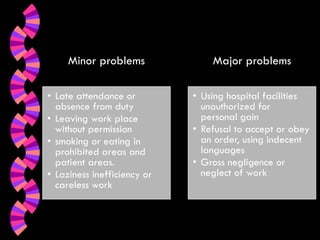
Minor problems
• Late attendance or
absence from duty
• Leaving work place
without permission
• smoking or eating in
prohibited areas and
patient areas.
• Laziness inefficiency or
careless work

Major problems
• Using hospital facilities
unauthorized for
personal gain
• Refusal to accept or obey
an order, using indecent
languages
• Gross negligence or
neglect of work
Absenteeism


Problems associated to absenteeism:
• Patient care may be below standard
• Replacement personnel need additional
supervision
• Financial management of the unit suffers
adverse effects
Effective strategies to deal absenteeism
Enhancing employment satisfaction
 Adopting a non-punitive discipline model
(Haddock)


• Remind the problem orally
• Follow up with a written reminder if the oral one fails
• Grant the employee a day of decision if the written
reminder fails
• Terminate if the employee decides not to adhere with
the standards
Characteristic changes in chemically
impaired employees


Changes in personality & behaviors
• increased irritability, personal care negligence, mood
swing, social isolation, increased forgetfulness



Changes in job performance
• Delayed work, sloppy charting, medication errors,
judgment errors, sleeping on duty



Changes in attendance & use of time
• Increased absence, excessive SL, consistent lateness
Dealing with the problem employees




Recognize & reinforce the intrinsic self-worth
of each employee and the role of successful
work performance in maintaining positive
self-image
Clearly identify the performance
expectations for all employees and
confronts employees when those
expectations are not met







Assign employees to work roles & situations
that successfully challenge or intermittently
stretch the employee; does not allow
employees to fail repeatedly
Focus on employee confrontations on
performance deficits and not on the cause of
the problem
Work in collaboration to formulate a
remedial plan of action
Ensure the employee understands the
performance expectations
References




Marquis LM & Houston CJ (2012),
Leadership roles & management functions in
nursing, 7th ed., LWW Health. Ch 25.
Patricia S & Wise Y (2007). Leading and
managing in nursing, 4th ed., St Louise,
Mosby. Ch. 24.

Discipline Nursing administration

  • 1.
    Bivin Jose Department ofPsychiatric Nursing Mar Baselios college of Nursing
  • 2.
    Introduction    A force thatpromotes individuals or groups to observe the rules, regulations and procedures. Necessary for the effective functioning of an organization “Disciplina” (Latin)= teaching, learning and growing.
  • 3.
    Meaning   Discipline- disciples (Pupils)+ Descipere (to comprehend). Applying standards in a consistent, flexible & fair manner.
  • 4.
    Definition  Orderly conduct ofaffairs by the members of an organization who adhere to its necessary regulations because they desire to cooperate harmoniously in forwarding the end which the group has in view and willingly recognize that, to do this, their wishes must be brought into a reasonable unison with the requirements on the group in action. • Ordway Teads
  • 5.
    Continues.. • Discipline consistsin the submission of one’s impulses & powers to a regulation which imposes from chaos & brings efficiency & economy where there would otherwise it is ineffective and waste. • Percununn
  • 6.
    Continues…  Discipline is acontrol mechanism employed to ensure compliance with the organizational objectives. It is used to control those who deviate from performance and behavioral standards • ILO
  • 7.
    Objectives    To make theorganizational climate adhere to the organizational goals To impart an element of uniformity despite several differences in informal behaviours & other related changes in an organization. To develop a spirit of tolerance & a desire to make adjustments.
  • 8.
    Continues…     To give &seek direction & responsibility To create an atmosphere of respect for the human personality and human relations To increase the working efficiency and morale among the employees To improve the productivity
  • 9.
    Types 1) Self controlled discipline Employeebrings her or his behavior in to agreement with the organizations official behavior code 2) Enforced Discipline Action being enforced by the organization and employee compliance with organization’s rules and regulation
  • 10.
    Aspects of discipline Positiveaspects • Employees believe & support to discipline • Adhere to the rules, regulations & desired standards of performance • Positive support & reinforcement is being imparted Negative aspects • Employees doesn’t believe in & support the discipline • Forces & constraints in obeying the rules & regulations is being made • Often termed as punitive approach
  • 11.
    Principles for effectivediscipline   All the rules should be framed in cooperation and collaboration with the representatives of employees. All the rules should be appraised at frequent and regular interval to ensure that they are, and continue to be, appropriate, sensible and useful.
  • 12.
         Rules should varywith changes in the working conditions of employees. Rules should be uniformly enforced if they are to be effective. Penalties should be clearly stated. A disciplinary policy should be preventive rather than punitive. Extreme caution should be exercised to ensure that infringements are not encouraged.
  • 13.
      If violations ofa particular rule are fairly frequent, the circumstances surrounding them should be carefully investigated and studied in order to discover the causes of such violations. Definite and precise provisions for appeal and review of all disciplinary actions should be expressly mentioned in the employees’ handbook or collective agreements.
  • 14.
    Approaches to discipline Human relation approach Employeesare helped to correct his deviant behaviors Human resource approach Act of indiscipline as failure in development, maintenance or utilization of resources Group discipline approach Group norms as the standards of discipline Autocratic approach Rules & disciplines are set and regulated by the leader/supervisors
  • 15.
    Guidelines for effectivediscipline 1. 2. 3. 4. 5. 6. Get the facts before acting Do not act while you are angry Do not suddenly tighten your enforcement rules Do not apply penalties inconsistently Discipline in private Make the offenses clear. Specify the accepted behavior
  • 16.
    Continues… Get the otherside of the story 8. Do not let the disciplining become personal 9. Do not back down when you are right 10. Inform HRD & administration of the outcome & other pertinent details 7.
  • 17.
    Self discipline   The abilityto regulate ones conduct by principle and sound judgment, rather than by impulse, desire, or social custom. Self discipline can be considered a type of selective training, creating new habits of thought, action, and speech toward improving yourself and reaching goals.
  • 18.
    Five pillars ofself discipline Acceptance Willpower Hard work Industry Persistence
  • 19.
    To be selfdisciplined Get yourself organized Don’t constantly seek to be entertained Be on time Keep your word Do the most difficult tasks first Finish what you start Accept correction Practice self denial Welcome responsibility
  • 20.
    Factors influencing self-discipline     Employeeawareness and understanding of rules and regulations that govern behavior There must exist an atmosphere of mutual trust Formal authority must be used judiciously Employees should identify with the goals of the organization
  • 21.
    Indiscipline   Disorderliness, insubordination andnot following the rules and regulation of an organization. Features • Change in the normal behaviour • Absenteeism, apathy, go-slow at work, increase in number and severity of grievances • Persistent and continuous demand for overtime allowance, and lack of concern for performance.
  • 22.
    Causes of indiscipline      Non-placementof the right person on the right job Undesirable behaviour of senior officials. Faulty evaluation of persons and situations by executives leads of favoritism. Lack of upward communication. Leadership which is weak, flexible, incompetent and distrustful.
  • 23.
         Defective supervision Lack ofproperly drawn rules and regulations. Workers’ personal problems, their fears, apprehensions, hopes and aspirations; and their lack of confidence in and their inability to adjust with their superior and equals. Worker’s reactions to rigidity and multiplicity of rules and their improper interpretation. Intolerably bad working conditions
  • 24.
        Personality charecteristics Absence ofenlightened, sympathetic and scientific management. Errors of judgment on the part of the supervisor or the top management. Discrimination based on caste, colour, creed, sex, language, and place in matters of selection, promotion, transfer, placement and discrimination in imposing penalties and handling out rewards.
  • 25.
    McGregor’s hot stoverule 4 discipline Forewarning Immediate consequences Impartiality Consistency
  • 26.
  • 27.
    Meaning  Includes marginal employees& impaired employees • Marginal employees: Disrupt the unit functions because of the quantity or quality of their works consistently meet only minimal standards at best • impaired employees are unable to perform their work as the expected level because of chemical/psychological impairment
  • 28.
    Minor problems • Lateattendance or absence from duty • Leaving work place without permission • smoking or eating in prohibited areas and patient areas. • Laziness inefficiency or careless work Major problems • Using hospital facilities unauthorized for personal gain • Refusal to accept or obey an order, using indecent languages • Gross negligence or neglect of work
  • 29.
    Absenteeism  Problems associated toabsenteeism: • Patient care may be below standard • Replacement personnel need additional supervision • Financial management of the unit suffers adverse effects
  • 30.
    Effective strategies todeal absenteeism Enhancing employment satisfaction  Adopting a non-punitive discipline model (Haddock)  • Remind the problem orally • Follow up with a written reminder if the oral one fails • Grant the employee a day of decision if the written reminder fails • Terminate if the employee decides not to adhere with the standards
  • 31.
    Characteristic changes inchemically impaired employees  Changes in personality & behaviors • increased irritability, personal care negligence, mood swing, social isolation, increased forgetfulness  Changes in job performance • Delayed work, sloppy charting, medication errors, judgment errors, sleeping on duty  Changes in attendance & use of time • Increased absence, excessive SL, consistent lateness
  • 32.
    Dealing with theproblem employees   Recognize & reinforce the intrinsic self-worth of each employee and the role of successful work performance in maintaining positive self-image Clearly identify the performance expectations for all employees and confronts employees when those expectations are not met
  • 33.
        Assign employees towork roles & situations that successfully challenge or intermittently stretch the employee; does not allow employees to fail repeatedly Focus on employee confrontations on performance deficits and not on the cause of the problem Work in collaboration to formulate a remedial plan of action Ensure the employee understands the performance expectations
  • 34.
    References   Marquis LM &Houston CJ (2012), Leadership roles & management functions in nursing, 7th ed., LWW Health. Ch 25. Patricia S & Wise Y (2007). Leading and managing in nursing, 4th ed., St Louise, Mosby. Ch. 24.