Reducing absenteeism
by Toronto Training and HR
May 2011
Contents
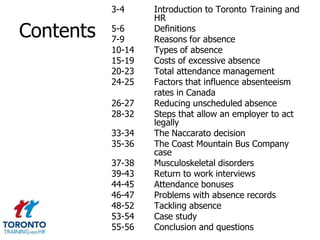
3-4 Introduction to Toronto Training and
HR
5-6 Definitions
7-9 Reasons for absence
10-14 Types of absence
15-19 Costs of excessive absence
20-23 Total attendance management
24-25 Factors that influence absenteeism
rates in Canada
26-27 Reducing unscheduled absence
28-32 Steps that allow an employer to act
legally
33-34 The Naccarato decision
35-36 The Coast Mountain Bus Company
case
37-38 Musculoskeletal disorders
39-43 Return to work interviews
44-45 Attendance bonuses
46-47 Problems with absence records
48-52 Tackling absence
53-54 Case study
55-56 Conclusion and questions
Page 3
Introduction
Page 4
Introduction to Toronto Training
and HR
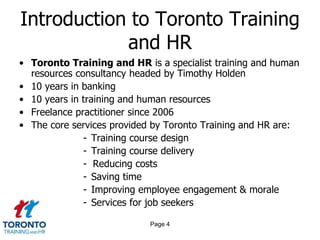
• Toronto Training and HR is a specialist training and human
resources consultancy headed by Timothy Holden
• 10 years in banking
• 10 years in training and human resources
• Freelance practitioner since 2006
• The core services provided by Toronto Training and HR are:
- Training course design
- Training course delivery
- Reducing costs
- Saving time
- Improving employee engagement & morale
- Services for job seekers
Page 5
Definitions
Page 6
Definitions
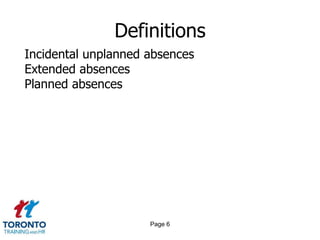
Incidental unplanned absences
Extended absences
Planned absences
Page 7
Reasons for absence
Page 8
Reasons for absence 1 of 2
Medical
Social
Physiological
Page 9
Reasons for absence 2 of 2
EXPLANATIONS FOR THE RISE IN CANADA
An aging demographic
Rising levels of work-related stress
Ever-increasing proportion of women in the
workforce with multiple responsibilities
Increasing prevalence of liberal leave policies
Page 10
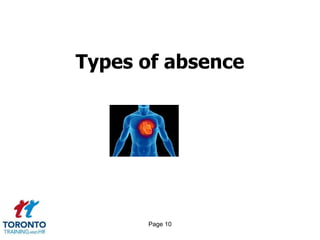
Types of absence
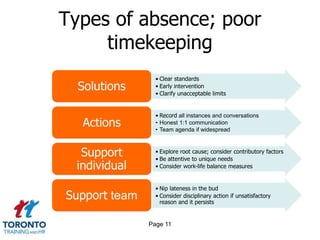
Types of absence; poor
timekeeping
• Clear standards
• Early intervention
• Clarify unacceptable limits
Solutions
• Record all instances and conversations
• Honest 1:1 communication
• Team agenda if widespread
Actions
• Explore root cause; consider contributory factors
• Be attentive to unique needs
• Consider work-life balance measures
Support
individual
• Nip lateness in the bud
• Consider disciplinary action if unsatisfactory
reason and it persists
Support team
Page 11
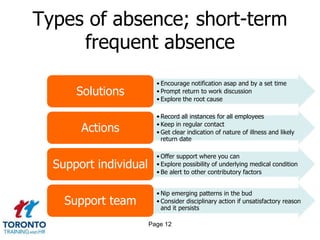
Types of absence; short-term
frequent absence
• Encourage notification asap and by a set time
• Prompt return to work discussion
• Explore the root cause
Solutions
• Record all instances for all employees
• Keep in regular contact
• Get clear indication of nature of illness and likely
return date
Actions
• Offer support where you can
• Explore possibility of underlying medical condition
• Be alert to other contributory factors
Support individual
• Nip emerging patterns in the bud
• Consider disciplinary action if unsatisfactory reason
and it persists
Support team
Page 12
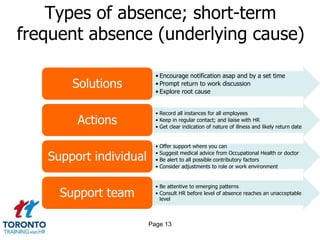
Types of absence; short-term
frequent absence (underlying cause)
• Encourage notification asap and by a set time
• Prompt return to work discussion
• Explore root cause
Solutions
• Record all instances for all employees
• Keep in regular contact; and liaise with HR
• Get clear indication of nature of illness and likely return date
Actions
• Offer support where you can
• Suggest medical advice from Occupational Health or doctor
• Be alert to all possible contributory factors
• Consider adjustments to role or work environment
Support individual
• Be attentive to emerging patterns
• Consult HR before level of absence reaches an unacceptable
level
Support team
Page 13
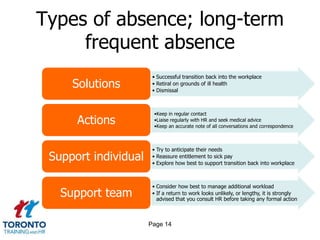
Types of absence; long-term
frequent absence
• Successful transition back into the workplace
• Retiral on grounds of ill health
• Dismissal
Solutions
•Keep in regular contact
•Liaise regularly with HR and seek medical advice
•Keep an accurate note of all conversations and correspondence
Actions
• Try to anticipate their needs
• Reassure entitlement to sick pay
• Explore how best to support transition back into workplace
Support individual
• Consider how best to manage additional workload
• If a return to work looks unlikely, or lengthy, it is strongly
advised that you consult HR before taking any formal action
Support team
Page 14
Page 15
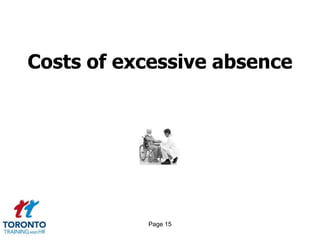
Costs of excessive absence
Page 16
Costs of excessive absence 1 of 4
All absence has cost consequences for the
employer –administrative and other. Absenteeism
that is avoidable, habitual and unscheduled can be
particularly costly to an employer, and to the
economy as a whole.
Disruptive to proper work scheduling and output.
Page 17
Costs of excessive absence 2 of 4
Increased team workloads
Low morale among colleagues expected to take on
extra work
Reduced performance and productivity
Missed deadlines due to a lack of trained,
experienced employees
Diminished reputation with customers and
potential employees
Lost business
Page 18
Costs of excessive absence 3 of 4
Direct costs
Indirect costs
Total cost
Page 19
Costs of excessive absence 4 of 4
PRODUCTIVITY LOSS
Replacement approach
Cost of replacement workers
Efficiency of replacement workers
Page 20
Total attendance
management
Page 21
Total attendance management 1 of 3
What is it?
Objective setting
Integrated approach
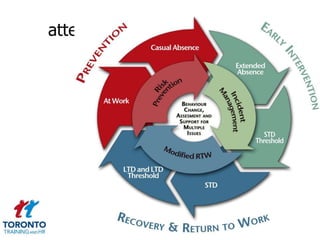
Prevention
Casual absence
STD/LTD
Workers’ compensation
Page 22
Total attendance management 2 of 3
Establish clear policies, procedures, roles and
responsibilities
Engage people leaders to participate effectively in
attendance management
Page 15
attendance management 3 of 2
Page 24
Factors that influence
absenteeism rates in
Canada
Page 25
Factors that influence
absenteeism rates in Canada
Unionization
Permanent status
Size of the organization
Province
Pay for sickness absence
Type of job
Dependant children
Page 26
Reducing unscheduled
absence
Page 27
Reducing unscheduled absence
Consider work-life balance measures
Clearly explain roles, duties, projects and tasks
Simplify processes and administration
Encourage communication
Page 28
Steps that allow an
employer to act legally
Page 29
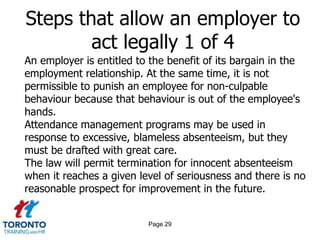
Steps that allow an employer to
act legally 1 of 4
An employer is entitled to the benefit of its bargain in the
employment relationship. At the same time, it is not
permissible to punish an employee for non-culpable
behaviour because that behaviour is out of the employee's
hands.
Attendance management programs may be used in
response to excessive, blameless absenteeism, but they
must be drafted with great care.
The law will permit termination for innocent absenteeism
when it reaches a given level of seriousness and there is no
reasonable prospect for improvement in the future.
Page 30
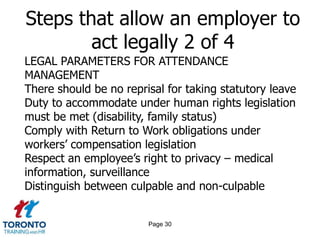
Steps that allow an employer to
act legally 2 of 4
LEGAL PARAMETERS FOR ATTENDANCE
MANAGEMENT
There should be no reprisal for taking statutory leave
Duty to accommodate under human rights legislation
must be met (disability, family status)
Comply with Return to Work obligations under
workers’ compensation legislation
Respect an employee’s right to privacy – medical
information, surveillance
Distinguish between culpable and non-culpable
Page 31
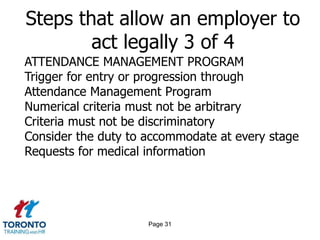
Steps that allow an employer to
act legally 3 of 4
ATTENDANCE MANAGEMENT PROGRAM
Trigger for entry or progression through
Attendance Management Program
Numerical criteria must not be arbitrary
Criteria must not be discriminatory
Consider the duty to accommodate at every stage
Requests for medical information
Page 32
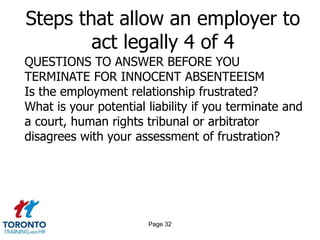
Steps that allow an employer to
act legally 4 of 4
QUESTIONS TO ANSWER BEFORE YOU
TERMINATE FOR INNOCENT ABSENTEEISM
Is the employment relationship frustrated?
What is your potential liability if you terminate and
a court, human rights tribunal or arbitrator
disagrees with your assessment of frustration?
Page 33
The Naccarato decision
Page 34
The Naccarato decision
Background
Limits on the duty to accommodate
Naccarato decision
What Naccarato means for employers
Page 35
The Coast Mountain Bus
Company case
Page 36
The Coast Mountain Bus
Company case
Background
Attendance Management Program
Reasons of the Court of Appeal
Critical implications for employer strategies to
manage absenteeism
What’s the problem?
Impact of the duty to accommodate
How much absenteeism must be accommodated?
Points to consider
Page 37
Musculoskeletal disorders
Page 38
Musculoskeletal disorders
Principles of management
What are the symptoms?
Acute, recurrent or chronic
Page 39
Return to work interviews
Page 40
Return to work interviews 1 of 4
PURPOSE
Welcome employees back
Check they are well enough to work
Identify the cause of the absence
Discuss the details of an agreed return to work based on
advice given by the doctor
Establish if the sickness is work related and what health &
safety issues need to be addressed
Tease out any other problems at work or at home
Discuss how they can get back to a normal work routine as
quickly as possible, update them on developments
Page 41
Return to work interviews 2 of 4
PREPARING FOR A RETURN TO WORK DISCUSSION
The discussion is confidential so find a quiet place
Have everything to hand at the meeting; employee records,
notes of previous discussions, advice from their doctor
Be prepared to discuss the employee’s absence in detail
including any emerging patterns
Consider how a return to work will work in practice-what
kind of questions will you ask? What does the absence
policy say? What issues may crop up during the discussion?
How would a phased return work?
Explain when the interview will take place and its purpose
Page 42
Return to work interviews 3 of 4
THE CONVERSATION
Most discussions will be informal and brief
Explore how the employee feels about returning to work
Be positive about the employee’s value to the organization
Explore how a return to work will work in practice
Ask your employee what information they would like shared
with their work colleagues
Be reassuring throughout
Update the employee about changes since they have been
away such as the progress on the projects they were
working on and any changes to the team
Page 43
Return to work interviews 4 of 4
THE CONVERSATION
What are the options for the future? Discuss all the options
and focus on positive outcomes. Where appropriate the
employee may agree to be referred to your organization’s
medical officer information or to an occupational health
therapist?
In some instances disciplinary action may be needed if the
explanations for absence/poor timekeeping are deemed
unsatisfactory. Have an open mind and agree an action
plan but don’t make hasty decisions
Take notes of the meeting
Page 44
Attendance bonuses
Page 45
Attendance bonuses
Consider making an employee assistance program available
to the workforce
Identify drivers of absence that are not sickness related
and think how you could mitigate them-for example,
flexible working for people with young children
Remember that attendance bonuses could be viewed as
discriminatory
Reinvest money that would have been spent on bonuses in
a company-funded wellbeing scheme
Carry out return-to-work interviews, even for short-term
absences
Page 46
Problems with absence
records
Page 47
Problems with absence records
Inadequate absence information required
Inaccurate records
Record-keeping system hinders analysis of
absences
Record-keeping system prevents proper analysis of
absences
Page 48
Tackling absence
Page 49
Tackling absence 1 of 4
Dust down your policies
Hold calibration sessions
Provide a support structure
Clear reporting is crucial
Get people back to work
Policies aren’t everything
Page 50
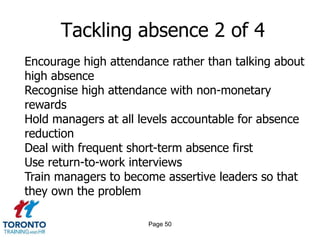
Tackling absence 2 of 4
Encourage high attendance rather than talking about
high absence
Recognise high attendance with non-monetary
rewards
Hold managers at all levels accountable for absence
reduction
Deal with frequent short-term absence first
Use return-to-work interviews
Train managers to become assertive leaders so that
they own the problem
Page 51
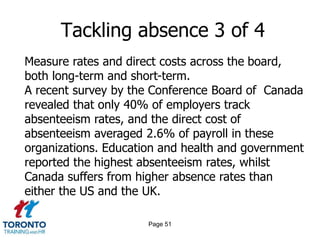
Tackling absence 3 of 4
Measure rates and direct costs across the board,
both long-term and short-term.
A recent survey by the Conference Board of Canada
revealed that only 40% of employers track
absenteeism rates, and the direct cost of
absenteeism averaged 2.6% of payroll in these
organizations. Education and health and government
reported the highest absenteeism rates, whilst
Canada suffers from higher absence rates than
either the US and the UK.
Page 52
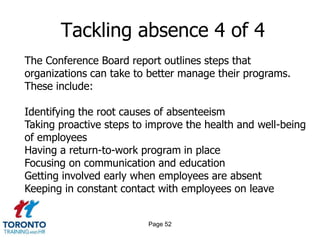
Tackling absence 4 of 4
The Conference Board report outlines steps that
organizations can take to better manage their programs.
These include:
Identifying the root causes of absenteeism
Taking proactive steps to improve the health and well-being
of employees
Having a return-to-work program in place
Focusing on communication and education
Getting involved early when employees are absent
Keeping in constant contact with employees on leave
Page 53
Case study
Page 54
Case study
Page 55
Conclusion & Questions
Page 56
Conclusion
Summary
Questions

Reducing absenteeism May 2011

  • 1.
    Reducing absenteeism by TorontoTraining and HR May 2011
  • 2.
    Contents 3-4 Introduction toToronto Training and HR 5-6 Definitions 7-9 Reasons for absence 10-14 Types of absence 15-19 Costs of excessive absence 20-23 Total attendance management 24-25 Factors that influence absenteeism rates in Canada 26-27 Reducing unscheduled absence 28-32 Steps that allow an employer to act legally 33-34 The Naccarato decision 35-36 The Coast Mountain Bus Company case 37-38 Musculoskeletal disorders 39-43 Return to work interviews 44-45 Attendance bonuses 46-47 Problems with absence records 48-52 Tackling absence 53-54 Case study 55-56 Conclusion and questions
  • 3.
  • 4.
    Page 4 Introduction toToronto Training and HR • Toronto Training and HR is a specialist training and human resources consultancy headed by Timothy Holden • 10 years in banking • 10 years in training and human resources • Freelance practitioner since 2006 • The core services provided by Toronto Training and HR are: - Training course design - Training course delivery - Reducing costs - Saving time - Improving employee engagement & morale - Services for job seekers
  • 5.
  • 6.
    Page 6 Definitions Incidental unplannedabsences Extended absences Planned absences
  • 7.
  • 8.
    Page 8 Reasons forabsence 1 of 2 Medical Social Physiological
  • 9.
    Page 9 Reasons forabsence 2 of 2 EXPLANATIONS FOR THE RISE IN CANADA An aging demographic Rising levels of work-related stress Ever-increasing proportion of women in the workforce with multiple responsibilities Increasing prevalence of liberal leave policies
  • 10.
  • 11.
    Types of absence;poor timekeeping • Clear standards • Early intervention • Clarify unacceptable limits Solutions • Record all instances and conversations • Honest 1:1 communication • Team agenda if widespread Actions • Explore root cause; consider contributory factors • Be attentive to unique needs • Consider work-life balance measures Support individual • Nip lateness in the bud • Consider disciplinary action if unsatisfactory reason and it persists Support team Page 11
  • 12.
    Types of absence;short-term frequent absence • Encourage notification asap and by a set time • Prompt return to work discussion • Explore the root cause Solutions • Record all instances for all employees • Keep in regular contact • Get clear indication of nature of illness and likely return date Actions • Offer support where you can • Explore possibility of underlying medical condition • Be alert to other contributory factors Support individual • Nip emerging patterns in the bud • Consider disciplinary action if unsatisfactory reason and it persists Support team Page 12
  • 13.
    Types of absence;short-term frequent absence (underlying cause) • Encourage notification asap and by a set time • Prompt return to work discussion • Explore root cause Solutions • Record all instances for all employees • Keep in regular contact; and liaise with HR • Get clear indication of nature of illness and likely return date Actions • Offer support where you can • Suggest medical advice from Occupational Health or doctor • Be alert to all possible contributory factors • Consider adjustments to role or work environment Support individual • Be attentive to emerging patterns • Consult HR before level of absence reaches an unacceptable level Support team Page 13
  • 14.
    Types of absence;long-term frequent absence • Successful transition back into the workplace • Retiral on grounds of ill health • Dismissal Solutions •Keep in regular contact •Liaise regularly with HR and seek medical advice •Keep an accurate note of all conversations and correspondence Actions • Try to anticipate their needs • Reassure entitlement to sick pay • Explore how best to support transition back into workplace Support individual • Consider how best to manage additional workload • If a return to work looks unlikely, or lengthy, it is strongly advised that you consult HR before taking any formal action Support team Page 14
  • 15.
    Page 15 Costs ofexcessive absence
  • 16.
    Page 16 Costs ofexcessive absence 1 of 4 All absence has cost consequences for the employer –administrative and other. Absenteeism that is avoidable, habitual and unscheduled can be particularly costly to an employer, and to the economy as a whole. Disruptive to proper work scheduling and output.
  • 17.
    Page 17 Costs ofexcessive absence 2 of 4 Increased team workloads Low morale among colleagues expected to take on extra work Reduced performance and productivity Missed deadlines due to a lack of trained, experienced employees Diminished reputation with customers and potential employees Lost business
  • 18.
    Page 18 Costs ofexcessive absence 3 of 4 Direct costs Indirect costs Total cost
  • 19.
    Page 19 Costs ofexcessive absence 4 of 4 PRODUCTIVITY LOSS Replacement approach Cost of replacement workers Efficiency of replacement workers
  • 20.
  • 21.
    Page 21 Total attendancemanagement 1 of 3 What is it? Objective setting Integrated approach Prevention Casual absence STD/LTD Workers’ compensation
  • 22.
    Page 22 Total attendancemanagement 2 of 3 Establish clear policies, procedures, roles and responsibilities Engage people leaders to participate effectively in attendance management
  • 23.
  • 24.
    Page 24 Factors thatinfluence absenteeism rates in Canada
  • 25.
    Page 25 Factors thatinfluence absenteeism rates in Canada Unionization Permanent status Size of the organization Province Pay for sickness absence Type of job Dependant children
  • 26.
  • 27.
    Page 27 Reducing unscheduledabsence Consider work-life balance measures Clearly explain roles, duties, projects and tasks Simplify processes and administration Encourage communication
  • 28.
    Page 28 Steps thatallow an employer to act legally
  • 29.
    Page 29 Steps thatallow an employer to act legally 1 of 4 An employer is entitled to the benefit of its bargain in the employment relationship. At the same time, it is not permissible to punish an employee for non-culpable behaviour because that behaviour is out of the employee's hands. Attendance management programs may be used in response to excessive, blameless absenteeism, but they must be drafted with great care. The law will permit termination for innocent absenteeism when it reaches a given level of seriousness and there is no reasonable prospect for improvement in the future.
  • 30.
    Page 30 Steps thatallow an employer to act legally 2 of 4 LEGAL PARAMETERS FOR ATTENDANCE MANAGEMENT There should be no reprisal for taking statutory leave Duty to accommodate under human rights legislation must be met (disability, family status) Comply with Return to Work obligations under workers’ compensation legislation Respect an employee’s right to privacy – medical information, surveillance Distinguish between culpable and non-culpable
  • 31.
    Page 31 Steps thatallow an employer to act legally 3 of 4 ATTENDANCE MANAGEMENT PROGRAM Trigger for entry or progression through Attendance Management Program Numerical criteria must not be arbitrary Criteria must not be discriminatory Consider the duty to accommodate at every stage Requests for medical information
  • 32.
    Page 32 Steps thatallow an employer to act legally 4 of 4 QUESTIONS TO ANSWER BEFORE YOU TERMINATE FOR INNOCENT ABSENTEEISM Is the employment relationship frustrated? What is your potential liability if you terminate and a court, human rights tribunal or arbitrator disagrees with your assessment of frustration?
  • 33.
  • 34.
    Page 34 The Naccaratodecision Background Limits on the duty to accommodate Naccarato decision What Naccarato means for employers
  • 35.
    Page 35 The CoastMountain Bus Company case
  • 36.
    Page 36 The CoastMountain Bus Company case Background Attendance Management Program Reasons of the Court of Appeal Critical implications for employer strategies to manage absenteeism What’s the problem? Impact of the duty to accommodate How much absenteeism must be accommodated? Points to consider
  • 37.
  • 38.
    Page 38 Musculoskeletal disorders Principlesof management What are the symptoms? Acute, recurrent or chronic
  • 39.
    Page 39 Return towork interviews
  • 40.
    Page 40 Return towork interviews 1 of 4 PURPOSE Welcome employees back Check they are well enough to work Identify the cause of the absence Discuss the details of an agreed return to work based on advice given by the doctor Establish if the sickness is work related and what health & safety issues need to be addressed Tease out any other problems at work or at home Discuss how they can get back to a normal work routine as quickly as possible, update them on developments
  • 41.
    Page 41 Return towork interviews 2 of 4 PREPARING FOR A RETURN TO WORK DISCUSSION The discussion is confidential so find a quiet place Have everything to hand at the meeting; employee records, notes of previous discussions, advice from their doctor Be prepared to discuss the employee’s absence in detail including any emerging patterns Consider how a return to work will work in practice-what kind of questions will you ask? What does the absence policy say? What issues may crop up during the discussion? How would a phased return work? Explain when the interview will take place and its purpose
  • 42.
    Page 42 Return towork interviews 3 of 4 THE CONVERSATION Most discussions will be informal and brief Explore how the employee feels about returning to work Be positive about the employee’s value to the organization Explore how a return to work will work in practice Ask your employee what information they would like shared with their work colleagues Be reassuring throughout Update the employee about changes since they have been away such as the progress on the projects they were working on and any changes to the team
  • 43.
    Page 43 Return towork interviews 4 of 4 THE CONVERSATION What are the options for the future? Discuss all the options and focus on positive outcomes. Where appropriate the employee may agree to be referred to your organization’s medical officer information or to an occupational health therapist? In some instances disciplinary action may be needed if the explanations for absence/poor timekeeping are deemed unsatisfactory. Have an open mind and agree an action plan but don’t make hasty decisions Take notes of the meeting
  • 44.
  • 45.
    Page 45 Attendance bonuses Considermaking an employee assistance program available to the workforce Identify drivers of absence that are not sickness related and think how you could mitigate them-for example, flexible working for people with young children Remember that attendance bonuses could be viewed as discriminatory Reinvest money that would have been spent on bonuses in a company-funded wellbeing scheme Carry out return-to-work interviews, even for short-term absences
  • 46.
    Page 46 Problems withabsence records
  • 47.
    Page 47 Problems withabsence records Inadequate absence information required Inaccurate records Record-keeping system hinders analysis of absences Record-keeping system prevents proper analysis of absences
  • 48.
  • 49.
    Page 49 Tackling absence1 of 4 Dust down your policies Hold calibration sessions Provide a support structure Clear reporting is crucial Get people back to work Policies aren’t everything
  • 50.
    Page 50 Tackling absence2 of 4 Encourage high attendance rather than talking about high absence Recognise high attendance with non-monetary rewards Hold managers at all levels accountable for absence reduction Deal with frequent short-term absence first Use return-to-work interviews Train managers to become assertive leaders so that they own the problem
  • 51.
    Page 51 Tackling absence3 of 4 Measure rates and direct costs across the board, both long-term and short-term. A recent survey by the Conference Board of Canada revealed that only 40% of employers track absenteeism rates, and the direct cost of absenteeism averaged 2.6% of payroll in these organizations. Education and health and government reported the highest absenteeism rates, whilst Canada suffers from higher absence rates than either the US and the UK.
  • 52.
    Page 52 Tackling absence4 of 4 The Conference Board report outlines steps that organizations can take to better manage their programs. These include: Identifying the root causes of absenteeism Taking proactive steps to improve the health and well-being of employees Having a return-to-work program in place Focusing on communication and education Getting involved early when employees are absent Keeping in constant contact with employees on leave
  • 53.
  • 54.
  • 55.
  • 56.