PREPARED BY:
AHMED ZINHOM RADY MUBARAK
MASTER IN NURSING ADMINISTRAYION
F.O.N
CAIRO UNIVERSITY
Time management
Objectives
 At the end of this lecture, each student will be able to :
 Define time management
 List the purpose of time management
 Define time wasters
 Identify the common time wasters
 Discuss the basic time management principles
 ApplyTime management technique
 Discuss the Basic principles of time management to deal with
time wasters
Outlines:
 Introduction
 Definition of time management
 Purpose of time management
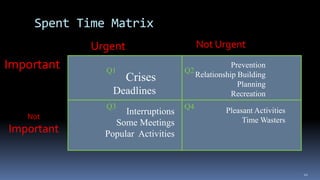
 Definition of time wasters
 Common time wasters
 Basic time management principles
 Time management technique
 Basic principles of time management to deal with time
wasters
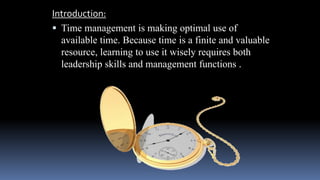
Introduction:
 Time management is making optimal use of
available time. Because time is a finite and valuable
resource, learning to use it wisely requires both
leadership skills and management functions .
 the leader /manager must initiate an analysis of how
time is managed on the unit level ,involve team
members and gain their cooperation in maximizing
time use and guide work to its conclusion and
successful implementation .
Definition
 Time management has been defined
as ‘a set of related skills that
helps you to use your time in the
most effective and productive way
possible’.
Time management is the act or process of
planning and exercising conscious control
over the amount of time spent on specific
activities, especially to increase
effectiveness, efficiency or productivity.
Time management is a set of principles, practices,
skills, tools and system that work together to help to
get more value out of your time.
I ASKYOU
Why time
management?
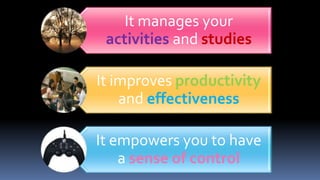
It manages your
activities and studies
It improves productivity
and effectiveness
It empowers you to have
a sense of control
time wasters:
 Is something that prevents person from
accomplishing the job or achieving the goal
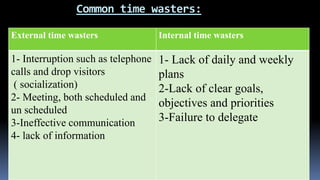
Common time wasters:
Internal time wastersExternal time wasters
1- Lack of daily and weekly
plans
2-Lack of clear goals,
objectives and priorities
3-Failure to delegate
1- Interruption such as telephone
calls and drop visitors
( socialization)
2- Meeting, both scheduled and
un scheduled
3-Ineffective communication
4- lack of information
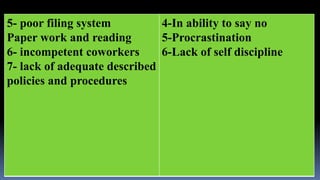
4-In ability to say no
5-Procrastination
6-Lack of self discipline
5- poor filing system
Paper work and reading
6- incompetent coworkers
7- lack of adequate described
policies and procedures
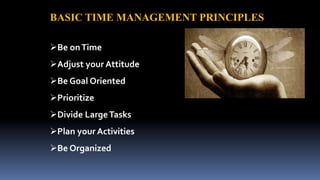
BASIC TIME MANAGEMENT PRINCIPLES
Be onTime
Adjust your Attitude
Be Goal Oriented
Prioritize
Divide LargeTasks
Plan your Activities
Be Organized
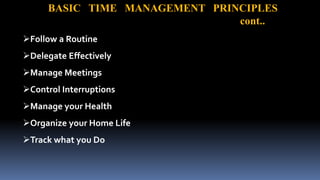
Follow a Routine
Delegate Effectively
Manage Meetings
Control Interruptions
Manage your Health
Organize your Home Life
Track what you Do
BASIC TIME MANAGEMENT PRINCIPLES
cont..
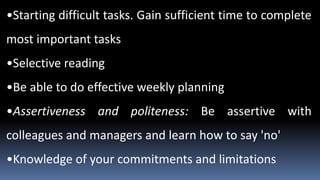
•Starting difficult tasks. Gain sufficient time to complete
most important tasks
•Selective reading
•Be able to do effective weekly planning
•Assertiveness and politeness: Be assertive with
colleagues and managers and learn how to say 'no'
•Knowledge of your commitments and limitations
How to deal with time
wasters?
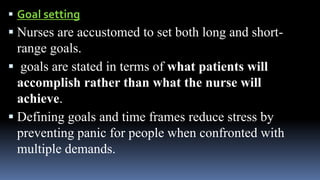
 Goal setting
 Nurses are accustomed to set both long and short-
range goals.
 goals are stated in terms of what patients will
accomplish rather than what the nurse will
achieve.
 Defining goals and time frames reduce stress by
preventing panic for people when confronted with
multiple demands.
Setting priorities
 Nurse managers should establish priorities, taking
into consideration both short and long term goals as
well as the importance and urgency of each
activity.
Time management matrix/urgent or important
matrix
• The time management matrix a useful tool to know
how to prioritize work, personal roles, goals and
commitments
• The time management matrix is split into the following
four quadrants.
21
Spent Time Matrix
Q1
Q3
Q2
Q4
Crises
Deadlines
Prevention
Relationship Building
Planning
Recreation
Interruptions
Some Meetings
Popular Activities
Pleasant Activities
Time Wasters
Urgent Not Urgent
Important
Not
Important
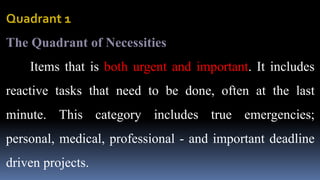
Quadrant 1
The Quadrant of Necessities
Items that is both urgent and important. It includes
reactive tasks that need to be done, often at the last
minute. This category includes true emergencies;
personal, medical, professional - and important deadline
driven projects.
Crises and deadlines are typical examples.
Time spent in this quadrant can't be avoided.
These are the things that we have to do because they are our
responsibility and need immediate attention.
Quadrant 2 - Important but not Urgent
The Quadrant of Quality
Q2 is the quadrant of personal proactively and power.
Items that is not urgent but important. This includes activities
that build capability, spot new opportunities, and ensure long
term success. It includes proactive tasks, often habitual, that
maintains or improves the quality of your work and life.
The more you expand this quadrant, the more you
reduce the other three quadrants
Quadrant 3 - Urgent but not Important
The Quadrant of Deception
This quadrant includes items that are urgent and not important,
These activities may seem important, but they are not really.
They only grasp your attention immediately.These are the
things that we allow to interrupt our working lives because we
believe they take precedence over other tasks.The worst
examples of such tasks are answering every phone call.
Quadrant 4 - Neither Urgent nor Important The Quadrant
of Waste
It includes items that are not urgent and not important.
These are the things that we don't need to do but that so often
we end up doing to fill in time or because we like doing them.
These include aimless socializing around and attending
unnecessary meetings. Covey calls these 'time-wasters'.
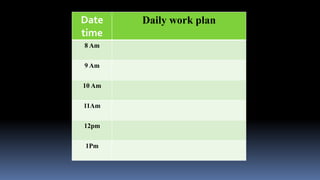
Daily planning and scheduling:
 Once goal and priorities have been established
the nurse manager can concentrate on
scheduling activities to do list should be
prepared each day , either after work hours or
early before on the same day
Daily work planDate
time
8 Am
9 Am
10 Am
11Am
12pm
1Pm
 the list is typically planned by workday or work
week , flexibility must be a major consideration
in this plan , some times should remain un
committed to allow the manager to deal with
emergencies and crises that are sure to happen
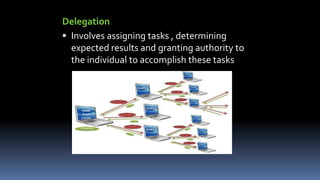
Delegation
 Involves assigning tasks , determining
expected results and granting authority to
the individual to accomplish these tasks
Controlling interruptions
 An interruption occurs any time to the nurse,
manager. we have two types of interruption,
interruption that is more important and
urgent and interruption as an emergencies or
crises situations .
 But there are some interruptions interfere
with achieving the nurse manager's job as
telephone calls and drop- in visitors, paper
work
Telephone calls:
 Are a major source of interruption but the nurse
manager can not function with out a telephone ,
nurse manager receive many telephone calls ,
some of them time wasters so handling telephone
calls effectively must occur by
Minimize socializing and small talk
 If you answer the phone with hello what can
I do for you rather than hello how are you
the caller is encouraged to get to business
first , be warm , friendly but don't allow
others to waste time
Plan calls
 Write down topics to be discussed before
making the call ,this prevents the need for
additional calls to inform other part of an
important point or ask a forgotten question
Set a time for calls
 The nurse manager may have a number of
calls to return as well as calls to initiate , it is
the best to set a time to handle routine phone
calls
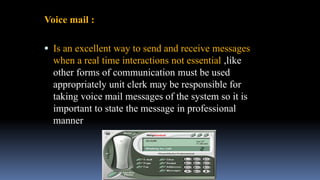
Voice mail :
 Is an excellent way to send and receive messages
when a real time interactions not essential ,like
other forms of communication must be used
appropriately unit clerk may be responsible for
taking voice mail messages of the system so it is
important to state the message in professional
manner
 Drop- in visitors
Drop- in visitors can last 10 minutes rather
than eliminate drop- in visits, the nurse
manager should skillfully direct the visit by
identifying the issues or questions
 Interruption also can be controlled by the
arrangement of furniture.
 the nurse manager whose desk is arranged so
that immediate eye contact is made with
passers –is asking about interruptions
 a desk turned 90 or even 180 degrees from
the door minimizes potential eye contact
Paper work
 Basic principles can help the nurse manager
process information while reducing it as a
waster of time
Plan and schedule paper work
 Writing and reading reports , forms, letters
are essential elements of the nurse manager's
job so nurse manager should learn the
organization's information system and
requirements of the position
 Sort paper work for effective processing
 It mean to handle file according to its
important and urgency , place all paper
work that is informational in nature and
related to present work in a file labeled (I)
 and place other reading material , such as
professional journals , technical reports ,and
other items that not relate directly to the
immediate work in a file labeled (R)
 The I file contain things that must be read immediately but
R file contain material are not as urgent and can be read later
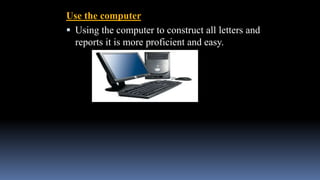
Use the computer
 Using the computer to construct all letters and
reports it is more proficient and easy.
Last words
The Challenge is not really to manage time
but to manage ourselves to be BALANCED,
EFFICIENT, and HAPPY
BEH!
BIBLIOGRAPHY: -
1.Jogindra vati,” principles and practice of nursing
management and admin istration”,1st edition, jay pee
publications, 2013 pp 522-531
2.Mary Lucita, “Nursing practice and public Health
administration”, 1st edition, Br Churchill Living stone pvt Ltd
New Delhi 2002, Pp 129-138.
3.Anna H.Gallahan, “Educational administration in nursing”,
1st edition, 1965, the Mac million company New York Pp 11-
13.
4.K.P. Neeraja, “Text book of Nursing education”, 1st edition,
2003, jaypee brothers medical publishers (p) Ltd. New Delhi
Pp 141-146.
5.Aquinas P.G(2005)”principles of management” 1st
edition,Annalm publications Pvt LTD.Ansari road.page no-
420-436

Time management

  • 1.
    PREPARED BY: AHMED ZINHOMRADY MUBARAK MASTER IN NURSING ADMINISTRAYION F.O.N CAIRO UNIVERSITY Time management
  • 2.
    Objectives  At theend of this lecture, each student will be able to :  Define time management  List the purpose of time management  Define time wasters  Identify the common time wasters  Discuss the basic time management principles  ApplyTime management technique  Discuss the Basic principles of time management to deal with time wasters
  • 3.
    Outlines:  Introduction  Definitionof time management  Purpose of time management  Definition of time wasters  Common time wasters  Basic time management principles  Time management technique  Basic principles of time management to deal with time wasters
  • 4.
    Introduction:  Time managementis making optimal use of available time. Because time is a finite and valuable resource, learning to use it wisely requires both leadership skills and management functions .
  • 5.
     the leader/manager must initiate an analysis of how time is managed on the unit level ,involve team members and gain their cooperation in maximizing time use and guide work to its conclusion and successful implementation .
  • 6.
    Definition  Time managementhas been defined as ‘a set of related skills that helps you to use your time in the most effective and productive way possible’.
  • 7.
    Time management isthe act or process of planning and exercising conscious control over the amount of time spent on specific activities, especially to increase effectiveness, efficiency or productivity.
  • 8.
    Time management isa set of principles, practices, skills, tools and system that work together to help to get more value out of your time.
  • 9.
  • 10.
    It manages your activitiesand studies It improves productivity and effectiveness It empowers you to have a sense of control
  • 11.
    time wasters:  Issomething that prevents person from accomplishing the job or achieving the goal
  • 12.
    Common time wasters: Internaltime wastersExternal time wasters 1- Lack of daily and weekly plans 2-Lack of clear goals, objectives and priorities 3-Failure to delegate 1- Interruption such as telephone calls and drop visitors ( socialization) 2- Meeting, both scheduled and un scheduled 3-Ineffective communication 4- lack of information
  • 13.
    4-In ability tosay no 5-Procrastination 6-Lack of self discipline 5- poor filing system Paper work and reading 6- incompetent coworkers 7- lack of adequate described policies and procedures
  • 14.
    BASIC TIME MANAGEMENTPRINCIPLES Be onTime Adjust your Attitude Be Goal Oriented Prioritize Divide LargeTasks Plan your Activities Be Organized
  • 15.
    Follow a Routine DelegateEffectively Manage Meetings Control Interruptions Manage your Health Organize your Home Life Track what you Do BASIC TIME MANAGEMENT PRINCIPLES cont..
  • 16.
    •Starting difficult tasks.Gain sufficient time to complete most important tasks •Selective reading •Be able to do effective weekly planning •Assertiveness and politeness: Be assertive with colleagues and managers and learn how to say 'no' •Knowledge of your commitments and limitations
  • 17.
    How to dealwith time wasters?
  • 18.
     Goal setting Nurses are accustomed to set both long and short- range goals.  goals are stated in terms of what patients will accomplish rather than what the nurse will achieve.  Defining goals and time frames reduce stress by preventing panic for people when confronted with multiple demands.
  • 19.
    Setting priorities  Nursemanagers should establish priorities, taking into consideration both short and long term goals as well as the importance and urgency of each activity.
  • 20.
    Time management matrix/urgentor important matrix • The time management matrix a useful tool to know how to prioritize work, personal roles, goals and commitments • The time management matrix is split into the following four quadrants.
  • 21.
    21 Spent Time Matrix Q1 Q3 Q2 Q4 Crises Deadlines Prevention RelationshipBuilding Planning Recreation Interruptions Some Meetings Popular Activities Pleasant Activities Time Wasters Urgent Not Urgent Important Not Important
  • 22.
    Quadrant 1 The Quadrantof Necessities Items that is both urgent and important. It includes reactive tasks that need to be done, often at the last minute. This category includes true emergencies; personal, medical, professional - and important deadline driven projects.
  • 23.
    Crises and deadlinesare typical examples. Time spent in this quadrant can't be avoided. These are the things that we have to do because they are our responsibility and need immediate attention.
  • 24.
    Quadrant 2 -Important but not Urgent The Quadrant of Quality Q2 is the quadrant of personal proactively and power. Items that is not urgent but important. This includes activities that build capability, spot new opportunities, and ensure long term success. It includes proactive tasks, often habitual, that maintains or improves the quality of your work and life.
  • 25.
    The more youexpand this quadrant, the more you reduce the other three quadrants
  • 26.
    Quadrant 3 -Urgent but not Important The Quadrant of Deception This quadrant includes items that are urgent and not important, These activities may seem important, but they are not really. They only grasp your attention immediately.These are the things that we allow to interrupt our working lives because we believe they take precedence over other tasks.The worst examples of such tasks are answering every phone call.
  • 27.
    Quadrant 4 -Neither Urgent nor Important The Quadrant of Waste It includes items that are not urgent and not important. These are the things that we don't need to do but that so often we end up doing to fill in time or because we like doing them. These include aimless socializing around and attending unnecessary meetings. Covey calls these 'time-wasters'.
  • 28.
    Daily planning andscheduling:  Once goal and priorities have been established the nurse manager can concentrate on scheduling activities to do list should be prepared each day , either after work hours or early before on the same day
  • 29.
    Daily work planDate time 8Am 9 Am 10 Am 11Am 12pm 1Pm
  • 30.
     the listis typically planned by workday or work week , flexibility must be a major consideration in this plan , some times should remain un committed to allow the manager to deal with emergencies and crises that are sure to happen
  • 31.
    Delegation  Involves assigningtasks , determining expected results and granting authority to the individual to accomplish these tasks
  • 32.
    Controlling interruptions  Aninterruption occurs any time to the nurse, manager. we have two types of interruption, interruption that is more important and urgent and interruption as an emergencies or crises situations .
  • 33.
     But thereare some interruptions interfere with achieving the nurse manager's job as telephone calls and drop- in visitors, paper work
  • 34.
    Telephone calls:  Area major source of interruption but the nurse manager can not function with out a telephone , nurse manager receive many telephone calls , some of them time wasters so handling telephone calls effectively must occur by
  • 35.
    Minimize socializing andsmall talk  If you answer the phone with hello what can I do for you rather than hello how are you the caller is encouraged to get to business first , be warm , friendly but don't allow others to waste time
  • 36.
    Plan calls  Writedown topics to be discussed before making the call ,this prevents the need for additional calls to inform other part of an important point or ask a forgotten question
  • 37.
    Set a timefor calls  The nurse manager may have a number of calls to return as well as calls to initiate , it is the best to set a time to handle routine phone calls
  • 38.
    Voice mail : Is an excellent way to send and receive messages when a real time interactions not essential ,like other forms of communication must be used appropriately unit clerk may be responsible for taking voice mail messages of the system so it is important to state the message in professional manner
  • 39.
     Drop- invisitors Drop- in visitors can last 10 minutes rather than eliminate drop- in visits, the nurse manager should skillfully direct the visit by identifying the issues or questions
  • 40.
     Interruption alsocan be controlled by the arrangement of furniture.  the nurse manager whose desk is arranged so that immediate eye contact is made with passers –is asking about interruptions  a desk turned 90 or even 180 degrees from the door minimizes potential eye contact
  • 41.
    Paper work  Basicprinciples can help the nurse manager process information while reducing it as a waster of time
  • 42.
    Plan and schedulepaper work  Writing and reading reports , forms, letters are essential elements of the nurse manager's job so nurse manager should learn the organization's information system and requirements of the position
  • 43.
     Sort paperwork for effective processing  It mean to handle file according to its important and urgency , place all paper work that is informational in nature and related to present work in a file labeled (I)
  • 44.
     and placeother reading material , such as professional journals , technical reports ,and other items that not relate directly to the immediate work in a file labeled (R)
  • 45.
     The Ifile contain things that must be read immediately but R file contain material are not as urgent and can be read later
  • 46.
    Use the computer Using the computer to construct all letters and reports it is more proficient and easy.
  • 47.
    Last words The Challengeis not really to manage time but to manage ourselves to be BALANCED, EFFICIENT, and HAPPY BEH!
  • 48.
    BIBLIOGRAPHY: - 1.Jogindra vati,”principles and practice of nursing management and admin istration”,1st edition, jay pee publications, 2013 pp 522-531 2.Mary Lucita, “Nursing practice and public Health administration”, 1st edition, Br Churchill Living stone pvt Ltd New Delhi 2002, Pp 129-138. 3.Anna H.Gallahan, “Educational administration in nursing”, 1st edition, 1965, the Mac million company New York Pp 11- 13.
  • 49.
    4.K.P. Neeraja, “Textbook of Nursing education”, 1st edition, 2003, jaypee brothers medical publishers (p) Ltd. New Delhi Pp 141-146. 5.Aquinas P.G(2005)”principles of management” 1st edition,Annalm publications Pvt LTD.Ansari road.page no- 420-436