



Absence from a legal perspective
and how to minimize it
by Toronto Training and HR
June 2014
CONTENTS
3-4 Introduction
5-6 Causes of absence
7-8 Measures
9-11 Costs of absence
12-13 Interventions
14-16 What will make employees turn up?
17-20 Strategies for employers
21-24 Culpable absenteeism
25-32 Innocent absenteeism
33-34 Dismissal and termination
35-36 The Human Rights Code
37-38 Workplace Safety and Insurance Act
39-42 Emergency leave and medical leave
43-44 The employer’s right to information
45-48 How much is too much?
49-50 Conclusion, summary and questions
Page 2
Page 3
Introduction
Page 4
Introduction to Toronto Training
and HR
Toronto Training and HR is a specialist training and
human resources consultancy headed by Timothy Holden
10 years in banking
15 years in training and human resources
Freelance practitioner since 2006
The core services provided by Toronto Training and HR
are:
Training event design
Training event delivery
HR support with an emphasis on reducing
costs, saving time plus improving employee
engagement and morale
Services for job seekers
Page 5
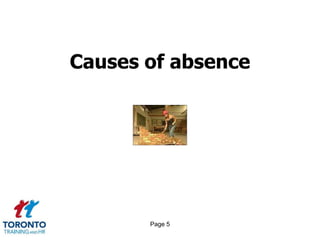
Causes of absence
Causes of
absence
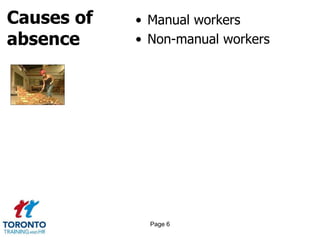
• Manual workers
• Non-manual workers
Page 6
Page 7
Measures
Measures • ‘Lost time’ rate
• Frequency rate
• Bradford factor
Page 8
Page 9
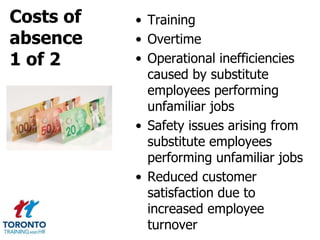
Costs of absence
Costs of
absence
1 of 2
• Training
• Overtime
• Operational inefficiencies
caused by substitute
employees performing
unfamiliar jobs
• Safety issues arising from
substitute employees
performing unfamiliar jobs
• Reduced customer
satisfaction due to
increased employee
turnover
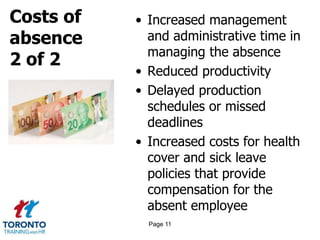
Costs of
absence
2 of 2
• Increased management
and administrative time in
managing the absence
• Reduced productivity
• Delayed production
schedules or missed
deadlines
• Increased costs for health
cover and sick leave
policies that provide
compensation for the
absent employee
Page 11
Page 12
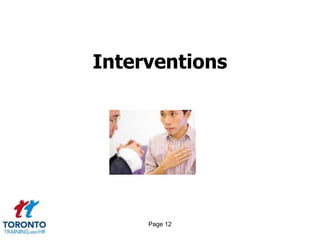
Interventions
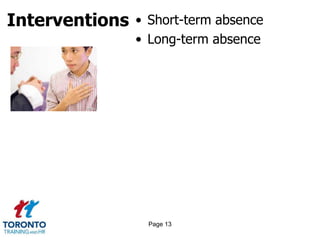
Interventions • Short-term absence
• Long-term absence
Page 13
Page 14
What will make employees
turn up?
What will
make
employees
turn up?
1 of 2
• Physical workplace
• Work and social
atmosphere
• Health, financial and family
benefits
• Vacation time and time off
• Employee communication
• Performance management
• Training and skills
development
• Community involvement
Page 15
What will
make
employees
turn up?
2 of 2
• Comfortable, well-lit and
healthy surroundings
• Comfortable, ergonomic,
and safe
tools/equipment/furniture
• Flexible hours
• Working from home
• Daycare facilities
• Recreation and leisure
facilities
Page 16
Page 17
Strategies for employers
Strategies for
employers
1 of 3
• Attendance management
programs
• Workplace wellness
initiatives
• Employee satisfaction
surveys
• Incentives to employees for
unused sick days and
meeting attendance targets
Page 18
Strategies for
employers
2 of 3
• Improve employee morale
by reducing stress,
rumours, negativity and
gossip
• Reduce employee stress by
improving the relationship
with the manager
• Provide management
training to improve people
skills
• Team building initiatives
Page 19
Strategies for
employers
3 of 3
• Work-life conflict
recognition
• Avoid discipline for
legitimate absences
• Allow employees to carry
over sick days
• Allow employees to
telecommute
Page 20
Page 21
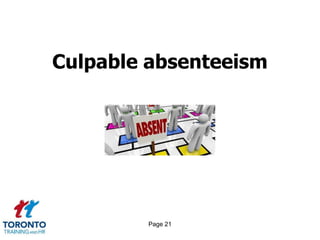
Culpable absenteeism
Culpable
absenteeism
1 of 3
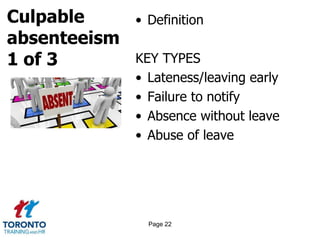
• Definition
KEY TYPES
• Lateness/leaving early
• Failure to notify
• Absence without leave
• Abuse of leave
Page 22
Culpable
absenteeism
2 of 3
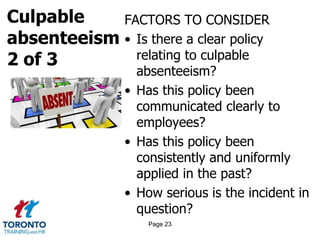
FACTORS TO CONSIDER
• Is there a clear policy
relating to culpable
absenteeism?
• Has this policy been
communicated clearly to
employees?
• Has this policy been
consistently and uniformly
applied in the past?
• How serious is the incident in
question?
Page 23
Culpable
absenteeism
3 of 3
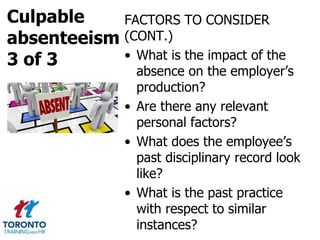
FACTORS TO CONSIDER
(CONT.)
• What is the impact of the
absence on the employer’s
production?
• Are there any relevant
personal factors?
• What does the employee’s
past disciplinary record look
like?
• What is the past practice
with respect to similar
instances?
Page 25
Innocent absenteeism
Innocent
absenteeism
1 of 7
• Definition
Page 26
Innocent
absenteeism
2 of 7
FACTORS TO BE
CONSIDERED
• Attendance record
• Prognosis for future
attendance
• Counselling
• Benefits status
• Human rights
considerations
• Employment Standards
Considerations
Page 27
Innocent
absenteeism
3 of 7
FACTORS TO BE CONSIDERED
(CONT.)
• Workplace Safety and
Insurance Act considerations
Page 28
Innocent
absenteeism
4 of 7
QUESTIONS TO ASK
• Is the level of absenteeism
unacceptably high
particularly when viewed in
terms of its pattern?
• Have you acquired all the
information you can
regarding the likelihood of
improvement in the future?
Page 29
Innocent
absenteeism
5 of 7
QUESTIONS TO ASK (CONT.)
• Have you counselled the
employee about the
consequences of failure to
attend regularly, and kept
records of having done so?
• Will termination interfere
with any contractual right the
employee may have to
disability benefits?
Page 30
Innocent
absenteeism
6 of 7
QUESTIONS TO ASK (CONT.)
• Is the absenteeism – or any
part of it– attributable to a
disability such that the
Human Rights Code may
apply?
• Is the absenteeism – or any
part of it – attributable to
emergency leave or family
medical leave under the
Employment Standards Act,
2000?
Page 31
Innocent
absenteeism
7 of 7
QUESTIONS TO ASK (CONT.)
• In the case of absences due
to work-related injuries or
illnesses, will the termination
interfere with the employer’s
re-employment obligations
under the WS and I Act?
• Have you complied with your
obligation under the ESA
2000 to provide statutory
notice (or termination pay)
and severance pay to the
employee?
Page 33
Dismissal and termination
Dismissal and
termination
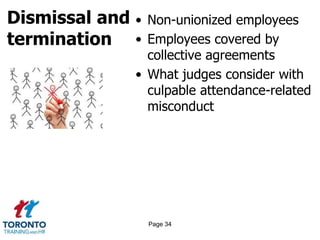
• Non-unionized employees
• Employees covered by
collective agreements
• What judges consider with
culpable attendance-related
misconduct
Page 34
Page 35
The Human Rights Code
The Human
Rights Code
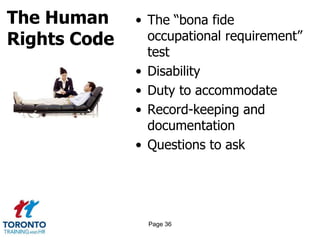
• The “bona fide
occupational requirement”
test
• Disability
• Duty to accommodate
• Record-keeping and
documentation
• Questions to ask
Page 36
Page 37
Workplace Safety and
Insurance Act
Workplace
Safety and
Insurance Act
• Schedule 1 employers
• Schedule 2 employers
• Return to work obligations
for the employer
• Return to work obligations
for the employee
• The functional abilities form
and the independent
medical examination
• Re-employment
• Termination
Page 38
Page 39
Emergency leave and
medical leave
Emergency
leave and
medical leave
1 of 3
PERSONAL EMERGENCY
LEAVE
• Who is covered
• The basic statutory
entitlement
• Notification
• Collective agreements and
employment contracts
• Reprisals
• What employers can do
Page 40
Emergency
leave and
medical leave
2 of 3
GOVERNMENT DECLARED
EMERGENCIES
• Emergency order
• Quarantine order
• Assistance to family
members
• Maximum number of days
FAMILY MEDICAL LEAVE
Page 41
Emergency
leave and
medical leave
3 of 3
FAMILY MEDICAL LEAVE
• Employment Standards Act
2000
• Who is family?
• One week blocks
• Written notice
• Doctor’s certificate
Page 42
Page 43
The employer’s right to
information
The
employer’s
right to
information
• Context
• Non-medical explanations
• Medical explanations
• Surveillance
• Duty to accommodate
• Consent
• Confidentiality
• Costs
Page 44
Page 45
How much is too much?
How much is
too much?
1 of 3
• Cost to the Canadian
economy
• Average
• HIGHEST-health care and
social assistance
• LOWEST-professional,
scientific and technical
services
Page 46
How much is
too much?
2 of 3
• Public v private
• Unionized v non-unionized
• Young v older
• Large employers v small
employers
• Per province
Page 47
How much is
too much?
3 of 3
• 351552 paid absence days
in TDSB
• Per employee?
Page 48
Page 49
Conclusion, summary and
questions
Page 50
Conclusion, summary and
questions
Conclusion
Summary
Videos
Questions

Absenteeism June 2014

  • 1.
    Absence from alegal perspective and how to minimize it by Toronto Training and HR June 2014
  • 2.
    CONTENTS 3-4 Introduction 5-6 Causesof absence 7-8 Measures 9-11 Costs of absence 12-13 Interventions 14-16 What will make employees turn up? 17-20 Strategies for employers 21-24 Culpable absenteeism 25-32 Innocent absenteeism 33-34 Dismissal and termination 35-36 The Human Rights Code 37-38 Workplace Safety and Insurance Act 39-42 Emergency leave and medical leave 43-44 The employer’s right to information 45-48 How much is too much? 49-50 Conclusion, summary and questions Page 2
  • 3.
  • 4.
    Page 4 Introduction toToronto Training and HR Toronto Training and HR is a specialist training and human resources consultancy headed by Timothy Holden 10 years in banking 15 years in training and human resources Freelance practitioner since 2006 The core services provided by Toronto Training and HR are: Training event design Training event delivery HR support with an emphasis on reducing costs, saving time plus improving employee engagement and morale Services for job seekers
  • 5.
  • 6.
    Causes of absence • Manualworkers • Non-manual workers Page 6
  • 7.
  • 8.
    Measures • ‘Losttime’ rate • Frequency rate • Bradford factor Page 8
  • 9.
  • 10.
    Costs of absence 1 of2 • Training • Overtime • Operational inefficiencies caused by substitute employees performing unfamiliar jobs • Safety issues arising from substitute employees performing unfamiliar jobs • Reduced customer satisfaction due to increased employee turnover
  • 11.
    Costs of absence 2 of2 • Increased management and administrative time in managing the absence • Reduced productivity • Delayed production schedules or missed deadlines • Increased costs for health cover and sick leave policies that provide compensation for the absent employee Page 11
  • 12.
  • 13.
    Interventions • Short-termabsence • Long-term absence Page 13
  • 14.
    Page 14 What willmake employees turn up?
  • 15.
    What will make employees turn up? 1of 2 • Physical workplace • Work and social atmosphere • Health, financial and family benefits • Vacation time and time off • Employee communication • Performance management • Training and skills development • Community involvement Page 15
  • 16.
    What will make employees turn up? 2of 2 • Comfortable, well-lit and healthy surroundings • Comfortable, ergonomic, and safe tools/equipment/furniture • Flexible hours • Working from home • Daycare facilities • Recreation and leisure facilities Page 16
  • 17.
  • 18.
    Strategies for employers 1 of3 • Attendance management programs • Workplace wellness initiatives • Employee satisfaction surveys • Incentives to employees for unused sick days and meeting attendance targets Page 18
  • 19.
    Strategies for employers 2 of3 • Improve employee morale by reducing stress, rumours, negativity and gossip • Reduce employee stress by improving the relationship with the manager • Provide management training to improve people skills • Team building initiatives Page 19
  • 20.
    Strategies for employers 3 of3 • Work-life conflict recognition • Avoid discipline for legitimate absences • Allow employees to carry over sick days • Allow employees to telecommute Page 20
  • 21.
  • 22.
    Culpable absenteeism 1 of 3 •Definition KEY TYPES • Lateness/leaving early • Failure to notify • Absence without leave • Abuse of leave Page 22
  • 23.
    Culpable absenteeism 2 of 3 FACTORSTO CONSIDER • Is there a clear policy relating to culpable absenteeism? • Has this policy been communicated clearly to employees? • Has this policy been consistently and uniformly applied in the past? • How serious is the incident in question? Page 23
  • 24.
    Culpable absenteeism 3 of 3 FACTORSTO CONSIDER (CONT.) • What is the impact of the absence on the employer’s production? • Are there any relevant personal factors? • What does the employee’s past disciplinary record look like? • What is the past practice with respect to similar instances?
  • 25.
  • 26.
  • 27.
    Innocent absenteeism 2 of 7 FACTORSTO BE CONSIDERED • Attendance record • Prognosis for future attendance • Counselling • Benefits status • Human rights considerations • Employment Standards Considerations Page 27
  • 28.
    Innocent absenteeism 3 of 7 FACTORSTO BE CONSIDERED (CONT.) • Workplace Safety and Insurance Act considerations Page 28
  • 29.
    Innocent absenteeism 4 of 7 QUESTIONSTO ASK • Is the level of absenteeism unacceptably high particularly when viewed in terms of its pattern? • Have you acquired all the information you can regarding the likelihood of improvement in the future? Page 29
  • 30.
    Innocent absenteeism 5 of 7 QUESTIONSTO ASK (CONT.) • Have you counselled the employee about the consequences of failure to attend regularly, and kept records of having done so? • Will termination interfere with any contractual right the employee may have to disability benefits? Page 30
  • 31.
    Innocent absenteeism 6 of 7 QUESTIONSTO ASK (CONT.) • Is the absenteeism – or any part of it– attributable to a disability such that the Human Rights Code may apply? • Is the absenteeism – or any part of it – attributable to emergency leave or family medical leave under the Employment Standards Act, 2000? Page 31
  • 32.
    Innocent absenteeism 7 of 7 QUESTIONSTO ASK (CONT.) • In the case of absences due to work-related injuries or illnesses, will the termination interfere with the employer’s re-employment obligations under the WS and I Act? • Have you complied with your obligation under the ESA 2000 to provide statutory notice (or termination pay) and severance pay to the employee?
  • 33.
  • 34.
    Dismissal and termination • Non-unionizedemployees • Employees covered by collective agreements • What judges consider with culpable attendance-related misconduct Page 34
  • 35.
    Page 35 The HumanRights Code
  • 36.
    The Human Rights Code •The “bona fide occupational requirement” test • Disability • Duty to accommodate • Record-keeping and documentation • Questions to ask Page 36
  • 37.
    Page 37 Workplace Safetyand Insurance Act
  • 38.
    Workplace Safety and Insurance Act •Schedule 1 employers • Schedule 2 employers • Return to work obligations for the employer • Return to work obligations for the employee • The functional abilities form and the independent medical examination • Re-employment • Termination Page 38
  • 39.
    Page 39 Emergency leaveand medical leave
  • 40.
    Emergency leave and medical leave 1of 3 PERSONAL EMERGENCY LEAVE • Who is covered • The basic statutory entitlement • Notification • Collective agreements and employment contracts • Reprisals • What employers can do Page 40
  • 41.
    Emergency leave and medical leave 2of 3 GOVERNMENT DECLARED EMERGENCIES • Emergency order • Quarantine order • Assistance to family members • Maximum number of days FAMILY MEDICAL LEAVE Page 41
  • 42.
    Emergency leave and medical leave 3of 3 FAMILY MEDICAL LEAVE • Employment Standards Act 2000 • Who is family? • One week blocks • Written notice • Doctor’s certificate Page 42
  • 43.
    Page 43 The employer’sright to information
  • 44.
    The employer’s right to information • Context •Non-medical explanations • Medical explanations • Surveillance • Duty to accommodate • Consent • Confidentiality • Costs Page 44
  • 45.
    Page 45 How muchis too much?
  • 46.
    How much is toomuch? 1 of 3 • Cost to the Canadian economy • Average • HIGHEST-health care and social assistance • LOWEST-professional, scientific and technical services Page 46
  • 47.
    How much is toomuch? 2 of 3 • Public v private • Unionized v non-unionized • Young v older • Large employers v small employers • Per province Page 47
  • 48.
    How much is toomuch? 3 of 3 • 351552 paid absence days in TDSB • Per employee? Page 48
  • 49.
  • 50.
    Page 50 Conclusion, summaryand questions Conclusion Summary Videos Questions