Accreditation
Prepared by:-
Ahmed Mohammed Zinhom
Under supervision of:
prof. Magda El Mola

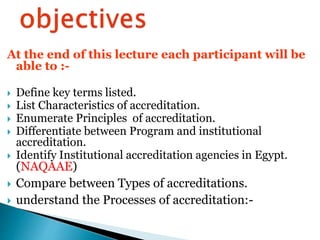
At the end of this lecture each participant will be
able to :-
 Define key terms listed.
 List Characteristics of accreditation.
 Enumerate Principles of accreditation.
 Differentiate between Program and institutional
accreditation.
 Identify Institutional accreditation agencies in Egypt.
(NAQAAE)
 Compare between Types of accreditations.
 understand the Processes of accreditation:-
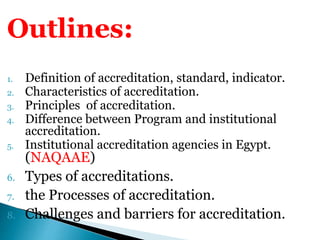
Outlines:
1. Definition of accreditation, standard, indicator.
2. Characteristics of accreditation.
3. Principles of accreditation.
4. Difference between Program and institutional
accreditation.
5. Institutional accreditation agencies in Egypt.
(NAQAAE)
6. Types of accreditations.
7. the Processes of accreditation.
8. Challenges and barriers for accreditation.
“The World is divided into three classes of
people.
 The first category comprises of a few people
who make things happen;
 the second type are the many who
watch things happen; and
 the third category are the overwhelming
majority who have no notion of what happens.”
- (N. M. Butler)
A process of quality
assurance that determines
whether an institution
meets established
standards for function,
structure, and performance.
 It is a self-regulatory process by
which governmental and non-
governmental organizations
grant formal recognition to
programs or institutions that
meet stated standards of quality
by fulfilling indicators established
by each institution.
Standards are a model or an
example to strive to achieve.
 Standards represent “what”
universities are required to
fulfill in order to be
accredited.
 An indicator is a statistic that
represents a measure of one
characteristic.
 Indicators are measurable
variables (or characteristics)
that can be used to determine
the degree of adherence to
standards or level of quality
achieved.
Indicators are used as
evidence of success in
accomplishing a goal and
/or institutional objectives.
Indicators should be
consistent with
internationally accepted
best practices.
the National Authority for Quality
Assurance and Accreditation of Education
(NAQAAE)
 The Egyptian National Quality
Assurance Agency(NAQAAE)
manages accreditation.
 NAQAAE grant formal recognition
to educational institutions
(universities) that meet NAQAAE
defined standards of educational
quality.
Educational institutions achieve
accreditation standards by
fulfilling indicators established
by each institution, however,
must be consistent with
internationally accepted best
practices adapted to the
Egyptian context.
According to NAQAAE establishment law, the authority is
responsible for evaluating more than 50,000 educational
institutions to be accredited within 5 years, such institutions
are categorized as follows:
A- Higher Education: A Total of 623 institutions (34
universities, 589 faculties and institutes) with a total of
approximately 4 million students.
B- Pre-University Education: A total of 49,640 educational
institution hosting 18,482,872 students. These institutes
include governmental schools, private schools and Al-Azhar
institutes.
C- Technical education: A total of 2063 technical schools
 1.Is to ensure that at least
minimum standards of quality
are met.( most accrediting
agencies state they aim to
achieve higher-than minimum
standards as determined by
peers in the field.
2. Is to provide recognition for
funding and student financial
aids.
3. Is to ensure consistency in
quality across academic
programs, thus facilitating
transfer of academic credit
from one institution to
another.
 4.To acknowledge the
comparability of one degree to
another in the same field
across institutions.
Accredited hospitals report significant
improvements in:
◦ Leadership
◦ Medical records management
◦ Infection control
◦ Reduction in medication errors
◦ Staff training and professional credentialing
◦ Clinical outcomes
Does it make a difference in
hospitals?
A.) its strong tradition of self-
regulation
B.) its reliance on evaluation
techniques
C.) its primary concern with quality
1- Based on accepted standards
Each organization seeking accreditation will
be surveyed and evaluated in terms of the
appropriateness and adequacy of its
philosophy and objectives and its terms of
the degree and competence and which it
achieves its goals.
2-Admits periodic review, criticism and
readjustment of its criteria, policies and
procedures to changes in education
3- provide opportunities for institutional
growth through self-survey and evaluation
and self-regulation.
1- Institutional accreditation
2- Specialized or programmatic
accreditation
“Program Accreditation,” refers to
the accreditation of academic courses
such as sciences, education,
commerce, law, engineering, nursing,
etc. PAASCU’s policy extends
accreditation by program.
 In contrast. “Institutional Accreditation,”
refers to the accreditation of the school,
college, universities or institution as a
whole. Under PAASCU policy, institutional
accreditation is not undertaken by itself;
only individual programs are accredited.
Only when all the programs of an
institution are accredited may that
particular institution be considered an
accredited institution under the PAASCU
policy.
 The Council for Higher
Education Accreditation CHEA
was formed in 1969.
 CHEA (2002) stated that the
accreditation process typically
involves FIVE major elements:
 1. Institutional self study:
 It is a self-analysis of
performance completed by the
school based on standard of
the accrediting association.
 2. Peer Review:
 Peer review occurs because of
the broad involvement of the
various stakeholders in the
educational environment such
as faculty, administrators, key
partners, and the public.
 3. Site Visits:
 Are typically conducted to verify
the results of the self-study and
to provide additional clarification
to the accrediting agency. This
action occurs after submission of
the self study report.
 4. Revision
 5. Monitoring and oversight
occurring through the idea of
annual reports by the school.
 Probationary Accreditation:
 It enables the nursing institution
or organization applying for
accreditation for the first time,
for a period no more than 3
years whilst completing
requirement for full accreditation
 Provisional Accreditation:
 It enable nursing institution or
organization which has been
accredited but which complies
with most but not all of the
required standards to operate for
a period not more than 1 year
whilst it addresses the areas of
concern.
 Full Accreditation:
 It indicates that the institution
complies with all the required
standards and may operate for a
period of five years before
applying for re-accreditation.
 Quality Consciousness at all levels will
take time
 Sustenance and consistency of efforts
will be required
 Commitment on a consistent basis
 High rates of attrition will require
repeated and continual training
 Public Sector will take a longer time to
get into the process
‫طليق‬ ‫بوجه‬ ‫اخاك‬ ‫تلقى‬ ‫أن‬ ‫ولو‬ ‫شيئا‬ ‫المعروف‬ ‫من‬ ‫تحقرن‬ ‫ال‬

Accreditation

  • 1.
    Accreditation Prepared by:- Ahmed MohammedZinhom Under supervision of: prof. Magda El Mola
  • 2.
    At the endof this lecture each participant will be able to :-  Define key terms listed.  List Characteristics of accreditation.  Enumerate Principles of accreditation.  Differentiate between Program and institutional accreditation.  Identify Institutional accreditation agencies in Egypt. (NAQAAE)  Compare between Types of accreditations.  understand the Processes of accreditation:-
  • 3.
    Outlines: 1. Definition ofaccreditation, standard, indicator. 2. Characteristics of accreditation. 3. Principles of accreditation. 4. Difference between Program and institutional accreditation. 5. Institutional accreditation agencies in Egypt. (NAQAAE) 6. Types of accreditations. 7. the Processes of accreditation. 8. Challenges and barriers for accreditation.
  • 4.
    “The World isdivided into three classes of people.  The first category comprises of a few people who make things happen;  the second type are the many who watch things happen; and  the third category are the overwhelming majority who have no notion of what happens.” - (N. M. Butler)
  • 5.
    A process ofquality assurance that determines whether an institution meets established standards for function, structure, and performance.
  • 6.
     It isa self-regulatory process by which governmental and non- governmental organizations grant formal recognition to programs or institutions that meet stated standards of quality by fulfilling indicators established by each institution.
  • 7.
    Standards are amodel or an example to strive to achieve.  Standards represent “what” universities are required to fulfill in order to be accredited.
  • 8.
     An indicatoris a statistic that represents a measure of one characteristic.  Indicators are measurable variables (or characteristics) that can be used to determine the degree of adherence to standards or level of quality achieved.
  • 9.
    Indicators are usedas evidence of success in accomplishing a goal and /or institutional objectives.
  • 10.
    Indicators should be consistentwith internationally accepted best practices.
  • 11.
    the National Authorityfor Quality Assurance and Accreditation of Education (NAQAAE)
  • 12.
     The EgyptianNational Quality Assurance Agency(NAQAAE) manages accreditation.  NAQAAE grant formal recognition to educational institutions (universities) that meet NAQAAE defined standards of educational quality.
  • 13.
    Educational institutions achieve accreditationstandards by fulfilling indicators established by each institution, however, must be consistent with internationally accepted best practices adapted to the Egyptian context.
  • 14.
    According to NAQAAEestablishment law, the authority is responsible for evaluating more than 50,000 educational institutions to be accredited within 5 years, such institutions are categorized as follows: A- Higher Education: A Total of 623 institutions (34 universities, 589 faculties and institutes) with a total of approximately 4 million students. B- Pre-University Education: A total of 49,640 educational institution hosting 18,482,872 students. These institutes include governmental schools, private schools and Al-Azhar institutes. C- Technical education: A total of 2063 technical schools
  • 15.
     1.Is toensure that at least minimum standards of quality are met.( most accrediting agencies state they aim to achieve higher-than minimum standards as determined by peers in the field.
  • 16.
    2. Is toprovide recognition for funding and student financial aids. 3. Is to ensure consistency in quality across academic programs, thus facilitating transfer of academic credit from one institution to another.
  • 17.
     4.To acknowledgethe comparability of one degree to another in the same field across institutions.
  • 18.
    Accredited hospitals reportsignificant improvements in: ◦ Leadership ◦ Medical records management ◦ Infection control ◦ Reduction in medication errors ◦ Staff training and professional credentialing ◦ Clinical outcomes Does it make a difference in hospitals?
  • 19.
    A.) its strongtradition of self- regulation B.) its reliance on evaluation techniques C.) its primary concern with quality
  • 20.
    1- Based onaccepted standards Each organization seeking accreditation will be surveyed and evaluated in terms of the appropriateness and adequacy of its philosophy and objectives and its terms of the degree and competence and which it achieves its goals.
  • 21.
    2-Admits periodic review,criticism and readjustment of its criteria, policies and procedures to changes in education 3- provide opportunities for institutional growth through self-survey and evaluation and self-regulation.
  • 22.
    1- Institutional accreditation 2-Specialized or programmatic accreditation
  • 23.
    “Program Accreditation,” refersto the accreditation of academic courses such as sciences, education, commerce, law, engineering, nursing, etc. PAASCU’s policy extends accreditation by program.
  • 24.
     In contrast.“Institutional Accreditation,” refers to the accreditation of the school, college, universities or institution as a whole. Under PAASCU policy, institutional accreditation is not undertaken by itself; only individual programs are accredited. Only when all the programs of an institution are accredited may that particular institution be considered an accredited institution under the PAASCU policy.
  • 25.
     The Councilfor Higher Education Accreditation CHEA was formed in 1969.  CHEA (2002) stated that the accreditation process typically involves FIVE major elements:
  • 26.
     1. Institutionalself study:  It is a self-analysis of performance completed by the school based on standard of the accrediting association.
  • 27.
     2. PeerReview:  Peer review occurs because of the broad involvement of the various stakeholders in the educational environment such as faculty, administrators, key partners, and the public.
  • 28.
     3. SiteVisits:  Are typically conducted to verify the results of the self-study and to provide additional clarification to the accrediting agency. This action occurs after submission of the self study report.
  • 29.
     4. Revision 5. Monitoring and oversight occurring through the idea of annual reports by the school.
  • 30.
     Probationary Accreditation: It enables the nursing institution or organization applying for accreditation for the first time, for a period no more than 3 years whilst completing requirement for full accreditation
  • 31.
     Provisional Accreditation: It enable nursing institution or organization which has been accredited but which complies with most but not all of the required standards to operate for a period not more than 1 year whilst it addresses the areas of concern.
  • 32.
     Full Accreditation: It indicates that the institution complies with all the required standards and may operate for a period of five years before applying for re-accreditation.
  • 34.
     Quality Consciousnessat all levels will take time  Sustenance and consistency of efforts will be required  Commitment on a consistent basis  High rates of attrition will require repeated and continual training  Public Sector will take a longer time to get into the process
  • 38.
    ‫طليق‬ ‫بوجه‬ ‫اخاك‬‫تلقى‬ ‫أن‬ ‫ولو‬ ‫شيئا‬ ‫المعروف‬ ‫من‬ ‫تحقرن‬ ‫ال‬