BUDGETING IN NURSING
PRACTICE
BY:
Pratibha Srivastava
Associate Professor
Rama University
INTRODUCTION
Budget, as a control device is an extension of
planning. After the planning and programming
decision, the approved programme is translated into a
totaled statement of monetary requirements and
financial consequence.
Budgeting, though primarily recognized as a device for
controlling, becomes a major part of the planning
process in any organization budgeting is done for
indicating the expected results of the business and
the possible future lines of action to be followed for
the attainment of such results
MEANING OF BUDGET
The word “budget” derived from the old
English word “budget tee” means a sack or
pouch which the Chancellor of the Exchequer
use to take out his papers for lying before the
parliament, the government, financial scheme
for the ensuring year.
DEFINITION
“Budget is a concrete precise picture of the
total operation of an enterprise in monetary
terms” (HM Donovan)
“Budget is a operation plan, for a definite
period usually a year- Expressed in financial
terms and bused an expected income and
expenditure”
PURPOSES
1. Budget supplies the mechanism for translating
fiscal objectives into projected monthly spending
pattern.
2. Fiscal planning and decision marking.
3. Controllable and uncontrollable cost areas.
4.Useful format for communicating fiscal objectives.
5. Feedback of utilization of budget.
6. Identify problem areas and facilities for effective
solution.
7.For measuring and recording financial success
with the objectives of the institution.
FEATURES OF BUDGET
• It should be flexible
• It should synthesis at past, present and future.
• It should be product joint venture, co-
operation of executives.
• It should be in the form of statistical standard
• It should have a support at top management
throughout the period of its planning and
implementation.
TYPES OF BUDGET
1.Coverage of functions master and functional
budgets.
2.Nature of activities covered – capital and
revenue budgets
3.Period of budgets – long term and short-term
budgets
4.Flexibility adopted – fixed and flexible
budgets.
Master and Functional budgets
A master budget is prepared for the entire
organization incorporating the budget of
different functions.
A functional budget is prepared
incorporating a major function and its sub-
functions. Since an organization may have a
number of functions, numerous functional
budgets are prepared.
Capital and Revenue budgets
Organization activities involve two
processes- creating facilities for carrying out
activities and actual performance activities.
Revenue budget involves the formulation
of target for a year or so in respect of various
organizational activities such as production,
marketing, finance, etc.
Long term and short-term budgets
Many organizations integrate their yearly
budgets with long-term projections of
business activities and along with yearly
budgets; they prepare budgets for a longer
period of 2 – 3 years.
The short term budget is for a year and is
divided into a number of periods for effective
implementation.
Fixed and flexible budgets
Generally, organizations prepare which
pertain to only certain projected fixed volume of
operations for a year. Such budgets are known as
fixed of static budgets.
A budget which is designed to change in
accordance with the activities of the organization
is known as flexible budget.
APPROACHES TO DEVELOP AN ORGANIZATION WIDE
BUDGET
Organizations adopt different approaches for
preparing their budgets. One of the most
common approaches is in the form of traditional
budget in which the current year’s budget is
taken as a base with the provisions of some
additions and deductions in the next year’s
budget. These have resulted into three types of
budgeting.
• Performance budgeting
• Zero base budgeting
• Strategic budgeting
1. Performance budgeting’s
performance budget is an input / output
budget or costs and results budget.
Performance budget emphasis on non-
financial measures of performance, which
can be related to financial measures in
explaining changes and deviations from
planned performance. Performance
measurements are useful for evaluating past
performance and for planning future
activities.
Performance budgeting, results into the
following.
• It correlates the financial and physical aspects
• It improves budget formulation, review and
decision making
• It facilitates better appreciation and review of
organizational activities by the top
management.
• more effective performance audit.
2. Zero base budgeting
This was applied for the first time in
preparing the divisional budgets of Texas
instruments of the USA in 1971.
The process of zero bases involves four
basic steps:
• Identification of decision units
• Analysis of each decision units
• Evaluation and ranking of all decision units
• Allocation of resources to each unit based
Benefits of zero base budgeting
• effective allocation of resources
• improvement in productively and cost
effectiveness
• effective means to control costs
• elimination of unnecessary activities
• Better focus on organizational objectives.
• Saving time of top management.
3.Strategic budgeting
It is used as a tool of resource allocation to
various strategic business units and other
units of an organization. Under strategic
budgeting, in determining the resource needs
of various units.
IMPORTANCE OF BUDGET
1.Budget is needed for planning for future course
of action and to have a control over all activities
in the organization.
2.Budget facilitates coordinating of various
departmental and selection for realizing
organizational objectives
3.Budget serves as a guide for action in the
organization.
PRICIPLES OF BUDGET
1.Budget should provide sound financial
management by focusing on requirement of the
organization.
2.Budget should focus objects and policies of the
organization.
3.Budget should ensure the most effective use of
scarce and financial and non- financial resources
4.Budgeting should include coordinating efforts of
various departments establishing a frame of
reference for managerial decisions
5.Budget period must be appropriate to the nature
of business or service and to the type of budget
6.Budget the prepared under direction and
supervision of the administrator or financial
officer
7.Budget are to be prepared and interpreted
consistently throughout the organization in the
communication of the planning process
8.Budget necessitates a review of the performance
of the previous year and an evaluation of its
adequacy both in quantity and quality
PLANNING THE BUDGET
Planning yields forecasts for one year and
several years. The budget is an annual plan,
intended to guide effective use of human and
material resources, products or service.
Budgetary planning ensures that the best
methods are used to achieve financial
objectives. In nursing, budgetary planning
helps to ensure that clients or patients receive
the nursing services they want and need from
satisfied nursing workers.
STEPS IN THE BUDGETARY PROCESS
1.Assessment
The first step is to assess what needs to be
covered in the budget. Historically, top-level
managers developed the budget for institution
without input from middle or first level
managers. Unit managers develop goals,
objectives and budgetary estimates with input
from colleagues and subordinates.
2. Develop a plan
The second step is to develop a plan. The
budget plan may be developed in many ways.
A budgeting cycle that is set for 12 months is
called a fiscal year budget. This fiscal year
which may or may not coincide with calendar
year, is then usually broken down into
quarters or subdivided into monthly, quarterly
or semiannual periods. Most budgets are
developed for a one-year period, but a
perpetual budget may be done on a continual
basis each month.
3. Implementation
The third step is implementation. In this
step, ongoing monitoring and analysis occur to
avoid inadequate or excess funds at the end of
fiscal year. In most health institutions,
monthly-computerized statements outline
each department’s projected budget and any
deviations from the budget. Each unit
manager is accountable for budget deviations
in their unit.
4. Evaluation:
This is last step. The budget must be reviewed
periodically and modified as needed
throughout the fiscal year. With each,
successive year of budgeting, managers can
more accurately predict their unit is budgetary
requirements.
BUDGET STAGES:
The nursing budget follows three stages of
development.
• Formulation
• Review and enactment
• Execution
Formulation stage
It is usually a set of number of month before
the beginning of the fiscal year for the budget.
One of the first steps in writing a budget is
gathering data for accurate prediction of
expenses and revenues (income). Other data
include programmes from other departments
that will require use or expansion of nursing
resources, expansion of nursing clinics and client
teaching programmes, incentive awards, library
requirements, clinical and office supplies and
equipments etc.
Review and enactment stage
Review and enactment stage are budget
development process that pull all the pieces
together for approved of a final budget. Once
the cost center managers present their
budgets to the budget council, the chief nurse
executive will consolidate the nursing budget.
The chief executive officer of the organization
and the governing broad will then give their
approval.
Execution stage
Execution of the budget involves directing,
executing, and evaluating activities. The nurse
administrator and managers who planned the
budget execute it. Revisions in execution of
the budgets are scheduled at stated intervals,
frequently once or twice during fiscal year.
THE BUDGET CALENDAR
Formulation stage:
1. Develop objectives and management plans
2. Gather all financial, historical and statistical
data
3. Analyze data
Review and enactment stage:
4. Prepare unit budgets
5. Present unit budgets for approval
6.Revise and combine into organization budget.
7. Present to budget council
8. Revise and present to governing board
9. Revise and distribute to cost center managers
Execution stage
10.Direct and evaluate expenses and receipts
11.Review budgets if indicated
BUDGETING FOR THE HOSPITAL
The hospitals are health care organizations
need to make a number of decisions related to
finance. They are required to invest for capital-
intensive machines, equipments and apparatus.
The management of finance in hospital is found a
bit difference to other profit making
organizations.
Budgeting is an opportunity to consider
better performance by the hospital. All
departments and sections must co-operate in the
preparation of budget.
TYPES
1.Operating budget
2.Capital budget
Operating revenue budget
The revenue comes from activities of hospital:
• Patient services
• Activities incidental to patient services
• Income from investments
• Other income donation, grant etc.
The income from patient services represents
the largest part of revenue for voluntary and
private hospitals. It consists of two parts.
1. Daily service changes (room, nursing care,
diet etc.) This varies with daily census, mix of
accommodation and type of service.
2. Special services (operative procedures,
investigations, etc).
Operating expenditure forecast
Recurrent (operating) costs are required for
the operation or maintenance of facilities and
services. The more important costs are for
salaries and wages, supplies like drugs,
dressings, fuel, etc, utilities including
electricity, water, telephone, etc and
equipment maintenance and purchase of
spare parts.
Salaries and wages
The trend could be analyzed, over staffing
could be avoided. The salaries have to be fixed
for all the personnel. In fixing the salary,
consideration must be given to the
requirements of qualification, experience and
skills, nature of work, fatigue, and prevailing
salaries in similar, nearby hospitals etc.
In addition to salaries, provision has to be
made provident fund contributions, gratuity
and other benefits.
Supplies
Supplies indices could be developed for
various services, working out per OPD visit,
I.P.days, normal and abnormal delivery,
various types of operation, laboratory test,
meals, house keeping, radiograph etc
Utilities
There is need to know expenditure on utilities
of high consuming areas like x-ray, central AC,
CSSD, laundry, kitchen and others.
Capital budget
Funds should be available for expenditure on
expiate items. These are required for
1. Growth with new facilities being provides.
2. Replacement of worn out equipment,
furniture and machinery
Case budget
cash must be available to meet the obligations and
when they arise. There is need to maintain the
right flow of cash. Cash receipts and disbursements
must be estimated: amounts and time.
FACTORS AFFECTING HOSPITAL EXPENDITURES
• Size of hospital
• Volume of activity
• Competition
• Service intensity
• Degree of investment
• Efficiency
• Design of hospital
Reports and statements for effective management
• Daily reports
• Daily cash collection and cash disbursement.
• Daily census report
• Daily bank / cash position
• Monthly reports
• Monthly financial report
• Free and confessionals care
• Quarterly reports
• Budget performance
Half-yearly reports
• Revenue / expense summary with
comparative analysis
• Balance sheet
– Current ratio
– Working capital
– Inventory turnover
– Collection period
– Payables outstanding
Yearly reports
• Comparative balance sheet
• Analysis of departmental income and
expenses and balance sheet
• Cost analysis – broken down by departments
• How much does it cost to a patient, general,
semi private or service wise.
• Salary and wages content.
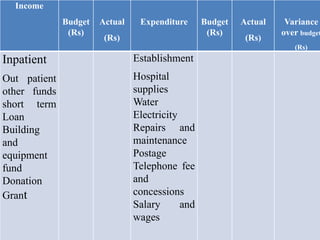
Preparation of income and Expenditure
Separate the OPD income and expenditure
from inpatient income and expenditure.
Depending on the size of the hospital.
Income
Routine services
• Room, medical care, nursing care, food, etc.
• OPD services like registration, dressing,
injection, operation and other procedures
• Casualty services
• Nursing / neonatal care services
Special professional services
• Operating theatre
• Delivery room
• Intensive care unit
• Medical and surgical wards
• Clinical pathology
• Radiology
• Pharmacy
• Physiotherapy
Other income
• Fees for training programmes – school of
nursing, laboratory training, radiographers
training and others
• Recoveries from staff for accommodation,
food, electricity, water, etc.
• Income from ambulance, canteen, parking lot,
etc.
Non-operating income
• Donation
• Grants
• Bank interest
• Property income
• Invest returns
• Sales of assets
Expenditure
• Operating expenditure
• Salaries and wages including employee
benefits like provident fund and gratuity.
• Supplies and expenses
• Utilities
• Maintenance
• Administrative expenses
Other expenses
• Training programmes – school of nursing,
laboratory training.
• Community health and community
development.
• Non-operating expenses
• Depreciation
• Fund raising – internal and external
• Property management.
Income
Budget
(Rs)
Actual
(Rs)
Expenditure Budget
(Rs)
Actual
(Rs)
Variance
over budget
(Rs)
Inpatient
Out patient
other funds
short term
Loan
Building
and
equipment
fund
Donation
Grant
Establishment
Hospital
supplies
Water
Electricity
Repairs and
maintenance
Postage
Telephone fee
and
concessions
Salary and
wages
THANK U

Budgeting in nursing

  • 1.
    BUDGETING IN NURSING PRACTICE BY: PratibhaSrivastava Associate Professor Rama University
  • 2.
    INTRODUCTION Budget, as acontrol device is an extension of planning. After the planning and programming decision, the approved programme is translated into a totaled statement of monetary requirements and financial consequence. Budgeting, though primarily recognized as a device for controlling, becomes a major part of the planning process in any organization budgeting is done for indicating the expected results of the business and the possible future lines of action to be followed for the attainment of such results
  • 3.
    MEANING OF BUDGET Theword “budget” derived from the old English word “budget tee” means a sack or pouch which the Chancellor of the Exchequer use to take out his papers for lying before the parliament, the government, financial scheme for the ensuring year.
  • 4.
    DEFINITION “Budget is aconcrete precise picture of the total operation of an enterprise in monetary terms” (HM Donovan) “Budget is a operation plan, for a definite period usually a year- Expressed in financial terms and bused an expected income and expenditure”
  • 5.
    PURPOSES 1. Budget suppliesthe mechanism for translating fiscal objectives into projected monthly spending pattern. 2. Fiscal planning and decision marking. 3. Controllable and uncontrollable cost areas. 4.Useful format for communicating fiscal objectives. 5. Feedback of utilization of budget. 6. Identify problem areas and facilities for effective solution. 7.For measuring and recording financial success with the objectives of the institution.
  • 6.
    FEATURES OF BUDGET •It should be flexible • It should synthesis at past, present and future. • It should be product joint venture, co- operation of executives. • It should be in the form of statistical standard • It should have a support at top management throughout the period of its planning and implementation.
  • 7.
    TYPES OF BUDGET 1.Coverageof functions master and functional budgets. 2.Nature of activities covered – capital and revenue budgets 3.Period of budgets – long term and short-term budgets 4.Flexibility adopted – fixed and flexible budgets.
  • 8.
    Master and Functionalbudgets A master budget is prepared for the entire organization incorporating the budget of different functions. A functional budget is prepared incorporating a major function and its sub- functions. Since an organization may have a number of functions, numerous functional budgets are prepared.
  • 9.
    Capital and Revenuebudgets Organization activities involve two processes- creating facilities for carrying out activities and actual performance activities. Revenue budget involves the formulation of target for a year or so in respect of various organizational activities such as production, marketing, finance, etc.
  • 10.
    Long term andshort-term budgets Many organizations integrate their yearly budgets with long-term projections of business activities and along with yearly budgets; they prepare budgets for a longer period of 2 – 3 years. The short term budget is for a year and is divided into a number of periods for effective implementation.
  • 11.
    Fixed and flexiblebudgets Generally, organizations prepare which pertain to only certain projected fixed volume of operations for a year. Such budgets are known as fixed of static budgets. A budget which is designed to change in accordance with the activities of the organization is known as flexible budget.
  • 12.
    APPROACHES TO DEVELOPAN ORGANIZATION WIDE BUDGET Organizations adopt different approaches for preparing their budgets. One of the most common approaches is in the form of traditional budget in which the current year’s budget is taken as a base with the provisions of some additions and deductions in the next year’s budget. These have resulted into three types of budgeting. • Performance budgeting • Zero base budgeting • Strategic budgeting
  • 13.
    1. Performance budgeting’s performancebudget is an input / output budget or costs and results budget. Performance budget emphasis on non- financial measures of performance, which can be related to financial measures in explaining changes and deviations from planned performance. Performance measurements are useful for evaluating past performance and for planning future activities.
  • 14.
    Performance budgeting, resultsinto the following. • It correlates the financial and physical aspects • It improves budget formulation, review and decision making • It facilitates better appreciation and review of organizational activities by the top management. • more effective performance audit.
  • 15.
    2. Zero basebudgeting This was applied for the first time in preparing the divisional budgets of Texas instruments of the USA in 1971. The process of zero bases involves four basic steps: • Identification of decision units • Analysis of each decision units • Evaluation and ranking of all decision units • Allocation of resources to each unit based
  • 16.
    Benefits of zerobase budgeting • effective allocation of resources • improvement in productively and cost effectiveness • effective means to control costs • elimination of unnecessary activities • Better focus on organizational objectives. • Saving time of top management.
  • 17.
    3.Strategic budgeting It isused as a tool of resource allocation to various strategic business units and other units of an organization. Under strategic budgeting, in determining the resource needs of various units.
  • 18.
    IMPORTANCE OF BUDGET 1.Budgetis needed for planning for future course of action and to have a control over all activities in the organization. 2.Budget facilitates coordinating of various departmental and selection for realizing organizational objectives 3.Budget serves as a guide for action in the organization.
  • 19.
    PRICIPLES OF BUDGET 1.Budgetshould provide sound financial management by focusing on requirement of the organization. 2.Budget should focus objects and policies of the organization. 3.Budget should ensure the most effective use of scarce and financial and non- financial resources 4.Budgeting should include coordinating efforts of various departments establishing a frame of reference for managerial decisions
  • 20.
    5.Budget period mustbe appropriate to the nature of business or service and to the type of budget 6.Budget the prepared under direction and supervision of the administrator or financial officer 7.Budget are to be prepared and interpreted consistently throughout the organization in the communication of the planning process 8.Budget necessitates a review of the performance of the previous year and an evaluation of its adequacy both in quantity and quality
  • 21.
    PLANNING THE BUDGET Planningyields forecasts for one year and several years. The budget is an annual plan, intended to guide effective use of human and material resources, products or service. Budgetary planning ensures that the best methods are used to achieve financial objectives. In nursing, budgetary planning helps to ensure that clients or patients receive the nursing services they want and need from satisfied nursing workers.
  • 22.
    STEPS IN THEBUDGETARY PROCESS 1.Assessment The first step is to assess what needs to be covered in the budget. Historically, top-level managers developed the budget for institution without input from middle or first level managers. Unit managers develop goals, objectives and budgetary estimates with input from colleagues and subordinates.
  • 23.
    2. Develop aplan The second step is to develop a plan. The budget plan may be developed in many ways. A budgeting cycle that is set for 12 months is called a fiscal year budget. This fiscal year which may or may not coincide with calendar year, is then usually broken down into quarters or subdivided into monthly, quarterly or semiannual periods. Most budgets are developed for a one-year period, but a perpetual budget may be done on a continual basis each month.
  • 24.
    3. Implementation The thirdstep is implementation. In this step, ongoing monitoring and analysis occur to avoid inadequate or excess funds at the end of fiscal year. In most health institutions, monthly-computerized statements outline each department’s projected budget and any deviations from the budget. Each unit manager is accountable for budget deviations in their unit.
  • 25.
    4. Evaluation: This islast step. The budget must be reviewed periodically and modified as needed throughout the fiscal year. With each, successive year of budgeting, managers can more accurately predict their unit is budgetary requirements.
  • 26.
    BUDGET STAGES: The nursingbudget follows three stages of development. • Formulation • Review and enactment • Execution
  • 27.
    Formulation stage It isusually a set of number of month before the beginning of the fiscal year for the budget. One of the first steps in writing a budget is gathering data for accurate prediction of expenses and revenues (income). Other data include programmes from other departments that will require use or expansion of nursing resources, expansion of nursing clinics and client teaching programmes, incentive awards, library requirements, clinical and office supplies and equipments etc.
  • 28.
    Review and enactmentstage Review and enactment stage are budget development process that pull all the pieces together for approved of a final budget. Once the cost center managers present their budgets to the budget council, the chief nurse executive will consolidate the nursing budget. The chief executive officer of the organization and the governing broad will then give their approval.
  • 29.
    Execution stage Execution ofthe budget involves directing, executing, and evaluating activities. The nurse administrator and managers who planned the budget execute it. Revisions in execution of the budgets are scheduled at stated intervals, frequently once or twice during fiscal year.
  • 30.
    THE BUDGET CALENDAR Formulationstage: 1. Develop objectives and management plans 2. Gather all financial, historical and statistical data 3. Analyze data Review and enactment stage: 4. Prepare unit budgets 5. Present unit budgets for approval 6.Revise and combine into organization budget.
  • 31.
    7. Present tobudget council 8. Revise and present to governing board 9. Revise and distribute to cost center managers Execution stage 10.Direct and evaluate expenses and receipts 11.Review budgets if indicated
  • 32.
    BUDGETING FOR THEHOSPITAL The hospitals are health care organizations need to make a number of decisions related to finance. They are required to invest for capital- intensive machines, equipments and apparatus. The management of finance in hospital is found a bit difference to other profit making organizations. Budgeting is an opportunity to consider better performance by the hospital. All departments and sections must co-operate in the preparation of budget.
  • 33.
    TYPES 1.Operating budget 2.Capital budget Operatingrevenue budget The revenue comes from activities of hospital: • Patient services • Activities incidental to patient services • Income from investments • Other income donation, grant etc.
  • 34.
    The income frompatient services represents the largest part of revenue for voluntary and private hospitals. It consists of two parts. 1. Daily service changes (room, nursing care, diet etc.) This varies with daily census, mix of accommodation and type of service. 2. Special services (operative procedures, investigations, etc).
  • 35.
    Operating expenditure forecast Recurrent(operating) costs are required for the operation or maintenance of facilities and services. The more important costs are for salaries and wages, supplies like drugs, dressings, fuel, etc, utilities including electricity, water, telephone, etc and equipment maintenance and purchase of spare parts.
  • 36.
    Salaries and wages Thetrend could be analyzed, over staffing could be avoided. The salaries have to be fixed for all the personnel. In fixing the salary, consideration must be given to the requirements of qualification, experience and skills, nature of work, fatigue, and prevailing salaries in similar, nearby hospitals etc. In addition to salaries, provision has to be made provident fund contributions, gratuity and other benefits.
  • 37.
    Supplies Supplies indices couldbe developed for various services, working out per OPD visit, I.P.days, normal and abnormal delivery, various types of operation, laboratory test, meals, house keeping, radiograph etc Utilities There is need to know expenditure on utilities of high consuming areas like x-ray, central AC, CSSD, laundry, kitchen and others.
  • 38.
    Capital budget Funds shouldbe available for expenditure on expiate items. These are required for 1. Growth with new facilities being provides. 2. Replacement of worn out equipment, furniture and machinery Case budget cash must be available to meet the obligations and when they arise. There is need to maintain the right flow of cash. Cash receipts and disbursements must be estimated: amounts and time.
  • 39.
    FACTORS AFFECTING HOSPITALEXPENDITURES • Size of hospital • Volume of activity • Competition • Service intensity • Degree of investment • Efficiency • Design of hospital
  • 40.
    Reports and statementsfor effective management • Daily reports • Daily cash collection and cash disbursement. • Daily census report • Daily bank / cash position • Monthly reports • Monthly financial report • Free and confessionals care • Quarterly reports • Budget performance
  • 41.
    Half-yearly reports • Revenue/ expense summary with comparative analysis • Balance sheet – Current ratio – Working capital – Inventory turnover – Collection period – Payables outstanding
  • 42.
    Yearly reports • Comparativebalance sheet • Analysis of departmental income and expenses and balance sheet • Cost analysis – broken down by departments • How much does it cost to a patient, general, semi private or service wise. • Salary and wages content.
  • 43.
    Preparation of incomeand Expenditure Separate the OPD income and expenditure from inpatient income and expenditure. Depending on the size of the hospital. Income Routine services • Room, medical care, nursing care, food, etc. • OPD services like registration, dressing, injection, operation and other procedures • Casualty services • Nursing / neonatal care services
  • 44.
    Special professional services •Operating theatre • Delivery room • Intensive care unit • Medical and surgical wards • Clinical pathology • Radiology • Pharmacy • Physiotherapy
  • 45.
    Other income • Feesfor training programmes – school of nursing, laboratory training, radiographers training and others • Recoveries from staff for accommodation, food, electricity, water, etc. • Income from ambulance, canteen, parking lot, etc.
  • 46.
    Non-operating income • Donation •Grants • Bank interest • Property income • Invest returns • Sales of assets
  • 47.
    Expenditure • Operating expenditure •Salaries and wages including employee benefits like provident fund and gratuity. • Supplies and expenses • Utilities • Maintenance • Administrative expenses
  • 48.
    Other expenses • Trainingprogrammes – school of nursing, laboratory training. • Community health and community development. • Non-operating expenses • Depreciation • Fund raising – internal and external • Property management.
  • 49.
    Income Budget (Rs) Actual (Rs) Expenditure Budget (Rs) Actual (Rs) Variance over budget (Rs) Inpatient Outpatient other funds short term Loan Building and equipment fund Donation Grant Establishment Hospital supplies Water Electricity Repairs and maintenance Postage Telephone fee and concessions Salary and wages
  • 50.