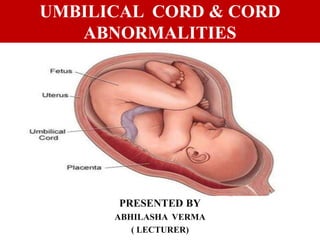

UMBILICAL CORD & CORD
ABNORMALITIES
PRESENTED BY
ABHILASHA VERMA
( LECTURER)
STRUCTURE OF UMBILICAL CORD
‱ It is the connecting link between placenta and fetus through which
fetal blood flows to and from placenta.
‱ It extends from fetal umbilicus to fetal surface of placenta.
‱ Development: Developed from connecting stalk and body stalk.
‱ Length: 50 – 60 cm
‱ Diameter: 2 cm. (1.5 cm)
‱ Shape: Tortous, showing false notes.
‱ Attachments: It is attached to fetal surface of placenta near its
center, the other attachment is to ventral aspect of fetal abdominal
wall.
‱ Contents: 2 umbilical arteries, one umbilical vein embedded in
wharton’s jelly and surrounded by amniotic membrane.
‱ Amnion covers the umbilical cord except near the fetal
insertion, where an epithelial covering is substituted.
‱ The arteries wind around the umbilical vein in a spiral fashion
and, because the vessels are longer the cord itself, there are a
number of foldings or tortuorties producing protusions or
false knots on the cord surface.
‱ The Wharton jelly protects the vessels from undue torsion
and compression.
‱ Functions:
– It contains umbilical vessels that connect the fetus to the
placenta.
– Allows free movement to fetus
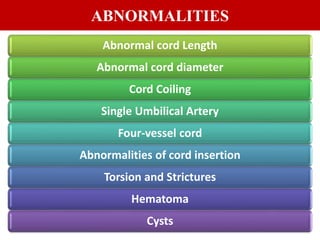
ABNORMALITIES
Abnormal cord Length
Abnormal cord diameter
Cord Coiling
Single Umbilical Artery
Four-vessel cord
Abnormalities of cord insertion
Torsion and Strictures
Hematoma
Cysts
Abnormal Cord Length
‱ Normal cord length is 50-60cm, averagely 55cm
‱ Short cord: < 35cm is defined as short cord,
(It may lead to fetal distress, placental abruptio,
prolonged labour).
‱ Long cord: > 80cm is defined as long cord, higher
occurrence of cord around neck, cord around body.
(It may leads to true cord knot, cord prolapse and
cord compression)
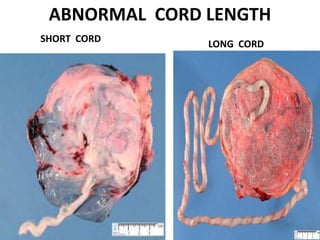
ABNORMAL CORD LENGTH
SHORT CORD
LONG CORD
Umbilical Cord Diameter
‱ Lean cords are associated with IUGR
‱ Large diameter cords are associated with
macrosomia
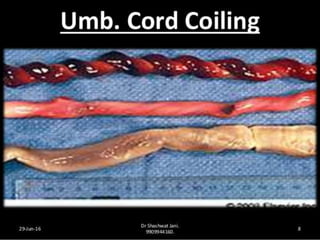
Umb. Cord Coiling
 Cord vessels spiral through the cord
 UCI ( Umbilical Coiling Index ) - is the no. of complete
coils divided by the cord length in cm They grouped
the UCI as follows:
‱ < 10th percentile — Hypocoiled;
‱ 10th – 90th percentile — Normocoiled;
‱ > 90th percentile — Hypercoiled.
 Hyper coiling is linked with fetal demise, IUGR &
intrapartum hypoxia.
Abnormalities of U. Cord Insertion
‱ Usually the cord is inserted at or near the
center of the fetal surface of placenta.
‱ Various cord insertion variations are:
Marginal Insertion ( Battledore Placenta )
Furcate insertion
Velamentous insertion
Vasa praevia
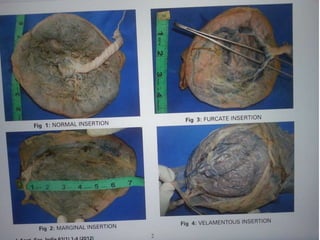
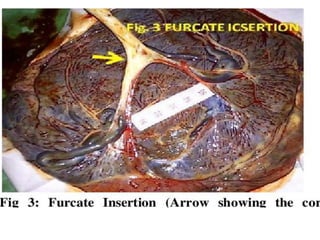
 Furcate insertion-
‱ Umbilical vessels separate from the cord substance before
their insertion into the placenta
‱ Rare
 Margnial Inserion-
‱ Found in Battledore placenta : cord insertion at the
placental margin 7% at term.
‱ Cord being pulled off during delivery of the placenta.
 Velamentous Insertion –
‱ Umbilical vessels separate in the membranes at a distance
from the placental margin
ABNORMAL CORD INSERTION
BATTLEDORE INSERTION VELAMENTOUS INSERTION
Abnormalities Of Vessels Number
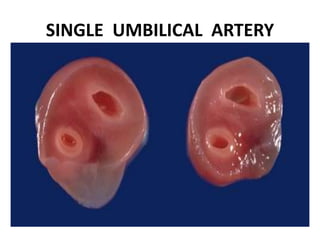
 Single umbilical artery : Results due to atrophy
of the previously existing umbilical artery.
‱ 30% of all infants with only one umbilical artery
have congenital anomalies .
‱ Aneuploidies
‱ Tracheo-oesophagial fistula
‱ Renal agenesis
‱ Imperforate anus
‱ Vertebral defects
‱ 34% are growth restricted
‱ 17% deliver preterm
SINGLE UMBILICAL ARTERY
Knots
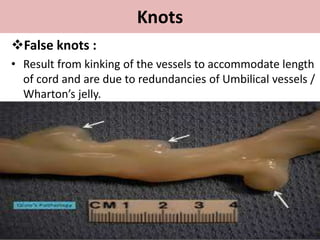
False knots :
‱ Result from kinking of the vessels to accommodate length
of cord and are due to redundancies of Umbilical vessels /
Wharton’s jelly.
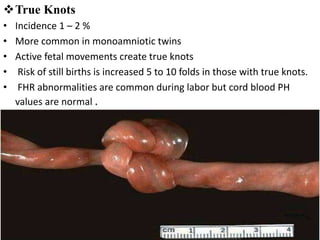
True Knots
‱ Incidence 1 – 2 %
‱ More common in monoamniotic twins
‱ Active fetal movements create true knots
‱ Risk of still births is increased 5 to 10 folds in those with true knots.
‱ FHR abnormalities are common during labor but cord blood PH
values are normal .
Umb. Cord Loops
The cord is frequently coiled around the fetus
 More likely with longer cords
Loops around fetal neck are termed a nuchal
cord.
Contractions may compress the nuchal cord and
cause FHR decelerations and low umbilical artery
Incidence :
‱ 1 loop of Nuchal cord 20-34%
‱ 2 loops of nuchal cord 2.5-5%
‱ 3 loops of nuchal cord 0.2-0.5%
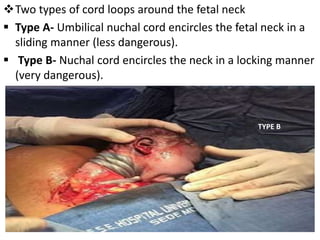
Two types of cord loops around the fetal neck
 Type A- Umbilical nuchal cord encircles the fetal neck in a
sliding manner (less dangerous).
 Type B- Nuchal cord encircles the neck in a locking manner
(very dangerous).
TYPE B
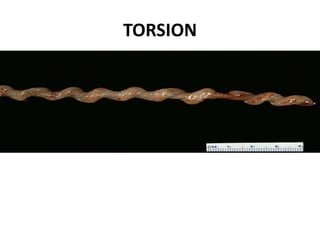
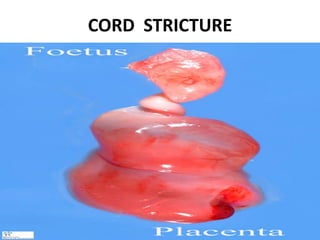
Torsion & Stricture
 Torsion :
 Rare
 Result from fetal movements during which the cord normally
becomes twisted
 fetal circulation is compromised.
 Stricture :
 More serious
 Most infants with this finding are stillborn
 Associated with an extreme focal deficiency in Wharton jelly.
 In mono amnionic twins, a significant fraction of the high
perinatal mortality rate is attributed to entwining of the
umbilical cords before labor.
TORSION
CORD STRICTURE
Hematoma
‱ Accumulations of blood are associated with short cords, trauma
and entanglement.
 True cysts: Remnants of the allantois.
 False Cysts: Due to degeneration of wharton’s jelly.
‱ Single cyst may resolve completely
‱ Multiple cysts may be associated with miscarriage /aneuploidy.
Umb. Cord Cysts
THANK YOU

Umbilical cord and cord abnormalities

  • 1.
    UMBILICAL CORD &CORD ABNORMALITIES PRESENTED BY ABHILASHA VERMA ( LECTURER)
  • 2.
    STRUCTURE OF UMBILICALCORD ‱ It is the connecting link between placenta and fetus through which fetal blood flows to and from placenta. ‱ It extends from fetal umbilicus to fetal surface of placenta. ‱ Development: Developed from connecting stalk and body stalk. ‱ Length: 50 – 60 cm ‱ Diameter: 2 cm. (1.5 cm) ‱ Shape: Tortous, showing false notes. ‱ Attachments: It is attached to fetal surface of placenta near its center, the other attachment is to ventral aspect of fetal abdominal wall. ‱ Contents: 2 umbilical arteries, one umbilical vein embedded in wharton’s jelly and surrounded by amniotic membrane.
  • 3.
    ‱ Amnion coversthe umbilical cord except near the fetal insertion, where an epithelial covering is substituted. ‱ The arteries wind around the umbilical vein in a spiral fashion and, because the vessels are longer the cord itself, there are a number of foldings or tortuorties producing protusions or false knots on the cord surface. ‱ The Wharton jelly protects the vessels from undue torsion and compression. ‱ Functions: – It contains umbilical vessels that connect the fetus to the placenta. – Allows free movement to fetus
  • 4.
    ABNORMALITIES Abnormal cord Length Abnormalcord diameter Cord Coiling Single Umbilical Artery Four-vessel cord Abnormalities of cord insertion Torsion and Strictures Hematoma Cysts
  • 5.
    Abnormal Cord Length ‱Normal cord length is 50-60cm, averagely 55cm ‱ Short cord: < 35cm is defined as short cord, (It may lead to fetal distress, placental abruptio, prolonged labour). ‱ Long cord: > 80cm is defined as long cord, higher occurrence of cord around neck, cord around body. (It may leads to true cord knot, cord prolapse and cord compression)
  • 6.
  • 7.
    Umbilical Cord Diameter ‱Lean cords are associated with IUGR ‱ Large diameter cords are associated with macrosomia
  • 8.
    Umb. Cord Coiling Cord vessels spiral through the cord  UCI ( Umbilical Coiling Index ) - is the no. of complete coils divided by the cord length in cm They grouped the UCI as follows: ‱ < 10th percentile — Hypocoiled; ‱ 10th – 90th percentile — Normocoiled; ‱ > 90th percentile — Hypercoiled.  Hyper coiling is linked with fetal demise, IUGR & intrapartum hypoxia.
  • 11.
    Abnormalities of U.Cord Insertion ‱ Usually the cord is inserted at or near the center of the fetal surface of placenta. ‱ Various cord insertion variations are: Marginal Insertion ( Battledore Placenta ) Furcate insertion Velamentous insertion Vasa praevia
  • 12.
     Furcate insertion- ‱Umbilical vessels separate from the cord substance before their insertion into the placenta ‱ Rare  Margnial Inserion- ‱ Found in Battledore placenta : cord insertion at the placental margin 7% at term. ‱ Cord being pulled off during delivery of the placenta.  Velamentous Insertion – ‱ Umbilical vessels separate in the membranes at a distance from the placental margin ABNORMAL CORD INSERTION
  • 15.
    ABNORMAL CORD INSERTION BATTLEDOREINSERTION VELAMENTOUS INSERTION
  • 16.
    Abnormalities Of VesselsNumber  Single umbilical artery : Results due to atrophy of the previously existing umbilical artery. ‱ 30% of all infants with only one umbilical artery have congenital anomalies . ‱ Aneuploidies ‱ Tracheo-oesophagial fistula ‱ Renal agenesis ‱ Imperforate anus ‱ Vertebral defects ‱ 34% are growth restricted ‱ 17% deliver preterm
  • 17.
  • 18.
    Knots False knots : ‱Result from kinking of the vessels to accommodate length of cord and are due to redundancies of Umbilical vessels / Wharton’s jelly.
  • 19.
    True Knots ‱ Incidence1 – 2 % ‱ More common in monoamniotic twins ‱ Active fetal movements create true knots ‱ Risk of still births is increased 5 to 10 folds in those with true knots. ‱ FHR abnormalities are common during labor but cord blood PH values are normal .
  • 20.
    Umb. Cord Loops Thecord is frequently coiled around the fetus  More likely with longer cords Loops around fetal neck are termed a nuchal cord. Contractions may compress the nuchal cord and cause FHR decelerations and low umbilical artery Incidence : ‱ 1 loop of Nuchal cord 20-34% ‱ 2 loops of nuchal cord 2.5-5% ‱ 3 loops of nuchal cord 0.2-0.5%
  • 21.
    Two types ofcord loops around the fetal neck  Type A- Umbilical nuchal cord encircles the fetal neck in a sliding manner (less dangerous).  Type B- Nuchal cord encircles the neck in a locking manner (very dangerous). TYPE B
  • 22.
    Torsion & Stricture Torsion :  Rare  Result from fetal movements during which the cord normally becomes twisted  fetal circulation is compromised.  Stricture :  More serious  Most infants with this finding are stillborn  Associated with an extreme focal deficiency in Wharton jelly.  In mono amnionic twins, a significant fraction of the high perinatal mortality rate is attributed to entwining of the umbilical cords before labor.
  • 23.
  • 24.
  • 25.
    Hematoma ‱ Accumulations ofblood are associated with short cords, trauma and entanglement.  True cysts: Remnants of the allantois.  False Cysts: Due to degeneration of wharton’s jelly. ‱ Single cyst may resolve completely ‱ Multiple cysts may be associated with miscarriage /aneuploidy. Umb. Cord Cysts
  • 26.