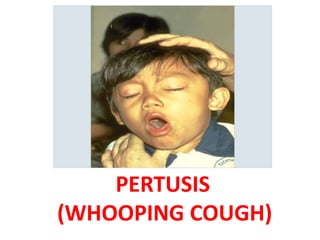
PERTUSIS
(WHOOPING COUGH)
 Acute infectious disease of young children,
caused by Bordetella pertusis.
 Characterized by an insidious onset with mild
fever and irritating cough, gradually becoming
paroxysmal with the characteristic “whoop” (loud
crowing inspiration) often with cyanosis and
vomiting.
 The Chinese call it a “Hundred Day Cough”.
PROPLEM STATEMENT
 Important cause of deaths in infants worldwide
 Public health concern even in countries with high
vaccination coverage
 During 2012 about 2.49 lac cases were reported
to WHO globally and the DPT3 immunization rate
was 83 percent
CONTI..
 In India, marked decline of the disease after
launch of UIP.
 1987 -> 1.63 lac cases reported
 2014 -> 61,417 cases reported
 Showing decline of about 62.3 percent
EPIDEMIOLOGICAL DETERMINANTS
Agent factors
a) AGENT : Bordetella pertusis (large proportion of
cases), B. parapertusis (less than 5% cases)
- Occurs in smooth and rough phases, capsulated
and non-capsulated forms, and elaborates an
exotoxin and endotoxin.
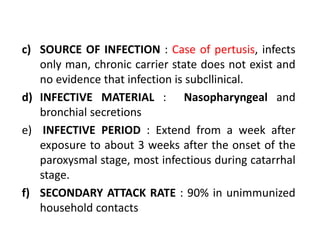
-Gram-negative, aerobic, pathogenic, encapsulated
coccobacillus
- Bacterium survives only for very short periods
outside the human body.
BORDETELLA PERTUSIS
c) SOURCE OF INFECTION : Case of pertusis, infects
only man, chronic carrier state does not exist and
no evidence that infection is subcllinical.
d) INFECTIVE MATERIAL : Nasopharyngeal and
bronchial secretions
e) INFECTIVE PERIOD : Extend from a week after
exposure to about 3 weeks after the onset of the
paroxysmal stage, most infectious during catarrhal
stage.
f) SECONDARY ATTACK RATE : 90% in unimmunized
household contacts
HOST FACTORS
a) AGE : Disease of infants and pre-school children,
highest incidence – below the age of 5 years, Infants
below the 6 months have the highest mortality.
b) SEX : Incidence and fatality – more among female
than male children.
c) IMMUNITY : Recovery from whooping cough or
adequate immunization is followed by immunity.
Infants are susceptible to infection from birth
because maternal antibody does not appear to give
them protection.
ENVIRONMENTAL FACTORS
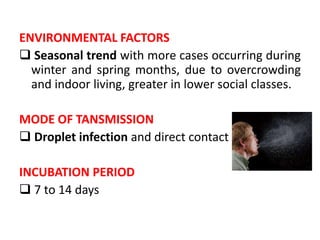
 Seasonal trend with more cases occurring during
winter and spring months, due to overcrowding
and indoor living, greater in lower social classes.
MODE OF TANSMISSION
 Droplet infection and direct contact
INCUBATION PERIOD
 7 to 14 days
CLINICAL FEATURES
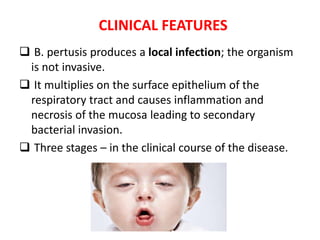
 B. pertusis produces a local infection; the organism
is not invasive.
 It multiplies on the surface epithelium of the
respiratory tract and causes inflammation and
necrosis of the mucosa leading to secondary
bacterial invasion.
 Three stages – in the clinical course of the disease.
Conti..
a) CATARRHAL STAGE : Lasting for about 10 days,
characterized by insidious onset, lacrimation,
sneezing and coryza, anorexia and malaise, and a
hacking night cough that becomes diurnal.
b) PAROXYSMAL STAGE : Lasting for 2—4 weeks,
characterized by burst of rapid, consecutive coughs
followed by a deep, high-pitched inspiration
(whoop), followed by vomiting.
c) CONVALESCENT STAGE : Lasting for1-2 weeks.
COMPLICATIONS
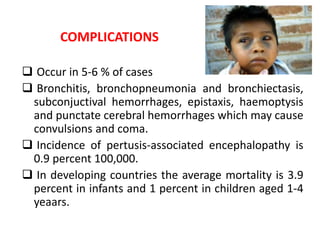
 Occur in 5-6 % of cases
 Bronchitis, bronchopneumonia and bronchiectasis,
subconjuctival hemorrhages, epistaxis, haemoptysis
and punctate cerebral hemorrhages which may cause
convulsions and coma.
 Incidence of pertusis-associated encephalopathy is
0.9 percent 100,000.
 In developing countries the average mortality is 3.9
percent in infants and 1 percent in children aged 1-4
yeaars.
CONTROL OF WHOOPING COUGH
1. CASES AND CONTACTS
a) Cases :
 Early diagnosis, isolation and treatment of cases,
and disinfection of discharges from nose and
throat.
 Early diagnosis by bacteriological examination of
nose and throat secretions by naso-pharyngeal
swabs.
 Erythromycin is the drug of choice, 30-50mg/kg of
body weight in 4 divided doses for 10 days.
Conti..
 Antibiotics may prevent or moderate clinical pertusis
when given during incubation period or in early
catarrhal stage.
 During paroxysmal stage, antimicrobial drugs may
eliminate the bacterium from the nasopharynx and
reduce transmission of disease.
 Useful in controlling secondary bacterial infections.
b) Contacts :
 Infants and young children should be kept away
from cases.
 Contacts with whooping cough, may be given
prophylactic antibiotic (erythromycin or ampicillin)
treatment for 10 days
2. ACTIVE IMMUNIZATION
 Active immunization is the best preventive measure
for pertusis.
 The vaccine is administered in National
Immunization Schedule as combined Pentavalent
vaccine.
 Pentavalent vaccine provides protection to a child
from 5 life-threatening diseases – Diphtheria,
Pertussis, Tetanus, Hepatitis B and Hib.
Conti..
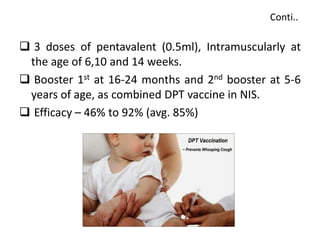
 3 doses of pentavalent (0.5ml), Intramuscularly at
the age of 6,10 and 14 weeks.
 Booster 1st at 16-24 months and 2nd booster at 5-6
years of age, as combined DPT vaccine in NIS.
 Efficacy – 46% to 92% (avg. 85%)
ACELLULAR PERTUSIS VACCINE
 Used for vaccination of older children and adults
 Lesser side effects
 Available preparation – aP, DTap, TdaP
 Efficacy – 54% to 89%
 The duration of protection following the primary 3
dose course in infants and 1 booster dose (1 year
later)- Average 6-12 years for both whole cell and
acellular pertusis vaccine.
UNTOWARD REACTIONS
 Local reactions at the site of injections
 Mild fever and irritability
 Rare vaccine reactions are persistent (more than 3
hours) inconsable screaming, seizures, hypotonic
hypo-responsive episodes, anaphylactic reactions
and very rarely encephalopathy.
CONTRAINDICATIONS
 Anaphylactic reactions
 Encephalopathy
 Personal or strong family history of epilapsy
 Convulsions
 CNS disorders
 Reaction to one of the previously given pentavalent
or triple vaccine injections.
3. PASSIVE IMMUUNIZATION
 No evidence of its efficacy in well-controlled trials.
CONCLUSION
 Whooping cough is a disease of respiratory mucous
membrane.
 It is a bacterial and contagious disease which mainly
caused by Bordetella Pertusis.
 It mainly occur in young children (3-5 years).
 It can be prevented by active immunization.
 It is treated by DPT vaccine and antibiotics.

Pertusis

  • 1.
  • 2.
     Acute infectiousdisease of young children, caused by Bordetella pertusis.  Characterized by an insidious onset with mild fever and irritating cough, gradually becoming paroxysmal with the characteristic “whoop” (loud crowing inspiration) often with cyanosis and vomiting.  The Chinese call it a “Hundred Day Cough”.
  • 3.
    PROPLEM STATEMENT  Importantcause of deaths in infants worldwide  Public health concern even in countries with high vaccination coverage  During 2012 about 2.49 lac cases were reported to WHO globally and the DPT3 immunization rate was 83 percent
  • 4.
    CONTI..  In India,marked decline of the disease after launch of UIP.  1987 -> 1.63 lac cases reported  2014 -> 61,417 cases reported  Showing decline of about 62.3 percent
  • 5.
    EPIDEMIOLOGICAL DETERMINANTS Agent factors a)AGENT : Bordetella pertusis (large proportion of cases), B. parapertusis (less than 5% cases) - Occurs in smooth and rough phases, capsulated and non-capsulated forms, and elaborates an exotoxin and endotoxin. -Gram-negative, aerobic, pathogenic, encapsulated coccobacillus - Bacterium survives only for very short periods outside the human body.
  • 6.
  • 7.
    c) SOURCE OFINFECTION : Case of pertusis, infects only man, chronic carrier state does not exist and no evidence that infection is subcllinical. d) INFECTIVE MATERIAL : Nasopharyngeal and bronchial secretions e) INFECTIVE PERIOD : Extend from a week after exposure to about 3 weeks after the onset of the paroxysmal stage, most infectious during catarrhal stage. f) SECONDARY ATTACK RATE : 90% in unimmunized household contacts
  • 8.
    HOST FACTORS a) AGE: Disease of infants and pre-school children, highest incidence – below the age of 5 years, Infants below the 6 months have the highest mortality. b) SEX : Incidence and fatality – more among female than male children. c) IMMUNITY : Recovery from whooping cough or adequate immunization is followed by immunity. Infants are susceptible to infection from birth because maternal antibody does not appear to give them protection.
  • 9.
    ENVIRONMENTAL FACTORS  Seasonaltrend with more cases occurring during winter and spring months, due to overcrowding and indoor living, greater in lower social classes. MODE OF TANSMISSION  Droplet infection and direct contact INCUBATION PERIOD  7 to 14 days
  • 10.
    CLINICAL FEATURES  B.pertusis produces a local infection; the organism is not invasive.  It multiplies on the surface epithelium of the respiratory tract and causes inflammation and necrosis of the mucosa leading to secondary bacterial invasion.  Three stages – in the clinical course of the disease.
  • 11.
    Conti.. a) CATARRHAL STAGE: Lasting for about 10 days, characterized by insidious onset, lacrimation, sneezing and coryza, anorexia and malaise, and a hacking night cough that becomes diurnal. b) PAROXYSMAL STAGE : Lasting for 2—4 weeks, characterized by burst of rapid, consecutive coughs followed by a deep, high-pitched inspiration (whoop), followed by vomiting. c) CONVALESCENT STAGE : Lasting for1-2 weeks.
  • 12.
    COMPLICATIONS  Occur in5-6 % of cases  Bronchitis, bronchopneumonia and bronchiectasis, subconjuctival hemorrhages, epistaxis, haemoptysis and punctate cerebral hemorrhages which may cause convulsions and coma.  Incidence of pertusis-associated encephalopathy is 0.9 percent 100,000.  In developing countries the average mortality is 3.9 percent in infants and 1 percent in children aged 1-4 yeaars.
  • 13.
    CONTROL OF WHOOPINGCOUGH 1. CASES AND CONTACTS a) Cases :  Early diagnosis, isolation and treatment of cases, and disinfection of discharges from nose and throat.  Early diagnosis by bacteriological examination of nose and throat secretions by naso-pharyngeal swabs.  Erythromycin is the drug of choice, 30-50mg/kg of body weight in 4 divided doses for 10 days.
  • 14.
    Conti..  Antibiotics mayprevent or moderate clinical pertusis when given during incubation period or in early catarrhal stage.  During paroxysmal stage, antimicrobial drugs may eliminate the bacterium from the nasopharynx and reduce transmission of disease.  Useful in controlling secondary bacterial infections.
  • 15.
    b) Contacts : Infants and young children should be kept away from cases.  Contacts with whooping cough, may be given prophylactic antibiotic (erythromycin or ampicillin) treatment for 10 days
  • 16.
    2. ACTIVE IMMUNIZATION Active immunization is the best preventive measure for pertusis.  The vaccine is administered in National Immunization Schedule as combined Pentavalent vaccine.  Pentavalent vaccine provides protection to a child from 5 life-threatening diseases – Diphtheria, Pertussis, Tetanus, Hepatitis B and Hib.
  • 17.
    Conti..  3 dosesof pentavalent (0.5ml), Intramuscularly at the age of 6,10 and 14 weeks.  Booster 1st at 16-24 months and 2nd booster at 5-6 years of age, as combined DPT vaccine in NIS.  Efficacy – 46% to 92% (avg. 85%)
  • 18.
    ACELLULAR PERTUSIS VACCINE Used for vaccination of older children and adults  Lesser side effects  Available preparation – aP, DTap, TdaP  Efficacy – 54% to 89%  The duration of protection following the primary 3 dose course in infants and 1 booster dose (1 year later)- Average 6-12 years for both whole cell and acellular pertusis vaccine.
  • 19.
    UNTOWARD REACTIONS  Localreactions at the site of injections  Mild fever and irritability  Rare vaccine reactions are persistent (more than 3 hours) inconsable screaming, seizures, hypotonic hypo-responsive episodes, anaphylactic reactions and very rarely encephalopathy.
  • 20.
    CONTRAINDICATIONS  Anaphylactic reactions Encephalopathy  Personal or strong family history of epilapsy  Convulsions  CNS disorders  Reaction to one of the previously given pentavalent or triple vaccine injections.
  • 21.
    3. PASSIVE IMMUUNIZATION No evidence of its efficacy in well-controlled trials. CONCLUSION  Whooping cough is a disease of respiratory mucous membrane.  It is a bacterial and contagious disease which mainly caused by Bordetella Pertusis.  It mainly occur in young children (3-5 years).  It can be prevented by active immunization.  It is treated by DPT vaccine and antibiotics.