Ravsa
Mr. Ravi Rai Dangi
Assistant Professor
Tuberculosis in Children
1
Ravsa
Outlines
• Introduction
• Risk factors
• Pathophysiology
• Clinical sign and symptoms
• Diagnostic investigation
• Management
• Exercise
• Learning outcome
• References
2
Ravsa
Introduction
• It is estimated that 1/3rd of the world’s population is infected with
Mycobacterium tuberculosis.
• Each year, about 9 million people develop TB, of whom about 1.5
million die.
• WHO has estimated that around 10% of global tuberculosis case load
occurs in children(0-14 years) of these childhood cases, 75% occur
annually in 22 high-burden countries that together account for 80% of
the world’s estimated incident cases.
Ravsa
4
• Children can present with TB at any age, but the majority of cases
present between 1 - 4 years.
• Disease usually develops within 1 year of infection –the younger, the
earlier and the more disseminated.
Ravsa
• Household contact with a newly diagnosed smear-positive case
• Age less than 5 years
• HIV infection
• Severe malnutrition.
5
Etiology & Risk factors
Ravsa
• The most common agent associated with pulmonary and most of the
extra- pulmonary tuberculosis is Mycobacterium tuberculosis
Others include
• M.Africanum
• M. Canetti
• M. Bovis
• M. Microti
6
Causative agent
Ravsa
• Is through inhalation of droplets of infected secretions.
• Person to person by air- born mucus droplet nuclei particles 1-5µm in
diameter that contain m. Tuberculosis.
• Environmental factors such as poor circulation enhance transmission.
• Young children rarely infect other children or adults.
Mode of Transmission
Ravsa
• Infection is spread by the tuberculosis patient, who discharges tubercle bacilli
in his sputum or nasopharyngeal secretions.
• In neonates, few infections may also spread by the trans placental route
(congenital tuberculosis).
Reservoir of Infection
Ravsa
• lungs – pulmonary tuberculosis
Extra pulmonary sites:-
• Meninges – tuberculous meningitis
• Kidneys –renal tuberculosis
• Bones – osteomyelitis
• Fallopian tube –salpingitis
• Lymphnodes – cervical region(lymphadenitis)
Sites Affected
Ravsa
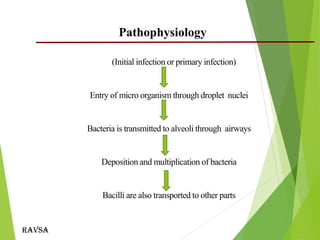
(Initial infection or primary infection)
Entry of micro organism through droplet nuclei
Bacteria is transmitted to alveoli through airways
Deposition and multiplication of bacteria
Bacilli are also transported to other parts
Pathophysiology
Ravsa
Phagocytosis by neutrophils and Macrophages
Accumulation of exudate in alveoli
New tissue masses of live and dead bacilli are surrounded by macrophages
which form a protective mass around granulomas
Granulomas then transforms to fibrous tissue mass and central portion of
which is called Ghon tubercle
Pathophysiology
Ravsa
Ghon tubercle becomes calcified and becomes Collagenous scar
Bacteria become dormant and no further progression of active disease
(Active disease or re infection)
Inadequate immune response
Activation of dormant bacteria
Infected lung become inflamed Further development of pneumonia and
tubercle
Tuberculosis Occur
Pathophysiology
Ravsa
• Pulmonary and extra pulmonary TB in pregnant women is associated
with increased risk of prematurity , growth retardation, LBW and
perinatal mortality.
• Congenital TB is rare because TB of female genital tract results in
infertility.
• Most common route of infection for the neonate is postnatal airborne
transmission from an adult with infectious pulmonary TB.
Tuberculosis in Pregnancy and newborn
Ravsa
Clinical Manifestation
• Mild fever
• Malaise
• Anorexia
• Weight loss
• Failure to thrive
• Decreased activity
• Fatigue
• Cough is inconsistent symptom
• Irritating dry cough – symptom of bronchial and tracheal compression
Ravsa
Diagnosis of TB in children
• Careful history (including history of TB contact and symptoms
consistent with TB)
• Clinical examination (including growth assessment)
• Tuberculin skin testing
• Bacteriological confirmation whenever possible
• Investigations relevant for suspected pulmonary
• TB and suspected extra pulmonary TB
• HIV testing (in high HIV prevalence areas)
Ravsa
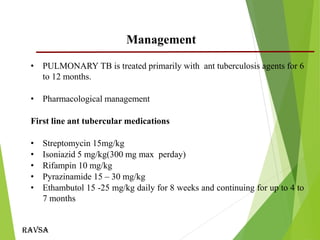
• PULMONARY TB is treated primarily with ant tuberculosis agents for 6
to 12 months.
• Pharmacological management
First line ant tubercular medications
• Streptomycin 15mg/kg
• Isoniazid 5 mg/kg(300 mg max perday)
• Rifampin 10 mg/kg
• Pyrazinamide 15 – 30 mg/kg
• Ethambutol 15 -25 mg/kg daily for 8 weeks and continuing for up to 4 to
7 months
Management
Ravsa
Second line medications
• Capreomycin 12 -15 mg/kg
• Ethionamide 15mg/kg
• Paraaminosalycilate sodium 200 - 300 mg/kg
• Cycloserine 15 mg/kg
• Vitamin b(pyridoxine)
Medical Management
Ravsa
• Assessment
• Obtain history of exposure to TB
• Assess for symptoms of active disease
• Auscultate lungs for crackles
• During drug therapy assess for liver function
Nursing Management
Ravsa
• Administer and teach self administration of medications ordered
• Encourage rest and avoidance of exertion
• Monitor breath sounds respiratory rates, sputum production and
dyspnea
• Provide supplemental oxygen as ordered
• Encourage increased fluid intake
• Instruct about best position to facilitate drainage
Nursing Management
Ravsa
• Beware that TB is transmitted by respiratory droplets
• Use high efficiency particulate masks for high risk procedures including
endoscopy
• Educate patient to control the spread of infection by covering mouth
and nose while coughing and sneezing
• Isolation of patient
• Instruct about risk of drug resistance if drug regimen is not strictly and
continuously followed
20
Nursing management:
Ravsa
• Carefully monitor vital signs and observe for temperature changes
• Explain the importance of eating nutritious diet to promote healing
and defense against infection
• Provide small frequent meals
• Monitor weight of the patient
• Administer vitamin supplements as ordered
Nursing management:
Ravsa
• Educate patient about etiology transmission and effects of TB
• Review adverse effects of drug therapy
• Participate in observation of medicine taking, weekly pill counts or
programmes designed to increase compliance with the treatment for
TB
• Explain that TB is a communicable disease and that taking
medications is most effective way of preventing transmission
• Instruct about medications schedule and side effects
Nursing management:
Ravsa
• ISOLATION
• Ventilate the room
• Cover the mouth
• Wear mask
• Finish entire course of medication
• vaccinations
Prevention
Ravsa
24

Tuberculosis in Children

  • 1.
    Ravsa Mr. Ravi RaiDangi Assistant Professor Tuberculosis in Children 1
  • 2.
    Ravsa Outlines • Introduction • Riskfactors • Pathophysiology • Clinical sign and symptoms • Diagnostic investigation • Management • Exercise • Learning outcome • References 2
  • 3.
    Ravsa Introduction • It isestimated that 1/3rd of the world’s population is infected with Mycobacterium tuberculosis. • Each year, about 9 million people develop TB, of whom about 1.5 million die. • WHO has estimated that around 10% of global tuberculosis case load occurs in children(0-14 years) of these childhood cases, 75% occur annually in 22 high-burden countries that together account for 80% of the world’s estimated incident cases.
  • 4.
    Ravsa 4 • Children canpresent with TB at any age, but the majority of cases present between 1 - 4 years. • Disease usually develops within 1 year of infection –the younger, the earlier and the more disseminated.
  • 5.
    Ravsa • Household contactwith a newly diagnosed smear-positive case • Age less than 5 years • HIV infection • Severe malnutrition. 5 Etiology & Risk factors
  • 6.
    Ravsa • The mostcommon agent associated with pulmonary and most of the extra- pulmonary tuberculosis is Mycobacterium tuberculosis Others include • M.Africanum • M. Canetti • M. Bovis • M. Microti 6 Causative agent
  • 7.
    Ravsa • Is throughinhalation of droplets of infected secretions. • Person to person by air- born mucus droplet nuclei particles 1-5µm in diameter that contain m. Tuberculosis. • Environmental factors such as poor circulation enhance transmission. • Young children rarely infect other children or adults. Mode of Transmission
  • 8.
    Ravsa • Infection isspread by the tuberculosis patient, who discharges tubercle bacilli in his sputum or nasopharyngeal secretions. • In neonates, few infections may also spread by the trans placental route (congenital tuberculosis). Reservoir of Infection
  • 9.
    Ravsa • lungs –pulmonary tuberculosis Extra pulmonary sites:- • Meninges – tuberculous meningitis • Kidneys –renal tuberculosis • Bones – osteomyelitis • Fallopian tube –salpingitis • Lymphnodes – cervical region(lymphadenitis) Sites Affected
  • 10.
    Ravsa (Initial infection orprimary infection) Entry of micro organism through droplet nuclei Bacteria is transmitted to alveoli through airways Deposition and multiplication of bacteria Bacilli are also transported to other parts Pathophysiology
  • 11.
    Ravsa Phagocytosis by neutrophilsand Macrophages Accumulation of exudate in alveoli New tissue masses of live and dead bacilli are surrounded by macrophages which form a protective mass around granulomas Granulomas then transforms to fibrous tissue mass and central portion of which is called Ghon tubercle Pathophysiology
  • 12.
    Ravsa Ghon tubercle becomescalcified and becomes Collagenous scar Bacteria become dormant and no further progression of active disease (Active disease or re infection) Inadequate immune response Activation of dormant bacteria Infected lung become inflamed Further development of pneumonia and tubercle Tuberculosis Occur Pathophysiology
  • 13.
    Ravsa • Pulmonary andextra pulmonary TB in pregnant women is associated with increased risk of prematurity , growth retardation, LBW and perinatal mortality. • Congenital TB is rare because TB of female genital tract results in infertility. • Most common route of infection for the neonate is postnatal airborne transmission from an adult with infectious pulmonary TB. Tuberculosis in Pregnancy and newborn
  • 14.
    Ravsa Clinical Manifestation • Mildfever • Malaise • Anorexia • Weight loss • Failure to thrive • Decreased activity • Fatigue • Cough is inconsistent symptom • Irritating dry cough – symptom of bronchial and tracheal compression
  • 15.
    Ravsa Diagnosis of TBin children • Careful history (including history of TB contact and symptoms consistent with TB) • Clinical examination (including growth assessment) • Tuberculin skin testing • Bacteriological confirmation whenever possible • Investigations relevant for suspected pulmonary • TB and suspected extra pulmonary TB • HIV testing (in high HIV prevalence areas)
  • 16.
    Ravsa • PULMONARY TBis treated primarily with ant tuberculosis agents for 6 to 12 months. • Pharmacological management First line ant tubercular medications • Streptomycin 15mg/kg • Isoniazid 5 mg/kg(300 mg max perday) • Rifampin 10 mg/kg • Pyrazinamide 15 – 30 mg/kg • Ethambutol 15 -25 mg/kg daily for 8 weeks and continuing for up to 4 to 7 months Management
  • 17.
    Ravsa Second line medications •Capreomycin 12 -15 mg/kg • Ethionamide 15mg/kg • Paraaminosalycilate sodium 200 - 300 mg/kg • Cycloserine 15 mg/kg • Vitamin b(pyridoxine) Medical Management
  • 18.
    Ravsa • Assessment • Obtainhistory of exposure to TB • Assess for symptoms of active disease • Auscultate lungs for crackles • During drug therapy assess for liver function Nursing Management
  • 19.
    Ravsa • Administer andteach self administration of medications ordered • Encourage rest and avoidance of exertion • Monitor breath sounds respiratory rates, sputum production and dyspnea • Provide supplemental oxygen as ordered • Encourage increased fluid intake • Instruct about best position to facilitate drainage Nursing Management
  • 20.
    Ravsa • Beware thatTB is transmitted by respiratory droplets • Use high efficiency particulate masks for high risk procedures including endoscopy • Educate patient to control the spread of infection by covering mouth and nose while coughing and sneezing • Isolation of patient • Instruct about risk of drug resistance if drug regimen is not strictly and continuously followed 20 Nursing management:
  • 21.
    Ravsa • Carefully monitorvital signs and observe for temperature changes • Explain the importance of eating nutritious diet to promote healing and defense against infection • Provide small frequent meals • Monitor weight of the patient • Administer vitamin supplements as ordered Nursing management:
  • 22.
    Ravsa • Educate patientabout etiology transmission and effects of TB • Review adverse effects of drug therapy • Participate in observation of medicine taking, weekly pill counts or programmes designed to increase compliance with the treatment for TB • Explain that TB is a communicable disease and that taking medications is most effective way of preventing transmission • Instruct about medications schedule and side effects Nursing management:
  • 23.
    Ravsa • ISOLATION • Ventilatethe room • Cover the mouth • Wear mask • Finish entire course of medication • vaccinations Prevention
  • 24.