
100 days Cough
Dr Deepak UpadhyayDr Deepak Upadhyay
Assistant Professor
Department of Community Medicine
Agent factors
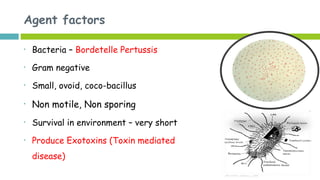
• Bacteria – Bordetelle Pertussis
• Gram negative
• Small, ovoid, coco-bacillus
• Non motile, Non sporing
• Survival in environment – very short
• Produce Exotoxins (Toxin mediated
disease)
Agent factors (cont.)
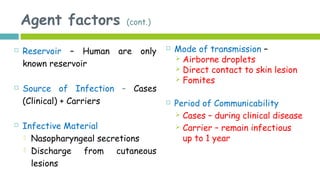
 Reservoir – Human are only known reservoir
 Source of Infection – Cases (Clinical + Subclinical)
 Infective Material – Nasopharyngeal secretions
 Mode of transmission - Airborne droplets
 Period of Communicability – In the catarrhal stage and 3 weeks
after the onset of cough
Host Factors
 Females > Male
 Age Incidence
 Pre vaccination era - children birth to 5 years
of age (Preschool Children)
 Post vaccination introduction - in School going
children (5 - 10 yr)
 Immunity –
 Maternal antibodies – no role / no protection
 One attack – 90% immunity
 Secondary attack – 10% cases
Environmental factors
 Endemic disease with epidemic potential
 Epidemics during winter season.
 Incubation period – 7 – 14 days
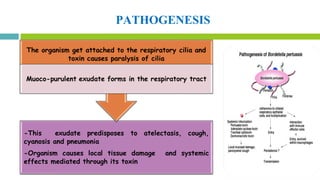
PATHOGENESIS
Clinical Manifestations
 Three stages
 Catarrhal stage
 Paroxysmal stage
 Convalescent stage
 Catarrhal stage
 Insidious onset of coryza
 Sneezing
 Low grade fever
 Occasional cough
 Maximum infectivity
 Duration - 1-2 weeks (Appr. 10 days)
Clinical Manifestations (cont.)
 Paroxysmal cough stage
 Cough increases – distinctive bouts
 Violent spasms of continuous coughing (Paroxysm)
 At the end of paroxysm - long inspiratory effort (whoop)
 Whoop end with vomiting and occasional aspiration
 During episode of cough - Cyanosis followed by vomiting,
exhaustion and seizures
Clinical Manifestations (cont.)
 In between episodes child look well
 Cough increase for next 2-3 weeks and decreases over next 10
weeks
 Paroxysmal cough>2 weeks with or without whoop and/or post-
tussive vomiting is the hallmark feature of pertussis
Convalescence stage
period of gradual recovery even up to 6 months
Complications
 Due to increase intra abdominal pressure
 Hernias (inguinal / umbilical)
 Rectal prolapse
 Sub-conjuctival hemorrhage
 Subcutaneous emphysema
 Bronchopneumonia
 Atelectasis
 Neurological complications (due to the toxin or hypoxia or cerebral
hemorrhage)
 Seizures (1 in 100)
 Encephalopathy (1 in 300)
DIAGNOSIS
Suspected on the basis of history and clinical examination
Confirmed by culture, genomics or serology
1.Blood investigations
Elevated WBC count with lymphocytosis.
The absolute lymphocyte count of ≥20,000 is highly suggestive
1.Direct fluorescent antibody testing
IgA antibodies in nasal secretions
IgM antibodies against toxin
DIAGNOSIS
3. Culture and Microscopy:
 Gold standard specially in the
catarrhal stage.
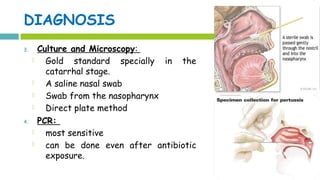
 A saline nasal swab
 Swab from the nasopharynx
 Direct plate method
4. PCR:
 most sensitive
 can be done even after antibiotic
exposure.
TREATMENT
1. Avoidance of irritants, smoke and other cough promoting factors
2.2. Antibiotics:Antibiotics:
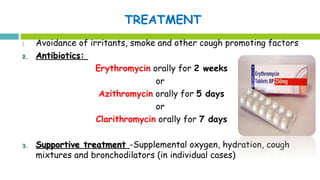
Erythromycin orally for 2 weeks
or
Azithromycin orally for 5 days
or
Clarithromycin orally for 7 days
3.3. Supportive treatmentSupportive treatment -Supplemental oxygen, hydration, cough
mixtures and bronchodilators (in individual cases)
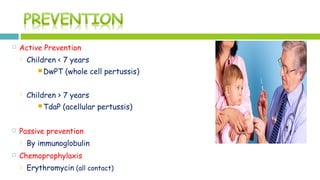
 Active Prevention
 Children < 7 years
 DwPT (whole cell pertussis)
 Children > 7 years
 TdaP (acellular pertussis)
 Passive prevention
 By immunoglobulin
 Chemoprophylaxis
 Erythromycin
Dr Deepak UpadhyayDr Deepak Upadhyay
Assistant Professor
Department of Community Medicine
Agent factors
• Bacteria – Corynebacterium diptheriae (Klebs-
Loefflers bacilli)
• Gram positive
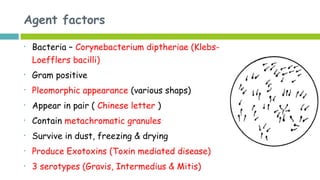
• Pleomorphic appearance (various shaps)
• Appear in pair ( Chinese letter )
• Contain metachromatic granules
• Survive in dust, freezing & drying
• Produce Exotoxins (Toxin mediated disease)
• 3 serotypes (Gravis, Intermedius & Mitis)
Agent factors (cont.)
 Reservoir – Human are only
known reservoir
 Source of Infection – Cases
(Clinical) + Carriers
 Infective Material
 Nasopharyngeal secretions
 Discharge from cutaneous
lesions
 Mode of transmission –
 Airborne droplets
 Direct contact to skin lesion
 Fomites
 Period of Communicability
 Cases – during clinical disease
 Carrier – remain infectious
up to 1 year
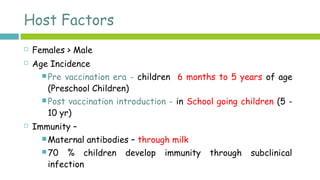
Host Factors
 Females > Male
 Age Incidence
 Pre vaccination era - children 6 months to 5 years of age
(Preschool Children)
 Post vaccination introduction - in School going children (5 -
10 yr)
 Immunity –
 Maternal antibodies – through milk
 70 % children develop immunity through subclinical
infection
Environmental factors
 Endemic disease with epidemic potential
 Epidemics during winter season.
 Incubation period – 7 – 14 days
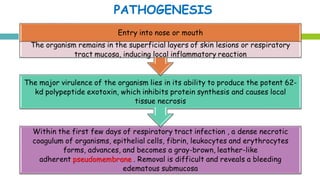
PATHOGENESIS
 Local effect of diphtheritic toxin:
Paralysis of the palate and hypopharynx
Pneumonia
 Systemic effects (Toxin absorption ):
kidney tubule necrosis
myocarditis and/or demyelination of nerves
 Myocarditis:10-14 days
 Demyelination of nerves: 3-7 weeks
Clinical Manifestations
 Classification ( depend upon location):
 Nasal
 Pharyngeal (Faucial Diptheria)
 tonsilar
 laryngeal or laryngo-tracheal
 skin, eye or genitalia
Nasal Diphtheria
 Infection of the anterior nares
 More common among infants,
 Causes serosanguineous, purulent, erosive rhinitis with membrane
formation
 Shallow ulceration of the external nares and upper lip is
characteristic
 Unilateral nasal discharge is quite pathognomic of nasal diphtheria
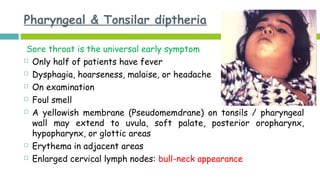
Pharyngeal & Tonsilar diptheria
Sore throat is the universal early symptom
 Only half of patients have fever
 Dysphagia, hoarseness, malaise, or headache
 On examination
 Foul smell
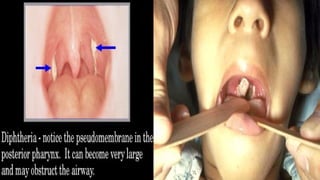
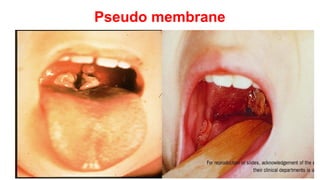
 A yellowish membrane (Pseudomemdrane) on tonsils / pharyngeal
wall may extend to uvula, soft palate, posterior oropharynx,
hypopharynx, or glottic areas
 Erythema in adjacent areas
 Enlarged cervical lymph nodes: bull-neck appearance
Pseudo membrane
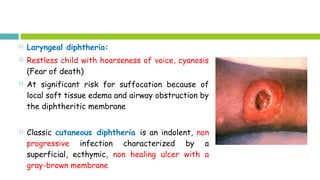
 Laryngeal diphtheria:
 Restless child with hoarseness of voice, cyanosis
(Fear of death)
 At significant risk for suffocation because of
local soft tissue edema and airway obstruction by
the diphtheritic membrane
 Classic cutaneous diphtheria is an indolent, non
progressive infection characterized by a
superficial, ecthymic, non healing ulcer with a
gray-brown membrane
COMPLICATIONS
1.1. Respiratory tract obstructionRespiratory tract obstruction by pseudomembranes
1.1. Toxic CardiomyopathyToxic Cardiomyopathy:
1. In 10-25% of patients
2. Responsible for 50-60% of deaths
3. Tachycardia out of proportion to fever
4. Prolonged PR interval and changes in the ST-T wave
5. Elevation of the serum aspartate aminotransferase
concentration closely parallels the severity of myonecrosis
3.3. Toxic NeuropathyToxic Neuropathy:
 Hypoesthesia and soft palate paralysis
 Afterwards weakness of the posterior pharyngeal, laryngeal, and
facial nerves : a nasal quality in the voice, difficulty in swallowing and
risk for aspiration
 Cranial neuropathies (5th wk): oculomotor and ciliary paralysis-
strabismus, blurred vision, or difficulty with accommodation
 Symmetric polyneuropathy (10 days to 3 mo): motor deficits with
diminished deep tendon reflexes
 Monitoring for paralysis of the diaphragm muscle
Recovery from the neuritis is often slow but usually complete.
Corticosteroids are not recommended.
DIAGNOSIS
Suspected on the basis of history and clinical examination
Confirmed by culture, toxigenicity
1.Blood investigations
Elevated WBC count with lymphocytosis.
1.Toxigenicity testing
•Elek s Gel precipitation testing
•Shick test
Microscopy & Culture
 Specimen – throat swab
 Smear microscopic examinations
Gram s staining
Albert's stain
Immunoflorescent methods
 Cultures on
 Loeffers serum slope
 Tellurite Blood agar
TREATMENT
1. Antitoxin:
 Mainstay of therapy
 Neutralizes only free toxin, efficacy diminishes with elapsed
time
2. Antimicrobial therapy
 Halt toxin production, treat localized infection and prevent
transmission of the organism to contacts
Erythromycin
Or
aqueous crystalline penicillin G / procaine penicillin
 Active Prevention
 Children < 7 years
 DwPT (whole cell pertussis)
 Children > 7 years
 TdaP (acellular pertussis)
 Passive prevention
 By immunoglobulin
 Chemoprophylaxis
 Erythromycin (all contact)
DwPT
 Dose – 0.5 ml
 Route – Intramuscular
 Site – anterolateral thigh / deltoid region
 Schedule –
 Three primary doses – at 6, 10, 14 weeks
 Two booster doses – at 18 months & 5 years
 Side effects – Local pain, fever, swelling
 Diphtheria – Toxoid
 Tetanus – Toxoid
 Pertussis – Live whole
cell vaccine
 Adjuvant – Aluminum
Phosphate
 Preservative –
Thiomersal
TdaP
 Dose – 0.5 ml
 Route – Intramuscular
 Site – anterolateral thigh / deltoid region
 Schedule –
 Two primary doses – at 0 and 1 month
 Booster dose – at 6 month
 Side effects – Local pain, fever, swelling
 Diphtheria – Toxoid
 Tetanus – Toxoid
 Pertussis – acellular
pertussis (Killed)

Diptheria & pertussis

  • 1.
    100 days Cough DrDeepak UpadhyayDr Deepak Upadhyay Assistant Professor Department of Community Medicine
  • 2.
    Agent factors • Bacteria– Bordetelle Pertussis • Gram negative • Small, ovoid, coco-bacillus • Non motile, Non sporing • Survival in environment – very short • Produce Exotoxins (Toxin mediated disease)
  • 3.
    Agent factors (cont.) Reservoir – Human are only known reservoir  Source of Infection – Cases (Clinical + Subclinical)  Infective Material – Nasopharyngeal secretions  Mode of transmission - Airborne droplets  Period of Communicability – In the catarrhal stage and 3 weeks after the onset of cough
  • 4.
    Host Factors  Females> Male  Age Incidence  Pre vaccination era - children birth to 5 years of age (Preschool Children)  Post vaccination introduction - in School going children (5 - 10 yr)  Immunity –  Maternal antibodies – no role / no protection  One attack – 90% immunity  Secondary attack – 10% cases
  • 5.
    Environmental factors  Endemicdisease with epidemic potential  Epidemics during winter season.  Incubation period – 7 – 14 days
  • 6.
  • 7.
    Clinical Manifestations  Threestages  Catarrhal stage  Paroxysmal stage  Convalescent stage  Catarrhal stage  Insidious onset of coryza  Sneezing  Low grade fever  Occasional cough  Maximum infectivity  Duration - 1-2 weeks (Appr. 10 days)
  • 8.
    Clinical Manifestations (cont.) Paroxysmal cough stage  Cough increases – distinctive bouts  Violent spasms of continuous coughing (Paroxysm)  At the end of paroxysm - long inspiratory effort (whoop)  Whoop end with vomiting and occasional aspiration  During episode of cough - Cyanosis followed by vomiting, exhaustion and seizures
  • 9.
    Clinical Manifestations (cont.) In between episodes child look well  Cough increase for next 2-3 weeks and decreases over next 10 weeks  Paroxysmal cough>2 weeks with or without whoop and/or post- tussive vomiting is the hallmark feature of pertussis Convalescence stage period of gradual recovery even up to 6 months
  • 10.
    Complications  Due toincrease intra abdominal pressure  Hernias (inguinal / umbilical)  Rectal prolapse  Sub-conjuctival hemorrhage  Subcutaneous emphysema  Bronchopneumonia  Atelectasis  Neurological complications (due to the toxin or hypoxia or cerebral hemorrhage)  Seizures (1 in 100)  Encephalopathy (1 in 300)
  • 11.
    DIAGNOSIS Suspected on thebasis of history and clinical examination Confirmed by culture, genomics or serology 1.Blood investigations Elevated WBC count with lymphocytosis. The absolute lymphocyte count of ≥20,000 is highly suggestive 1.Direct fluorescent antibody testing IgA antibodies in nasal secretions IgM antibodies against toxin
  • 12.
    DIAGNOSIS 3. Culture andMicroscopy:  Gold standard specially in the catarrhal stage.  A saline nasal swab  Swab from the nasopharynx  Direct plate method 4. PCR:  most sensitive  can be done even after antibiotic exposure.
  • 13.
    TREATMENT 1. Avoidance ofirritants, smoke and other cough promoting factors 2.2. Antibiotics:Antibiotics: Erythromycin orally for 2 weeks or Azithromycin orally for 5 days or Clarithromycin orally for 7 days 3.3. Supportive treatmentSupportive treatment -Supplemental oxygen, hydration, cough mixtures and bronchodilators (in individual cases)
  • 14.
     Active Prevention Children < 7 years  DwPT (whole cell pertussis)  Children > 7 years  TdaP (acellular pertussis)  Passive prevention  By immunoglobulin  Chemoprophylaxis  Erythromycin
  • 15.
    Dr Deepak UpadhyayDrDeepak Upadhyay Assistant Professor Department of Community Medicine
  • 16.
    Agent factors • Bacteria– Corynebacterium diptheriae (Klebs- Loefflers bacilli) • Gram positive • Pleomorphic appearance (various shaps) • Appear in pair ( Chinese letter ) • Contain metachromatic granules • Survive in dust, freezing & drying • Produce Exotoxins (Toxin mediated disease) • 3 serotypes (Gravis, Intermedius & Mitis)
  • 17.
    Agent factors (cont.) Reservoir – Human are only known reservoir  Source of Infection – Cases (Clinical) + Carriers  Infective Material  Nasopharyngeal secretions  Discharge from cutaneous lesions  Mode of transmission –  Airborne droplets  Direct contact to skin lesion  Fomites  Period of Communicability  Cases – during clinical disease  Carrier – remain infectious up to 1 year
  • 18.
    Host Factors  Females> Male  Age Incidence  Pre vaccination era - children 6 months to 5 years of age (Preschool Children)  Post vaccination introduction - in School going children (5 - 10 yr)  Immunity –  Maternal antibodies – through milk  70 % children develop immunity through subclinical infection
  • 19.
    Environmental factors  Endemicdisease with epidemic potential  Epidemics during winter season.  Incubation period – 7 – 14 days
  • 20.
  • 21.
     Local effectof diphtheritic toxin: Paralysis of the palate and hypopharynx Pneumonia  Systemic effects (Toxin absorption ): kidney tubule necrosis myocarditis and/or demyelination of nerves  Myocarditis:10-14 days  Demyelination of nerves: 3-7 weeks
  • 22.
    Clinical Manifestations  Classification( depend upon location):  Nasal  Pharyngeal (Faucial Diptheria)  tonsilar  laryngeal or laryngo-tracheal  skin, eye or genitalia
  • 23.
    Nasal Diphtheria  Infectionof the anterior nares  More common among infants,  Causes serosanguineous, purulent, erosive rhinitis with membrane formation  Shallow ulceration of the external nares and upper lip is characteristic  Unilateral nasal discharge is quite pathognomic of nasal diphtheria
  • 24.
    Pharyngeal & Tonsilardiptheria Sore throat is the universal early symptom  Only half of patients have fever  Dysphagia, hoarseness, malaise, or headache  On examination  Foul smell  A yellowish membrane (Pseudomemdrane) on tonsils / pharyngeal wall may extend to uvula, soft palate, posterior oropharynx, hypopharynx, or glottic areas  Erythema in adjacent areas  Enlarged cervical lymph nodes: bull-neck appearance
  • 26.
  • 27.
     Laryngeal diphtheria: Restless child with hoarseness of voice, cyanosis (Fear of death)  At significant risk for suffocation because of local soft tissue edema and airway obstruction by the diphtheritic membrane  Classic cutaneous diphtheria is an indolent, non progressive infection characterized by a superficial, ecthymic, non healing ulcer with a gray-brown membrane
  • 28.
    COMPLICATIONS 1.1. Respiratory tractobstructionRespiratory tract obstruction by pseudomembranes 1.1. Toxic CardiomyopathyToxic Cardiomyopathy: 1. In 10-25% of patients 2. Responsible for 50-60% of deaths 3. Tachycardia out of proportion to fever 4. Prolonged PR interval and changes in the ST-T wave 5. Elevation of the serum aspartate aminotransferase concentration closely parallels the severity of myonecrosis
  • 29.
    3.3. Toxic NeuropathyToxicNeuropathy:  Hypoesthesia and soft palate paralysis  Afterwards weakness of the posterior pharyngeal, laryngeal, and facial nerves : a nasal quality in the voice, difficulty in swallowing and risk for aspiration  Cranial neuropathies (5th wk): oculomotor and ciliary paralysis- strabismus, blurred vision, or difficulty with accommodation  Symmetric polyneuropathy (10 days to 3 mo): motor deficits with diminished deep tendon reflexes  Monitoring for paralysis of the diaphragm muscle Recovery from the neuritis is often slow but usually complete. Corticosteroids are not recommended.
  • 30.
    DIAGNOSIS Suspected on thebasis of history and clinical examination Confirmed by culture, toxigenicity 1.Blood investigations Elevated WBC count with lymphocytosis. 1.Toxigenicity testing •Elek s Gel precipitation testing •Shick test
  • 31.
    Microscopy & Culture Specimen – throat swab  Smear microscopic examinations Gram s staining Albert's stain Immunoflorescent methods  Cultures on  Loeffers serum slope  Tellurite Blood agar
  • 32.
    TREATMENT 1. Antitoxin:  Mainstayof therapy  Neutralizes only free toxin, efficacy diminishes with elapsed time 2. Antimicrobial therapy  Halt toxin production, treat localized infection and prevent transmission of the organism to contacts Erythromycin Or aqueous crystalline penicillin G / procaine penicillin
  • 33.
     Active Prevention Children < 7 years  DwPT (whole cell pertussis)  Children > 7 years  TdaP (acellular pertussis)  Passive prevention  By immunoglobulin  Chemoprophylaxis  Erythromycin (all contact)
  • 34.
    DwPT  Dose –0.5 ml  Route – Intramuscular  Site – anterolateral thigh / deltoid region  Schedule –  Three primary doses – at 6, 10, 14 weeks  Two booster doses – at 18 months & 5 years  Side effects – Local pain, fever, swelling  Diphtheria – Toxoid  Tetanus – Toxoid  Pertussis – Live whole cell vaccine  Adjuvant – Aluminum Phosphate  Preservative – Thiomersal
  • 35.
    TdaP  Dose –0.5 ml  Route – Intramuscular  Site – anterolateral thigh / deltoid region  Schedule –  Two primary doses – at 0 and 1 month  Booster dose – at 6 month  Side effects – Local pain, fever, swelling  Diphtheria – Toxoid  Tetanus – Toxoid  Pertussis – acellular pertussis (Killed)

Editor's Notes

  • #9 Due to difficulty in expelling the thick mucous form the tracheobronchial tree
  • #10 Due to difficulty in expelling the thick mucous form the tracheobronchial tree
  • #14 Erythromycin (40-50 mg/kg/day 6 hrly orally for 2 weeks or Azithromycin 10 mg/kg for 5 days in children&amp;lt;6 months and for children&amp;gt;6 months 10 mg/kg on day 1, followed by 5mg/kg from day2-5 or Clarithromycin 15 mg/kg 12 hrly for 7 days
  • #15 The vaccine is live and attenuated and confers lifelong immunity. Given to children 12 and 15 months and again between 3-6 years of age
  • #18 All types of carriers are seen Even cattle act as carrior
  • #29 The risk for significant complications correlates directly with the extent and severity of exudative local oropharyngeal disease as well as delay in administration of antitoxin
  • #33 Antitoxin is administered as a single empirical dose of 20,000-120,000 U based on the degree of toxicity, site and size of the membrane, and duration of illness Elimination of the organism should be documented by negative results of at least 2 successive cultures of specimens from the nose and throat (or skin) obtained 24 hr apart after completion of therapy Prognosis: depends on the virulence of the organism (subspecies gravis), patient age, immunization status, site of infection and speed of administration of the antitoxin The case fatality rate of almost 10% for respiratory tract diphtheria At recovery, administration of diphtheria toxoid is indicated to complete the primary series or booster doses of immunization, because not all patients develop antibodies to diphtheritic toxin after infection
  • #34 The vaccine is live and attenuated and confers lifelong immunity. Given to children 12 and 15 months and again between 3-6 years of age