Interpretation of ABGs and
Spirometry
DR. SUBODH KUMAR MAHTO
PGI PGIMER,DR.RML HOSPITAL.
NEW Delhi
Acid base disorders
• Acid–base homeostasis is fundamental for maintaining life
• The hydrogen-ion concentration is tightly regulated because
changes in hydrogen ions alter virtually all protein and
membrane functions.
• The three major methods of quantifying acid–base disorders are
– The physiological approach-isohydric principle
– The base-excess approach
– The physicochemical approach –Stewart method
Normal components of ABG report
Parameters Normal range
pH 7.35 – 7.45
PaCO2 35 – 45
PaO2 80- 100
HCO3 22-26
SaO2 >95%
Check for ERRORS
Have the required parameters been correctly
fed..???
 Patient’s Temperature
 Fi O₂ : specially if patient is in ventilator
 Hemoglobin : some machines may not measure it
 Barometric pressure : some machines may not measure it
A Stepwise
Approach to
Solving
Acid-Base
Disorders
Step 1:Assessment of validity of test
results
• Assess the internal consistency of the values using the Henderseon-
Hasselbach equation
• If there is a discripancy between the 2 results, the blood should be
reanalyzed.
• HCO3 should be within 1-3 mEq/L of Total CO2 (electrolyte). A
difference of > 4 mEq/L = technical error
[H+] in nmol/L = 24 × PaCO₂/HCO₃
pH is inversely related to [H+]; a pH change of
1.00 represents a 10-fold change in [H+]
pH [H+] in nanomoles/L
7.00 100
7.10 80
7.30 50
7.40 40
7.52 30
7.70 20
8.00 10
Relation b/w pH & H+ conc.
Step 1: Assessment of validity of test results
STEP -2: Acidemia or alkalemia..???
See the pH (<7.35 or >7.45)
 Acidemia –pH less than 7.35
 Acidosis – A process that would cause acidemia, if not
compensated
 Alkalemia–pH greater than 7.45
 Alkalosis – A process that would cause alkalemia if not
compensated
Four primary acid-base disorders
 Metabolic acidosis
 Metabolic alkalosis
 Respiratory acidosis
 Respiratory alkalosis
STEP -3 : Identify the primary disorder
See the change in PaCo2 & HCO3
-
 If the PaCo2 is deranged in the same direction of pH then the primary
disorder is metabolic
 If the PaCo2 is deranged in the opposite direction of pH then the
primary disorder is respiratory
pH PaCo2 HCO3
7.25 60 26
Respiratory
acidosis
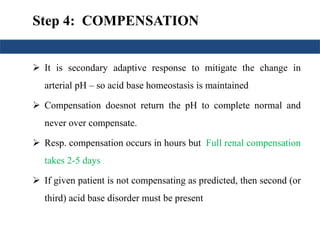
Step 4: COMPENSATION
 It is secondary adaptive response to mitigate the change in
arterial pH – so acid base homeostasis is maintained
 Compensation doesnot return the pH to complete normal and
never over compensate.
 Resp. compensation occurs in hours but Full renal compensation
takes 2-5 days
 If given patient is not compensating as predicted, then second (or
third) acid base disorder must be present
Prediction of compensation
Metabolic acidosis PaCO2= (1.5 x HCO3
-) + 8 ± 2
Metabolic alkalosis
PaCO2 will↑ 0.75 mmHg per mmol/L ↑ in
[HCO3
-] or
PaCO2= 40 + {0.7(HCO3
- - 24)}
Respiratory
acidosis
Acute
[HCO3
-] will ↑ 1 mmol/L per 10 mmHg
in PaCO2
Chronic
[HCO3
-] will ↑ 4 mmol/L per 10 mmHg
in PaCO2
Respiratory
alkalosis
Acute
[HCO3
-] will ↓ 2 mmol/L per 10 mmHg
↓ in PaCO2
Chronic
[HCO3
-] will ↓ 4 mmol/L per 10 mmHg
↓in PaCO2
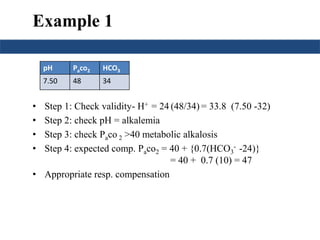
Example 1
• Step 1: Check validity- H+ = 24 (48/34) = 33.8 (7.50 -32)
• Step 2: check pH = alkalemia
• Step 3: check Paco 2 >40 metabolic alkalosis
• Step 4: expected comp. Paco2 = 40 + {0.7(HCO3
- -24)}
= 40 + 0.7 (10) = 47
• Appropriate resp. compensation
pH Paco2 HCO3
7.50 48 34
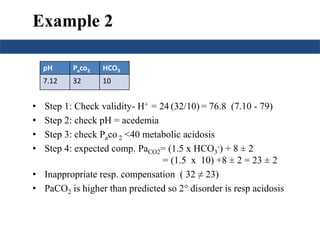
Example 2
• Step 1: Check validity- H+ = 24 (32/10) = 76.8 (7.10 - 79)
• Step 2: check pH = acedemia
• Step 3: check Paco 2 <40 metabolic acidosis
• Step 4: expected comp. PaCO2= (1.5 x HCO3
-) + 8 ± 2
= (1.5 x 10) +8 ± 2 = 23 ± 2
• Inappropriate resp. compensation ( 32 ≠ 23)
• PaCO2 is higher than predicted so 2° disorder is resp acidosis
pH Paco2 HCO3
7.12 32 10
STEP -5 : Calculate anion gap
 Calculation of the anion gap is useful in the initial evaluation of
metabolic acidosis.
 An elevated anion gap usually indicates the production of pathologic
acid (unmesured anion).
 Total Serum Cations = Total Serum Anions
 Unmeasured anions- unmeasured cations= Na+] – {[Cl-]+[HCO3-]}
 Anion gap = [Na+] - [Cl-]-[HCO3-]
 Up to 12 is normal anion gap
• Albumin is the major unmeasured anion
• The anion gap should be corrected if there are gross changes in
serum albumin levels.
AG (CORRECTED) = AG + { (4 – [ALBUMIN]) × 2.5}
Causes of High AG Met Acidosis
• A useful mnemonic for the most common causes is GOLD
MARRK
 G - Ethylene Glycol
 O - 5-oxoproline [pyroglutamic acid]
 L -Lactic Acidosis – metformin ?
 D – d lactate – bacterial overgrowth syndrome
 M – Methanol
 A- Aspirin
 R- Renal Failure
 R- Rhabdomyolsis
 K - Ketoacidosis:
Cowen – Woods classification of lactic acidosis
Type A - hypoxic Type B — nonhypoxic
(septic shock, mesenteric
ischemia, hypoxemia,
hypovolemic shock, carbon
monoxide
poisoning, cyanide)
B1 – 2nd to
Hepatic failure
Renal failure
malignancy
B2:
Thiamine def, seizure
Toxins - salicylate, ethylene
glycol, propylene glycol,
methanol, paraldehyde
Drugs - metformin, propofol,
niacin, isoniazid, iron or NNRTI
B3 – inherited syndromes
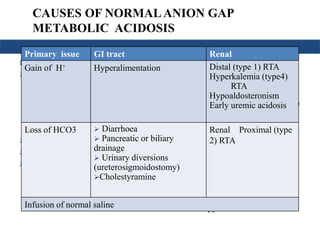
CAUSES OF NORMALANION GAP
METABOLIC ACIDOSIS
1. HCO3 loss:
 GIT
 Diarrhoea
 Pancreatic or biliary
drainage
 Urinary diversions
(ureterosigmoidostomy)
 Renal Proximal (type 2) RTA
 Ketoacidosis (during therapy)
 Post-chronic hypocapnia
2. Impaired renal acid
excretion:
 Distal (type 1) RTA
 Hyperkalemia (type 4)
RTA
 Hypoaldosteronism
 Early uremic acidosis
3. Misc:
 Acid Administration
(NH4Cl)
 Hyperalimentation
Primary issue GI tract Renal
Gain of H+ Hyperalimentation Distal (type 1) RTA
Hyperkalemia (type4)
RTA
Hypoaldosteronism
Early uremic acidosis
Loss of HCO3  Diarrhoea
 Pancreatic or biliary
drainage
 Urinary diversions
(ureterosigmoidostomy)
Cholestyramine
Renal Proximal (type
2) RTA
Infusion of normal saline
NORMALANION GAP METABOLIC ACIDOSIS
• It occurs when the decrease in HCO3
- corresponds with an
increase in Cl- to retain electroneutrality - hyperchloremic
metabolic acidosis.
• Leads to increased renal excretion of NH4.
• Measurement of urinary NH4 can be used to differentiate
between renal and extrarenal causes.
• Urinary anion gap and urinary osmolal gap are often used as
surrogate measures of urinary ammonium.
NORMALANION GAP METABOLIC ACIDOSIS
• UAG
= [Na+ + K+]u – [Cl–]u
• Hence a -ve UAG seen in GI causes while +ve value seen in renal causes
• The urinary osmolal gap
= (2 × [Na+] + 2 × [K+]) + (urine urea nitrogen ÷ 2.8) + (urine glucose ÷ 18)
• Osmolal gap below 40 mmol/L indicates renal cause
• Urine pH
– If urine pH > 5.5 : Type 1 RTA
– If urine pH < 5.5 : Type 2 or Type 4 RTA
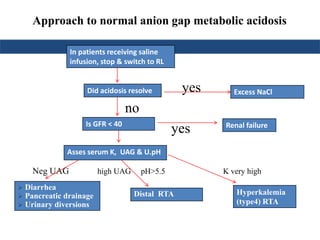
Approach to normal anion gap metabolic acidosis
yes
no
yes
Neg UAG high UAG pH>5.5 K very high
In patients receiving saline
infusion, stop & switch to RL
Did acidosis resolve
Is GFR < 40 Renal failure
Excess NaCl
Hyperkalemia
(type4) RTA
Asses serum K, UAG & U.pH
Distal RTA
 Diarrhea
 Pancreatic drainage
 Urinary diversions
STEP -6 : Calculate the delta gap/ delta ratio
 To diagnose a high anion-gap acidosis with concomitant metabolic
alkalosis or normal anion-gap acidosis
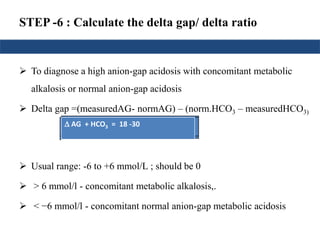
 Delta gap =(measuredAG- normAG) – (norm.HCO3 – measuredHCO3)
= ( AG) - ( HCO3
- )
 Usual range: -6 to +6 mmol/L ; should be 0
 > 6 mmol/l - concomitant metabolic alkalosis,.
 < −6 mmol/l - concomitant normal anion-gap metabolic acidosis
Delta gap= ( AG) - (24 –
measuredHCO3)
±6 = ( AG) - 24 + HCO3)±6 +24 = ( AG) + HCO3) AG + HCO3 = 18 -30
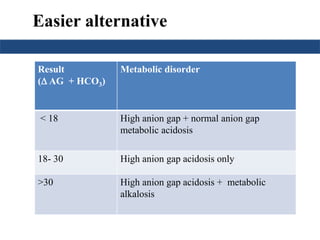
Easier alternative
Result
( AG + HCO3)
Metabolic disorder
< 18 High anion gap + normal anion gap
metabolic acidosis
18- 30 High anion gap acidosis only
>30 High anion gap acidosis + metabolic
alkalosis
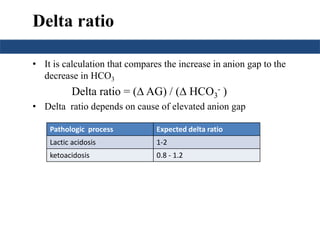
Delta ratio
• It is calculation that compares the increase in anion gap to the
decrease in HCO3
Delta ratio = ( AG) / ( HCO3
- )
• Delta ratio depends on cause of elevated anion gap
Pathologic process Expected delta ratio
Lactic acidosis 1-2
ketoacidosis 0.8 - 1.2
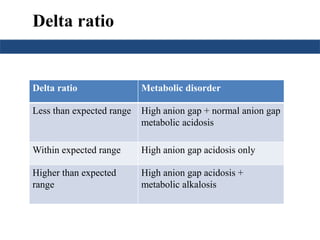
Delta ratio
Delta ratio Metabolic disorder
Less than expected range High anion gap + normal anion gap
metabolic acidosis
Within expected range High anion gap acidosis only
Higher than expected
range
High anion gap acidosis +
metabolic alkalosis
PLASMA OSMOLAR GAP
 Calculated Plasma Osmolarity = 2[Na+] + [Gluc]/18 + [BUN]/2.8
Normal Measured Plasma Osmolarity > Calculated Plasma Osmolarity
(upto 10 mOsm/L)
 Measured Plasma Osmolarity - Calculated Plasma Osmolarity > 10
mOsm/kg indicates presence of abnormal osmotically active substance
Ethanol
Methanol
Ethylene glycol
METABOLIC
ALKALOSIS
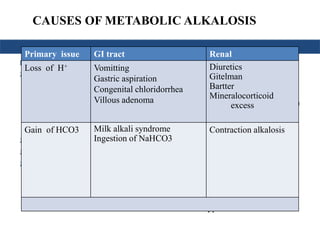
CAUSES OF METABOLIC ALKALOSIS
1. HCO3 loss:
 GIT
 Diarrhoea
 Pancreatic or biliary
drainage
 Urinary diversions
(ureterosigmoidostomy)
 Renal Proximal (type 2) RTA
 Ketoacidosis (during therapy)
 Post-chronic hypocapnia
2. Impaired renal acid
excretion:
 Distal (type 1) RTA
 Hyperkalemia (type 4)
RTA
 Hypoaldosteronism
 Early uremic acidosis
3. Misc:
 Acid Administration
(NH4Cl)
 Hyperalimentation
Primary issue GI tract Renal
Loss of H+ Vomitting
Gastric aspiration
Congenital chloridorrhea
Villous adenoma
Diuretics
Gitelman
Bartter
Mineralocorticoid
excess
Gain of HCO3 Milk alkali syndrome
Ingestion of NaHCO3
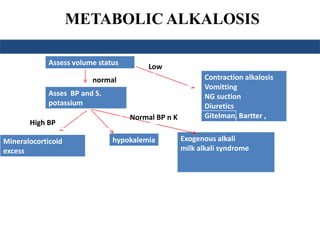
Contraction alkalosis
METABOLIC ALKALOSIS
Assess volume status
Low
Asses BP and S.
potassium
Contraction alkalosis
Vomitting
NG suction
Diuretics
Gitelman, Bartter ,
Exogenous alkali
milk alkali syndrome
Mineralocorticoid
excess
hypokalemia
normal
High BP
Normal BP n K
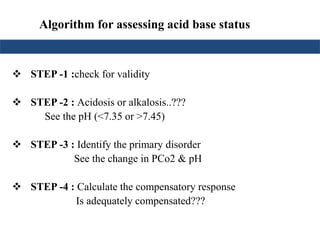
 STEP -1 :check for validity
 STEP -2 : Acidosis or alkalosis..???
See the pH (<7.35 or >7.45)
 STEP -3 : Identify the primary disorder
See the change in PCo2 & pH
 STEP -4 : Calculate the compensatory response
Is adequately compensated???
Algorithm for assessing acid base status
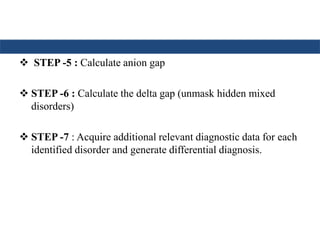
 STEP -5 : Calculate anion gap
 STEP -6 : Calculate the delta gap (unmask hidden mixed
disorders)
 STEP -7 : Acquire additional relevant diagnostic data for each
identified disorder and generate differential diagnosis.
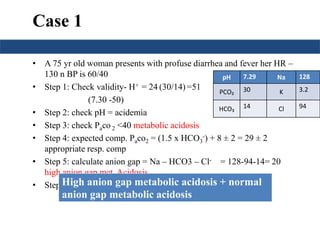
Case 1
• A 75 yr old woman presents with profuse diarrhea and fever her HR –
130 n BP is 60/40
• Step 1: Check validity- H+ = 24 (30/14) =51
(7.30 -50)
• Step 2: check pH = acidemia
• Step 3: check Paco 2 <40 metabolic acidosis
• Step 4: expected comp. Paco2 = (1.5 x HCO3
-) + 8 ± 2 = 29 ± 2
appropriate resp. comp
• Step 5: calculate anion gap = Na – HCO3 – Cl- = 128-94-14= 20
high anion gap met. Acidosis
• Step 6: delta ratio = ( AG) / ( HCO3
- ) =(20-12)/10 = 0.8.
pH 7.29 Na 128
PCO₂ 30 K 3.2
HCO₃ 14 Cl 94
High anion gap metabolic acidosis + normal
anion gap metabolic acidosis
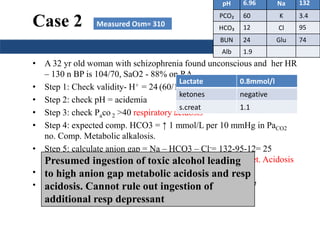
Case 2
• A 32 yr old woman with schizophrenia found unconscious and her HR
– 130 n BP is 104/70, SaO2 - 88% on RA
• Step 1: Check validity- H+ = 24 (60/13) = 110 (6.95 -112)
• Step 2: check pH = acidemia
• Step 3: check Paco 2 >40 respiratory acidosis
• Step 4: expected comp. HCO3 = ↑ 1 mmol/L per 10 mmHg in PaCO2
no. Comp. Metabolic alkalosis.
• Step 5: calculate anion gap = Na – HCO3 – Cl-= 132-95-12= 25
adjusted anion gap =25 + 2.5(4-alb)=30 high anion gap met. Acidosis
• Step 6: delta ratio = ( AG) / ( HCO3
- ) =(30-12)/12 = 1.5
• Calculate Plasma Osmolarity = 2(132) +24/2.8+74/18= 277
pH 6.96 Na 132
PCO₂ 60 K 3.4
HCO₃ 12 Cl 95
BUN 24 Glu 74
Alb 1.9
Lactate 0.8mmol/l
ketones negative
s.creat 1.1
Measured Osm= 310
Presumed ingestion of toxic alcohol leading
to high anion gap metabolic acidosis and resp
acidosis. Cannot rule out ingestion of
additional resp depressant
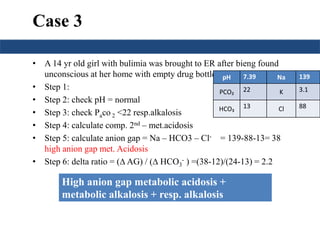
Case 3
• A 14 yr old girl with bulimia was brought to ER after bieng found
unconscious at her home with empty drug bottle nearby.
• Step 1:
• Step 2: check pH = normal
• Step 3: check Paco 2 <22 resp.alkalosis
• Step 4: calculate comp. 2nd – met.acidosis
• Step 5: calculate anion gap = Na – HCO3 – Cl- = 139-88-13= 38
high anion gap met. Acidosis
• Step 6: delta ratio = ( AG) / ( HCO3
- ) =(38-12)/(24-13) = 2.2
pH 7.39 Na 139
PCO₂ 22 K 3.1
HCO₃ 13 Cl 88
High anion gap metabolic acidosis +
metabolic alkalosis + resp. alkalosis
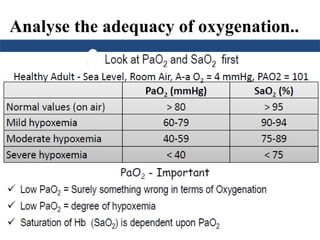
Analyse the adequacy of oxygenation..
• Causes of hypoxia
– Hypoxemia
– Anemia
– Dyshemoglobenemia
– Histotoxic hypoxia
A-a gradient
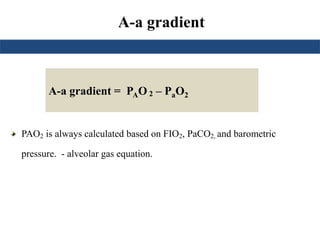
PAO2 is always calculated based on FIO2, PaCO2, and barometric
pressure. - alveolar gas equation.
A-a gradient = PAO 2 – PaO2
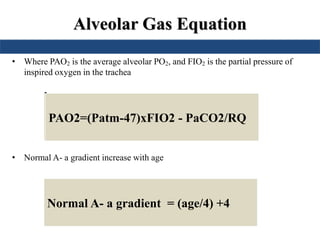
Alveolar Gas Equation
• Where PAO2 is the average alveolar PO2, and FIO2 is the partial pressure of
inspired oxygen in the trachea
•
• Normal A- a gradient increase with age
PAO2=150 – 1.25(PaCO2)PAO2=(760-47)x0.21 - PaCO2/0.8PAO2=(Patm-47)xFIO2 - PaCO2/RQ
Normal A- a gradient = (age/4) +4
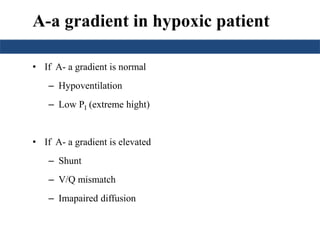
A-a gradient in hypoxic patient
• If A- a gradient is normal
– Hypoventilation
– Low PI (extreme hight)
• If A- a gradient is elevated
– Shunt
– V/Q mismatch
– Imapaired diffusion
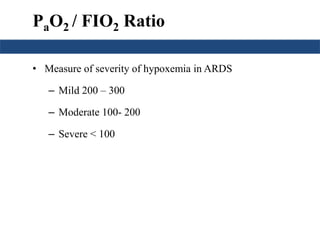
PaO2 / FIO2 Ratio
• Measure of severity of hypoxemia in ARDS
– Mild 200 – 300
– Moderate 100- 200
– Severe < 100
Saturation gap
• Saturation gap = [ SpO2 - Sa O2]
• > 5% is significant.
• Causes: methemoglobinemia
carboxyhemoglobinemia
Example 1
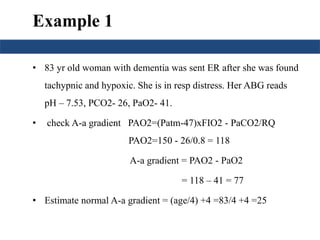
• 83 yr old woman with dementia was sent ER after she was found
tachypnic and hypoxic. She is in resp distress. Her ABG reads
pH – 7.53, PCO2- 26, PaO2- 41.
• check A-a gradient PAO2=(Patm-47)xFIO2 - PaCO2/RQ
PAO2=150 - 26/0.8 = 118
A-a gradient = PAO2 - PaO2
= 118 – 41 = 77
• Estimate normal A-a gradient = (age/4) +4 =83/4 +4 =25
Example 2
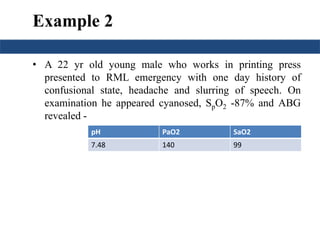
• A 22 yr old young male who works in printing press
presented to RML emergency with one day history of
confusional state, headache and slurring of speech. On
examination he appeared cyanosed, SpO2 -87% and ABG
revealed -
pH PaO2 SaO2
7.48 140 99
Spirometry
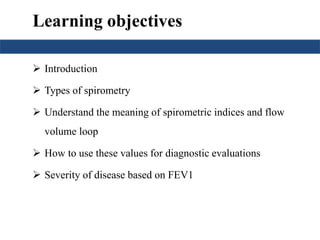
Learning objectives
 Introduction
 Types of spirometry
 Understand the meaning of spirometric indices and flow
volume loop
 How to use these values for diagnostic evaluations
 Severity of disease based on FEV1
Spirometry
• Method of assessing lung function by measuring the volume of
air that the patient is able to expel from the lungs after a maximal
inspiration.
• It is a reliable method of differentiating between obstructive
airways disorders and restrictive diseases.
• Spirometry is the most effective way of determining the severity
of COPD.
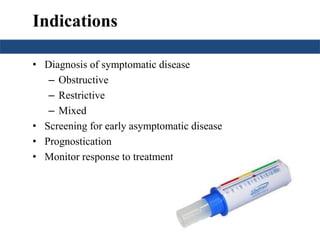
Indications
• Diagnosis of symptomatic disease
– Obstructive
– Restrictive
– Mixed
• Screening for early asymptomatic disease
• Prognostication
• Monitor response to treatment
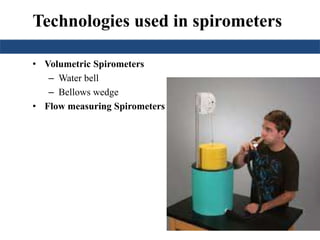
Technologies used in spirometers
• Volumetric Spirometers
– Water bell
– Bellows wedge
• Flow measuring Spirometers
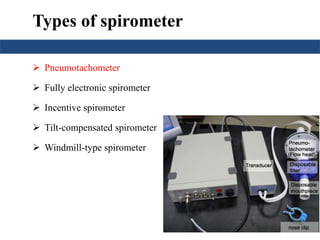
Types of spirometer
 Pneumotachometer
 Fully electronic spirometer
 Incentive spirometer
 Tilt-compensated spirometer
 Windmill-type spirometer
Spirograms
• Most spirometers display the following graphs
 a volume-time curve, showing volume (liters) along the Y-axis
and time (seconds) along the X-axis
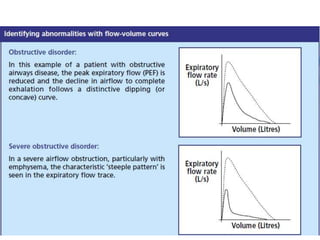
 a flow-volume loop, which graphically depicts the rate of airflow
on the Y-axis and the total volume inspired or expired on the X-
axis
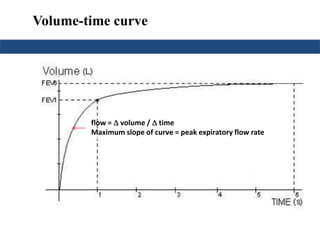
Volume-time curve
flow =  volume /  time
Maximum slope of curve = peak expiratory flow rate
Spirometry indices
• FVC – the total volume of air that the patient can forcibly exhale
in one breath after maximal inspiration.
• FEV1 – the volume of air that the patient is able to exhale in the
first second of forced expiration.
• FEV1 /FVC – the ratio of FEV1 to FVC expressed as a fraction
(previously this was expressed as a percentage).
• MEF25-75 This is the mid expiratory flow rate between 25-75%
of an expired air .
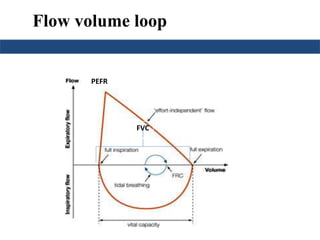
Flow volume loop
FVC
PEFR
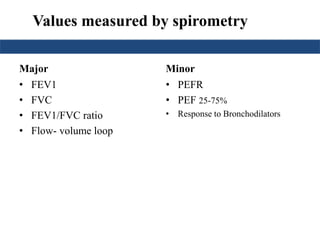
Values measured by spirometry
Major
• FEV1
• FVC
• FEV1/FVC ratio
• Flow- volume loop
Minor
• PEFR
• PEF 25-75%
• Response to Bronchodilators
INTERPRETATION
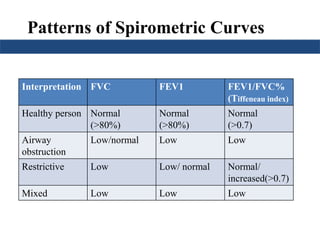
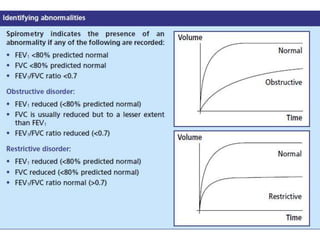
Patterns of Spirometric Curves
Interpretation FVC FEV1 FEV1/FVC%
(Tiffeneau index)
Healthy person Normal
(>80%)
Normal
(>80%)
Normal
(>0.7)
Airway
obstruction
Low/normal Low Low
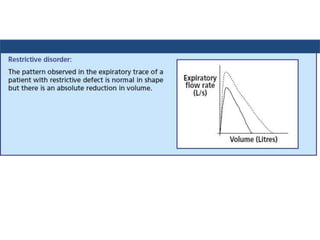
Restrictive Low Low/ normal Normal/
increased(>0.7)
Mixed Low Low Low
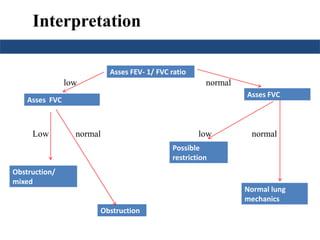
Interpretation
low normal
Low normal low normal
Asses FEV- 1/ FVC ratio
Asses FVC
Asses FVC
Normal lung
mechanics
Possible
restriction
Obstruction
Obstruction/
mixed
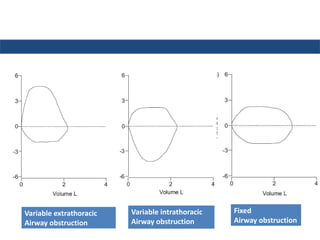
Fixed
Airway obstruction
Variable extrathoracic
Airway obstruction
Variable intrathoracic
Airway obstruction
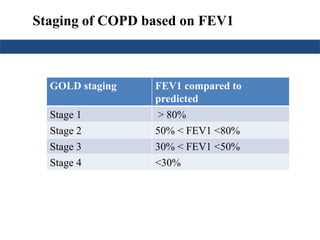
Staging of COPD based on FEV1
GOLD staging FEV1 compared to
predicted
Stage 1 > 80%
Stage 2 50% < FEV1 <80%
Stage 3 30% < FEV1 <50%
Stage 4 <30%
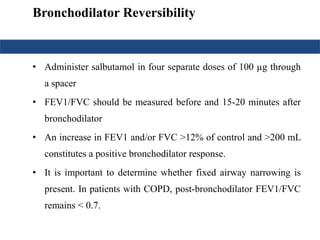
Bronchodilator Reversibility
• Administer salbutamol in four separate doses of 100 µg through
a spacer
• FEV1/FVC should be measured before and 15-20 minutes after
bronchodilator
• An increase in FEV1 and/or FVC >12% of control and >200 mL
constitutes a positive bronchodilator response.
• It is important to determine whether fixed airway narrowing is
present. In patients with COPD, post-bronchodilator FEV1/FVC
remains < 0.7.
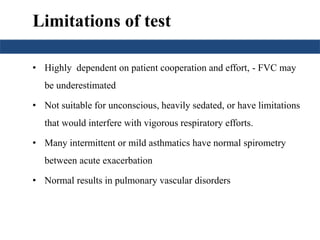
Limitations of test
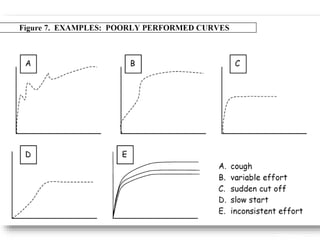
• Highly dependent on patient cooperation and effort, - FVC may
be underestimated
• Not suitable for unconscious, heavily sedated, or have limitations
that would interfere with vigorous respiratory efforts.
• Many intermittent or mild asthmatics have normal spirometry
between acute exacerbation
• Normal results in pulmonary vascular disorders
goldcopd.com
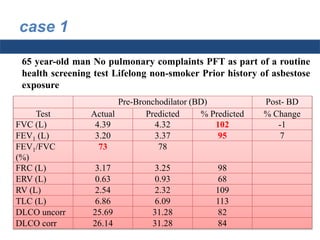
case 1
Pre-Bronchodilator (BD) Post- BD
Test Actual Predicted % Predicted % Change
FVC (L) 4.39 4.32 102 -1
FEV1 (L) 3.20 3.37 95 7
FEV1/FVC
(%)
73 78
FRC (L) 3.17 3.25 98
ERV (L) 0.63 0.93 68
RV (L) 2.54 2.32 109
TLC (L) 6.86 6.09 113
DLCO uncorr 25.69 31.28 82
DLCO corr 26.14 31.28 84
65 year-old man No pulmonary complaints PFT as part of a routine
health screening test Lifelong non-smoker Prior history of asbestose
exposure
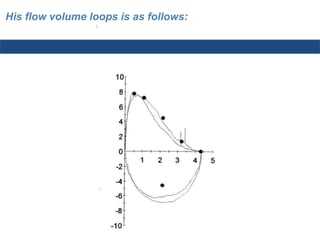
His flow volume loops is as follows:
:
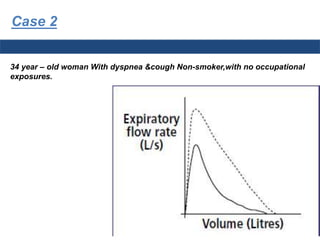
34 year – old woman With dyspnea &cough Non-smoker,with no occupational
exposures.
Case 2
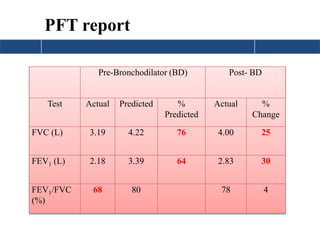
Pre-Bronchodilator (BD) Post- BD
Test Actual Predicted %
Predicted
Actual %
Change
FVC (L) 3.19 4.22 76 4.00 25
FEV1 (L) 2.18 3.39 64 2.83 30
FEV1/FVC
(%)
68 80 78 4
PFT report
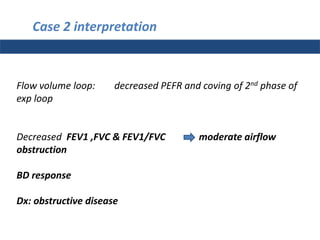
Flow volume loop: decreased PEFR and coving of 2nd phase of
exp loop
Decreased FEV1 ,FVC & FEV1/FVC moderate airflow
obstruction
BD response
Dx: obstructive disease
Case 2 interpretation
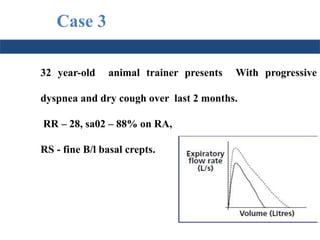
32 year-old animal trainer presents With progressive
dyspnea and dry cough over last 2 months.
RR – 28, sa02 – 88% on RA,
RS - fine B/l basal crepts.
Case 3
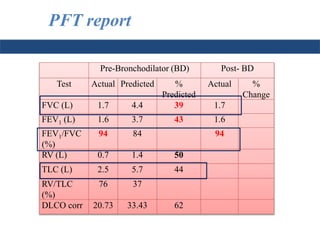
Pre-Bronchodilator (BD) Post- BD
Test Actual Predicted %
Predicted
Actual %
Change
FVC (L) 1.7 4.4 39 1.7
FEV1 (L) 1.6 3.7 43 1.6
FEV1/FVC
(%)
94 84 94
RV (L) 0.7 1.4 50
TLC (L) 2.5 5.7 44
RV/TLC
(%)
76 37
DLCO corr 20.73 33.43 62
PFT report
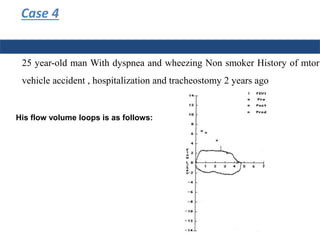
25 year-old man With dyspnea and wheezing Non smoker History of mtor
vehicle accident , hospitalization and tracheostomy 2 years ago
Case 4
His flow volume loops is as follows:
Pre-Bronchodilator (BD)
Test Actual Predicted % Predicted
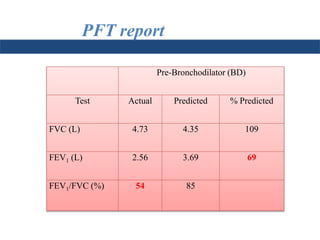
FVC (L) 4.73 4.35 109
FEV1 (L) 2.56 3.69 69
FEV1/FVC (%) 54 85
PFT report
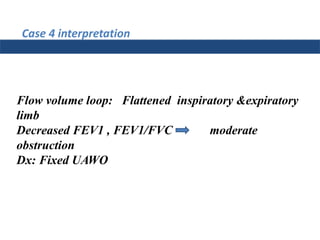
Case 4 interpretation
Flow volume loop: Flattened inspiratory &expiratory
limb
Decreased FEV1 , FEV1/FVC moderate
obstruction
Dx: Fixed UAWO
Take home messages…
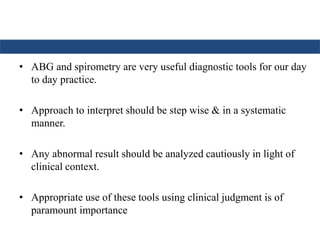
• ABG and spirometry are very useful diagnostic tools for our day
to day practice.
• Approach to interpret should be step wise & in a systematic
manner.
• Any abnormal result should be analyzed cautiously in light of
clinical context.
• Appropriate use of these tools using clinical judgment is of
paramount importance
Bibliography
• HARRISON’S principles of internal medicine, 18th edition.
• Disorders of Fluids and Electrolytes, Julie R. Ingelfinger, M.D.,
NEJM, 0ct-9, 2014.
• Spirometry for health care providers, GOLD, 2010.
• ‘‘ATS/ERS TASK FORCE: STANDARDISATION OF LUNG
FUNCTION TESTING’’ V. Brusasco, R. Crapo and G. Viegi,
Eur Respir J 2005; 26: 948–968
• Vijayan ; Spirometry in South Indian children Indian J Chest Dis
Allied Sci 2000; 42: 147–156
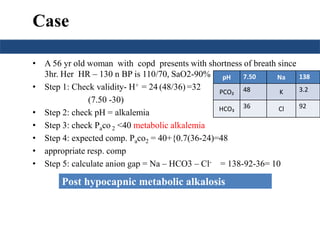
Case
• A 56 yr old woman with copd presents with shortness of breath since
3hr. Her HR – 130 n BP is 110/70, SaO2-90%
• Step 1: Check validity- H+ = 24 (48/36) =32
(7.50 -30)
• Step 2: check pH = alkalemia
• Step 3: check Paco 2 <40 metabolic alkalemia
• Step 4: expected comp. Paco2 = 40+{0.7(36-24)=48
• appropriate resp. comp
• Step 5: calculate anion gap = Na – HCO3 – Cl- = 138-92-36= 10
pH 7.50 Na 138
PCO₂ 48 K 3.2
HCO₃ 36 Cl 92
Post hypocapnic metabolic alkalosis

ABG and spirometry

  • 1.
    Interpretation of ABGsand Spirometry DR. SUBODH KUMAR MAHTO PGI PGIMER,DR.RML HOSPITAL. NEW Delhi
  • 2.
    Acid base disorders •Acid–base homeostasis is fundamental for maintaining life • The hydrogen-ion concentration is tightly regulated because changes in hydrogen ions alter virtually all protein and membrane functions. • The three major methods of quantifying acid–base disorders are – The physiological approach-isohydric principle – The base-excess approach – The physicochemical approach –Stewart method
  • 3.
    Normal components ofABG report Parameters Normal range pH 7.35 – 7.45 PaCO2 35 – 45 PaO2 80- 100 HCO3 22-26 SaO2 >95%
  • 4.
    Check for ERRORS Havethe required parameters been correctly fed..???  Patient’s Temperature  Fi O₂ : specially if patient is in ventilator  Hemoglobin : some machines may not measure it  Barometric pressure : some machines may not measure it
  • 5.
  • 6.
    Step 1:Assessment ofvalidity of test results • Assess the internal consistency of the values using the Henderseon- Hasselbach equation • If there is a discripancy between the 2 results, the blood should be reanalyzed. • HCO3 should be within 1-3 mEq/L of Total CO2 (electrolyte). A difference of > 4 mEq/L = technical error [H+] in nmol/L = 24 × PaCO₂/HCO₃
  • 7.
    pH is inverselyrelated to [H+]; a pH change of 1.00 represents a 10-fold change in [H+] pH [H+] in nanomoles/L 7.00 100 7.10 80 7.30 50 7.40 40 7.52 30 7.70 20 8.00 10 Relation b/w pH & H+ conc. Step 1: Assessment of validity of test results
  • 8.
    STEP -2: Acidemiaor alkalemia..??? See the pH (<7.35 or >7.45)  Acidemia –pH less than 7.35  Acidosis – A process that would cause acidemia, if not compensated  Alkalemia–pH greater than 7.45  Alkalosis – A process that would cause alkalemia if not compensated
  • 9.
    Four primary acid-basedisorders  Metabolic acidosis  Metabolic alkalosis  Respiratory acidosis  Respiratory alkalosis
  • 10.
    STEP -3 :Identify the primary disorder See the change in PaCo2 & HCO3 -  If the PaCo2 is deranged in the same direction of pH then the primary disorder is metabolic  If the PaCo2 is deranged in the opposite direction of pH then the primary disorder is respiratory pH PaCo2 HCO3 7.25 60 26 Respiratory acidosis
  • 11.
    Step 4: COMPENSATION It is secondary adaptive response to mitigate the change in arterial pH – so acid base homeostasis is maintained  Compensation doesnot return the pH to complete normal and never over compensate.  Resp. compensation occurs in hours but Full renal compensation takes 2-5 days  If given patient is not compensating as predicted, then second (or third) acid base disorder must be present
  • 12.
    Prediction of compensation Metabolicacidosis PaCO2= (1.5 x HCO3 -) + 8 ± 2 Metabolic alkalosis PaCO2 will↑ 0.75 mmHg per mmol/L ↑ in [HCO3 -] or PaCO2= 40 + {0.7(HCO3 - - 24)} Respiratory acidosis Acute [HCO3 -] will ↑ 1 mmol/L per 10 mmHg in PaCO2 Chronic [HCO3 -] will ↑ 4 mmol/L per 10 mmHg in PaCO2 Respiratory alkalosis Acute [HCO3 -] will ↓ 2 mmol/L per 10 mmHg ↓ in PaCO2 Chronic [HCO3 -] will ↓ 4 mmol/L per 10 mmHg ↓in PaCO2
  • 13.
    Example 1 • Step1: Check validity- H+ = 24 (48/34) = 33.8 (7.50 -32) • Step 2: check pH = alkalemia • Step 3: check Paco 2 >40 metabolic alkalosis • Step 4: expected comp. Paco2 = 40 + {0.7(HCO3 - -24)} = 40 + 0.7 (10) = 47 • Appropriate resp. compensation pH Paco2 HCO3 7.50 48 34
  • 14.
    Example 2 • Step1: Check validity- H+ = 24 (32/10) = 76.8 (7.10 - 79) • Step 2: check pH = acedemia • Step 3: check Paco 2 <40 metabolic acidosis • Step 4: expected comp. PaCO2= (1.5 x HCO3 -) + 8 ± 2 = (1.5 x 10) +8 ± 2 = 23 ± 2 • Inappropriate resp. compensation ( 32 ≠ 23) • PaCO2 is higher than predicted so 2° disorder is resp acidosis pH Paco2 HCO3 7.12 32 10
  • 15.
    STEP -5 :Calculate anion gap  Calculation of the anion gap is useful in the initial evaluation of metabolic acidosis.  An elevated anion gap usually indicates the production of pathologic acid (unmesured anion).  Total Serum Cations = Total Serum Anions  Unmeasured anions- unmeasured cations= Na+] – {[Cl-]+[HCO3-]}  Anion gap = [Na+] - [Cl-]-[HCO3-]  Up to 12 is normal anion gap
  • 16.
    • Albumin isthe major unmeasured anion • The anion gap should be corrected if there are gross changes in serum albumin levels. AG (CORRECTED) = AG + { (4 – [ALBUMIN]) × 2.5}
  • 17.
    Causes of HighAG Met Acidosis • A useful mnemonic for the most common causes is GOLD MARRK  G - Ethylene Glycol  O - 5-oxoproline [pyroglutamic acid]  L -Lactic Acidosis – metformin ?  D – d lactate – bacterial overgrowth syndrome  M – Methanol  A- Aspirin  R- Renal Failure  R- Rhabdomyolsis  K - Ketoacidosis: Cowen – Woods classification of lactic acidosis Type A - hypoxic Type B — nonhypoxic (septic shock, mesenteric ischemia, hypoxemia, hypovolemic shock, carbon monoxide poisoning, cyanide) B1 – 2nd to Hepatic failure Renal failure malignancy B2: Thiamine def, seizure Toxins - salicylate, ethylene glycol, propylene glycol, methanol, paraldehyde Drugs - metformin, propofol, niacin, isoniazid, iron or NNRTI B3 – inherited syndromes
  • 18.
    CAUSES OF NORMALANIONGAP METABOLIC ACIDOSIS 1. HCO3 loss:  GIT  Diarrhoea  Pancreatic or biliary drainage  Urinary diversions (ureterosigmoidostomy)  Renal Proximal (type 2) RTA  Ketoacidosis (during therapy)  Post-chronic hypocapnia 2. Impaired renal acid excretion:  Distal (type 1) RTA  Hyperkalemia (type 4) RTA  Hypoaldosteronism  Early uremic acidosis 3. Misc:  Acid Administration (NH4Cl)  Hyperalimentation Primary issue GI tract Renal Gain of H+ Hyperalimentation Distal (type 1) RTA Hyperkalemia (type4) RTA Hypoaldosteronism Early uremic acidosis Loss of HCO3  Diarrhoea  Pancreatic or biliary drainage  Urinary diversions (ureterosigmoidostomy) Cholestyramine Renal Proximal (type 2) RTA Infusion of normal saline
  • 19.
    NORMALANION GAP METABOLICACIDOSIS • It occurs when the decrease in HCO3 - corresponds with an increase in Cl- to retain electroneutrality - hyperchloremic metabolic acidosis. • Leads to increased renal excretion of NH4. • Measurement of urinary NH4 can be used to differentiate between renal and extrarenal causes. • Urinary anion gap and urinary osmolal gap are often used as surrogate measures of urinary ammonium.
  • 20.
    NORMALANION GAP METABOLICACIDOSIS • UAG = [Na+ + K+]u – [Cl–]u • Hence a -ve UAG seen in GI causes while +ve value seen in renal causes • The urinary osmolal gap = (2 × [Na+] + 2 × [K+]) + (urine urea nitrogen ÷ 2.8) + (urine glucose ÷ 18) • Osmolal gap below 40 mmol/L indicates renal cause • Urine pH – If urine pH > 5.5 : Type 1 RTA – If urine pH < 5.5 : Type 2 or Type 4 RTA
  • 21.
    Approach to normalanion gap metabolic acidosis yes no yes Neg UAG high UAG pH>5.5 K very high In patients receiving saline infusion, stop & switch to RL Did acidosis resolve Is GFR < 40 Renal failure Excess NaCl Hyperkalemia (type4) RTA Asses serum K, UAG & U.pH Distal RTA  Diarrhea  Pancreatic drainage  Urinary diversions
  • 22.
    STEP -6 :Calculate the delta gap/ delta ratio  To diagnose a high anion-gap acidosis with concomitant metabolic alkalosis or normal anion-gap acidosis  Delta gap =(measuredAG- normAG) – (norm.HCO3 – measuredHCO3) = ( AG) - ( HCO3 - )  Usual range: -6 to +6 mmol/L ; should be 0  > 6 mmol/l - concomitant metabolic alkalosis,.  < −6 mmol/l - concomitant normal anion-gap metabolic acidosis Delta gap= ( AG) - (24 – measuredHCO3) ±6 = ( AG) - 24 + HCO3)±6 +24 = ( AG) + HCO3) AG + HCO3 = 18 -30
  • 23.
    Easier alternative Result ( AG+ HCO3) Metabolic disorder < 18 High anion gap + normal anion gap metabolic acidosis 18- 30 High anion gap acidosis only >30 High anion gap acidosis + metabolic alkalosis
  • 24.
    Delta ratio • Itis calculation that compares the increase in anion gap to the decrease in HCO3 Delta ratio = ( AG) / ( HCO3 - ) • Delta ratio depends on cause of elevated anion gap Pathologic process Expected delta ratio Lactic acidosis 1-2 ketoacidosis 0.8 - 1.2
  • 25.
    Delta ratio Delta ratioMetabolic disorder Less than expected range High anion gap + normal anion gap metabolic acidosis Within expected range High anion gap acidosis only Higher than expected range High anion gap acidosis + metabolic alkalosis
  • 26.
    PLASMA OSMOLAR GAP Calculated Plasma Osmolarity = 2[Na+] + [Gluc]/18 + [BUN]/2.8 Normal Measured Plasma Osmolarity > Calculated Plasma Osmolarity (upto 10 mOsm/L)  Measured Plasma Osmolarity - Calculated Plasma Osmolarity > 10 mOsm/kg indicates presence of abnormal osmotically active substance Ethanol Methanol Ethylene glycol
  • 27.
  • 28.
    CAUSES OF METABOLICALKALOSIS 1. HCO3 loss:  GIT  Diarrhoea  Pancreatic or biliary drainage  Urinary diversions (ureterosigmoidostomy)  Renal Proximal (type 2) RTA  Ketoacidosis (during therapy)  Post-chronic hypocapnia 2. Impaired renal acid excretion:  Distal (type 1) RTA  Hyperkalemia (type 4) RTA  Hypoaldosteronism  Early uremic acidosis 3. Misc:  Acid Administration (NH4Cl)  Hyperalimentation Primary issue GI tract Renal Loss of H+ Vomitting Gastric aspiration Congenital chloridorrhea Villous adenoma Diuretics Gitelman Bartter Mineralocorticoid excess Gain of HCO3 Milk alkali syndrome Ingestion of NaHCO3 Contraction alkalosis
  • 29.
    METABOLIC ALKALOSIS Assess volumestatus Low Asses BP and S. potassium Contraction alkalosis Vomitting NG suction Diuretics Gitelman, Bartter , Exogenous alkali milk alkali syndrome Mineralocorticoid excess hypokalemia normal High BP Normal BP n K
  • 30.
     STEP -1:check for validity  STEP -2 : Acidosis or alkalosis..??? See the pH (<7.35 or >7.45)  STEP -3 : Identify the primary disorder See the change in PCo2 & pH  STEP -4 : Calculate the compensatory response Is adequately compensated??? Algorithm for assessing acid base status
  • 31.
     STEP -5: Calculate anion gap  STEP -6 : Calculate the delta gap (unmask hidden mixed disorders)  STEP -7 : Acquire additional relevant diagnostic data for each identified disorder and generate differential diagnosis.
  • 32.
    Case 1 • A75 yr old woman presents with profuse diarrhea and fever her HR – 130 n BP is 60/40 • Step 1: Check validity- H+ = 24 (30/14) =51 (7.30 -50) • Step 2: check pH = acidemia • Step 3: check Paco 2 <40 metabolic acidosis • Step 4: expected comp. Paco2 = (1.5 x HCO3 -) + 8 ± 2 = 29 ± 2 appropriate resp. comp • Step 5: calculate anion gap = Na – HCO3 – Cl- = 128-94-14= 20 high anion gap met. Acidosis • Step 6: delta ratio = ( AG) / ( HCO3 - ) =(20-12)/10 = 0.8. pH 7.29 Na 128 PCO₂ 30 K 3.2 HCO₃ 14 Cl 94 High anion gap metabolic acidosis + normal anion gap metabolic acidosis
  • 33.
    Case 2 • A32 yr old woman with schizophrenia found unconscious and her HR – 130 n BP is 104/70, SaO2 - 88% on RA • Step 1: Check validity- H+ = 24 (60/13) = 110 (6.95 -112) • Step 2: check pH = acidemia • Step 3: check Paco 2 >40 respiratory acidosis • Step 4: expected comp. HCO3 = ↑ 1 mmol/L per 10 mmHg in PaCO2 no. Comp. Metabolic alkalosis. • Step 5: calculate anion gap = Na – HCO3 – Cl-= 132-95-12= 25 adjusted anion gap =25 + 2.5(4-alb)=30 high anion gap met. Acidosis • Step 6: delta ratio = ( AG) / ( HCO3 - ) =(30-12)/12 = 1.5 • Calculate Plasma Osmolarity = 2(132) +24/2.8+74/18= 277 pH 6.96 Na 132 PCO₂ 60 K 3.4 HCO₃ 12 Cl 95 BUN 24 Glu 74 Alb 1.9 Lactate 0.8mmol/l ketones negative s.creat 1.1 Measured Osm= 310 Presumed ingestion of toxic alcohol leading to high anion gap metabolic acidosis and resp acidosis. Cannot rule out ingestion of additional resp depressant
  • 34.
    Case 3 • A14 yr old girl with bulimia was brought to ER after bieng found unconscious at her home with empty drug bottle nearby. • Step 1: • Step 2: check pH = normal • Step 3: check Paco 2 <22 resp.alkalosis • Step 4: calculate comp. 2nd – met.acidosis • Step 5: calculate anion gap = Na – HCO3 – Cl- = 139-88-13= 38 high anion gap met. Acidosis • Step 6: delta ratio = ( AG) / ( HCO3 - ) =(38-12)/(24-13) = 2.2 pH 7.39 Na 139 PCO₂ 22 K 3.1 HCO₃ 13 Cl 88 High anion gap metabolic acidosis + metabolic alkalosis + resp. alkalosis
  • 35.
    Analyse the adequacyof oxygenation..
  • 36.
    • Causes ofhypoxia – Hypoxemia – Anemia – Dyshemoglobenemia – Histotoxic hypoxia
  • 37.
    A-a gradient PAO2 isalways calculated based on FIO2, PaCO2, and barometric pressure. - alveolar gas equation. A-a gradient = PAO 2 – PaO2
  • 38.
    Alveolar Gas Equation •Where PAO2 is the average alveolar PO2, and FIO2 is the partial pressure of inspired oxygen in the trachea • • Normal A- a gradient increase with age PAO2=150 – 1.25(PaCO2)PAO2=(760-47)x0.21 - PaCO2/0.8PAO2=(Patm-47)xFIO2 - PaCO2/RQ Normal A- a gradient = (age/4) +4
  • 39.
    A-a gradient inhypoxic patient • If A- a gradient is normal – Hypoventilation – Low PI (extreme hight) • If A- a gradient is elevated – Shunt – V/Q mismatch – Imapaired diffusion
  • 40.
    PaO2 / FIO2Ratio • Measure of severity of hypoxemia in ARDS – Mild 200 – 300 – Moderate 100- 200 – Severe < 100
  • 41.
    Saturation gap • Saturationgap = [ SpO2 - Sa O2] • > 5% is significant. • Causes: methemoglobinemia carboxyhemoglobinemia
  • 42.
    Example 1 • 83yr old woman with dementia was sent ER after she was found tachypnic and hypoxic. She is in resp distress. Her ABG reads pH – 7.53, PCO2- 26, PaO2- 41. • check A-a gradient PAO2=(Patm-47)xFIO2 - PaCO2/RQ PAO2=150 - 26/0.8 = 118 A-a gradient = PAO2 - PaO2 = 118 – 41 = 77 • Estimate normal A-a gradient = (age/4) +4 =83/4 +4 =25
  • 43.
    Example 2 • A22 yr old young male who works in printing press presented to RML emergency with one day history of confusional state, headache and slurring of speech. On examination he appeared cyanosed, SpO2 -87% and ABG revealed - pH PaO2 SaO2 7.48 140 99
  • 44.
  • 45.
    Learning objectives  Introduction Types of spirometry  Understand the meaning of spirometric indices and flow volume loop  How to use these values for diagnostic evaluations  Severity of disease based on FEV1
  • 46.
    Spirometry • Method ofassessing lung function by measuring the volume of air that the patient is able to expel from the lungs after a maximal inspiration. • It is a reliable method of differentiating between obstructive airways disorders and restrictive diseases. • Spirometry is the most effective way of determining the severity of COPD.
  • 47.
    Indications • Diagnosis ofsymptomatic disease – Obstructive – Restrictive – Mixed • Screening for early asymptomatic disease • Prognostication • Monitor response to treatment
  • 48.
    Technologies used inspirometers • Volumetric Spirometers – Water bell – Bellows wedge • Flow measuring Spirometers
  • 49.
    Types of spirometer Pneumotachometer  Fully electronic spirometer  Incentive spirometer  Tilt-compensated spirometer  Windmill-type spirometer
  • 50.
    Spirograms • Most spirometersdisplay the following graphs  a volume-time curve, showing volume (liters) along the Y-axis and time (seconds) along the X-axis  a flow-volume loop, which graphically depicts the rate of airflow on the Y-axis and the total volume inspired or expired on the X- axis
  • 51.
    Volume-time curve flow = volume /  time Maximum slope of curve = peak expiratory flow rate
  • 52.
    Spirometry indices • FVC– the total volume of air that the patient can forcibly exhale in one breath after maximal inspiration. • FEV1 – the volume of air that the patient is able to exhale in the first second of forced expiration. • FEV1 /FVC – the ratio of FEV1 to FVC expressed as a fraction (previously this was expressed as a percentage). • MEF25-75 This is the mid expiratory flow rate between 25-75% of an expired air .
  • 53.
  • 54.
    Values measured byspirometry Major • FEV1 • FVC • FEV1/FVC ratio • Flow- volume loop Minor • PEFR • PEF 25-75% • Response to Bronchodilators
  • 55.
  • 56.
    Patterns of SpirometricCurves Interpretation FVC FEV1 FEV1/FVC% (Tiffeneau index) Healthy person Normal (>80%) Normal (>80%) Normal (>0.7) Airway obstruction Low/normal Low Low Restrictive Low Low/ normal Normal/ increased(>0.7) Mixed Low Low Low
  • 57.
    Interpretation low normal Low normallow normal Asses FEV- 1/ FVC ratio Asses FVC Asses FVC Normal lung mechanics Possible restriction Obstruction Obstruction/ mixed
  • 61.
    Fixed Airway obstruction Variable extrathoracic Airwayobstruction Variable intrathoracic Airway obstruction
  • 62.
    Staging of COPDbased on FEV1 GOLD staging FEV1 compared to predicted Stage 1 > 80% Stage 2 50% < FEV1 <80% Stage 3 30% < FEV1 <50% Stage 4 <30%
  • 63.
    Bronchodilator Reversibility • Administersalbutamol in four separate doses of 100 µg through a spacer • FEV1/FVC should be measured before and 15-20 minutes after bronchodilator • An increase in FEV1 and/or FVC >12% of control and >200 mL constitutes a positive bronchodilator response. • It is important to determine whether fixed airway narrowing is present. In patients with COPD, post-bronchodilator FEV1/FVC remains < 0.7.
  • 64.
    Limitations of test •Highly dependent on patient cooperation and effort, - FVC may be underestimated • Not suitable for unconscious, heavily sedated, or have limitations that would interfere with vigorous respiratory efforts. • Many intermittent or mild asthmatics have normal spirometry between acute exacerbation • Normal results in pulmonary vascular disorders
  • 65.
  • 66.
    case 1 Pre-Bronchodilator (BD)Post- BD Test Actual Predicted % Predicted % Change FVC (L) 4.39 4.32 102 -1 FEV1 (L) 3.20 3.37 95 7 FEV1/FVC (%) 73 78 FRC (L) 3.17 3.25 98 ERV (L) 0.63 0.93 68 RV (L) 2.54 2.32 109 TLC (L) 6.86 6.09 113 DLCO uncorr 25.69 31.28 82 DLCO corr 26.14 31.28 84 65 year-old man No pulmonary complaints PFT as part of a routine health screening test Lifelong non-smoker Prior history of asbestose exposure
  • 67.
    His flow volumeloops is as follows: :
  • 68.
    34 year –old woman With dyspnea &cough Non-smoker,with no occupational exposures. Case 2
  • 69.
    Pre-Bronchodilator (BD) Post-BD Test Actual Predicted % Predicted Actual % Change FVC (L) 3.19 4.22 76 4.00 25 FEV1 (L) 2.18 3.39 64 2.83 30 FEV1/FVC (%) 68 80 78 4 PFT report
  • 70.
    Flow volume loop:decreased PEFR and coving of 2nd phase of exp loop Decreased FEV1 ,FVC & FEV1/FVC moderate airflow obstruction BD response Dx: obstructive disease Case 2 interpretation
  • 71.
    32 year-old animaltrainer presents With progressive dyspnea and dry cough over last 2 months. RR – 28, sa02 – 88% on RA, RS - fine B/l basal crepts. Case 3
  • 72.
    Pre-Bronchodilator (BD) Post-BD Test Actual Predicted % Predicted Actual % Change FVC (L) 1.7 4.4 39 1.7 FEV1 (L) 1.6 3.7 43 1.6 FEV1/FVC (%) 94 84 94 RV (L) 0.7 1.4 50 TLC (L) 2.5 5.7 44 RV/TLC (%) 76 37 DLCO corr 20.73 33.43 62 PFT report
  • 73.
    25 year-old manWith dyspnea and wheezing Non smoker History of mtor vehicle accident , hospitalization and tracheostomy 2 years ago Case 4 His flow volume loops is as follows:
  • 74.
    Pre-Bronchodilator (BD) Test ActualPredicted % Predicted FVC (L) 4.73 4.35 109 FEV1 (L) 2.56 3.69 69 FEV1/FVC (%) 54 85 PFT report
  • 75.
    Case 4 interpretation Flowvolume loop: Flattened inspiratory &expiratory limb Decreased FEV1 , FEV1/FVC moderate obstruction Dx: Fixed UAWO
  • 76.
  • 77.
    • ABG andspirometry are very useful diagnostic tools for our day to day practice. • Approach to interpret should be step wise & in a systematic manner. • Any abnormal result should be analyzed cautiously in light of clinical context. • Appropriate use of these tools using clinical judgment is of paramount importance
  • 78.
    Bibliography • HARRISON’S principlesof internal medicine, 18th edition. • Disorders of Fluids and Electrolytes, Julie R. Ingelfinger, M.D., NEJM, 0ct-9, 2014. • Spirometry for health care providers, GOLD, 2010. • ‘‘ATS/ERS TASK FORCE: STANDARDISATION OF LUNG FUNCTION TESTING’’ V. Brusasco, R. Crapo and G. Viegi, Eur Respir J 2005; 26: 948–968 • Vijayan ; Spirometry in South Indian children Indian J Chest Dis Allied Sci 2000; 42: 147–156
  • 81.
    Case • A 56yr old woman with copd presents with shortness of breath since 3hr. Her HR – 130 n BP is 110/70, SaO2-90% • Step 1: Check validity- H+ = 24 (48/36) =32 (7.50 -30) • Step 2: check pH = alkalemia • Step 3: check Paco 2 <40 metabolic alkalemia • Step 4: expected comp. Paco2 = 40+{0.7(36-24)=48 • appropriate resp. comp • Step 5: calculate anion gap = Na – HCO3 – Cl- = 138-92-36= 10 pH 7.50 Na 138 PCO₂ 48 K 3.2 HCO₃ 36 Cl 92 Post hypocapnic metabolic alkalosis