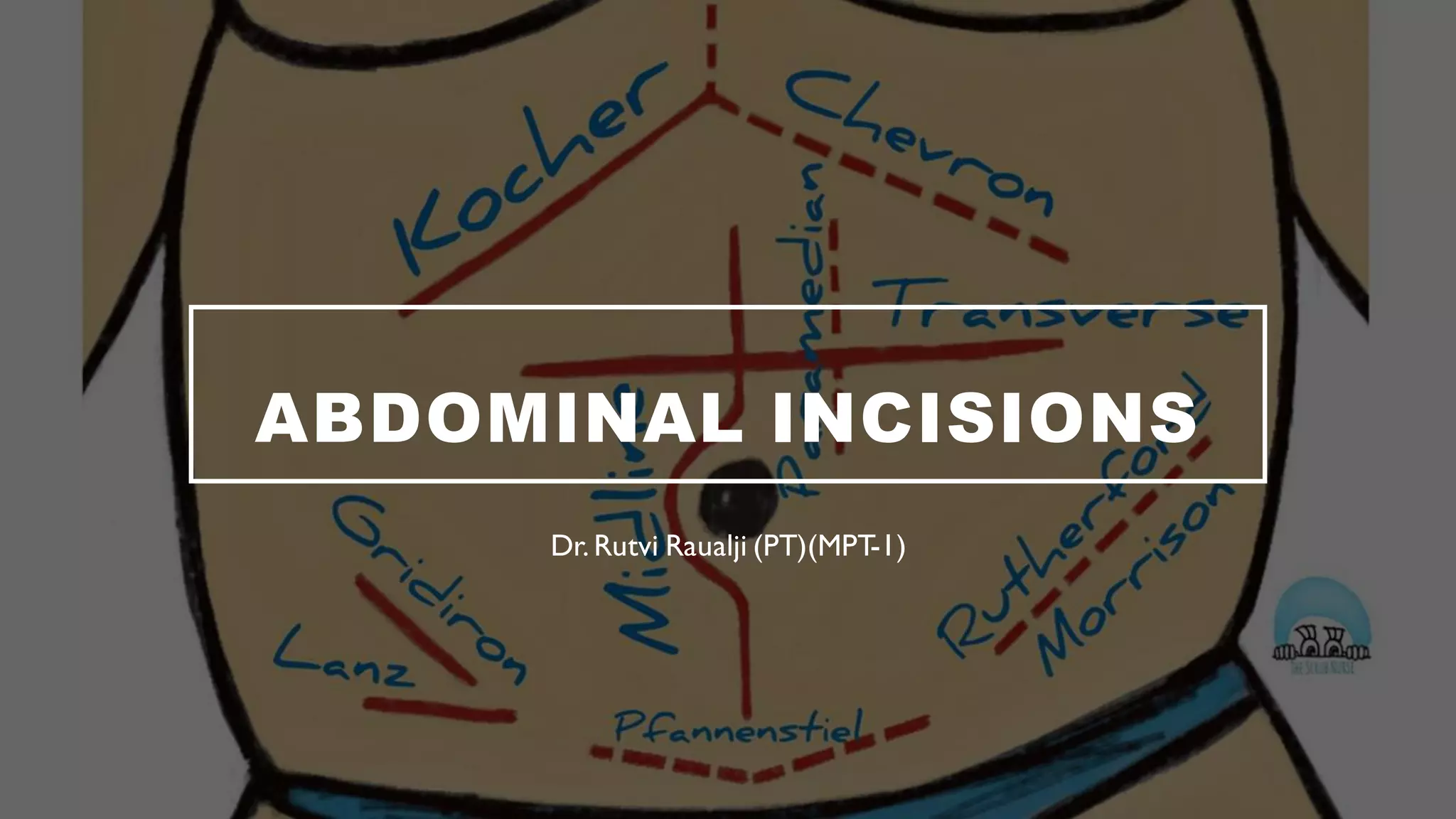
ABDOMINAL INCISIONS
Dr. Rutvi Raualji (PT)(MPT-1)
CONTENT
➢Incision
➢Principles
➢Choice of incision and ideal incision
➢Langer's Lines
➢Classification of incision
➢Abdominal surgery
➢Quadrantsof abdomen
➢Verticalincisions
➢Transverse/ obliqueincision
➢Complicationsafterabdominal surgery
INCISION
Surgical incisions is a cut made through skin to
facilitate operation or procedure.
It should be the aim of the surgeon to employ the
type of incision considered to be the most suitable
for the particular operation to be performed.
Following
should be
achieved:
• Accessibility
• Extensibility
• A reliable closure
PRINCIPLES
1. Incision should be long enough
for good exposure.
2. Splitting > cutting.
3. Avoid cutting of nerves and
vessels.
4. Retract muscle, abdominal
organs towards neurovascular
bundle.
5. Insert drainage tube through a
separate incision
6. Transverse incisions > vertical
incisions .
7. Close the wound layer by layer.
CHOICE OF INCISION
Depend upon:
1. Type of surgery (elective/
emergency)
2. Target organ
3. Surgeons own experience
and preference, and
4. Previous surgery.
Allows:
1. Ease of access to the
desired structures
2. Can be extended if
needed
3. Ideally muscles should be
split rather than cut
4. Heals quickly with
minimal scarring.
IDEAL INCISION
LANGER'S LINES
❖Langer's line corresponds to
the natural orientation of
collagen fibres in the dermis,
and are generally parallel to
the orientation of the
underlying muscle fibres.
❖Incisions made parallel to
Langer's lines may heal better
and produce less scarring
than those that cut across.
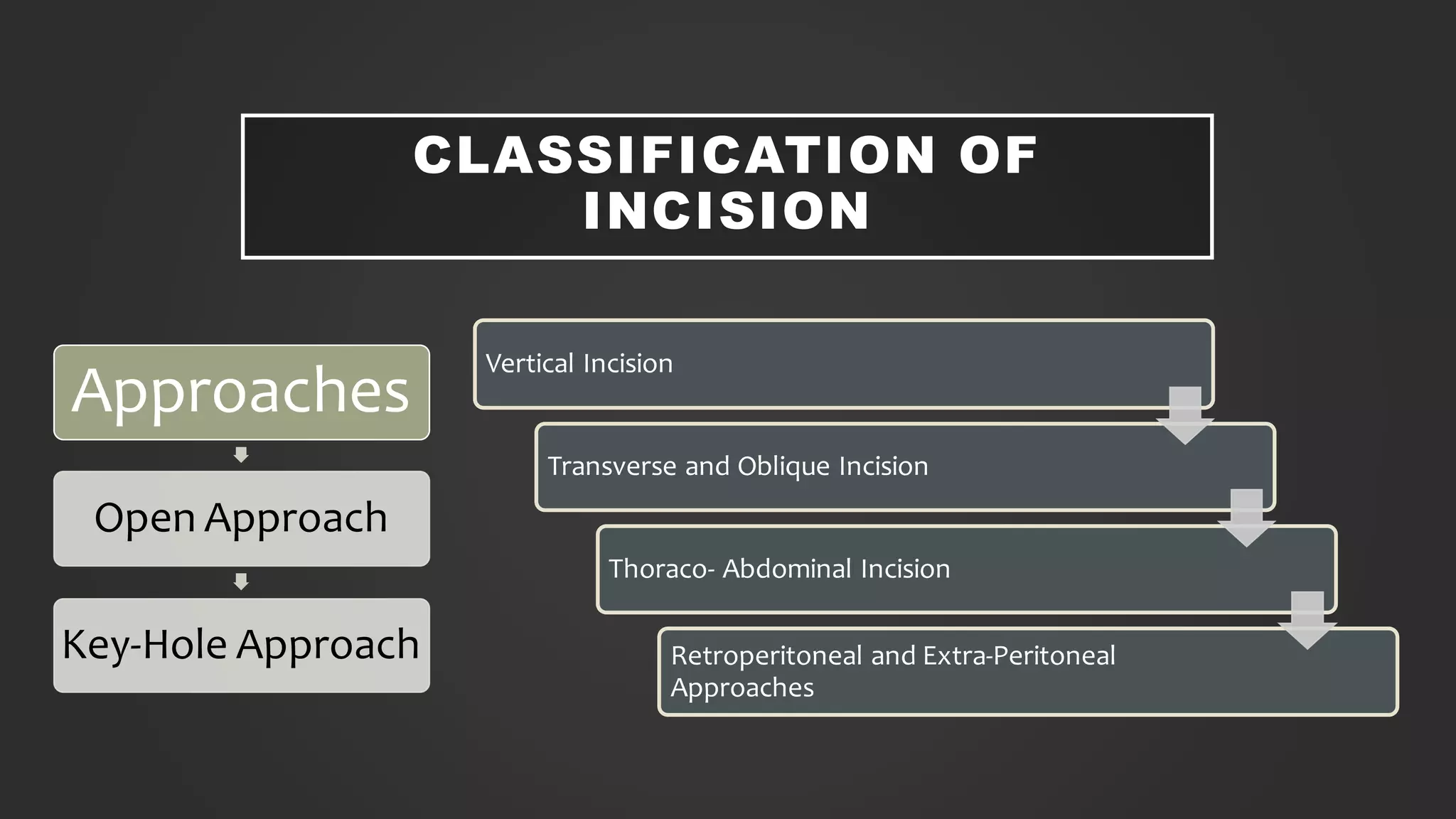
CLASSIFICATION OF
INCISION
Vertical Incision
Transverse and Oblique Incision
Thoraco- Abdominal Incision
Retroperitoneal and Extra-Peritoneal
Approaches
Approaches
Open Approach
Key-Hole Approach
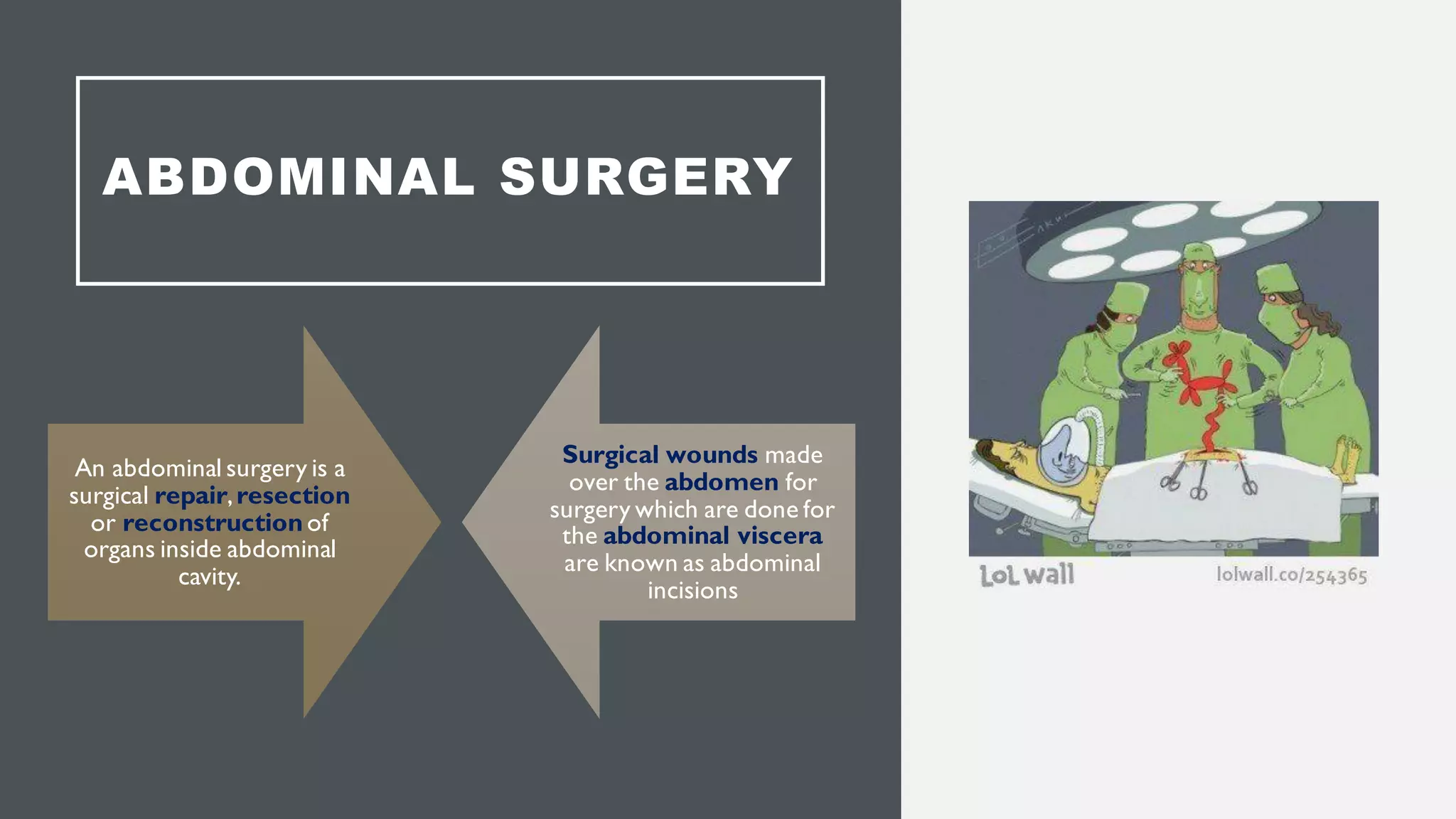
ABDOMINAL SURGERY
An abdominal surgery is a
surgical repair,resection
or reconstruction of
organs inside abdominal
cavity.
Surgical wounds made
over the abdomen for
surgery which are done for
the abdominal viscera
are known as abdominal
incisions
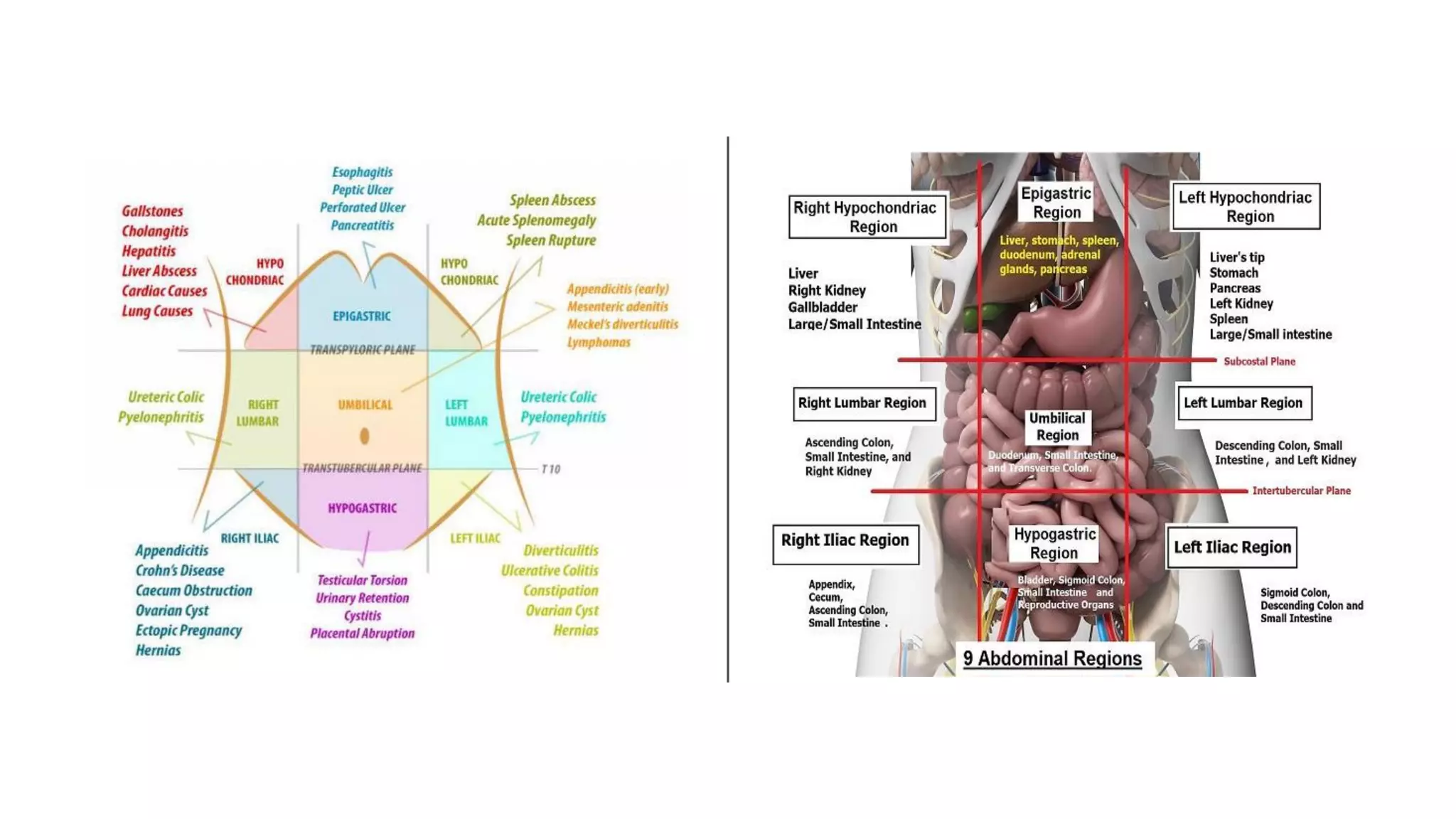
QUADRANTS
OF ABDOMEN
There are total 9 quadrants in
abdomen:
i. Right hypocondrium
ii. Epigastric
iii. Left hypocondrium
iv. Right lumbar
v. Umbilical
vi. Left lumbar
vii. Right iliac
viii.Hypogastric
ix. Left iliac
VERTICAL INCISION
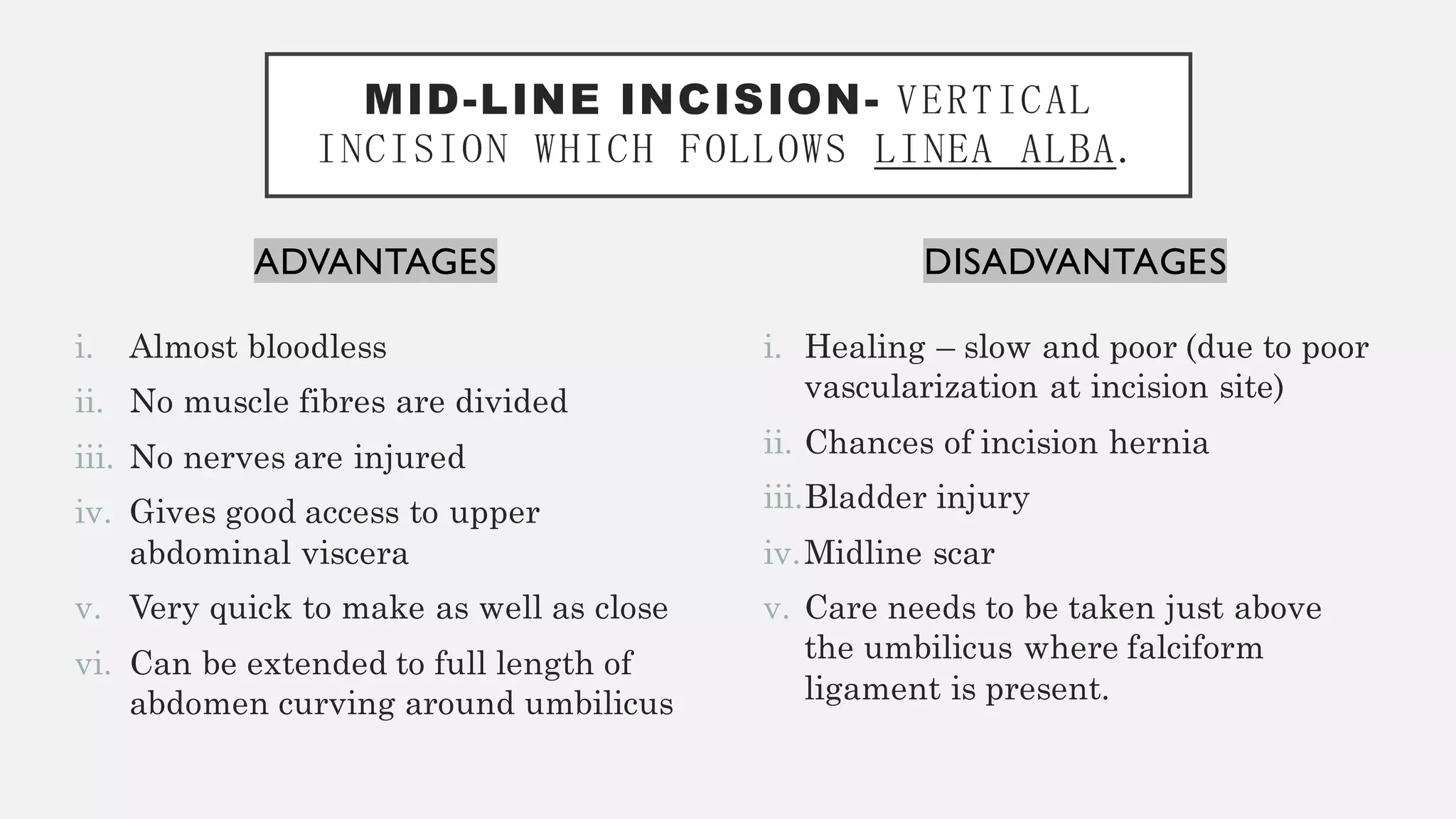
1. Mid-line Incision
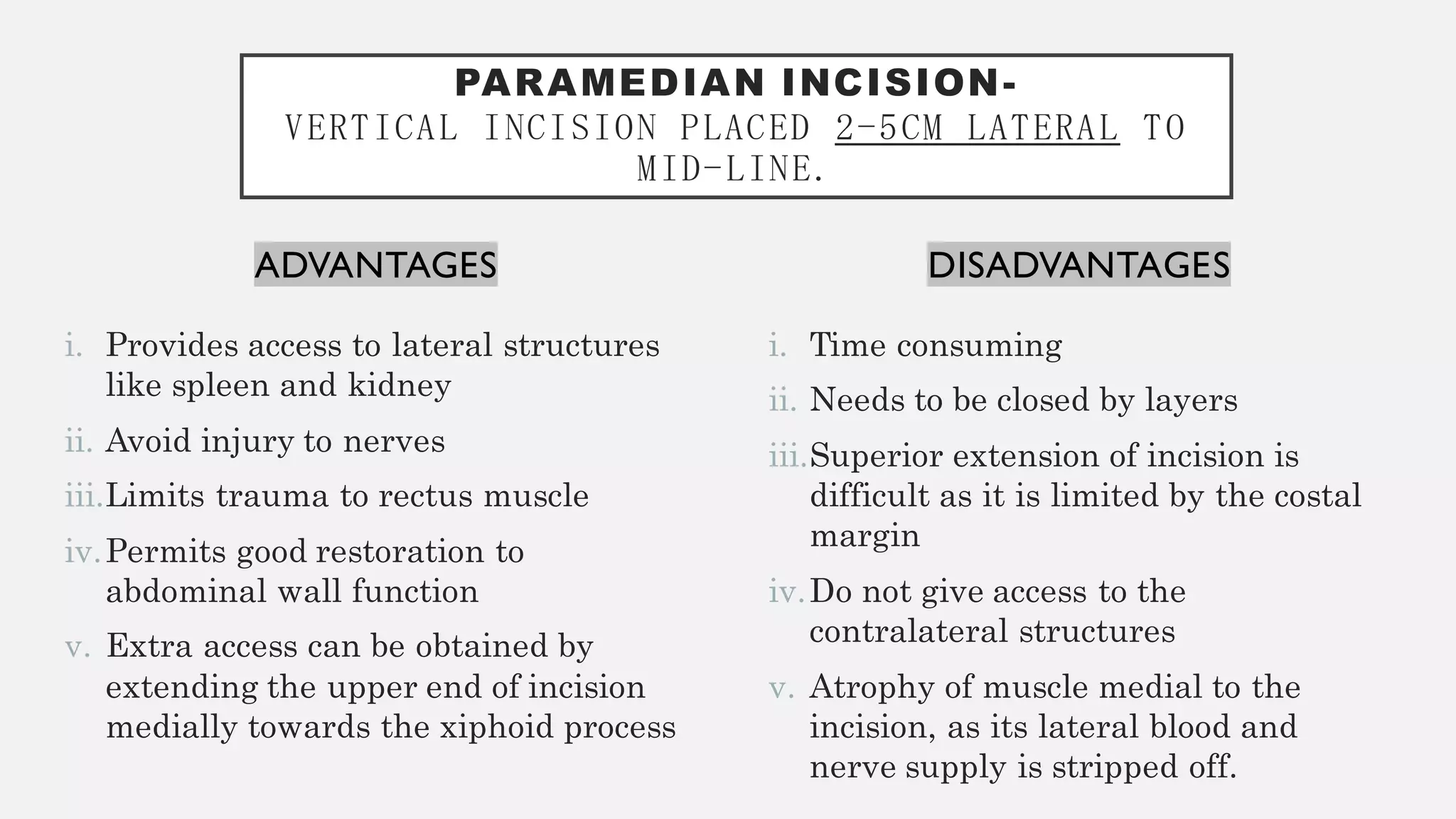
2. Paramedian Incision
i. Healing – slow and poor (due to poor
vascularization at incision site)
ii. Chances of incision hernia
iii.Bladder injury
iv.Midline scar
v. Care needs to be taken just above
the umbilicus where falciform
ligament is present.
ADVANTAGES
i. Almost bloodless
ii. No muscle fibres are divided
iii. No nerves are injured
iv. Gives good access to upper
abdominal viscera
v. Very quick to make as well as close
vi. Can be extended to full length of
abdomen curving around umbilicus
DISADVANTAGES
MID-LINE INCISION- VERTICAL
INCISION WHICH FOLLOWS LINEA ALBA.
ADVANTAGES
i. Provides access to lateral structures
like spleen and kidney
ii. Avoid injury to nerves
iii.Limits trauma to rectus muscle
iv.Permits good restoration to
abdominal wall function
v. Extra access can be obtained by
extending the upper end of incision
medially towards the xiphoid process
i. Time consuming
ii. Needs to be closed by layers
iii.Superior extension of incision is
difficult as it is limited by the costal
margin
iv.Do not give access to the
contralateral structures
v. Atrophy of muscle medial to the
incision, as its lateral blood and
nerve supply is stripped off.
DISADVANTAGES
PARAMEDIAN INCISION-
VERTICAL INCISION PLACED 2-5CM LATERAL TO
MID-LINE.
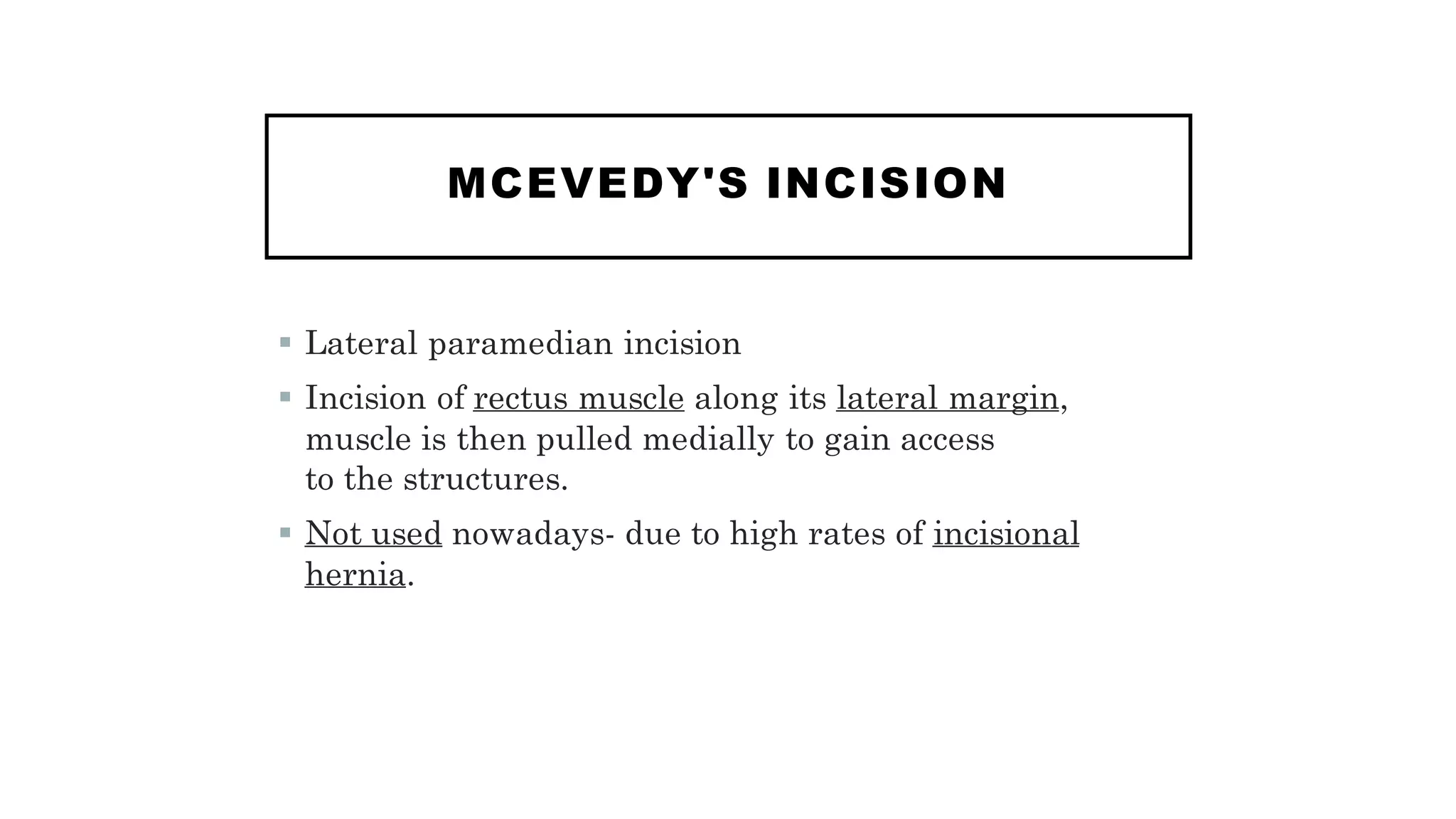
MCEVEDY'S INCISION
▪ Lateral paramedian incision
▪ Incision of rectus muscle along its lateral margin,
muscle is then pulled medially to gain access
to the structures.
▪ Not used nowadays- due to high rates of incisional
hernia.
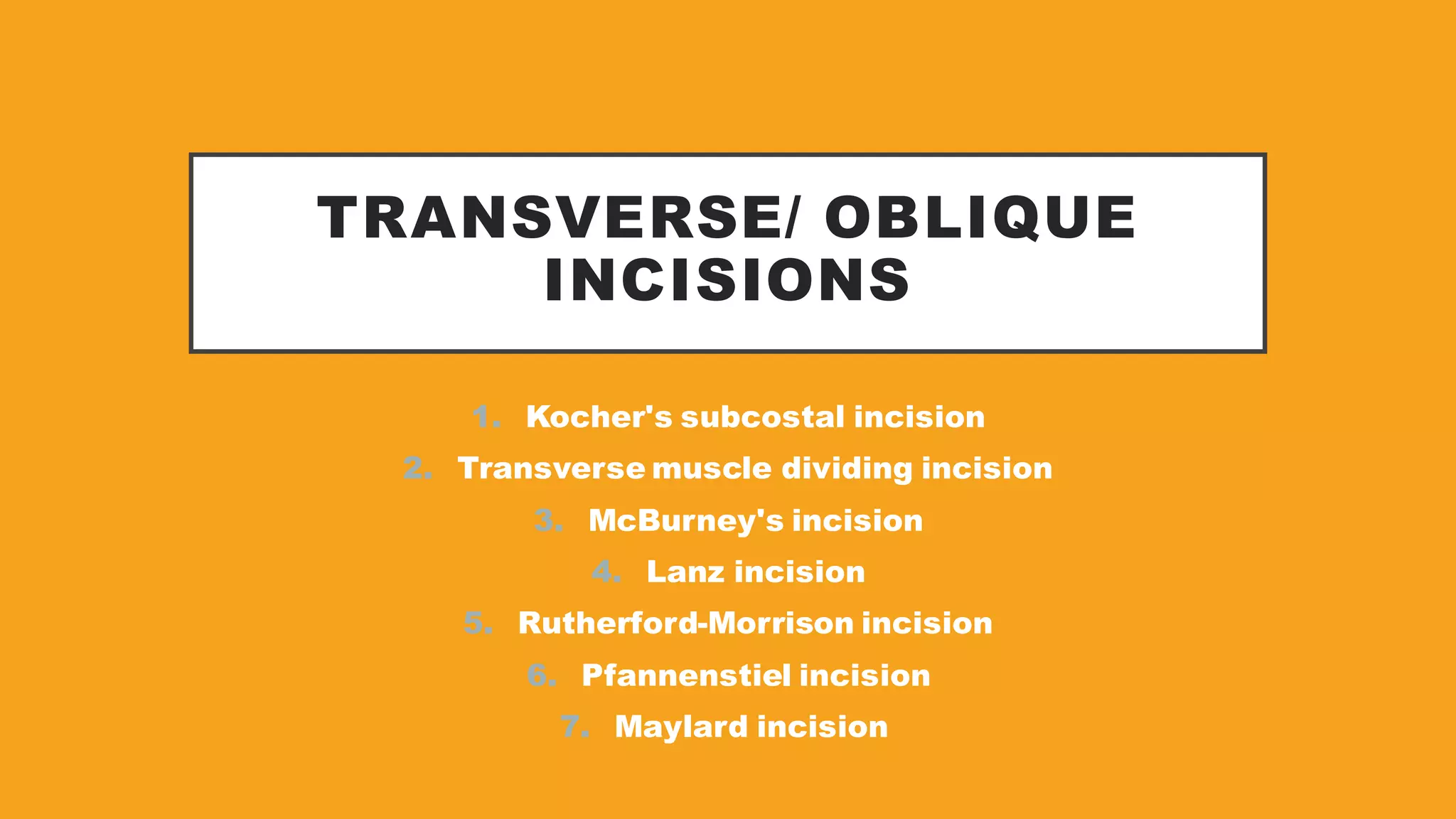
TRANSVERSE/ OBLIQUE
INCISIONS
1. Kocher's subcostal incision
2. Transverse muscle dividing incision
3. McBurney's incision
4. Lanz incision
5. Rutherford-Morrison incision
6. Pfannenstiel incision
7. Maylard incision
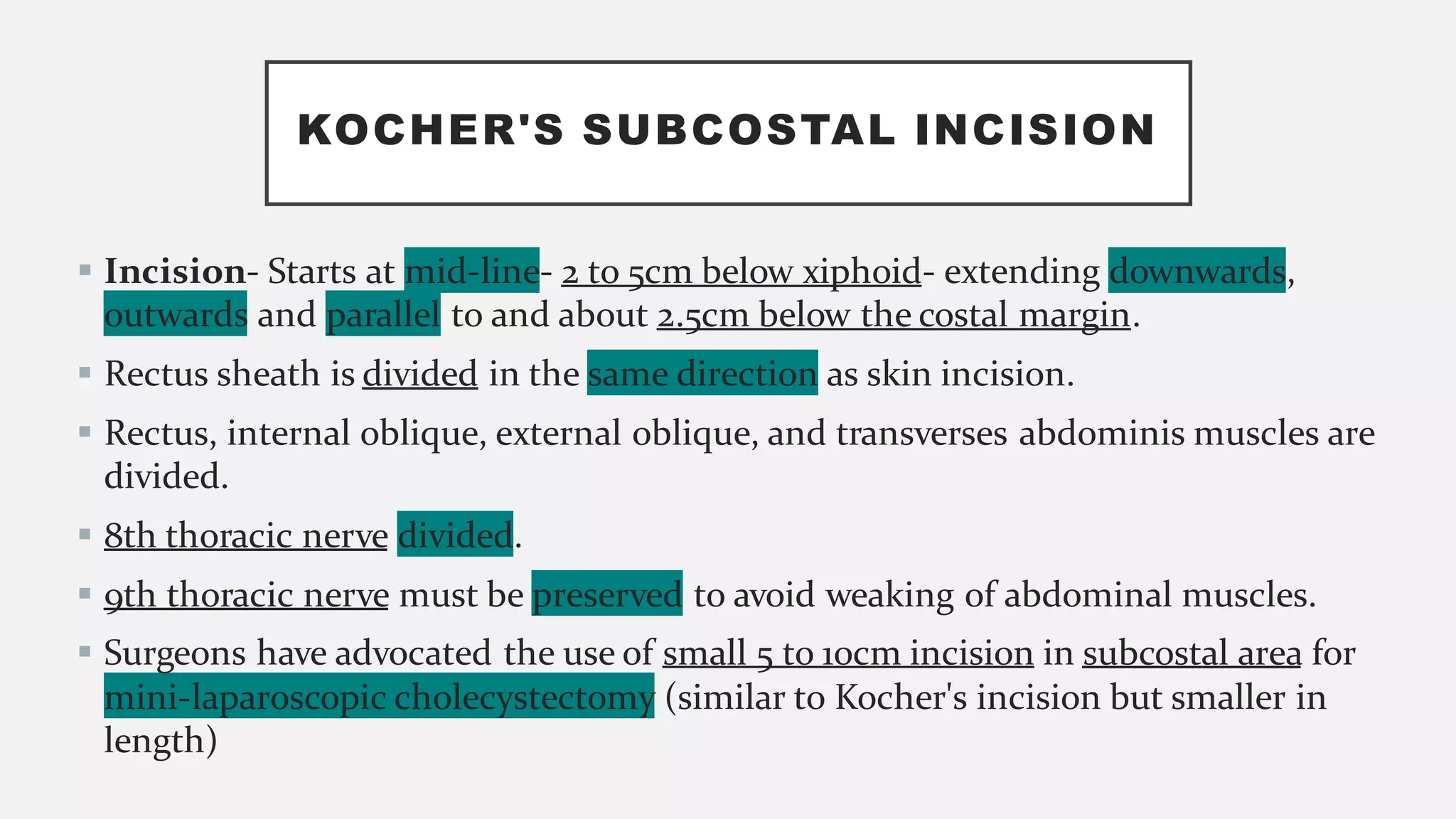
KOCHER'S SUBCOSTAL INCISION
▪ Incision- Starts at mid-line- 2 to 5cm below xiphoid- extending downwards,
outwards and parallel to and about 2.5cm below the costal margin.
▪ Rectus sheath is divided in the same direction as skin incision.
▪ Rectus, internal oblique, external oblique, and transverses abdominis muscles are
divided.
▪ 8th thoracic nerve divided.
▪ 9th thoracic nerve must be preserved to avoid weaking of abdominal muscles.
▪ Surgeons have advocated the use of small 5 to 10cm incision in subcostal area for
mini-laparoscopic cholecystectomy (similar to Kocher's incision but smaller in
length)
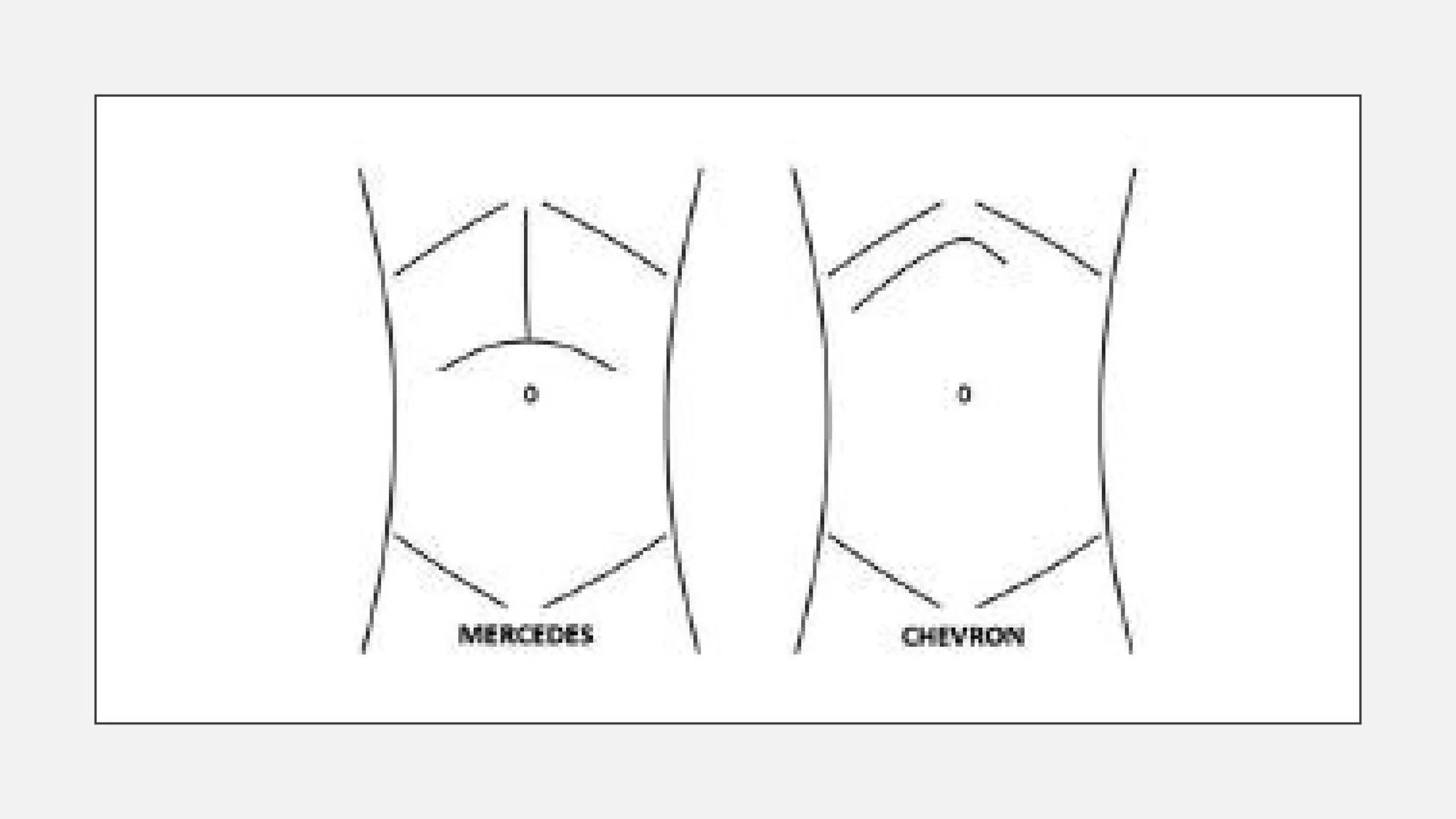
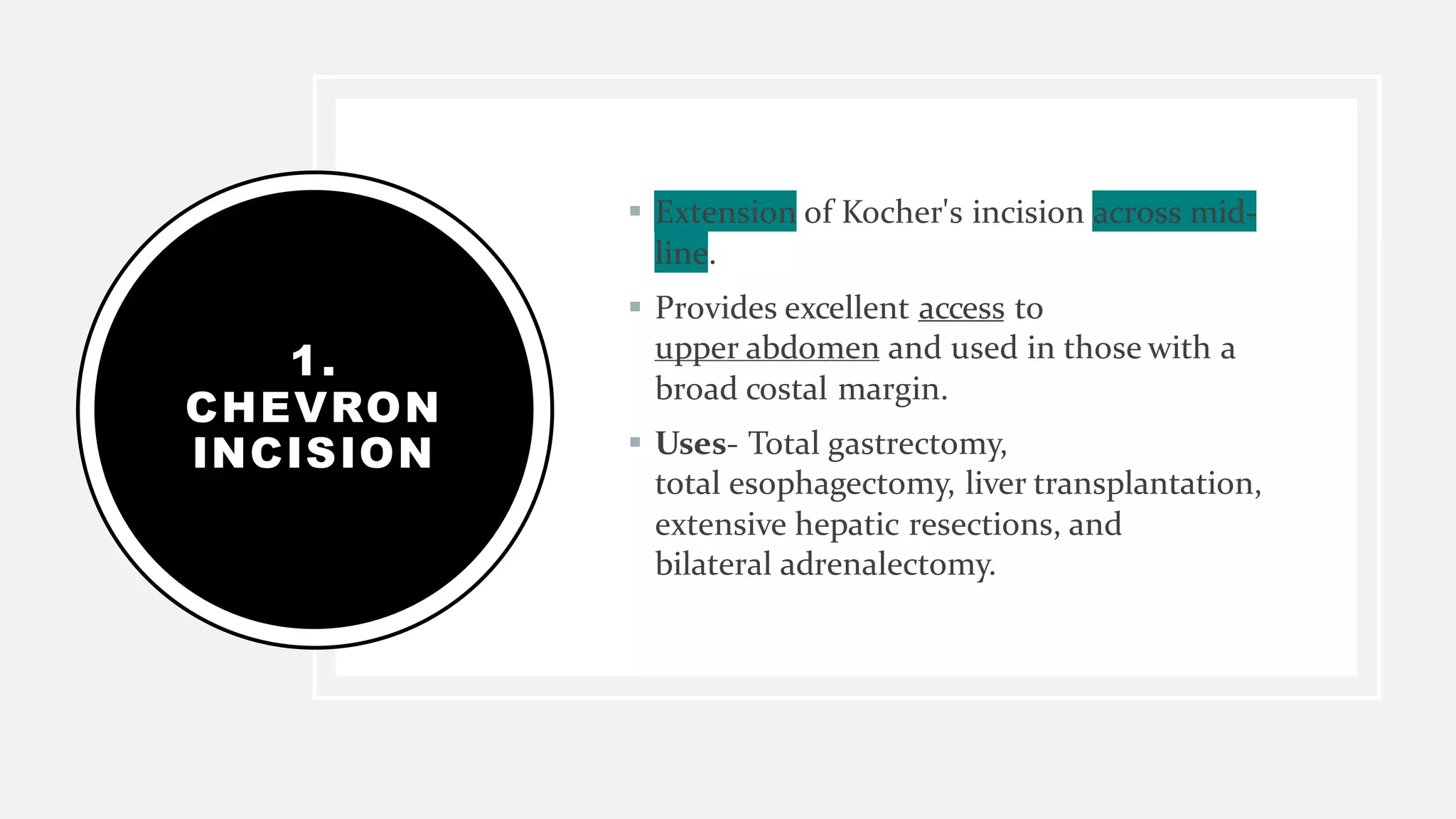
1.
CHEVRON
INCISION
▪ Extension of Kocher's incision across mid-
line.
▪ Provides excellent access to
upper abdomen and used in those with a
broad costal margin.
▪ Uses- Total gastrectomy,
total esophagectomy, liver transplantation,
extensive hepatic resections, and
bilateral adrenalectomy.
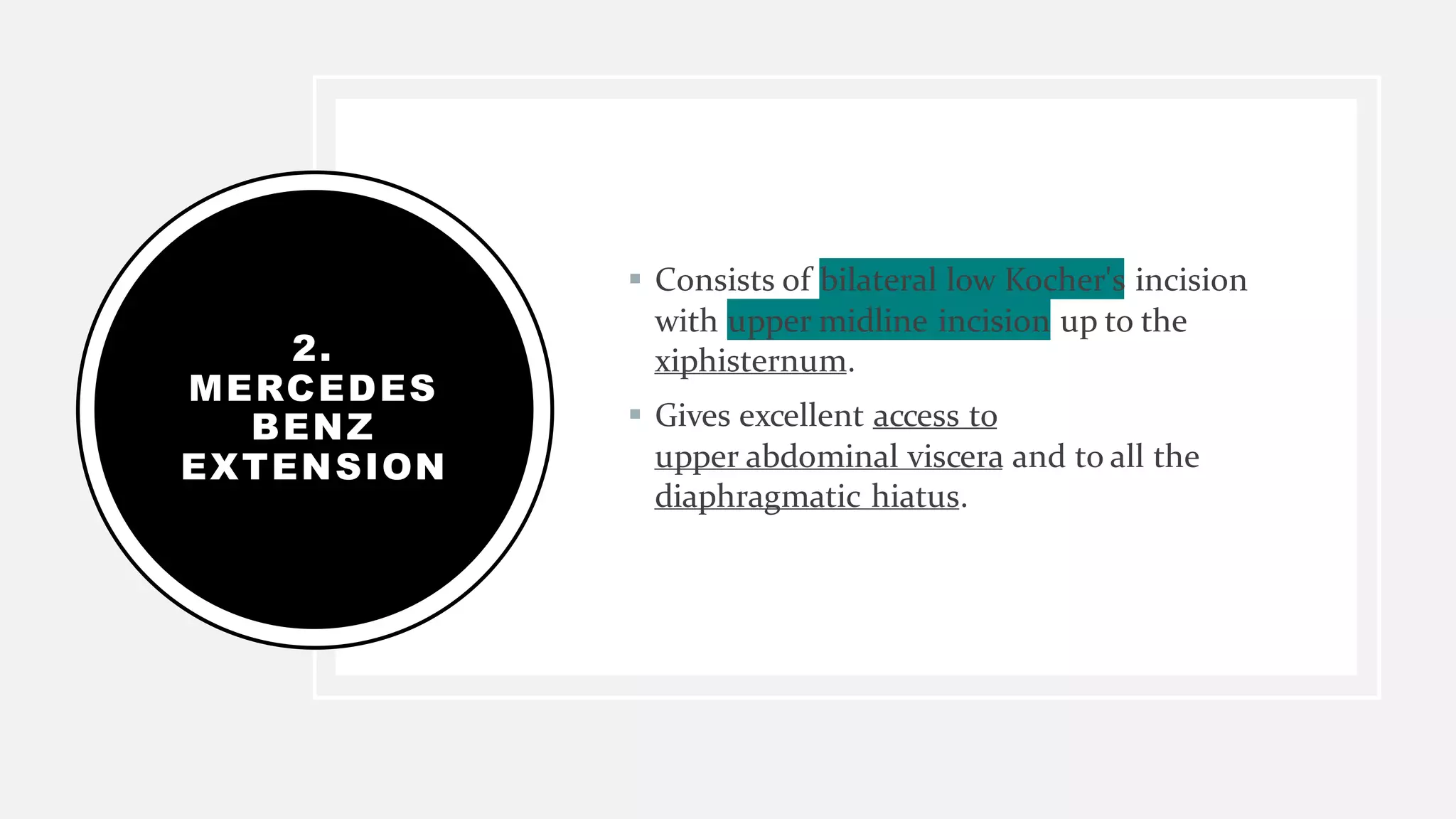
2.
MERCEDES
BENZ
EXTENSION
▪ Consists of bilateral low Kocher's incision
with upper midline incision up to the
xiphisternum.
▪ Gives excellent access to
upper abdominal viscera and to all the
diaphragmatic hiatus.
TRANSVERSE MUSCLE DIVIDING
INCISION
▪ Rectus muscle can be divided transversely.
▪ Its anterior and posterior sheaths are closed without any serious weaking of
abdominal muscles.
▪ It has a segmental nerve supply, so there is no risk of
transverse incision depriving the distal part of rectus muscle of its innervation.
▪ Similar to Kocher's incision.
▪ Preferred in new born and infants, because infant's abdomen has a longer
transverse than vertical girth- so more abdominal exposure is gained.
▪ Also, true for short and obese individuals.
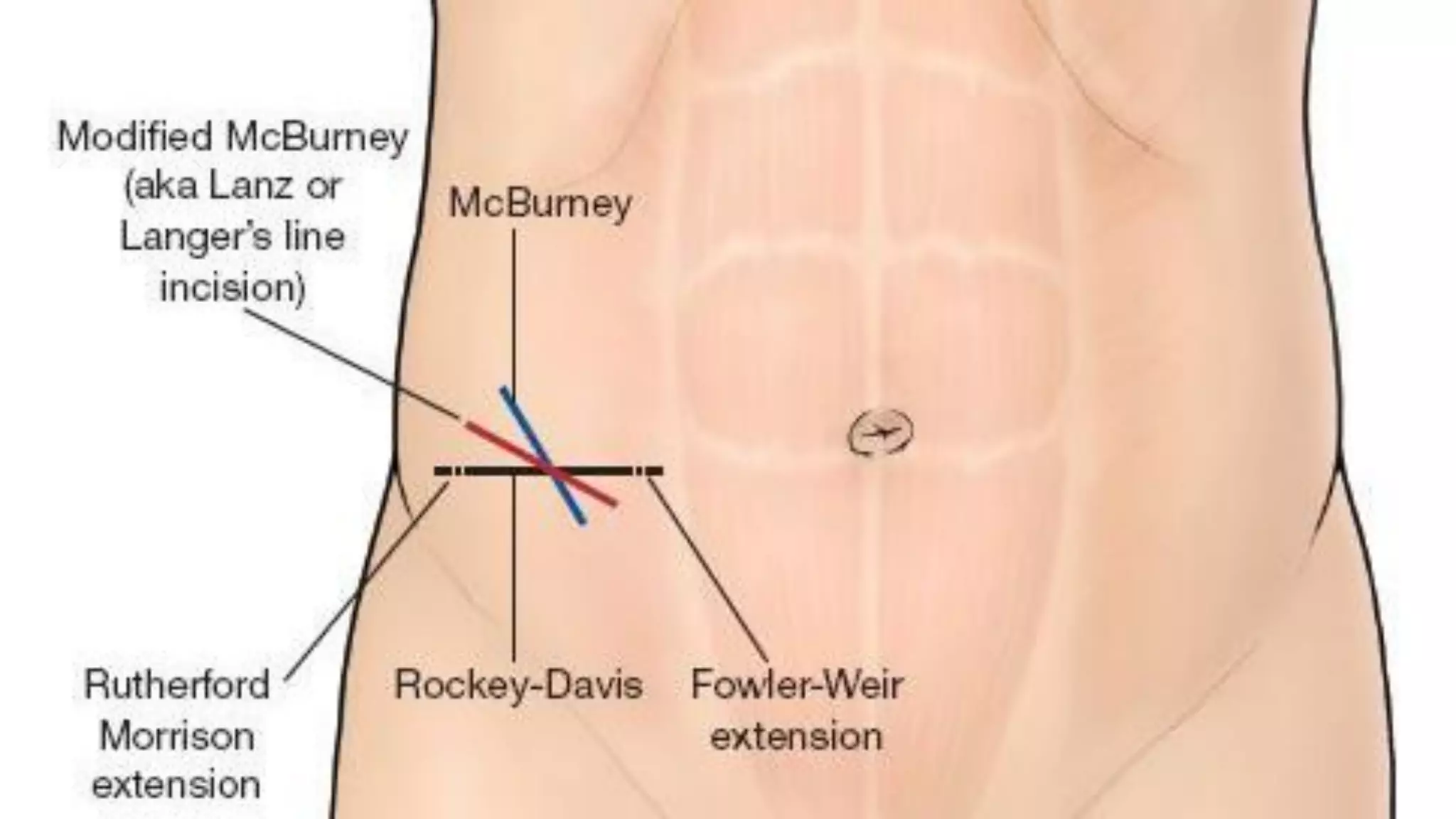
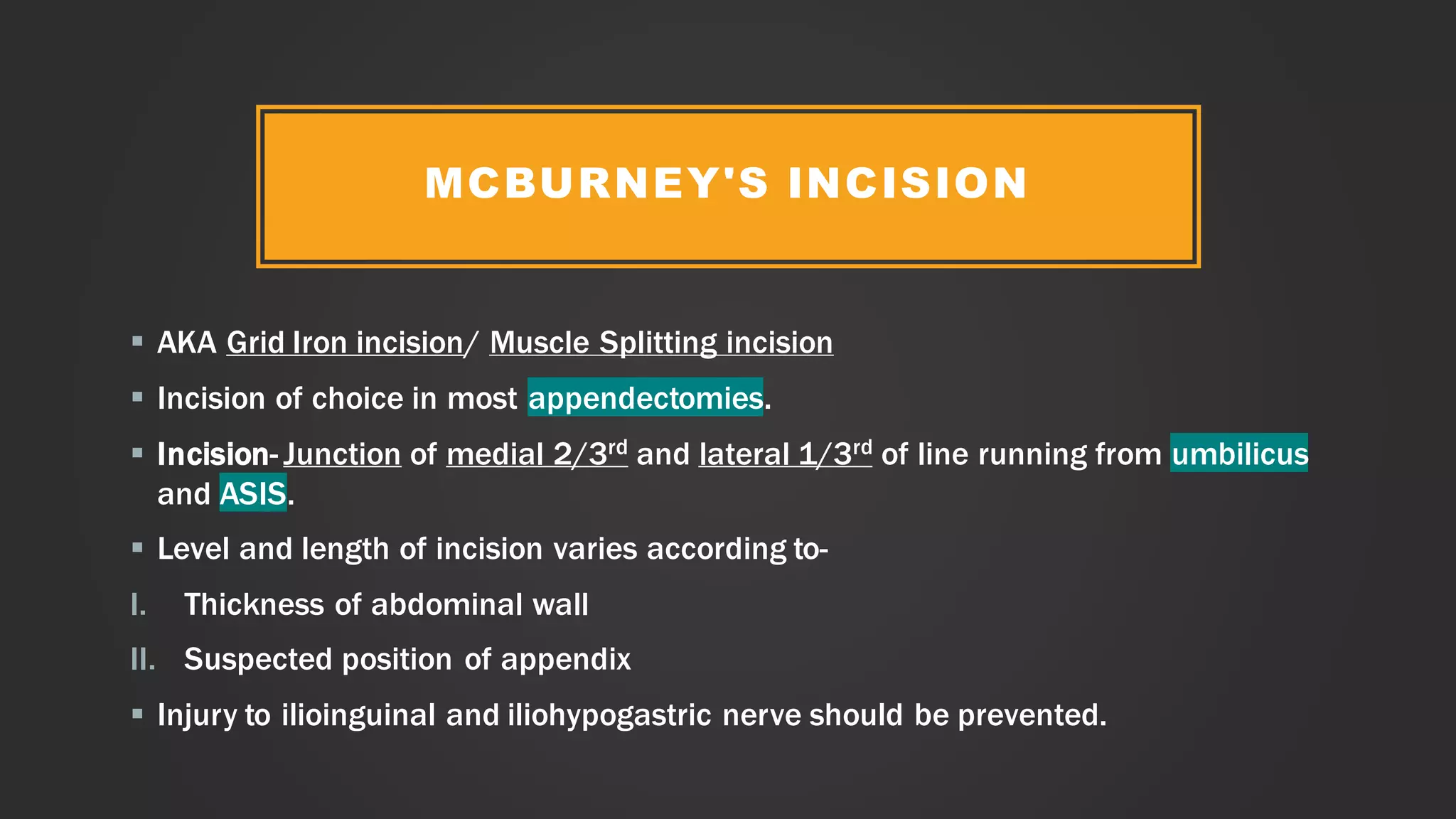
MCBURNEY'S INCISION
▪ AKA Grid Iron incision/ Muscle Splitting incision
▪ Incision of choice in most appendectomies.
▪ Incision- Junction of medial 2/3rd and lateral 1/3rd of line running from umbilicus
and ASIS.
▪ Level and length of incision varies according to-
I. Thickness of abdominal wall
II. Suspected position of appendix
▪ Injury to ilioinguinal and iliohypogastric nerve should be prevented.
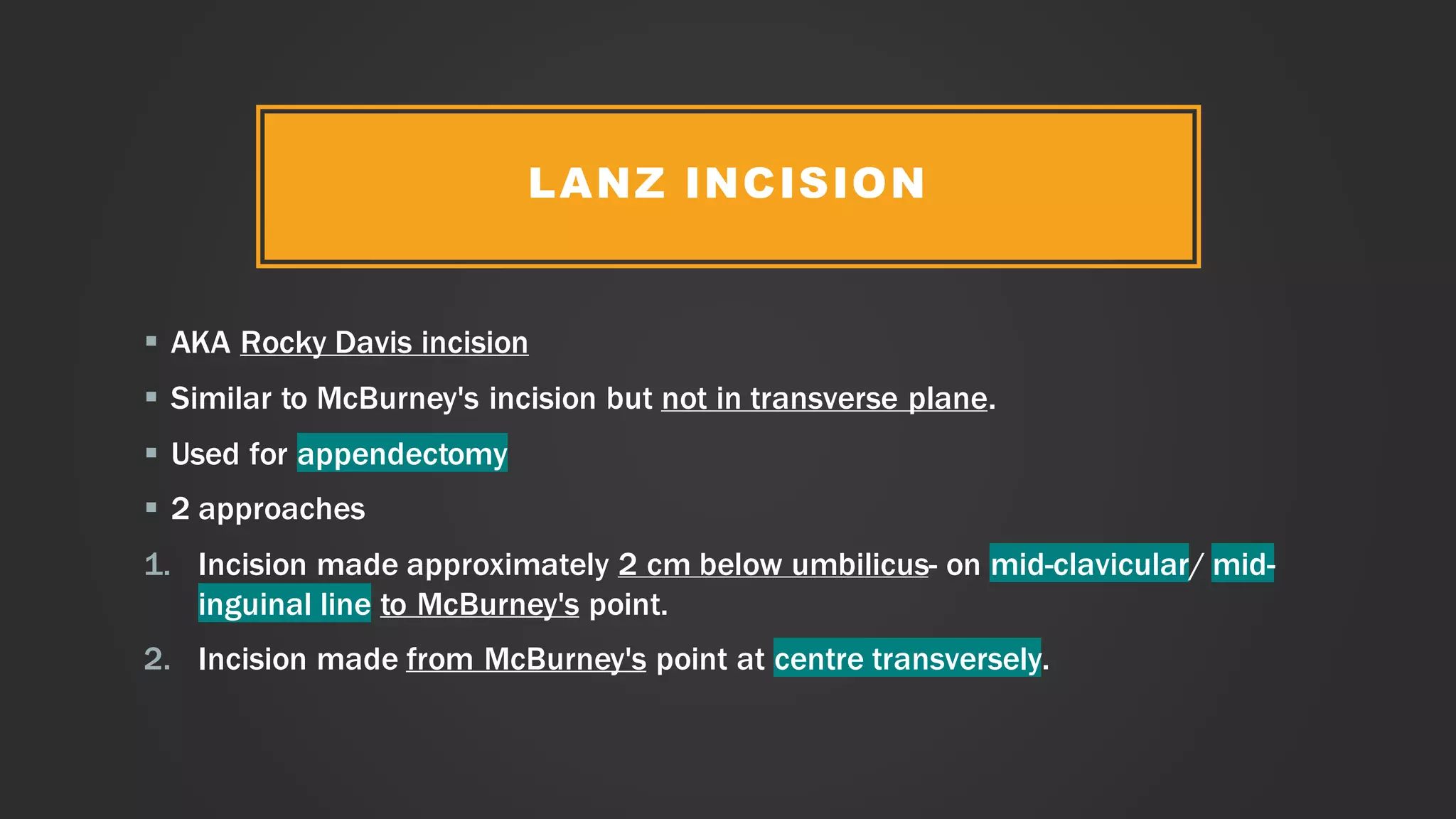
LANZ INCISION
▪ AKA Rocky Davis incision
▪ Similar to McBurney's incision but not in transverse plane.
▪ Used for appendectomy
▪ 2 approaches
1. Incision made approximately 2 cm below umbilicus- on mid-clavicular/ mid-
inguinal line to McBurney's point.
2. Incision made from McBurney's point at centre transversely.
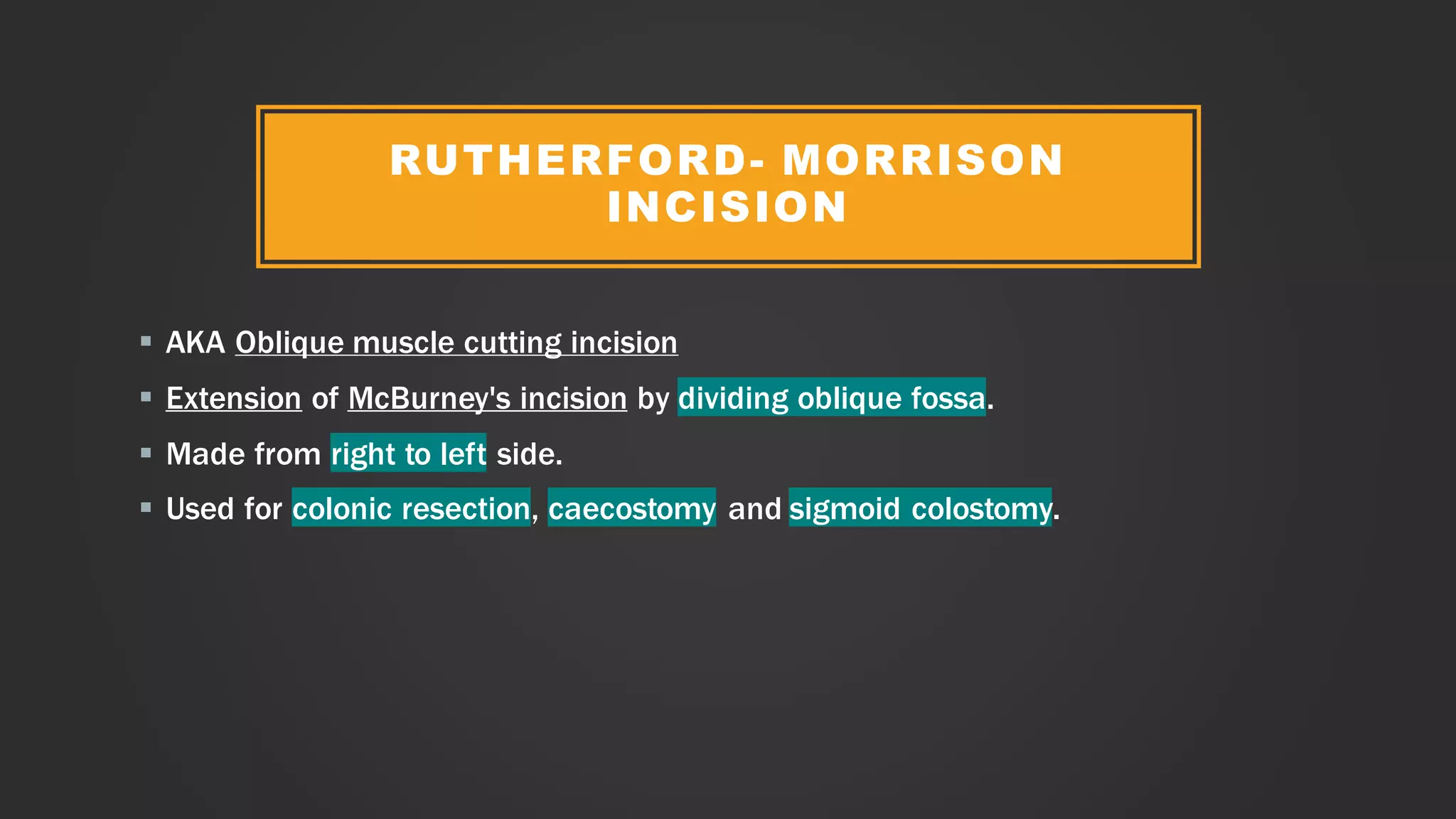
RUTHERFORD- MORRISON
INCISION
▪ AKA Oblique muscle cutting incision
▪ Extension of McBurney's incision by dividing oblique fossa.
▪ Made from right to left side.
▪ Used for colonic resection, caecostomy and sigmoid colostomy.
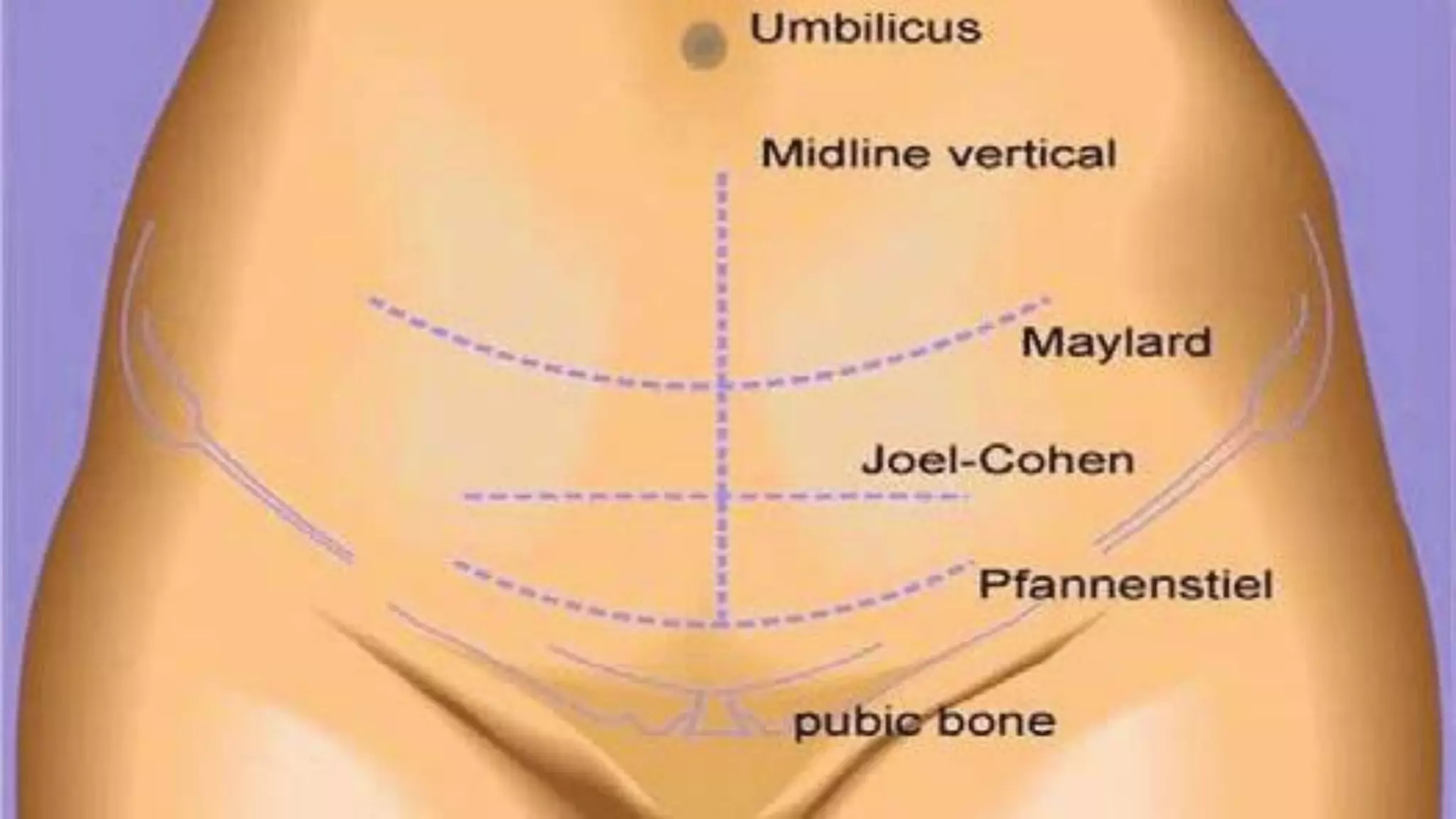
▪ AKA Kerr incision
▪ Made in lower segment of uterus.
▪ 10cm long incision and is made 5cm above pubic
symphysis.
▪ Used for-
1. C- Section
2. Abdominal Hysterectomy
▪ Classical Pfannenstiel incision, skin and
subcutaneous tissue are incised transversely but
linea alba vertically.
PFANNENSTIEL
INCISION
• Modification of Pfannenstiel incision
• Gives excellent exposure to pelvic organs.
• Skin incision is placed above but parallel to the
traditional pfannenstiel incision
• Here, rectus abdominis muscle is sectioned
transversely to permit wider access to pelvis.
MARLARD
INCISION
ADVANTAGES
i. Better cosmetically
ii. Stronger than vertical
iii. Less painful
iv. Good access to upper GI
structures
v. More advantages in children
and obese patients.
i. Limited exposure to the
organ
DISADVANTAGES
COMPLICATIONS
AFTER
ABDOMINAL
SURGERY
IMMEDIATE
• Bleeding
• Airway complications
• Hypoxia
• Hemodynamic
complications
EARLY
• Pyrexia
• Pain
• Nausea/Vomiting
LATE
• Infection
• Incisional Hernia
• DVT and Pedal
oedema
• Reduced bowel
function
• Delirium
• Pressure Sore
• Wound Dehiscence
• Keloid formation
• Cosmetic appearance
THANK
YOU

Abdominal Incision.pdf

  • 1.
    ABDOMINAL INCISIONS Dr. RutviRaualji (PT)(MPT-1)
  • 2.
    CONTENT ➢Incision ➢Principles ➢Choice of incisionand ideal incision ➢Langer's Lines ➢Classification of incision ➢Abdominal surgery ➢Quadrantsof abdomen ➢Verticalincisions ➢Transverse/ obliqueincision ➢Complicationsafterabdominal surgery
  • 3.
    INCISION Surgical incisions isa cut made through skin to facilitate operation or procedure. It should be the aim of the surgeon to employ the type of incision considered to be the most suitable for the particular operation to be performed. Following should be achieved: • Accessibility • Extensibility • A reliable closure
  • 4.
    PRINCIPLES 1. Incision shouldbe long enough for good exposure. 2. Splitting > cutting. 3. Avoid cutting of nerves and vessels. 4. Retract muscle, abdominal organs towards neurovascular bundle. 5. Insert drainage tube through a separate incision 6. Transverse incisions > vertical incisions . 7. Close the wound layer by layer.
  • 5.
    CHOICE OF INCISION Dependupon: 1. Type of surgery (elective/ emergency) 2. Target organ 3. Surgeons own experience and preference, and 4. Previous surgery. Allows: 1. Ease of access to the desired structures 2. Can be extended if needed 3. Ideally muscles should be split rather than cut 4. Heals quickly with minimal scarring. IDEAL INCISION
  • 6.
    LANGER'S LINES ❖Langer's linecorresponds to the natural orientation of collagen fibres in the dermis, and are generally parallel to the orientation of the underlying muscle fibres. ❖Incisions made parallel to Langer's lines may heal better and produce less scarring than those that cut across.
  • 7.
    CLASSIFICATION OF INCISION Vertical Incision Transverseand Oblique Incision Thoraco- Abdominal Incision Retroperitoneal and Extra-Peritoneal Approaches Approaches Open Approach Key-Hole Approach
  • 8.
    ABDOMINAL SURGERY An abdominalsurgery is a surgical repair,resection or reconstruction of organs inside abdominal cavity. Surgical wounds made over the abdomen for surgery which are done for the abdominal viscera are known as abdominal incisions
  • 9.
    QUADRANTS OF ABDOMEN There aretotal 9 quadrants in abdomen: i. Right hypocondrium ii. Epigastric iii. Left hypocondrium iv. Right lumbar v. Umbilical vi. Left lumbar vii. Right iliac viii.Hypogastric ix. Left iliac
  • 11.
    VERTICAL INCISION 1. Mid-lineIncision 2. Paramedian Incision
  • 13.
    i. Healing –slow and poor (due to poor vascularization at incision site) ii. Chances of incision hernia iii.Bladder injury iv.Midline scar v. Care needs to be taken just above the umbilicus where falciform ligament is present. ADVANTAGES i. Almost bloodless ii. No muscle fibres are divided iii. No nerves are injured iv. Gives good access to upper abdominal viscera v. Very quick to make as well as close vi. Can be extended to full length of abdomen curving around umbilicus DISADVANTAGES MID-LINE INCISION- VERTICAL INCISION WHICH FOLLOWS LINEA ALBA.
  • 14.
    ADVANTAGES i. Provides accessto lateral structures like spleen and kidney ii. Avoid injury to nerves iii.Limits trauma to rectus muscle iv.Permits good restoration to abdominal wall function v. Extra access can be obtained by extending the upper end of incision medially towards the xiphoid process i. Time consuming ii. Needs to be closed by layers iii.Superior extension of incision is difficult as it is limited by the costal margin iv.Do not give access to the contralateral structures v. Atrophy of muscle medial to the incision, as its lateral blood and nerve supply is stripped off. DISADVANTAGES PARAMEDIAN INCISION- VERTICAL INCISION PLACED 2-5CM LATERAL TO MID-LINE.
  • 15.
    MCEVEDY'S INCISION ▪ Lateralparamedian incision ▪ Incision of rectus muscle along its lateral margin, muscle is then pulled medially to gain access to the structures. ▪ Not used nowadays- due to high rates of incisional hernia.
  • 16.
    TRANSVERSE/ OBLIQUE INCISIONS 1. Kocher'ssubcostal incision 2. Transverse muscle dividing incision 3. McBurney's incision 4. Lanz incision 5. Rutherford-Morrison incision 6. Pfannenstiel incision 7. Maylard incision
  • 18.
    KOCHER'S SUBCOSTAL INCISION ▪Incision- Starts at mid-line- 2 to 5cm below xiphoid- extending downwards, outwards and parallel to and about 2.5cm below the costal margin. ▪ Rectus sheath is divided in the same direction as skin incision. ▪ Rectus, internal oblique, external oblique, and transverses abdominis muscles are divided. ▪ 8th thoracic nerve divided. ▪ 9th thoracic nerve must be preserved to avoid weaking of abdominal muscles. ▪ Surgeons have advocated the use of small 5 to 10cm incision in subcostal area for mini-laparoscopic cholecystectomy (similar to Kocher's incision but smaller in length)
  • 20.
    1. CHEVRON INCISION ▪ Extension ofKocher's incision across mid- line. ▪ Provides excellent access to upper abdomen and used in those with a broad costal margin. ▪ Uses- Total gastrectomy, total esophagectomy, liver transplantation, extensive hepatic resections, and bilateral adrenalectomy.
  • 21.
    2. MERCEDES BENZ EXTENSION ▪ Consists ofbilateral low Kocher's incision with upper midline incision up to the xiphisternum. ▪ Gives excellent access to upper abdominal viscera and to all the diaphragmatic hiatus.
  • 23.
    TRANSVERSE MUSCLE DIVIDING INCISION ▪Rectus muscle can be divided transversely. ▪ Its anterior and posterior sheaths are closed without any serious weaking of abdominal muscles. ▪ It has a segmental nerve supply, so there is no risk of transverse incision depriving the distal part of rectus muscle of its innervation. ▪ Similar to Kocher's incision. ▪ Preferred in new born and infants, because infant's abdomen has a longer transverse than vertical girth- so more abdominal exposure is gained. ▪ Also, true for short and obese individuals.
  • 25.
    MCBURNEY'S INCISION ▪ AKAGrid Iron incision/ Muscle Splitting incision ▪ Incision of choice in most appendectomies. ▪ Incision- Junction of medial 2/3rd and lateral 1/3rd of line running from umbilicus and ASIS. ▪ Level and length of incision varies according to- I. Thickness of abdominal wall II. Suspected position of appendix ▪ Injury to ilioinguinal and iliohypogastric nerve should be prevented.
  • 26.
    LANZ INCISION ▪ AKARocky Davis incision ▪ Similar to McBurney's incision but not in transverse plane. ▪ Used for appendectomy ▪ 2 approaches 1. Incision made approximately 2 cm below umbilicus- on mid-clavicular/ mid- inguinal line to McBurney's point. 2. Incision made from McBurney's point at centre transversely.
  • 27.
    RUTHERFORD- MORRISON INCISION ▪ AKAOblique muscle cutting incision ▪ Extension of McBurney's incision by dividing oblique fossa. ▪ Made from right to left side. ▪ Used for colonic resection, caecostomy and sigmoid colostomy.
  • 29.
    ▪ AKA Kerrincision ▪ Made in lower segment of uterus. ▪ 10cm long incision and is made 5cm above pubic symphysis. ▪ Used for- 1. C- Section 2. Abdominal Hysterectomy ▪ Classical Pfannenstiel incision, skin and subcutaneous tissue are incised transversely but linea alba vertically. PFANNENSTIEL INCISION
  • 30.
    • Modification ofPfannenstiel incision • Gives excellent exposure to pelvic organs. • Skin incision is placed above but parallel to the traditional pfannenstiel incision • Here, rectus abdominis muscle is sectioned transversely to permit wider access to pelvis. MARLARD INCISION
  • 31.
    ADVANTAGES i. Better cosmetically ii.Stronger than vertical iii. Less painful iv. Good access to upper GI structures v. More advantages in children and obese patients. i. Limited exposure to the organ DISADVANTAGES
  • 32.
    COMPLICATIONS AFTER ABDOMINAL SURGERY IMMEDIATE • Bleeding • Airwaycomplications • Hypoxia • Hemodynamic complications EARLY • Pyrexia • Pain • Nausea/Vomiting LATE • Infection • Incisional Hernia • DVT and Pedal oedema • Reduced bowel function • Delirium • Pressure Sore • Wound Dehiscence • Keloid formation • Cosmetic appearance
  • 33.