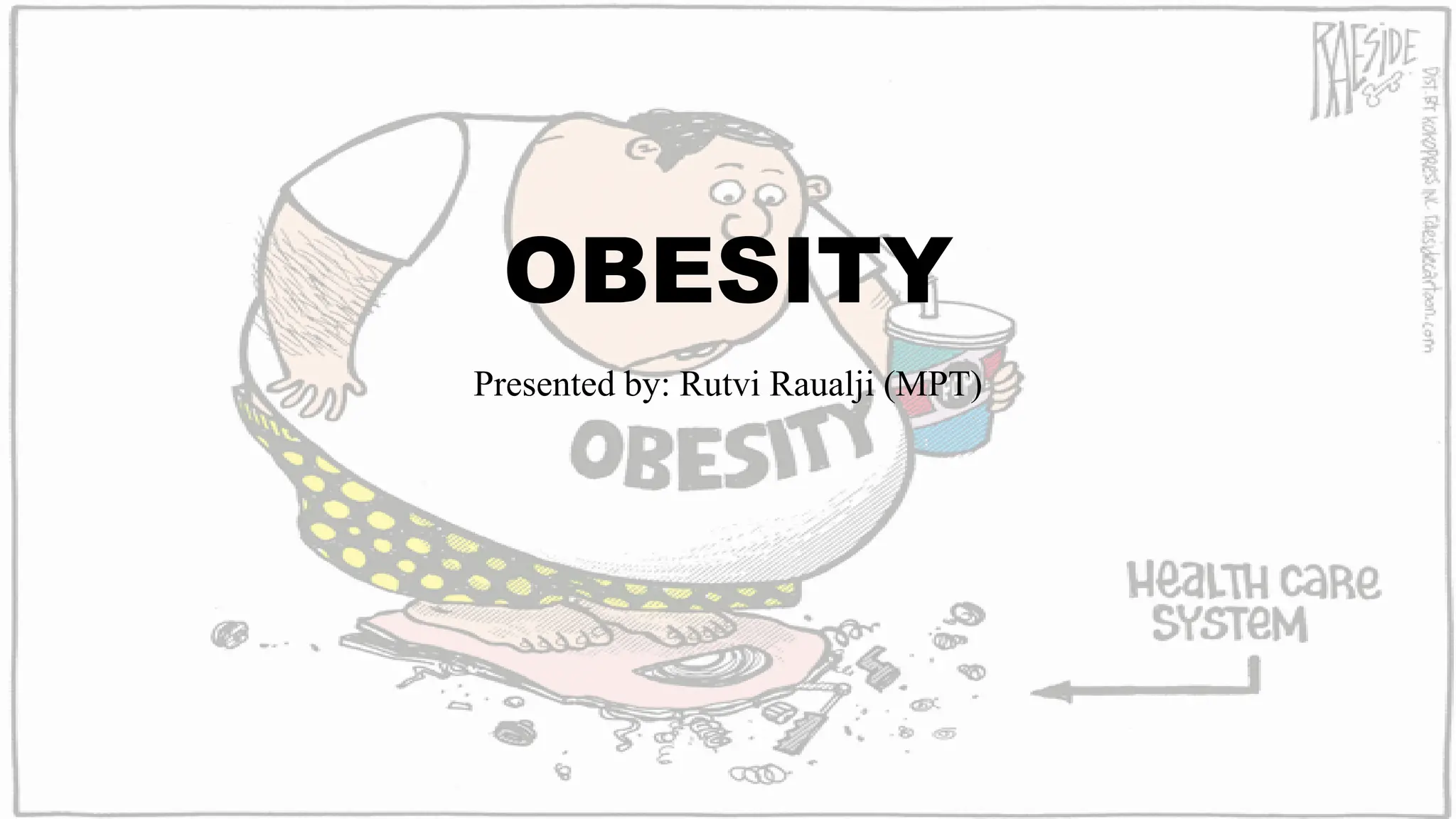
OBESITY
Presented by: Rutvi Raualji (MPT)
Contents
• Introduction
• Obesity: a global pandemic
• Causes of obesity
• Co-morbidities due to obesity
• Complications
Introduction
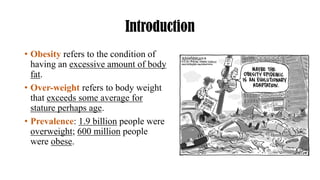
• Obesity refers to the condition of
having an excessive amount of body
fat.
• Over-weight refers to body weight
that exceeds some average for
stature perhaps age.
• Prevalence: 1.9 billion people were
overweight; 600 million people
were obese.
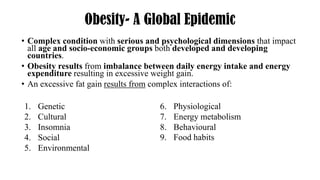
Obesity- A Global Epidemic
• Complex condition with serious and psychological dimensions that impact
all age and socio-economic groups both developed and developing
countries.
• Obesity results from imbalance between daily energy intake and energy
expenditure resulting in excessive weight gain.
• An excessive fat gain results from complex interactions of:
1. Genetic
2. Cultural
3. Insomnia
4. Social
5. Environmental
6. Physiological
7. Energy metabolism
8. Behavioural
9. Food habits
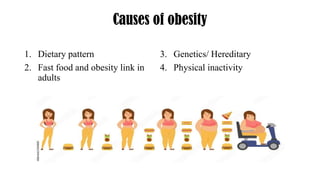
Causes of obesity
1. Dietary pattern
2. Fast food and obesity link in
adults
3. Genetics/ Hereditary
4. Physical inactivity
DIETARY PATTERN
• Changes in diet and reduced energy expenditure
via patterns of work often referred as nutrition
transition- leading to obesity worldwide.
• Adverse changes in diet- which is composed of
greater saturated fat and added sugars; reduction
in complex carbs, dietary fruits and vegetables.
FAST FOOD AND OBESITY LINK IN
ADULTS
• Fast food consumption is one/ more times per
week.
• Characteristics of fast food: excessive amount of
refined starch, added sugar, high fat content, low
dietary fibre.
• Research suggests fast food directly increased
energy intake and is inversely proportional to the
quality of food.
GENETICS
• Researches have provided dear evidences of a
biological mechanism susceptible to gain weight
and is dominated by high calorie food and
sedentary lifestyle.
• Protein encoded gene F70 is affected and makes
person susceptible of becoming obese.
PHYSICAL INACTIVITY
• Regular physical activity, through either
recreation or occupation can help to minimize
weight gain and fat gain.
• Increases tendency to regain lost weight and
counters a common genetic variation that makes
people more likely to gain excess weight.
• Variation in physical activity accounts for >75%
of weight gain.
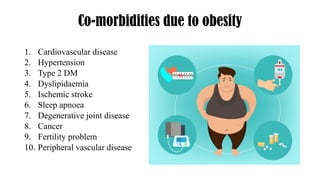
Co-morbidities due to obesity
1. Cardiovascular disease
2. Hypertension
3. Type 2 DM
4. Dyslipidaemia
5. Ischemic stroke
6. Sleep apnoea
7. Degenerative joint disease
8. Cancer
9. Fertility problem
10. Peripheral vascular disease
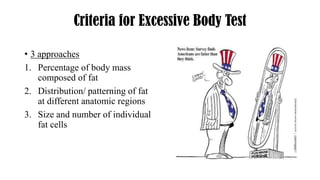
Criteria for Excessive Body Test
• 3 approaches
1. Percentage of body mass
composed of fat
2. Distribution/ patterning of fat
at different anatomic regions
3. Size and number of individual
fat cells
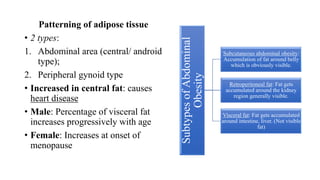
Patterning of adipose tissue
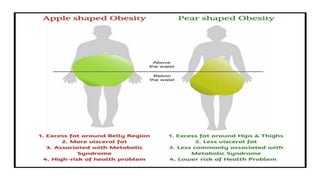
• 2 types:
1. Abdominal area (central/ android
type);
2. Peripheral gynoid type
• Increased in central fat: causes
heart disease
• Male: Percentage of visceral fat
increases progressively with age
• Female: Increases at onset of
menopause
Subtypes
of
Abdominal
Obesity
Subcutaneous abdominal obesity:
Accumulation of fat around belly
which is obviously visible.
Retroperitoneal fat: Fat gets
accumulated around the kidney
region generally visible.
Visceral fat: Fat gets accumulated
around intestine, liver. (Not visible
fat)
Investigations
1. Thyroid function test
2. Blood sugar
3. Abdominal USG
4. MRI to see visceral fat
5. ECG
6. Lipid profile
Assessment in Physiotherapy
1. BMI
2. Waist-to-Hip ratio
3. Skin fold measurements
Assessment
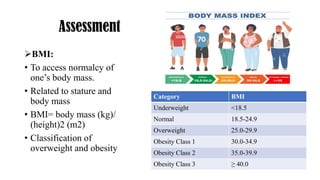
➢BMI:
• To access normalcy of
one’s body mass.
• Related to stature and
body mass
• BMI= body mass (kg)/
(height)2 (m2)
• Classification of
overweight and obesity
Category BMI
Underweight <18.5
Normal 18.5-24.9
Overweight 25.0-29.9
Obesity Class 1 30.0-34.9
Obesity Class 2 35.0-39.9
Obesity Class 3 ≥ 40.0
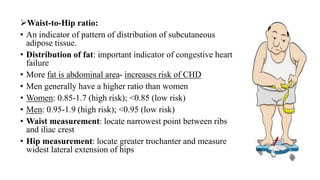
➢Waist-to-Hip ratio:
• An indicator of pattern of distribution of subcutaneous
adipose tissue.
• Distribution of fat: important indicator of congestive heart
failure
• More fat is abdominal area- increases risk of CHD
• Men generally have a higher ratio than women
• Women: 0.85-1.7 (high risk); <0.85 (low risk)
• Men: 0.95-1.9 (high risk); <0.95 (low risk)
• Waist measurement: locate narrowest point between ribs
and iliac crest
• Hip measurement: locate greater trochanter and measure
widest lateral extension of hips
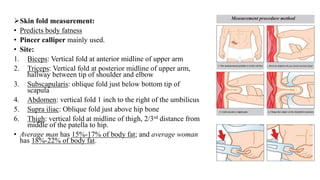
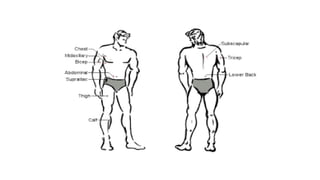
➢Skin fold measurement:
• Predicts body fatness
• Pincer calliper mainly used.
• Site:
1. Biceps: Vertical fold at anterior midline of upper arm
2. Triceps: Vertical fold at posterior midline of upper arm,
hallway between tip of shoulder and elbow
3. Subscapularis: oblique fold just below bottom tip of
scapula
4. Abdomen: vertical fold 1 inch to the right of the umbilicus
5. Supra iliac: Oblique fold just above hip bone
6. Thigh: vertical fold at midline of thigh, 2/3rd distance from
middle of the patella to hip.
• Average man has 15%-17% of body fat; and average woman
has 18%-22% of body fat.
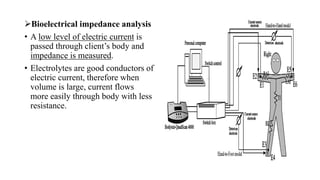
➢Bioelectrical impedance analysis
• A low level of electric current is
passed through client’s body and
impedance is measured.
• Electrolytes are good conductors of
electric current, therefore when
volume is large, current flows
more easily through body with less
resistance.
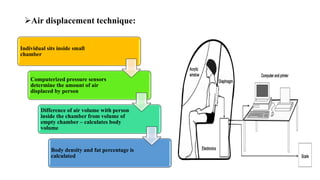
➢Air displacement technique:
Individual sits inside small
chamber
Computerized pressure sensors
determine the amount of air
displaced by person
Difference of air volume with person
inside the chamber from volume of
empty chamber – calculates body
volume
Body density and fat percentage is
calculated
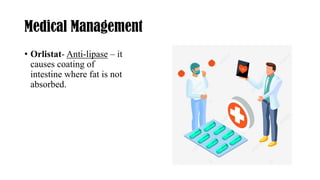
Medical Management
• Orlistat- Anti-lipase – it
causes coating of
intestine where fat is not
absorbed.
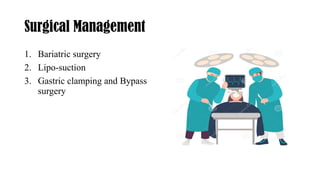
Surgical Management
1. Bariatric surgery
2. Lipo-suction
3. Gastric clamping and Bypass
surgery
Aims to manage obesity
1. Education of the client
2. Optimal nutrition
3. Behavioural interventions: Increased exercise and physical activity
along with medical supplementations
1.) Education
• To break the myth: Many people are falsely led to
believe that they can lose weight without putting
in effort or changing from sedentary lifestyle.
• Guiding the client utilizing exercise as means of
reducing obesity.
• Encourage them to make list of personal reasons
to adopt active lifestyles.
• Set short-term goals- this focus attention of
participants toward behaviour change.
• Self managements technique like planning and
goal setting.
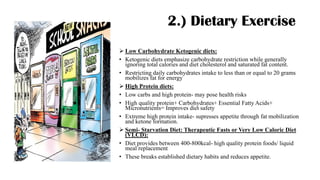
2.) Dietary Exercise
➢ Low Carbohydrate Ketogenic diets:
• Ketogenic diets emphasize carbohydrate restriction while generally
ignoring total calories and diet cholesterol and saturated fat content.
• Restricting daily carbohydrates intake to less than or equal to 20 grams
mobilizes fat for energy
➢ High Protein diets:
• Low carbs and high protein- may pose health risks
• High quality protein+ Carbohydrates+ Essential Fatty Acids+
Micronutrients= Improves diet safety
• Extreme high protein intake- supresses appetite through fat mobilization
and ketone formation.
➢ Semi- Starvation Diet: Therapeutic Fasts or Very Low Caloric Diet
(VLCD):
• Diet provides between 400-800kcal- high quality protein foods/ liquid
meal replacement
• These breaks established dietary habits and reduces appetite.
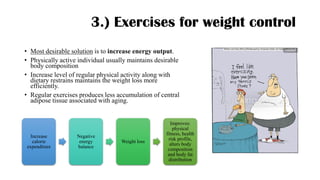
3.) Exercises for weight control
• Most desirable solution is to increase energy output.
• Physically active individual usually maintains desirable
body composition
• Increase level of regular physical activity along with
dietary restrains maintains the weight loss more
efficiently.
• Regular exercises produces less accumulation of central
adipose tissue associated with aging.
Increase
calorie
expenditure
Negative
energy
balance
Weight loss
Improves:
physical
fitness, health
risk profile,
alters body
composition
and body fat
distribution
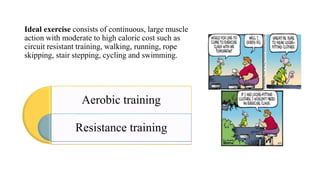
Ideal exercise consists of continuous, large muscle
action with moderate to high caloric cost such as
circuit resistant training, walking, running, rope
skipping, stair stepping, cycling and swimming.
Aerobic training
Resistance training
Caloric restraint + Exercise = Ideal combination
• Provides more flexibility in reducing weight.
• Advantages:
1. Increases overall size of energy deficit
2. Facilitates lipid mobilization and oxidation from adipose tissues
3. Increase relative body fat loss by preserving fat free body mass.
4. Requires less reliance on caloric restrains
5. Contributes to long term success
6. Provides significant health related benefits
7. Offsets deterioration in immune system function- accompanies weight loss
Behaviour Therapy
1. It provides a set of strategies for patients to modify their eating and
physical activity.
2. Record keeping: individual tracks the type and amount of foods and
beverages consumed, along with their caloric content. This helps in
monitoring eating patterns, select targets for reducing calorie intake
and track progress in meeting daily calorie goals.
3. Tracking weight regularly; once a week during weight loss and as
often as daily during weight loss maintenance.
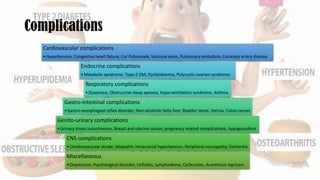
Complications
Cardiovascular complications
•Hypertension, Congestive heart failure, Cor Pulmonale, Varicose veins, Pulmonary embolism, Coronary artery disease
Endocrine complications
•Metabolic syndrome, Type-2 DM, Dyslipidaemia, Polycystic ovarian syndrome
Respiratory complications
•Dyspnoea, Obstructive sleep apnoea, Hypo-ventilatory syndrome, Asthma
Gastro-intestinal complications
•Gastro-oesophageal reflex disorder, Non-alcoholic fatty liver, Bladder stone, Hernia, Colon cancer
Genito-urinary complications
•Urinary stress incontinence, Breast and uterine cancer, pregnancy related complications, hypogonadism
CNS complications
•Cerebrovascular stroke, Idiopathic intracranial hypertension, Peripheral neuropathy, Dementia
Miscellaneous
•Depression, Psychological disorder, Cellulitis, Lymphedema, Carbuncles, Acanthosis nigricans
References
• Physiology of Sports and Exercise- Jack H. Wilmore, David L. Costill
• Exercise Physiology- William D. McArdle, Frank I. Katch, Victor L.
Katch
• Alamuddin N, Bakizada Z, Wadden TA. Management of obesity.
Journal of Clinical Oncology. 2016 Dec 10;34(35):4295-305.
• Heymsfield SB, Wadden TA. Mechanisms, pathophysiology, and
management of obesity. New England Journal of Medicine. 2017 Jan
19;376(3):254-66.
That’s all folks.

Obesity.pdf

  • 1.
  • 2.
    Contents • Introduction • Obesity:a global pandemic • Causes of obesity • Co-morbidities due to obesity • Complications
  • 3.
    Introduction • Obesity refersto the condition of having an excessive amount of body fat. • Over-weight refers to body weight that exceeds some average for stature perhaps age. • Prevalence: 1.9 billion people were overweight; 600 million people were obese.
  • 4.
    Obesity- A GlobalEpidemic • Complex condition with serious and psychological dimensions that impact all age and socio-economic groups both developed and developing countries. • Obesity results from imbalance between daily energy intake and energy expenditure resulting in excessive weight gain. • An excessive fat gain results from complex interactions of: 1. Genetic 2. Cultural 3. Insomnia 4. Social 5. Environmental 6. Physiological 7. Energy metabolism 8. Behavioural 9. Food habits
  • 5.
    Causes of obesity 1.Dietary pattern 2. Fast food and obesity link in adults 3. Genetics/ Hereditary 4. Physical inactivity
  • 6.
    DIETARY PATTERN • Changesin diet and reduced energy expenditure via patterns of work often referred as nutrition transition- leading to obesity worldwide. • Adverse changes in diet- which is composed of greater saturated fat and added sugars; reduction in complex carbs, dietary fruits and vegetables. FAST FOOD AND OBESITY LINK IN ADULTS • Fast food consumption is one/ more times per week. • Characteristics of fast food: excessive amount of refined starch, added sugar, high fat content, low dietary fibre. • Research suggests fast food directly increased energy intake and is inversely proportional to the quality of food. GENETICS • Researches have provided dear evidences of a biological mechanism susceptible to gain weight and is dominated by high calorie food and sedentary lifestyle. • Protein encoded gene F70 is affected and makes person susceptible of becoming obese. PHYSICAL INACTIVITY • Regular physical activity, through either recreation or occupation can help to minimize weight gain and fat gain. • Increases tendency to regain lost weight and counters a common genetic variation that makes people more likely to gain excess weight. • Variation in physical activity accounts for >75% of weight gain.
  • 7.
    Co-morbidities due toobesity 1. Cardiovascular disease 2. Hypertension 3. Type 2 DM 4. Dyslipidaemia 5. Ischemic stroke 6. Sleep apnoea 7. Degenerative joint disease 8. Cancer 9. Fertility problem 10. Peripheral vascular disease
  • 8.
    Criteria for ExcessiveBody Test • 3 approaches 1. Percentage of body mass composed of fat 2. Distribution/ patterning of fat at different anatomic regions 3. Size and number of individual fat cells
  • 9.
    Patterning of adiposetissue • 2 types: 1. Abdominal area (central/ android type); 2. Peripheral gynoid type • Increased in central fat: causes heart disease • Male: Percentage of visceral fat increases progressively with age • Female: Increases at onset of menopause Subtypes of Abdominal Obesity Subcutaneous abdominal obesity: Accumulation of fat around belly which is obviously visible. Retroperitoneal fat: Fat gets accumulated around the kidney region generally visible. Visceral fat: Fat gets accumulated around intestine, liver. (Not visible fat)
  • 11.
    Investigations 1. Thyroid functiontest 2. Blood sugar 3. Abdominal USG 4. MRI to see visceral fat 5. ECG 6. Lipid profile
  • 12.
    Assessment in Physiotherapy 1.BMI 2. Waist-to-Hip ratio 3. Skin fold measurements
  • 13.
    Assessment ➢BMI: • To accessnormalcy of one’s body mass. • Related to stature and body mass • BMI= body mass (kg)/ (height)2 (m2) • Classification of overweight and obesity Category BMI Underweight <18.5 Normal 18.5-24.9 Overweight 25.0-29.9 Obesity Class 1 30.0-34.9 Obesity Class 2 35.0-39.9 Obesity Class 3 ≥ 40.0
  • 14.
    ➢Waist-to-Hip ratio: • Anindicator of pattern of distribution of subcutaneous adipose tissue. • Distribution of fat: important indicator of congestive heart failure • More fat is abdominal area- increases risk of CHD • Men generally have a higher ratio than women • Women: 0.85-1.7 (high risk); <0.85 (low risk) • Men: 0.95-1.9 (high risk); <0.95 (low risk) • Waist measurement: locate narrowest point between ribs and iliac crest • Hip measurement: locate greater trochanter and measure widest lateral extension of hips
  • 15.
    ➢Skin fold measurement: •Predicts body fatness • Pincer calliper mainly used. • Site: 1. Biceps: Vertical fold at anterior midline of upper arm 2. Triceps: Vertical fold at posterior midline of upper arm, hallway between tip of shoulder and elbow 3. Subscapularis: oblique fold just below bottom tip of scapula 4. Abdomen: vertical fold 1 inch to the right of the umbilicus 5. Supra iliac: Oblique fold just above hip bone 6. Thigh: vertical fold at midline of thigh, 2/3rd distance from middle of the patella to hip. • Average man has 15%-17% of body fat; and average woman has 18%-22% of body fat.
  • 17.
    ➢Bioelectrical impedance analysis •A low level of electric current is passed through client’s body and impedance is measured. • Electrolytes are good conductors of electric current, therefore when volume is large, current flows more easily through body with less resistance.
  • 18.
    ➢Air displacement technique: Individualsits inside small chamber Computerized pressure sensors determine the amount of air displaced by person Difference of air volume with person inside the chamber from volume of empty chamber – calculates body volume Body density and fat percentage is calculated
  • 19.
    Medical Management • Orlistat-Anti-lipase – it causes coating of intestine where fat is not absorbed.
  • 20.
    Surgical Management 1. Bariatricsurgery 2. Lipo-suction 3. Gastric clamping and Bypass surgery
  • 21.
    Aims to manageobesity 1. Education of the client 2. Optimal nutrition 3. Behavioural interventions: Increased exercise and physical activity along with medical supplementations
  • 22.
    1.) Education • Tobreak the myth: Many people are falsely led to believe that they can lose weight without putting in effort or changing from sedentary lifestyle. • Guiding the client utilizing exercise as means of reducing obesity. • Encourage them to make list of personal reasons to adopt active lifestyles. • Set short-term goals- this focus attention of participants toward behaviour change. • Self managements technique like planning and goal setting.
  • 23.
    2.) Dietary Exercise ➢Low Carbohydrate Ketogenic diets: • Ketogenic diets emphasize carbohydrate restriction while generally ignoring total calories and diet cholesterol and saturated fat content. • Restricting daily carbohydrates intake to less than or equal to 20 grams mobilizes fat for energy ➢ High Protein diets: • Low carbs and high protein- may pose health risks • High quality protein+ Carbohydrates+ Essential Fatty Acids+ Micronutrients= Improves diet safety • Extreme high protein intake- supresses appetite through fat mobilization and ketone formation. ➢ Semi- Starvation Diet: Therapeutic Fasts or Very Low Caloric Diet (VLCD): • Diet provides between 400-800kcal- high quality protein foods/ liquid meal replacement • These breaks established dietary habits and reduces appetite.
  • 24.
    3.) Exercises forweight control • Most desirable solution is to increase energy output. • Physically active individual usually maintains desirable body composition • Increase level of regular physical activity along with dietary restrains maintains the weight loss more efficiently. • Regular exercises produces less accumulation of central adipose tissue associated with aging. Increase calorie expenditure Negative energy balance Weight loss Improves: physical fitness, health risk profile, alters body composition and body fat distribution
  • 25.
    Ideal exercise consistsof continuous, large muscle action with moderate to high caloric cost such as circuit resistant training, walking, running, rope skipping, stair stepping, cycling and swimming. Aerobic training Resistance training
  • 26.
    Caloric restraint +Exercise = Ideal combination • Provides more flexibility in reducing weight. • Advantages: 1. Increases overall size of energy deficit 2. Facilitates lipid mobilization and oxidation from adipose tissues 3. Increase relative body fat loss by preserving fat free body mass. 4. Requires less reliance on caloric restrains 5. Contributes to long term success 6. Provides significant health related benefits 7. Offsets deterioration in immune system function- accompanies weight loss
  • 27.
    Behaviour Therapy 1. Itprovides a set of strategies for patients to modify their eating and physical activity. 2. Record keeping: individual tracks the type and amount of foods and beverages consumed, along with their caloric content. This helps in monitoring eating patterns, select targets for reducing calorie intake and track progress in meeting daily calorie goals. 3. Tracking weight regularly; once a week during weight loss and as often as daily during weight loss maintenance.
  • 28.
    Complications Cardiovascular complications •Hypertension, Congestiveheart failure, Cor Pulmonale, Varicose veins, Pulmonary embolism, Coronary artery disease Endocrine complications •Metabolic syndrome, Type-2 DM, Dyslipidaemia, Polycystic ovarian syndrome Respiratory complications •Dyspnoea, Obstructive sleep apnoea, Hypo-ventilatory syndrome, Asthma Gastro-intestinal complications •Gastro-oesophageal reflex disorder, Non-alcoholic fatty liver, Bladder stone, Hernia, Colon cancer Genito-urinary complications •Urinary stress incontinence, Breast and uterine cancer, pregnancy related complications, hypogonadism CNS complications •Cerebrovascular stroke, Idiopathic intracranial hypertension, Peripheral neuropathy, Dementia Miscellaneous •Depression, Psychological disorder, Cellulitis, Lymphedema, Carbuncles, Acanthosis nigricans
  • 29.
    References • Physiology ofSports and Exercise- Jack H. Wilmore, David L. Costill • Exercise Physiology- William D. McArdle, Frank I. Katch, Victor L. Katch • Alamuddin N, Bakizada Z, Wadden TA. Management of obesity. Journal of Clinical Oncology. 2016 Dec 10;34(35):4295-305. • Heymsfield SB, Wadden TA. Mechanisms, pathophysiology, and management of obesity. New England Journal of Medicine. 2017 Jan 19;376(3):254-66.
  • 30.