ABDOMINAL INCISION
 Surgical Incision is a cut made through the skin to
facilitate an operation or precedure.
 It should be the aim of the surgeon to employ the type
of incision considered to be the most suitable for that
particular operation to be performed. In doing so,
three essentials should be achieved:
 1.Accessibility
 2.Extensibility
 3.Security
PRINCIPLES
 Incision should be long enough for good exposure
 Splitting is better than cutting
 Avoid cutting of nerves and vessels
 Retract muscle, abdominal organs towards
neurovascular bundle
 Insert DT through a separate incision
 Transverse incisions better than vertical incisions
 Close the wound layer by layer
Factors affecting the strength of
scar
 Types of surgery(acute abdomen, surgery for malignancy,
major surgery)
 Obesity
 Pregnancy
 Straining
 Cough
 Ascites
 Nutrition
 Diabetes
 Immunosuppression
 Types of incision
Complications of abdominal
incision
 Hematoma, Stitch abscess, Wound infection
 Wound dehiscence
 Burst abdomen
 Fistula formation
 Wound pain
 Incisional hernia
 Adhesion and its complications
 Unsightly scar
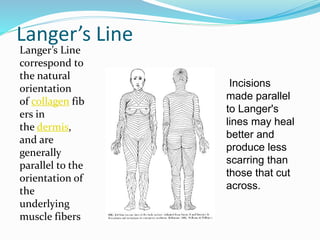
Langer’s Line
Langer’s Line
correspond to
the natural
orientation
of collagen fib
ers in
the dermis,
and are
generally
parallel to the
orientation of
the
underlying
muscle fibers
Incisions
made parallel
to Langer's
lines may heal
better and
produce less
scarring than
those that cut
across.
Layer of Anterior Abdominal Wall
 Skin
 Subcutaneous tissue
 Superficial Fascia
-Camper’s Fascia-fatty superficial layer
-Scarpa’s Fascia-deep fibrous layer
 Deep Fascia(Gallaudet’s Fascia)
 Musculoaponeurotic Layer
-External Oblique Muscle
-Internal Oblique Muscle
-Transverse Abdominal Muscle
-Rectus Abdominis-Pyramidalis Muscle
 Fascia Transversalis
 Preperitoneal Fatty Tissue
 Peritoneum
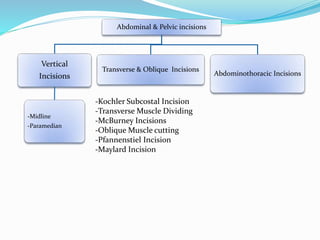
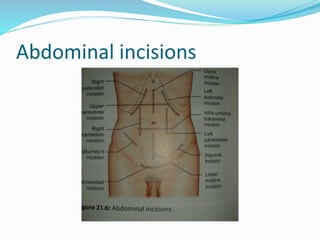
Abdominal & Pelvic incisions
Vertical
Incisions
-Midline
-Paramedian
Transverse & Oblique Incisions
Abdominothoracic Incisions
-Kochler Subcostal Incision
-Transverse Muscle Dividing
-McBurney Incisions
-Oblique Muscle cutting
-Pfannenstiel Incision
-Maylard Incision
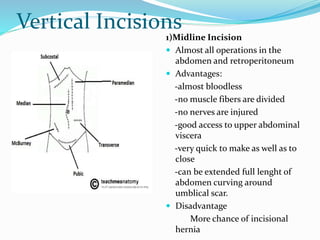
Vertical Incisions
1)Midline Incision
 Almost all operations in the
abdomen and retroperitoneum
 Advantages:
-almost bloodless
-no muscle fibers are divided
-no nerves are injured
-good access to upper abdominal
viscera
-very quick to make as well as to
close
-can be extended full lenght of
abdomen curving around
umblical scar.
 Disadvantage
More chance of incisional
hernia
Midline incision ctd…
 Emergency laprotomies,colonic resection,APR,Anterior rection
 Upper midline incision
oesophagial hiatus, abdominal oesophagus, stomach,
duodenum, gall bladder, pancreas, spleen.
 Lower midline incision
sigmoid colon, rectum,pelvic organs
Vertical Incisions
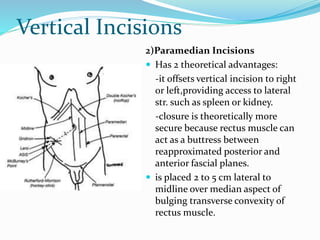
2)Paramedian Incisions
 Has 2 theoretical advantages:
-it offsets vertical incision to right
or left,providing access to lateral
str. such as spleen or kidney.
-closure is theoretically more
secure because rectus muscle can
act as a buttress between
reapproximated posterior and
anterior fascial planes.
 is placed 2 to 5 cm lateral to
midline over median aspect of
bulging transverse convexity of
rectus muscle.
Vertical Incisions
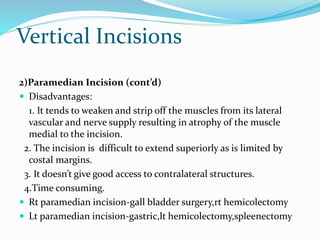
2)Paramedian Incision (cont’d)
 Disadvantages:
1. It tends to weaken and strip off the muscles from its lateral
vascular and nerve supply resulting in atrophy of the muscle
medial to the incision.
2. The incision is difficult to extend superiorly as is limited by
costal margins.
3. It doesn’t give good access to contralateral structures.
4.Time consuming.
 Rt paramedian incision-gall bladder surgery,rt hemicolectomy
 Lt paramedian incision-gastric,lt hemicolectomy,spleenectomy
Transverse incisions
 Advantages
1.Transeverse incisions in langer lines gives better
cosmetic results than vertical incisions.
2.It has more intrinsic strength than vertical
incisions so the chance for incisional hernia and
wound dehiscence is less than vertical incision.
 Disadvantages
Limited exposure to the organs
Transverse Incisions
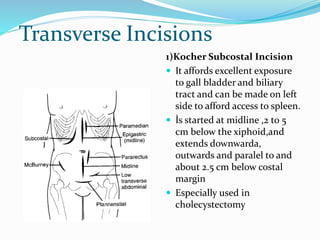
1)Kocher Subcostal Incision
 It affords excellent exposure
to gall bladder and biliary
tract and can be made on left
side to afford access to spleen.
 İs started at midline ,2 to 5
cm below the xiphoid,and
extends downwarda,
outwards and paralel to and
about 2.5 cm below costal
margin
 Especially used in
cholecystectomy
Transverse Incisions
1)Kocher Subcostal Incisions(cont’d)
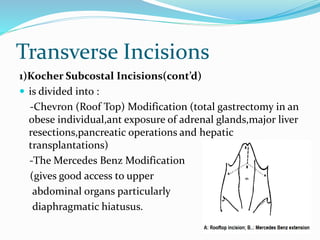
 is divided into :
-Chevron (Roof Top) Modification (total gastrectomy in an
obese individual,ant exposure of adrenal glands,major liver
resections,pancreatic operations and hepatic
transplantations)
-The Mercedes Benz Modification
(gives good access to upper
abdominal organs particularly
diaphragmatic hiatusus.
Transverse Incisions
2)Transverse Muscle dividing
 In newborn and infants, this incision is preferred
bcs more abdominal exposure is gained per lenght
of incision than with vertical exposure
 Because infants’ abdomen longer transverse than
vertical girth.
 Also in short, obese adult
Transverse Incisions
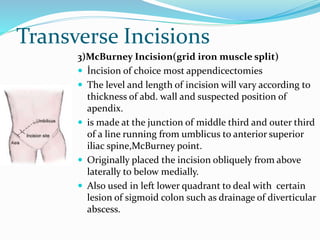
3)McBurney Incision(grid iron muscle split)
 İncision of choice most appendicectomies
 The level and length of incision will vary according to
thickness of abd. wall and suspected position of
apendix.
 is made at the junction of middle third and outer third
of a line running from umblicus to anterior superior
iliac spine,McBurney point.
 Originally placed the incision obliquely from above
laterally to below medially.
 Also used in left lower quadrant to deal with certain
lesion of sigmoid colon such as drainage of diverticular
abscess.
Other Incisions in appendicectomy
Transverse Incision
Abdominal incisions
Transverse incisions ctd…
 Upper abdominal transverse incision
gallbladder,gastric surgeries
 Infra umblical incision
exploratory laparotomy in children
Transverse Incisions
4) Pfannenstiel Incision
 Used frequently by gynecologist and urologist for
access to pelvic organ, bladder, prostate and for c-
section.
 is usually 12 cm long and is made in skin fold
approximately 5 cm above symphysis pubis.
Transverse Incisions
5)Maylard Transverse Muscle Cutting Incision
 gives excellent exposure to pelvic organ
 Skin incision is placed above but parallel to traditional
placement of Pfannenstiel incision
Thoracoabdominal Incisions
 Either right or left
 Converts pleural and peritoneal cavities into one common
cavity
 Thereby gives excellent exposure
 Right incision may be particularly useful in elective and
emergency hepatic resections
 Left incision may be used in resection of lower end of
esophagus and proximal portion of stomach.
 Incision is extended along line of 8th intercostal space,the
space immediately distal to inferior pole of scapula.
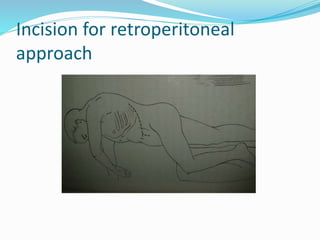
Incisions for retroperitoneal
approach
 Indications –nephrectomy,aortic surgery,lumbar
sympathectomy, ureterolithotomy
 For lt side surgery-Patient positioned in supine
position with lt side elevated to 30 to 45 degres and
with lt knee hip flexed
 incision begins at the level of umblicus at the margin
of rectus sheath and extended into the flank toward
the 12th rib for 12 to 20 cm
Incision for retroperitoneal
approach
Thank You

skin incisions

  • 2.
    ABDOMINAL INCISION  SurgicalIncision is a cut made through the skin to facilitate an operation or precedure.  It should be the aim of the surgeon to employ the type of incision considered to be the most suitable for that particular operation to be performed. In doing so, three essentials should be achieved:  1.Accessibility  2.Extensibility  3.Security
  • 3.
    PRINCIPLES  Incision shouldbe long enough for good exposure  Splitting is better than cutting  Avoid cutting of nerves and vessels  Retract muscle, abdominal organs towards neurovascular bundle  Insert DT through a separate incision  Transverse incisions better than vertical incisions  Close the wound layer by layer
  • 4.
    Factors affecting thestrength of scar  Types of surgery(acute abdomen, surgery for malignancy, major surgery)  Obesity  Pregnancy  Straining  Cough  Ascites  Nutrition  Diabetes  Immunosuppression  Types of incision
  • 5.
    Complications of abdominal incision Hematoma, Stitch abscess, Wound infection  Wound dehiscence  Burst abdomen  Fistula formation  Wound pain  Incisional hernia  Adhesion and its complications  Unsightly scar
  • 6.
    Langer’s Line Langer’s Line correspondto the natural orientation of collagen fib ers in the dermis, and are generally parallel to the orientation of the underlying muscle fibers Incisions made parallel to Langer's lines may heal better and produce less scarring than those that cut across.
  • 7.
    Layer of AnteriorAbdominal Wall  Skin  Subcutaneous tissue  Superficial Fascia -Camper’s Fascia-fatty superficial layer -Scarpa’s Fascia-deep fibrous layer  Deep Fascia(Gallaudet’s Fascia)  Musculoaponeurotic Layer -External Oblique Muscle -Internal Oblique Muscle -Transverse Abdominal Muscle -Rectus Abdominis-Pyramidalis Muscle  Fascia Transversalis  Preperitoneal Fatty Tissue  Peritoneum
  • 8.
    Abdominal & Pelvicincisions Vertical Incisions -Midline -Paramedian Transverse & Oblique Incisions Abdominothoracic Incisions -Kochler Subcostal Incision -Transverse Muscle Dividing -McBurney Incisions -Oblique Muscle cutting -Pfannenstiel Incision -Maylard Incision
  • 9.
    Vertical Incisions 1)Midline Incision Almost all operations in the abdomen and retroperitoneum  Advantages: -almost bloodless -no muscle fibers are divided -no nerves are injured -good access to upper abdominal viscera -very quick to make as well as to close -can be extended full lenght of abdomen curving around umblical scar.  Disadvantage More chance of incisional hernia
  • 10.
    Midline incision ctd… Emergency laprotomies,colonic resection,APR,Anterior rection  Upper midline incision oesophagial hiatus, abdominal oesophagus, stomach, duodenum, gall bladder, pancreas, spleen.  Lower midline incision sigmoid colon, rectum,pelvic organs
  • 11.
    Vertical Incisions 2)Paramedian Incisions Has 2 theoretical advantages: -it offsets vertical incision to right or left,providing access to lateral str. such as spleen or kidney. -closure is theoretically more secure because rectus muscle can act as a buttress between reapproximated posterior and anterior fascial planes.  is placed 2 to 5 cm lateral to midline over median aspect of bulging transverse convexity of rectus muscle.
  • 12.
    Vertical Incisions 2)Paramedian Incision(cont’d)  Disadvantages: 1. It tends to weaken and strip off the muscles from its lateral vascular and nerve supply resulting in atrophy of the muscle medial to the incision. 2. The incision is difficult to extend superiorly as is limited by costal margins. 3. It doesn’t give good access to contralateral structures. 4.Time consuming.  Rt paramedian incision-gall bladder surgery,rt hemicolectomy  Lt paramedian incision-gastric,lt hemicolectomy,spleenectomy
  • 13.
    Transverse incisions  Advantages 1.Transeverseincisions in langer lines gives better cosmetic results than vertical incisions. 2.It has more intrinsic strength than vertical incisions so the chance for incisional hernia and wound dehiscence is less than vertical incision.  Disadvantages Limited exposure to the organs
  • 14.
    Transverse Incisions 1)Kocher SubcostalIncision  It affords excellent exposure to gall bladder and biliary tract and can be made on left side to afford access to spleen.  İs started at midline ,2 to 5 cm below the xiphoid,and extends downwarda, outwards and paralel to and about 2.5 cm below costal margin  Especially used in cholecystectomy
  • 15.
    Transverse Incisions 1)Kocher SubcostalIncisions(cont’d)  is divided into : -Chevron (Roof Top) Modification (total gastrectomy in an obese individual,ant exposure of adrenal glands,major liver resections,pancreatic operations and hepatic transplantations) -The Mercedes Benz Modification (gives good access to upper abdominal organs particularly diaphragmatic hiatusus.
  • 16.
    Transverse Incisions 2)Transverse Muscledividing  In newborn and infants, this incision is preferred bcs more abdominal exposure is gained per lenght of incision than with vertical exposure  Because infants’ abdomen longer transverse than vertical girth.  Also in short, obese adult
  • 17.
    Transverse Incisions 3)McBurney Incision(gridiron muscle split)  İncision of choice most appendicectomies  The level and length of incision will vary according to thickness of abd. wall and suspected position of apendix.  is made at the junction of middle third and outer third of a line running from umblicus to anterior superior iliac spine,McBurney point.  Originally placed the incision obliquely from above laterally to below medially.  Also used in left lower quadrant to deal with certain lesion of sigmoid colon such as drainage of diverticular abscess.
  • 18.
    Other Incisions inappendicectomy
  • 19.
  • 20.
  • 21.
    Transverse incisions ctd… Upper abdominal transverse incision gallbladder,gastric surgeries  Infra umblical incision exploratory laparotomy in children
  • 22.
    Transverse Incisions 4) PfannenstielIncision  Used frequently by gynecologist and urologist for access to pelvic organ, bladder, prostate and for c- section.  is usually 12 cm long and is made in skin fold approximately 5 cm above symphysis pubis.
  • 23.
    Transverse Incisions 5)Maylard TransverseMuscle Cutting Incision  gives excellent exposure to pelvic organ  Skin incision is placed above but parallel to traditional placement of Pfannenstiel incision
  • 24.
  • 25.
    Thoracoabdominal Incisions  Eitherright or left  Converts pleural and peritoneal cavities into one common cavity  Thereby gives excellent exposure  Right incision may be particularly useful in elective and emergency hepatic resections  Left incision may be used in resection of lower end of esophagus and proximal portion of stomach.  Incision is extended along line of 8th intercostal space,the space immediately distal to inferior pole of scapula.
  • 26.
    Incisions for retroperitoneal approach Indications –nephrectomy,aortic surgery,lumbar sympathectomy, ureterolithotomy  For lt side surgery-Patient positioned in supine position with lt side elevated to 30 to 45 degres and with lt knee hip flexed  incision begins at the level of umblicus at the margin of rectus sheath and extended into the flank toward the 12th rib for 12 to 20 cm
  • 27.
  • 28.